
North America Digital Avatar Market Size and Share
Market Overview
| Study Period | 2020 - 2031 |
|---|---|
| Forecast Data Period | 2026 - 2031 |
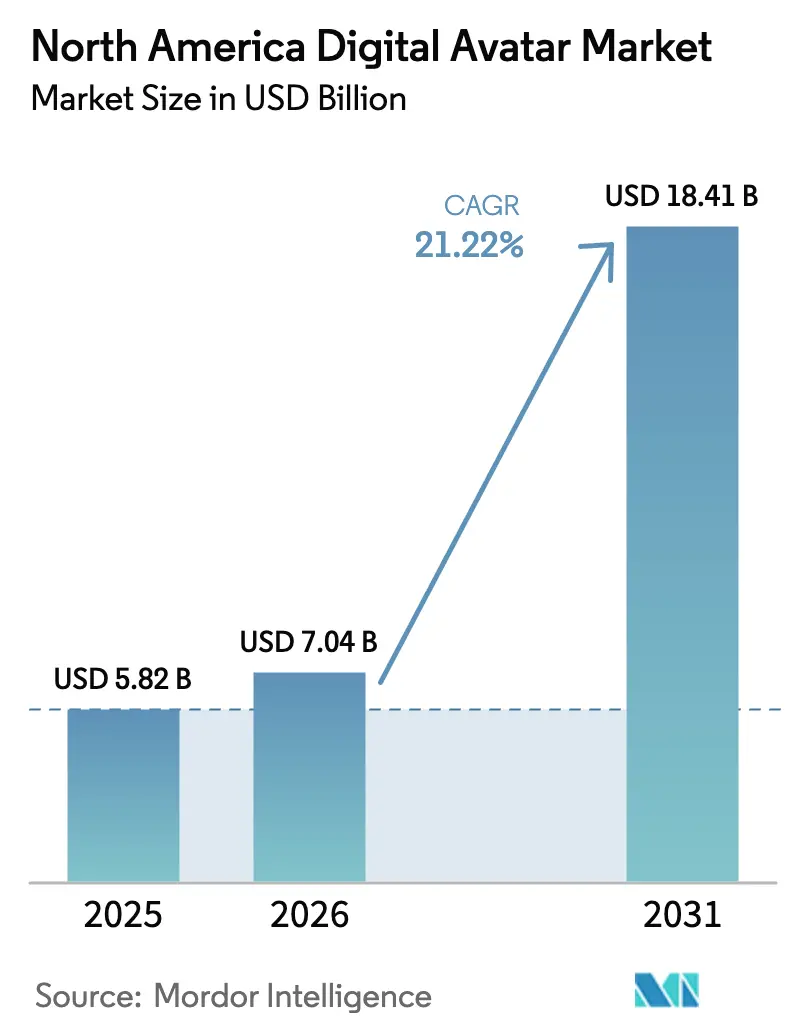
| Base Year Market Size (2025) | USD 5.82 Billion |
| Market Size (2026) | USD 7.04 Billion |
| Market Size (2031) | USD 18.41 Billion |
| Growth Rate (2026 - 2031) | 21.22 % |
| Market Concentration | Medium |
Major Players *Disclaimer: Major Players sorted in no particular order Image © Mordor Intelligence. Reuse requires attribution under CC BY 4.0. | |
North America Digital Avatar Market Analysis by Mordor Intelligence
The North America digital avatar market size is expected to increase from USD 5.82 billion in 2025 to USD 7.04 billion in 2026 and reach USD 18.41 billion by 2031, growing at a CAGR of 21.22% over 2026-2031. Persistent hardware progress, emotion-AI breakthroughs, and clear disclosure rules are accelerating enterprise adoption across customer care, telehealth, and immersive commerce. Heavy investment by hyperscalers such as Meta Platforms and Microsoft, which together earmark well above USD 10 billion per year for metaverse tooling, keeps compute and software capabilities on an aggressive improvement curve. At the same time, rising labor shortages in health systems and retail contact centers are prompting budget reallocation from headcount to avatar-enabled automation, while legal certainty around COPPA 2.0 and state biometric statutes is reducing procurement friction. These converging forces position the North America digital avatar market to outgrow most adjacent conversational-AI segments over the next five years.
Key Report Takeaways
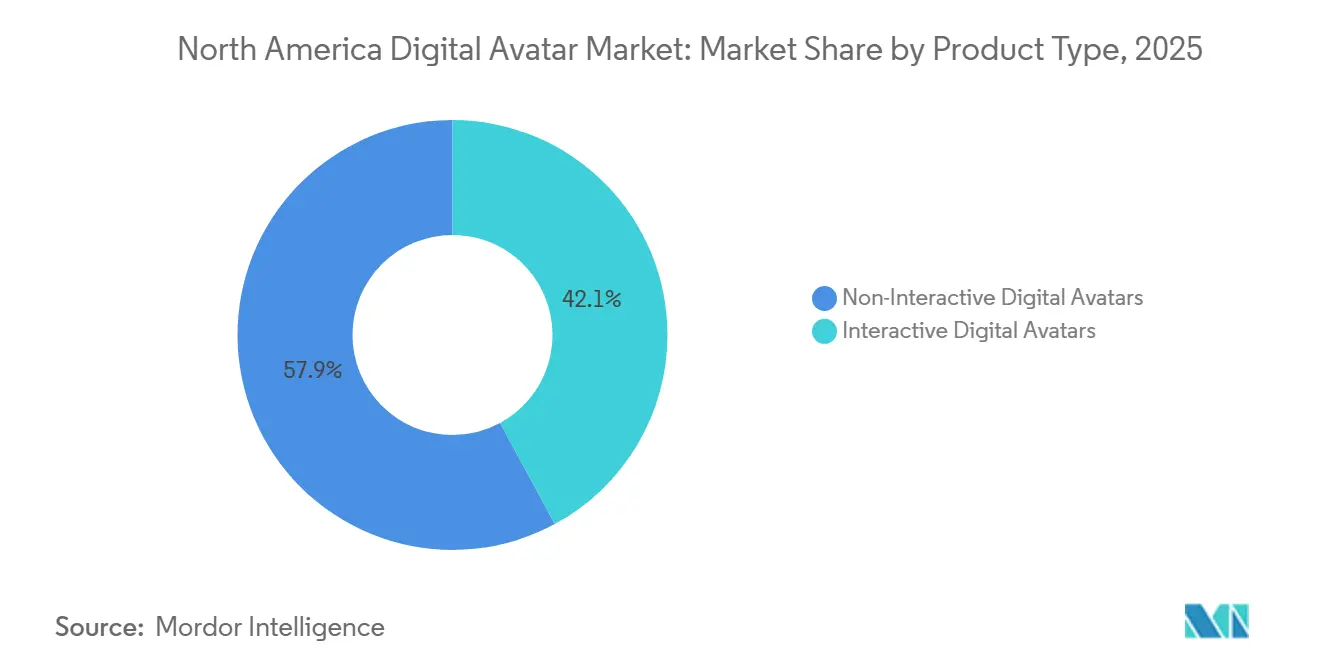
- By product type, non-interactive avatars led with 57.89% of the market share in 2025, while interactive avatars is forecast to expand at a 22.53% CAGR through 2031.
- By technology, 3D avatars accounted for 52.32% of the North America digital avatar market share in 2025, but AI-generated realistic human avatars is projected to grow at the highest CAGR of 22.67% to 2031.
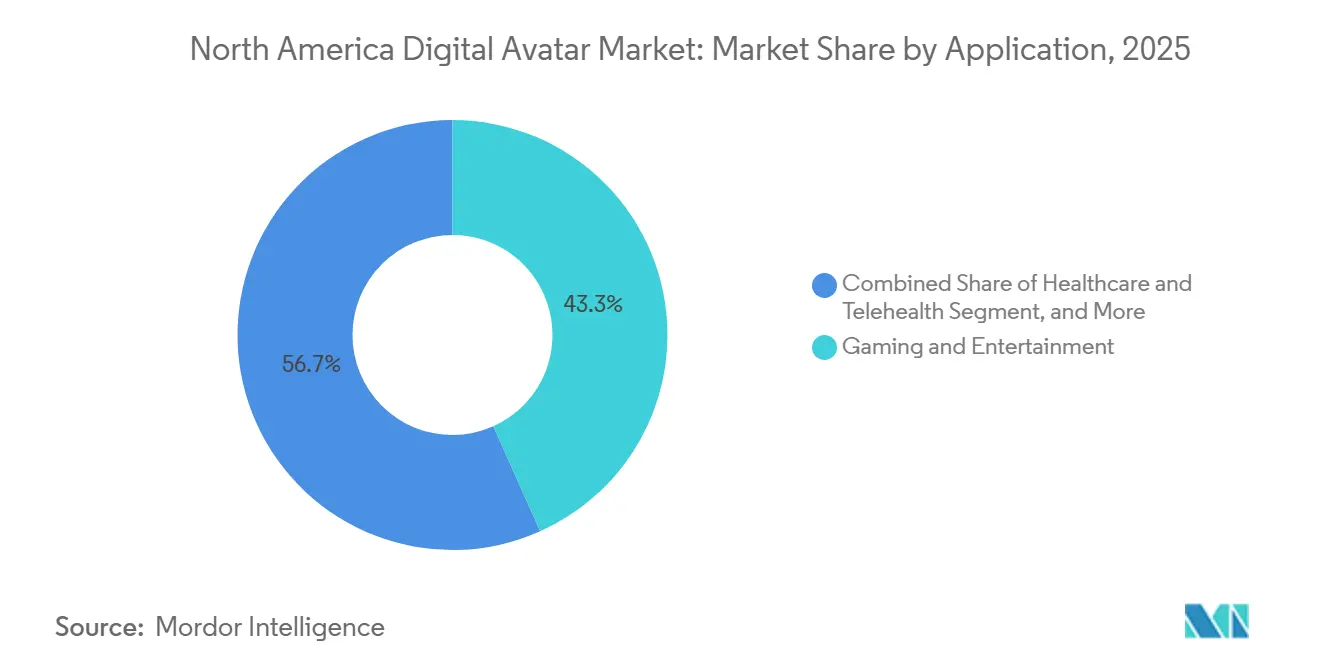
- By application, gaming and entertainment commanded 43.31% share of the North America digital avatar market size in 2025, and healthcare is projected to grow the fastest at 23.08% CAGR between 2026-2031.
- By end-user industry, media and entertainment dominated with 38.49% of the market in 2025, whereas healthcare providers is advancing at a 23.14% CAGR through 2031.
- By country, the United States accounted for 79.43% of the market share in 2025, and Mexico is set to deliver the fastest expansion at a 22.95% CAGR across 2026-2031.
Note: Market size and forecast figures in this report are generated using Mordor Intelligence’s proprietary estimation framework, updated with the latest available data and insights as of January 2026.
North America Digital Avatar Market Trends and Insights
Drivers Impact Analysis*
| Driver | (~) % Impact on CAGR Forecast | Geographic Relevance | Impact Timeline |
|---|---|---|---|
| Proliferation of Virtual Reality and Augmented Reality Hardware | +4.2% | United States, Canada | Medium term (2-4 years) |
| Growing Adoption of Digital Avatars in Customer Service Chatbots | +5.1% | North America-wide, concentrated in BFSI and retail hubs | Short term (≤ 2 years) |
| Increasing Popularity of Virtual Influencers for Brand Marketing | +3.8% | United States, Mexico | Medium term (2-4 years) |
| Rise of Metaverse Platforms Led by Gaming and Social Media | +4.5% | United States, Canada | Long term (≥ 4 years) |
| Integration of Emotion-AI for Hyper-Realistic Avatar Expressions | +3.6% | United States, early adoption in Canadian healthcare | Short term (≤ 2 years) |
| Expansion of Telepresence Robots Powered by Photorealistic Avatars | +2.9% | United States, Canada, focused on education and healthcare sectors | Medium term (2-4 years) |
| Source: Mordor Intelligence | |||
Proliferation of Virtual Reality and Augmented Reality Hardware
Rapid uptake of affordable head-mounted displays is lifting baseline demand for immersive identity layers. Meta’s USD 299 Quest 3S, released in late 2024, and Apple’s Vision Pro, which entered commercial circulation in early 2025, collectively pushed the North American installed base of XR headsets past 15 million devices. Both headsets ship with built-in codec-avatar pipelines that map facial muscle movement and hand gestures, enabling lifelike embodiment during remote collaboration, virtual showrooms, and surgical simulations.[1] Middleware vendors such as Unity have responded with on-device inference engines that shave server round-trips, lowering latency beneath the 100 millisecond threshold viewed by cognitive researchers as critical for natural social presence.[2] As edge rendering capacity increases, enterprises no longer face a trade-off between photorealism and responsiveness, removing a historical adoption ceiling for the North America digital avatar market.
Growing Adoption of Digital Avatars in Customer Service Chatbots
Contact-center cost inflation and consumer demand for 24/7 assistance have produced a surge in avatar-equipped virtual agents. More than 8,000 such agents went live across financial and retail networks in 2025, up 140% year over year. BNY Mellon alone activated 20,000 photorealistic assistants that now resolve two-thirds of tier-1 wealth-management inquiries, trimming annual operating spend by USD 42 million. Disclosure mandates from the Federal Trade Commission require clear identification of synthetic staff, and this legal clarity has paradoxically accelerated procurement as chief risk officers now have definitive compliance frameworks.[3] The measurable lift in customer-satisfaction scores is persuading additional banks and retailers to pilot conversational avatars in 2026, cementing the channel as an early-cycle revenue driver for the North America digital avatar market.
Increasing Popularity of Virtual Influencers for Brand Marketing
Marketers spent roughly USD 450 million on virtual-influencer activations in 2025, attracted by the ability to orchestrate simultaneous campaigns without the unpredictability of human talent. Telecom provider O2’s “Daisy” scam-baiter avatar, for instance, captured 12 million social impressions and elevated favorability by 22 percentage points among older adults, while Wimbledon's “Mia” amassed 8.5 million TikTok followers during the 2025 tournament. Platforms that clone influencer likenesses at scale are further compressing production timelines, letting consumer-goods giants run multivariate creative tests far faster than with live endorsers. These successes are stimulating demand for rights-management tools and emotion-AI modules, strengthening the monetization engine that underpins continued expansion of the North America digital avatar market.
Rise of Metaverse Platforms Led by Gaming and Social Media
Roblox, Horizon Worlds, and similar venues deliver persistent social spaces where users customize and transact with avatars, making them prime distribution points for identity assets. Roblox ended 2025 with 28.4 million daily active users in the region, each investing nearly three hours per session and collectively generating USD 890 million in quarterly creator payouts. Newly added generative design tools allow accessories and apparel to be produced from text prompts in minutes, widening the funnel of independent creators and reinforcing network lock-in. Meta’s Horizon Worlds, now equipped with second-generation codec avatars, gives enterprises private collaboration grounds, cutting employee travel budgets by double-digit percentages. Collectively these platforms act as high-visibility storefronts, elevating normative expectations for avatar fidelity and fueling parallel demand in enterprise contexts.
Restraints Impact Analysis*
| Restraint | (~) % Impact on CAGR Forecast | Geographic Relevance | Impact Timeline |
|---|---|---|---|
| High Computational Costs for Real-Time Rendering | -3.4% | United States, Canada, particularly impacting SMEs and startups | Short term (≤ 2 years) |
| Data Privacy and Security Concerns Around Biometric Likeness | -2.8% | North America-wide, acute in California, Illinois, Washington | Medium term (2-4 years) |
| Limited Interoperability Standards Across Avatar Ecosystems | -2.1% | United States, Canada | Long term (≥ 4 years) |
| Ethical Backlash Against Deepfake-based Avatar Generation | -1.9% | United States, Canada, Mexico | Medium term (2-4 years) |
| Source: Mordor Intelligence | |||
High Computational Costs for Real-Time Rendering
Despite progress in edge inference, photorealistic avatars still require premium GPUs or substantial cloud budgets. A single RTX 6000 Ada card retails at roughly USD 6,800, and enterprise-grade servers often need multiple units to sustain 4K, 60 fps sessions. On-demand cloud rendering, priced near USD 0.45 per GPU-hour, converts into monthly bills that many small businesses cannot absorb. Optimization tools such as Unity’s Ziva have shaved polygon counts by 40%, yet the residual cost still restrains broad deployments in education and mid-tier healthcare systems. Unless Moore’s-law-like efficiency gains reach rendering stacks, this expense will continue to drag on the North America digital avatar market growth.
Data Privacy and Security Concerns Around Biometric Likeness
States like California and Illinois have tightened regulations around facial and voice data, exposing companies to multi-million-dollar liabilities for non-compliance. The need to secure explicit consent and to localize storage is elongating project lead times and adding capital outlays for on-premise clusters, particularly in regulated verticals such as healthcare and banking. Cloud-native startups that cannot guarantee data residency are at a competitive disadvantage, pushing enterprises toward large vendors with regional datacenters and established compliance tooling. While eventual federal harmonization could streamline requirements, uncertainty over future amendments is causing some buyers to adopt a wait-and-see stance, tempering near-term momentum in segments of the North America digital avatar industry.
*Our forecasts treat driver/restraint impacts as directional, not additive. The impact forecasts reflect baseline growth, mix effects, and variable interactions.
Segment Analysis
By Product Type: Interactive Avatars Gain Traction in Enterprise
The interactive avatars is scaling quickly, advancing at a 22.53% CAGR as organizations migrate from one-way mascots to conversational agents that deliver measurable business outcomes. Hospitals within the Ardent network shortened average emergency-department wait times by 22 minutes after installing triage avatars, a performance proof point that encourages further health-system rollouts. Interactive designs incorporate automatic speech recognition, large-language reasoning, and emotion-AI, allowing them to deflect repetitive inquiries and escalate only complex cases, thereby preserving staff bandwidth. In gaming, Microsoft Teams’ Mesh avatars now host internal project reviews and client demos for more than 1.8 million corporate users, reducing reported meeting fatigue by double digits.
Non-interactive avatars remain central to branding missions, especially in entertainment franchises determined to maintain color-graded stylistic consistency. Their 57.89% share in 2025 reflects wide deployment across social channels, festivals, and merchandise campaigns. However, as language models improve contextual guardrails, interactive agents are expected to absorb much of the marketing storytelling workload. Ongoing advances in low-latency rendering are helping diminish user frustration over lag, making the North America digital avatar market progressively skew toward two-way formats.
By Technology: AI-Generated Realism Challenges 3D Incumbents
3D avatars held a 52.32% share in 2025, but AI-generated humans is expected to grow at a CAGR of 22.67% during the forecast period. It is closing the gap by promising cinematic quality without weeks of manual rigging. Epic Games’ MetaHuman Creator compresses asset build time from nearly a month to under 2 hours, a shift that brought 420 studios into the workflow last year. Neural rendering add-ons such as NVIDIA Audio2Face hit 98% lip-sync accuracy across 14 languages, a vital feature for localized content in multicultural North America. Enterprises favor these toolchains because they permit rapid A/B experimentation of persona tone, attire, and voice without reshoots.
3D avatars are not vanishing; their lower compute requirements make them attractive for browser-based or mobile contexts with bandwidth ceilings. Snap’s Bitmoji, which retains a stylized 2D-plus aesthetic, serves hundreds of millions of messages daily and continues to anchor brand partnership packs. Over the forecast horizon, hybrid toolkits that merge procedural meshes with neural texturing will dominate, cushioning the transition for art teams steeped in legacy workflows while satisfying executive mandates for higher realism in customer-facing deployments. Such convergence sustains multi-stack demand, broadening the addressable base for the North America digital avatar market.
By Application: Healthcare Avatars Outpace Gaming Growth
Gaming and entertainment captured 43.31% of North American revenue in 2025, but CAGR leadership has shifted to healthcare and telehealth, which is projected at 23.08% through 2031. Cooper University Health Care cut nurse call-button volume by 35% after installing AvaSure’s “Vicky” avatar across 12 sites, illustrating how synthetic staff can mitigate labor shortages. Mayo Clinic recorded lower no-show rates for post-operative check-ins when patients met a physician avatar that mirrored empathy through micro-expressions.
Gaming will remain large as user-generated economies on Roblox and Epic pivot toward photorealistic skins, but its growth is decelerating as console cycles mature. Customer-service avatars in banking and retail rank as the second-fastest use case, leveraging emotion-detection and CRM integration to shorten handle times. Training and e-learning scenarios follow closely, with corporations citing 30% reductions in time-to-competency for new hires after switching to avatar-facilitated modules. Collectively these expansions underscore how diverse verticals are reinforcing the North America digital avatar market, limiting over-reliance on gaming spend.

By End-User Industry: Healthcare Providers Accelerate Adoption
Media and entertainment entities accounted for 38.49% of the market share in 2025, a position supported by Hollywood’s heavy visual-effects output and game-engine licensing. Yet hospitals and clinics form the fastest-ascendant buyer block, growing at 23.14% CAGR as administrators confront nursing vacuums and shift care toward omnichannel models. Ready-to-use emotion engines let providers install bedside companions that answer routine questions and monitor patient sentiment, freeing clinicians for critical care tasks.
Retailers and e-commerce operators now deploy virtual try-on avatars across 1,800 merchant storefronts in the region, slashing return rates by up to 30% and lifting conversion in fashion categories. Banks have begun outfitting branches with photorealistic advisors that can nod, smile, and reference account history, lifting cross-sell penetration by nearly one-fifth. Education and government remain trailing adopters because of budget cycles and compliance hurdles, but successful pilots with telepresence robots suggest latent upside once funding aligns. The pattern points to expanding vertical diversity that will cushion the North America digital avatar market against cyclical shocks in any single sector.
Geography Analysis
The United States dominated the region with 79.43% share in 2025, blending Silicon Valley innovation, Hollywood content pipelines, and Fortune 500 purchasing power. California’s biometric statutes and the Federal Trade Commission’s impersonation rules raised compliance overhead yet simultaneously provided the legal predictability that procurement teams demanded, prompting 340 firms to revise consent flows during 2025. Meta’s commitment of USD 16 billion to avatar R&D channeled substantial capital into Bay Area supply chains, while Seattle and Austin house parallel GPU and cloud resources that service medical and retail deployments.
Canada contributes a smaller slice of the North America digital avatar market size, but its policy posture is shaping architectural best practices. Bill C-27’s emphasis on data sovereignty is nudging buyers toward on-premise or in-country cloud zones, a shift that benefits hyperscalers with extensive datacenter footprints. Toronto’s dense animation workforce, subsidized by provincial tax credits, funnels skilled labor into U.S. projects, effectively integrating the two ecosystems while keeping intellectual-property creation north of the border. Canadian single-payer health authorities, which negotiate platform-wide license deals, rolled out avatar-based telehealth across 18 jurisdictions by late 2025, illustrating how centralized procurement can expedite scale.
Mexico is emerging as the region’s breakout growth engine with a 22.95% CAGR outlook. Mobile-centric consumers and recent backbone upgrades support high-definition streaming, enabling carriers and retailers to introduce Spanish-language avatar agents inside 1,200 retail locations and multiple e-commerce portals. The absence of a federal biometric-privacy statute lowers administrative hurdles, but executives recognize that convergence with USMCA partners is probable, so many are already adopting opt-in consent flows to future-proof deployments. White-space opportunity is greatest in financial services and public utilities, where avatar-as-a-service providers can localize front-end personas for underserved Spanish speakers, thereby amplifying market depth for the North America digital avatar market.
Competitive Landscape
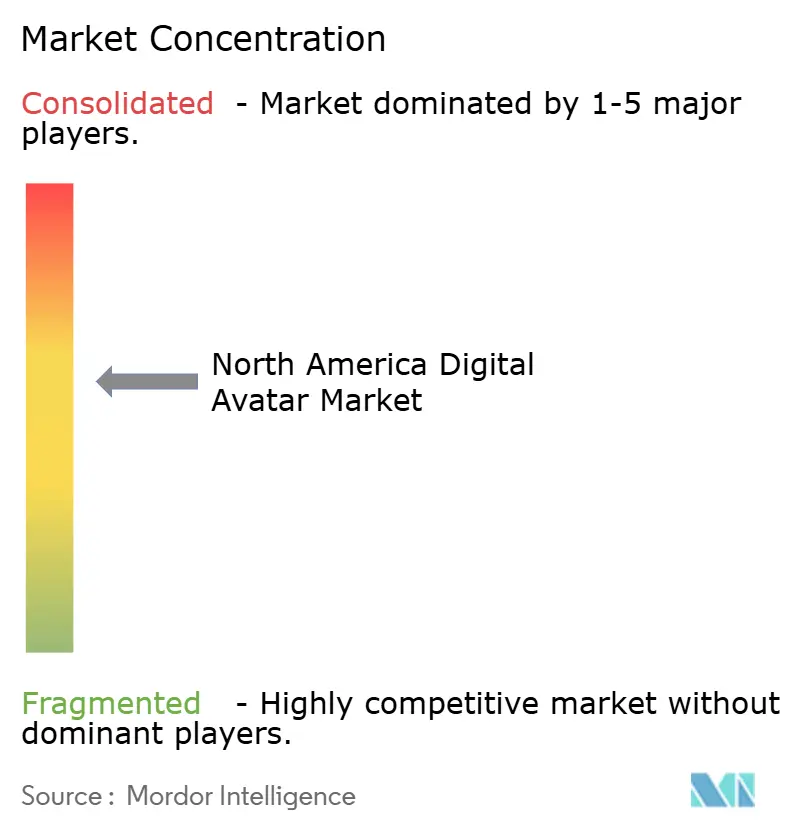
Market concentration remains moderate, with players including Meta Platforms, Microsoft, NVIDIA, Unity Software, Epic Games, and others. Hyperscalers are seeking end-to-end ownership; Meta is acquiring motion-capture studios, Microsoft bundles Mesh avatars into Teams and Dynamics, and NVIDIA wraps Omniverse subscriptions with its ACE service stack. Such vertical integration squeezes margin for middleware-only firms but assures enterprise buyers of seamless upgrades and compliance support, an attractive proposition for regulated industries considering high-stakes deployments.
Interoperability is the next competitive battleground. Ready Player Me’s cross-platform identity layer processed 120 million avatar creations in 2025, encouraging developers to abandon walled-garden avatar formats in favor of a single persistent persona. Standards bodies such as the Khronos Group, propagating glTF 2.0, and Pixar’s USD workflow enjoy rising adoption, pushing engine vendors to embrace open pipelines or risk isolation. The effect is a tilt toward portability, which undermines lock-in tactics and creates room for nimble startups specializing in vertical taste, cultural nuance, and micro-emotion rendering.
White-space verticals provide growth lanes for entrants. Manufacturing sites and municipal agencies have barely scratched the surface of avatar-based training and citizen service, primarily because capital-planning cycles lag tech turnover. When pilots do materialize, newcomers with domain-specific curricula or policy-compliant cloud options can outmaneuver larger rivals encumbered by generic stacks. Venture financing trends, including Ready Player Me’s USD 56 million Series B, signal investor appetite for differentiated value propositions rather than raw scale. Overall strategic positioning in the North America digital avatar market favors firms that can fuse open-standard portability with turnkey compliance and vertically tailored emotional intelligence.
North America Digital Avatar Industry Leaders
-
Meta Platforms Inc.
-
Microsoft Corporation
-
Apple Inc.
-
Roblox Corporation
-
Unity Software Inc.
- *Disclaimer: Major Players sorted in no particular order
Recent Industry Developments
- February 2026: NVIDIA partnered with Mayo Clinic to roll out ACE-powered physician avatars across eight additional campuses, supported by a USD 15 million on-premise GPU installation.
- January 2026: Microsoft integrated Mesh avatars into Dynamics 365 Customer Service, enabling 2,400 clients to tap real-time CRM context during avatar interactions.
- December 2025: Meta Platforms launched Codec Avatars 2.0 inside Horizon Worlds, adding real-time cloth and hair simulation and attracting 600,000 new monthly users within 30 days.
- November 2025: Ready Player Me closed a USD 56 million Series B round led by Andreessen Horowitz, earmarking funds for enterprise avatar-as-a-service expansion.
North America Digital Avatar Market Report Scope
The North America Digital Avatar Market refers to the industry focused on the development, deployment, and utilization of digital representations of individuals or entities, which can be interactive or non-interactive. These avatars are used across various applications such as customer service, gaming, healthcare, and marketing, leveraging technologies like 2D, 3D, and AI-generated realistic human avatars.
The North America Digital Avatar Market Report is Segmented by Product Type (Interactive Digital Avatars, and Non-Interactive Digital Avatars), Technology (2D Avatar, 3D Avatars, and AI-Generated Realistic Human Avatars), Application (Customer Service and Virtual Agents, Marketing and Advertising, Gaming and Entertainment, E-Learning and Training, Healthcare and Telehealth, and Social Media and Content Creation), End User Industry (Media and Entertainment, Retail and Ecommerce, Healthcare Providers, Education Institutions, Banking and Financial Services, Government and Public Services, and Other End User Industries), and Country (United States, Canada, and Mexico). The Market Forecasts are Provided in Terms of Value (USD).
| Interactive Digital Avatars |
| Non-Interactive Digital Avatars |
| 2D Avatar |
| 3D Avatars |
| AI-Generated Realistic Human Avatars |
| Customer Service and Virtual Agents |
| Marketing and Advertising |
| Gaming and Entertainment |
| E-Learning and Training |
| Healthcare and Telehealth |
| Social Media and Content Creation |
| Media and Entertainment |
| Retail and Ecommerce |
| Healthcare Providers |
| Education Institutions |
| Banking and Financial Services (BFSI) |
| Government and Public Services |
| Other End User Industries |
| United States |
| Canada |
| Mexico |
| By Product Type | Interactive Digital Avatars |
| Non-Interactive Digital Avatars | |
| By Technology | 2D Avatar |
| 3D Avatars | |
| AI-Generated Realistic Human Avatars | |
| By Application | Customer Service and Virtual Agents |
| Marketing and Advertising | |
| Gaming and Entertainment | |
| E-Learning and Training | |
| Healthcare and Telehealth | |
| Social Media and Content Creation | |
| By End User Industry | Media and Entertainment |
| Retail and Ecommerce | |
| Healthcare Providers | |
| Education Institutions | |
| Banking and Financial Services (BFSI) | |
| Government and Public Services | |
| Other End User Industries | |
| By Country | United States |
| Canada | |
| Mexico |
Key Questions Answered in the Report
How large will the North America digital avatar market be by 2031?
It is forecast to reach USD 18.41 billion by 2031, expanding at a 21.22% CAGR over 2026-2031.
Which application segment is growing the fastest?
Healthcare and telehealth avatars are projected to grow at 23.08% CAGR over 2026-2031, outpacing gaming and entertainment.
Why are interactive avatars gaining share over non-interactive types?
Enterprises value two-way engagement that reduces handle time and triages support requests, driving a 22.53% CAGR for interactive formats.
What regulatory issues most affect avatar deployment?
State biometric-privacy laws and FTC disclosure rules require explicit consent and clear labeling, extending project timelines but offering legal certainty.
Which country will deliver the quickest growth within North America?
Mexico is set to grow at 22.95% CAGR through 2031 thanks to improving infrastructure and Spanish-language service gaps.