
North America Bottling Line Accumulating and Collating Machinery Market Size and Share
Market Overview
| Study Period | 2021 - 2032 |
|---|---|
| Forecast Data Period | 2027 - 2032 |
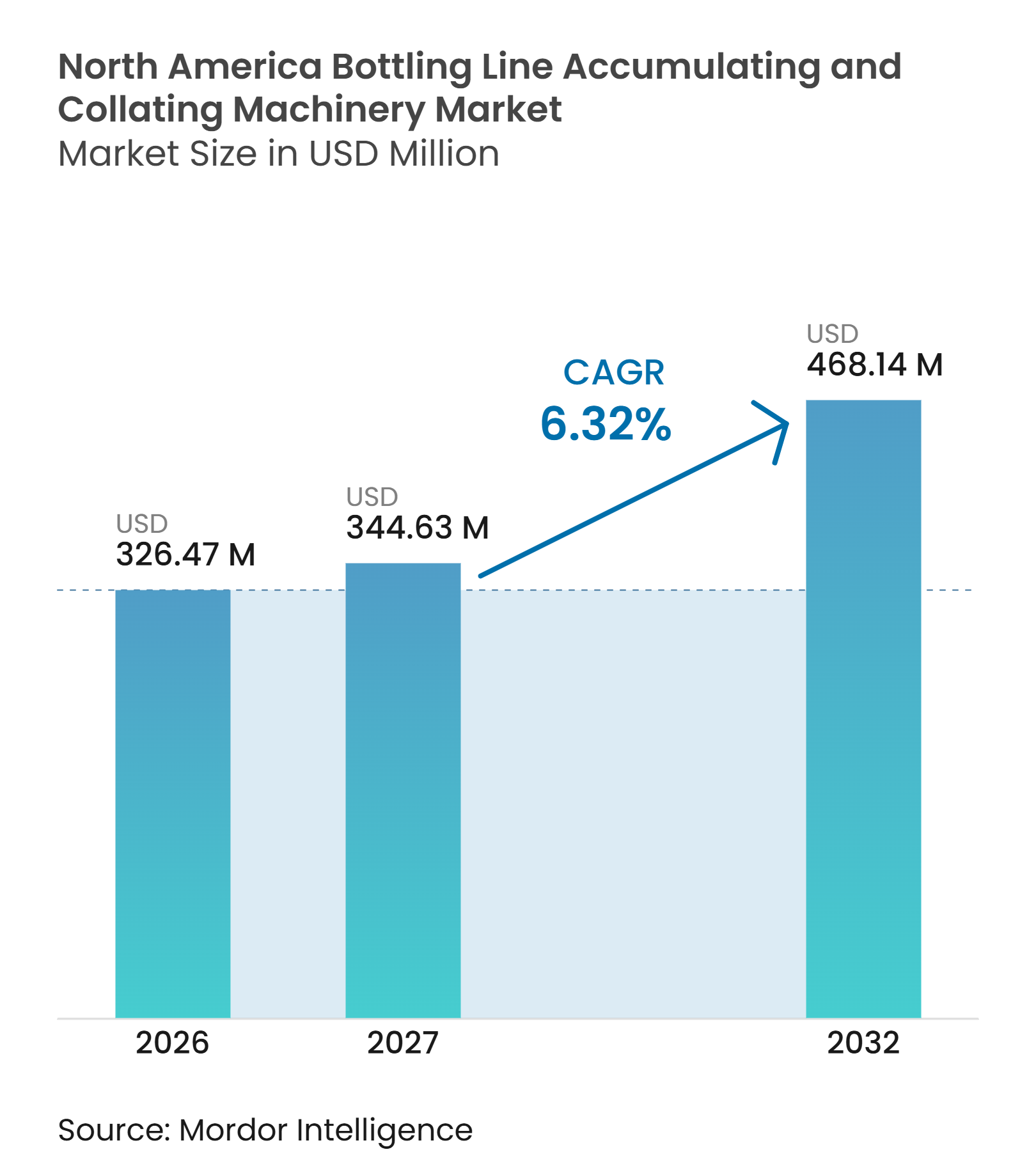
| Base Year Market Size (2026) | USD 326.47 Million |
| Market Size (2027) | USD 344.63 Million |
| Market Size (2032) | USD 468.14 Million |
| Growth Rate (2027 - 2032) | 6.32 % |
| Market Concentration | Medium |
Major Players *Disclaimer: Major Players sorted in no particular order Image © Mordor Intelligence. Reuse requires attribution under CC BY 4.0. | |
North America Bottling Line Accumulating and Collating Machinery Market Analysis by Mordor Intelligence
The North America bottling line accumulating and collating machinery market size is valued at USD 326.47 million in 2026 and is forecast to reach USD 468.14 million by 2032, growing at a CAGR of 6.32% during 2027-2032. The North America bottling line accumulating and collating machinery market is moving toward systems that actively manage throughput rather than simply hold containers between line stages. Fully automatic equipment requires a higher investment because large bottling sites need continuous production with limited manual handling. More single-serve products, ready-to-drink beverages, and aluminum containers are increasing the need for equipment that handles frequent format changes without damaging containers. Suppliers are responding by offering compact buffers, integrated controls, and faster commissioning support for facilities operating several lines. Tariff-related volatility in aluminum costs and shortages of technical labor remain material constraints, as they affect both equipment investment decisions and line commissioning.
Key Report Takeaways
- By equipment type, inline, serpentine, and mass-flow accumulators held 27.43% of the North America bottling line accumulating and collating machinery market share in 2026, while alpine, spiral, and vertical accumulators are projected to expand at a 7.16% CAGR through 2032.
- By material type, plastic held 49.78% of the market in 2026, while metal and aluminum containers are projected to expand at a 7.41% CAGR through 2032 in the North America bottling line accumulating and collating machinery market.
- By container shape, round containers held 66.24% of the market in 2026, while specialty and irregular geometry containers are projected to expand at a 7.26% CAGR through 2032.
- By automation, fully automatic systems held 74.69% of the market in 2026 and are projected to expand at a 7.34% CAGR through 2032.
- By end user, beverage producers held 44.37% of the market in 2026, while pharmaceutical and healthcare producers are projected to expand at a 7.52% CAGR through 2032.
- By geography, the United States held 83.52% of the market in 2026, while Mexico is projected to expand at a 7.19% CAGR through 2032.
Note: Market numbers in this report are based on Mordor Intelligence's proprietary estimation framework, which combines nine months of actuals with Q4 projections for base year 2026.
Market Trends and Insights
Drivers Impact Analysis of North America Bottling Line Accumulating and Collating Machinery Market*
| Driver | (~) % Impact on CAGR Forecast | Geographic Relevance | Impact Timeline |
|---|---|---|---|
| Expansion of High-Speed Beverage and Contract Packaging Lines | +1.8% | United States and Mexico | Short term (≤ 2 years) |
| Demand for Flexible Formats and Rapid SKU Changeovers | +1.5% | United States and Canada | Medium term (2-4 years) |
| Labor Scarcity and Rising Cost of Manual Material Handling | +1.4% | United States | Short term (≤ 2 years) |
| Food Safety, Cleanability, and Hygienic Line Design | +0.9% | United States and Canada | Medium term (2-4 years) |
| Growth of Single-Serve and Ready-to-Drink Beverages | +0.8% | United States | Medium term (2-4 years) |
| Lightweight and Unstable Containers Requiring Low-Pressure Handling | +0.5% | United States and Mexico | Long term (≥ 4 years) |
| Source: Mordor Intelligence | |||
Expansion of High-Speed Beverage and Contract Packaging Lines
North American contract beverage manufacturing is in a concentrated investment cycle that supports demand for high-performance accumulation and collation equipment. DrinkPAK committed USD 195 million to a third U.S. filling plant in Philadelphia during December 2025. SunOpta completed a USD 35 million fourth production line at its Midlothian, Texas, site during September 2026. Such projects need buffer infrastructure that can sustain production at high container speeds and link filling, labeling, packing, and palletizing operations. PMMI reported that 90% of U.S. beverage facilities plan to buy some type of packaging machinery within 3 years, which supports replacement and expansion activity across the North America bottling line accumulating and collating machinery market.[1] Suppliers are therefore placing more value on standard interfaces and faster start-up support because contract facilities have limited tolerance for lengthy integration work.
Demand for Flexible Formats and Rapid SKU Changeovers
SKU proliferation is changing equipment requirements across the North America bottling line accumulating and collating machinery market. Buyers increasingly need systems that can shift among bottle geometries, neck finishes, and grouping patterns without extended downtime. PMMI identified format variation and demand for flexible machinery as important forces shaping packaging equipment procurement. Servo-driven controls, recipe settings, and tool-free adjustments help operators complete changeovers more consistently. ProMach presented servo-integrated case-erecting and robotic infeed equipment for high-mix operations, indicating that flexibility is influencing product development across end-of-line equipment. The requirement favors machinery suppliers that can combine container control with practical maintenance access and clear operator interfaces.
Labor Scarcity and Rising Cost of Manual Material Handling
Labor availability is shifting automation from a cost-efficiency decision to a continuity requirement for many packaging operations. PMMI reported that 95% of surveyed end users are struggling to hire skilled operators and technicians. This shortage increases the value of automated transfer, accumulation, and grouping tasks that reduce reliance on manual handling. The North America bottling line accumulating and collating machinery market benefits when manufacturers replace manual side transfers and hand-stacking stations with automated systems. These installations can stabilize container flow between equipment stages and reduce the operational effect of unfilled shifts. They also create a need for simpler diagnostics and commissioning support, as facility teams may have reduced technical capacity after installation.
Food Safety, Cleanability, and Hygienic Line Design
Food-contact equipment must meet U.S. requirements for cleanable, corrosion-resistant, and nontoxic surfaces under 21 CFR Part 117.40. Bottled water operations also face sanitary-operation requirements under 21 CFR Part 129.37. These compliance factors support the use of stainless-steel open-frame designs in beverage and food lines. Equipment layouts that allow inspection, cleaning, and drainage help producers reduce avoidable downtime. The North America bottling line accumulating and collating machinery market consequently rewards suppliers that can demonstrate cleanable designs and documented material suitability. Third-party expectations associated with EHEDG or NSF/ANSI 51 can further influence vendor selection for food and beverage applications.
Restraints Impact Analysis of North America Bottling Line Accumulating and Collating Machinery Market*
| Restraint | (~) % Impact on CAGR Forecast | Geographic Relevance | Impact Timeline |
|---|---|---|---|
| High Capital Cost and Integration Engineering Requirements | -1.2% | United States and Canada | Short term (≤ 2 years) |
| Skilled Maintenance and Controls Talent Shortage | -0.9% | United States | Medium term (2-4 years) |
| Production Disruption During Retrofit and Commissioning | -0.6% | United States and Canada | Short term (≤ 2 years) |
| Container Geometry Drift and Label-Surface Damage During Collation | -0.4% | United States | Long term (≥ 4 years) |
| Source: Mordor Intelligence | |||
High Capital Cost and Integration Engineering Requirements
Capital availability and uncertain payback periods limit equipment purchases, especially at mid-sized facilities. High costs pose a barrier when packaging automation must compete with brand spending and working capital needs. Integrating a new accumulator into an existing line can require custom guarding, electrical work, controls integration, and acceptance testing. The resulting scope favors larger beverage producers, pharmaceutical manufacturers, and well-capitalized contract packagers. It also gives full-line suppliers an advantage when they can spread engineering work across several equipment classes. In the North America bottling line accumulating and collating machinery market, this can narrow the accessible customer base for standalone equipment suppliers.
Skilled Maintenance and Controls Talent Shortage
The same labor gap that encourages automation can limit the performance of installed machinery. PMMI identified knowledge loss from retiring technicians and limited onboarding for PLC-based systems as contributors to unplanned downtime. Complex servo systems need operators and maintenance personnel who can adjust settings, identify faults, and preserve stable operation. When those skills are unavailable, high-speed systems may operate at below-rated efficiency after commissioning. This condition increases demand for machine guidance, remote diagnostics, and preventive-maintenance support. It also slows the North America bottling line accumulating and collating machinery market where buyers are concerned that they cannot sustain the equipment after installation.
*Our forecasts treat driver/restraint impacts as directional, not additive. The impact forecasts reflect baseline growth, mix effects, and variable interactions.
North America Bottling Line Accumulating and Collating Machinery Market Segment Analysis
By Equipment Type:
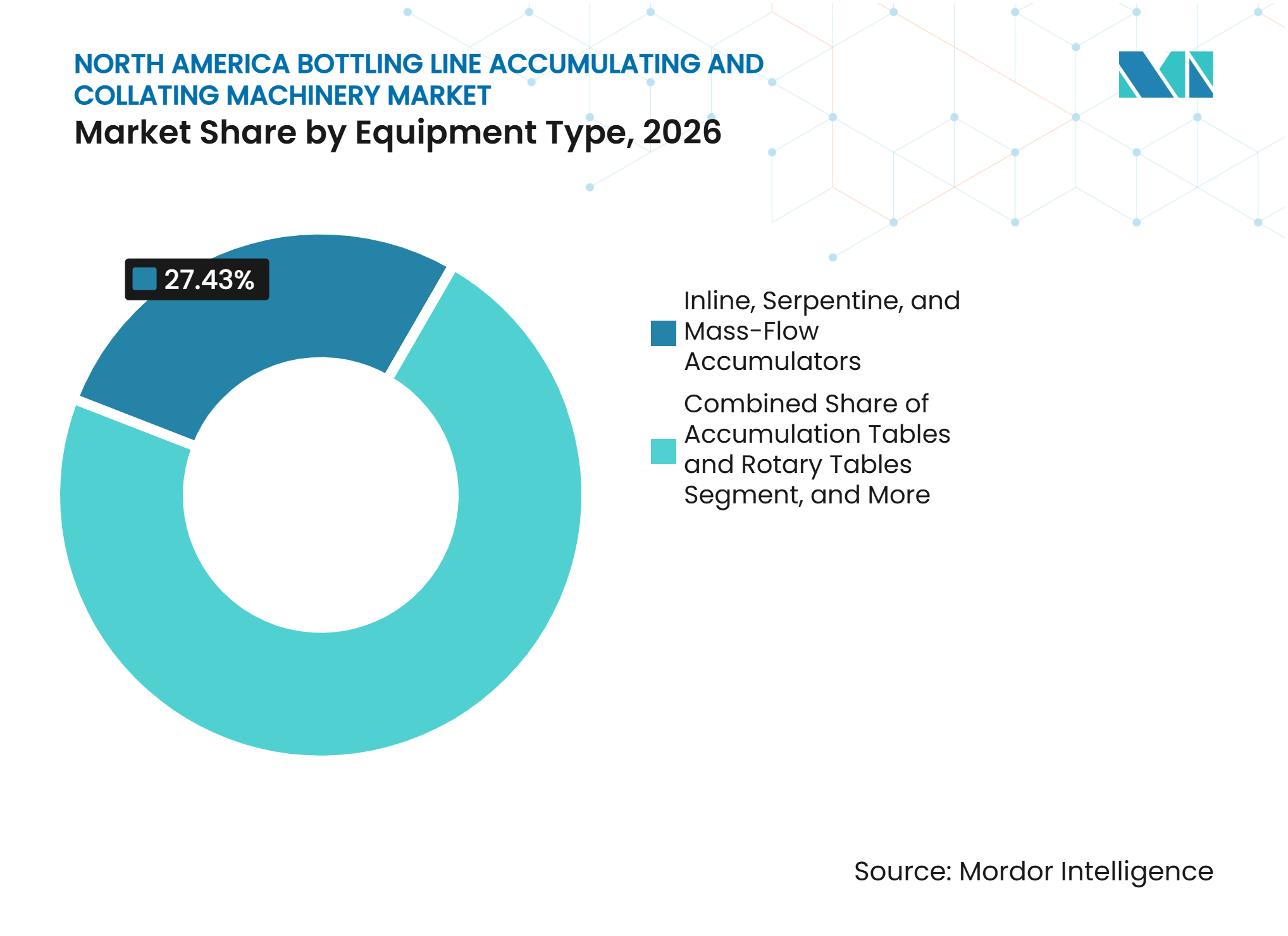
Vertical Buffering Gains Where Floor Space Is ConstrainedInline, serpentine, and mass-flow accumulators held 27.43% of the North America bottling line accumulating and collating machinery market size in 2026. Their installed position reflects compatibility with established linear layouts in high-speed beverage plants. These systems provide a familiar approach to buffering containers along the production path. They also allow manufacturers to manage temporary speed differences between upstream and downstream machines. Hygienic access requirements support their use in food and beverage settings because their operating areas can be designed for inspection and cleaning.
Alpine, spiral, and vertical accumulators are projected to grow at a 7.16% CAGR through 2032. Their value proposition is strongest where a plant must add buffer capacity without expanding its floor footprint. Krones presented its LinaFlex eSync single-lane canning buffer as an alternative to wide bulk conveyors, with up to 40% floor-space savings in the wet-end section.[2] Bi-directional and recirculating equipment remains relevant where first-in, first-out sequencing matters, including pharmaceutical secondary packaging. Standalone collators and grouping systems also serve personal care lines that need varied pack patterns and frequent format adjustments.



By Material Type:
Aluminum Growth Expands Handling RequirementsPlastic held 49.78% of the market in 2026 because it remains widely used in still water, carbonated soft drinks, and personal care applications. This material base sustains demand for systems designed around familiar PET and HDPE handling conditions. Plastic containers move through a substantial share of North American bottling-line volume. Their continuing use keeps low-pressure transfer and stable accumulation performance important. It also leaves suppliers with a broad retrofit market at existing consumer-goods and beverage facilities.
Metal and aluminum containers are projected to grow at a 7.41% CAGR through 2032. Ball reported that its global aluminum packaging shipments increased 4.1% during 2025, with North American energy drink and flavored-alcohol volumes outperforming the wider category. Aluminum formats increase the need for careful pressure management and stable container orientation. Glass continues to support demand in spirits and premium beer, where low-pressure handling remains essential. Carton and composite containers are also used for plant-based milk and juice, requiring collating systems that can accommodate varying surface friction characteristics.
By Container Shape:
Non-Round Formats Require More Controlled HandlingRound containers held 66.24% of the market in 2026. Their circular form supports mass-flow accumulation at high speed with less complex back-pressure management. The large installed base of equipment designed for round bottles and cans supports continuing replacement demand. Beverage plants can use these systems across common container sizes with relatively stable handling behavior. This installed base remains an important source of recurring upgrade activity within the North America bottling line accumulating and collating machinery market.
Specialty and irregular geometries containers are projected to grow at a 7.26% CAGR through 2032. Pharmaceutical and consumer-product formats can introduce square, oval, rectangular, contoured, or other non-round designs. Such formats require guide rails, sensors, and controls to maintain orientation and prevent scuffing or label damage. Servo-driven platforms offer adjustable handling settings to meet these requirements. The growth of shaped containers makes configuration flexibility more important for suppliers that serve mixed-format production lines.
By Automation:
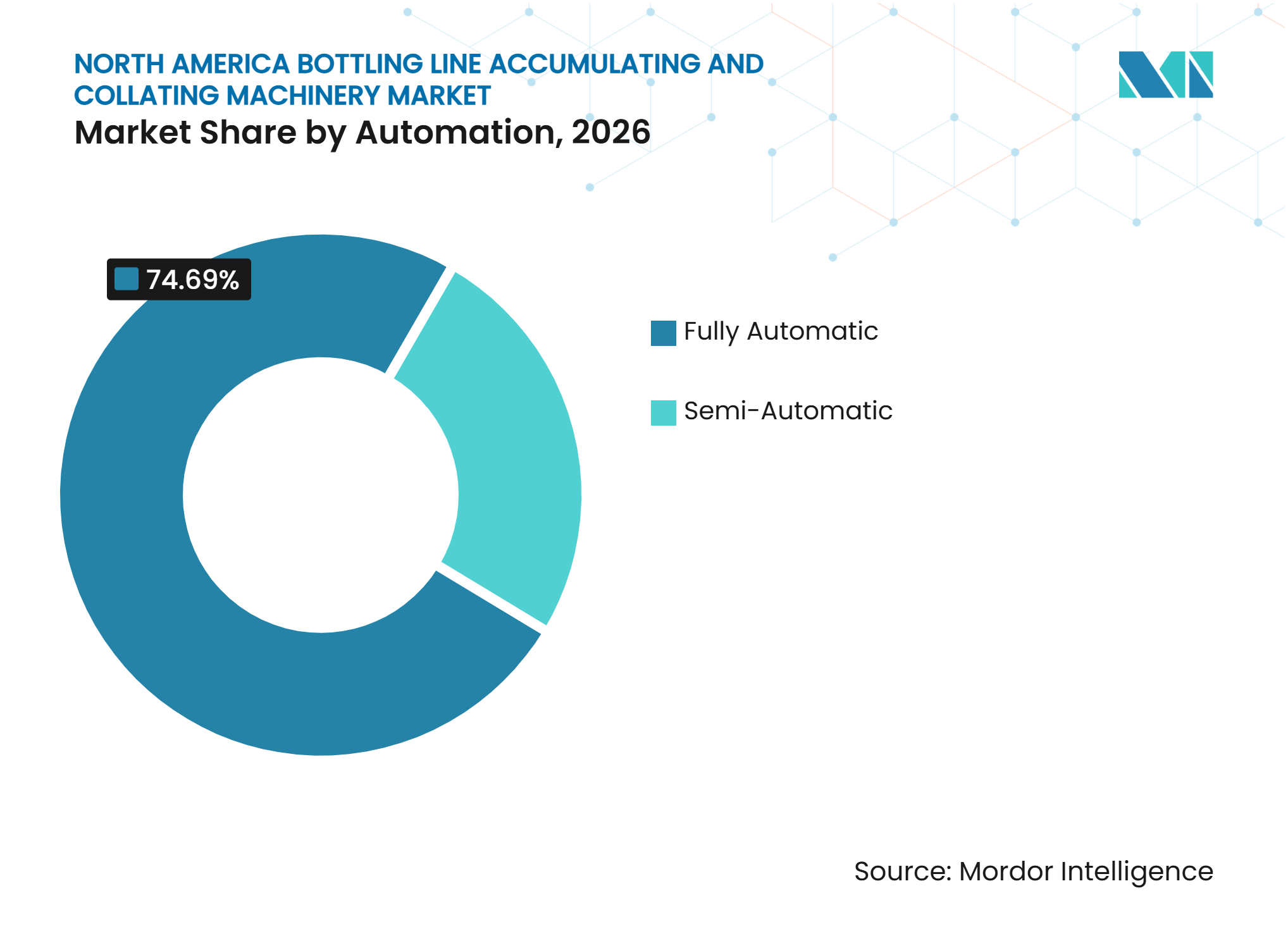
Fully Automatic Systems Lead Adoption and GrowthFully automatic systems held 74.69% of the market in 2026. The segment also represents the primary automation approach for large facilities that require continuous operation and limited manual material handling. PMMI stated that 72% of North American packaging facilities use robotics, while 61% plan to increase robotics investment within the next year. Loading, unloading, and accumulation are relevant targets for these investments. The dominance of fully automatic equipment indicates that producers are prioritizing reliable throughput and repeatable container control.
Fully automatic systems are projected to grow at a 7.34% CAGR through 2032. Labor shortages support that growth because facilities seek to reduce their reliance on manual operations. Semi-automatic systems remain relevant for smaller producers and specialty contract packagers with limited capital budgets or lower batch volumes. PMMI also reported that 35% of consumer packaged goods companies had no automation in the listed areas during 2025. This remaining base supports a continuing role for less-automated equipment even as automated systems expand. Suppliers must therefore offer both advanced controls for large plants and practical equipment configurations for lower-volume buyers.

By End User:
Pharmaceutical Demand Grows Faster Than Beverage DemandBeverage producers held 44.37% of the market in 2026. Their leading position reflects continued investment in beverage filling and canning capacity, with accumulation equipment as a standard line element. Lee Li Holdings announced a USD 394 million beverage manufacturing expansion in Mississauga during December 2025. Beverage operators need stable container flow across filling, labeling, packing, and palletizing stages. This need supports equipment demand across captive and contract production sites.
Pharmaceutical and healthcare producers are projected to grow at a 7.52% CAGR through 2032. Tjoapack announced a major U.S. expansion, including packaging and logistics capacity, underscoring continued investment in pharmaceutical packaging infrastructure. Pharmaceutical secondary packaging requires traceability, orderly product flow, and controls suited to validated operations. Food and dairy producers also need flexible systems as product variety expands. Personal care and cosmetics producers use adjustable collation for premium and small-batch formats. Chemical and household-product producers maintain baseline demand for heavy-duty equipment compatible with HDPE and composite containers.
Geography Analysis
United States
The United States held 83.52% of the North America bottling line accumulating and collating machinery market in 2026. Its position rests on a dense concentration of beverage, pharmaceutical, and consumer-goods facilities that operate high-speed packaging lines. The large installed base supports replacement demand as operators update older mass-flow conveyors and add servo-driven equipment for new container formats. PMMI reported USD 6.2 billion in U.S. food and beverage processing machinery shipments during 2025, up 3.2% from the prior year. Woodstock Sterile Solutions invested USD 8 million in a new automated high-speed bottle packaging line during 2025. FDA sanitary and current good manufacturing practice expectations continue to influence equipment selection in food, beverage, and pharmaceutical settings.
Mexico
Mexico is projected to grow at a 7.19% CAGR through 2032. Nearshoring is expanding industrial bottling capacity across Monterrey, Guadalajara, Coahuila, and Querétaro. New consumer-goods plants often specify integrated packaging lines that include accumulation and collation systems from the outset. The Bajío region is becoming an important location for beverage and consumer-goods capacity. Mexico’s pharmaceutical manufacturing expansion also supports demand for secondary packaging equipment that can align with U.S. Food and Drug Administration traceability expectations. These conditions make greenfield investment, rather than only replacement demand, an important driver for the North America bottling line accumulating and collating machinery market in Mexico.
Canada and Regional Supply-Chain Dynamics
Canada recorded CAD 1.2 billion (USD 870 million) in domestic packaging machinery shipments in 2025. Food accounted for 43.6% of those shipments. Ontario and British Columbia remain important co-packing and food-processing centers, supporting demand for mid-speed systems for carton, glass, and PET packaging. Invest Ontario reported that Lee Li Holdings planned a USD 384 million multi-facility beverage investment in Mississauga.[3] Provincial extended producer responsibility measures and single-use plastic restrictions are encouraging greater use of aluminum and glass. The resulting substrate changes support modular equipment that can be reconfigured while overall bottling volumes remain stable.
Competitive Landscape
Market Concentration
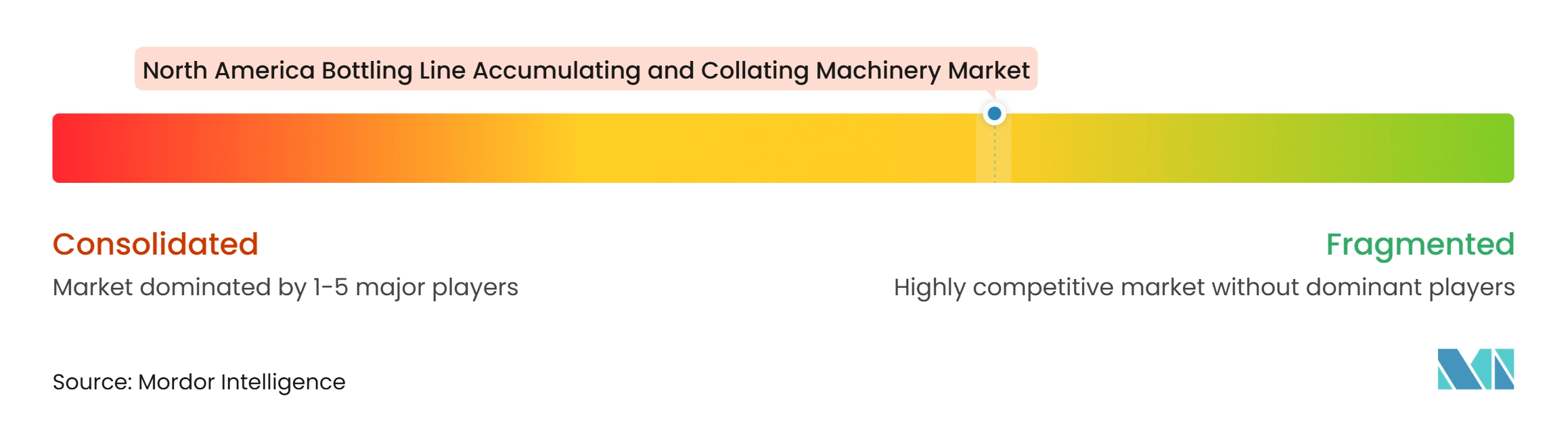
The North America bottling line accumulating and collating machinery market is moderately fragmented. European full-line suppliers such as Krones AG, KHS GmbH, and Sidel International AG compete with North American specialists including Garvey Corporation, Dyco, Inc., and Nercon Conveyor Systems. Full-line suppliers can combine equipment, controls, and service across an entire packaging line. Specialists can compete through lead times and familiarity with mid-market operating needs. This mix gives buyers several sourcing options while preserving clear advantages for suppliers capable of managing complex integration work.
Krones presented its Robobox SynFlow sorting system at Interpack 2026, placing container distribution directly upstream of the packer.[4] The move shows how larger suppliers are incorporating accumulation functions into broader line-management systems. Krones also presented LinaFlex eSync, a compact single-lane canning buffer designed to replace wide bulk conveyors in wet-end operations. ProMach introduced servo-integrated equipment for high-mix environments, adding another example of suppliers responding to format-change requirements. These moves emphasize compact layouts, automated transfer, and flexible controls.
Mid-tier beverage facilities operating below 20,000 containers per hour remain a practical opportunity for right-sized equipment with plug-and-play controls. These operators may find large full-line packages too extensive and custom-engineered systems too slow to implement. Smaller suppliers such as Keenline Conveyor Systems and Multi-Conveyor are using IIoT-enabled data logging to support return-on-investment discussions during commissioning. The approach is relevant for multi-line operators with constrained maintenance teams. Competitive success will depend on installation support, cleanable design, container-control capability, and the ability to deliver reliable equipment without prolonged line disruption. The North America bottling line accumulating and collating machinery market therefore remains open to both integrated suppliers and focused specialists.
North America Bottling Line Accumulating and Collating Machinery Industry Leaders
-
Krones AG
-
KHS GmbH
-
ProMach, Inc.
-
Coesia S.p.A.
-
Sidel Group
- *Disclaimer: Major Players sorted in no particular order
North America Bottling Line Accumulating and Collating Machinery Market Companies Covered in this Report
- Krones AG
- KHS GmbH
- Sidel Group
- ProMach, Inc.
- Coesia S.p.A.
- Syntegon Technology GmbH
- Barry-Wehmiller Companies, Inc.
- Duravant LLC
- Douglas Machine Inc.
- Garvey Corporation
- Dyco, Inc.
- Uni-Pak Corp., Inc.
- Nercon Conveyor Systems, LLC
- Multi-Conveyor LLC
- Span Tech LLC
- mk North America, Inc.
- Dillin Automation Systems, Inc.
- Arrowhead Systems, Inc.
- Chase-Logeman, Inc.
- FlexLink AB
- Keenline Conveyor Systems, LLC
- A&E Conveyor Systems, Inc.
Recent Industry Developments in North America Bottling Line Accumulating and Collating Machinery Market
- October 2026: Systech launched the ST33 and ST34 Carton Serialization Stations, automated systems that verify and serialize up to 600 cartons per minute. The ST34 adds tamper-evident sealing at up to 400 parts per minute, reinforcing serialization as a standard specification in pharmaceutical accumulation projects.
- October 2026: At PACK EXPO International 2026, Massman Companies introduced integrated accumulation tables, connected conveyors, and the NEM Compact Unscrambler, combining a low-profile hopper, vertical elevator, and gentle bottle orientation within a single enclosed, space-saving frame for high-speed North American bottling lines.
- May 2026: Krones AG premiered the LinaFlex eSync single-lane canning buffer at Interpack 2026, demonstrating up to 40% floor-space savings in the wet-end section by replacing wide bulk conveyors with a compact dynamic buffer integrated into the pasteurizer.
- May 2026: Krones AG showcased the Robobox SynFlow sorting system and AGV-integrated autonomous material handling at Interpack 2026, integrating container distribution upstream of packaging machines into Krones’ digital line management architecture.
North America Bottling Line Accumulating and Collating Machinery Market Report Scope
The North America bottling line accumulating and collating machinery market refers to equipment that manages, organizes, and buffers bottles and other containers during bottling operations. This machinery supports continuous production flows by accumulating containers between processing stages and collating them into organized groups for packaging, labeling, palletizing, or further handling.
The North America Bottling Line Accumulating and Collating Machinery Market Report is Segmented by Equipment Type (Bi-Directional and Recirculating Accumulators, Alpine, Spiral, and Vertical Accumulators, Inline, Serpentine, and Mass-Flow Accumulators, Standalone Collators and Grouping Systems, Bottle Laners, Combiners, and Lane Dividers, Accumulation Tables and Rotary Tables, and Other Equipment Types), Material Type (Plastic, Glass, Metal and Aluminum, and Carton and Composite Containers), Container Shape (Round Containers, Non-Round / Shaped Containers, and Specialty and Irregular Geometries Containers), Automation (Semi-Automatic, and Fully Automatic), End User (Beverage Producers, Food and Dairy Producers, Pharmaceutical and Healthcare Producers, Personal Care and Cosmetics Producers, Chemical and Household Product Producers, and Other End Users), and Geography (United States, Mexico, and Canada). The Market Forecasts are Provided in Terms of Value (USD).
Segmentation Overview
| Bi-Directional and Recirculating Accumulators |
| Alpine, Spiral, and Vertical Accumulators |
| Inline, Serpentine, and Mass-Flow Accumulators |
| Standalone Collators and Grouping Systems |
| Bottle Laners, Combiners, and Lane Dividers |
| Accumulation Tables and Rotary Tables |
| Other Equipment Types |
| Plastic |
| Glass |
| Metal and Aluminum |
| Carton and Composite Containers |
| Round Containers |
| Non-Round / Shaped Containers |
| Specialty and Irregular Geometries Containers |
| Semi-Automatic |
| Fully Automatic |
| Beverage Producers |
| Food and Dairy Producers |
| Pharmaceutical and Healthcare Producers |
| Personal Care and Cosmetics Producers |
| Chemical and Household Product Producers |
| Other End Users |
| United States |
| Canada |
| Mexico |
| By Equipment Type | Bi-Directional and Recirculating Accumulators |
| Alpine, Spiral, and Vertical Accumulators | |
| Inline, Serpentine, and Mass-Flow Accumulators | |
| Standalone Collators and Grouping Systems | |
| Bottle Laners, Combiners, and Lane Dividers | |
| Accumulation Tables and Rotary Tables | |
| Other Equipment Types | |
| By Material Type | Plastic |
| Glass | |
| Metal and Aluminum | |
| Carton and Composite Containers | |
| By Container Shape | Round Containers |
| Non-Round / Shaped Containers | |
| Specialty and Irregular Geometries Containers | |
| By Automation | Semi-Automatic |
| Fully Automatic | |
| By End User | Beverage Producers |
| Food and Dairy Producers | |
| Pharmaceutical and Healthcare Producers | |
| Personal Care and Cosmetics Producers | |
| Chemical and Household Product Producers | |
| Other End Users | |
| By Geography | United States |
| Canada | |
| Mexico |
Key Questions Answered in the Report
What is the size of the North America bottling line accumulating and collating machinery market?
The market is valued at USD 326.47 million in 2026 and is forecast to reach USD 468.14 million by 2032 at a 6.32% CAGR.
What equipment type leads demand for bottling-line accumulation systems?
Inline, serpentine, and mass-flow accumulators lead equipment types with a 27.43% share in 2026.
Which automation approach is most widely used in bottling-line accumulation equipment?
Fully automatic systems hold 74.69% of demand in 2026 and are projected to grow at a 7.34% CAGR through 2032.
Which end-user group is growing fastest for accumulation and collating equipment?
Pharmaceutical and healthcare producers are projected to grow at a 7.52% CAGR through 2032.
Which North American country is expected to grow fastest in this field?
Mexico is projected to grow at a 7.19% CAGR through 2032, supported by nearshoring and greenfield manufacturing investment.