
North America Aviation Manufacturing Market Size and Share
Market Overview
| Study Period | 2019 - 2031 |
|---|---|
| Forecast Data Period | 2026 - 2031 |
| Base Year Market Size (2025) | USD 272.37 Billion |
| Market Size (2026) | USD 288.53 Billion |
| Market Size (2031) | USD 383.79 Billion |
| Growth Rate (2026 - 2031) | 5.87 % |
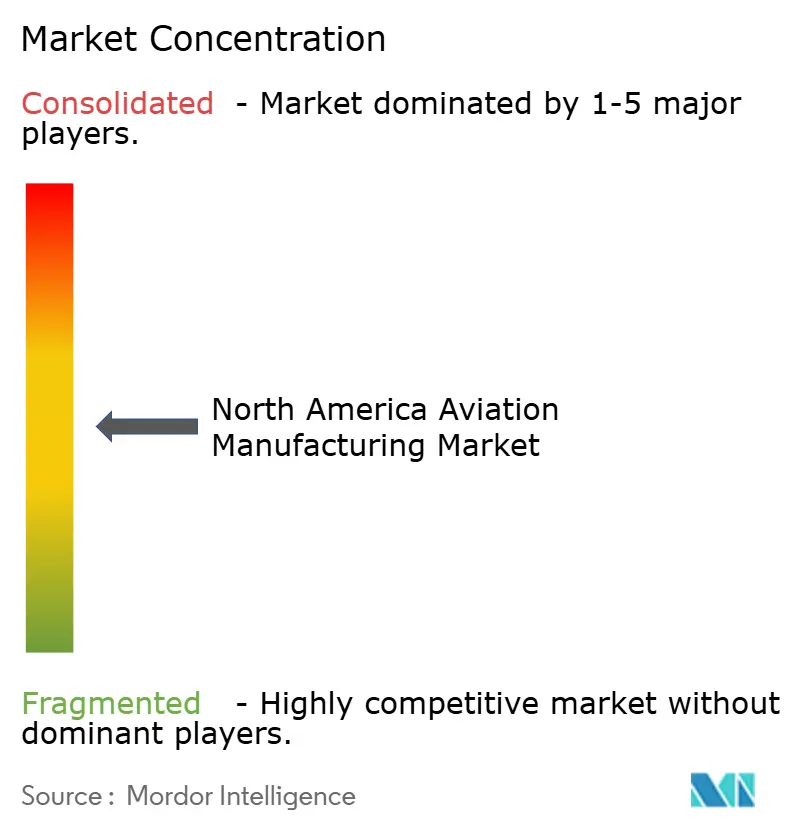
| Market Concentration | Medium |
Major Players *Disclaimer: Major Players sorted in no particular order Image © Mordor Intelligence. Reuse requires attribution under CC BY 4.0. | |

North America Aviation Manufacturing Market Analysis by Mordor Intelligence
The North America aviation manufacturing market size is expected to grow from USD 272.37 billion in 2025 to USD 288.53 billion in 2026 and is forecasted to reach USD 383.73 billion by 2031 at a 5.87% CAGR over 2026-2031. The region’s growth outlook is supported by sustained defense procurement, a deep supplier base across aerostructures and systems, and modernization cycles in commercial and business aviation fleets. Demand visibility benefits from long backlogs and airline fleet-retirement profiles that favor new-technology aircraft with lower fuel burn. Within the North America aviation manufacturing market, electrification pathways, sustainable fuel adoption, and avionics digitalization shape investment priorities and product roadmaps. Supply-chain resiliency and workforce development remain pivotal execution variables for OEMs and tiered suppliers. Policy support for infrastructure and air traffic modernization helps align manufacturing throughput with capacity and safety gains across the aviation system
Key Report Takeaways
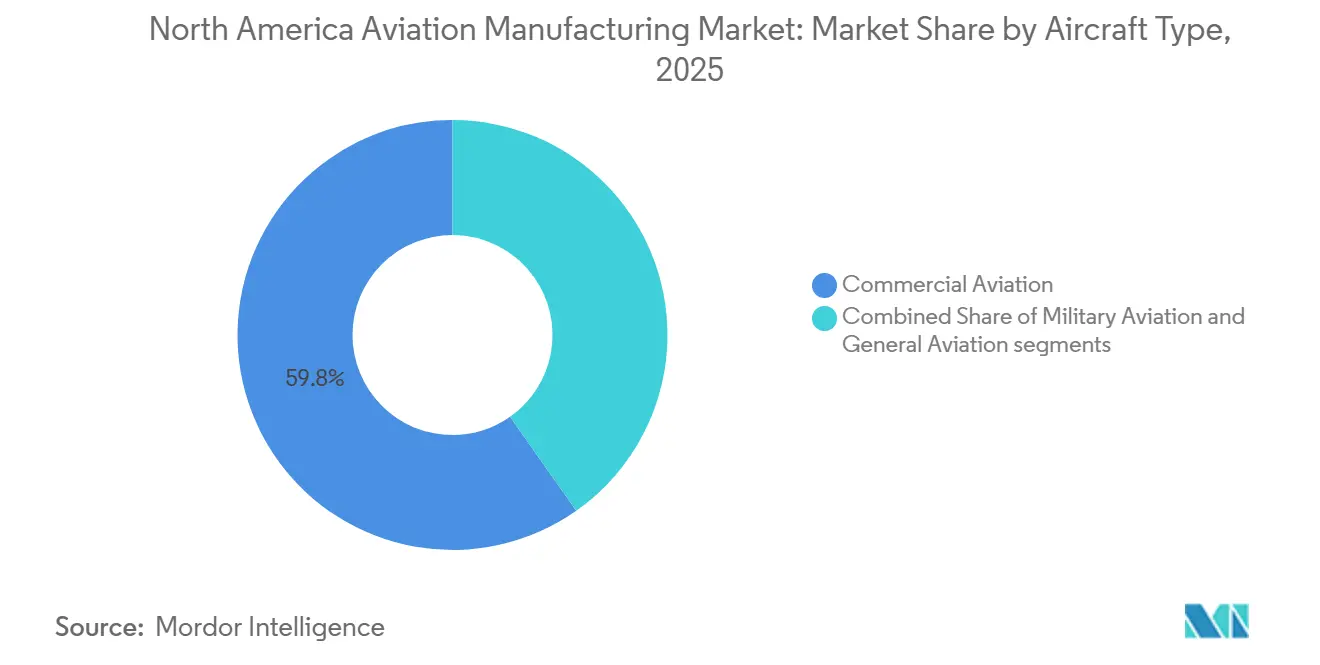
- By aircraft type, commercial aviation led the North America aviation manufacturing market with 59.76% market share in 2025, and military aviation is forecast to expand at a 7.98% CAGR through 2031.
- By component, airframe structures held 39.81% in 2025, and avionics and flight-control systems are estimated to post the fastest 6.60% CAGR through 2031.
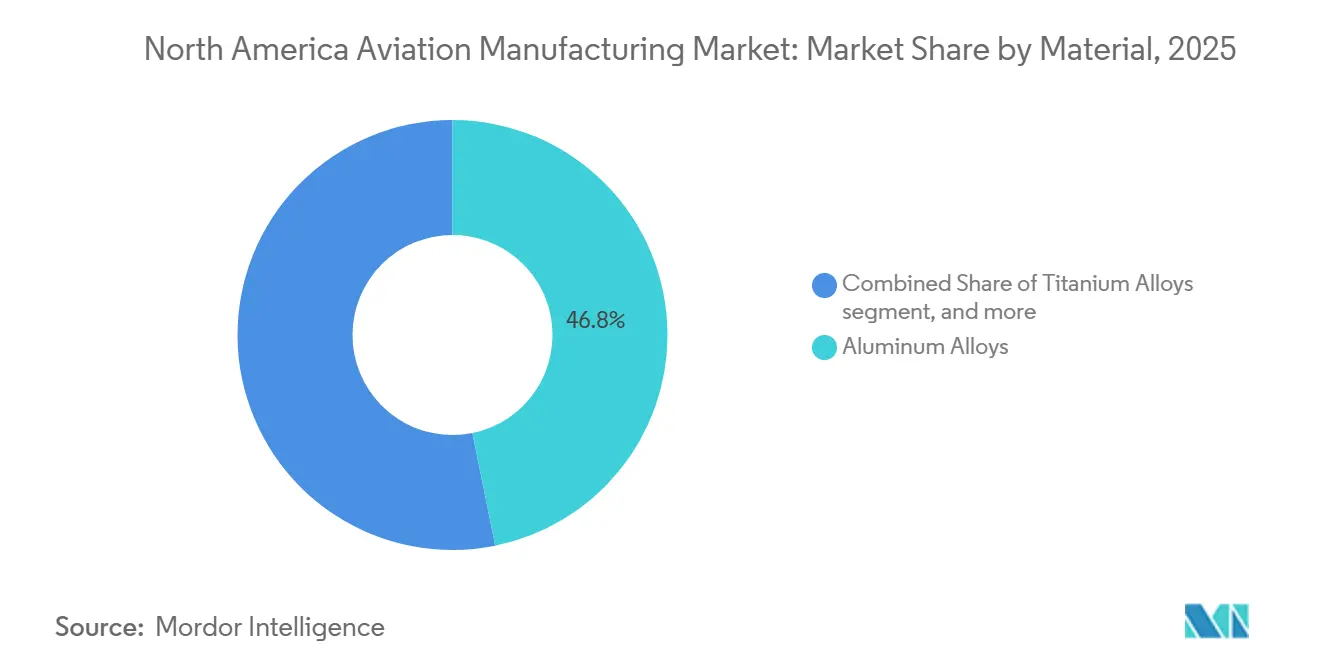
- By material, aluminum alloys retained 46.81% in 2025, and carbon-fiber composites are projected to grow at a 6.91% CAGR through 2031.
- By geography, the United States accounted for 65.98% in 2025, and Canada is expected to grow at a 6.12% CAGR through 2031.
Note: Market size and forecast figures in this report are generated using Mordor Intelligence’s proprietary estimation framework, updated with the latest available data and insights as of January 2026.
Market Trends and Insights
Drivers Impact Analysis of North America Aviation Manufacturing Market*
| Driver | (~) % Impact on CAGR Forecast | Geographic Relevance | Impact Timeline |
|---|---|---|---|
| Passenger-traffic rebound driving capacity expansion | +1.80% | US hubs, Canadian metros, Mexico City | Medium term (2-4 years) |
| Electrification readiness for eVTOL and hybrid-electric aircraft | +1.20% | US urban corridors, early trials in California, Texas, Florida | Long term (≥ 4 years) |
| Sustainable-aviation-fuel fueling infrastructure rollout | +0.90% | California, Oregon, Washington, Texas, Midwest ethanol belt | Medium term (2-4 years) |
| E-commerce-led air-cargo boom boosting freight facilities | +0.90% | North America, with emphasis on US freight gateways | Medium term (2-4 years) |
| Bipartisan Infrastructure Law grants accelerating capital projects | +0.70% | US (all states), with concentration in Tier 2/3 airports | Short term (≤ 2 years) |
| Next-gen air-traffic-management investments (ADS-B, SWIM) | +0.60% | US controlled airspace, Canadian NAV CANADA integration | Short term (≤ 2 years) |
| Source: Mordor Intelligence | |||
Passenger-Traffic Rebound Driving Capacity Expansion
Air travel demand in North America is on a multi-year recovery path as airports and carriers in the region align capacity with steady passenger gains. Airports Council International projected the region to have 2.1 billion passengers in 2025 and forecast long-term average passenger growth of 2.3% annually through 2054, which sustains demand for new aircraft across narrowbody, widebody, and regional fleets.[1] Fleet retirement dynamics enhance this pull, as OEM outlooks indicate a significant share of current aircraft will be replaced over the next 20 years, supporting multi-program production stability in the North America aviation manufacturing market. Boeing projects the need for 21,100 aircraft replacements and 22,500 new aircraft for growth over the next 20 years, with the global fleet expected to increase from 27,150 currently to 49,640 by 2044. Airlines prioritize fuel efficiency and cabin upgrades to meet customer expectations and cost objectives, which channels orders toward next-generation platforms. Continuous improvement in route planning and aircraft utilization supports sustained orders beyond replacement cycles. The North America aviation manufacturing market benefits from this demand environment as suppliers book long-dated contracts across structures, engines, avionics, and interiors.
Bipartisan Infrastructure Law Grants Accelerating Capital Projects
The Bipartisan Infrastructure Law provides a multi-year runway for airport modernization, which lifts demand for equipment and systems produced within the North America aviation manufacturing market. The FAA released a fifth tranche of infrastructure grants in October 2025, bringing total awards under the law’s airport programs to date into the billions and targeting runways, taxiways, terminals, and airfield systems. These programs emphasize domestic sourcing of iron, steel, and manufactured products, favoring North American suppliers and keeping value creation in the region. Short execution windows tied to grant cycles compress procurement and installation timelines, which raises factory utilization at manufacturers of jet bridges, baggage systems, power units, and lighting. Airports advancing phased capital plans add multi-year visibility for manufacturers, integrators, and service providers. As projects move from planning to construction, the near-term lift is strongest for airside equipment and building systems, with knock-on benefits for training, maintenance tooling, and certification support.
Next-Gen Air-Traffic-Management Investments (ADS-B, SWIM)
The FAA transitioned multiple NextGen capabilities into steady-state operations by the end of 2025, which supports avionics retrofits and linefit upgrades across commercial and business fleets in the North America aviation manufacturing market. ADS-B is operational across most controlled airspace, and Data Comm services operate at all 20 Air Route Traffic Control Centers, enhancing safety, streamlining clearances, and reducing radio congestion. System-Wide Information Management improves data exchange among stakeholders and enables new airspace-management tools that benefit both airlines and general aviation. These capabilities require compatible flight-deck systems and communications equipment, which creates retrofit programs for older aircraft and linefit demand for new deliveries. Upgrades spill into airport surface-movement systems and terminal-area optimization, which opens opportunities for surveillance sensors, augmentation systems, and software that leverage NextGen data streams. The result is a durable equipment pipeline that favors avionics, communications, and IT integration providers in the North America aviation manufacturing market.
Sustainable-Aviation-Fuel Fueling Infrastructure Rollout
Sustainable aviation fuel supply expanded from 2024 into 2025 with a growing network of airports and FBOs allowing carriers and business aviation operators to blend SAF with conventional jet fuel. Industry data show 110 million gallons of US SAF supply in 2024, with expectations of 150 to 200 million gallons in 2025 as additional facilities scale, supported by state-level incentives and clean-fuels programs.[2] Producers advanced new capacity through projects backed by Department of Energy loans, including Montana Renewables and Gevo, which target meaningful output additions over the latter part of the decade. Major downstream suppliers expanded distribution points across key states, supporting airline operational testing and early volumes for corporate flight departments. Near-term policy changes to credits and feedstock eligibility affect pricing and financing, placing a premium on modular, scalable equipment solutions at production and blending sites. In the North America aviation manufacturing market, the equipment bill of materials spans hydrotreating, Fischer-Tropsch, and alcohol-to-jet process units, as well as instrumentation and logistics equipment, which sustains multi-year orders for industrial suppliers.
Restraints Impact Analysis of North America Aviation Manufacturing Market*
| Restraint | (~) % Impact on CAGR Forecast | Geographic Relevance | Impact Timeline |
|---|---|---|---|
| Budget constraints and cost overruns | -0.60% | US (all states), Canada, Mexico | Short term (≤ 2 years) |
| Environmental permitting and community opposition | -0.80% | US (concentrated in California, Minnesota, Northeast) | Medium term (2-4 years) |
| Construction-material supply-chain bottlenecks | -1.10% | Global, with acute impact on US final assembly and tier-one suppliers | Medium term (2-4 years) |
| Skilled labor shortage in airport construction trades | -0.90% | North America, particularly US Sunbelt and Canadian provinces | Long term (≥ 4 years) |
| Source: Mordor Intelligence | |||
Environmental Permitting and Community Opposition
Permitting timelines lengthen capital projects and can defer capacity additions that the North America aviation manufacturing market relies on for steady equipment demand. Reported averages for priority permits in Minnesota between 2018 and 2023 extended well beyond statutory targets, with air and water permits taking 476 days on average and some applications exceeding 1,000 days.[3] Extended review cycles introduce additional financing costs and can shift project phasing, altering when manufacturers receive orders and when installation occurs. Community feedback on noise and local impacts requires project sponsors to adapt designs and mitigation plans, potentially changing specifications for systems and materials. Project sponsors who plan early engagement and complete baseline studies more quickly reduce the risk of rework and deficiency cycles during review. Timelier approvals support predictable procurement, which is important for factory scheduling and labor planning across suppliers in the North America aviation manufacturing market.
Construction-Material Supply-Chain Bottlenecks
Supply-chain constraints continue to influence delivery timelines and production sequencing for airframes and systems, which flows through to installation pace at airports and MRO facilities. Industry assessments during 2025 flagged continued challenges in critical materials and components, with knock-on effects at tier-one and tier-two suppliers and at final assembly. Backlogs in aircraft deliveries translate into higher airline operating costs due to deferred efficiency benefits and create coordination challenges for maintenance planning. Engine delivery pacing often lags airframe readiness, which queues aircraft awaiting powerplants and delays revenue service, further complicating scheduling for downstream installations and avionics updates. Manufacturers respond with inventory buffers, dual-sourcing where feasible, and qualification of alternative materials, which take time and engineering effort. Coordinated planning across OEMs and suppliers helps reduce ripple effects, but constraints still affect output and lead times in the North America aviation manufacturing market.
*Our forecasts treat driver/restraint impacts as directional, not additive. The impact forecasts reflect baseline growth, mix effects, and variable interactions.
North America Aviation Manufacturing Market Segment Analysis
By Aircraft Type:
Defense Modernization Outpaces Commercial RecoveryCommercial aviation accounted for 59.76% in 2025, on the back of rising narrowbody deliveries and a recovery in long-haul routes, and the North America aviation manufacturing market reflects steady workstreams for structures, engines, avionics, and interiors. Airlines in the region prepare for mid-life upgrades and cabin refresh cycles in parallel with new deliveries, which keep retrofit and linefit channels active. Demand visibility is reinforced by long-term forecasts that call for sustained replacement of older aircraft and ongoing growth in total departures, which supports a multi-year production runway for OEMs and suppliers. Fleet modernization also brings avionics and connectivity upgrades as Data Comm and ADS-B equipage become standard baselines, directing incremental orders to cockpit and communications providers in the North America aviation manufacturing market. Widebody platforms now move forward in line with long-haul traffic recovery, while regional jets and turboprops target thin routes and feeder networks for continued accessibility and flexibility.
Military aviation is set to expand at a 7.98% CAGR through 2031 as multi-year procurement sustains output across fighters, transports, and rotorcraft, and the North America aviation manufacturing market size for Military Aviation is projected to expand at this pace over the forecast period. Lockheed Martin confirmed delivery of a record 191 F-35 aircraft in 2025 and finalized a large follow-on contract for production Lots 18 and 19, providing suppliers with volume visibility for airframes, avionics, and materials. Tankers, transports, and ISR platforms remain integral to mobility and surveillance missions, which support demand for missionized systems and structures. Military rotorcraft also advance through modernization milestones as heavy-lift and future vertical lift solutions progress, which sustains demand for transmissions, blades, and avionics. Defense investment underpins a stable baseline of production in the North America aviation manufacturing market and provides a countercyclical buffer to commercial cycles in the region.

By Component:
Avionics Digitalization Leads GrowthAirframe structures accounted for 39.81% in 2025 due to the high content of wings, fuselage, empennage, and nacelles, and these categories remain labor- and material-intensive within the North America aviation manufacturing market. Tier-one partners execute large composite and metallic assemblies with growing adoption of automated fiber placement, resin infusion, and large-part machining. Quality systems and regulatory traceability remain central to production assurance, which shapes factory systems and supplier audits across the chain. Propulsion remains a major spend area as engine OEMs invest in geared, open-fan, and adaptive-cycle technologies to improve fuel burn and mission performance across both civil and defense programs. GE Aerospace announced a USD 1 billion investment in US manufacturing in March 2026 to support LEAP production and new engine technologies, strengthening domestic capacity and supply resiliency for the North America aviation manufacturing market.
Avionics and flight control systems are the fastest-growing component segment, with a 6.60% CAGR through 2031, driven by cockpit digitalization, flight-management upgrades, and the adoption of fly-by-wire architectures. The North America aviation manufacturing market for avionics and flight control systems is advancing at this growth rate. The FAA's NextGen transition into steady-state operations increases the value of connected avionics that can handle Data Comm and integrate ADS-B with navigation and surveillance functions. Retrofits extend this pull to in-service fleets, while new-builds embed higher-capability suites as standard linefit equipment. Landing gear and actuation systems are evolving toward electric architectures that reduce weight and maintenance, aligning with operators' efficiency goals. Environmental-control, fuel, and electrical systems also gain content as electrification pathways raise thermal loads and require better power management across the North America aviation manufacturing market.
By Material:
Composites Gain as Weight Reduction Drives EfficiencyAluminum alloys retained 46.81% in 2025, supported by established metallurgy, broad supplier capacity, and cost-effectiveness for many structural parts across the North America aviation manufacturing market. Aerospace-grade products from major North American mills meet AMS specifications and integrate with performance and traceability requirements across programs. Weight-reduction imperatives guide material selection and drive substitution in some primary structures, which opens the way for advanced composites. Carbon fiber composites are set to expand at a 6.91% CAGR through 2031, and large commercial programs highlight extensive composite content in primary structures, including wings and fuselage panels. Suppliers scale automated layup and curing capability to meet rate expectations and pursue process innovations that reduce cycle time. Recycling and end-of-life pathways for thermosets and thermoplastics continue to develop as volumes grow and sustainability targets tighten in the North America aviation manufacturing market.
Titanium alloys serve high-load and high-temperature applications such as landing gear, pylons, and engine structures, complementing aluminum and composites. Sourcing diversification reduces geopolitical risks and aligns with supply-chain resilience priorities underlined by large delivery backlogs reported in 2025. Specialty steels, superalloys, ceramics, and additive-manufactured powders enable performance in hot sections and critical fasteners. Metal additive manufacturing matured further for select flight hardware, shortening lead times and enabling consolidation of parts into single builds. Qualification frameworks emphasize process control and inspection rigor, which favors suppliers investing in in-process monitoring and post-processing automation across the North America aviation manufacturing market.
Geography Analysis
United States Aviation Manufacturing Market
The United States accounted for 65.98% of regional output in 2025 as the country hosts major final assembly and extensive supplier footprints across the Pacific Northwest, Texas, the Southeast, and traditional aerospace hubs. Large defense procurement continues to anchor production with the F-35 program reaching record deliveries in 2025 and a multi-year order book that enhances visibility across coatings, composites, and mission systems in the North America aviation manufacturing market. The FAA’s roll-out of NextGen capabilities and infrastructure grants adds demand for avionics, communications, and airport systems, and supports US suppliers through Buy America provisions and modernization timelines. Propulsion capacity is strengthening with new US investments to expand LEAP production and advance next-generation engines for military use, bolstering the domestic supplier base in the North America aviation manufacturing market. Permitting timelines remain a constraint on expansions in several states, requiring careful project planning to avoid delays and cost escalation.
Canada Aviation Manufacturing Market
Canada is projected to post the fastest growth at a 6.12% CAGR through 2031, reflecting the strength of the business-jet market and deepening industrial linkages with US primes. Bombardier delivered 157 business jets in 2025 and reported USD 9.55 billion in revenue for the year, demonstrating strong backlog conversion and supporting higher-rate production in 2026 in the North America aviation manufacturing market. The company also announced a USD 100 million expansion to support the Global family, which underpins supplier demand in Quebec and Ontario. Canada’s supplier base provides landing gear, aerostructures, and flight simulation systems to commercial and defense programs, and benefits from bilateral safety agreements that streamline certification across borders. Canada’s role in high-value niches continues to expand as transport authorities align regulatory frameworks and OEMs allocate work based on capability and schedule.
Mexico Aviation Manufacturing Market
Mexico continues to strengthen its role as a cost-competitive manufacturing base, closely integrated with the US through the North American trade framework. Suppliers operate machining, wiring harness, composite layup, and subassembly facilities, positioned for just-in-time delivery to US final assembly lines, which support the North America aviation manufacturing market’s regionalized supply model. Labor supply and training pipelines are expanding through technical education programs that backfill growing aerospace and adjacent industries. Infrastructure upgrades and improvements in power reliability enhance the operating environment, while trade rules of origin maintain incentives for North American content. The North America aviation manufacturing market benefits from this tri-national integration as OEMs hedge geopolitical risk and reduce transportation lead times.
Competitive Landscape
The North America aviation manufacturing market features a concentrated top tier across large commercial and defense platforms and a broad base of tiered suppliers spanning structures, engines, avionics, and interiors. On the civil side, airlines and lessors manage delivery delays from large backlogs, which increases the value of reliability and rate stability in program management. Defense programs provide multi-year ballast to the production outlook, with F-35 deliveries reaching a record in 2025 and a large follow-on contract that sustains supplier capacity and investment. Business aviation remains competitive at the ultra-long-range end, where product launches and certifications shape share dynamics among leading brands. Across tiers, execution on quality, delivery, and cost control remains decisive as primes focus on supplier performance and resilience.
Strategic capital deployment supports manufacturing upgrades and risk reduction across critical workstreams in the North America aviation manufacturing market. GE Aerospace committed USD 1 billion to US manufacturing in 2026 to add LEAP capacity and develop adaptive-cycle engines, which strengthens the propulsion segment’s ability to meet civil and military demand. Avionics and communications upgrade cycles continue as NextGen capabilities transition into standard operations, which incentivizes retrofits and linefit enhancements for connected flight decks. Certification progress in business aviation introduces new cabins and performance envelopes, driving demand for interior reconfiguration and associated systems orders. Primes emphasize digital manufacturing, advanced materials, and automation to raise yields and reduce rework, improving overall throughput in the North America aviation manufacturing market.
Electrification and advanced air mobility open new addressable content pools for established avionics, battery, and electric-propulsion suppliers in the North America aviation manufacturing market. Archer reported that the FAA has accepted all Means of Compliance submissions for its Midnight aircraft and outlined first-revenue flights targeted for 2026, advancing the eVTOL commercialization path. Electra submitted a Part 23 type certification application for its hybrid-electric EL-9 in December 2025, signaling progress in short-takeoff-and-landing concepts for regional markets. SAF infrastructure expansion supports additional growth vectors for process-equipment suppliers and instrumentation providers as projects financed in 2025 and 2026 move forward. Companies that align their portfolios with efficiency, sustainability, and digital operations are positioned to capture higher-value content and sustain growth in the North America aviation manufacturing market.
North America Aviation Manufacturing Industry Leaders
-
Airbus SE
-
The Boeing Company
-
Lockheed Martin Corporation
-
RTX Corporation
-
GE Aerospace (General Electric Company)
- *Disclaimer: Major Players sorted in no particular order
North America Aviation Manufacturing Market Companies Covered in this Report
- Airbus SE
- The Boeing Company
- Lockheed Martin Corporation
- RTX Corporation
- GE Aerospace (General Electric Company)
- Rolls-Royce Holdings plc
- Safran SA
- Leonardo S.p.A.
- Bombardier Inc.
- Mitsubishi Heavy Industries, Ltd.
- Israel Aerospace Industries Ltd.
- GKN Aerospace Services Limited (Melrose Industries plc)
- Eaton Corporation plc
- Parker-Hannifin Corporation
- Honeywell International Inc.
- Singapore Technologies Engineering Ltd.
- Textron Aviation Inc.
Recent Industry Developments in North America Aviation Manufacturing Market
- March 2026: GE Aerospace announced its intention to invest an additional USD 1 billion in its US manufacturing facilities and supplier network in 2026. This investment aims to expedite engine deliveries, increase the production of components that extend intervals between maintenance shop visits, and enhance defense production to meet growing military demand.
- February 2026: Transport Canada approved Gulfstream G700 and G800 business jets, enabling entry into service for new ultra-long-range platforms.
- January 2026: Bombardier announced a USD 100 million expansion of its Dorval, Quebec, manufacturing center to support rising production rates for the Global business jet product line.
North America Aviation Manufacturing Market Report Scope
The North America aviation manufacturing market includes the production of commercial, military, and general aviation aircraft, along with their components and systems. The market benefits from a geographically concentrated manufacturing base, with the US as the leading producer, supported by aerospace programs in Canada and Mexico.
The North America aviation manufacturing market is segmented by aircraft type, component, material, and geography. By aircraft type, the market is segmented into commercial aviation, military aviation, and general aviation. By component, the market is segmented into airframe structures, propulsion systems, avionics and flight control systems, cabin and interior modules, landing gear and actuation, and other components. By material, the market is segmented into aluminum alloys, carbon fiber composites, titanium alloys, high-strength steel, and other materials. The report also covers the market sizes and forecasts for the North America aviation manufacturing market in three countries across the region. For each segment, the market size and forecast are provided in terms of value (USD).
| Commercial Aviation | Narrowbody Aircraft |
| Widebody Aircraft | |
| Regional Jets | |
| Military Aviation | Combat Aircraft |
| Non-Combat Aircraft | |
| Helicopters | |
| General Aviation | Business Jets |
| Turboprop Aircraft | |
| Piston Aircraft | |
| Helicopters |
| Airframe Structures |
| Propulsion Systems |
| Avionics and Flight Control Systems |
| Cabin and Interior Modules |
| Landing Gear and Actuation |
| Other Components |
| Aluminum Alloys |
| Carbon Fiber Composites |
| Titanium Alloys |
| High-Strength Steel |
| Other Materials |
| United States |
| Canada |
| Mexico |
| By Aircraft Type | Commercial Aviation | Narrowbody Aircraft |
| Widebody Aircraft | ||
| Regional Jets | ||
| Military Aviation | Combat Aircraft | |
| Non-Combat Aircraft | ||
| Helicopters | ||
| General Aviation | Business Jets | |
| Turboprop Aircraft | ||
| Piston Aircraft | ||
| Helicopters | ||
| By Component | Airframe Structures | |
| Propulsion Systems | ||
| Avionics and Flight Control Systems | ||
| Cabin and Interior Modules | ||
| Landing Gear and Actuation | ||
| Other Components | ||
| By Material | Aluminum Alloys | |
| Carbon Fiber Composites | ||
| Titanium Alloys | ||
| High-Strength Steel | ||
| Other Materials | ||
| By Geography | United States | |
| Canada | ||
| Mexico | ||
Key Questions Answered in the Report
What is the size and growth outlook for the North America aviation manufacturing market to 2031?
The North America aviation manufacturing market size is USD 288.53 billion in 2026 and is projected to reach USD 383.79 billion by 2031 at a 5.87% CAGR over 2026 to 2031.
Which segments lead and grow fastest within the North America aviation manufacturing market?
Commercial aviation led with 59.76% in 2025 while military aviation is forecasted to grow at 7.98% CAGR through 2031, and avionics and flight control systems are the fastest-growing component area at a 6.60% CAGR.
How are infrastructure and air traffic modernization affecting the North America aviation manufacturing market?
FAA infrastructure grants and the transition of NextGen capabilities like ADS-B and Data Comm to steady-state operations are generating multi-year demand for airport systems and connected avionics.
What materials trends are shaping aircraft production in North America?
Aluminum alloys retain the largest share, while carbon fiber composites gain with a 6.91% CAGR as OEMs prioritize weight reduction and fuel efficiency in primary structures.
Which countries are driving regional performance within North America?
The United States held 65.98% of regional output in 2025, and Canada is the fastest-growing country at a 6.12% CAGR through 2031, supported by business-jet strength and supplier integration.
What recent moves indicate strategic investment in the North America aviation manufacturing market?
GE Aerospace’s USD 1 billion US manufacturing investment in March 2026, record F-35 deliveries in 2025 with a large follow-on contract, and new certifications in business aviation signal sustained capacity expansion and product advancement.