
North America Agricultural Technical Textile Market Size and Share
Market Overview
| Study Period | 2021 - 2032 |
|---|---|
| Forecast Data Period | 2027 - 2032 |
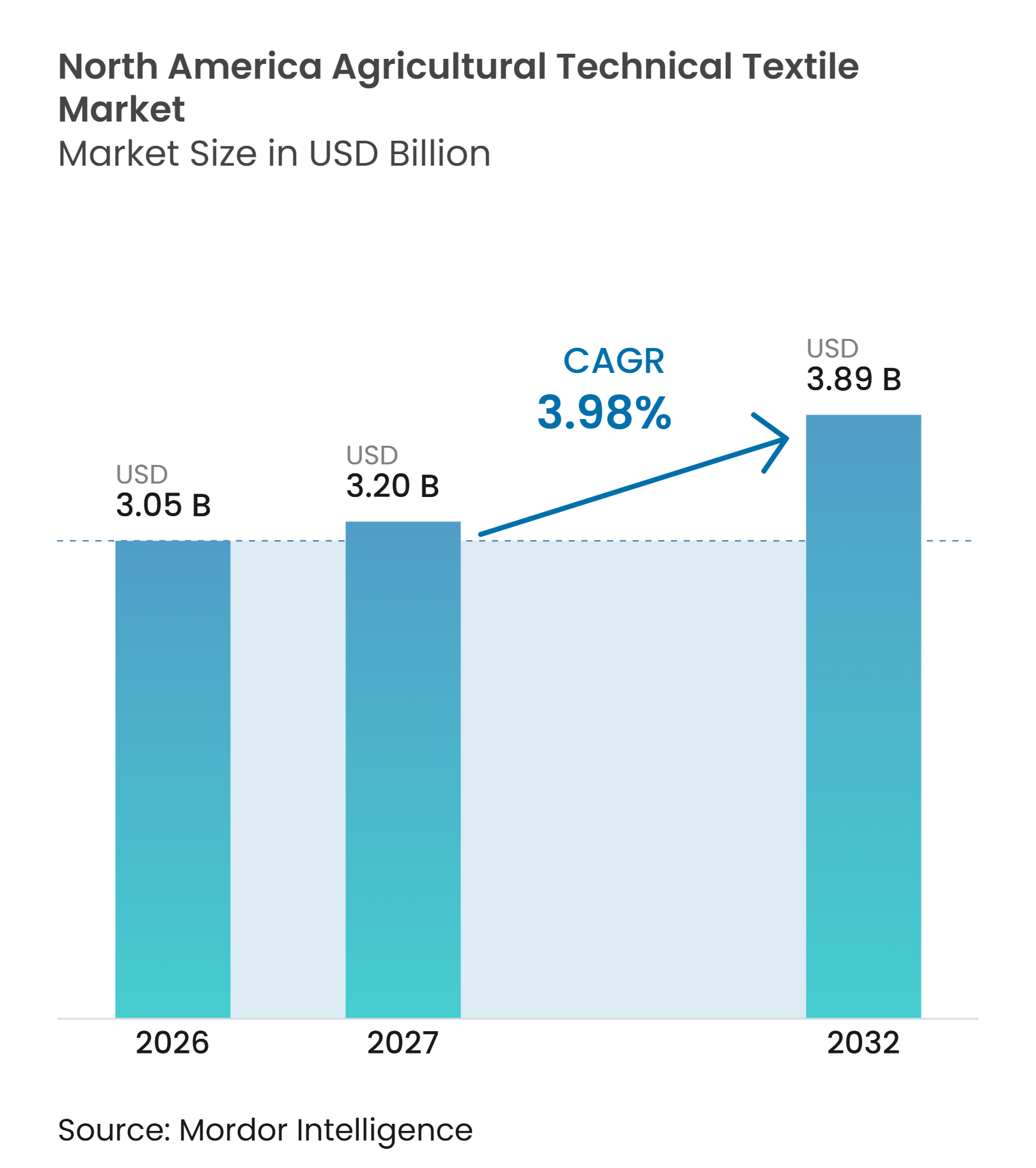
| Base Year Market Size (2026) | USD 3.05 Billion |
| Market Size (2027) | USD 3.20 Billion |
| Market Size (2032) | USD 3.89 Billion |
| Growth Rate (2027 - 2032) | 3.98 % |
| Market Concentration | Medium |
Major Players *Disclaimer: Major Players sorted in no particular order Image © Mordor Intelligence. Reuse requires attribution under CC BY 4.0. | |
North America Agricultural Technical Textile Market Analysis by Mordor Intelligence
The North America Agricultural Technical Textile Market size is expected to grow from USD 3.05 billion in 2026 to USD 3.20 billion in 2027 and is forecast to reach USD 3.89 billion by 2032 at 3.98% CAGR over 2027-2032.
The North America agricultural technical textile market is supported by investment in controlled-environment agriculture, which requires polyethylene covers, shade screens, blackout systems, and thermal curtains during both facility construction and regular crop production. Large livestock and forage operations also need bale-wrapping and silage-film systems that reduce feed spoilage, improve handling, and help operators manage larger volumes within short harvesting windows. Demand spans crop protection, mulch and ground covers, greenhouse systems, harvesting materials, and aquaculture containment. This diversity reduces dependence on a single crop category or production region, and links demand to multiple farm management needs, including weather protection, crop establishment, moisture control, feed preservation, containment, nursery support, orchard protection, and temperature and light control for protected crops. These applications serve operations of different sizes and accommodate varied crop calendars, production locations, growing conditions, farm business models, and input purchasing cycles. Seasonal and permanent applications require renewal as performance declines due to repeated exposure and use in demanding agricultural conditions during each production year. The installed base of covered agriculture is also expected to create replacement demand for climate screens as light transmission and thermal performance decline, while recycling requirements are raising the importance of single-material, recycled-content, and biodegradable product designs, especially where collection programs can support farm-level recovery after use and help purchasers consider end-of-life handling when selecting materials.
Key Report Takeaways
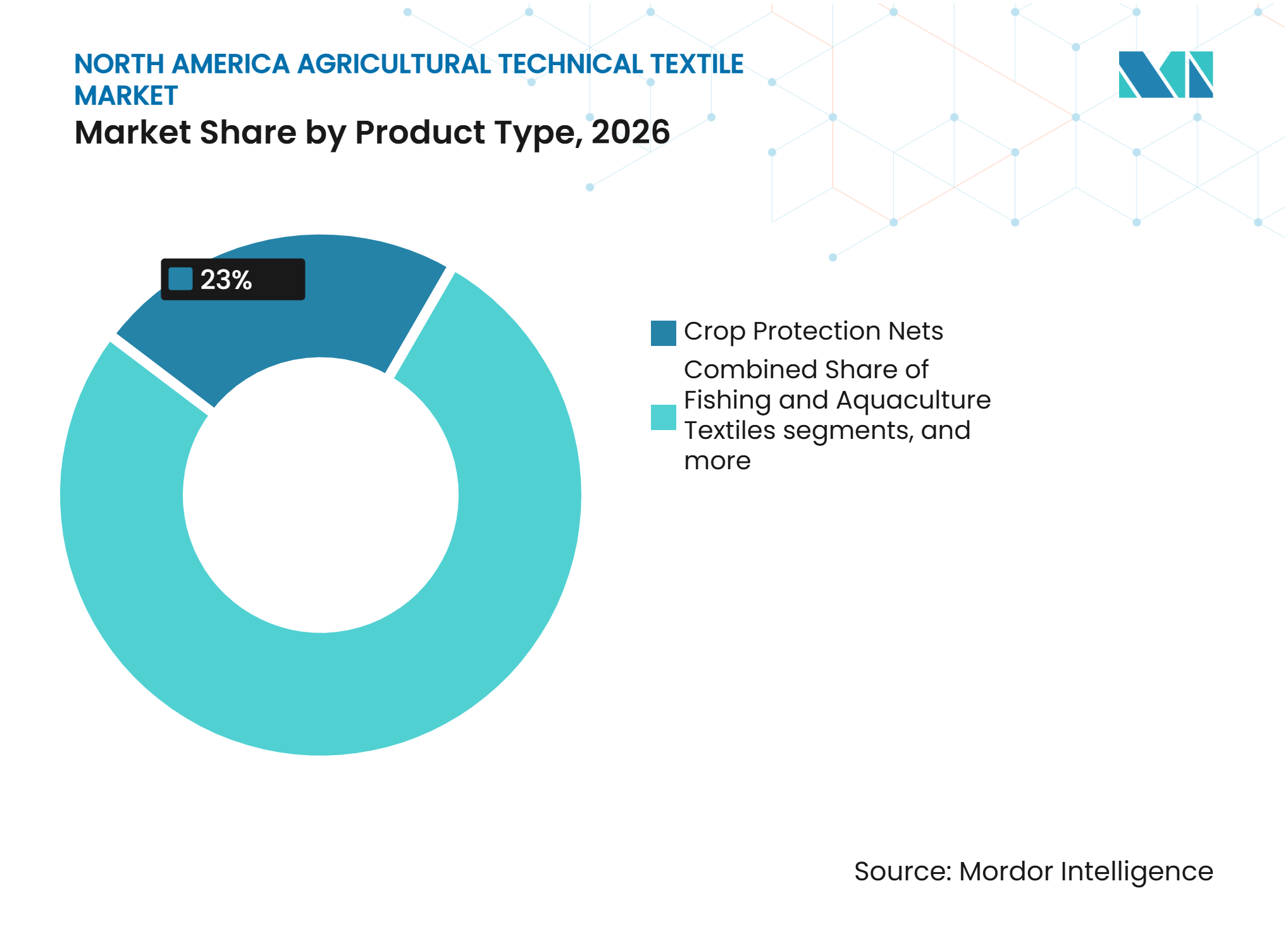
- By product type, crop protection nets accounted for 23% of the North America agricultural technical textile market share in 2026, while agricultural shade nets and greenhouse climate screens are projected to be the fastest-growing, registering a 6.5% CAGR through 2032.
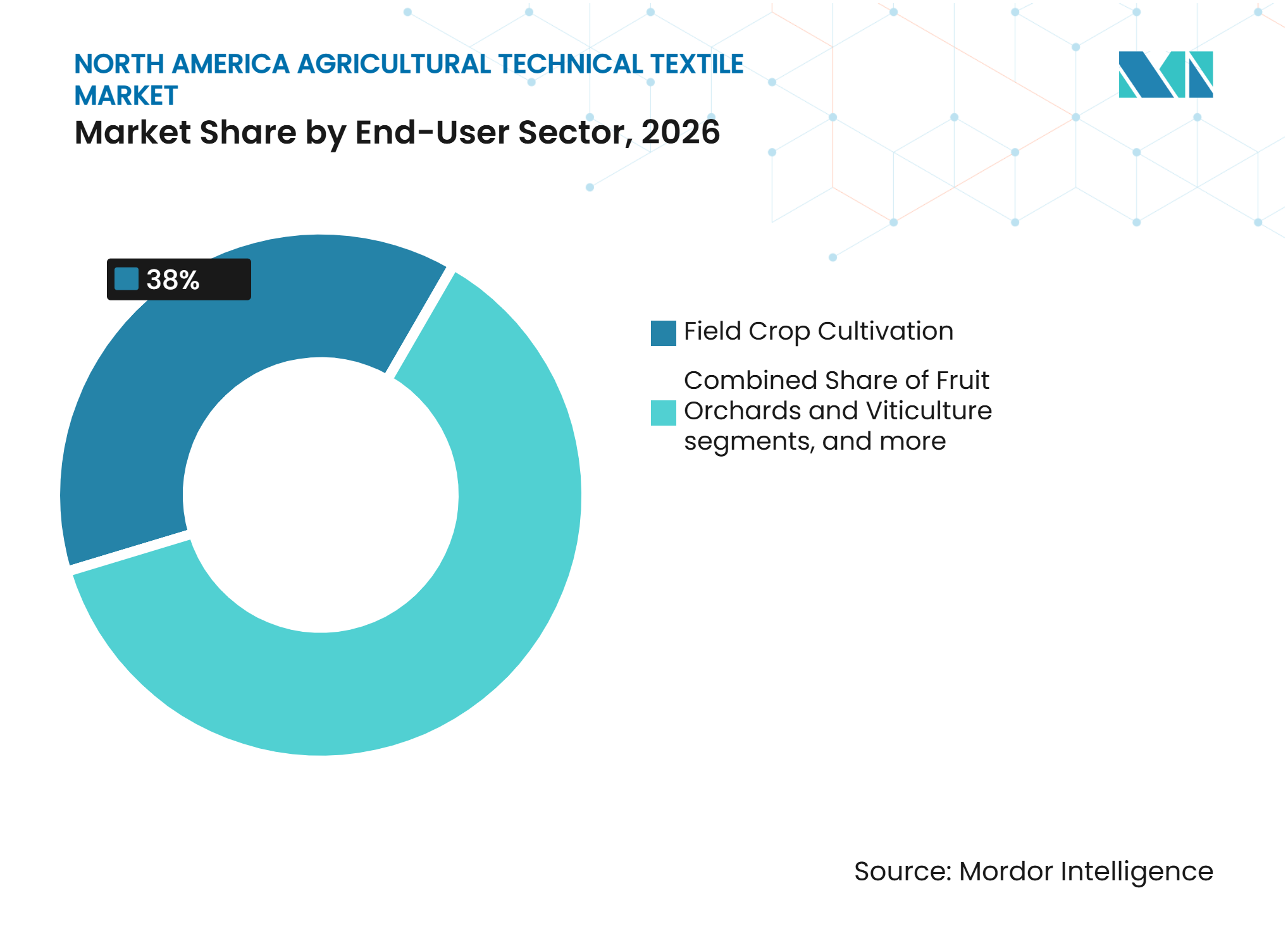
- By end-use sector, field crop cultivation accounted for 38% of the North America agricultural technical textile market size in 2026, while vegetable, floriculture, and nursery cultivation are projected to be the fastest-growing end-use sector, registering a 6.2% CAGR through 2032.
- By geography, the United States accounted for 76% of the North America revenue share in 2026, while Mexico is projected to grow at a 5.5% CAGR through 2032.
Note: Market numbers in this report are based on Mordor Intelligence's proprietary estimation framework, which combines nine months of actuals with Q4 projections for base year 2026.
Market Trends and Insights
Drivers Impact Analysis of North America Agricultural Technical Textile Market*
| Driver | (~) % Impact on CAGR Forecast | Geographic Relevance | Impact Timeline |
|---|---|---|---|
| Expansion of Controlled-Environment Agriculture | +1.0% | United States, Canada, early momentum in Mexico | Medium term (2-4 years) |
| Climate-Volatility-Driven Crop Protection | +0.8% | United States, including the Plains, Gulf Coast, and Pacific Northwest, and Mexico border zones | Short term (≤ 2 years) |
| Water and Labor Efficiency from Mulch and Ground Covers | +0.6% | United States, Southwest and Mexico, with spillover to Canadian Prairie provinces | Medium term (2-4 years) |
| Mechanized Farming and Forage-Loss Reduction | +0.5% | United States Midwest and Great Plains and Canadian Prairie provinces | Medium term (2-4 years) |
| Conservation Funding for Erosion and Soil Stabilization | +0.3% | United States, with early gains in the Corn Belt and southeastern states | Long term (≥ 4 years) |
| Recyclable and Biodegradable Material Innovation | +0.2% | United States and Canada, driven by EPR policy adoption | Long term (≥ 4 years) |
| Source: Mordor Intelligence | |||
Expansion of Controlled-Environment Agriculture
Controlled-environment agriculture is creating concentrated demand for covers, shade systems, blackout screens, and thermal curtains in the North America agricultural technical textile market, because each commercial greenhouse uses several technical textile layers rather than a single cover. Oasthouse Ventures committed USD 104.8 million to a 65-acre tomato greenhouse in Virginia during February 2025. Sensei Ag announced a USD 40 million greenhouse and warehouse facility in Texas during November 2025, including 283,625 square feet of advanced greenhouse space. These projects require separate materials for light control, heat retention, condensation management, and crop protection, so new floor area provides a direct indicator of procurement needs across several product groups. The USDA Natural Resources Conservation Service high tunnel initiative also provides cost-share support for producers installing covered structures, expanding the base of growers able to invest in protected cultivation beyond the largest greenhouse operators. Climate screens can reach replacement thresholds after seven to twelve years, meaning present installations can add future replacement demand to new-project demand as the protected-cropping base matures and more facilities enter routine maintenance cycles.[1]
Climate-Volatility-Driven Crop Protection
Weather losses are strengthening the business case for crop protection systems in the North America agricultural technical textile market, particularly where high-value crops face repeated exposure to hail, frost, high winds, and insect pressure. The National Weather Service recorded USD 275.46 million in crop damage from natural hazards in 2025, including USD 193.79 million linked to fire weather and USD 58.74 million from thunderstorm winds. USDA National Agricultural Statistics Service records also documented crop damage associated with the July 2025 Texas flooding event, which shows that the risk is distributed across crop regions and weather events. Anti-hail nets, frost fleece, windbreak netting, and insect-exclusion mesh address different risk conditions, enabling growers to select protection according to crop type, production system, local weather exposure, and the value that must be protected at harvest. Crop insurance costs add pressure on growers to consider physical protection alongside insurance coverage and annual premium costs. Product development is therefore moving toward structures that combine insect protection, hail protection, and wind management in one installation, which can simplify deployment for horticultural producers managing several production risks at once.[2]
Water and Labor Efficiency from Mulch and Ground Covers
Mulch and ground-cover systems are becoming more relevant in water-stressed production areas of the North America agricultural technical textile market, where water use, weed control, and labor requirements are closely connected. USDA NRCS recognizes synthetic mulch and landscape fabric under Practice Code 484 for reducing moisture loss, suppressing weeds, and improving irrigation efficiency, functions that are useful across both specialty crops and field applications. A 2025 Florida study reported that modified crop-bed designs with surface covers reduced farm water consumption by up to 25%, showing the practical value of surface-cover approaches in constrained water settings. The 2025 adverse-effect wage rate of USD 16.08 per hour in the southeastern United States also increases the relative appeal of systems that reduce hand weeding and repeated manual field passes. Commercial landscape fabric can be reused for up to five years, which spreads its cost across multiple growing cycles and improves the comparison with seasonal weed-control labor. Biodegradable mulch films add another option because they can reduce post-season retrieval work, and a 2025 study reported 64% mass loss for a multilayer PBAT and thermoplastic-starch film under laboratory composting.
Mechanized, Large-Scale Farming and Forage-Loss Reduction
Mechanized forage operations are increasing demand for high-performance bale nets and silage wraps in the North America agricultural technical textile market, where material performance affects both harvesting speed and the quality of stored feed. RKW Group presented Rondotex Wizard in March 2025 with 33 warp threads, reporting 30% more bales per unit time and 15% material savings per bale. Berry Global introduced Silotite Film&Film in April 2025, and field tests reported a 52% reduction in silage losses compared with conventional netwraps. United States farm production expenses are forecast at USD 477.7 billion in 2026, keeping attention on systems that reduce avoidable material use and protect the feed value of harvested forage. Baler-wrapper automation makes material use per bale more visible to operators and procurement teams, allowing them to compare material grades against throughput, waste, and spoilage outcomes. Tama’s EZ-web combines net and mantle-film functions in a recyclable product, showing how productivity and end-of-life management are becoming linked product requirements.
Restraints Impact Analysis of North America Agricultural Technical Textile Market*
| Restraint | (~) % Impact on CAGR Forecast | Geographic Relevance | Impact Timeline |
|---|---|---|---|
| Polymer Feedstock Price Volatility | -1.2% | Global, with concentrated cost pressure on North American manufacturers | Short term (≤ 2 years) |
| High Installation and Replacement Cost for Specialty Systems | -0.8% | United States and Canada, less acute in Mexico | Medium term (2-4 years) |
| End-of-Life Collection and Contamination Constraints | -0.4% | North America, most acute in the United States agricultural-plastic hotspots and Canadian Prairie provinces | Medium term (2-4 years) |
| Performance Trade-Offs in Fine-Mesh Pest Protection | -0.2% | North America, most visible in vegetable and horticultural applications | Short term (≤ 2 years) |
| Source: Mordor Intelligence | |||
Polymer Feedstock Price Volatility
Polypropylene and polyethylene expose producers and buyers in the North America agricultural technical textile market to crude oil and natural gas feedstock prices, which are outside the control of farm operators and converters. These polymers are used in crop protection nets, bale nets, mulch films, and greenhouse covers, so the exposure is present in both commodity-facing and higher-specification products. USDA ERS forecasts United States farm sector production expenses at USD 477.7 billion in 2026, after USD 473.1 billion in 2025, which keeps pressure on farm input budgets. USDA agricultural projections indicate that production costs are likely to remain above historical averages through the outlook period, limiting the ability of many growers to absorb sudden input-cost changes. Seasonal purchasing for bale nets, silage films, and mulch mats can expose farms to price increases during compressed pre-season buying periods, when postponing purchases may disrupt planting or harvesting plans. EQIP can offset selected conservation practices, but standard bulk bale netting and mulch film do not receive the same coverage, leaving a substantial share of polymer-based procurement tied to raw-material cycles.
High Installation and Replacement Cost for Specialty Systems
High installation costs can limit adoption of specialized systems in the North America agricultural technical textile market, especially where products need permanent frames, motors, or professional installation. Automated greenhouse screens, thermal blankets, and permanent orchard anti-hail netting require capital that differs from ordinary annual input spending, even when the systems offer operational benefits over several seasons. The USDA NRCS Iowa high-tunnel fact sheet describes EQIP financial assistance intended to offset the cost burden of high-tunnel installation for small and mid-sized producers. Motorized climate screens with thermal and blackout functions cost more than passive structures, and their payback depends partly on uncertain energy costs and on whether a facility can use the systems throughout the year. Commercial landscape fabric has an expected service life of five years, while energy-saving screens require replacement after performance declines, which creates a second capital requirement after the initial installation. Operations without cost-share support or favorable credit may therefore defer adoption, leaving the strongest demand among larger commercial farms that can plan around installation and replacement cycles.
*Our forecasts treat driver/restraint impacts as directional, not additive. The impact forecasts reflect baseline growth, mix effects, and variable interactions.
North America Agricultural Technical Textile Market Segment Analysis
By Product Type:
Crop Protection Nets Lead, Climate Screens Set the PaceCrop protection nets accounted for 23.0% of the North America agricultural technical textile market share in 2026. The segment includes anti-insect, anti-hail, anti-bird, and windbreak netting used across field crops, orchards, and viticulture, where crop value and exposure vary materially by location. Weather protection nets are gaining relevance as producers compare permanent installation costs with recurring crop-loss exposure, including the documented 2025 damage associated with natural hazards. Crop covers and plant protection fleece retain steady demand among frost-risk horticultural and nursery operations because nonwoven row covers and thermal materials help protect early-season crop establishment.
Agricultural shade nets and greenhouse climate screens are expected to be the fastest-growing product category, at a 6.5% CAGR from 2027 to 2032, supported by greenhouse capacity additions and the need for thermal curtains, light-diffusing screens, and blackout systems. Ludvig Svensson’s 2025 collaboration with Wageningen University & Research reflects continued work on climate-screen performance and lifespan. The North America agricultural technical textile market size for climate screens also benefits because several screen types may be used within a single facility to manage light, heat, and seasonal growing conditions. Mulch mats and ground covers have a favorable outlook because water constraints, higher labor costs, and biodegradable material development support their use in horticulture. Freudenberg Performance Materials introduced bio-based PLA and wood-pulp nonwovens for horticultural propagation in October 2025. Harvesting and forage-management textiles benefit from materials that improve baling efficiency and reduce silage losses, while aquaculture, nursery, forestry, and other uses provide smaller specialized demand streams.



By End-Use Sector:
Vegetable and Floriculture Operations Emerge as High-Intensity Textile UsersField crop cultivation held 38.0% of the North America agricultural technical textile market size in 2026. Large producers of corn, soy, wheat, and cotton use soil-stabilization products, windbreak netting, and mulch ground covers over broad areas, which gives field crops the largest current consumption base. The segment also benefits from conservation practices that support soil protection and moisture management. Fruit orchards and viticulture are more textile intensive because hail exposure in California, Washington, and Ontario encourages permanent netting. Livestock and forage operations provide repeat demand for bale nets and silage wraps as feed-loss performance becomes measurable at the bale level.
Vegetable, floriculture, and nursery cultivation is forecast to grow at a 6.2% CAGR through 2032. This portion of the North America agricultural technical textile industry uses several layers during a single crop cycle, including row covers, insect-exclusion nets, shade structures, and drip-compatible mulch mats. Textile spending per acre can be higher than in broad-acre field crops because specialized growers use several protection systems together. Modest expansion in specialty horticulture can therefore create disproportionate volume gains for suppliers serving protected and high-value crops. Forestry and landscape cultivation use biodegradable establishment mats and other support materials, while fisheries and aquaculture require high-tenacity containment netting across the United States and Canadian Pacific coast operations.

Geography Analysis
The United States accounted for 76% of the North America agricultural technical textile market size in 2026. Its scale supports demand across crop protection, greenhouse systems, soil stabilization, forage management, and high-value specialty horticulture. USDA NRCS assistance through EQIP and high-tunnel programs can reduce the investment threshold for covered cultivation and selected conservation practices. Organic producers also use physical pest-exclusion and frost-protection systems where synthetic pesticide options are restricted. Weather damage of USD 275.46 million in 2025 reinforces the value of protective systems for exposed production areas.
Greenhouse investments in Virginia and Texas during 2025 add direct procurement needs for polyethylene covers, shade netting, and climate screens. The Ontario greenhouse cluster and Prairie production systems support Canada. Cleanfarms reported progress in agricultural-plastic collection in 2025, reflecting growing capacity for material recovery. A Fraser Valley program for bale wrap and silage-plastic collection began in May 2025 and supports the practical collection side of recyclable-material adoption.[3]
Mexico is projected to grow at a 5.5% CAGR from 2027 to 2032 in the North America agricultural technical textile market. Water-efficiency policies promote surface-cover practices in dry growing areas, which supports mulch mat adoption. Export producers are also adopting shade nets and insect mesh to meet retailer requirements in the United States and Canada. This demand is linked to crop quality and pesticide-residue management rather than only commodity input cycles. Canada and Mexico together held the remaining 24.0% of regional value in 2026, and Mexico’s lower use of technical agricultural textiles relative to the United States leaves room for additional adoption as export-oriented horticulture develops.
Competitive Landscape
Market Concentration
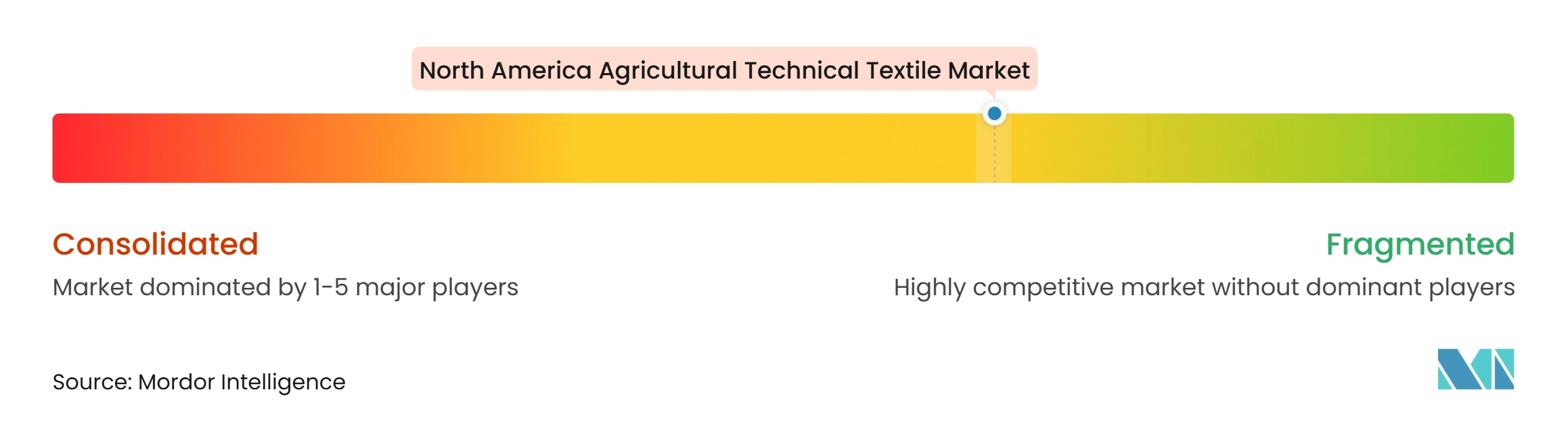
The North America agricultural technical textile market is moderately fragmented because product categories often have different supplier groups. Specialists in greenhouse climate screens compete through documented light transmission, thermal efficiency, and product lifespan. Ludvig Svensson formalized a research collaboration with Wageningen University & Research in 2025 to improve climate-screen application and optimization. This type of technical evidence matters most in premium greenhouse applications, while scale, distribution coverage, material performance, and recycling credentials matter more in bale wraps, bale nets, and mulch films.
Berry Global launched the recyclable, dual-layer Silotite Film&Film in April 2025, supported by field tests that reported 52% lower silage losses than conventional net wraps. The company also committed to 30% recycled content across agricultural films by the end of 2025. RKW uses patented folding technology in Polydress TWISTA Strong, while Tama uses a tape-thread construction in EZ-web, and equipment compatibility can create switching costs in bale packaging. Freudenberg Performance Materials added bio-based PLA and wood-pulp wetlaid nonwovens for horticultural propagation in October 2025. These examples show that recyclability, performance, and crop-specific function are increasingly assessed together.
Opportunities remain for recyclable systems with verified North American take-back routes, particularly where growers need confidence that used bale wrap, silage film, or other agricultural plastics can enter a workable collection stream. Modular crop covers for small and mid-sized farms address a part of the market with fewer high-cost installation options and may be better aligned with smaller operating budgets. Multifunctional textiles combining shade, insect exclusion, and water management can reduce the number of separate installations required by growers and simplify seasonal field preparation. Regional manufacturing can be attractive when imported supply has longer lead times, especially for products that must be available within narrow planting and harvesting windows. The North America agricultural technical textile market therefore includes global specialists, diversified film suppliers, and regional converters serving proximity-based needs, with buyer choice shaped by technical performance, delivery reliability, equipment fit, and end-of-life options.
North America Agricultural Technical Textile Industry Leaders
-
Berry Global Inc.
-
DuPont de Nemours, Inc.
-
RKW Group
-
DeWitt Company, Inc.
-
Garware Technical Fibres Ltd.
- *Disclaimer: Major Players sorted in no particular order
North America Agricultural Technical Textile Market Companies Covered in this Report
- Berry Global Inc.
- DeWitt Company, Inc.
- DuPont de Nemours, Inc.
- Garware Technical Fibres Ltd.
- Propex Operating Company, LLC
- Freudenberg Performance Materials
- RKW Group
- Ludvig Svensson
- HUESKER Group
- Drape Net North America
- Fibertex Nonwovens A/S
- Texel Technical Materials Inc.
- Sioen Industries NV
- Tenax Corporation
- Tama Group
- Bridon Cordage
- Acadian Industrial Textiles
- Herculite Inc.
- Shade Haven
- U.S. Netting Inc.
Recent Industry Developments in North America Agricultural Technical Textile Market
- June 2026: CTK Bio Canada launched a home-compostable paper mulch film for agricultural applications. The product suppresses weeds, retains soil moisture, regulates soil temperature, and reduces plastic waste and post-harvest removal requirements. This launch reflects ongoing innovation in sustainable agricultural textiles and crop-protection materials.
- November 2025: Tama Group exhibited EZ-web and Edibale at Agritechnica 2025, Hannover. EZ-web combines net and mantle film in a single recyclable PE product compatible with both baling system types, reducing plastic per bale and simplifying post-use recycling. Edibale, in development, is designed as an ingestible bale material that eliminates the packaging-separation step at feeding time.
- November 2025: Sensei Ag Holdings announced a USD 40 million investment in a high-tech greenhouse and warehouse complex in Lockhart, Texas, comprising 283,625 square feet of advanced greenhouse space, supported by a performance-linked incentive agreement with Lockhart EDC.
North America Agricultural Technical Textile Market Report Scope
The North America Agricultural Technical Textile Market Report is Segmented by Product Type (Crop Protection Nets, Fishing and Aquaculture Textiles, Crop Covers and Plant Protection Fleece, and More), by End-User Sector (Field Crop Cultivation, Fruit Orchards and Viticulture, and More), and by Geography (United States, Canada, and Mexico). The Report Offers Market Size and Forecasts in Value (USD) for all the Above Segments.
Segmentation Overview
| Crop Protection Nets | Anti-Insect and Pest Protection Nets |
| Anti-Hail and Weather Protection Nets | |
| Anti-Bird and Wildlife Protection Nets | |
| Agricultural Windbreak Nets | |
| Agricultural Shade Nets and Greenhouse Climate Screens | Agricultural Shade Nets |
| Thermo-Reflective and Light-Diffusion Screens | |
| Thermal and Energy-Saving Greenhouse Screens | |
| Greenhouse Blackout and Light-Control Screens | |
| Crop Covers and Plant Protection Fleece | Nonwoven Floating Row Covers |
| Frost and Thermal Protection Textiles | |
| Other Woven and Knitted Crop Covers | |
| Fishing and Aquaculture Textiles | Commercial Fishing Nets |
| Aquaculture Cage and Containment Nets | |
| Specialized Aquaculture Protection Nets | |
| Mulch Mats and Agricultural Ground Covers | |
| Nursery, Plant Support and Forestry Textiles | |
| Harvesting and Forage Management Textiles | |
| Other Agricultural Technical Textiles |
| Field Crop Cultivation |
| Vegetable, Floriculture and Nursery Cultivation |
| Fruit Orchards and Viticulture |
| Forestry and Landscape Cultivation |
| Livestock and Forage Operations |
| Fisheries and Aquaculture |
| United States |
| Canada |
| Mexico |
| By Product Type | Crop Protection Nets | Anti-Insect and Pest Protection Nets |
| Anti-Hail and Weather Protection Nets | ||
| Anti-Bird and Wildlife Protection Nets | ||
| Agricultural Windbreak Nets | ||
| Agricultural Shade Nets and Greenhouse Climate Screens | Agricultural Shade Nets | |
| Thermo-Reflective and Light-Diffusion Screens | ||
| Thermal and Energy-Saving Greenhouse Screens | ||
| Greenhouse Blackout and Light-Control Screens | ||
| Crop Covers and Plant Protection Fleece | Nonwoven Floating Row Covers | |
| Frost and Thermal Protection Textiles | ||
| Other Woven and Knitted Crop Covers | ||
| Fishing and Aquaculture Textiles | Commercial Fishing Nets | |
| Aquaculture Cage and Containment Nets | ||
| Specialized Aquaculture Protection Nets | ||
| Mulch Mats and Agricultural Ground Covers | ||
| Nursery, Plant Support and Forestry Textiles | ||
| Harvesting and Forage Management Textiles | ||
| Other Agricultural Technical Textiles | ||
| By End-Use Sector | Field Crop Cultivation | |
| Vegetable, Floriculture and Nursery Cultivation | ||
| Fruit Orchards and Viticulture | ||
| Forestry and Landscape Cultivation | ||
| Livestock and Forage Operations | ||
| Fisheries and Aquaculture | ||
| By Geography | United States | |
| Canada | ||
| Mexico | ||
Key Questions Answered in the Report
What is the projected value of the North America agricultural technical textile market by 2032?
The North America agricultural technical textile market is projected to reach USD 3.89 billion by 2032, from USD 3.20 billion in 2027, at a 3.98% CAGR.
Which product category has the largest share of North America agricultural technical textiles?
Crop protection nets held the largest product share at 23.0% in 2026.
Which product category is growing fastest through 2032?
Agricultural shade nets and greenhouse climate screens are forecast to grow at a 6.5% CAGR through 2032.
Which end-use sector leads to demand for agricultural technical textiles?
Field crop cultivation accounted for 38.0% of value in 2026, while vegetable, floriculture and nursery cultivation is projected to grow at a 6.2% CAGR through 2032.
Which country has the largest share in the region?
The United States held 76.0% of regional value in 2026.
Why are recyclable agricultural textile systems becoming more important?
Collection pilots and higher agricultural-plastic recovery volumes in Canada are encouraging demand for recyclable materials and systems with practical take.