
North America 3D Construction Market Size and Share
Market Overview
| Study Period | 2020 - 2031 |
|---|---|
| Forecast Data Period | 2026 - 2031 |
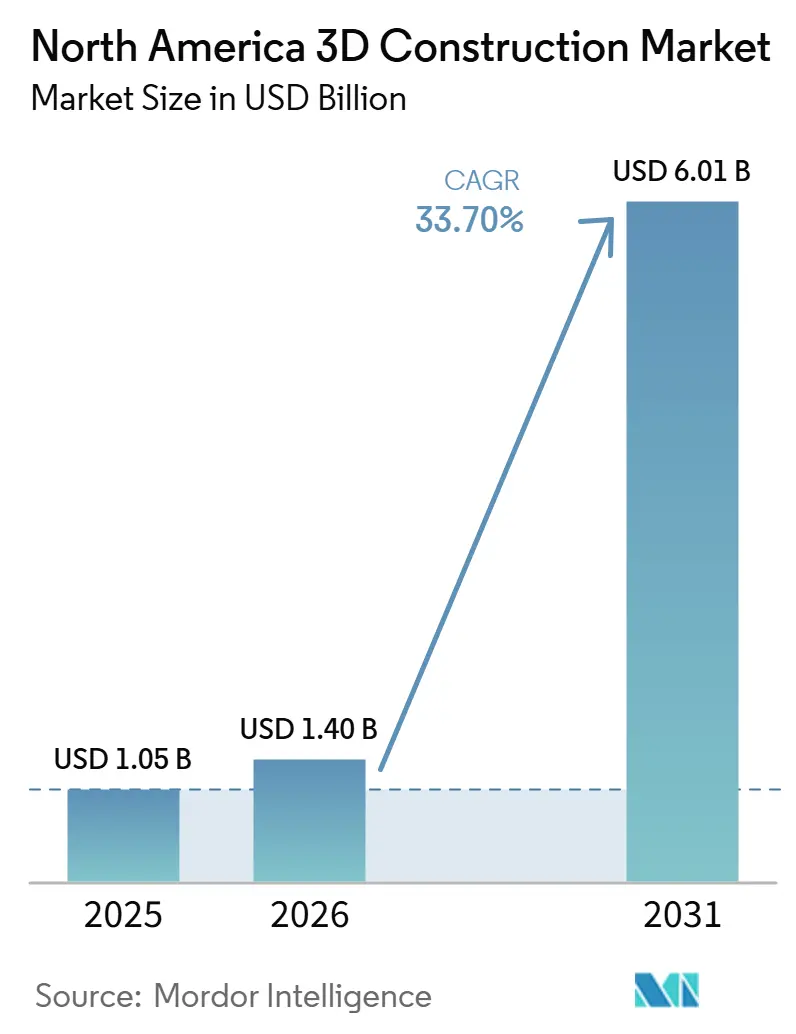
| Base Year Market Size (2025) | USD 1.05 Billion |
| Market Size (2026) | USD 1.40 Billion |
| Market Size (2031) | USD 6.01 Billion |
| Growth Rate (2026 - 2031) | 33.70 % |
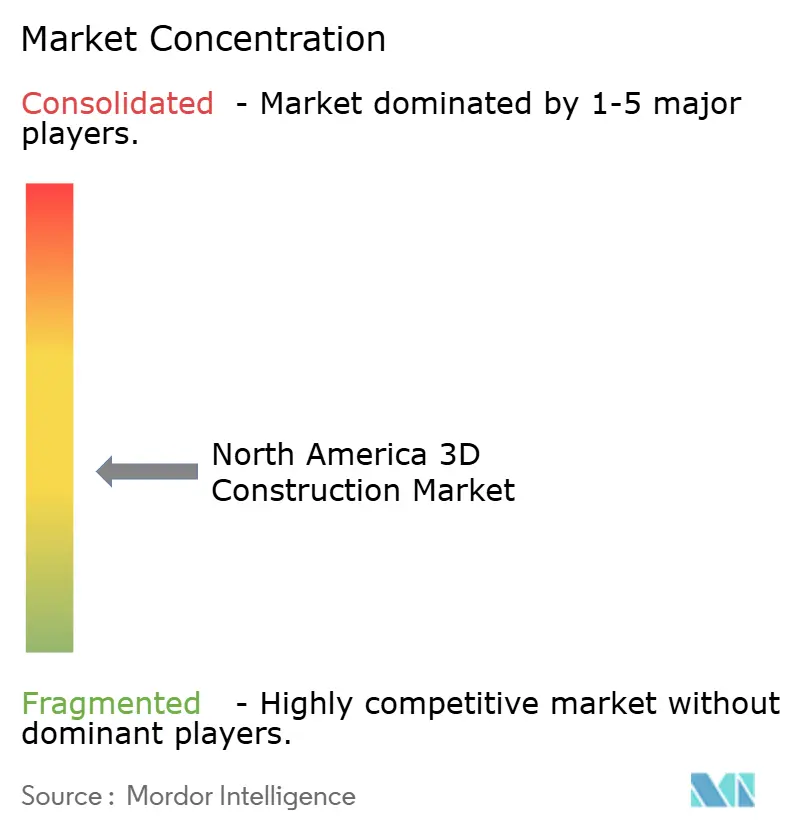
| Market Concentration | Medium |
Major Players *Disclaimer: Major Players sorted in no particular order Image © Mordor Intelligence. Reuse requires attribution under CC BY 4.0. | |
North America 3D Construction Market Analysis by Mordor Intelligence
The North America 3D Construction Market size was valued at USD 1.05 billion in 2025 and is estimated to grow from USD 1.40 billion in 2026 to reach USD 6.01 billion by 2031, at a CAGR of 33.70% during the forecast period (2026-2031).
The North America 3D construction market is moving beyond early pilot activity because housing shortages, workforce constraints, and project delivery delays are now structural issues across the region rather than short-lived conditions. Public demand has also become more durable, as military and housing agencies are using additive construction in real procurement programs, which gives the North America 3D construction market a firmer base than a purely venture-led adoption cycle. The market is also becoming more investable because certification pathways for printed concrete walls are more formal than before, and that improves lender, insurer, and contractor confidence even if local adoption still varies by jurisdiction[1]International Code Council, “ICC 1150-2026 Standard for 3D Automated Construction Technology for 3D Concrete Walls,” ICC Shop, shop.iccsafe.org. Competitive activity is rising as platform companies combine hardware, materials, design, and financing support, while major cement and admixture suppliers use certified printable mixes to secure recurring roles across multiple printer ecosystems. The main drag on the North America 3D construction market remains regulatory fragmentation and equipment cost, because uneven code adoption and high printer capex can still slow broader deployment even when project economics are attractive.
Key Report Takeaways
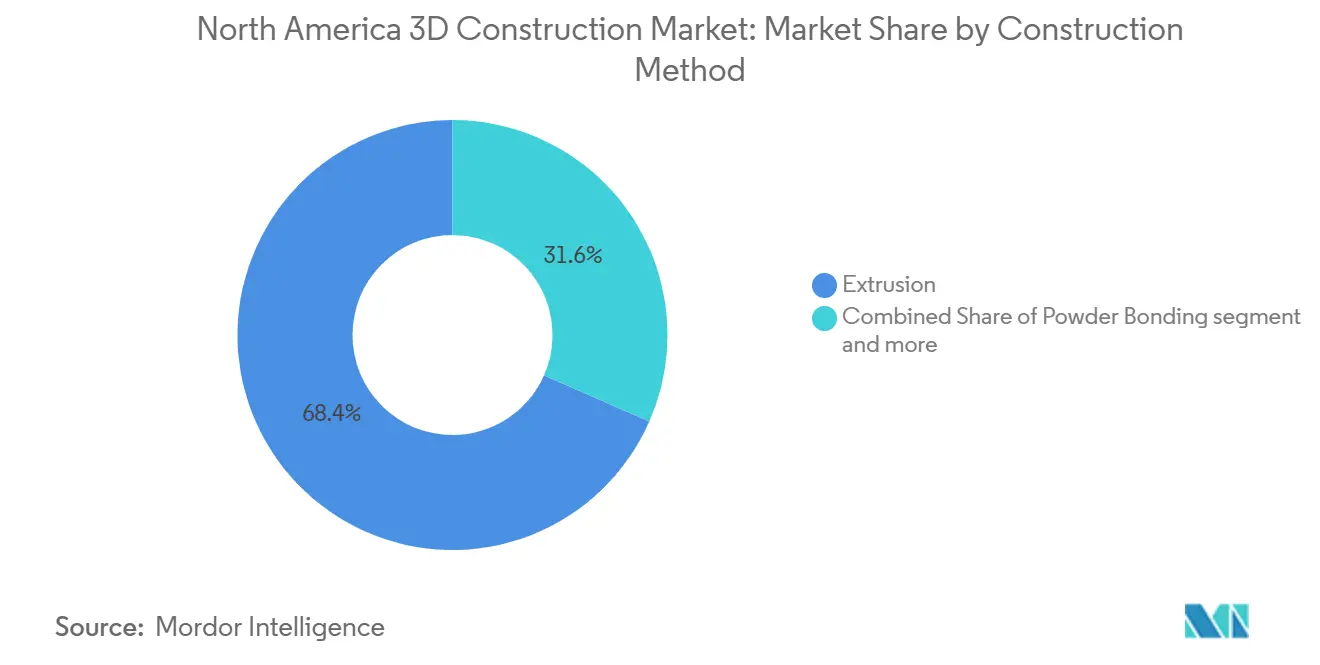
- By construction method, extrusion held 68.4% of the North America 3D construction market share in 2025, while powder bonding is projected to expand at a 39.8% CAGR through 2031.
- By material type, concrete held 61.5% share in 2025, while metal is forecast to record the highest CAGR at 51.2% through 2031.
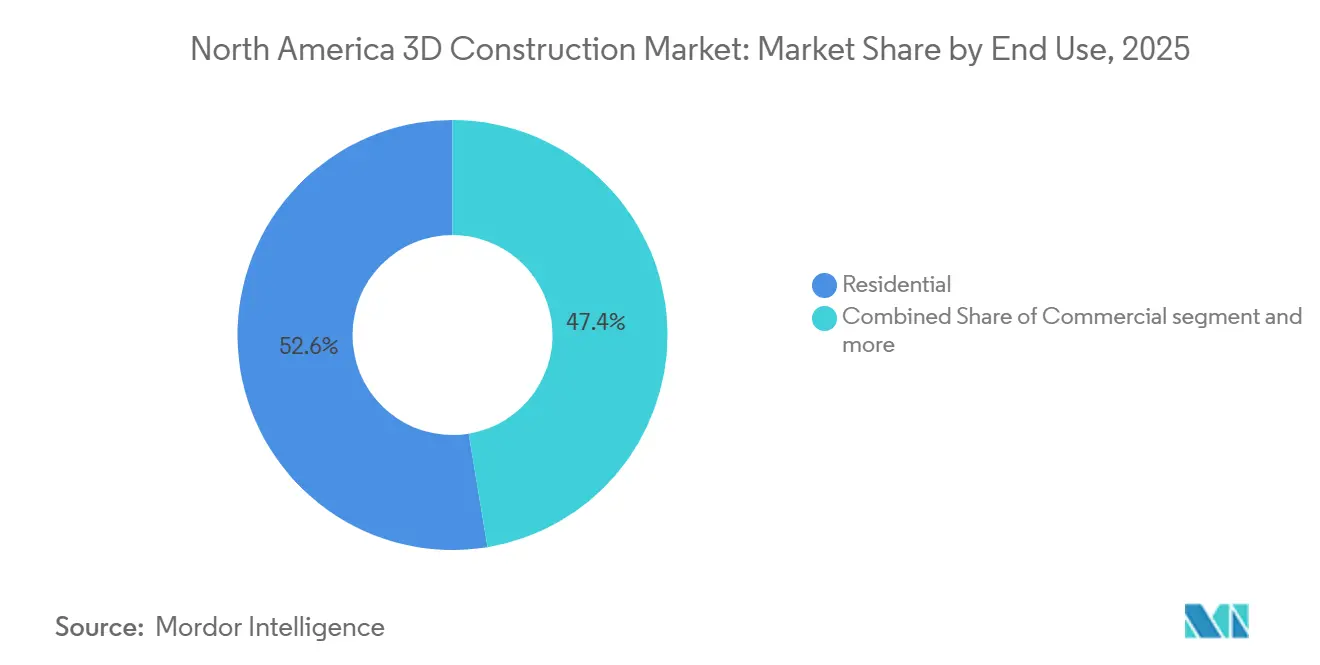
- By end use, residential accounted for 52.6% of the North America 3D construction market size in 2025, while infrastructure is projected to grow at a 44.1% CAGR through 2031.
- By construction setting, on-site printing held 72.3% share in 2025, while off-site printing is expected to advance at a 38.7% CAGR through 2031.
- By geography, the United States held 82.5% share in 2025, while Mexico is projected to expand at a 43.5% CAGR through 2031.
Note: Market size and forecast figures in this report are generated using Mordor Intelligence’s proprietary estimation framework, updated with the latest available data and insights as of January 2026.
Market Trends and Insights
Drivers Impact Analysis of North America 3D Construction Market*
| Drivers | (~) % Impact on CAGR Forecast | Geographic Relevance | Impact Timeline |
|---|---|---|---|
| Acute Construction Labor Shortages Accelerating Automation | +8.0% | United States, Canada, Mexico | Medium term (2-4 years) |
| Federal And State Funding For Affordable Printed Housing | +5.5% | United States, Canada | Short term (≤ 2 years) |
| Mix Design Advances Improving Structural Reliability | +4.5% | Global, with early gains in U.S. Southwest and Texas | Medium term (2-4 years) |
| US Military And FEMA Emergency Shelter Adoption | +3.5% | United States | Short term (≤ 2 years) |
| Carbon-Lowering Binder Systems And Waste Reduction | +3.0% | United States, Canada | Long term (≥ 4 years) |
| Digital Quality Control And Rework Reduction | +2.5% | United States, with spill-over to Canada and Mexico | Long term (≥ 4 years) |
| Source: Mordor Intelligence | |||
Acute Construction Labor Shortages Accelerating Automation
Labor scarcity remains one of the strongest structural drivers for the North America 3D construction market because the shortage is no longer limited to isolated trades or short seasonal gaps. The Associated General Contractors of America reported in its 2025 workforce survey that 88% of firms had open positions, with workforce gaps cited as a leading cause of delayed work and weaker execution schedules. The Home Builders Institute’s Fall 2025 construction labor market report estimated an annual impact of USD 10.8 billion from skilled labor shortfalls, including USD 8.1 billion in lost output and nearly 19,000 homes not built. The project-level effect is even clearer, as Alquist 3D’s Walmart addition in Lamar, Missouri, was completed by 5 workers in 7 days, while conventional masonry would have required 30 workers over 3 to 4 weeks, according to the supplied draft. That gap is meaningful because it changes additive construction from a niche building method into a response to labor reliability and schedule risk. As a result, the North America 3D construction market is benefiting from a shift in buyer priorities, where contractors value crew efficiency and project certainty as much as direct material savings.
Federal And State Funding for Affordable Printed Housing
Federal policy is one of the clearest near-term supports for the North America 3D construction market because grant programs are now tied to real housing delivery rather than only technical evaluation. HUD’s Office of Policy Development and Research published a multi-part assessment of 3D-printed concrete construction systems for low- and moderate-income housing, providing the technology with a stronger federal reference point for housing agencies and local partners. HUD also backed a USD 1.6 million matching grant for a mobile 3D printer engineered for subarctic use in Nome, Alaska, demonstrating that additive construction is being applied where conventional building methods struggle with logistics, climate, and cost. In Canada, CMHC contributed CAD 2.7 million (USD 1.95 million) at 2025 average exchange rates to the Gananoque Townhomes project in Ontario, and residents moved in during Fall 2025. That funding logic matters for the North America 3D construction market because once a digital home design is approved, it can be reused at a very low marginal review cost across similar projects. This lowers approval friction over time and improves the economics of repeatable affordable housing programs in ways that conventional site-built methods do not match as easily.
Mix Design Advances Improving Structural Reliability
Mix design progress is reducing one of the most persistent adoption barriers in the North America 3D construction market, which is the need to prove that printed concrete can perform like conventional structural systems under recognized design conditions. A 2026 study in Materials and Structures found that 3D-printed shotcrete reinforced concrete beams met ultimate and serviceability limit-state requirements under bending, using nearly half the steel reinforcement mass of comparable cast systems. A separate 2026 paper reported that limestone-calcined clay cement formulations achieved a 36% lower climate-change impact than conventional 30 MPa 3D printing cement while maintaining equivalent mechanical performance. A 2026 study in Nature Communications also showed that cellulose nanofiber and limestone filler systems can support high-performance, cost-efficient, and lower-carbon printable concrete at a robotic scale. These developments strengthen the North America 3D construction market because documented material behavior makes certification more repeatable and gives suppliers defensible roles in approval workflows. They also shift competition toward proprietary mix qualification, which matters more now that code pathways are starting to require clearer supporting evidence for structural acceptance.
US Military and FEMA Emergency Shelter Adoption
Military procurement is one of the most durable demand anchors in the North America 3D construction market because it is less exposed to homebuyer finance cycles and less dependent on speculative private development timing. ICON received a USD 62.8 million U.S. Army production contract in January 2026 to 3D print 10 barracks at Fort Bliss, Texas, with a 6-month delivery window that contrasts sharply with conventional multi-year construction timelines. In March 2026, the company also secured a USD 67.9 million Army contract at Fort Polk, Louisiana, with a total potential value of USD 201 million for a rotational unit billeting area and related infrastructure. ICON Prime, launched in April 2026, accumulated more than USD 263 million in U.S. government contract awards in Q1 2026 alone, which shows that public procurement now views robotic construction as a deployable capability rather than an experiment. The secondary effect is important for the North America 3D construction market because defense-funded testing, tooling, and materials qualification also strengthen the technical base used later in civilian projects. That shortens commercialization time for private buyers and lets residential and infrastructure applications benefit from the capability building that government contracts already financed.
Restraints Impact Analysis of North America 3D Construction Market*
| Restraints | (~) % Impact on CAGR Forecast | Geographic Relevance | Impact Timeline |
|---|---|---|---|
| High Upfront Capex For Large-Format Printers | -5.5% | United States, Canada, Mexico | Short term (≤ 2 years) |
| State-Level Building Code Fragmentation And Approval Cycles | -4.5% | United States | Medium term (2-4 years) |
| Insurance And Warranty Acceptance Gaps | -2.5% | United States, Canada | Medium term (2-4 years) |
| Feedstock Quality And Additive Supply Constraints | -2.0% | United States, Mexico | Long term (≥ 4 years) |
| Source: Mordor Intelligence | |||
High Upfront Capex for Large-Format Printers
Capital intensity remains the most immediate barrier for smaller contractors in the North America 3D construction market because equipment ownership requires a level of scale that many local builders do not yet have. ICON launched the Titan multi-story system in March 2026 at USD 899,000 per unit, which sets a clear benchmark for the cost of professional large-format deployment. Even when financing is available, the barrier persists, especially for contractors in rural Canada or Mexico that do not have the same institutional credit access as larger U.S. operators. Utilization is the less visible issue because printer economics work well only when machines stay active across a steady project pipeline rather than moving between isolated jobs. The supplied draft points to Alquist 3D’s partnership with Hugg and Hall as one market response through rental, logistics, and maintenance support for the A1X Series, yet the rental model for these systems is still early and lacks mature residual-value benchmarks and service norms. That keeps the North America 3D construction market tilted toward platform operators and better-capitalized firms rather than broad-based adoption among smaller regional builders.
State-Level Building Code Fragmentation and Approval Cycles
Code fragmentation remains a major drag on the North America 3D construction market because national standards do not automatically translate into uniform local acceptance. ICC 1150-2026 established a formal framework for automated construction technology for 3D concrete walls, but each state and municipality still adopts model codes on its own schedule and often with local amendments. That means a system or design path accepted in Texas can still face fresh review in another state, which lengthens permitting and raises documentation costs for contractors and developers. The supplied draft also noted that buyers and insurers monitor code adoption velocity as a proxy for technology risk, which means approval delays affect more than construction timelines because they also shape credit and coverage terms. Mexico faces a similar challenge because additive construction still depends on case-by-case structural engineer certification in the absence of a comparable national technical framework. Until local adoption becomes more consistent, the North America 3D construction market will continue to see strong project economics offset by slower scaling in jurisdictions with more cautious approval practices.
*Our forecasts treat driver/restraint impacts as directional, not additive. The impact forecasts reflect baseline growth, mix effects, and variable interactions.
North America 3D Construction Market Segment Analysis
By Construction Method:
Extrusion Anchors the Market and Powder Bonding Expands Material OptionsExtrusion held 68.4% of the 2025 North America 3D construction market share by construction method, which made it the clear commercial leader across active deployments. That position reflects a deeper installed base, broader operator familiarity, more visible training programs, and better alignment with current compliance pathways than competing methods. The most visible systems in the supplied draft, including ICON’s Titan, Alquist 3D’s A1X, and COBOD’s BOD2, all sit within the extrusion ecosystem and define much of today’s commercial reference set across the region. Extrusion also benefits from regulatory advantages, as ICC 1150-2026 specifically addresses extrusion-deposited concrete walls, reducing uncertainty for builders and code officials working with that method. In the North America 3D construction industry, that combination of field familiarity and clearer approval language gives extrusion a stronger starting point than alternatives that still rely more heavily on project-specific review.
Powder bonding is projected to advance at a 39.8% CAGR through 2031, which makes it the fastest-growing construction method in the North America 3D construction market. Its appeal comes from greater flexibility in material chemistry, especially for geopolymers, waste-derived aggregates, and zero-OPC pathways that do not fit easily within continuous-flow extrusion systems. The supplied draft also linked powder bonding to complex geometries and lower-cement mix designs, where rheological constraints can be harder to manage with extrusion. A 2025 study in Construction and Building Materials found that carbonatable ternary cementitious systems with cellulose nanocrystals offer a viable low-carbon route for structural additive manufacturing, which supports the longer-term logic behind powder-based approaches[2] Construction and Building Materials, “Additive Manufacturing of Carbonatable Ternary Cementitious Systems with Cellulose Nanocrystals,” Construction and Building Materials, doi.org. The others category, including contour crafting and binder jetting for large-scale elements, remains small and experimental in regional terms, so near-term competition still centers on mature extrusion systems versus more flexible but less standardized powder routes. As the North America 3D construction market develops, powder bonding is likely to gain where material diversity and lower-carbon formulations matter more than current code familiarity.


By Material Type:
Concrete Dominates Volume; Metal's Premium Niche Drives the Fastest CAGRConcrete held 61.5% of the 2025 North America 3D construction market size by material type, which kept it firmly ahead of metal, composites, and other emerging formulations. Its lead rests on direct compatibility with current wall printing systems, a large body of published performance work, and easier alignment with existing certification pathways for structural walls. The concrete segment is also evolving rather than staying static, because supplementary cementitious materials such as fly ash, silica fume, and limestone-calcined clay are improving the carbon profile of printable mixes without losing mechanical performance. The supplied draft specifically noted that LC3 formulations are documented at 36% lower climate-change impact than conventional 30 MPa 3D printing cement at equivalent strength, which supports concrete’s continued relevance even as sustainability demands rise. Composite and other materials remain a smaller niche in the North America 3D construction market, though regional work in Mexico around bio-based and corn-waste-derived inputs suggests that localized material innovation is still widening the future range of printable options.
Metal is forecast to record the fastest CAGR at 51.2% through 2031, which gives it the strongest growth profile among material categories in the North America 3D construction market. Growth is centered on wire arc additive manufacturing for structural steel connectors, bespoke load-bearing elements, hybrid reinforcement systems, and applications where certification matters more than raw material cost. The supplied draft noted that this sub-segment is driven especially by defense and heavy civil engineering clients, for whom structural acceptance is a higher priority than per-square-foot benchmarks. A 2026 study in Materials and Structures found that additively manufactured concrete beams reinforced with WAAM-fabricated rebar showed bond-slip and flexural performance equivalent to conventional systems, which strengthens the case for printed metal as a reinforcement supply solution rather than only an architectural novelty. MX3D’s U.S. distribution partnership with Phillips Corporation, established in 2025, also signals that the supply side for certified WAAM systems is becoming more organized in the United States. In the North America 3D construction industry, that gives metal a narrower but higher-value role that can expand even without matching concrete on total deployment volume.
By End Use:
Residential Provides the Base and Infrastructure Extends the OpportunityResidential construction accounted for 52.6% of the 2025 North America 3D construction market share by end use, which made it the largest demand base in the study period. That lead is tied closely to affordable housing policy, public grants, and repeatable single-family design formats that align well with robotic construction economics. The supplied draft highlighted HUD’s Nome project, Virginia Housing’s USD 1.1 million support for the Darbytown Road development in Richmond, and Houston’s Zuri Gardens community as examples where housing policy and additive construction are working together rather than operating in separate tracks. That alignment matters because the value of printed housing is strongest where speed, labor efficiency, and design replication directly affect affordability goals. The commercial segment is smaller, but it remains strategically important because multi-site retail deployments create documented benchmarks on cost, labor, and schedule that residential developers and lenders can study when evaluating the broader North America 3D construction market.
Infrastructure is projected to expand at a 44.1% CAGR through 2031, which makes it the fastest-growing end-use segment in the North America 3D construction market. Military barracks and related public infrastructure contribute much of the current momentum, but the supplied draft also points to data center foundations, utility infrastructure, and factory-printed precast units as expanding use cases. Those applications matter because they depend less on consumer mortgage markets and more on standardized components, procurement reliability, and repeatable engineering formats. The same draft noted that factory-printed precast units are now being produced at more than 50 units per week in controlled environments, which highlights how infrastructure demand can support higher printer utilization and more stable production planning. Alquist 3D’s Walmart program also reinforces the commercial side of this shift, because standardized building formats help prove where robotic construction works best at scale. As the North America 3D construction market widens beyond housing, infrastructure is becoming the segment that most clearly expands the addressable opportunity and changes the investor profile following the sector.

By Construction Setting:
On-site Leads on Volume; Off-site Competes on Unit EconomicsOn-site printing held 72.3% of the 2025 market by construction setting, which shows that the North America 3D construction market still relies mainly on in-situ deployment. That leadership reflects the current mix of projects, because residential communities, military facilities, and location-specific building programs often require direct site deposition instead of factory production. The supplied draft described dominant on-site platforms such as rail-mounted gantries and robotic arm systems that can be set up quickly and adjusted to project-specific geometry. It also pointed to the Gananoque Townhomes project in Ontario as evidence that on-site robotic construction can stay on budget and on schedule in a colder climate, which addressed an earlier concern around weather and operating reliability. The current scale of the North America 3D construction market, therefore, still depends more on field-deployed printing than on factory output, especially for walls and structures that must respond to local site conditions.
Off-site printing is projected to grow at a 38.7% CAGR through 2031, which makes it the fastest-growing construction setting in the North America 3D construction market. Factory-controlled environments improve consistency, reduce weather disruption, support multi-shift operation, and create clearer production documentation for insurers and compliance teams. Turner Construction’s launch of the 200,000-square-foot xPL Offsite facility in Decatur, Alabama, showed that major contractors are preparing for broader factory-based delivery models that can incorporate 3D printing alongside modular and panelized workflows. The Modular Building Institute also noted in June 2026 that 3D concrete printing is emerging as a production expansion capability for off-site manufacturers, allowing wall panels and structural components to be fabricated while site preparation happens in parallel. That parallel sequencing improves total project timing and gives off-site strategies a stronger economic case even though they still start from a smaller base. Over time, the North America 3D construction market is likely to use both settings in complementary ways, with on-site methods serving bespoke structures and off-site workflows serving repeatable components and higher-throughput production.
Geography Analysis
United States 3D Construction Market
The United States held 82.5% of the 2025 North America 3D construction market share, making it the clear regional leader. Its dominance reflects the deepest platform ecosystem, the strongest institutional financing links, and the largest volume of visible public procurement and commercial deployment. Texas remains the operational center because it connects ICON’s home base, Fort Bliss and Fort Polk military contracts, the Zuri Gardens housing development in Houston, and the completed Lennar-ICON 100-home community referenced in the supplied draft. The U.S. market is also broadening geographically, as Los Angeles County issued its first approved permit for a 3D concrete-printed home in 2026, using Sika 3DCP materials and technologies, while Florida and Virginia have also recorded meaningful activity, according to the draft. That spread matters because the North America 3D construction market needs local reference projects to build regulatory confidence outside early adopter states.
Canada 3D Construction Market
Canada remained the second-largest country sub-market in the study, with most activity concentrated in Ontario and selected institutional projects. The supplied draft noted the federal government’s 2024 allocation of CAD 600 million (USD 432 million) at 2024 average exchange rates, toward innovative housing technologies including robotics and 3D printing, and this has helped convert interest into structured project pipelines rather than isolated demonstrations. Gananoque Townhomes completed 26 units by Fall 2025 and showed that large on-site robotic housing could move into occupancy under Canadian conditions. The University of Windsor and Aretek are also advancing Canada’s first multi-storey 3D-printed net-zero student residence, with completion targeted for late summer 2026. Canada’s pace is still limited by a thinner commercial installer network and weaker access to secondary-market financing for printed buildings, so public and nonprofit programs continue to carry a larger share of momentum than in the United States.
Mexico 3D Construction Market
Mexico is forecast to expand at a 43.5% CAGR through 2031, which makes it the fastest-growing country market in the regional study. The demand logic in Mexico is structurally different from that in the United States because the housing deficit is large and labor productivity gains have a more immediate effect on project economics. The supplied draft stated that the deficit exceeds 9 million units based on INEGI estimates, which gives the North America 3D construction market a strong demand base in Mexico even before wider regulatory normalization takes place. CEMEX was the first company to introduce 3D concrete printing in Mexico, using proprietary formulations to reduce material waste and shorten construction timelines for affordable housing. Holcim Mexico is operating a parallel initiative through its TectorPrint materials program, while universities and startups in Toluca, Querétaro, and Monterrey are developing locally sourced geopolymer and corn-waste-derived printable mixes that better fit local material and sustainability requirements[3] Fast Company Mexico, “Corncretl, El Material de Construcción Mexicano Hecho con Maíz,” Fast Company Mexico, fastcompany.mx. The main obstacle is still the absence of a comparable national technical guideline from CONAVI, which means projects often rely on case-by-case structural certification and slower investor decision cycles.
Competitive Landscape
The North America 3D construction market is moderately concentrated at the platform tier and more fragmented across the broader supplier base. ICON and Alquist 3D hold the clearest leadership positions because each has built a commercial model that extends beyond printer hardware into execution, deployment scale, and ecosystem relationships. ICON’s model combines hardware systems, digital design, mix certification, and large public contracts, while Alquist has pushed an asset-light route tied to equipment distribution, service support, and multi-site commercial rollouts. That split matters because the North American 3D construction market rewards companies that connect technology to deployment channels rather than firms that rely on one-time hardware transactions. The supplied draft also made clear that competitive intensity is rising faster than overall market size suggests, because leading firms are now contesting control over materials, certifications, financing relationships, and contractor access simultaneously.
Material suppliers form the second major competitive layer in the North America 3D construction market. Holcim, Sika, CEMEX, and Heidelberg Materials operate across multiple printer brands, which gives them cross-platform relevance and recurring revenue potential regardless of which equipment supplier wins a given project. Their role is important because documented printable formulations are increasingly part of the approval process rather than simple inputs sold after the fact . Heidelberg Materials showed this direction in June 2026 when its evoZero carbon-captured cement was used in the world’s first 3D-printed supermarket with STRABAG subsidiary ZÜBLIN, linking low-carbon materials to large-format commercial printing rather than to pilot-scale demonstration alone. That type of move suggests that material differentiation in the North America 3D construction market will increasingly depend on certified performance and emissions value, not only on pumpability or print speed.
Strategic moves in 2025 and 2026 show that competition is now shifting toward scaled execution and stronger ecosystem control. ICON launched ICON Prime in April 2026 and secured more than USD 263 million in government contract awards in Q1 2026 alone, which gave it a stronger position in defense-led infrastructure demand and helped deepen its testing and certification base. Alquist 3D launched its A1 Series robotics platform and sold 12 A1X systems to FMGI and Hugg & Hall in support of a Walmart-anchored rollout across more than a dozen U.S. locations, which expanded its commercial footprint through a distribution-led model. MX3D also widened the field through its U.S. partnership with Phillips Corporation, which is bringing certified WAAM systems into defense and heavy industrial channels and creating a construction-adjacent metal opportunity that does not depend on concrete wall printing alone. The supplied draft also pointed to white space in off-site precast and in the installer tier across Canada and Mexico, which means the North America 3D construction market still has room for regional integrators that can pair local code knowledge with material supply and project execution capacity. At the same time, the December 2025 Chapter 11 filing of Black Buffalo 3D in the draft underlined that hardware-only models face weaker economics as the sector shifts toward integrated platforms and service-backed deployment.
North America 3D Construction Industry Leaders
ICON Technology, Inc.
Alquist 3D
Mighty Buildings, Inc.
Contour Crafting Corporation
Branch Technology
- *Disclaimer: Major Players sorted in no particular order
North America 3D Construction Market Companies Covered in this Report
- ICON Technology, Inc.
- Alquist 3D
- Mighty Buildings, Inc.
- Black Buffalo 3D Corporation
- Contour Crafting Corporation
- Branch Technology
- COBOD International A/S
- Apis Cor Inc.
- CyBe Construction B.V.
- PERI SE
- Holcim Ltd.
- Sika AG
- CEMEX S.A.B. de C.V.
- Heidelberg Materials AG
- WASP (World's Advanced Saving Project)
- Putzmeister Group
- Total Kustom
- MX3D

Recent Industry Developments in North America 3D Construction Market
- May 2026: Wells Fargo named ICON its preferred home mortgage lender, committing to originate 30-year mortgages on ICON-built homes and to offer a 50-basis-point lender credit to qualifying buyers. The arrangement also covers Wells Fargo's co-financing of Titan printer purchases by builders, the first time a top-5 U.S. bank has underwritten both the supply and demand sides of 3D printing construction at commercial scale.
- May 2026: Wells Fargo named ICON its preferred home mortgage lender to support 3D-built homes, including 30-year mortgages for eligible buyers and co-financing for Titan printer purchases by builders, which marked a major step in improving financing access for the North America 3D construction market.
- April 2026: Alquist 3D launched its A1 Series robotics platform and sold 12 A1X systems to FMGI and Hugg & Hall for deployment across more than a dozen U.S. commercial sites tied to Walmart projects, representing the largest commercial 3D construction printing rollout in the United States.


North America 3D Construction Market Report Scope
| Extrusion |
| Powder Bonding |
| Others |
| Concrete |
| Metal |
| Composite |
| Other Material Types |
| Residential |
| Commercial |
| Infrastructure |
| On-site (In-situ) Printing |
| Off-site (Factory / Precast) Printing |
| United States |
| Canada |
| Mexico |
| By Construction Method | Extrusion |
| Powder Bonding | |
| Others | |
| By Material Type | Concrete |
| Metal | |
| Composite | |
| Other Material Types | |
| By End Use | Residential |
| Commercial | |
| Infrastructure | |
| By Construction Setting | On-site (In-situ) Printing |
| Off-site (Factory / Precast) Printing | |
| By Country | United States |
| Canada | |
| Mexico |


Key Questions Answered in the Report
What is the size outlook for the North America 3D construction market?
The North America 3D construction market is valued at USD 1.4 billion in 2026 and is projected to reach USD 6.01 billion by 2031 at a 33.7% CAGR.
Which construction method leads this sector in North America?
Extrusion is the leading method, holding 68.4% share in 2025 because it has the most established commercial systems, training support, and code familiarity.
Which material category is growing the fastest in 3D construction across North America?
Metal is the fastest-growing material segment, with a projected 51.2% CAGR through 2031, supported by WAAM-based structural and reinforcement applications.
Why does residential construction account for the largest share?
Residential held 52.6% share in 2025 because affordable housing programs, public grants, and repeatable digital home designs align well with robotic construction economics.
Which country offers the fastest growth opportunity in the region?
Mexico is expected to grow the fastest at a 43.5% CAGR through 2031, supported by a large housing deficit and favorable labor-productivity gains from additive construction.
Page last updated on:





