
Nordics ITSM Market Size and Share
Market Overview
| Study Period | 2024 - 2031 |
|---|---|
| Forecast Data Period | 2026 - 2031 |
| Base Year Market Size (2025) | USD 398 Million |
| Market Size (2026) | USD 455.90 Million |
| Market Size (2031) | USD 933.46 Million |
| Growth Rate (2026 - 2031) | 15.41 % |
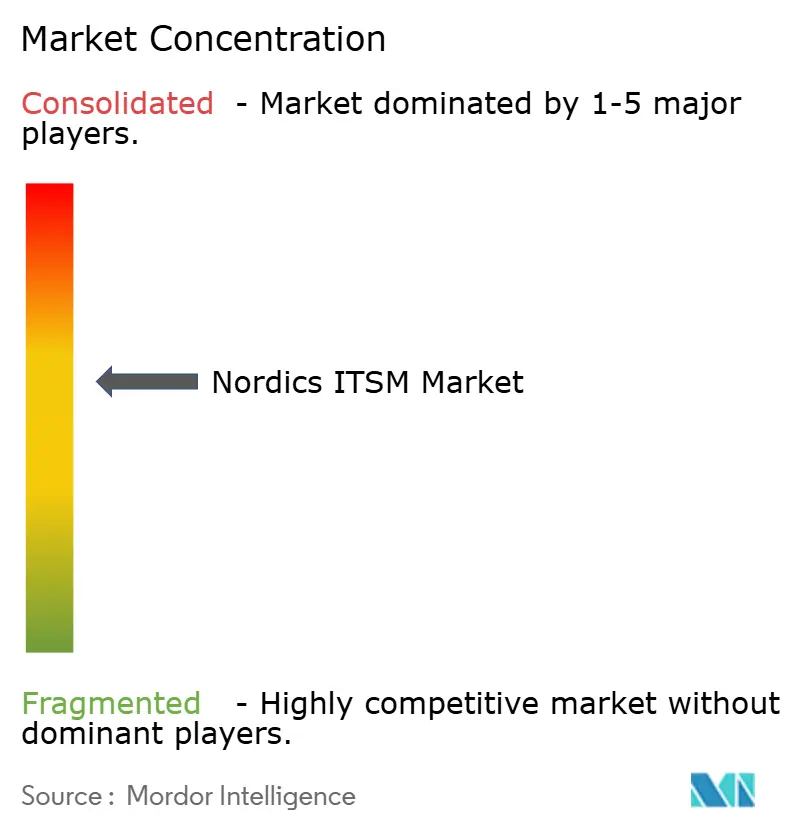
| Market Concentration | Medium |
Major Players *Disclaimer: Major Players sorted in no particular order Image © Mordor Intelligence. Reuse requires attribution under CC BY 4.0. | |
Nordics ITSM Market Analysis by Mordor Intelligence
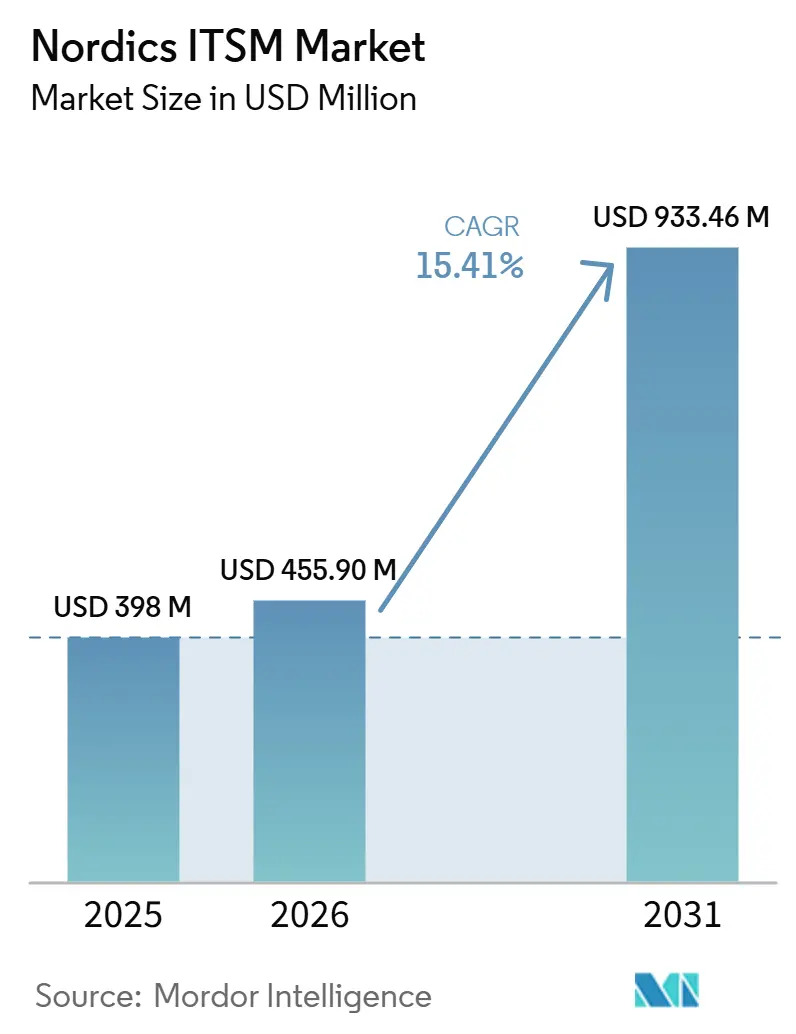
The Nordics ITSM Market size was valued at USD 398 million in 2025 and is estimated to grow from USD 455.90 million in 2026 to reach USD 933.46 million by 2031, at a CAGR of 15.41% during the forecast period (2026-2031).
The Nordic ITSM market is experiencing growth driven by strong enterprise demand for centralized service operations, increased adoption of cloud-based delivery models, and a gradual shift toward workflow automation in core support functions. Regulatory requirements in the region are encouraging organizations to enhance change control, incident response, asset visibility, and audit readiness, aligning service management platforms with broader digital governance objectives. Public institutions and regulated enterprises significantly influence purchasing decisions due to their need for stable integration, robust security controls, and comprehensive documentation across multiple systems. Competitive activity is intensifying as global vendors and regional partners expand their implementation capabilities, managed services offerings, and AI-enabled features to secure enterprise modernization projects and mid-market platform replacements. Additionally, the Nordic ITSM market is creating opportunities for vendors that can streamline deployment, address sovereign cloud requirements, and demonstrate operational value in environments where legacy system complexities continue to hinder decision-making processes.
Key Report Takeaways
- By component, solutions held 67% share in 2025, while services are projected to expand at an 18.40% CAGR through 2031.
- By deployment, cloud accounted for 75% share in 2025 and is projected to expand at a 17.95% CAGR through 2031.
- By application, service desk and incident management held 31% share in 2025, while knowledge management is projected to expand at a 16.40% CAGR through 2031.
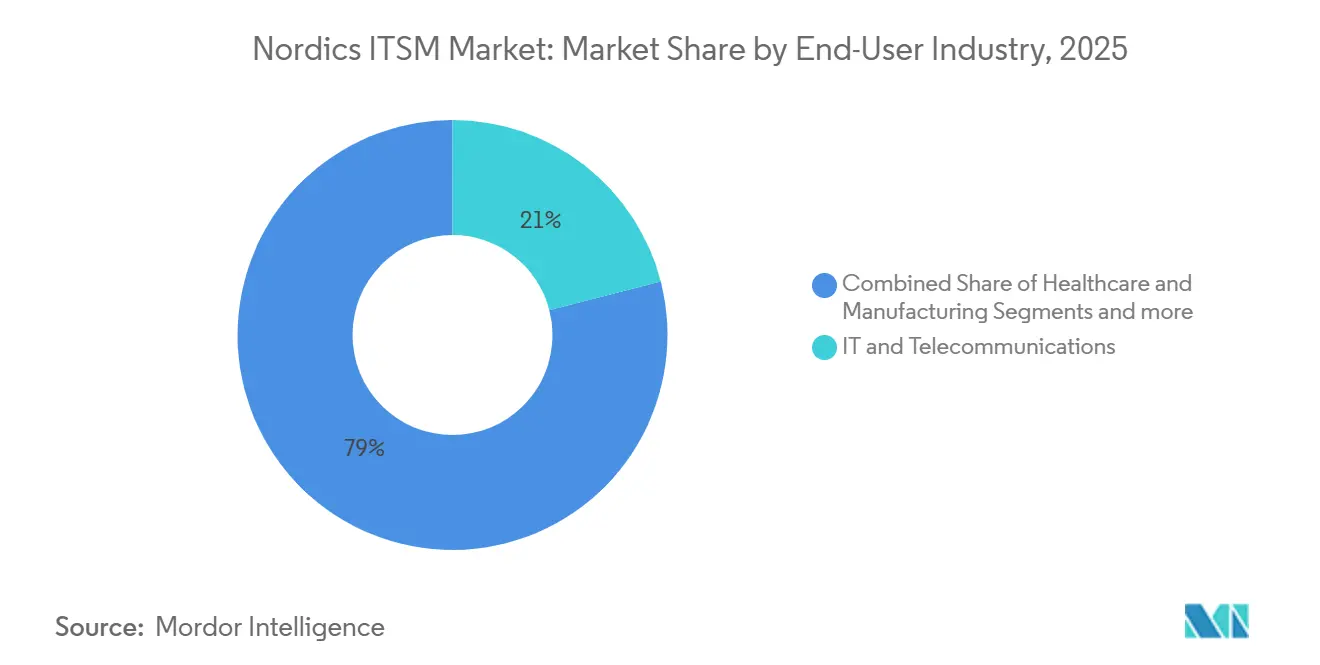
- By end-user industry, IT and telecommunications accounted for 21% share in 2025, while healthcare is projected to expand at a 16.93% CAGR through 2031.
- By enterprise size, large enterprises held 62% share in 2025, while SMEs are projected to expand at a 19.30% CAGR through 2031.
- By geography, Sweden held 38% of the Nordic ITSM market share in 2025, while the Rest of Nordics is projected to expand at a 17.21% CAGR through 2031.
Note: Market size and forecast figures in this report are generated using Mordor Intelligence’s proprietary estimation framework, updated with the latest available data and insights as of January 2026.
Nordics ITSM Market Trends and Insights
Drivers Impact Analysis*
| Driver | (~) % Impact on CAGR Forecast | Geographic Relevance | Impact Timeline |
|---|---|---|---|
| Increasing Cloud Migration Across Nordic Enterprises | +4.1% | All Nordic markets, strongest momentum in Sweden and Denmark | Short term (≤ 2 years) |
| Strong Public Sector Digitalization Programs | +3.2% | Sweden, Denmark, Finland, with cross-border spillover | Medium term (2-4 years) |
| Rising Demand for Centralized IT Service Operations | +2.6% | All Nordic markets | Short term (≤ 2 years) |
| Tightened Cybersecurity And Operational Resilience Expectations | +2.3% | All Nordic markets, with EU-wide alignment | Medium term (2-4 years) |
| Expansion Of Hybrid And Remote Work Support Requirements | +1.5% | Sweden, Norway, Finland | Short term (≤ 2 years) |
| Growing Need For IT Workflow Automation And Self-Service | +1.2% | All Nordic markets, with early leadership in Finland and Sweden | Long term (≥ 4 years) |
| Source: Mordor Intelligence | |||
Increasing Cloud Migration Across Nordic Enterprises
Cloud migration remains a significant driver of demand in the Nordic ITSM market, as service management platforms are increasingly required to support distributed applications, shared service environments, and multivendor support structures. By 2025, cloud accounted for 75% of market demand and continues to be the fastest-growing deployment model through 2031. This trend highlights a shift in procurement preferences toward scalable SaaS-based operating models rather than standalone service desk tools. Additionally, this shift is increasingly compliance-focused, with regulated buyers seeking platforms that provide governance, access control, and traceability across cloud environments. Ivanti’s launch of its Sovereign Edition EU offering in April 2026 demonstrates how vendors are adapting product designs to meet European data residency and audit requirements, further linking cloud adoption with service management investments[1]Ivanti, “Ivanti Launches Sovereign Cloud Solution to Support European Data Sovereignty and Compliance,” ivanti.com. In the Nordic ITSM market, this trend underpins sustained demand for platforms capable of managing incidents, requests, assets, and workflow orchestration in cloud-first enterprise environments.
Strong Public Sector Digitalization Programs
Public sector digitalization is driving sustained demand in the Nordic ITSM market as governments across the region work to standardize service operations across agencies, municipalities, and sector programs. Sweden's 2024 ordinance on coordinated and secure government IT operations established a shared framework for state IT delivery, increasing the need for interoperable and centrally governed service management tools. In Denmark, the City of Copenhagen extended its four-year ServiceNow partnership in 2025, focusing on a significant HR deployment covering over 47,000 employees, demonstrating the continued expansion of large municipal workflows[2]City of Copenhagen and Devoteam, “Devoteam and City of Copenhagen Announce Four-Year Partnership Renewal,” devoteam.com. Finland's involvement in the VALO program is advancing structured health data governance across Nordic institutions, creating additional demand for service integration and operational discipline in public digital systems. As these initiatives progress, the Nordic ITSM market benefits from repeatable procurement models, broader service scopes, and higher service maturity requirements.
Rising Demand For Centralized IT Service Operations
The Nordic ITSM market is benefiting from the growing demand to replace fragmented support models with unified systems capable of managing requests, incidents, service catalogs, and asset tracking within a single operational framework. This demand intensifies when organizations simultaneously operate cloud applications, legacy internal systems, and external service providers, as each additional environment increases coordination challenges and reduces visibility if support remains dispersed across multiple tools. Norway issued a tender in December 2025 for a cloud-based ESM and ITSM SaaS platform, highlighting a shift among public buyers, who are now prioritizing operating models that encompass establishment, management, and ongoing services within a single contract. In the Nordic ITSM market, such procurement trends indicate a broader preference for platforms that serve as comprehensive systems of record rather than limited ticketing solutions. This approach also enables managed service providers to offer service management as an operational service, catering to buyers seeking enterprise-grade workflows without the need to develop extensive internal support teams.
Tightened Cybersecurity And Operational Resilience Expectations
Cybersecurity and resilience requirements are emerging as key growth drivers for the Nordic ITSM market, as service management platforms increasingly address needs for evidence, control, and traceability beyond routine support functions. Sweden’s new Cybersecurity Act, which came into effect on January 15, 2026, mandates in-scope entities to enhance security measures, register with authorities, and report major incidents. These obligations elevate the importance of structured incident records and governed change processes. This is particularly significant as incident timelines, configuration records, and service documentation are becoming integral to broader compliance programs in essential and regulated sectors. Ivanti’s launch of a sovereign cloud in April 2026 highlights the growing demand for solutions that align endpoint management and service operations with auditability and data residency requirements in Europe. Consequently, service management platforms in the Nordic ITSM market remain closely linked to resilience planning, regulatory oversight, and operational accountability.
Restraints Impact Analysis*
| Restraint | (~) % Impact on CAGR Forecast | Geographic Relevance | Impact Timeline |
|---|---|---|---|
| High Integration Complexity With Legacy Enterprise Systems | -2.7% | All Nordic markets, most acute in Swedish and Danish manufacturing and BFSI | Medium term (2-4 years) |
| Budget Scrutiny And Long Replacement Cycles In Large Enterprises | -1.4% | All Nordic markets, concentrated in Norway and Sweden large enterprises | Medium term (2-4 years) |
| Data Residency And Compliance Constraints Across Nordic Markets | -0.9% | All Nordic markets, most acute for public sector and financial services | Short term (≤ 2 years) |
| Limited Internal ITSM Maturity In Small And Mid-Size Enterprises | -0.6% | All Nordic markets, most pronounced in Denmark and Norway SME segments | Long term (≥ 4 years) |
| Source: Mordor Intelligence | |||
High Integration Complexity With Legacy Enterprise Systems
Legacy integration continues to be a significant restraint in the Nordic ITSM market, as many large organizations rely on older ERP, HR, and asset systems that were not designed to meet modern service integration requirements. In cases where these systems are heavily customized, even a platform upgrade can necessitate extensive validation across interconnected upstream and downstream applications. This increases costs and delays rollout timelines. The challenge is particularly evident in industries such as banking, manufacturing, logistics, and utilities, where digital systems are closely tied to broader operational workflows that cannot be easily disrupted. In the Nordic ITSM market, this creates a practical obstacle for organizations seeking modernization while ensuring business continuity and managing complex internal dependencies. Consequently, implementation partners, middleware solutions, and phased migration strategies remain critical, even as the market increasingly moves toward modern cloud-based service management solutions.
Budget Scrutiny And Long Replacement Cycles In Large Enterprises
Budget scrutiny impacts the Nordic ITSM market as large organizations often operate under multi-year platform agreements, which slow down vendor replacement even when alternative solutions with new features are available. When service management extends beyond IT to include HR, facilities, finance, legal, and other shared functions, procurement decisions undergo broader review, making it more challenging to secure quick approval for the business case. While this expanded scope can support long-term adoption, it also lengthens approval cycles as stakeholders assess spending across multiple departments rather than a single technical team. This dynamic is particularly significant for large enterprises in the Nordic ITSM market seeking AI-enabled automation, enhanced analytics, or sovereign deployment options but facing challenges such as renewal timing and contract lock-in. Consequently, vendors must focus on offering a clear migration path, operational value, and minimal disruption, rather than relying solely on feature breadth to compete effectively.
*Our forecasts treat driver/restraint impacts as directional, not additive. The impact forecasts reflect baseline growth, mix effects, and variable interactions.
Segment Analysis
By Component: Services Gain Ground As Deployment Complexity Rises
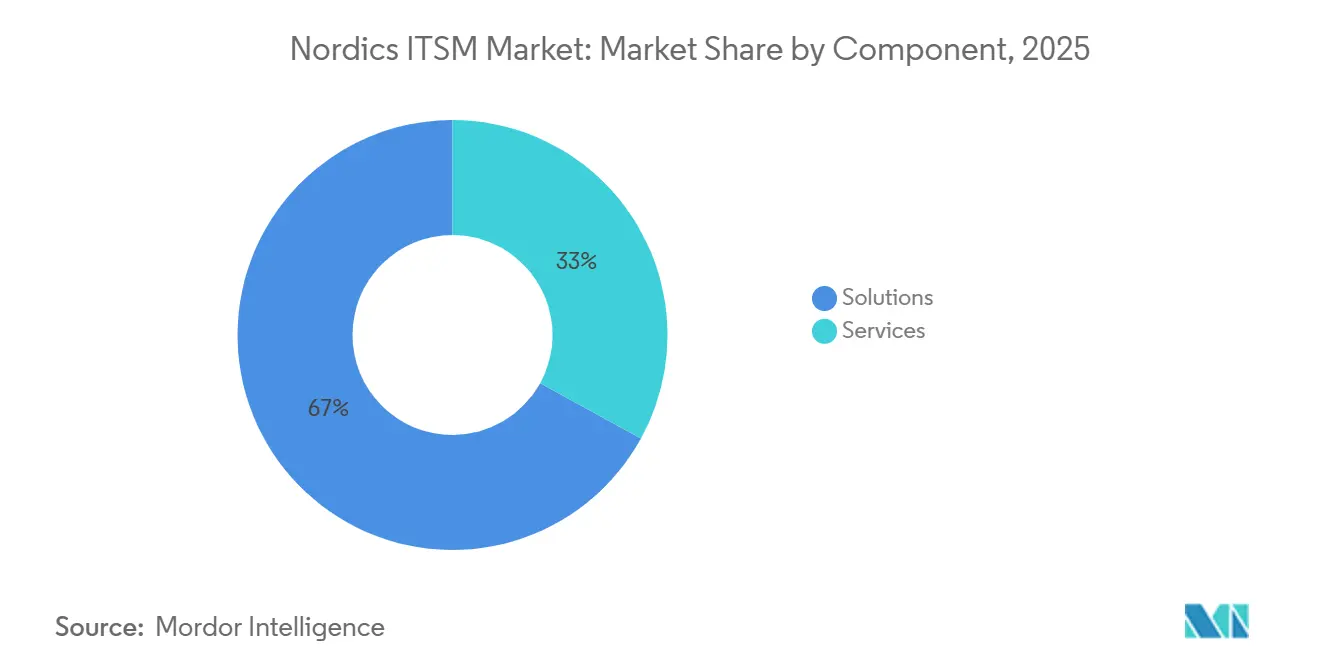
Solutions accounted for 67% of the market in 2025, indicating that software subscriptions and licenses remain the largest expenditure within the Nordic ITSM market. This segment continues to be pivotal as large organizations standardize service delivery, enhance asset visibility, and support governance through core platforms aligned with enterprise workflow strategies. Buyers prioritize the stability offered by platforms capable of serving multiple departments over extended periods, particularly when procurement aligns with modernization initiatives rather than isolated help desk replacements. As a result, solutions remain central to platform budgets, even as service expectations evolve and expand.
The services segment is projected to grow at a compound annual growth rate (CAGR) of 18.40% through 2031, outpacing the overall Nordic ITSM market growth. This growth reflects increasing demand for implementation, integration, managed operations, and training as organizations adopt broader enterprise service management use cases. The acquisition of a majority stake in The Cloud People by NTT Data in December 2025, following the company's achievement of NOK 500 million (USD 47 million) in revenue, highlights the strategic investment in service capacity within the region. Additionally, the expansion of managed service models demonstrates the preference of many buyers for enterprise workflows without assuming the full administrative burden internally. This trend supports the continued robust growth of the services segment in the Nordic ITSM market.


By Deployment: Cloud Becomes The Standard Operating Model
Cloud accounted for 75% of demand in 2025, securing the largest share of the Nordic ITSM market and establishing SaaS delivery as the dominant model in the region. This trend highlights the demand for faster deployment, simplified updates, and enhanced support for distributed user bases operating across multiple applications and service environments. It also indicates a shift in investment focus from maintaining isolated on-premises service desks to adopting broader workflow platforms capable of scaling across functions and geographies. In the Nordic ITSM market, cloud has become not only a preferred deployment option but also the default strategy for platform development.
Cloud deployment is projected to grow at a 17.95% CAGR through 2031, making it both the largest and fastest-growing deployment category. While on-premises environments remain relevant in sectors such as defense, finance, and parts of government due to strict control and residency requirements, the market is increasingly shifting toward hybrid and sovereign cloud solutions. For instance, Ivanti launched a sovereign EU cloud endpoint management solution in April 2026, demonstrating how vendors are adapting their offerings to meet regulated European use cases. Hybrid deployments continue to serve organizations bridging legacy infrastructure with newer services, but the primary growth in the Nordic ITSM market is centered on cloud environments that enable stronger governance and streamlined service coordination.
By Application: Incident Management Leads While Knowledge Tools Advance
Service desk and incident management accounted for 31% of the market in 2025, making it the largest application area in the Nordic ITSM market. This dominance aligns with its role as the initial module adopted by many organizations due to its direct impact on employee support, issue resolution, and daily service performance. Additionally, it serves as the operational foundation for broader ITSM implementations, as subsequent modules often rely on well-structured request and incident workflows to deliver value. Consequently, incident management maintains its leading position even as platform capabilities expand into related service functions.
Knowledge management is expected to grow at a compound annual growth rate (CAGR) of 16.40% through 2031, driven by increasing demand for self-service options, guided resolutions, and improved access to support content. This trend is further supported by advancements from leading vendors integrating service management with AI-driven workflow support and enhanced operational visibility. For instance, Atlassian reported in its Q3 FY2026 shareholder communication that its Service Collection surpassed USD 1 billion in annual recurring revenue, achieving over 30% year-over-year growth. This highlights the strong demand for service platforms that extend beyond traditional ticket handling. Similarly, Freshworks integrated IT Asset Management (ITAM) and IT Operations Management (ITOM) into Freshservice in May 2026, promoting broader service orchestration and strengthening the role of knowledge workflows within the Nordic ITSM market.
By End-User Industry: Healthcare Emerges As The Main Growth Pocket
In 2025, the IT and telecommunications segment accounted for a 21% share, making it the largest end-user segment in the Nordic ITSM market. This segment leads due to its extensive service management history, robust internal digital capabilities, and significant need for structured workflows in incident, request, and change management. Many companies in this sector manage complex support environments spanning networks, software, infrastructure, and customer-facing platforms. As a result, service management is a routine operational necessity rather than a discretionary initiative. This maturity underpins the segment's ability to sustain current revenue levels, even as demand grows in other areas.
The healthcare segment is projected to grow at a compound annual growth rate (CAGR) of 16.93% through 2031. This growth is driven by system consolidation, health data initiatives, and increasing service coordination needs across interconnected clinical and administrative environments. For instance, the Danish Health Data Authority’s 2025 selection of NNIT and Edora for a national health data development project highlights the expanding scope of digital health infrastructure. This expansion necessitates governed service management for mission-critical platforms. Healthcare stands out in the Nordic ITSM market due to its combination of strong growth potential and the increasing complexity of managing operations through fragmented local systems. The BFSI (Banking, Financial Services, and Insurance) sector remains a significant buyer group in the Nordic ITSM market. This is attributed to its emphasis on resilience and continuity, which ties service records and change control closely to risk management practices. The sector's operational requirements ensure continued investment in ITSM solutions to maintain stability and compliance.

By Enterprise Size: SME Demand Changes How Platforms Are Sold
Large enterprises accounted for 62% of market revenue in 2025, which means they still control the biggest portion of Nordic ITSM market size. Their lead reflects long buying cycles, larger deployment scopes, and the use of service management platforms across multiple departments rather than only central IT teams. These organizations also have the scale to support multi-year agreements, deep customization, and wider integration work, which keeps average contract values high relative to smaller accounts. As a result, large enterprise demand remains the base that supports the region’s platform vendors and partner ecosystems.
SMEs are projected to expand at a 19.30% CAGR through 2031, making them the fastest-growing enterprise size segment in the Nordic ITSM market. This growth shows that ITSM adoption is moving beyond highly mature enterprise buyers and reaching organizations that previously relied on basic help desk tools, spreadsheets, or informal service processes. Product strategies aimed at the mid-market are helping that shift by reducing deployment burden and making workflow configuration easier for smaller teams. In practice, the Nordic ITSM market is becoming more accessible to SMEs through managed services, lighter commercial models, and platforms that are easier to implement without large internal administration teams.
Geography Analysis
Sweden held 38% of the market demand in 2025, giving it the leading position in the Nordic ITSM market share and making it the largest national contributor in the region. Its lead reflects the country’s large enterprise base, strong technology footprint, and a policy setting that supports automation, digital operations, and structured service delivery across both public and private institutions[3]Swedish Government, “Förordning (2024:1005) om Samordnad Och Säker Statlig It-Drift,” riksdagen.se. Sweden’s regulatory agenda also adds weight to the market because shared government IT frameworks and tighter cybersecurity obligations raise the value of interoperable service management tooling. The new Cybersecurity Act that entered into force in January 2026 further ties operational resilience to governed incident and change processes, which reinforces platform demand in regulated settings. Sweden, therefore, remains the core revenue engine of the Nordic ITSM market even as other parts of the region post faster growth.
Norway reflects a different demand pattern because public procurement and critical sectors play a larger role in shaping buying activity. The Norwegian public tender issued in December 2025 for a cloud-based ESM and ITSM platform shows that buyers are increasingly seeking full operating arrangements that combine technology, management, and service continuity in a single procurement structure. Denmark, meanwhile, benefits from very mature public digital systems and concentrated financial and health sector requirements, which makes it an important market for enterprise-grade service management programs. The City of Copenhagen’s large ServiceNow deployment and renewal in 2025 gives Denmark a visible reference point for public sector scale and repeatability.
The Rest of Nordics segment is projected to expand at a 17.21% CAGR through 2031, making it the fastest-growing geography within the Nordic ITSM market size. Finland is the main reason for this pace because regulatory implementation, ecosystem depth, and defense-adjacent demand are strengthening service management adoption across a wider buyer base. Finland’s role in the VALO initiative supports more centralized health data governance, while Sofigate’s 2025 expansion into Continental Europe shows the maturity and outward strength of its domestic service management ecosystem. This combination of regulation, ecosystem capability, and strategic sector demand keeps the Rest of Nordics on the fastest growth path in the Nordic ITSM market.
Competitive Landscape
The Nordic ITSM market is moderately concentrated at the platform level, but competition is sharper across implementation partners, managed service providers, and ecosystem specialists that influence how enterprise deals are executed. ServiceNow remains the strongest platform presence because it combines large-scale enterprise relevance with a broad partner network that supports implementation, advisory, and managed workflows across the region. Atlassian is the most credible challenger among major platforms, supported by strong service management momentum and continued competitive displacement activity in enterprise accounts[4]Atlassian, “Q3 FY2026 Letter to Shareholders,” atlassian.com Source: The Cloud People and NTT Data, “One of the World’s Largest Consulting Firms, NTT Data, Invests in The Cloud People Group,” thecloudpeople.com . BMC Helix, Ivanti, Freshworks, and ManageEngine also remain important because they serve different buyer groups through combinations of AI features, deployment flexibility, and cost positioning, which keeps the Nordic ITSM market active across both large transformation programs and mid-market replacement cycles.
Strategic moves since 2025 show that companies are expanding through capability and footprint rather than only product messaging. NTT Data’s majority stake acquisition in The Cloud People in December 2025 strengthened its Nordic ServiceNow services base and turned regional specialist capacity into a strategic growth asset. Plat4mation’s June 2026 plan to acquire Adeno added Danish expertise in risk, security, compliance, CRM, and AI-enabled automation, reinforcing its end-to-end regional position. Communardo’s January 2026 acquisition of Ambientia’s Atlassian business in Finland also demonstrated that vendors and partners are racing to build complete pan-Nordic delivery footprints as enterprise demand deepens.
Product strategy is shifting because AI automation, self-service quality, and operational integration now carry more weight in platform selection. Freshworks expanded Freshservice in May 2026 by combining AI-first service capabilities with ITAM and ITOM functions, reflecting a broader market move toward unified service and operations environments. BMC strengthened its position through Helix updates and AI-led incident management capabilities, maintaining relevance in complex enterprise environments where automation must integrate with broader operational workflows. In the Nordic ITSM market, the most attractive whitespace remains around sovereign cloud deployments, managed ITSM for SMEs, and AI-enabled knowledge management for sectors such as healthcare, where service complexity is growing faster than support capacity.
Nordics ITSM Industry Leaders
ServiceNow
BMC Software
Atlassian
IBM Corporation
Microsoft
- *Disclaimer: Major Players sorted in no particular order

Recent Industry Developments
- June 2026: Plat4mation announced plans to acquire Adeno, a Copenhagen-based ServiceNow specialist backed by Keensight Capital and ServiceNow Ecosystem Ventures. The transaction will expand Plat4mation's Nordic footprint, following the launch of its Sweden office in 2024, and add Adeno's Danish expertise in risk, security, compliance, CRM, and AI-enabled automation. The deal will position Plat4mation as a unified, end-to-end ServiceNow advisory, implementation, and managed services partner across the Nordics and EMEA.
- May 2026: Freshworks launched Freddy AI Agent Studio, a no-code environment for building custom agentic AI applications and deploying more than 20 prebuilt workflows within Freshservice, at its Refresh 2026 event. The company also integrated IT Asset Management (ITAM) and IT Operations Management (ITOM), including the Device42 acquisition and FireHydrant's incident response capabilities, into a unified Freshservice platform. The launch positions Freshservice as a consolidated IT and employee service management platform for enterprise customers that previously relied on point-solution stacks.
- April 2026: Ivanti launched Ivanti Neurons for MDM, Sovereign Edition, EU, a purpose-built cloud endpoint management solution for European organizations and public sector institutions with stringent data sovereignty, auditability, and resilience requirements. Operated by sector27 from BSI-certified EU data centers, the solution targets Nordic public sector entities and critical infrastructure operators that must demonstrate verifiable sovereignty status to qualify for EU public tenders. The release directly addresses a structural gap in Nordic ITSM cloud deployments, where GDPR and NIS2 compliance requirements often conflict with multi-tenant global SaaS architectures.
- January 2026: ServiceNow reported FY2025 total revenue of USD 13,278 million, reflecting 21% year-over-year growth, with EMEA revenue reaching USD 3,402 million. The company disclosed that new logo net new Annual Contract Value in EMEA grew nearly 30% year-over-year in Q4 2025. ServiceNow also reported more than 8,800 total customers, including 603 customers generating over USD 5 million in Annual Contract Value, underscoring sustained enterprise demand for AI-driven workflow platforms in the Nordic and broader European market.
- January 2026: Communardo acquired Ambientia Group's Atlassian business in Finland, completing a pan-Nordic Atlassian organization spanning Sweden, Norway, Denmark, and Finland. Communardo Nordics now operates with nearly 100 Atlassian specialists across all four Nordic countries, making it the region's largest dedicated Atlassian delivery organization. The company provides a unified service model covering consulting, managed services, and cloud transformation.


Nordics ITSM Market Report Scope
The Nordic IT Service Management (ITSM) Market Report is Segmented by Component (Solutions, Services), Deployment (Cloud, On-Premises, Hybrid), Application (Service Desk and Incident Management, Asset and Configuration Management, and More), End-User Industry (BFSI, Manufacturing, and More), and Enterprise Size (Large Enterprises, Small and Medium Enterprises). The Market Forecasts are Provided in Terms of Value (USD).
| Solutions |
| Services |
| Cloud |
| On-Premise |
| Hybrid |
| Service Desk and Incident Management |
| Asset and Configuration Management |
| Change and Release Management |
| Service Request Management |
| Knowledge Management |
| Other Applications |
| BFSI |
| Manufacturing |
| Government and Public Sector |
| IT and Telecommunications |
| Retail and E-commerce |
| Healthcare |
| Travel and Hospitality |
| Other Industries |
| Large Enterprises |
| Small and Mid-size Enterprises |
| Sweden |
| Norway |
| Denmark |
| Rest of Nordics |
| By Component | Solutions |
| Services | |
| By Deployment | Cloud |
| On-Premise | |
| Hybrid | |
| By Application | Service Desk and Incident Management |
| Asset and Configuration Management | |
| Change and Release Management | |
| Service Request Management | |
| Knowledge Management | |
| Other Applications | |
| By End-User Industry | BFSI |
| Manufacturing | |
| Government and Public Sector | |
| IT and Telecommunications | |
| Retail and E-commerce | |
| Healthcare | |
| Travel and Hospitality | |
| Other Industries | |
| By Enterprise Size | Large Enterprises |
| Small and Mid-size Enterprises | |
| By Geography | Sweden |
| Norway | |
| Denmark | |
| Rest of Nordics |


Key Questions Answered in the Report
What is the 2026 size of the Nordic ITSM market?
The Nordic ITSM market stands at USD 455.90 million in 2026 and is forecast to reach USD 933.46 million by 2031 at a 15.41% CAGR.
Which deployment model leads ITSM demand across the Nordics?
Cloud leads the region with a 75% share in 2025 and is also the fastest-growing deployment type, expanding at a 17.95% CAGR through 2031.
Which country contributes the most to Nordic ITSM demand?
Sweden holds the largest geographic share at 38% in 2025, supported by its large technology base and strong digital governance environment.
Which application area remains the core entry point for adoption?
Service desk and incident management remains the leading application with a 31% share in 2025 because it directly supports daily issue resolution and user support.
Where is the fastest end-user growth coming from in the region?
Healthcare is the fastest-growing end-user segment, projected to expand at a 16.93% CAGR through 2031 as health data programs and service integration needs increase.
Why are SMEs becoming more important in Nordic ITSM adoption?
SMEs are projected to grow at a 19.30% CAGR through 2031 because lighter platforms, managed services, and easier deployment models are making adoption more practical for smaller organizations.
Page last updated on:


 Your data is secure and never sold or shared.


