
Non-Phthalate Plasticizers Market Size and Share
Market Overview
| Study Period | 2021 - 2031 |
|---|---|
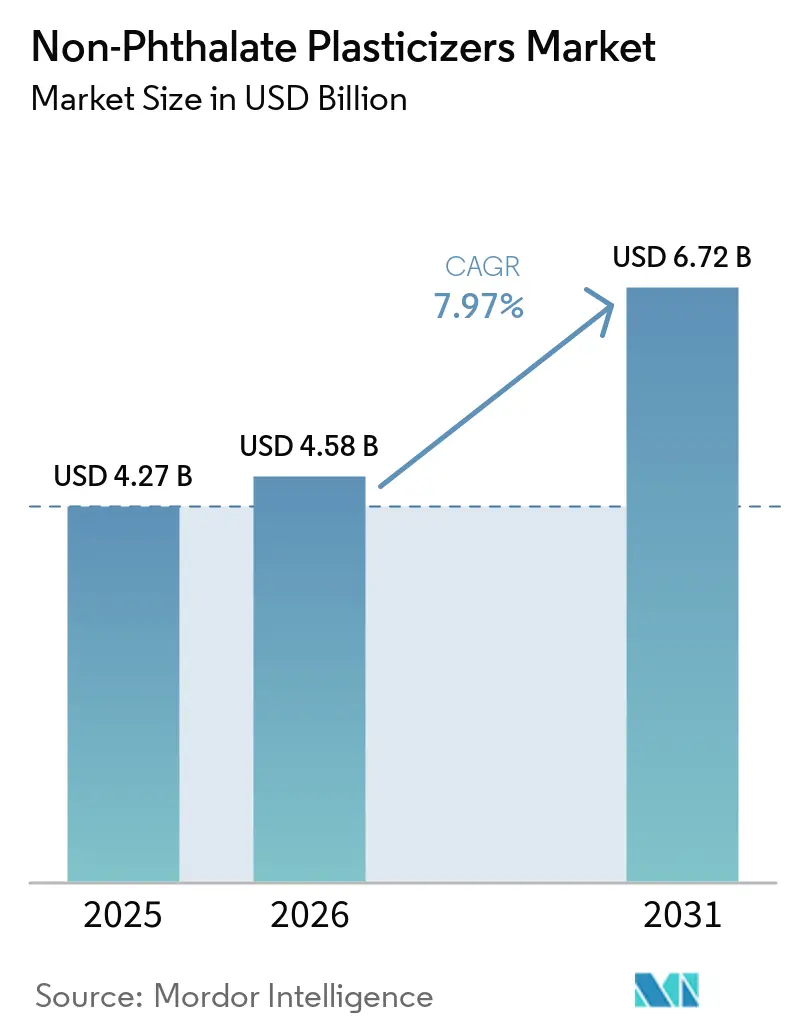
| Market Size (2026) | USD 4.58 Billion |
| Market Size (2031) | USD 6.72 Billion |
| Growth Rate (2026 - 2031) | 7.97 % |
| Fastest Growing Market | Asia-Pacific |
| Largest Market | Asia-Pacific |
| Market Concentration | Low |
Major Players *Disclaimer: Major Players sorted in no particular order Image © Mordor Intelligence. Reuse requires attribution under CC BY 4.0. | |
Non-Phthalate Plasticizers Market Analysis by Mordor Intelligence
The Non-Phthalate Plasticizers Market was valued at USD 4.27 billion in 2025 and is estimated to grow from USD 4.58 billion in 2026 to reach USD 6.72 billion by 2031, at a CAGR of 7.97% during the forecast period (2026–2031). The non-phthalate plasticizers market is moving from early compliance substitutions toward broader reformulation across construction, healthcare, electrical systems, and consumer-facing polyvinyl chloride (PVC) products. Restrictions on certain ortho-phthalates are reinforced by procurement rules, sustainability commitments, and building-product specifications. This combination gives converters reasons to change formulations before a regulatory deadline takes effect. Suppliers are also competing on carbon traceability and technical qualification, rather than volume alone. Feedstock concentration and lengthy product validation remain material limits on the pace of adoption
Key Report Takeaways
- By type, terephthalates held 34.82% of the non-phthalate plasticizers market share in 2025, while citrates are projected to advance at a 9.63% CAGR through 2031.
- By application, flooring and wall coverings accounted for 26.91% of the non-phthalate plasticizers market share in 2025, while medical devices are projected to advance at an 8.17% CAGR through 2031.
- By end-use industry, building and construction held 31.22% of the non-phthalate plasticizers market share in 2025, while healthcare and pharmaceuticals is projected to advance at a 9.53% CAGR through 2031.
- By geography, Asia-Pacific held 45.62% of the non-phthalate plasticizers market share in 2025 and is projected to advance at an 8.77% CAGR through 2031.
Note: Market size and forecast figures in this report are generated using Mordor Intelligence’s proprietary estimation framework, updated with the latest available data and insights as of January 2026.
Market Trends and Insights
Drivers Impact Analysis of Non-Phthalate Plasticizers Market*
| Driver | (~) % Impact on CAGR Forecast | Geographic Relevance | Impact Timeline |
|---|---|---|---|
| Phthalate Restrictions and Safer-Substitution Mandates | +2.6% | Global, with primary enforcement in EU, North America, and Japan; spill-over compliance to APAC export manufacturers | Short term (≤ 2 years) |
| Flexible PVC Demand in Construction and Infrastructure | +2.0% | APAC core (China, India, Southeast Asia), with secondary gains in Middle-East and North Africa | Medium term (2–4 years) |
| Electrification-Driven Demand for High-Temperature Cable Insulation | +1.3% | Global; concentrated in EV manufacturing corridors including China, Germany, South Korea, and US battery-belt states | Medium term (2–4 years) |
| Medical-Device Conversion to Validated Alternative Plasticizers | +1.1% | North America, EU, Japan, South Korea; early-stage adoption in India and Southeast Asia | Long term (≥ 4 years) |
| Brand-Owner Preference for Traceable Low-Carbon Formulations | +0.7% | EU and North America primary; spill-over to APAC export-oriented producers | Medium term (2–4 years) |
| Source: Mordor Intelligence | |||
Phthalate Restrictions and Safer-Substitution Mandates
Regulatory restriction is one of the largest structural drivers for conversion in the non-phthalate plasticizers market. Under Registration, Evaluation, Authorisation and Restriction of Chemicals (REACH), Di(2-Ethylhexyl) Phthalate (DEHP), Benzyl Butyl Phthalate (BBP), Dibutyl Phthalate (DBP), and Diisobutyl Phthalate (DIBP) require authorization for continued use, and the Candidate List contained 242 entries in November 2024. The EU medical-device exception extended the DEHP compliance deadline from May 2025 to July 2030. Manufacturers, therefore, have time to qualify alternatives before the deadline. The revised date does not eliminate the need for reformulation because device producers must prepare compliant product lines before July 2030. REACH, Toxic Substances Control Act (TSCA), and China’s GB 9685 standard collectively shape substitution requirements across major producing and consuming regions.
Flexible PVC Demand in Construction and Infrastructure
Construction remains the main revenue anchor for the non-phthalate plasticizers market because flexible PVC is used in flooring, cable conduit, waterproofing membranes, and other building products. Infrastructure programs in Asia-Pacific, the Middle-East, and parts of Latin America support demand for these applications. The EU Construction Products Regulation, Regulation (EU) 2024/3110, became applicable from January 8, 2026, and aligns construction-product requirements across the bloc[1]. This framework supports the use of compliant materials in European architectural product supply chains. In commercial renovation, Dioctyl Terephthalate (DOTP)-formulated luxury vinyl tile is gaining attention where tenants and facility managers seek low-migration and low-Volatile Organic Compound (VOC) flooring. Those specifications can increase demand even when a direct product restriction does not apply.
Electrification-Driven Demand for High-Temperature Cable Insulation
Electric Vehicle (EV) wiring harnesses and charging cables require insulation that can perform under sustained heat. This favors trimellitates, including trioctyl trimellitate, and cycloaliphatic alternatives in the non-phthalate plasticizers market. Higher-voltage EV platforms place more demanding requirements on cable materials than standard vehicle systems. BASF stated that its Palatinol trioctyl trimellitate (TOTM) products serve wire and cable applications and that its North American biomass-balanced grades received International Sustainability and Carbon Certification (ISCC) PLUS certification in February 2025. This indicates that traceability requirements are reaching cable and wire supply chains. Trimellitate and cyclohexanoate capacity is concentrated in a limited number of qualified production locations. The limited availability of qualified supply benefits suppliers that already have application approvals.
Medical-Device Conversion to Validated Alternative Plasticizers
Citrate esters and selected trimellitates are increasingly used in medical-grade PVC within the non-phthalate plasticizers market. ISO 10993 requires biological evaluation within a risk-management process for medical devices, which makes a material change more involved than a routine formulation adjustment. A replacement for DEHP must pass biocompatibility evaluation, extractables and leachables testing, toxicological assessment, and updated regulatory documentation. The Food and Drug Administration’s regulations list permitted substances for rubber articles intended for repeated use, including applicable citrate ester provisions[2]. Acetyl tributyl citrate can support flexibility and sterilization resistance in relevant medical tubing applications. Qualification work initiated in 2025 and 2026 can translate into procurement conversion during 2028 to 2030. This supports the longer adoption period for medical applications.
Restraints Impact Analysis of Non-Phthalate Plasticizers Market*
| Restraint | (~) % Impact on CAGR Forecast | Geographic Relevance | Impact Timeline |
|---|---|---|---|
| Higher Cost Versus Legacy Phthalates in Price-Sensitive Formulations | -1.9% | Global; most pronounced in South and Southeast Asia, Africa, and Latin America | Short term (≤ 2 years) |
| Feedstock and Esterification Capacity Volatility | -1.1% | Global | Medium term (2–4 years) |
| Performance Trade-Offs Across Temperature, Migration, and Fusion | -0.7% | Global | Long term (≥ 4 years) |
| Source: Mordor Intelligence | |||
Higher Cost Versus Legacy Phthalates in Price-Sensitive Formulations
The price difference between DINP and DIDP continues to limit the uptake of alternatives in cost-sensitive uses. These legacy phthalates remain authorized for general use in several applications, so a mandatory switch does not always occur. DOTP commonly carries a 10-20% unit-cost premium over DINP in comparable flexible PVC formulations. Cyclohexanoate alternatives can cost more than DOTP. Mid-sized PVC compounders in South and Southeast Asia often work with specifications that do not yet require non-phthalate materials. This makes the price differential a direct constraint on the non-phthalate plasticizers market in commodity construction and consumer applications.
Feedstock and Esterification Capacity Volatility
Supply reliability is less secure for some non-phthalate alternatives than for conventional phthalates. DOTP uses terephthalic acid and 2-ethylhexanol, which are petroleum-linked inputs exposed to energy-cycle pricing. Citrate capacity is concentrated in China’s fermentation infrastructure. This concentration can affect supply security for the fastest-growing chemistry type. Cyclohexanoate capacity for medical and EV uses is concentrated at BASF’s Ludwigshafen complex and a small number of licensed Asian producers. Evonik announced an expansion of ELATUR CH and ELATUR DINCH capacity at Marl, Germany, in October 2024, but stated that the project would take time to provide additional supply.
*Our forecasts treat driver/restraint impacts as directional, not additive. The impact forecasts reflect baseline growth, mix effects, and variable interactions.
Non-Phthalate Plasticizers Market Segment Analysis
By Type:
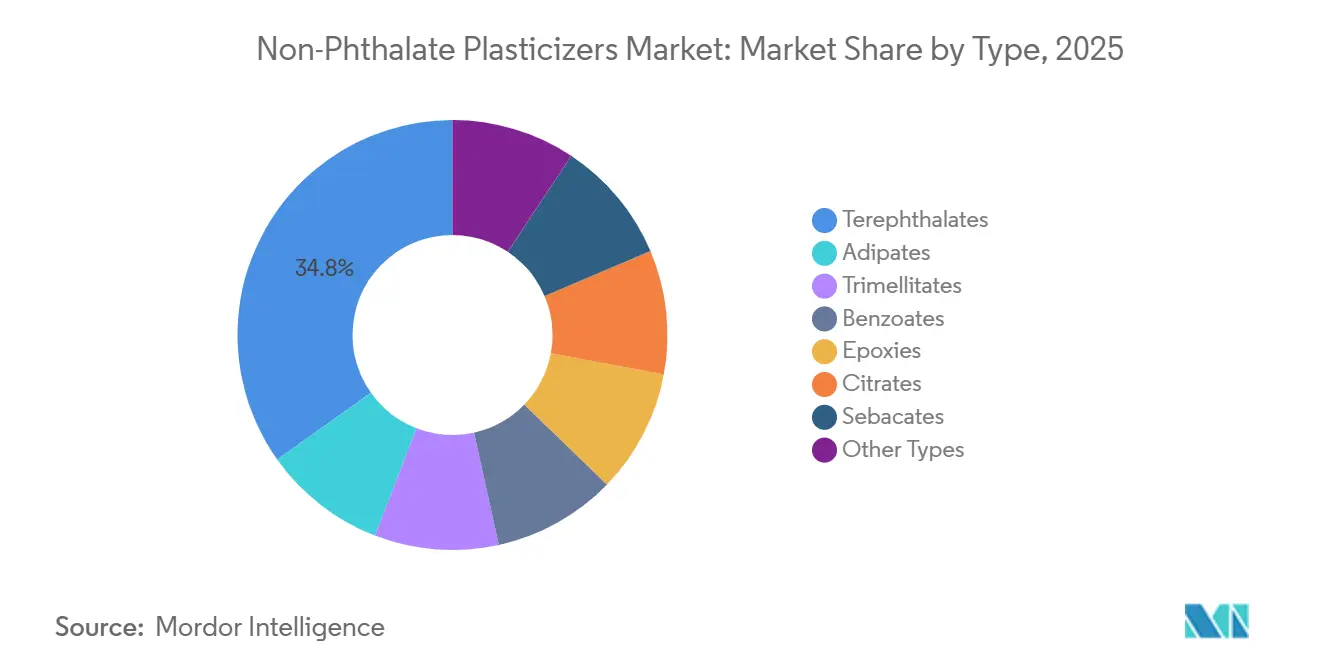
Terephthalates Lead While Citrates Growth Signals Formulation PremiumTerephthalates held 34.82% of the non-phthalate plasticizers market share in 2025. DOTP provides a cost-performance balance for flexible PVC uses such as flooring, wire insulation, and automotive vinyl. Its low volatility and thermal stability make it suitable for a wide group of applications. FDA food-contact clearance also supports its use where contact requirements matter. Eastman 168 is an example of DOTP used as a general-purpose non-phthalate alternative. The non-phthalate plasticizers industry relies on terephthalates as a main replacement route for DEHP. Adipates address cold-climate and specialized automotive uses because they retain flexibility at lower temperatures. Trimellitates, including TOTM, address electrical and automotive wiring uses that require higher thermal performance.
Citrates are forecast to expand at a 9.63% CAGR through 2031. Medical-grade PVC conversion and food-contact uses support this growth. Bio-origin feedstocks also align with sustainability programs used by brand owners. Perstorp launched Pevalen Pro 100 in January 2024 as a non-phthalate plasticizer based on 100% renewable carbon under mass-balance traceability. The company stated that the product had ISCC PLUS certification and an 80% lower product carbon footprint than its fossil-based equivalent. Benzoates and other alternatives are therefore increasingly differentiated through sourcing as well as performance. Epoxies support PVC heat stabilization. Sebacates serve applications requiring very low-temperature flexibility, while other types address specialty coating needs.

By Application:
Flooring and Wall Coverings Anchors Revenue While Medical Devices AcceleratesFlooring and wall coverings accounted for 26.91% of the non-phthalate plasticizers market share in 2025. Flexible vinyl remains widely used across commercial and residential construction. Luxury vinyl tile and resilient sheet flooring increasingly use DOTP formulations. Indoor air quality requirements and low-VOC building-product standards support this change. The large installed base of flooring products creates substantial demand even when conversion rates are modest. Long reformulation cycles in construction also make the shift gradual. The non-phthalate plasticizers market benefits when flooring specifications seek low-migration products. Demand is linked to renovation activity as well as new construction.
Medical devices are forecast to grow at an 8.17% CAGR through 2031. Medical manufacturers are replacing DEHP in patient-contact and long-dwell-time devices. ATBC and high-purity DOTP are key alternatives in these uses. The regulatory framework for medical-grade PVC supports materials that meet applicable evaluation requirements. Wires and cables are also becoming strategically important because EV and charging systems need materials that can perform at 105 °C to 125 °C service ratings. IEC 60502 sets requirements for power cables with extruded insulation in specified voltage ranges. Films and sheets, coated fabrics, consumer goods, and adhesives and sealants show different conversion rates based on consumer contact, brand requirements, and the rules in the end market.
By End-Use Industry:
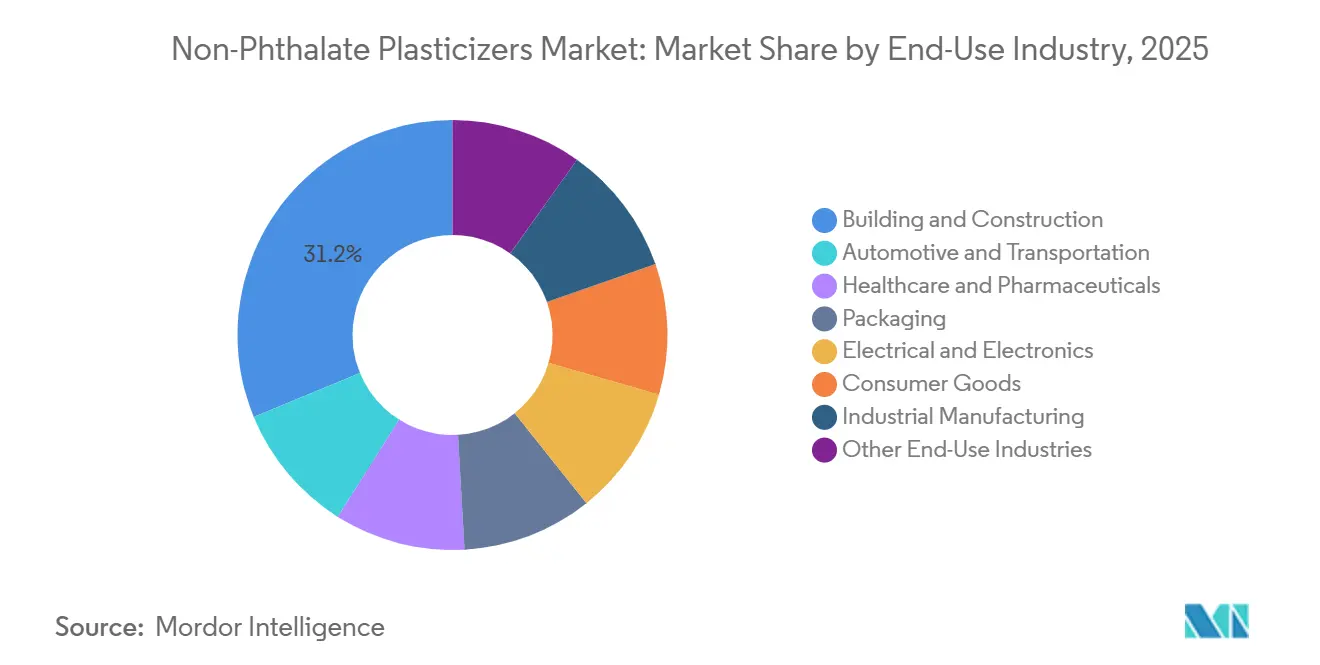
Building and Construction Leads, Healthcare and Pharmaceuticals Command the Growth PremiumBuilding and construction accounted for 31.22% of revenue in 2025. Flexible PVC is used in electrical conduit, waterproofing membranes, flooring, and window-sealing profiles. South and Southeast Asian investment programs continue to absorb construction-grade plasticizers. This occurs even in markets where non-phthalate specifications are not mandatory. Regulation (EU) 2024/3110 strengthens the long-term compliance basis for construction products entering European markets. The non-phthalate plasticizers industry gains from a higher compliance threshold in European building-product supply chains. Construction demand remains sensitive to local project activity and formulation cost.
Healthcare and pharmaceuticals is projected to advance at a 9.53% CAGR through 2031. Medical device manufacturers are working through ISO 10993 evaluation and EU MDR qualification pathways. These processes support systematic DEHP substitution in catheter, blood-contact, and intravenous applications. In automotive and transportation, EV interior trim, gaskets, and wiring components increasingly use phthalate-free formulations. Original equipment manufacturers' (OEMs) sustainability expectations have begun to influence Tier 1 suppliers' material choices. Packaging, electrical and electronics, consumer goods, and industrial manufacturing make up the remaining demand base. Their conversion rates vary by geography and by the regulatory requirements that apply to the product.
Geography Analysis
APAC Non-Phthalate Plasticizers Market
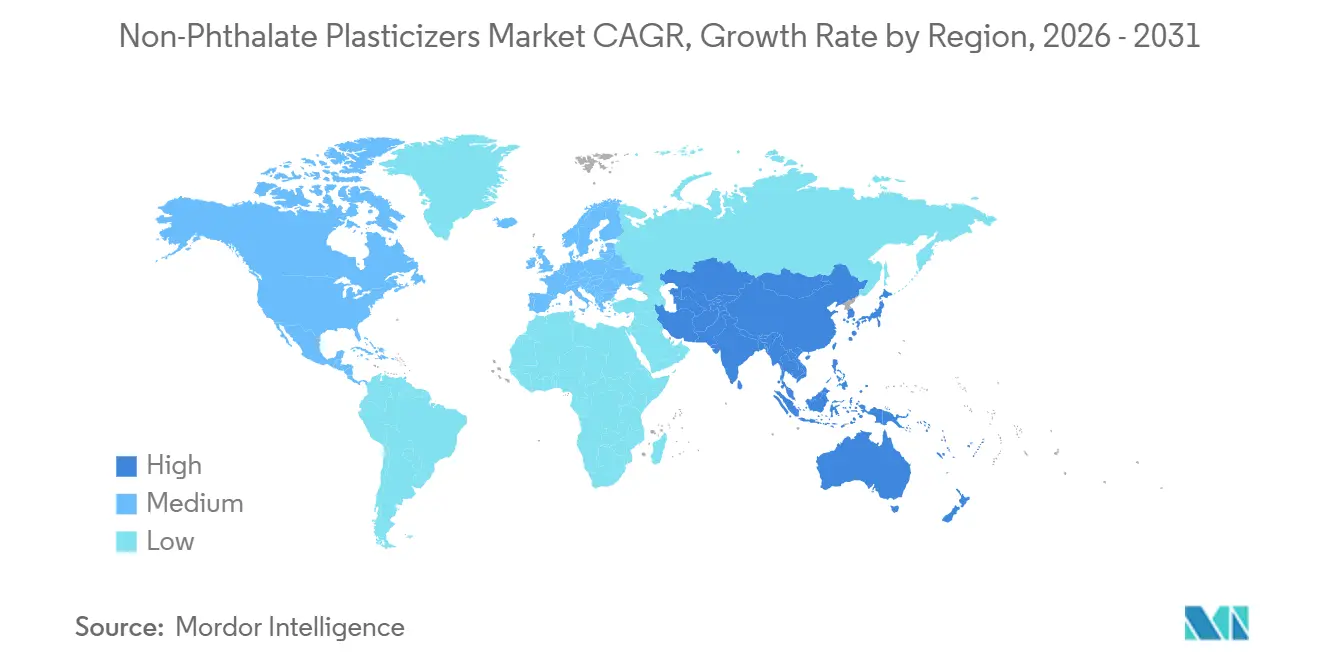
Asia-Pacific held 45.62% of the non-phthalate plasticizers market share in 2025 and is forecast to grow at an 8.77% CAGR through 2031. China contributes through its large, flexible PVC production base and continuing infrastructure investment. Export manufacturers also face compliance requests from European and U.S. buyers. India is an important regional growth point because housing expansion and the Smart Cities Mission support demand for flooring and cable insulation. Domestic plasticizer capacity has not kept pace with rising demand. This supports imports from South Korea, Japan, and China. Japan and South Korea provide highervalue trimellitate and specialty citrate grades for domestic and Southeast Asian markets.
North America and Europe Non-Phthalate Plasticizers Market
North America’s demand is supported by production infrastructure from ExxonMobil, Eastman Chemical, and BASF. TSCA requirements, California Proposition 65, and AB 2300 support DEHP substitution in medical tubing and packaging. The U.S. wire and cable segment is supported by grid modernization, renewable-energy connections, and EV charging infrastructure. These uses require more high-temperature insulation materials. Europe has the highest regulatory compliance baseline because REACH has displaced DEHP in many consumer-facing and medical applications. Growth is concentrated in DINCH, trimellitates, and bio-based alternatives as commodity terephthalate demand matures. Germany leads the regional market, while France, Italy, and the United Kingdom have medical and packaging conversion demand.
South America and MEA Non-Phthalate Plasticizers Market
In South America, and Middle-East and Africa, construction activity and gradual alignment with international chemical-safety requirements support demand. Brazil provides South America’s demand base through pipes, cables, and flooring used in housing projects. Non-phthalate specifications often enter through export-oriented manufacturing. Saudi Arabia and South Africa support regional demand through petrochemical investment and local compounding capacity. These investments can reduce dependence on imports. Cost sensitivity and limited binding mandates continue to restrict adoption in several product categories. Export-led compliance requirements are gradually increasing the baseline for non-phthalate formulations.
Competitive Landscape
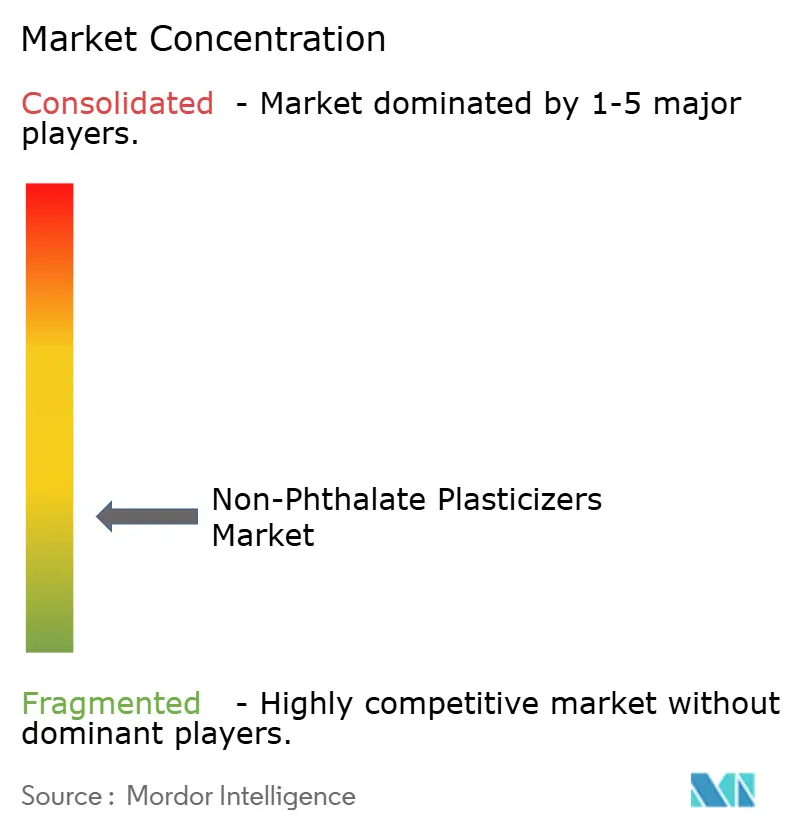
The non-phthalate plasticizers market is highly fragmented, with the top five players including BASF, Eastman Chemical Company, Exxon Mobil Corporation, Evonik Industries AG, and Perstorp. BASF extended ISCC PLUS certification to North American biomass-balanced and Ccycled Palatinol DOTP and TOTM grades in February 2025. This gives customers supply-chain documentation for alternative feedstock content. Brand owners and OEMs increasingly request chain-of-custody records for bio-based or recycled inputs. Suppliers with this documentation can participate in procurement programs that require verified material attributes. Competition in medical and EV wiring products is increasingly based on application qualifications rather than price alone.
The non-phthalate plasticizers market has openings in medical-grade citrate capacity outside China. It also has a supply gap for high-purity trimellitates used in EV wiring in Southeast Asia. Consumer-goods producers seeking 100% renewable-content certification represent a third opportunity. Indian specialty chemical producers are integrating from feedstock to finished ester. Nan Ya Plastics and UPC Technology are expanding non-phthalate portfolios to address export-compliance demand from global customers. Hallstar and Valtris Specialty Chemicals focus on high-performance uses, including lubricants, cable compounds, and medical polymers. Their application engineering can differentiate them from volume-focused suppliers.
Perstorp’s January 2024 Pevalen Pro 100 launch showed that 100% renewable carbon was commercially available for a non-phthalate plasticizer. The product was positioned with mass-balance traceability and ISCC PLUS certification. Perstorp stated that the product had an 80% lower carbon footprint than its fossil-based equivalent. This placed greater pressure on established suppliers to show comparable sustainability credentials. Evonik also announced a capacity expansion for ELATUR CH and ELATUR DINCH at its Marl site in October 2024. The investment is intended to improve delivery reliability for European customers. The competitive landscape, therefore, combines supply assurance, application support, compliance evidence, and material traceability.
Non-Phthalate Plasticizers Industry Leaders
-
BASF
-
Eastman Chemical Company
-
Exxon Mobil Corporation
-
Evonik Industries AG
-
Perstorp
- *Disclaimer: Major Players sorted in no particular order
Non-Phthalate Plasticizers Market Companies Covered in this Report
- Aekyung Chemical Co., Ltd.
- BASF
- Eastman Chemical Company
- Evonik Industries AG
- Exxon Mobil Corporation
- Hallstar
- Hanwha Solutions
- KLJ Group
- Nan Ya Plastics Corporation
- Perstorp
- UPC Technology Corporation
- Valtris Specialty Chemicals
- Velsicol Chemical LLC
Recent Industry Developments in Non-Phthalate Plasticizers Market
- June 2026: The Directorate General of Trade Remedies (DGTR) under India's Ministry of Commerce and Industry finalized a bilateral safeguard measure on non-phthalate plasticizers (DOTP and DEHCH) imported from South Korea. The measure set duties at 100% of the Most Favored Nation (MFN) rate in year one and 75% in year two.
- June 2026: Univar Solutions, LLC became the exclusive distributor of BASF's Hexamoll DINCH in the United States and Canada, expanding product access, logistics support, and supply chain collaboration between the two companies. The agreement strengthened the distribution network for non-phthalate plasticizers in North America, improving product availability for medical, consumer goods, and other applications requiring safer phthalate-free plasticizer solutions.
Global Non-Phthalate Plasticizers Market Report Scope
Non-phthalate plasticizers are additives used to improve the flexibility, durability, and processability of polymers without the health and environmental concerns associated with traditional phthalate-based plasticizers. They are widely used in PVC and other polymer products across construction, healthcare, automotive, packaging, and consumer applications to meet evolving regulatory and sustainability requirements.
The Non-Phthalate Plasticizers Market is segmented by type, application, end-use industry, and geography. By type, the market is segmented into terephthalates, adipates, trimellitates, benzoates, epoxies, citrates, sebacates, and other types. By application, the market is segmented into flooring and wall coverings, wires and cables, films and sheets, coated fabrics, medical devices, consumer goods, adhesives and sealants, and other applications. By end-use industry, the market is segmented into building and construction, automotive and transportation, healthcare and pharmaceuticals, packaging, electrical and electronics, consumer goods, industrial manufacturing, and other end-use industries. The report also covers the market size and forecasts for non-phthalate plasticizers in 16 countries across major regions. For each segment, the market sizing and forecasts have been done on the basis of value (USD).
Segmentation Overview
| Terephthalates |
| Adipates |
| Trimellitates |
| Benzoates |
| Epoxies |
| Citrates |
| Sebacates |
| Other Types |
| Flooring and Wall Coverings |
| Wires and Cables |
| Films and Sheets |
| Coated Fabrics |
| Medical Devices |
| Consumer Goods |
| Adhesives and Sealants |
| Other Applications |
| Building and Construction |
| Automotive and Transportation |
| Healthcare and Pharmaceuticals |
| Packaging |
| Electrical and Electronics |
| Consumer Goods |
| Industrial Manufacturing |
| Other End-Use Industries |
| Asia-Pacific | China |
| India | |
| Japan | |
| South Korea | |
| Rest of Asia-Pacific | |
| North America | United States |
| Canada | |
| Mexico | |
| Europe | Germany |
| United Kingdom | |
| France | |
| Italy | |
| Russia | |
| Rest of Europe | |
| South America | Brazil |
| Argentina | |
| Rest of South America | |
| Middle-East and Africa | Saudi Arabia |
| South Africa | |
| Rest of Middle-East and Africa |
| By Type | Terephthalates | |
| Adipates | ||
| Trimellitates | ||
| Benzoates | ||
| Epoxies | ||
| Citrates | ||
| Sebacates | ||
| Other Types | ||
| By Application | Flooring and Wall Coverings | |
| Wires and Cables | ||
| Films and Sheets | ||
| Coated Fabrics | ||
| Medical Devices | ||
| Consumer Goods | ||
| Adhesives and Sealants | ||
| Other Applications | ||
| By End-Use Industry | Building and Construction | |
| Automotive and Transportation | ||
| Healthcare and Pharmaceuticals | ||
| Packaging | ||
| Electrical and Electronics | ||
| Consumer Goods | ||
| Industrial Manufacturing | ||
| Other End-Use Industries | ||
| By Geography | Asia-Pacific | China |
| India | ||
| Japan | ||
| South Korea | ||
| Rest of Asia-Pacific | ||
| North America | United States | |
| Canada | ||
| Mexico | ||
| Europe | Germany | |
| United Kingdom | ||
| France | ||
| Italy | ||
| Russia | ||
| Rest of Europe | ||
| South America | Brazil | |
| Argentina | ||
| Rest of South America | ||
| Middle-East and Africa | Saudi Arabia | |
| South Africa | ||
| Rest of Middle-East and Africa | ||
Key Questions Answered in the Report
What is the size of the non-phthalate plasticizers market?
The market stands at USD 4.58 billion in 2026 and is forecast to reach USD 6.72 billion by 2031.
Which type led non-phthalate plasticizer demand in 2025?
Terephthalates led with 34.82% of the market revenue in 2025, supported by their use in flexible PVC, flooring, wire insulation, and automotive vinyl.
Which application is expected to grow fastest through 2031?
Medical devices are forecast to grow at an 8.17% CAGR through 2031 as manufacturers qualify alternatives to di(2-ethylhexyl) phthalate (DEHP) in patient-contact products.
Why are citrates expected to grow fastest through 2031?
Citrates are forecast to expand at a 9.63% CAGR through 2031 because of medical-grade PVC conversion and food-contact applications.