
NIR Industrial Imaging Systems Market Size and Share
Market Overview
| Study Period | 2020 - 2031 |
|---|---|
| Market Size (2026) | USD 1.96 Billion |
| Market Size (2031) | USD 2.93 Billion |
| Growth Rate (2026 - 2031) | 8.37 % |
| Fastest Growing Market | Asia-Pacific |
| Largest Market | Asia-Pacific |
| Market Concentration | Medium |
Major Players *Disclaimer: Major Players sorted in no particular order Image © Mordor Intelligence. Reuse requires attribution under CC BY 4.0. | |
NIR Industrial Imaging Systems Market Analysis by Mordor Intelligence
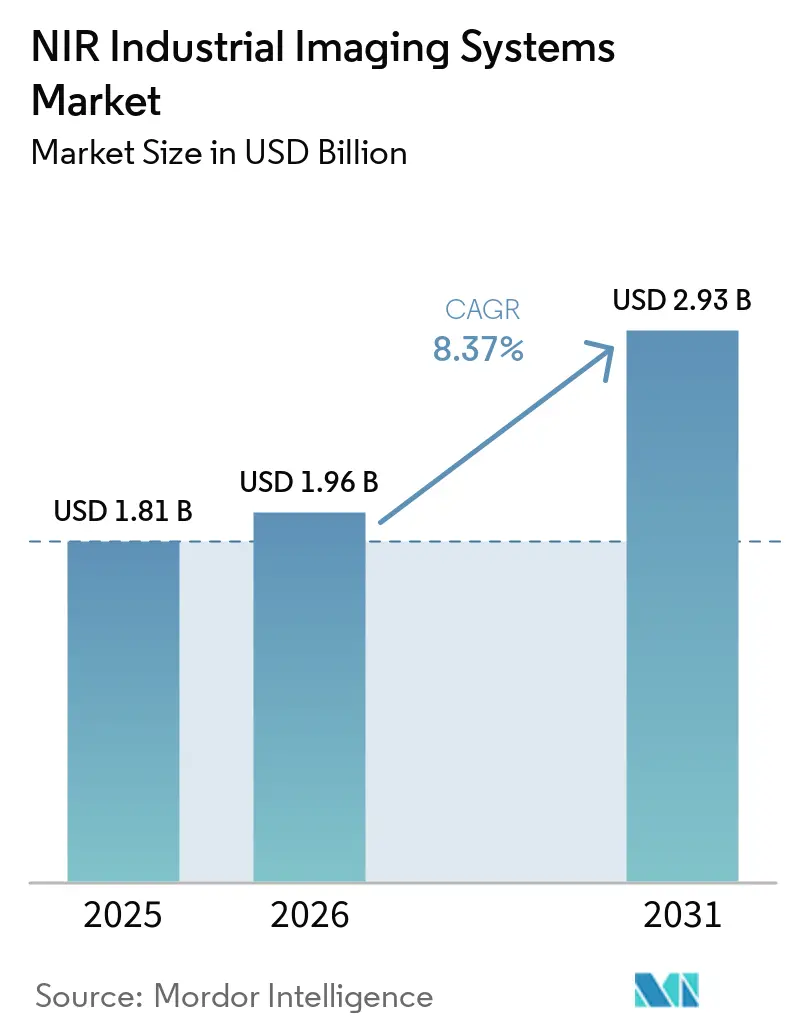
The NIR industrial imaging systems market size was valued at USD 1.81 billion in 2025 and estimated to expand from USD 1.96 billion in 2026 to USD 2.93 billion by 2031, at a CAGR of 8.37% during the forecast period (2026-2031). Factory automation is raising the need for inspection methods that can operate continuously at production speed. Battery, semiconductor, and electronics plants are adding inspection stations as they build new capacity, rather than relying only on replacement demand. AI-enabled spectral analysis is also making cameras more useful in process control because it can turn image data into immediate quality decisions. Suppliers are responding with faster cameras, wider wavelength coverage, rugged housings, and embedded computing. The NIR industrial imaging systems market therefore has opportunities where manufacturers need to inspect materials, coatings, moisture, and hidden defects without slowing the line.
Key Report Takeaways
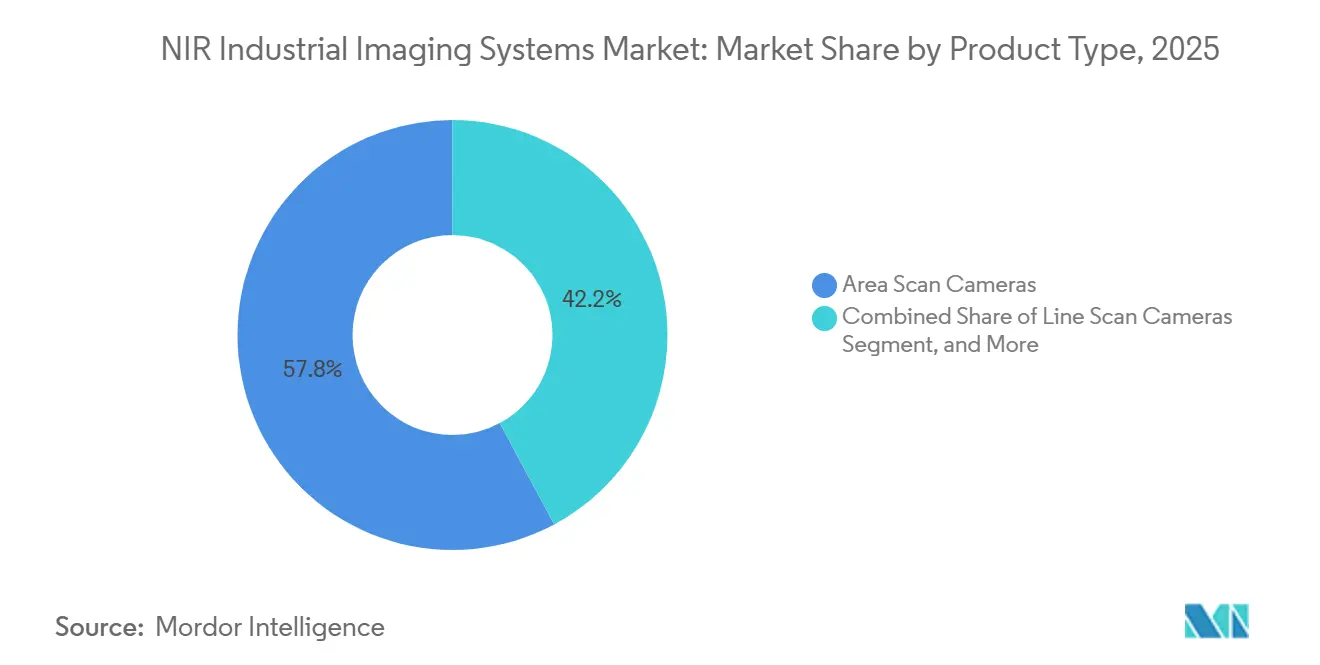
- By product type, area scan cameras held 57.84% of the NIR industrial imaging systems market share in 2026, while line scan cameras are projected to expand at an 8.92% CAGR through 2031.
- By wavelength band, NIR (701-1,000 nm) accounted for 44.26% of the segment in 2026, while extended NIR (1,001-1,700 nm) is projected to expand at an 8.94% CAGR through 2031.
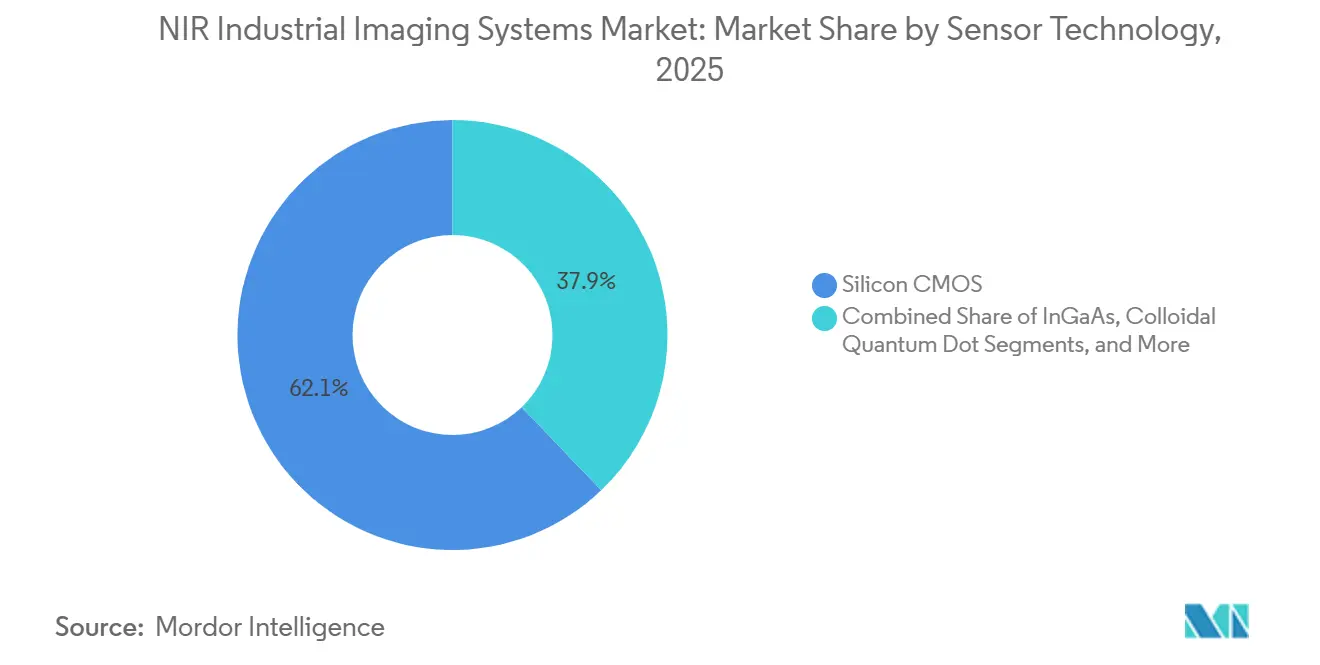
- By sensor technology, silicon CMOS held 62.15% of the segment in 2026, while InGaAs is projected to expand at a 9.21% CAGR through 2031.
- By imaging modality, monochrome imaging held 48.73% of the segment in 2026, while hyperspectral imaging is projected to expand at a 9.16% CAGR through 2031.
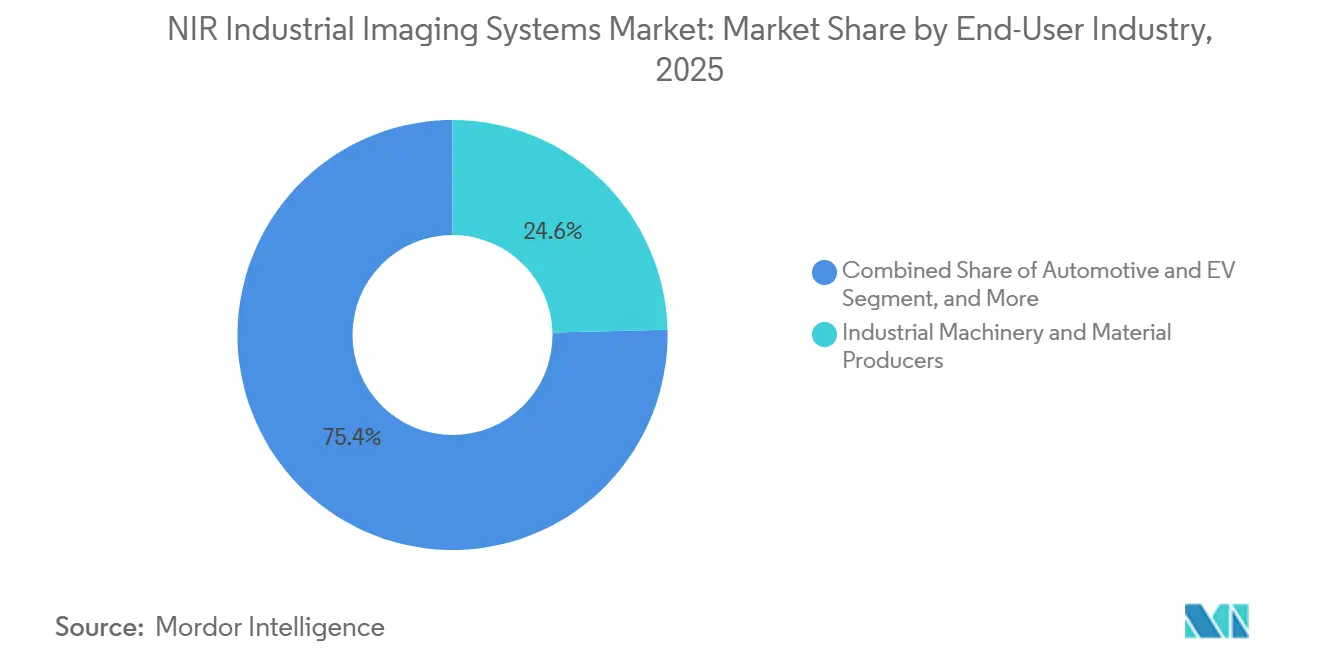
- By end-user industry, industrial machinery and material producers held 24.61% of the segment in 2026, while automotive and EV is projected to expand at an 8.74% CAGR through 2031.
- By deployment, inline and fixed production systems held 51.38% of the segment in 2026, while robotic arm-mounted systems are projected to expand at an 8.83% CAGR through 2031.
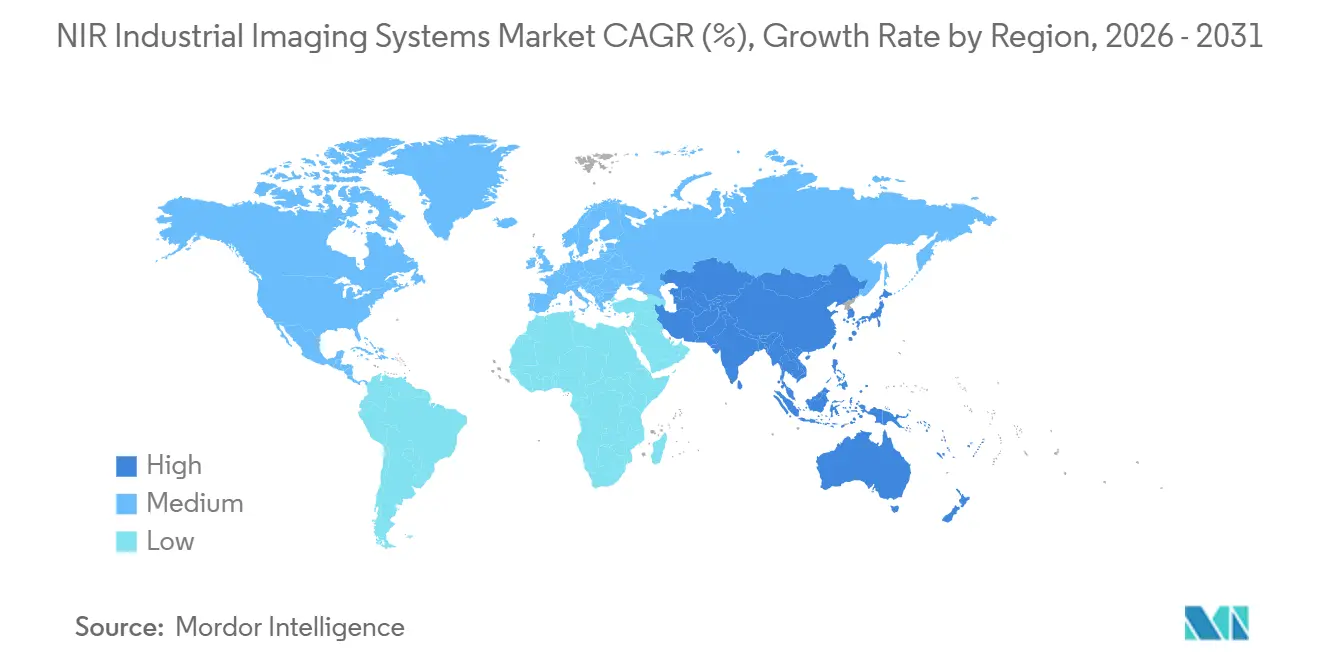
- By geography, Asia-Pacific held 38.47% of the segment in 2026 and is projected to expand at a 9.17% CAGR through 2031.
Note: Market size and forecast figures in this report are generated using Mordor Intelligence’s proprietary estimation framework, updated with the latest available data and insights as of January 2026.
Global NIR Industrial Imaging Systems Market Trends and Insights
Drivers Impact Analysis*
| Driver | (~) % Impact on CAGR Forecast | Geographic Relevance | Impact Timeline |
|---|---|---|---|
| Factory Automation and High-Speed Inline Inspection | +2.1% | Global, concentrated in Asia-Pacific core and North America | Short term (≤ 2 years) |
| AI-Enabled Material Classification and Edge Inference | +1.8% | Global, early adoption in Asia-Pacific and North America | Medium term (2-4 years) |
| Semiconductor and Electronics Yield-Correction Demand | +1.5% | Asia-Pacific core, China, South Korea, Taiwan, and Japan, with spillover to North America | Short term (≤ 2 years) |
| EV Battery and Advanced Materials Manufacturing Expansion | +1.2% | Asia-Pacific core, with spillover to North America and Europe | Medium term (2-4 years) |
| Non-Destructive Inspection of Moisture, Coatings, and Internal Defects | +0.9% | Global | Medium term (2-4 years) |
| Lower-Cost InGaAs and SWIR Sensor Commercialization | +0.7% | Global, led by North America and Europe on the supply side | Long term (≥ 4 years) |
| Source: Mordor Intelligence | |||
Factory Automation and High-Speed Inline Inspection
Automated production lines need quality checks that can keep pace with continuous manufacturing. In battery electrode coating, NIR line-scan equipment must cover the full web at speeds above 45 m/min and at 200 µm inspection intervals. This requirement is becoming a production baseline in Chinese gigafactories. CATL facilities in Yibin and Ningde used hybrid hyperspectral and line-scan CCD systems, including Specim FX17e equipment that operated from 900 nm to 1,700 nm at 670 fps and detected more than 30 defect classes in real time.[1]Specim, Spectral Imaging Ltd., “Specim Showcases Hyperspectral Imaging Solutions at Laser World of Photonics China 2026,” Specim, specim.com The NIR industrial imaging systems market benefits as camera suppliers add near-infrared sensitivity to factory-ready equipment, which reduces the entry cost for smaller manufacturers. ISO 9001 and IATF 16949 documentation requirements also support the use of traceable inspection records in automotive production.
AI-Enabled Material Classification and Edge Inference
AI processing at the camera level reduces the need for separate computing hardware near a production line. Cognex launched the In-Sight 6900 Vision Controller in April 2026 with NVIDIA Jetson technology and up to 157 TOPS of AI performance. The controller supports few-sample classification using 10-20 training images, which can reduce model deployment work for smaller lines. Edge processing can also allow a camera to be reassigned across inspection tasks without a full external computing setup. Fraunhofer IPMS demonstrated a compact AI-embedded hyperspectral camera that identifies regions of interest before triggering detailed spectral analysis. This approach can reduce data volume and processing load in the NIR industrial imaging systems market.
Semiconductor and Electronics Yield-Correction Demand
Advanced semiconductor nodes require inspection methods that can reveal defects beneath silicon surfaces. Silicon becomes optically transparent at longer near-infrared wavelengths, allowing NIR and SWIR systems to inspect bonded wafers, through-silicon vias, and advanced packaging interfaces. A study in Light: Advanced Manufacturing demonstrated highly repeatable through-silicon-via depth measurements through a silicon wafer using near-infrared wavelengths. Samsung presented an AI-enhanced inspection method for advanced semiconductor nodes at SPIE, reporting improved defect capture and a significant reduction in the SEM review budget. These results make NIR-enabled inspection an important yield-protection tool in the NIR industrial imaging systems market. Japan’s NEDO and Nikon also developed a broadband visible-to-NIR alignment metrology system for next-generation semiconductor manufacturing.[2]NEDO and Nikon, “Wafer Alignment Measurement System Using Broadband NIR Optics,” IZA Press Release, iza.ne.jp
EV Battery and Advanced Materials Manufacturing Expansion
Battery producers are applying spectral imaging at electrode coating, electrolyte filling, and final seal verification. Each step has failure modes that can be detected without contact when the system operates at line speed. BMW’s Gen6 high-voltage battery operation at Plant Woodruff uses more than 250 robots and AI-assisted inline monitoring throughout production. General Motors developed the BVSeal system, which uses gas-imaging cameras on cobots to identify battery-tray leaks on the production line.[3]General Motors, “GM Develops Automated Inspection for EV Battery Packs,” Vision Systems Design, vision-systems.com NIR optical coherence tomography is also being applied to battery packaging films and electrode-tab tape because it provides micron-level imaging of multilayer structures. These requirements support the NIR industrial imaging systems market as battery pack designs become more complex.
Restraints Impact Analysis*
| Restraint | (~) % Impact on CAGR Forecast | Geographic Relevance | Impact Timeline |
|---|---|---|---|
| High InGaAs Sensor and Specialized Optics Cost | -1.3% | Global, particularly constraining in South Asia, Southeast Asia, and South America | Short term (≤ 2 years) |
| Shortage of Spectral-Modeling and Integration Expertise | -0.8% | Global, most acute in emerging manufacturing economies | Medium term (2-4 years) |
| Calibration Drift Across Production Environments | -0.5% | Global, concentrated in high-temperature and chemically harsh environments | Medium term (2-4 years) |
| Limited ROI Visibility in Low-Volume Manufacturing | -0.4% | National, with early adoption barriers in small-batch and job-shop manufacturing | Long term (≥ 4 years) |
| Source: Mordor Intelligence | |||
High InGaAs Sensor and Specialized Optics Cost
InGaAs focal plane arrays enable extended NIR and SWIR imaging, but their manufacturing process remains costly. Bonding InGaAs photodiode arrays to silicon readout integrated circuits limits wafer sizes, affecting yield and keeping industrial camera prices high. This cost creates an adoption barrier for mid-sized manufacturers, particularly in South Asia and Southeast Asia. A recent Sensors study reported that InAs colloidal quantum dot SWIR sensors can deliver a high dynamic range and strong external quantum efficiency through monolithic thin-film deposition on silicon readout circuits. Specialized optics that preserve focus across large sensor formats and extended NIR wavelengths add further costs in the NIR industrial imaging systems market.
Shortage of Spectral-Modeling and Integration Expertise
NIR imaging systems require validated chemometric models that translate spectral patterns into quality decisions. Developing these models requires optical knowledge, production-process experience, appropriate lighting, and real-time processing capability. This combination of skills is limited and cannot be replaced easily through general machine-learning hiring. Headwall Photonics identifies calibrated models, lighting architecture, and real-time processing as prerequisites for dependable hyperspectral inspection. Manufacturers can therefore face deployment periods of 6-18 months before a system achieves production qualification. This specialization shapes deployment timelines across the NIR industrial imaging systems market.
*Our forecasts treat driver/restraint impacts as directional, not additive. The impact forecasts reflect baseline growth, mix effects, and variable interactions.
Segment Analysis
By Product Type: Line Scan Cameras Gain Importance on High-Throughput Lines
Area scan cameras held 57.84% of the product type segment in 2026. This position reflects their use in semiconductor wafer and PCB inspection, where stationary parts suit two-dimensional image capture and established production geometry. The cameras are available from 2 MP to 25 MP and work with silicon CMOS, CCD, and InGaAs sensors. Mature GenICam and GigE Vision ecosystems make integration familiar for machine builders and reduce implementation uncertainty. Area scan systems remain the default option for many new machine-vision deployments. Their installed base supports a large share of established factory applications.
Line scan cameras are projected to expand at an 8.92% CAGR through 2031. They are well-suited to battery electrode lines, solar cell inspection, and pharmaceutical film coating because they inspect continuous materials at high linear speeds. Their format enables complete inline coverage without the data constraints associated with wide-format area scan arrays. This capability is important because missed areas of moving material can result in scrap, rework, or downstream product failures. Allied Vision launched the FXO camera lineup with substantially higher frame rates than earlier models through a high-bandwidth fiber interface. Basler also introduced a CoaXPress-over-Fiber TDI system that provides high bandwidth, fast line rates, high resolution, and multiple TDI stages. Push-broom hyperspectral systems remain important for food sorting and recycling, where modular line-scan configurations can improve the cost per inspected unit.



By Wavelength Band: Extended NIR Supports Battery and Moisture Detection
The NIR 701-1,000 nm band accounted for 44.26% of the wavelength segment in 2026. Silicon CMOS and CCD compatibility makes this band the lowest-cost entry point for food, pharmaceutical, and general factory applications. It supports many inspection tasks without the cost of extended NIR components. The range is relevant where manufacturers need basic material differentiation, fixed-wavelength checks, or conventional near-infrared sensitivity. It remains an established foundation for the NIR industrial imaging systems market. Its broad device compatibility helps machine builders serve cost-sensitive deployments and retain conventional camera architectures.
Extended NIR from 1,001 nm to 1,700 nm is projected to expand at an 8.94% CAGR through 2031. This range includes water absorption bands used in food and pharmaceutical drying. It also enables silicon-transparency inspection in semiconductor packaging and cathode-material discrimination in lithium-ion cells. These combined uses make the range relevant across several of the fastest-expanding application areas. Hamamatsu released its G-series InGaAs sensors for NIR hyperspectral imaging, offering high frame rates, a wide dynamic range, and USB connectivity. Visible-NIR remains useful for multispectral color inspection, while longer-wavelength SWIR remains expensive because it requires cooled InGaAs or MCT detectors. Teledyne introduced the SCION camera family with sensor coverage extending into longer-wavelength SWIR, indicating continued investment in commercial SWIR systems.
By Sensor Technology: InGaAs Gains Use as Quantum Dot Platforms Emerge
Silicon CMOS held 62.15% of the sensor technology segment in 2026. Its position reflects favorable cost per pixel, conventional foundry compatibility, and proven performance at visible and near-infrared wavelengths. Silicon CCD retains a place in scientific and laboratory work where low noise and high dynamic range are important. CMOS is the common choice for industrial systems that need an accessible sensor architecture and standard production components. It supports a large portion of the sensor segment in standard machine-vision installations. Its maturity gives suppliers a broad base of compatible components, software, and integration knowledge in the NIR industrial imaging systems market.
InGaAs is projected to expand at a 9.21% CAGR through 2031. It is used in through-substrate semiconductor inspection, battery electrode analysis, and hyperspectral food and pharmaceutical sorting. These applications operate beyond the wavelengths where silicon CMOS sensitivity is strongest. Teledyne’s SCION family combines in-house InGaAs and VisGaAs sensor fabrication, vacuum packaging, and camera electronics in one platform. This vertically integrated approach addresses performance and supply-chain cost considerations within the sensor category. A recent Nature Communications paper demonstrated a dual-band NIR and SWIR PbS colloidal quantum dot focal plane array with low spectral crosstalk across both wavelength bands. Related SPIE work showed PbS quantum dot sensors with high quantum efficiency in the NIR range and wafer-scale manufacturing potential, which could lower costs relative to InGaAs.
By Imaging Modality: Hyperspectral Imaging Moves into Production
Monochrome imaging held 48.73% of the imaging modality segment in 2026. It is common in high-speed production lines that use fixed wavelengths or bandpass filters. These systems prioritize throughput and cost efficiency over detailed spectral resolution. Multispectral imaging serves a middle position in food grading and pharmaceutical tablet inspection. It uses a limited number of discrete wavelength bands where full spectral cubes are not required. Monochrome systems therefore remain a substantial part of the NIR industrial imaging systems market size for established inline tasks.
Hyperspectral imaging is projected to expand at a 9.16% CAGR through 2031. It is used where intensity images alone cannot identify coating uniformity, moisture patterns, polymer types, or subsurface wafer defects. The method provides pixel-level spectral maps rather than a single intensity image, which supports more detailed material decisions. Teledyne DALSA launched the Kaleido SWIR hyperspectral camera in May 2026 with 1,280-pixel spatial resolution and line rates above 2.3 kHz. The system includes spectral band selection and aberration correction for industrial machine builders. Fluorescence and reflectance imaging remain specialized methods for pharmaceutical quality control and research settings. Headwall Photonics and Hamamatsu demonstrated real-time defect and contamination detection at Automate 2025, showing that hyperspectral platforms can support broader manufacturing use.
By End-User Industry: Automotive and EV Advances While Electronics Remains Core
Industrial machinery and material producers held 24.61% of the end-user segment in 2026. NIR inspection supports materials characterization, sorting, and process control in bulk production settings. Electronics and semiconductors form a second major demand base through wafer inspection, PCB verification, and advanced packaging. These applications have high equipment value, stable technical requirements, and low tolerance for hidden defects. Food and beverage producers use NIR for moisture, sugar, and foreign-object detection. These established uses anchor demand across the NIR industrial imaging systems market.
Automotive and EV are projected to expand at an 8.74% CAGR through 2031. Battery production requires strict contamination control because a 50 µm metal particle can contribute to thermal runaway in a completed pack. This condition makes full spectral inspection a quality and risk-management requirement rather than an optional check. Food manufacturers are also moving toward hyperspectral systems as buyers and regulators seek compositional data with safety verification. Pharmaceutical and biotechnology users benefit from FDA Process Analytical Technology guidance, which recognizes inline NIR analysis as a process-control tool. Mining, recycling, and waste operators use hyperspectral sorting to replace manual sorting and single-wavelength equipment as European material-recovery targets support automated recovery.
By Deployment: Robotic Arm Systems Expand in Flexible Manufacturing Cells
Inline and fixed production systems held 51.38% of the deployment segment in 2026. Conveyor-integrated cameras have an established base in food, pharmaceuticals, semiconductors, and battery plants. Fixed geometry is technically sufficient for many of these applications and can be more capital efficient. These systems provide consistent lighting, speed, working distance, and inspection conditions. Their position reflects the need for repeatable inspection within stable process layouts. Fixed installations account for the largest deployment base in the NIR industrial imaging systems market.
Robotic arm-mounted systems are projected to expand at an 8.83% CAGR through 2031. A robot-mounted NIR camera can inspect multiple part shapes and viewing angles inside flexible manufacturing cells. This flexibility can reduce the need for several fixed inspection stations where the task requires different access angles. BMW’s Plant Woodruff battery operation uses more than 250 robots alongside continuous inline documentation at each production step. Laboratory and benchtop equipment support university, contract laboratory, and pharmaceutical process-development work, including calibration and method development. Portable systems support mining, recycling commissioning, and field food-safety sampling, although their role is limited by throughput and calibration-stability needs.
Geography Analysis
Asia-Pacific held 38.47% of the NIR industrial imaging systems market share in 2026 and is projected to expand at a 9.17% CAGR through 2031. China’s battery capacity additions, Taiwan’s advanced-node fabs, South Korea’s logic and DRAM expansion, and India’s developing semiconductor fabrication base create demand across the equipment stack. Japan supports both supply and demand through its industrial imaging companies and domestic semiconductor customers. Hamamatsu began selling the Solid Cold Emmi-X failure-analysis camera in July 2026 at JPY 130 million (USD 882,000) per unit. European suppliers are also increasing direct engagement with China, as shown by Specim’s participation in Laser World of Photonics China in March 2026.
North America is a high-value area in the NIR industrial imaging systems market, supported by semiconductor fabrication, pharmaceutical manufacturing, and food-safety applications. CHIPS Act-supported domestic fabrication investment, including TSMC capacity in Arizona and Intel’s domestic nodes, supports a multiyear need for advanced wafer inspection. General Motors’ BVSeal battery-tray inspection system and BMW’s Woodruff operation show automotive investment in the region. Canada contributes a photonics manufacturing base through Teledyne DALSA in Waterloo, Ontario. Mexico is emerging as a nearshoring location for battery assembly and associated inspection equipment.
Europe maintains an important supply role in the NIR industrial imaging systems market, with German companies such as Basler and IDS serving industrial customers globally. Basler’s 2026 GMSL and CoaXPress-over-Fiber product activity reflects continued investment in systems for embedded and semiconductor applications. European circular-economy policies also support demand for NIR recycling equipment in Germany, France, and the United Kingdom. South America, the Middle East, and Africa remain emerging areas where food processing, agriculture, and mining are central applications. Adoption in these regions is constrained by integration capability and capital-cost sensitivity. Turkey and the UAE have shown interest in food safety and downstream petrochemical inspection under industrial diversification programs.

Competitive Landscape
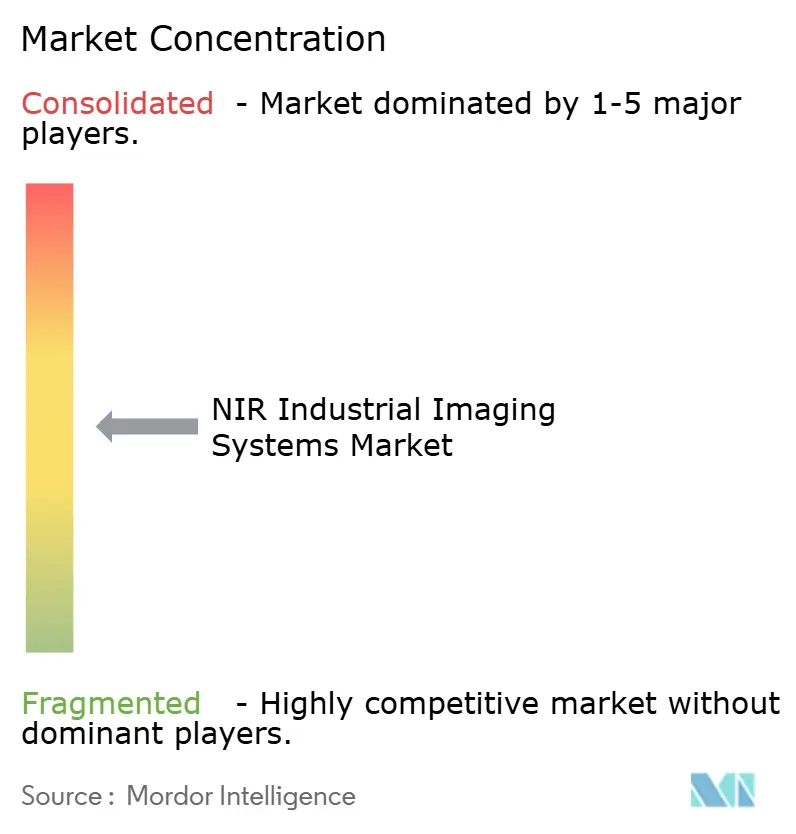
The NIR industrial imaging systems market is moderately consolidated at the system level and fragmented across sensors, optics, and software. This structure favors suppliers that can manage several layers of the technical stack. Teledyne has a broad position through sensor fabrication, vacuum packaging, camera electronics, and application software. The January 2026 SCION camera family and the May 2026 Kaleido hyperspectral camera illustrate its integrated product approach. Integrated offerings can reduce component compatibility and supply-chain concerns for machine builders.
European specialists, including Basler, Allied Vision, IDS Imaging, and Xenics, compete across the NIR industrial imaging systems market through application performance, environmental durability, and interface choice. Basler introduced a CoaXPress-over-Fiber TDI platform in April 2026 for high-bandwidth semiconductor and flat-panel inspection. Allied Vision launched the FXO 100GigE lineup in July 2026 to address high-throughput 2D and 3D inspection. Cognex introduced the In-Sight 6900 controller in April 2026 with up to 157 TOPS of embedded AI performance. Cognex reported USD 994 million in FY2025 revenue and an adjusted EBITDA margin of 21.5%, which supports continued product investment.
Headwall Photonics, Specim, HySpex, and Norsk Elektro Optikk compete in hyperspectral systems within the NIR industrial imaging systems market. Their equipment is paired with chemometrics software and factory calibration for applications such as food sorting, recycling, and materials inspection. Headwall added EVK DI Kerschhaggl GmbH in 2025, broadening its capabilities in hyperspectral imaging, lighting, and processing. System integration remains important because validated models for electrode coatings, pharmaceutical tablets, and plastics sorting are difficult to reproduce. GigE Vision and GenICam standards maintained by the European Machine Vision Association reduce hardware switching barriers. Competition therefore rests increasingly on software, application expertise, and spectral model libraries.
NIR Industrial Imaging Systems Industry Leaders
Teledyne Technologies Incorporated
Allied Vision Technologies GmbH
Specim, Spectral Imaging Ltd.
Exosens
JAI A/S
- *Disclaimer: Major Players sorted in no particular order

Recent Industry Developments
- July 2026: Allied Vision launched the FXO 100GigE camera lineup built on Sony Pregius S global-shutter sensors, including 24.5 MP fxo925x and 12.3 MP fxo926x models. The cameras delivered a 4× frame-rate increase over prior-generation 24 MP models through a 100GigE QSFP28 fiber interface with RDMA over cable runs up to 10 km. They target high-throughput 2D and 3D automated optical inspection in semiconductor and electronics manufacturing, metrology, and laser triangulation.
- July 2026: Hamamatsu Photonics began selling the Solid Cold Emmi-X emission microscope camera on July 7, 2026. The product targeted advanced semiconductor failure analysis at 400 mV operating conditions on leading-edge nodes. It was priced at JPY 130 million (USD 882,000) per unit with an annual first-year sales target of 10 units.
- May 2026: Teledyne DALSA launched Kaleido, a SWIR hyperspectral camera with 1,280-pixel spatial resolution and line rates above 2.3 kHz through a 10 GigE interface. The platform integrated the sensor, spectrograph, and interface for recycling, food safety, pharmaceuticals, and waste management. It included spectral band selection and metadata tagging to reduce downstream processing work.
- May 2026: Cognex Corporation launched the In-Sight 3900 and In-Sight 6900 edge AI vision systems. The In-Sight 3900 used Qualcomm Dragonwing technology, processed inspections up to 4× faster than earlier systems, supported up to 25 MP resolution, and offered IP67 protection. The In-Sight 6900 Vision Controller used NVIDIA Jetson technology with up to 157 TOPS for semiconductor, automotive, packaging, and consumer electronics inspection.


Global NIR Industrial Imaging Systems Market Report Scope
NIR Industrial Imaging Systems Market refers to cameras, sensors, and integrated imaging solutions that capture and analyze near-infrared (NIR) light, typically in the 700-1700 nm range, for non-contact inspection, material analysis, and process monitoring in industrial settings. These systems include NIR area and line-scan cameras, hyperspectral and multispectral imagers, lenses, illumination, and software for real-time spectral and spatial analysis.
The NIR Industrial Imaging Systems Report is Segmented by Product Type (Area Scan Cameras, Line Scan Cameras, and Other Product Types), Wavelength Band (Visible-NIR (400-700 nm), NIR (701-1,000 nm), Extended NIR (1,001-1,700 nm), and SWIR (1,701-2,500 nm)), Sensor Technology (Silicon CMOS, Silicon CCD, InGaAs, Colloidal Quantum Dot, and Other Sensor Technologies), Imaging Modality (Monochrome Imaging, Multispectral Imaging, Hyperspectral Imaging, and Fluorescence and Reflectance Imaging (Specialty)), End-User Industry (Electronics and Semiconductors, Food and Beverage, Pharmaceutical and Biotechnology, Automotive and EV, Industrial Machinery and Material Producers, Mining, Recycling, and Waste Operators, Research Institutes and Contract Laboratories, and Other End-User Industries), Deployment (Inline/Fixed Production Systems, Robotic Arm-Mounted Systems, Laboratory and Benchtop Systems, and Portable and Field Systems), and Geography (North America, South America, Europe, Asia-Pacific, Middle East, and Africa). The Market Forecasts are Provided in Terms of Value (USD).
| Area Scan Cameras |
| Line Scan Cameras |
| Other Product Types |
| Visible-NIR (400-700 nm) |
| NIR (701-1,000 nm) |
| Extended NIR (1,001-1,700 nm) |
| SWIR (1,701-2,500 nm) |
| Silicon CMOS |
| Silicon CCD |
| InGaAs |
| Colloidal Quantum Dot |
| Other Sensor Technologies |
| Monochrome Imaging |
| Multispectral Imaging |
| Hyperspectral Imaging |
| Fluorescence and Reflectance Imaging (Specialty) |
| Electronics and Semiconductors |
| Food and Beverage |
| Pharmaceutical and Biotechnology |
| Automotive and EV |
| Industrial Machinery and Material Producers |
| Mining, Recycling, and Waste Operators |
| Research Institutes and Contract Laboratories |
| Other End-User Industries |
| Inline/Fixed Production Systems |
| Robotic Arm-Mounted Systems |
| Laboratory and Benchtop Systems |
| Portable and Field Systems |
| North America | United States |
| Canada | |
| Mexico | |
| South America | Brazil |
| Rest of South America | |
| Europe | Germany |
| United Kingdom | |
| France | |
| Italy | |
| Russia | |
| Rest of Europe | |
| Asia-Pacific | China |
| Japan | |
| South Korea | |
| Taiwan | |
| India | |
| Australia | |
| Rest of Asia-Pacific | |
| Middle East | Turkey |
| Saudi Arabia | |
| United Arab Emirates | |
| Rest of Middle East | |
| Africa | South Africa |
| Rest of Africa |
| By Product Type | Area Scan Cameras | |
| Line Scan Cameras | ||
| Other Product Types | ||
| By Wavelength Band | Visible-NIR (400-700 nm) | |
| NIR (701-1,000 nm) | ||
| Extended NIR (1,001-1,700 nm) | ||
| SWIR (1,701-2,500 nm) | ||
| By Sensor Technology | Silicon CMOS | |
| Silicon CCD | ||
| InGaAs | ||
| Colloidal Quantum Dot | ||
| Other Sensor Technologies | ||
| By Imaging Modality | Monochrome Imaging | |
| Multispectral Imaging | ||
| Hyperspectral Imaging | ||
| Fluorescence and Reflectance Imaging (Specialty) | ||
| End-User Industry | Electronics and Semiconductors | |
| Food and Beverage | ||
| Pharmaceutical and Biotechnology | ||
| Automotive and EV | ||
| Industrial Machinery and Material Producers | ||
| Mining, Recycling, and Waste Operators | ||
| Research Institutes and Contract Laboratories | ||
| Other End-User Industries | ||
| By Deployment | Inline/Fixed Production Systems | |
| Robotic Arm-Mounted Systems | ||
| Laboratory and Benchtop Systems | ||
| Portable and Field Systems | ||
| By Geography | North America | United States |
| Canada | ||
| Mexico | ||
| South America | Brazil | |
| Rest of South America | ||
| Europe | Germany | |
| United Kingdom | ||
| France | ||
| Italy | ||
| Russia | ||
| Rest of Europe | ||
| Asia-Pacific | China | |
| Japan | ||
| South Korea | ||
| Taiwan | ||
| India | ||
| Australia | ||
| Rest of Asia-Pacific | ||
| Middle East | Turkey | |
| Saudi Arabia | ||
| United Arab Emirates | ||
| Rest of Middle East | ||
| Africa | South Africa | |
| Rest of Africa | ||


Key Questions Answered in the Report
What is the NIR industrial imaging systems market size?
The NIR industrial imaging systems market size is estimated at USD 1.96 billion in 2026 and is forecast to reach USD 2.93 billion by 2031, at an 8.37% CAGR.
What is driving adoption of NIR industrial imaging systems?
Factory automation, semiconductor yield control, EV battery quality requirements, and AI-enabled inspection are supporting adoption.
Which product type leads NIR industrial imaging systems?
Area scan cameras led the product type segment with 57.84% share in 2026, supported by wafer and PCB inspection.
Which sensor technology is expanding fastest?
InGaAs is projected to expand at a 9.21% CAGR through 2031 because it supports extended NIR uses in batteries, semiconductors, and hyperspectral inspection.
Which region has the strongest outlook for NIR industrial imaging systems?
Asia-Pacific held 38.47% share in 2026 and is projected to expand at a 9.17% CAGR through 2031.
Why are hyperspectral systems used in industrial inspection?
Hyperspectral systems help identify material composition, coating uniformity, moisture distribution, contamination, and hidden defects that conventional cameras can miss.
Page last updated on:





