
Nigeria Wire and Cable Market Size and Share
Market Overview
| Study Period | 2020 - 2031 |
|---|---|
| Forecast Data Period | 2026 - 2031 |
| Base Year Market Size (2025) | USD 652.07 Million |
| Market Size (2026) | USD 670.07 Million |
| Market Size (2031) | USD 767.88 Million |
| Growth Rate (2026 - 2031) | 2.76 % |
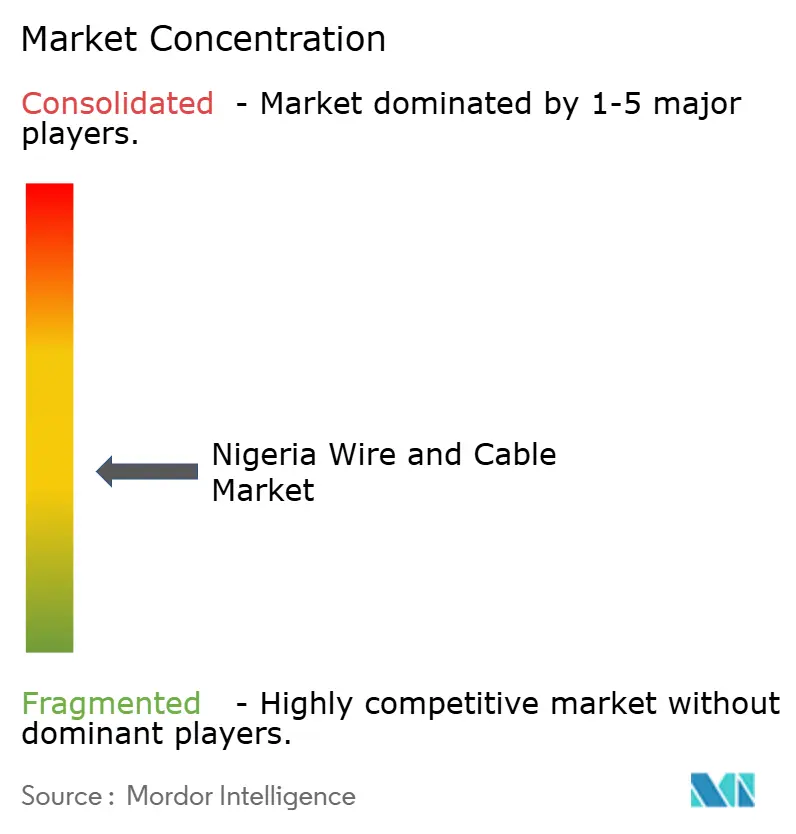
| Market Concentration | Medium |
Major Players *Disclaimer: Major Players sorted in no particular order Image © Mordor Intelligence. Reuse requires attribution under CC BY 4.0. | |
Nigeria Wire and Cable Market Analysis by Mordor Intelligence
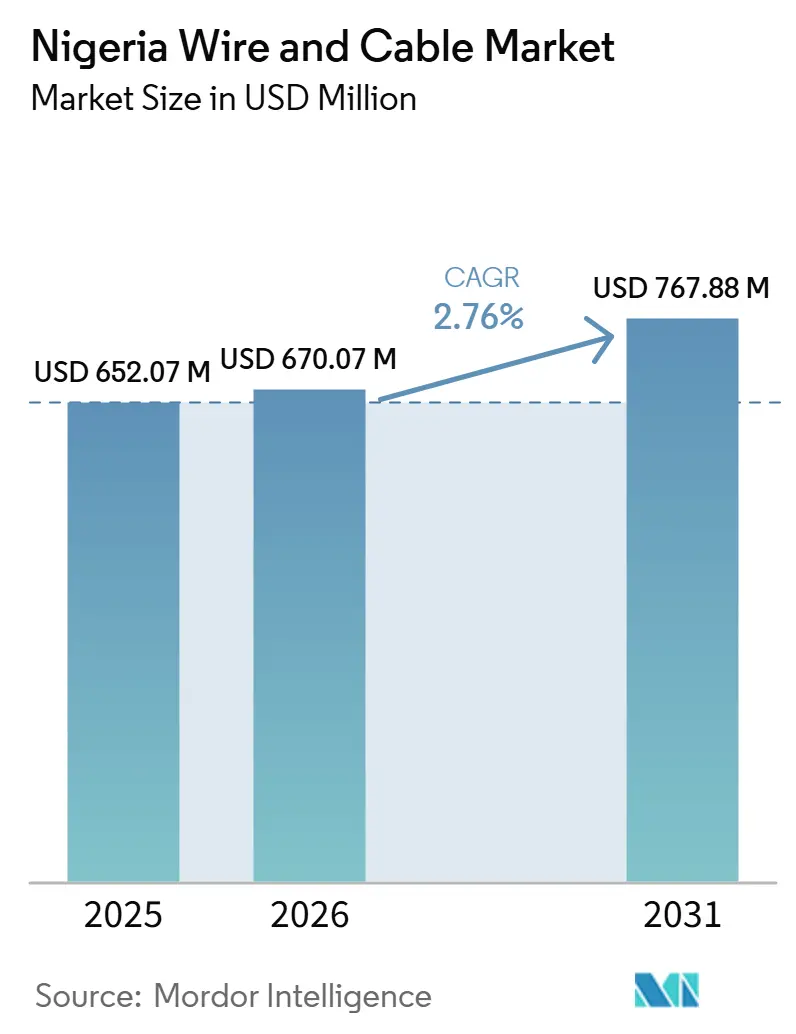
The Nigeria wire and cable market size is projected to expand from USD 652.07 million in 2025 and USD 670.07 million in 2026 to USD 767.88 million by 2031, registering a CAGR of 2.76% from 2026 to 2031. Grid rehabilitation, fiber deployment, rural electrification, and construction activity are shifting demand toward medium-voltage, fiber-optic, and certified cables. Public transmission projects and the national fiber program are creating procurement opportunities that local producers have not always been able to meet at scale. Imported copper, aluminum, insulation compounds, and specialized cable remain exposed to currency and commodity costs. Competition, therefore, depends on technical capability, compliance with standards, delivery capacity, and the ability to serve large infrastructure projects while maintaining a presence in construction wiring. The Nigerian wire and cable market, therefore, presents a larger opportunity for products that meet utility, digital infrastructure, and industrial specifications, while suppliers focused on standard building wire must manage price-sensitive demand, imported materials, certification requirements, and competition from lower-cost alternatives.
Key Report Takeaways
- By voltage, low-voltage cables held 49.86% of revenue share in the Nigeria wire and cable market in 2025, while medium-voltage cables are projected to expand at a 3.72% CAGR through 2031.
- By cable type, power cable held 72.44% of revenue share in the Nigeria wire and cable market in 2025, while fiber-optic cable is projected to expand at a 4.08% CAGR through 2031.
- By conductor material, copper accounted for 55.62% of revenue share in the Nigeria wire and cable market in 2025, while optical glass/polymer is projected to expand at a 4.22% CAGR through 2031.
- By installation, overhead systems held 52.36% of revenue share in the Nigeria wire and cable market in 2025, while underground systems are projected to expand at a 3.41% CAGR through 2031.
- By end-user vertical, power infrastructure (utilities and renewables) accounted for 26.74% of revenue share in the Nigeria wire and cable market in 2025, while telecommunications and data centers are projected to expand at a 4.16% CAGR through 2031.
- By insulation, insulated cable held 88.96% of revenue share in the Nigeria wire and cable market in 2025 and is projected to expand at a 2.92% CAGR through 2031.
Note: Market size and forecast figures in this report are generated using Mordor Intelligence’s proprietary estimation framework, updated with the latest available data and insights as of January 2026.
Nigeria Wire and Cable Market Trends and Insights
Drivers Impact Analysis*
| Driver | (~) % Impact on CAGR Forecast | Geographic Relevance | Impact Timeline |
|---|---|---|---|
| Grid Rehabilitation and Transmission Expansion | +0.7% | National, with early gains in Northwest, Southeast, and South-South corridors | Medium term (2-4 years) |
| Fiber Backbone and Data Center Buildout | +0.6% | National backbone, with near-term concentration in Lagos, Abuja, and commercial hubs | Medium term (2-4 years) |
| Renewable Energy and Mini-Grid Electrification | +0.5% | National rural rollout across 19 states under the DARES program | Medium term (2-4 years) |
| Urban Construction and Housing Wiring Demand | +0.4% | Lagos, Abuja, Port Harcourt, secondary cities, and peri-urban areas | Short term (≤ 2 years) |
| Industrial and Oil and Gas Project Electrification | +0.3% | South-South and Southeast, including Niger Delta, Cross River, and offshore facilities | Long term (≥ 4 years) |
| Local Manufacturing, Quality Certification, and Import Substitution | +0.2% | National, with early gains in Lagos and Southeast manufacturing clusters | Long term (≥ 4 years) |
| Source: Mordor Intelligence | |||
Grid Rehabilitation and Transmission Expansion
Grid investment is the leading near-term source of demand in the Nigeria wire and cable market. Transmission projects valued at more than USD 1.3 billion were active across Nigeria and received support from the World Bank, the French Development Agency, the African Development Bank, and the Japan International Cooperation Agency. These projects added 8,500 MVA of transformation capacity and increased bulk power wheeling capacity from 7,000 MW in January 2024 to 8,700 MW in November 2025. The Federal Government targeted an additional 4,000 MW of grid capacity by the end of 2026 under the Presidential Power Initiative. Re-conductoring projects need more cable and conductor material than the single-circuit lines they replace, especially where a double-circuit quad-conductor design is used. Nigerian Industrial Standards requirements and public procurement rules also favor products that meet specified cable standards, so manufacturers need documented certification, consistent testing, and adequate production capacity to compete for these large public infrastructure orders.
Fiber Backbone and Data Center Buildout
Fiber deployment is expanding the role of optical cable in the Nigeria wire and cable market. Project BRIDGE targets expanding the national fiber backbone from 35,000 km to 125,000 km, creating a multi-year need for fiber-optic cable.[1]Federal Ministry of Communications, Innovation and Digital Economy, “Project BRIDGE,” Federal Ministry of Communications, Innovation and Digital Economy, fmcide.gov.ng Telecommunications operators invested more than NGN 2.5 trillion (USD 1.65 billion) in network infrastructure in 2025. The country had deployed 101,148 km of fiber by July 2026, while Lagos and Abuja accounted for 18.35% of that network. Data center plans also increased the need for structured cabling, fiber trunking, and dense power distribution. Local manufacturers that develop optical cable drawing and assembly capability could compete for procurement that has largely relied on imports, especially in projects that require regular supply across secondary cities, rural routes, and data center connections.
Renewable Energy and Mini-Grid Electrification
Rural electrification is supporting demand for distribution cable beyond the central grid. The Rural Electrification Agency approved a USD 750 million facility for 1,350 solar mini-grids, including 250 interconnected systems that supply power into the national grid. The DARES program had 391 projects under grant agreements by early 2026, with a target of providing access to 17.5 million people across 19 states.[2]World Bank, “Distributed Access Through Renewable Energy Scale-Up Programme,” World Bank, documents1.worldbank.org The 2026 mini-grid rules raised the maximum capacity of isolated systems from 1 MW to 5 MW and interconnected systems to 10 MW. Larger sites require longer distribution networks and more medium-voltage cable before service reaches homes and businesses. This supports recurring demand for low-voltage, medium-voltage, and control cable across rural installations, since each site needs connections from generation equipment through distribution networks to individual households, businesses, and public facilities.
Urban Construction and Housing Wiring Demand
Housing demand provides a continuing base for low-voltage building wire and distribution cable. The Federal Government measured Nigeria's housing deficit at 14.925 million units in 2025. Meeting that deficit would require 550,000 new units each year and annual construction expenditure of NGN 5.5 trillion (USD 3.62 billion) over 10 years.[3]Federal Ministry of Information and National Orientation, “FG's Technical Committee Releases New Housing Data, Pegs Deficit at 15 Million Units,” Federal Ministry of Information and National Orientation, fmino.gov.ng Real estate generated NGN 16.42 trillion (USD 10.81 billion) in nominal value in the first quarter of 2025. Construction projects can be delayed by inflation and high financing costs, even when the underlying demand remains substantial. Mandatory Nigerian Industrial Standards certification for building wire gives certified suppliers a stronger position in formal construction and federal procurement, where buyers require documented compliance and seek to reduce risks associated with substandard electrical products.
Restraints Impact Analysis*
| Restraint | (~) % Impact on CAGR Forecast | Geographic Relevance | Impact Timeline |
|---|---|---|---|
| Naira Depreciation and Imported Input Cost Inflation | -0.5% | National, with the greatest effect in the Lagos import-dependent manufacturing cluster | Short term (≤ 2 years) |
| Copper and Aluminum Price Volatility | -0.3% | National, with added exposure in Nnewi and Lagos manufacturing clusters | Medium term (2-4 years) |
| Counterfeit and Substandard Cable Competition | -0.2% | National, with high concentration in open markets in Lagos, Kano, and Aba | Short term (≤ 2 years) |
| Limited High-Voltage Manufacturing and Testing Capacity | -0.1% | National, particularly public infrastructure and oil and gas procurement | Long term (≥ 4 years) |
| Source: Mordor Intelligence | |||
Naira Depreciation and Imported Input Cost Inflation
Exchange-rate movements remain a material constraint for the Nigeria wire and cable market because copper rod, aluminum rod, PVC, XLPE compounds, and steel wire armor are commonly priced in foreign currency. Imported inputs account for a large share of manufacturers' cost base. Long-term industrial and utility contracts can restrict the frequency of price revisions, even when input costs change quickly. This leaves manufacturers exposed when contract revenue is received in naira while materials are purchased in foreign currency. The pressure is particularly high in lower-margin residential cable, where cheaper imported alternatives can take sales from certified local producers. The Central Bank of Nigeria's foreign exchange measures may improve stability, but manufacturers remain sensitive to renewed currency weakness.
Copper and Aluminum Price Volatility
Copper is the leading conductor material and is central to cost control in the Nigeria wire and cable market. Copper prices can represent 55-65% of cable manufacturing costs, while Nigerian producers must import copper rod rather than smelt it locally. Manufacturers therefore face the combined effect of global copper prices, exchange-rate movement, import duties, and logistics costs. Aluminum can be more economical for overhead distribution lines, but its performance limits its use in underground and building-wire applications that need copper. Aluminum bar import prices stood at USD 2,851 per ton in 2025. Nigerian Industrial Standards for purity and conductor dimensions require additional compliance spending for certified manufacturers.
*Our forecasts treat driver/restraint impacts as directional, not additive. The impact forecasts reflect baseline growth, mix effects, and variable interactions.
Segment Analysis
By Voltage: Medium-Voltage Demand Gains Momentum Amid Grid Upgrades
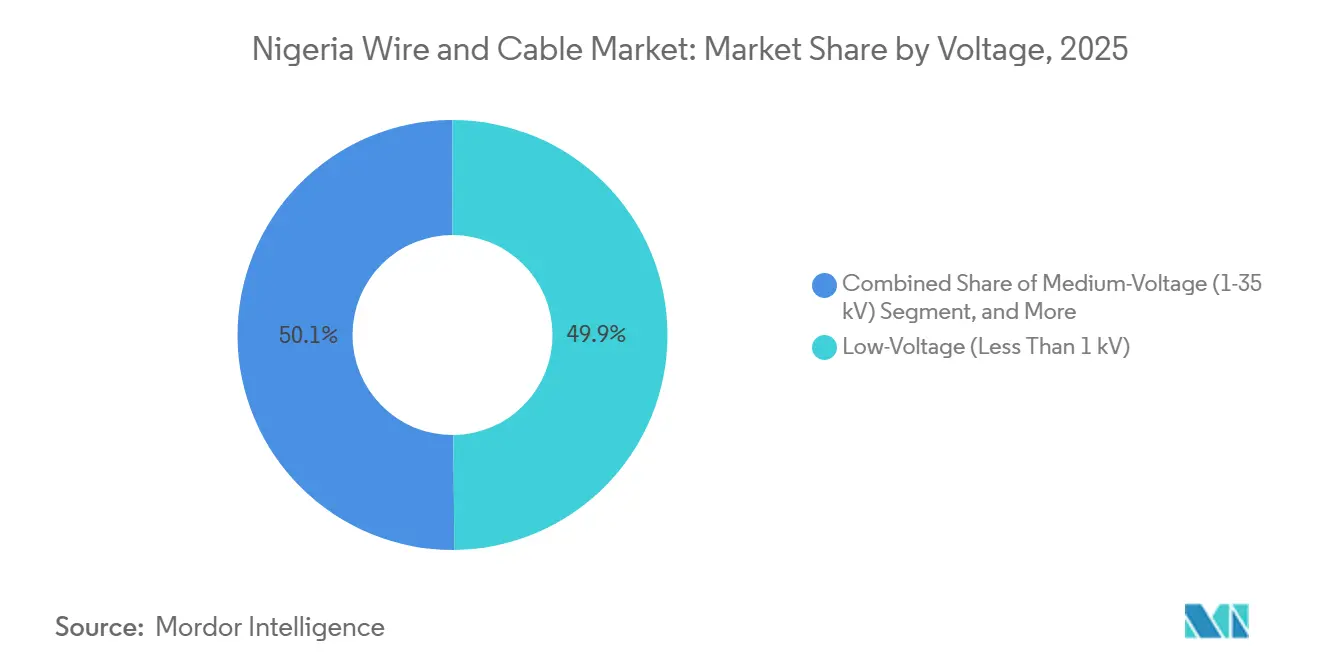
Low-voltage cables held 49.86% of the Nigeria wire and cable market share in 2025. They are widely used in residential and commercial buildings, where demand centers on building wire and local distribution cable. Within the Nigeria wire and cable market, this base reflects the scale of construction projects and the need to connect new homes, offices, and small businesses. Certified low-voltage products remain important because building wire must meet the Nigerian Industrial Standards. The Nigeria wire and cable industry continues to depend on this category for broad project volume, including the routine building connections and local distribution work that follow housing construction, commercial development, and formal public-sector wiring requirements.
Medium-voltage cables are projected to expand at a 3.72% CAGR between 2026 and 2031. Substation expansion, interconnected mini-grids using 33 kV collector cable, and distribution rehabilitation support this growth. The NNPC and Seplat joint venture commissioned an underground power system at NOGAPS Odukpani in November 2025, comprising more than 27 km of medium-voltage cable and 19 packaged substations. Extra-high-voltage and high-voltage cables continue to generate lower revenue because local production capacity is limited. The Alaoji-Onitsha 330 kV upgrade and the Mando-Rimin Zakara line offer procurement opportunities that are still largely served by imports, as domestic suppliers have limited production and testing capabilities for these high-specification conductor classes.



By Cable Type: Fiber-Optic Cable Changes a Power Cable-Dominated Mix
Power cable accounted for 72.44% of the Nigeria wire and cable market in 2025. It is used across residential, commercial, industrial, utility, and renewable power projects. Within the Nigeria wire and cable market, its scale reflects the need for electricity distribution in nearly every end-user setting. Grid rehabilitation and construction work keep the power cable at the center of procurement. The product category also includes higher-specification cables for transmission and industrial projects, where capacity, insulation performance, and installation environment determine the required cable design.
Fiber-optic cable is projected to expand at a 4.08% CAGR through 2031, the fastest pace among cable types. Project BRIDGE plans a large national backbone buildout and supports demand beyond the main metropolitan areas. Signal, control, coaxial, and data cables support automation in oil and gas facilities, manufacturing sites, and data center campuses. Procurement in these categories increasingly appears in Nigerian Content Development and Monitoring Board-compliant project packages. International suppliers with single-mode, multi-mode, and connectivity system portfolios are better placed to supply specialized fiber projects while domestic capability develops, particularly where buyers need integrated cable, connector, and network equipment packages.
By Conductor Material: Copper Retains a Leading Position as Optical Glass/Polymer Grows
Copper accounted for 55.62% of revenue in 2025. Its conductivity supports power cable, building wire, and data cable applications where conductor performance and cross-sectional requirements are important. In the Nigeria wire and cable market, copper demand is closely linked to construction wiring and medium-voltage distribution. Imported copper rods also make the segment sensitive to foreign exchange and global commodity prices. This exposure affects both local producers and project buyers, who must manage raw-material price changes while maintaining the required conductor quality and cable specifications for each installation.
Optical glass/polymer is projected to expand at a 4.22% CAGR through 2031. Each kilometer of Project BRIDGE requires an optical fiber strand, buffer tubes, strengthening elements, and sheathing materials. Aluminum remains useful in overhead distribution and transmission because it reduces the weight on long spans. Fiber-enabled smart metering for solar mini-grids provides an additional demand channel for optical materials. MicCom Cables and Wires announced a USD 30 million expansion into cable production from 33 kV to above 110 kV, showing a local effort to move into higher-value power conductors. Optical fiber manufacturing at scale remains a longer-term prospect in Nigeria, even as domestic cable producers seek to expand their position in higher-voltage power cable and related value-added products.
By Installation: Underground Cable Use Grows in Cities and Oil and Gas Projects
Overhead installation held 52.36% of revenue in 2025. Its leading position reflects Nigeria's existing distribution network and the lower per-kilometer cost of overhead construction compared with underground trenching. The Nigeria wire and cable market continues to rely on overhead systems for rural and peri-urban network expansion. They are also used in the rehabilitation of existing distribution lines. This method remains important where project budgets prioritize network reach, particularly in rural and peri-urban areas where long line distances and constrained project budgets favor overhead construction.
Underground installation is projected to expand at a 3.41% CAGR from 2026 to 2031. Distribution companies value vandal-resistant infrastructure, especially after cable theft on overhead lines. Urban grid hardening in Lagos and Abuja, and industrial development in the Niger Delta, also support underground cable. The Federal Government signed a USD 118 million contract with Elsewedy Electric Company and Power China for the construction of 687 km of new distribution lines and the rehabilitation of 1,983 km of existing lines. Submarine cable remains a small installation category, but deepwater developments require specialized subsea power and control umbilicals that local manufacturers do not currently produce, leaving these high-value orders dependent on global supply.
By End-User Vertical: Telecommunications and Data Centers Lead Growth
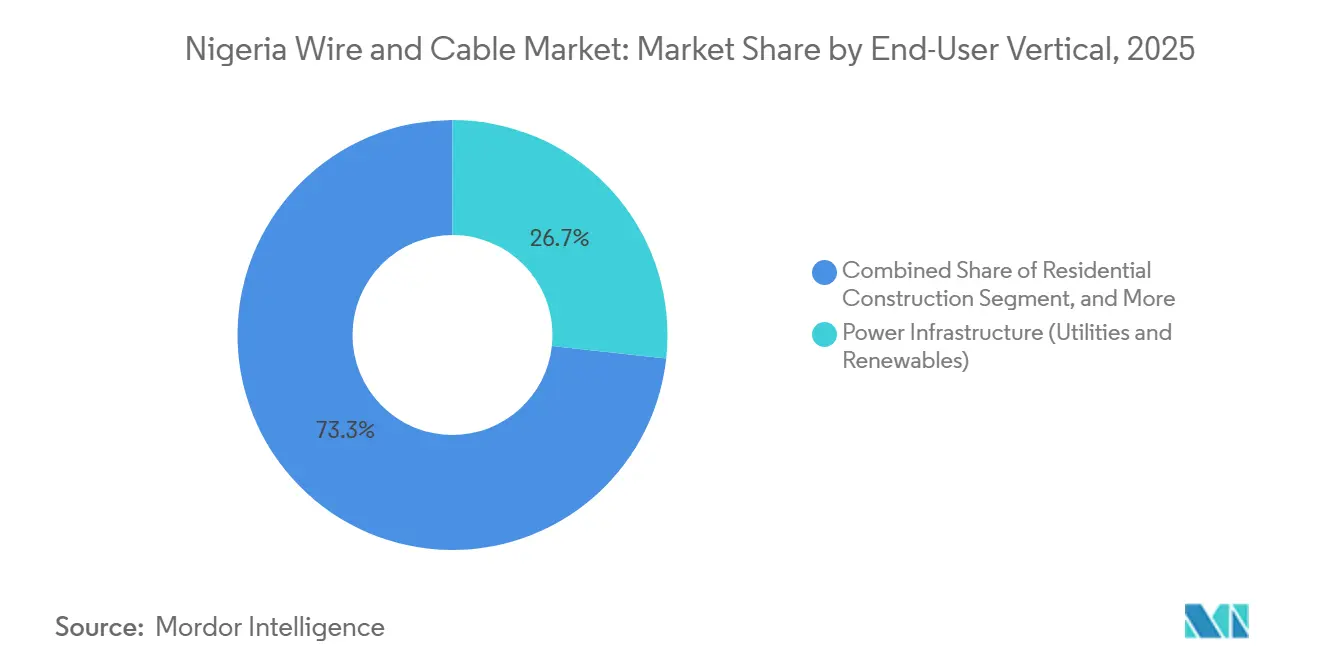
Power infrastructure, utilities, and renewables accounted for 26.74% of the Nigeria wire and cable market share in 2025. Transmission, distribution rehabilitation, and grid-connected renewable projects sustain demand in this vertical. Rural mini-grids also need medium-voltage feeders, household connections, and control cable. The World Bank-backed DARES program is supporting electrification projects across 19 states. Public-sector power programs create larger orders with specific technical and certification requirements, which can favor suppliers that can demonstrate compliance, provide technical documentation, and support project delivery schedules.
Telecommunications and data centers are projected to expand at a 4.16% CAGR through 2031. Data centers require structured cabling, high-density power cable distribution, and fiber trunking that add cable content to each data hall. Kasi Cloud opened the first phase of its planned 100 MW campus in Lagos in May 2026. Oil and gas, and petrochemicals, can create periodic demand for medium-voltage and control cables as projects enter construction. Residential and commercial construction have lower cable values per project but form a large base of smaller projects. Industrial manufacturing, automotive, and mobility remain the smallest end-user verticals, though charging infrastructure is beginning to drive demand at commercial locations, while factory modernization can increase demand for control, data, and power cables.
By Insulation: Insulated Cable Leads Across Applications
Insulated cable held 88.96% of revenue in 2025. In the Nigeria wire and cable market, it is the standard choice for underground residential wiring, data center cable systems, fiber ductwork, and medium-voltage distribution. The high share reflects an end-use mix that generally requires insulation for safety and performance. Certified insulated cable also aligns with formal procurement requirements. The residual non-insulated category is concentrated in bare aluminum overhead conductors, which remain relevant for some rural distribution lines but have narrower use in newer protected network configurations.
Insulated cable is projected to expand at a 2.92% CAGR through 2031. XLPE remains a preferred material for medium- and high-voltage applications because it meets thermal and electrical performance requirements. Non-insulated cable is used in rural overhead distribution, but its relative share may decline as underground and insulated aerial bundled cable systems expand. Urban grid-hardening projects favor protected cable configurations. This sustained preference creates demand across construction, utilities, telecommunications, and industrial applications, as these sectors increasingly specify protected cable systems to support safety, reliability, and operational performance.
Geography Analysis
Lagos and the southwestern corridor had the highest density of cable procurement across construction, telecommunications, and data center development. Lagos accounted for 11.4% of Nigeria's 101,148 km of deployed fiber in July 2026. The city hosts a concentration of formal economic activity and continued demand for low-voltage, medium-voltage, and fiber-optic cable. Kasi Cloud's 100 MW Lekki campus, Equinix's Lagos expansion, Digital Realty's LKK2 facility, and OADC's planned facility add to the local need for power and structured cable. The DARES program also points to continued distribution investment in the southwest despite higher electricity access than many other regions, because formal network improvements remain necessary to reduce reliance on informal generation and strengthen local connections.
Northern and southeastern states represent important areas for federally funded transmission procurement, including 330 kV line projects in Kano and Kaduna and the Mando-Rimin Zakara double-circuit quad-conductor line. The Nigeria wire and cable market size for these corridors is also supported by the 138 km Alaoji-Onitsha 330 kV upgrade, which started right-of-way compensation in April 2026 and is expected to finish within 18 months. Rural programs distribute mini-grid installations across 19 northern and central states where grid access is lower. Abuja is a secondary demand hub because it combines public construction activity with the country's second-largest accumulated fiber deployment. These areas require transmission conductors, distribution cables, household wiring, and control cables, with requirements varying across large federal line upgrades, local mini-grid projects, government facilities, and commercial digital infrastructure.
South-South and Southeast states, including Rivers, Bayelsa, Delta, Edo, and Cross River, have the most capital-intensive cable demand per project. Oil and gas facilities require medium-voltage cable, control cable, and, in deepwater fields, specialized subsea umbilicals. The NOGAPS Odukpani project in Cross River used more than 27 km of medium-voltage cable in a single industrial site. ExxonMobil's USD 1 billion Usan Infill Project, the future activity at Zabazaba and Etan, and Shell's Bonga Southwest Aparo project point to further offshore cable requirements. The Bonga Southwest Aparo project received a USD 20 billion federal tax incentive in July 2026 and is expected to require cable across subsea, medium-voltage, and control applications when construction proceeds, reinforcing the region's importance to suppliers with offshore technical capability.
Competitive Landscape
The Nigeria wire and cable market is moderately fragmented, with no local producer holding a dominant share. Kabelmetal Nigeria Plc, an affiliate of Nexans S.A., has one of the broadest local manufacturing positions across power, instrumentation, construction, and oil-and-gas cables. It supplied instrumentation and power cable for Nigeria LNG Limited's Train 5 work at Bonny Island in February 2026. Cutix PLC, Coleman Wires and Cables, Nigerchin Electrical Development Company Limited, and MicCom Cables and Wires are established in low-voltage residential and commercial cable, while Prysmian S.p.A., Belden Inc., Furukawa Electric Co., Ltd., Sumitomo Electric Industries, Ltd., and ZTT International Nigeria Ltd. are positioned for high-specification fiber-optic, medium-voltage, and subsea cable, where product qualifications and specialized engineering capability remain important.
Product complexity separates domestic and international competitors in the Nigeria wire and cable industry. MicCom Cables and Wires announced a USD 30 million expansion in 2025 to produce cables from 33 kV to above 110 kV, including factory renovations, new machinery, and a dedicated high-voltage production facility. Elsewedy Electric Company and Power China secured a USD 118 million federal contract to construct and rehabilitate distribution lines, showing the value of combining cable supply with installation engineering. Kabelmetal Nigeria inaugurated a solar plant at its Ikeja facility in November 2025 to reduce diesel-related production costs. International companies also use in-country partnerships and Nigerian Content Development and Monitoring Board-aligned structures to participate in upstream projects, reflecting the need to satisfy local-content expectations alongside technical project requirements.
Optical glass/polymer cable is a clear capability gap because significant local fiber manufacturing capacity has yet to emerge. Project BRIDGE provides a multi-year fiber demand pipeline, while imports continue to serve specialized cable needs. Counterfeit products weaken pricing power for manufacturers that comply with standards, and the Standards Organization of Nigeria reported enforcement action against fake electrical cables and other substandard products. A local producer with IEC-compliant optical cable could strengthen its position in public procurement and import substitution. The competitive position of suppliers will continue to depend on certification, technical range, project partnerships, and reliability of supply, because customers must balance price with verified quality, delivery capability, and suitability for the intended installation.
Nigeria Wire and Cable Industry Leaders
Coleman Wires and Cables
Kabelmetal Nigeria Plc
Cutix PLC
Nigerchin Electrical Development Company Limited
MicCom Cables & Wires LTD
- *Disclaimer: Major Players sorted in no particular order

Recent Industry Developments
- July 2026: The Federal Government approved a USD 20 billion production-linked tax incentive for Shell's Bonga Southwest Aparo deepwater project, which is expected to deliver 150,000 barrels per day of crude oil and 140 million standard cubic feet per day of gas upon completion. The scale of the project's subsea and topsides infrastructure will generate substantial offshore cable procurement across umbilicals, power cables, and control cable systems across its multi-year development cycle.
- July 2026: The Rural Electrification Agency, through the DARES program, broke ground on 4 solar-hybrid mini-grid projects in Rivers State, totaling 11.9 MWp, delivering electricity access to more than 13,492 households, businesses, and public institutions. The projects, funded with World Bank support, require medium-voltage distribution cable and low-voltage household wiring, adding to the nation's recurring demand for mini-grid cable.


Nigeria Wire and Cable Market Report Scope
The Nigeria wire and cable market revenue is generated through the sale of low-, medium-, and high-voltage wires and cables, including power, fiber-optic, signal and control, and coaxial/data cables with copper, aluminum, or optical glass/polymer conductors, along with associated value-added products and installation-specific solutions for overhead, underground, and submarine network deployments.
The Nigeria wire and cable market report is segmented by voltage (extra- and high-voltage (greater than 35 kV), medium-voltage (1-35 kV), and low-voltage (less than 1 kV)), cable type (power cable, fiber-optic cable, signal and control cable, and coaxial and data cable), conductor material (copper, aluminum, and optical glass/polymer), installation (overhead, underground, and submarine), end-user vertical (residential construction, commercial construction, power infrastructure (utilities and renewables), telecommunications and data centers, oil and gas and petrochemicals, automotive and mobility, and industrial manufacturing), and insulation (insulated and non-insulated). The market forecasts are provided in terms of value (USD).
| Extra- and High-Voltage (Greater Than 35 kV) |
| Medium-Voltage (1-35 kV) |
| Low-Voltage (Less Than 1 kV) |
| Power Cable |
| Fiber-Optic Cable |
| Signal and Control Cable |
| Coaxial and Data Cable |
| Copper |
| Aluminum |
| Optical Glass/Polymer |
| Overhead |
| Underground |
| Submarine |
| Residential Construction |
| Commercial Construction |
| Power Infrastructure (Utilities and Renewables) |
| Telecommunications and Data Centers |
| Oil and Gas and Petrochemicals |
| Automotive and Mobility |
| Industrial Manufacturing |
| Insulated |
| Non-Insulated |
| By Voltage | Extra- and High-Voltage (Greater Than 35 kV) |
| Medium-Voltage (1-35 kV) | |
| Low-Voltage (Less Than 1 kV) | |
| By Cable Type | Power Cable |
| Fiber-Optic Cable | |
| Signal and Control Cable | |
| Coaxial and Data Cable | |
| By Conductor Material | Copper |
| Aluminum | |
| Optical Glass/Polymer | |
| By Installation | Overhead |
| Underground | |
| Submarine | |
| By End-User Vertical | Residential Construction |
| Commercial Construction | |
| Power Infrastructure (Utilities and Renewables) | |
| Telecommunications and Data Centers | |
| Oil and Gas and Petrochemicals | |
| Automotive and Mobility | |
| Industrial Manufacturing | |
| By Insulation | Insulated |
| Non-Insulated |


Key Questions Answered in the Report
What is the Nigeria wire and cable market size?
The Nigeria wire and cable market was valued at USD 652.07 million in 2025 and is estimated to reach USD 767.88 million by 2031 at a 2.76% CAGR.
Which voltage category is growing fastest in Nigeria?
Medium-voltage cable is projected to grow at a 3.72% CAGR through 2031, supported by grid upgrades and larger interconnected mini-grids.
Which cable type has the highest growth outlook?
Fiber-optic cable is projected to expand at a 4.08% CAGR through 2031 as Project BRIDGE expands national digital infrastructure.
What is driving cable demand from telecommunications and data centers?
The telecommunications and data center vertical is projected to grow at a 4.16% CAGR through 2031 because fiber deployment and new data center projects need power and structured cable.
Why is underground cable becoming more important in Nigeria?
Underground installation is projected to grow at a 3.41% CAGR through 2031 because utilities and cities need more protected, vandal-resistant infrastructure.
What limits local cable manufacturing capability?
Producers face imported input costs, commodity price volatility, counterfeit competition, and limited high-voltage and optical cable production capability.
Page last updated on:





