
New Zealand Sustainable Tourism Market Size and Share
Market Overview
| Study Period | 2022 - 2031 |
|---|---|
| Forecast Data Period | 2026 - 2031 |
| Base Year Market Size (2025) | USD 5.35 Billion |
| Market Size (2026) | USD 5.97 Billion |
| Market Size (2031) | USD 7.98 Billion |
| Growth Rate (2026 - 2031) | 5.98 % |
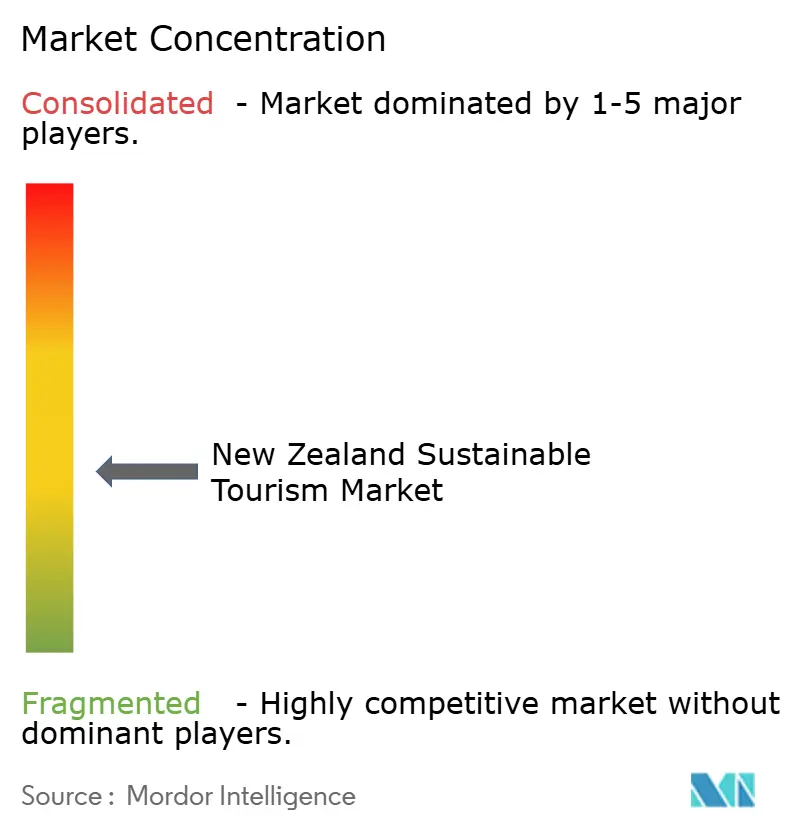
| Market Concentration | Medium |
Major Players *Disclaimer: Major Players sorted in no particular order Image © Mordor Intelligence. Reuse requires attribution under CC BY 4.0. | |
New Zealand Sustainable Tourism Market Analysis by Mordor Intelligence
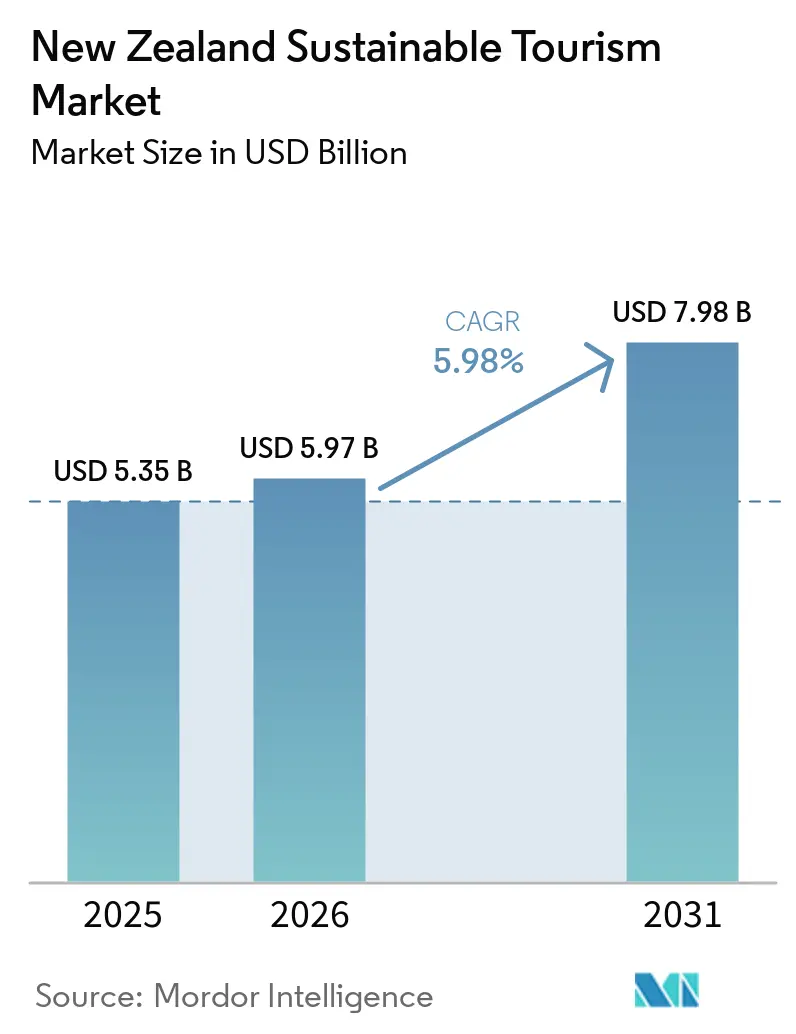
The New Zealand Sustainable Tourism Market was valued at USD 5.35 billion in 2025 and estimated to grow from USD 5.97 billion in 2026 to reach USD 7.98 billion by 2031, at a CAGR of 5.98% during the forecast period (2026-2031). Growth is driven by policies promoting high-value, low-impact tourism. The "Tourism Growth Roadmap" targets 3.89 million international arrivals by 2026, with 3.51 million recorded in 2025, achieving 90% of the goal. Total tourism expenditure reached NZD 46.6 billion (USD 27.04 billion) by March 2025, a 3.3% increase from 2024, while international spending recovered to 106% of 2019 levels[1]Stats NZ, “Tourism Satellite Account: Year Ended March 2025,” Stats NZ, stats.govt.nz. Tourism contributed 4.6% to GDP in 2025, highlighting its role in New Zealand’s economy. Conservation funding also supports the market, with the "International Visitor Conservation and Tourism Levy" generating NZD 145.98 million (USD 84.71 million) in FY2024/25, funding infrastructure and natural asset protection. Challenges include seasonality and infrastructure pressure, but opportunities are growing in regenerative, regional, and off-peak tourism, where demand outpaces supply.
Key Report Takeaways
- By tourism type, Ecotourism commanded a 38.73% share of the New Zealand Sustainable Tourism Market in 2025, while Wellness Tourism is projected to grow at the highest CAGR of 6.73% in the New Zealand Sustainable Tourism Market by 2031.
- By service type, Accommodation commanded a 34.46% share of the New Zealand Sustainable Tourism Market in 2025, while Activities and Experiences are projected to grow at the highest CAGR of 6.45% in the New Zealand Sustainable Tourism Market by 2031.
- By booking channel, Online Travel Agencies commanded a 38.94% share of the New Zealand Sustainable Tourism Market in 2025, while Direct Booking is projected to grow at the highest CAGR of 6.38% in the New Zealand Sustainable Tourism Market by 2031.
- By traveler type, International Travelers commanded a 60.45% share of the New Zealand Sustainable Tourism Market in 2025, while Domestic Travelers are projected to grow at the highest CAGR of 7.14% in the New Zealand Sustainable Tourism Market by 2031.
- By geography, the South Island commanded a 58.39% share of the New Zealand Sustainable Tourism Market in 2025, while the North Island is projected to grow at the highest CAGR of 7.35% in the New Zealand Sustainable Tourism Market by 2031.
Note: Market size and forecast figures in this report are generated using Mordor Intelligence’s proprietary estimation framework, updated with the latest available data and insights as of January 2026.
New Zealand Sustainable Tourism Market Trends and Insights
Drivers Impact Analysis*
| Driver | (~) % Impact on CAGR Forecast | Geographic Relevance | Impact Timeline |
|---|---|---|---|
| Government-Led Sustainable Tourism Positioning | +0.7% | National, with early gains in Queenstown, Rotorua, Fiordland, and Auckland | Medium term (2-4 years) |
| Growing Demand for Off-Peak and Year-Round Visitation | +0.5% | National, with spillover to Northland, Bay of Plenty, and the West Coast | Medium term (2-4 years) |
| Rising Preference for Nature-Based and Low-Impact Travel | +0.9% | South Island core, with spillover to North Island conservation areas | Short term (≤ 2 years) |
| Direct Flight Connectivity and Long-Haul Accessibility | +0.6% | Christchurch, Queenstown, and Auckland international gateways | Short term (≤ 2 years) |
| Expansion of Certification-Led Tourism Offerings | +0.4% | National, concentrated in Rotorua, Queenstown, and Marlborough | Medium term (2-4 years) |
| Digital Booking and Responsible-Travel Discovery | +0.4% | Demand side, with strongest platform effects in Auckland and nationwide | Short term (≤ 2 years) |
| Source: Mordor Intelligence | |||
Government-Led Sustainable Tourism Positioning
New Zealand has shifted its tourism strategy from increasing visitor numbers to prioritizing value-driven and regenerative growth, providing a clear policy framework for the Sustainable Tourism Market. Budget 2025 allocated NZD 55 million (USD 31.92 million) annually from the IVL to the Department of Conservation and NZD 35 million (USD 20.31 million) to MBIE, creating a steady funding source for conservation and tourism infrastructure[2]Ministry of Business, Innovation and Employment, “Budget 2025 Major Spending Decisions, International Visitor Conservation and Tourism Levy,” MBIE, mbie.govt.nz. The Tourism Growth Roadmap aims to double 2023 tourism exports to NZD 19.8 billion (USD 11.49 billion) by 2034 and designates NZD 19.5 million (USD 11.32 million) for international marketing in FY2025/26. These measures support operators aligning their offerings with conservation goals, regional tourism dispersal, and higher-spending visitor segments. This approach strengthens the Sustainable Tourism Market by reinvesting increased visitor demand into improving destination quality and accessibility.
Growing Demand for Off-Peak and Year-Round Visitation
Tourism New Zealand's Statement of Performance Expectations for 2024-2028 emphasizes off-peak demand conversion as a key priority. This marks a shift toward making year-round visitation a national goal rather than a secondary marketing focus. The first MBIE Domestic Visitor Survey found that 78% of New Zealanders planned at least two overnight domestic trips within six months, indicating a broader domestic travel demand beyond traditional international peak periods. Additionally, 24% of domestic day-trip respondents cited natural attractions as their primary motivation, highlighting opportunities for shoulder-season and regional visits if offerings are well-packaged. Seasonal smoothing allows operators to better utilize labor, transport, and accommodation throughout the year[3]Tourism New Zealand, “Statement of Performance Expectations 2024-28,” Tourism New Zealand, tourismnewzealand.com. It also supports New Zealand's Sustainable Tourism Market by reducing congestion at popular sites and creating space for regional products, easing peak-period pressures.
Rising Preference for Nature-Based and Low-Impact Travel
Nature-led travel is driving demand in New Zealand's sustainable tourism market. Nearly 73% of international visitors participated in walking, hiking, or tramping in the year ended June 2025, while 52% visited a national park, highlighting the importance of conservation assets in travel itineraries. The Great Walks network recorded 154,000 bednights at a 78% occupancy rate during the 2024/25 season, a 10% increase from the previous year, signaling capacity challenges. International visitors accounted for 40% of bookings, while domestic walkers contributed nearly 60%, reflecting the appeal of nature-focused activities to both groups. Longer-stay visitors offered significant opportunities, with German travelers staying a median of 28.3 days and spending an average of NZD 6,499 per trip (USD 3,771.2), favoring slower and more diverse itineraries.
Direct Flight Connectivity and Long-Haul Accessibility
Air access is essential for the growth of New Zealand's sustainable tourism market, as long-haul and interregional trips rely on efficient routing. Air New Zealand plans to introduce non-stop routes from Christchurch to Singapore, Tokyo, and Perth in late October 2026, significantly improving direct access to the South Island. A Queenstown-Brisbane non-stop route is also set to launch in 2026, facilitating easier travel for short-haul visitors to adventure and nature destinations. Overseas visitor arrivals by air increased by 4% in 2025, supported by a 207,000-seat capacity expansion, indicating continued recovery in air access. Direct entry points to the South Island are expected to distribute first-night spending and travel flows more evenly, benefiting sustainable operators who previously relied on Auckland-based itineraries.
Restraints Impact Analysis*
| Restraint | (~) % Impact on CAGR Forecast | Geographic Relevance | Impact Timeline |
|---|---|---|---|
| Seasonality Creates Capacity and Yield Volatility | -0.6% | Fiordland, Queenstown Lakes, Bay of Islands, and Coromandel | Medium term (2-4 years) |
| Infrastructure Pressure in Visitor Hotspots | -0.5% | Milford Sound, Queenstown, Abel Tasman, and Tongariro | Medium term (2-4 years) |
| High Cost of Low-Impact Transport and Operations | -0.4% | National, with stronger pressure in the remote South Island | Long term (≥ 4 years) |
| Limited Supplier Readiness for Regenerative Standards | -0.3% | Regional operators outside major centers | Medium term (2-4 years) |
| Source: Mordor Intelligence | |||
Seasonality Creates Capacity and Yield Volatility
Tourism revenue in New Zealand remains concentrated in the December to March period, creating challenges in pricing, staffing, and asset utilization during the rest of the year. Severe weather events in 2025 disrupted access and damaged infrastructure, as noted by Tourism Industry Aotearoa in 2026. These disruptions made shoulder periods less reliable for operators dependent on narrow seasonal windows. Low-impact tourism activities, such as hiking, marine wildlife tours, alpine activities, and stargazing, are particularly affected due to their sensitivity to weather and daylight conditions. Single-site operators face higher risks from this volatility compared to businesses capable of adjusting visitor flows across seasons, locations, or service combinations. This seasonality continues to restrict the New Zealand Sustainable Tourism Market's ability to convert strong demand into evenly distributed annual earnings.
Infrastructure Pressure in Visitor Hotspots
Infrastructure challenges continue to hinder growth, as high-profile sites experience concentrated demand while physical upgrades progress slowly. Milford Sound Piopiotahi exemplifies this issue, with a significant milestone reached only after a long-term concession was granted in January 2026, following years of planning[4]Department of Conservation, “Key Concession Decision Provides Certainty for Milford Tourism,” Department of Conservation, doc.govt.nz. The NZD 8.2 million (USD 4.76 million) IVL-funded investment in the Milford corridor supports conservation efforts and access management but does not fully resolve throughput or visitor service limitations. When demand surpasses site capacity, operators face reduced flexibility in scheduling, pricing, and product design. As a result, infrastructure bottlenecks are expected to restrict parts of the New Zealand Sustainable Tourism Market until destination upgrades align with the recovery in visitor numbers.
*Our forecasts treat driver/restraint impacts as directional, not additive. The impact forecasts reflect baseline growth, mix effects, and variable interactions.
Segment Analysis
By Tourism Type: Conservation-Integrated Models Support Ecotourism Leadership
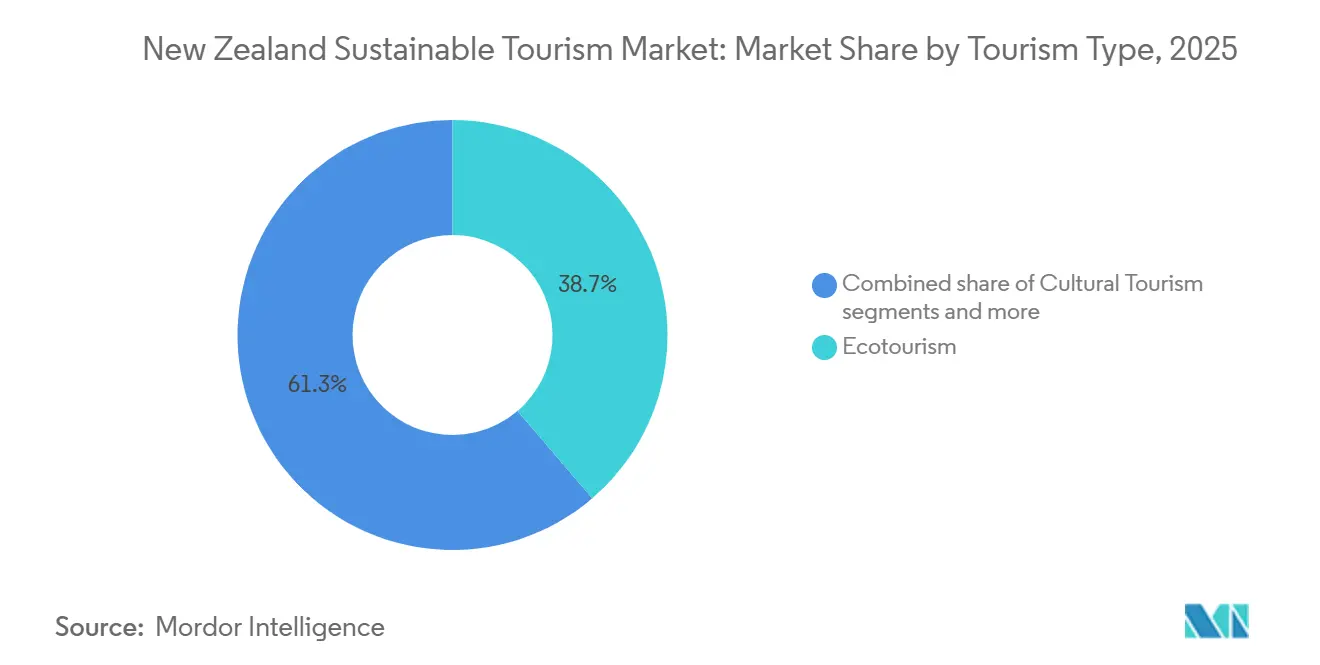
Ecotourism represented 38.73% of New Zealand's sustainable tourism market in 2025, driven by protected landscapes and DOC-managed experiences. The Milford Track sold out in 34 minutes during the 2026 booking season, with 13,500 concurrent users on the booking page, reflecting strong demand for nature-based experiences. Visitors from 70 countries booked DOC facilities, and international travelers accounted for 34% of Great Walk bookings, highlighting global and consistent interest in ecotourism. Cultural tourism ranked as the second-largest segment, supported by a Māori tourism sector valued at NZD 1.2 billion (USD 0.70 billion), which grew 23% since 2018. Wai Ariki Hot Springs and Spa exemplify this segment by combining geothermal wellness with te ao Māori, appealing to both domestic and international visitors.
Wellness tourism is the fastest-growing segment, with a projected CAGR of 6.73% through 2031, signaling diversification in New Zealand's sustainable tourism offerings. The Global Wellness Institute (GWI) projects the global wellness economy to hit record heights, with the specific wellness tourism market having already crossed USD 1 trillion and continuing its rapid expansion through 2026. This immense global demand enhances New Zealand’s competitive positioning, allowing local operators to leverage the country's premium geothermal and natural assets. Wai Ariki was developed with NZD 60 million (USD 34.82 million) investment, while RealNZ committed to planting 50,000 native trees and installing 2,000 predator traps by 2028, linking guest experiences to habitat restoration and strengthening the sector’s focus on verified environmental outcomes.



By Service Type: Accommodation Leads While Experiences Lift Growth
Accommodation represented 34.46% of New Zealand's sustainable tourism market in 2025, highlighting its importance in domestic and international travel. International spending on accommodation reached NZD 3.1 billion (USD 1.80 billion) by June 2025, reflecting a recovery in visitor nights and paid stays. Sustainable certification gained traction, with the New Zealand International Convention Centre achieving Qualmark Gold in February 2026. Certified accommodations are easier to market through trade channels and sustainability-focused booking filters, expanding the market to include larger venues and event-linked stays alongside boutique eco-lodges.
Activities and experiences are projected to grow at a 6.45% CAGR from 2026 to 2031, showing strong yield growth. An official report says that 58% of overnight domestic travelers participated in walking or hiking, demonstrating high demand for active, place-based experiences. Transportation remains constrained due to limited low-emission travel options outside major centers, especially for nature-based products requiring long transfers. While Air New Zealand’s SAF initiatives show progress, the transition remains gradual and costly. The market increasingly relies on certified accommodation for baseline demand, with growth driven by experience rather than transport-heavy models.
By Booking Channel: OTAs Hold Scale While Direct Channels Gain Speed
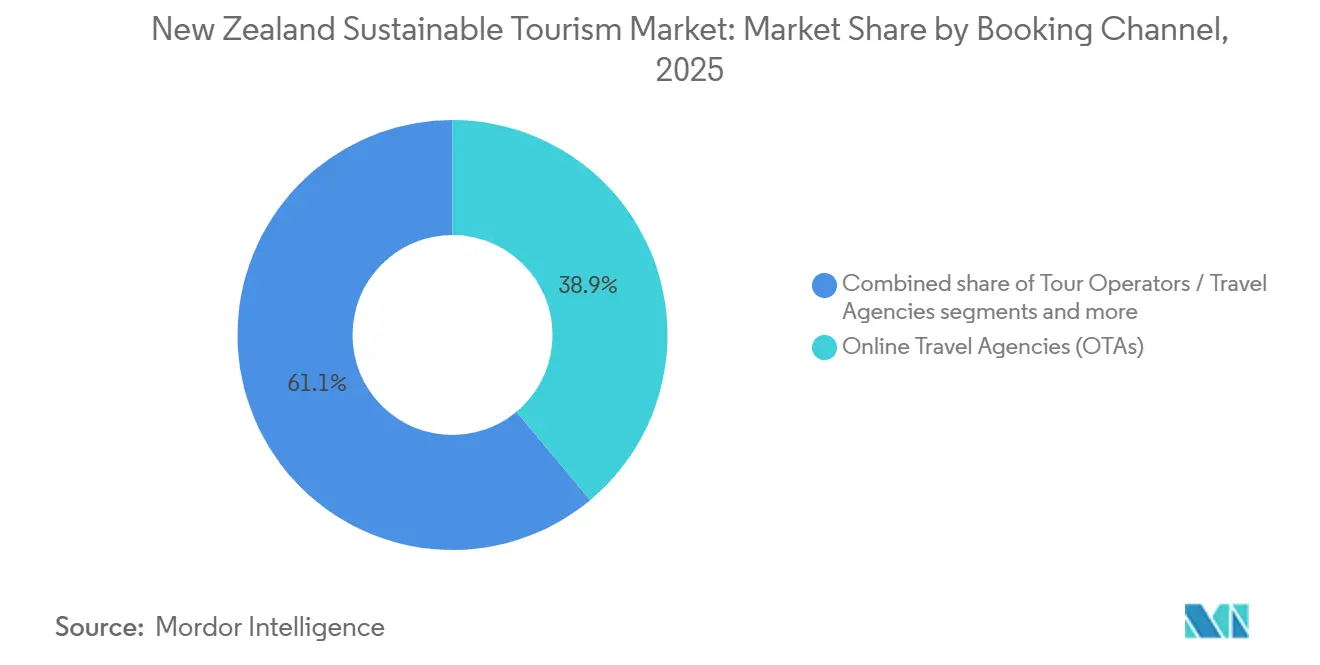
Online travel agencies accounted for 38.94% of the booking channel share in 2026, making them the largest channel in New Zealand's Sustainable Tourism Market. Their position is supported by the GSTC Market Access framework, which highlights sustainable properties on major digital travel platforms. This framework benefits smaller operators by reducing the visibility gap with larger brands as sustainability becomes a key search and ranking factor. Direct bookings are growing at a 6.38% CAGR through 2031, reflecting operators' focus on improving websites, relationship marketing, and repeat-guest strategies. This shift enhances net margins and provides operators with greater control over guest communication, cancellation policies, and sustainability narratives.
Tour operators and travel agencies remain significant for long-haul travelers seeking curated itineraries. Intrepid Travel’s acquisition of Haka Tours in August 2025 strengthened this channel by connecting New Zealand offerings to global distribution. Destination management companies continue to support business events and group travel, with official data reporting that business event visitors spend NZD 175 (USD 101.55) more daily than leisure visitors. Tourism New Zealand’s 2026 trade outlook identified active escapes, noctourism, and digital detoxing as emerging themes, aligning with specialist operators and direct channels. OTAs are expected to retain volume, while direct and specialist channels capture more purpose-driven demand.
By Traveler Type: International Demand Anchors Value While Domestic Travel Accelerates
International travelers accounted for 60.45% of New Zealand's Sustainable Tourism Market in 2025, reflecting the sector's reliance on inbound spending. International tourism expenditure reached NZD 18.1 billion (USD 10.50 billion) by March 2025, exceeding 2019 levels in nominal terms. Australia was the largest source market, contributing NZD 3.8 billion (USD 2.21 billion) with 1.52 million arrivals. The United States followed with NZD 1.9 billion (USD 1.10 billion) and the highest daily spend of NZD 338 (USD 196.13), while China added NZD 1.2 billion (USD 0.70 billion). These figures highlight the market's dependence on short-haul visitors and select high-value long-haul segments.
Domestic travelers represented 39.55% of the market's value in 2025 and are projected to grow at a 7.14% CAGR through 2031, making them the fastest-growing segment. Household travel expenditure in New Zealand reached NZD 21.2 billion (USD 12.30 billion) in 2025, indicating strong domestic demand supporting regional and shoulder-season growth. A survey by MBIE showed 78% of New Zealanders planned at least two overnight trips in the next six months, reflecting a solid repeat-travel base. German visitors remained significant, staying a median of 28 days and spending NZD 8,100 (USD 4,700.22) per trip. These trends indicate a balanced approach between international revenue and domestic stability.
Geography Analysis
The South Island accounted for 58.39% of New Zealand's Sustainable Tourism Market in 2025, driven by destinations like Fiordland, Queenstown Lakes, Abel Tasman, and Kaikōura. These areas offer iconic outdoor attractions aligned with visitor interests in walking, national parks, and low-impact experiences. Queenstown’s carbon-zero goal by 2030 emphasizes regenerative growth over volume expansion. Air New Zealand’s new Christchurch routes to Singapore, Tokyo, and Perth, starting in late 2026, will enhance long-haul access. Milford Sound’s long-term concession decision and Ngāi Tahu’s 33.33% acquisition of Milford Sound Tourism Limited in March 2026 strengthen operational stability and community trust.
The North Island is growing faster, with a forecasted 7.35% CAGR through 2031. Growth is driven by wellness, cultural experiences, and gateway-linked visitation rather than reliance on a single outdoor corridor. Rotorua is central to this trend, supported by NZD 60 million (USD 34.82 million) invested in Wai Ariki Hot Springs and Spa, which focuses on Māori cultural and geothermal wellness. MBIE’s October 2025 official data reported 36% of overnight domestic travelers visited museums or galleries, and 13% explored Māori cultural sites, highlighting demand in urban and cultural hubs. Auckland remains a key international gateway, supporting first-arrival distribution and urban tourism spending.
While the South Island held 58.39% of the market in 2025, the North Island is expected to close the gap with its faster growth rate. The market is shifting from being solely driven by iconic scenery to incorporating wellness, culture, and urban access. Improved air connectivity will better distribute visitors between islands, reducing reliance on Auckland and boosting regional spending. New Zealand’s Sustainable Tourism Market reflects a dual dynamic, with the South Island anchoring share and the North Island leading growth.
Competitive Landscape
The New Zealand Sustainable Tourism Market is realistically fragmented, with no single operator dominating the national supply. Competition arises from a mix of major players and numerous certified small to mid-sized businesses across accommodation, transport, guiding, and destination experiences. Qualmark’s GSTC-recognized certification has become a key competitive factor, enhancing trade access and visibility in sustainable travel channels. Many businesses hold Qualmark certification, reflecting the broad competitive field. Success in this market depends on combining channel access, product credibility, and destination stewardship rather than relying solely on scale.
Tourism Holdings Limited, a significant operator, reported rental revenue growth in FY25, supported by a large vehicle fleet. However, its underlying profit declined due to challenging cost conditions, highlighting that scale alone does not ensure profitability. RealNZ has differentiated itself by integrating measurable conservation goals, including tree planting and predator control targets by 2028. This approach was recognized with the Air New Zealand Supreme Tourism Award in 2024. Intrepid Travel’s acquisition of Haka Tours in August 2025 connected New Zealand’s small-group offerings with a broader international network.
Air New Zealand influences competition through network decisions, with new Christchurch routes expected to benefit South Island operators from late 2026. Opportunities remain in regional North Island products, lower-carbon inter-island travel, and multi-day Māori cultural itineraries. As more operators adopt certification and conservation-focused strategies, competition is expected to intensify, making verifiable sustainability efforts more critical. The market continues to prioritize local expertise, route access, and proven environmental performance over national scale.
New Zealand Sustainable Tourism Industry Leaders
Tourism New Zealand
Air New Zealand
Tourism Holdings Limited
Haka Tourism Group
RealNZ
- *Disclaimer: Major Players sorted in no particular order

Recent Industry Developments
- May 2026: Air New Zealand has partnered with Christchurch Airport through a long-term MOU to support sustainable aviation growth in the South Island. The airline will launch non-stop routes from Christchurch to Singapore, Tokyo (Narita), and Perth in late October 2026. These routes mark the first direct connections to Asia and Australia from Christchurch in over a decade, enhancing access to the South Island's key ecotourism corridor and promoting nature tourism in the region.
- February 2026: The New Zealand International Convention Centre (NZICC) has earned Qualmark Gold certification, meeting GSTC-recognized criteria as a sustainable large-scale tourism venue. It is the first major convention center certified under Qualmark's updated 2025 assessment model, enhancing Auckland's sustainable event tourism capacity.
- December 2025: Ngāi Tahu acquired a 33.33% stake in Milford Sound Tourism Limited (MSTL), forming equal ownership with RealNZ (Real Group) and Skeggs Group. The Southland District Council exited, enhancing Ngāi Tahu's role in Māori co-governance of New Zealand's most visited fjord.
- August 2025: Intrepid Travel has acquired Haka Tours and rebranded it as Intrepid DMC New Zealand Limited. This move consolidates Haka Tours and ANZ Nature Tours under one inbound tourism leadership for the first time. The company aims to rank among the top three travel brands in New Zealand.


New Zealand Sustainable Tourism Market Report Scope
| Ecotourism |
| Cultural Tourism |
| Adventure Tourism |
| Wellness Tourism |
| Transportation |
| Accommodation |
| Food & Beverage |
| Activities & Experiences |
| Online Travel Agencies (OTAs) |
| Direct Booking (Hotels / Resorts / Operators) |
| Tour Operators / Travel Agencies |
| Destination Management Companies (DMCs) |
| Domestic Travelers |
| International Travelers |
| South Island |
| North Island |
| By Tourism Type | Ecotourism |
| Cultural Tourism | |
| Adventure Tourism | |
| Wellness Tourism | |
| By Service Type | Transportation |
| Accommodation | |
| Food & Beverage | |
| Activities & Experiences | |
| By Booking Channel | Online Travel Agencies (OTAs) |
| Direct Booking (Hotels / Resorts / Operators) | |
| Tour Operators / Travel Agencies | |
| Destination Management Companies (DMCs) | |
| By Traveler Type | Domestic Travelers |
| International Travelers | |
| By Geography | South Island |
| North Island |


Key Questions Answered in the Report
What is the current size of the New Zealand sustainable tourism sector?
The New Zealand Sustainable Tourism Market was valued at USD 5.35 billion in 2025 and is estimated at USD 5.97 billion in 2026, with growth to USD 7.98 billion by 2031 at a 5.98% CAGR.
Which tourism type leads demand in New Zealand?
Ecotourism led in 2025 with 38.73% share, supported by strong demand for Great Walks, national parks, and DOC-managed conservation experiences.
Which traveler group is growing fastest in New Zealand?
Domestic travelers are growing fastest, with a projected 7.14% CAGR through 2031, supported by strong household travel spending and repeat overnight trip intent among New Zealand residents.
Why is the South Island still the core tourism region?
The South Island held 58.39% share in 2025 because it concentrates iconic nature assets such as Fiordland and Queenstown, and new Christchurch international routes should strengthen this position further.
How important is sustainability certification for tourism operators in New Zealand?
Certification is becoming increasingly important because Qualmark’s GSTC-recognized standard supports trade credibility, digital visibility, and access to sustainability-focused promotion and booking channels.
What are the biggest constraints on future growth?
The main constraints are seasonality, infrastructure pressure at iconic destinations, high costs of low-impact transport, and uneven supplier readiness for regenerative standards.
Page last updated on:


 Your data is secure and never sold or shared.


