
Neutral Host Private Networks Market Size and Share
Market Overview
| Study Period | 2020 - 2031 |
|---|---|
| Market Size (2026) | USD 50.16 Billion |
| Market Size (2031) | USD 89.68 Billion |
| Growth Rate (2026 - 2031) | 12.32 % |
| Fastest Growing Market | Asia-Pacific |
| Largest Market | North America |
| Market Concentration | Low |
Major Players *Disclaimer: Major Players sorted in no particular order Image © Mordor Intelligence. Reuse requires attribution under CC BY 4.0. | |
Neutral Host Private Networks Market Analysis by Mordor Intelligence
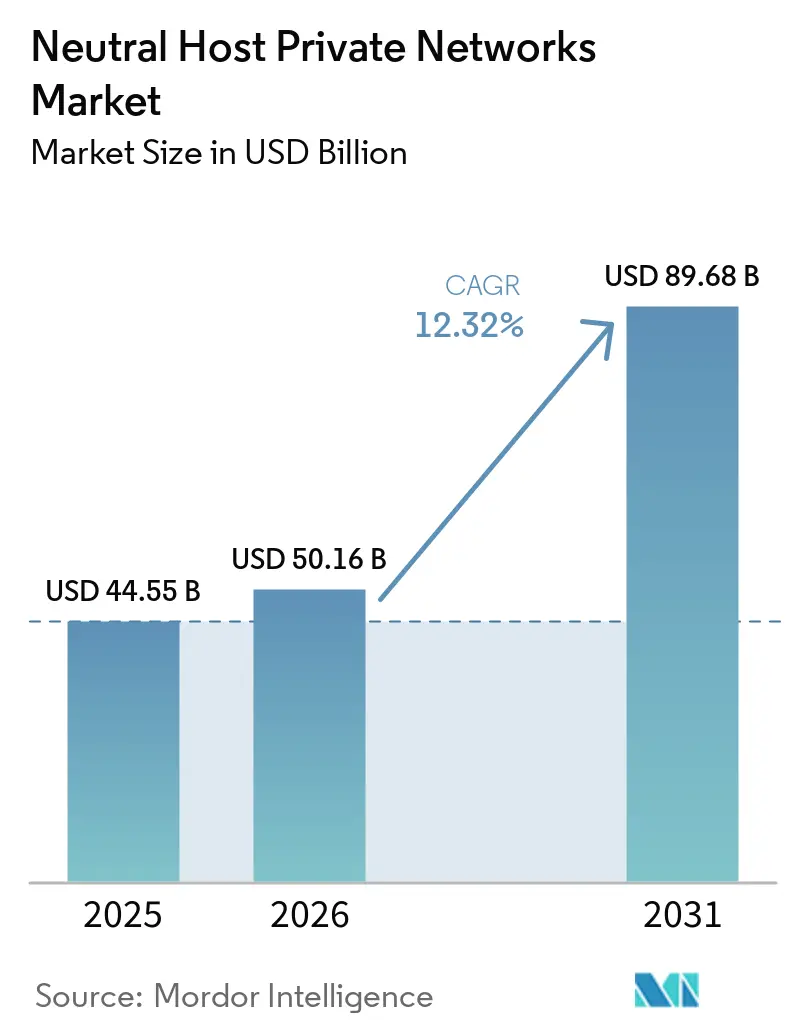
The Neutral Host Private Networks Market size is projected to expand from USD 44.55 billion in 2025 to USD 50.16 billion in 2026, and to USD 89.68 billion by 2031, registering a CAGR of 12.32% between 2026 and 2031. Growth reflects a change in how enterprises and venue owners obtain cellular coverage, as they increasingly fund shared infrastructure rather than wait for mobile network operators to build each site. The Global Mobile Suppliers Association identified 2,003 organizations with private mobile network deployments above EUR 100,000 (USD 115500) across 88 countries by the end of Q1 2026, confirming that private wireless has moved beyond limited trials. Shared systems can give several carriers access to the same radio infrastructure, which improves the financial case for coverage in large buildings, transit facilities, and public venues. Demand is also moving toward systems that connect indoor work areas with yards, loading zones, and other outdoor operational spaces. Regulatory choices on shared and local spectrum, together with difficult retrofit work in older buildings, will continue to affect project timing and investment decisions.
Key Report Takeaways
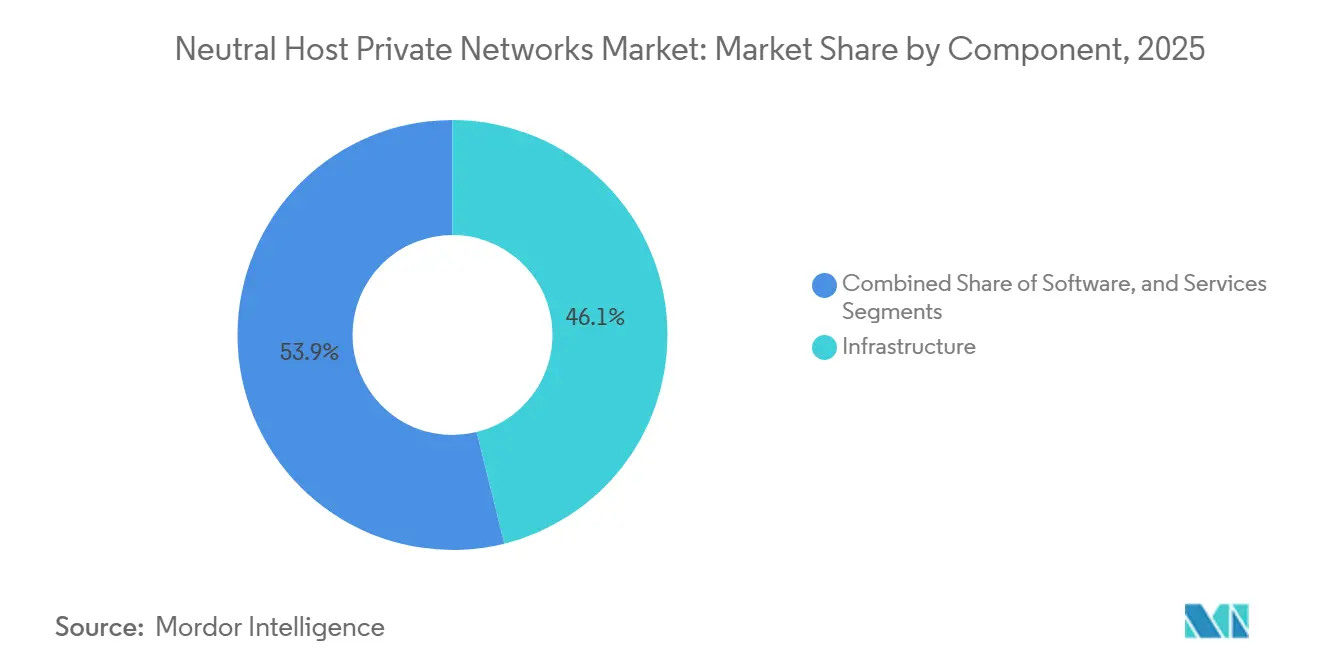
- By component, infrastructure held 46.12% of the Neutral Host Private Networks Market share in 2025, while software is forecast to grow at a 12.43% CAGR through 2031.
- By technology, small cells held 34.16% of the Neutral Host Private Networks Market share in 2025, while Open RAN is forecast to grow at a 12.41% CAGR through 2031.
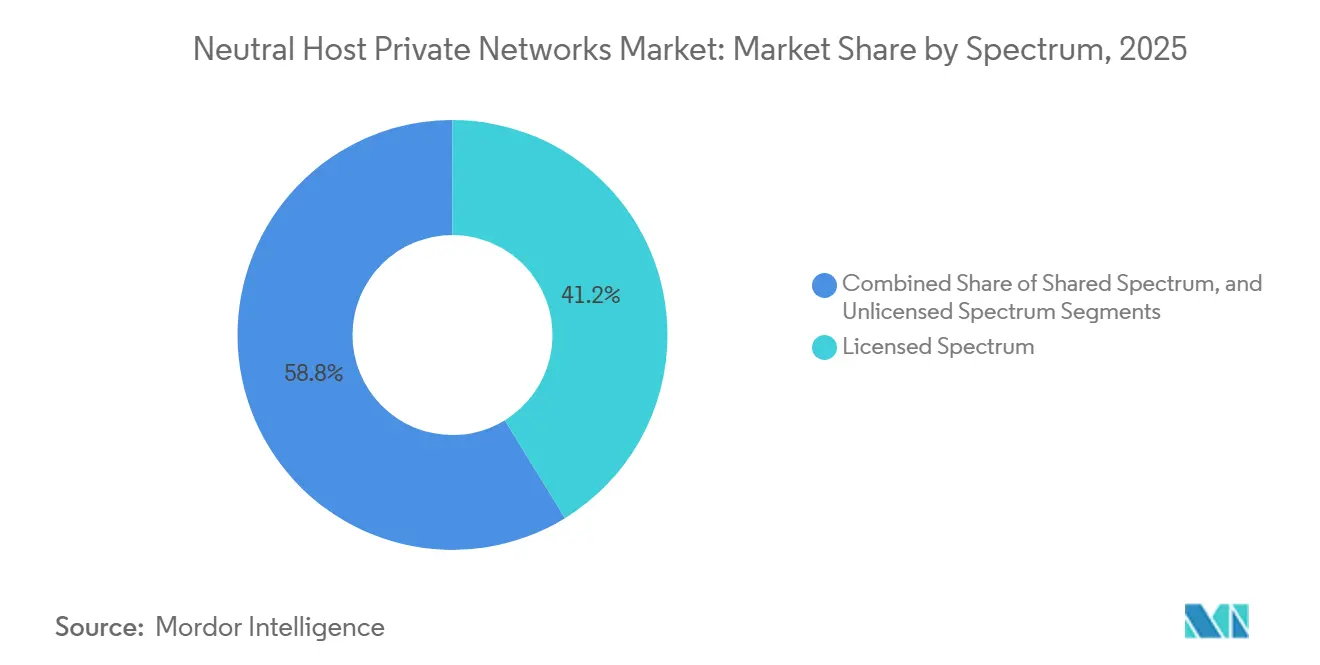
- By spectrum, licensed spectrum held 41.23% of the segment in 2025, while shared spectrum is forecast to grow at a 12.46% CAGR through 2031.
- By ownership model, single-operator systems held 58.14% of the segment in the Neutral Host Private Networks Market in 2025, while multi-operator systems are forecast to grow at a 12.63% CAGR through 2031.
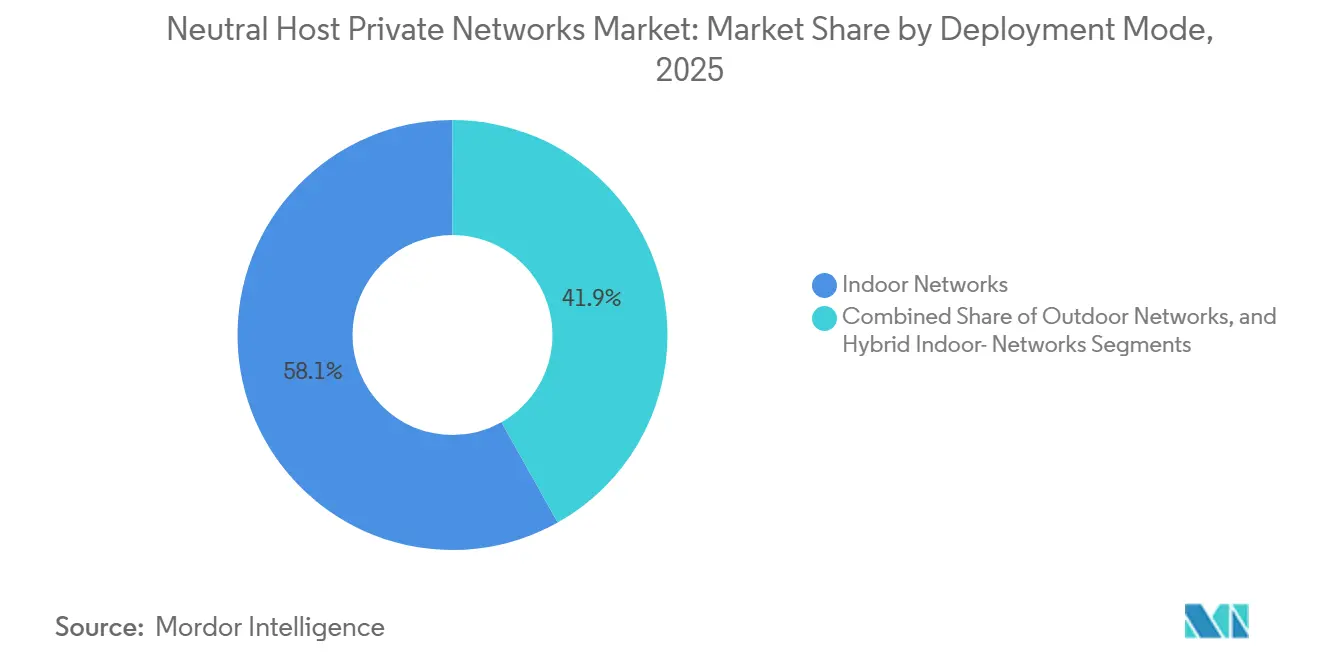
- By deployment mode, indoor networks held 44.12% of deployments in 2025, while hybrid networks are forecast to grow at a 12.74% CAGR through 2031.
- By end-use industry, telecommunications held 22.18% of the segment in Neutral Host Private Networks Market in 2025, while transportation and logistics are forecast to grow at a 12.88% CAGR through 2031.
Note: Market size and forecast figures in this report are generated using Mordor Intelligence’s proprietary estimation framework, updated with the latest available data and insights as of January 2026.
Market Trends and Insights
Drivers Impact Analysis of Neutral Host Private Networks Market*
| Driver | (~) % Impact on CAGR Forecast | Geographic Relevance | Impact Timeline |
|---|---|---|---|
| Adoption of Private 5G and Enterprise Wireless Networks | +3.2% | Global, with concentration in North America, Europe, and Asia-Pacific | Short term (≤ 2 years) |
| Demand for High-Performance Indoor Coverage | +2.6% | Global, with strongest relevance in North America, the United Kingdom, Germany, and Japan | Short term (≤ 2 years) |
| Shared Infrastructure Cost Efficiency | +2.1% | Global, extending to the Middle East and South America | Medium term (2-4 years) |
| Smart Transportation and High-Density Venue Connectivity | +1.6% | North America, Europe, and Asia-Pacific, extending to the Middle East and Africa | Medium term (2-4 years) |
| Healthcare Dual-Network Architecture for Public and Mission-Critical Users | +1.0% | North America and Europe, with early activity in Gulf Cooperation Council countries | Medium term (2-4 years) |
| CBRS, Local-Spectrum, and Multi-Operator Access Expansion | +0.7% | United States, Europe, India, Japan, and South Korea | Long term (≥ 4 years) |
| Source: Mordor Intelligence | |||
Adoption of Private 5G and Enterprise Wireless Networks
Private 5G deployment is moving from trials to operational use across a wider set of enterprises. The GSA recorded 2,003 organizations deploying qualifying private mobile networks in 88 countries by the end of Q1 2026. More than half of the deployments announced since 2022 have used 5G, indicating that newer projects increasingly favor 5G capabilities over private LTE. This change gives neutral host providers a larger pool of sites where coverage, capacity, and shared access are needed together. Open interfaces also allow a venue operator to choose radio, core, and management suppliers separately. The Neutral Host Private Networks Market therefore benefits when enterprises treat wireless connectivity as an operational asset rather than a limited pilot project.
Demand for High-Performance Indoor Coverage
Indoor coverage remains an important reason for deploying shared cellular systems. Steel, concrete, and insulated glass reduce outdoor cellular signals, while mobile operators have focused much of their spending on broader 5G coverage. Building owners and operators are consequently taking greater responsibility for indoor connectivity. Ericsson has positioned its Radio Dot system as a compact alternative to traditional distributed antenna system designs for indoor 5G coverage.[1] The Small Cell Forum expects neutral hosts to operate 28% of enterprise small cells by 2030, compared with 14% in 2023. These conditions support projects in offices, hospitals, hotels, transit stations, and other sites where reliable indoor service is necessary.
Shared Infrastructure Cost Efficiency
A neutral host system allows several mobile operators to use one radio access network and share the cost of building and operating it. This approach is useful at transit sites, stadiums, and multi-tenant properties where a single carrier may not be able to justify a full deployment. Long concession periods allow the provider to spread equipment and construction costs over many years. Boldyn Networks' London Underground program covers 137 stations and 217 tunnels under a 20-year concession, showing how a shared model can support a large transit network.[2] The Small Cell Forum's Hosted RAN framework provides a common design basis for neutral-host and private-network deployments. The Neutral Host Private Networks Market can therefore gain from repeatable designs that reduce planning work and make multi-carrier projects easier to structure.
Smart Transportation and High-Density Venue Connectivity
Ports, airports, rail systems, and large event venues need dependable wireless coverage for both public users and operational systems. Private 5G can support cargo equipment, real-time location services, passenger communications, and safety-related applications on the same site. Three Group Solutions completed a private 5G network across the Port of Felixstowe, Harwich International Port, and London Thamesport in 2025.[3] The network supports autonomous horizontal transport, remote crane control, predictive maintenance, and drone inspections. In such settings, a neutral-host architecture can provide public carrier access, while separate private capacity supports operational requirements. This makes the Neutral Host Private Networks Market relevant to facilities that are replacing separate radio systems with a more integrated connectivity platform.
Restraints Impact Analysis of Neutral Host Private Networks Market*
| Restraint | (~) % Impact on CAGR Forecast | Geographic Relevance | Impact Timeline |
|---|---|---|---|
| High Deployment and Integration Costs | -2.5% | Global, with greater pressure in South America and Africa | Short term (≤ 2 years) |
| Spectrum, Licensing, and Public-Safety Regulatory Fragmentation | -1.8% | North America, Europe, and the Middle East, with global effects | Long term (≥ 4 years) |
| Multi-MNO Commercial Alignment Complexity | -1.2% | Global, concentrated in countries with 3 or more mobile operators | Medium term (2-4 years) |
| Fiber, Power, and Backhaul Constraints in Existing Buildings | -0.8% | Global, with severe constraints in retrofitted buildings across Asia-Pacific and South America | Medium term (2-4 years) |
| Source: Mordor Intelligence | |||
High Deployment and Integration Costs
Large neutral host projects require radio-frequency planning, construction work, carrier coordination, and integration across multiple suppliers. The installation period can be extended when building owners, carriers, and system integrators must approve different parts of the design. Older buildings can add further cost because existing coaxial cable, power systems, and equipment rooms may not support active digital architectures. Fiber and Category 6A upgrades can require civil work that is disruptive and expensive. Building codes, fire safety requirements, and carrier interoperability testing add further steps before service begins. These requirements favor operators with established financing, installation capability, and carrier relationships, which can limit entry into the Neutral Host Private Networks Market.
Spectrum, Licensing, and Public-Safety Regulatory Fragmentation
Spectrum rules vary across countries, creating a practical challenge for suppliers and operators that serve multiple regions. The United States uses CBRS for shared access, while Germany and Japan use separate local 5G licensing approaches. The OnGo Alliance has stated that dedicated and shared mid-band spectrum is important for private networking and has noted that 10 of 11 leading private network countries, excluding China, have dedicated spectrum for industrial use. Transit and government deployments may also need to meet public-safety interoperability requirements. These conditions narrow equipment choices and can lengthen procurement cycles. The Neutral Host Private Networks Market will depend on operators' ability to align spectrum access, carrier agreements, and public-safety obligations at each site.
*Our forecasts treat driver/restraint impacts as directional, not additive. The impact forecasts reflect baseline growth, mix effects, and variable interactions.
Neutral Host Private Networks Market Segment Analysis
By Component:
Software Extends Infrastructure-Led RevenueInfrastructure accounted for 46.12% of the Neutral Host Private Networks Market size in 2025. This position reflects the upfront requirements for distributed antenna system headends, small-cell radios, cloud-based network hardware, and indoor connectivity equipment. Long concessions can spread these costs across 15 to 20 years. Services remain important because customers often outsource network design, integration, monitoring, maintenance, and day-to-day operations. Venue owners typically do not maintain internal teams for radio-frequency engineering. Infrastructure will remain necessary as operators add coverage to buildings, stations, campus sites, and transport facilities.
Software is projected to be the fastest-growing component, at a 12.43% CAGR through 2031. Management, monitoring, security orchestration, automation, and analytics tools increase the value derived from the installed radio network. Open RAN separates the hardware and software layers, allowing operators to use management applications from multiple suppliers. This supports recurring license revenue that was less common in traditional DAS projects. Ericsson's Intelligent Automation Platform was integrated with CommScope's OneCell platform and validated with AT&T's O-RAN DAS work in 2025, showing the role of software coordination in multi-vendor deployments. The Neutral Host Private Networks Market industry is therefore moving toward a balance between physical coverage assets and software that manages them.

By Technology:
Open RAN Broadens the Supplier BaseSmall cells held 34.16% of the technology segment in 2025. Their digital architecture supports 4G and 5G service, carrier aggregation, network slicing, and private 5G activation in compact installations. They are often used in offices and medium-sized venues where a traditional passive DAS design is less suitable. Distributed antenna systems continue to play a role in large hospitals, transit stations, stadiums, and other high-capacity sites. Wi-Fi remains an additional capacity layer in many locations, but it does not replace carrier-grade cellular service where mobile operator access is needed.
Open RAN is forecast to grow at a 12.41% CAGR through 2031. NTT EAST released a joint demonstration report in March 2026 covering a multi-vendor O-RAN RAN Intelligent Controller test for private 5G in Japan, with 26 participating companies.[4] This work shows that suppliers are testing interoperability beyond a single integrated vendor stack. Open interfaces can reduce dependence on a single equipment provider and offer operators greater sourcing flexibility. They can also make it easier to replace or upgrade elements without redesigning an entire system. The Neutral Host Private Networks Market benefits when this flexibility lowers technology and procurement barriers for shared networks.
By Spectrum:
Shared Access Builds a Second Deployment PathLicensed spectrum held 41.23% of the spectrum segment in 2025. Carrier-sponsored systems remain a straightforward model because the mobile network operator provides the spectrum and service commitments. Licensed access offers predictable interference control and supports quality requirements in public safety, healthcare, and transportation. Unlicensed spectrum, including Wi-Fi 6 and Wi-Fi 7, is generally used as an overlay in hospitality, retail, and enterprise sites. It provides extra coverage and capacity but does not offer the same carrier-controlled cellular service.
Shared spectrum is forecast to expand at a 12.46% CAGR through 2031. CBRS and Licensed Shared Access offer mid-band spectrum access without the full cost of an exclusive license. The OnGo Alliance has argued that balanced mid-band policy supports private networking, shared-spectrum use, and long-term technology development. Shared access can lower the threshold for enterprises that require local private coverage but lack a carrier spectrum agreement. However, the approach remains tied to changes in spectrum policy and local licensing conditions. The Neutral Host Private Networks Market is likely to use both licensed and shared spectrum models rather than rely on either one alone.
By Ownership Model:
Multi-Operator Systems Gain Commercial SupportSingle-operator systems held 58.14% of the ownership segment in 2025. Early private 5G and in-building projects were often tied to a single carrier that served as a funding partner or anchor tenant. This model can speed commercial decisions and simplify radio-frequency management. It also suits markets where multi-carrier access agreements are still developing. Carriers continue to use this approach for venues where their own subscriber coverage needs provide the initial business case.
Multi-operator systems are forecast to grow at a 12.63% CAGR through 2031. The model allows several carriers to pay access fees for a shared network over a long operating period. The Hosted RAN framework from the Small Cell Forum was developed with industry participants, including Crown Castle, Cellnex, and CommScope, to support multi-carrier, neutral-host design. A site with several carrier tenants has a stronger case for infrastructure investment than one with only a single tenant. This can improve the operator's position in access-fee negotiations. The Neutral Host Private Networks Market industry is consequently moving toward ownership structures that spread cost and demand across more participants.
By Deployment Mode:
Hybrid Coverage Connects Buildings and YardsIndoor networks accounted for 44.12% of deployments in 2025. Large commercial and institutional buildings often have weak cellular service because building materials attenuate the signal. DAS and small-cell systems remain central to indoor coverage at transit stations, hospitals, hotels, and multi-tenant offices. Outdoor systems address coverage gaps across campuses, industrial sites, and stadium areas. Their design is shaped more by terrain, obstructions, and site layout than by interior building materials.
Hybrid systems are forecast to grow at a 12.74% CAGR through 2031. Manufacturing sites, ports, airports, and educational campuses need connectivity that extends throughout interior workspaces, loading areas, and outdoor yards. Such configurations can connect yard equipment and later extend coverage to warehouses. Industrial sites must also align their connectivity design with operational technology systems. The Neutral Host Private Networks Market is supported by this requirement for a single network footprint across diverse working environments.
By End-Use Industry:
Transportation and Logistics Builds from Automation NeedsTelecommunications held 22.18% of the end-use segment in 2025. Mobile network operators and tower companies use shared infrastructure to extend service in stations, stadiums, and other high-traffic locations. They can act as anchor tenants while also building or operating infrastructure through subsidiaries and concession agreements. Healthcare, hospitality and retail, manufacturing, education, government and public safety, and commercial real estate contribute additional demand. In healthcare, a dual-network model can provide public cellular access for visitors while reserving private 5G functions for clinical operations.
Transportation and logistics are forecast to grow at a 12.88% CAGR through 2031. Automated port and airport operations need secure communications for equipment, sensors, real-time location services, and remote control. Three Group Solutions' 2025 network across 3 United Kingdom port locations supports autonomous transport, crane control, maintenance, and inspections. Transportation operators can build neutral-host-compatible infrastructure by introducing automated equipment rather than waiting for a retrofit. This expands the installed base as new terminals and facilities are modernized. The Neutral Host Private Networks Market can grow where operational networks and public carrier coverage are planned together.
Geography Analysis
North America Neutral Host Private Networks Market
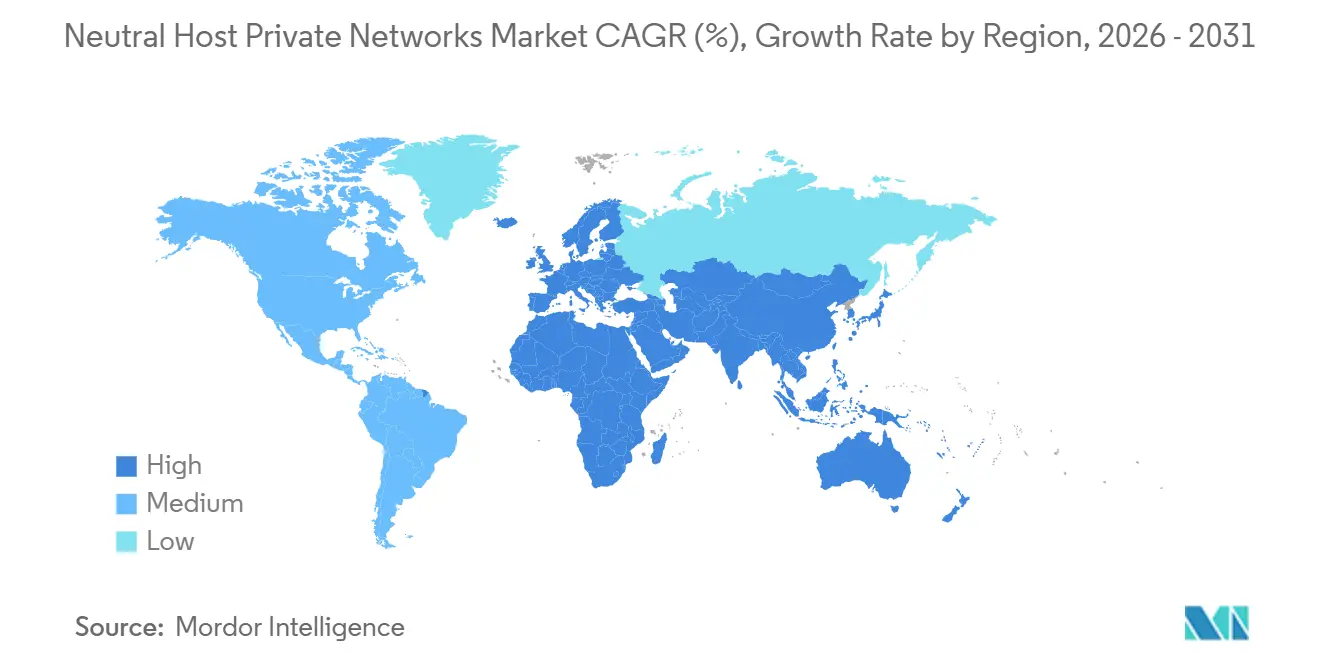
North America accounted for 36.14% of the regional segment in 2025. The United States has a large base of high-value venues and a shared-spectrum option through CBRS. Boldyn Networks and AT&T extended cellular service in 2025 across additional sections of New York City subway tunnels on the 4, 5, and G lines. This kind of transit program demonstrates how a neutral host can provide shared infrastructure for carriers in challenging coverage areas. FirstNet interoperability requirements also influence choices for public-sector and transit venues. North American operators, therefore, need to manage shared access, licensed spectrum, and public-safety obligations within the same project.
APAC Neutral Host Private Networks Market
Asia-Pacific is forecast to be the fastest-growing geography at a 12.96% CAGR through 2031. China is increasing industrial private 5G activity, while Japan has developed a structured local 5G framework. In June 2026, China's Ministry of Industry and Information Technology and 4 other ministries issued a notice supporting industrial 5G standalone private network pilots across raw materials, equipment manufacturing, electronics, energy, transportation, and defense. NTT DOCOMO Business launched its 5G Slicing service in March 2026 and reported 260 combined private 5G and network slicing project references at launch. South Korea, Australia, and India add demand through dedicated spectrum, mining and industrial projects, and captive private network frameworks. This diversity gives the Neutral Host Private Networks Market several regional routes to growth.
EMEA and South America Neutral Host Private Networks Market
Europe combines mature neutral host activity in the United Kingdom with industrial private 5G activity in Germany. Boldyn's London Underground concession offers a long-term reference model for multi-operator transit coverage. The European Commission has supported next-generation airport connectivity through its NextGen 5G Airports initiative, including dedicated 5G standalone private networks at Croatian airports. South America, the Middle East, and Africa remain earlier-stage opportunities as spectrum rules and operator footprints evolve. Brazil's private network spectrum allocation, smart transportation investments in Qatar and the United Arab Emirates, and South Africa's early deployments provide an initial foundation. These regions can become more material after 2026 as regulatory models and local delivery capabilities mature.
Competitive Landscape
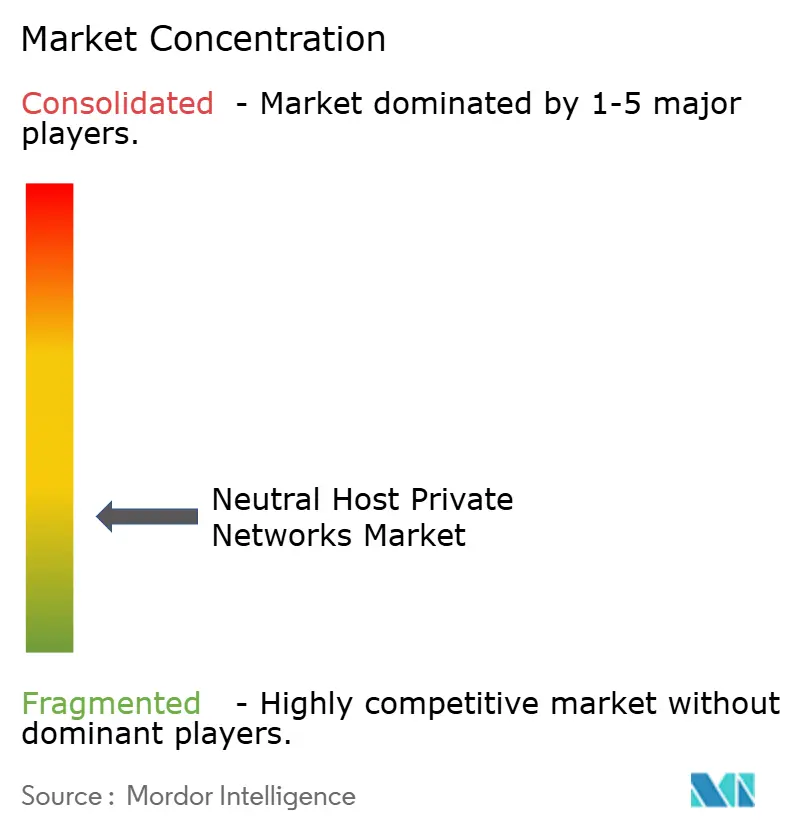
The Neutral Host Private Networks Market is fragmented. Specialist neutral host operators, tower companies, equipment suppliers, and mobile network operators all compete across overlapping parts of the value chain. Boldyn Networks, BAI Communications, ExteNet Systems, Freshwave Group, and Wireless Infrastructure Group focus on designing, building, and operating shared infrastructure under long-term agreements. Nokia, Ericsson, CommScope, JMA Wireless, Airspan Networks, and Celona compete across radio, DAS, core network, and software platforms. The variety of supplier types gives venue owners several options, but it also makes multi-vendor integration and carrier coordination important. No combined top-player share is provided in the source material, which is consistent with a fragmented supplier environment.
Leading firms are using partnerships and delivery contracts to expand their positions. Rakuten Symphony and Celona announced a collaboration in April 2026 for end-to-end Open RAN private 5G solutions for logistics, manufacturing, ports, and mining. The partnership combines cloud-native Open RAN infrastructure with an enterprise 5G platform to reduce deployment complexity. Ericsson announced in April 2026 that Proptivity had commercially deployed its Host Management Control feature in Oslo, allowing multiple operators to connect baseband equipment to a shared indoor Radio Dot system while retaining individual control. These moves show that suppliers are competing through interoperability and simpler deployment models, not only through proprietary radio equipment.
Infrastructure portfolio changes also shape the competitive field. Crown Castle completed the sale of its fiber and small-cell business to EQT and Zayo in May 2026 for USD 8.4 billion. The transaction narrowed Crown Castle's direct role in small-cell and in-building infrastructure while shifting those assets to new owners. Boldyn was selected in 2025 to design, build, and manage a next-generation 5G DAS at Seattle-Tacoma International Airport, covering more than 1 million square feet. Such contracts create durable operating positions by combining construction, carrier access, and long-term venue relationships. Competitive outcomes in the Neutral Host Private Networks Market will therefore depend on financing capacity, carrier agreements, multi-vendor capabilities, and access to large-venue concessions.
Neutral Host Private Networks Industry Leaders
-
American Tower Corporation
-
Crown Castle Inc.
-
Cellnex Telecom, S.A.
-
SBA Communications Corporation
-
Indus Towers Limited
- *Disclaimer: Major Players sorted in no particular order
Neutral Host Private Networks Market Companies Covered in this Report
- Boldyn Networks
- American Tower Corporation
- Crown Castle Inc.
- Cellnex Telecom, S.A.
- Verizon Communications Inc.
- Boingo Wireless, Inc.
- ExteNet Systems, Inc.
- CommScope Holding Company, Inc.
- Nokia Corporation
- Ericsson AB
- Huawei Investment & Holding Co., Ltd.
- Cisco Systems, Inc.
- Celona, Inc.
- Betacom Incorporated
- BAI Communications Pty Ltd
- Freshwave Group Limited
- JMA Wireless
- Airspan Networks Holdings Inc.
- Wireless Infrastructure Group Limited
- Shared Access Limited
- Mobilitie LLC
Recent Industry Developments in Neutral Host Private Networks Market
- June 2026: China's Ministry of Industry and Information Technology, Ministry of Transport, State-Owned Assets Supervision and Administration Commission, and 2 other government ministries jointly issued a notice deploying industrial 5G standalone private network pilots. The initiative supports large enterprises in raw materials, equipment manufacturing, electronics, defense, energy, and transportation in building fully independent 5G standalone networks. It represents a move from virtual network slicing toward physically isolated enterprise private networks.
- May 2026: Crown Castle completed the sale of its fiber and small-cell business to EQT for small cells and Zayo for fiber solutions, for aggregate cash proceeds of USD 8.4 billion. The transaction reorients Crown Castle's portfolio toward tower assets and changes the competitive structure of the United States small-cell neutral host field
- April 2026: Rakuten Symphony and Celona announced a collaboration to develop end-to-end Open RAN-based private 5G solutions on O-RAN specifications for large and medium-scale enterprises in logistics, manufacturing, ports, and mining. The pre-integrated platform combines Rakuten Symphony's cloud-native 5G Open RAN infrastructure with Celona's 5G LAN enterprise platform. It is intended to reduce deployment complexity and total cost of ownership for neutral host operators
- April 2026: Proptivity completed the commercial deployment of Ericsson's Host Management Control feature at a commercial property in Oslo. The feature allows multiple mobile operators to independently connect baseband equipment into a shared indoor 5G Radio Dot system while retaining operator-level control. Ericsson described this as the first disclosed deployment of the multi-operator feature
Global Neutral Host Private Networks Market Report Scope
The neutral host private networks market refers to the ecosystem of shared wireless infrastructure, software, and professional services designed to provide multi-carrier cellular and broadband connectivity within high-density or large-venue environments. Unlike traditional single-operator networks, neutral host models allow multiple mobile network operators (MNOs) or enterprises to simultaneously host and deliver their services over a common physical infrastructure. This includes technologies such as distributed antenna systems (DAS), small cells, Wi-Fi, and open radio access networks (O-RAN), utilizing licensed, shared, or unlicensed spectrum bands. Deployed as indoor, outdoor, or hybrid networks, these solutions are utilized across various end-use industries, including commercial real estate, healthcare, transportation, and hospitality. By adopting a single-operator or multi-operator ownership model, neutral host networks enable venue owners to reduce infrastructure clutter and deployment costs while allowing telecom operators to efficiently extend coverage, increase network capacity, and enhance user experience without the capital expenditure of building dedicated, overlapping networks.
The Neutral Host Private Networks Market Report is Segmented by Component 9(Infrastructure (Distributed Antenna System Infrastructure, Small Cell Infrastructure, Wireless Network Hardware, Cloud-Based Network Infrastructure, and In-Building Connectivity Infrastructure), Services (Network Deployment Services, Managed Connectivity Services, Network Design and Planning Services, Integration and Installation Services, and Maintenance and Support Services), and Software (Network Management Software, Network Monitoring Software, Security Management Software, Cloud Network Orchestration Software, and Data Analytics and Optimization Software)), Technology (Distributed Antenna System, Small Cells, Wireless Fidelity, Open Radio Access Network, and Other Technologies), Spectrum (Licensed Spectrum, Shared Spectrum, and Unlicensed Spectrum), Ownership Model (Single-Operator Model, and Multi-Operator Model), Deployment Mode (Indoor Networks, Outdoor Networks, and Hybrid Indoor-Outdoor Networks), End-Use Industry (Telecommunications, Transportation and Logistics, Healthcare Facilities, Hospitality and Retail, Industrial and Manufacturing, Education and Higher Education, Government and Public Safety, and Commercial Real Estate and Offices), and Geography (North America, South America, Europe, Asia-Pacific, Middle East, and Africa). The Market Forecasts are Provided in Terms of Value (USD).
| Infrastructure | Distributed Antenna System Infrastructure |
| Small Cell Infrastructure | |
| Wireless Network Hardware | |
| Cloud-Based Network Infrastructure | |
| In-Building Connectivity Infrastructure | |
| Services | Network Deployment Services |
| Managed Connectivity Services | |
| Network Design and Planning Services | |
| Integration and Installation Services | |
| Maintenance and Support Services | |
| Software | Network Management Software |
| Network Monitoring Software | |
| Security Management Software | |
| Cloud Network Orchestration Software | |
| Data Analytics and Optimization Software |
| Distributed Antenna System |
| Small Cells |
| Wireless Fidelity |
| Open Radio Access Network |
| Other Technologies |
| Licensed Spectrum |
| Shared Spectrum |
| Unlicensed Spectrum |
| Single-Operator Model |
| Multi-Operator Model |
| Indoor Networks |
| Outdoor Networks |
| Hybrid Indoor-Outdoor Networks |
| Telecommunications |
| Transportation and Logistics |
| Healthcare Facilities |
| Hospitality and Retail |
| Industrial and Manufacturing |
| Education and Higher Education |
| Government and Public Safety |
| Commercial Real Estate and Offices |
| North America | United States |
| Canada | |
| Mexico | |
| South America | Brazil |
| Argentina | |
| Rest of South America | |
| Europe | United Kingdom |
| Germany | |
| France | |
| Italy | |
| Russia | |
| Rest of Europe | |
| Asia-Pacific | China |
| Japan | |
| India | |
| South Korea | |
| Australia | |
| Rest of Asia-Pacific | |
| Middle East | Saudi Arabia |
| United Arab Emirates | |
| Qatar | |
| Israel | |
| Rest of Middle East | |
| Africa | South Africa |
| Egypt | |
| Morocco | |
| Rest of Africa |
| By Component | Infrastructure | Distributed Antenna System Infrastructure |
| Small Cell Infrastructure | ||
| Wireless Network Hardware | ||
| Cloud-Based Network Infrastructure | ||
| In-Building Connectivity Infrastructure | ||
| Services | Network Deployment Services | |
| Managed Connectivity Services | ||
| Network Design and Planning Services | ||
| Integration and Installation Services | ||
| Maintenance and Support Services | ||
| Software | Network Management Software | |
| Network Monitoring Software | ||
| Security Management Software | ||
| Cloud Network Orchestration Software | ||
| Data Analytics and Optimization Software | ||
| By Technology | Distributed Antenna System | |
| Small Cells | ||
| Wireless Fidelity | ||
| Open Radio Access Network | ||
| Other Technologies | ||
| By Spectrum | Licensed Spectrum | |
| Shared Spectrum | ||
| Unlicensed Spectrum | ||
| By Ownership Model | Single-Operator Model | |
| Multi-Operator Model | ||
| By Deployment Mode | Indoor Networks | |
| Outdoor Networks | ||
| Hybrid Indoor-Outdoor Networks | ||
| By End-Use Industry | Telecommunications | |
| Transportation and Logistics | ||
| Healthcare Facilities | ||
| Hospitality and Retail | ||
| Industrial and Manufacturing | ||
| Education and Higher Education | ||
| Government and Public Safety | ||
| Commercial Real Estate and Offices | ||
| By Geography | North America | United States |
| Canada | ||
| Mexico | ||
| South America | Brazil | |
| Argentina | ||
| Rest of South America | ||
| Europe | United Kingdom | |
| Germany | ||
| France | ||
| Italy | ||
| Russia | ||
| Rest of Europe | ||
| Asia-Pacific | China | |
| Japan | ||
| India | ||
| South Korea | ||
| Australia | ||
| Rest of Asia-Pacific | ||
| Middle East | Saudi Arabia | |
| United Arab Emirates | ||
| Qatar | ||
| Israel | ||
| Rest of Middle East | ||
| Africa | South Africa | |
| Egypt | ||
| Morocco | ||
| Rest of Africa | ||
Key Questions Answered in the Report
How large is the Neutral Host Private Networks Market?
It is projected to increase from USD 50.16 billion in 2026 to USD 89.68 billion by 2031 at a 12.32% CAGR.
What is driving demand for neutral host private networks?
Building owners and enterprises need dependable indoor and campus connectivity, while shared systems allow more than 1 carrier to use the same infrastructure.
Which technology leads current deployments?
Small cells held 34.16% share in 2025, while Open RAN is projected to grow fastest at a 12.41% CAGR through 2031.
Why are hybrid private networks growing?
Ports, airports, factories, and campuses need continuous coverage across indoor facilities and outdoor operating areas. Hybrid networks are forecast to grow at a 12.74% CAGR.
Which end user is growing fastest?
Transportation and logistics is expected to grow at a 12.88% CAGR through 2031, supported by automated ports, airports, and transit operations.
What can slow private network projects?
High installation costs, spectrum variation, carrier alignment, and fiber or power upgrades in older buildings can extend deployment schedules.