
Network Slice Orchestration Software Market Size and Share
Market Overview
| Study Period | 2020 - 2031 |
|---|---|
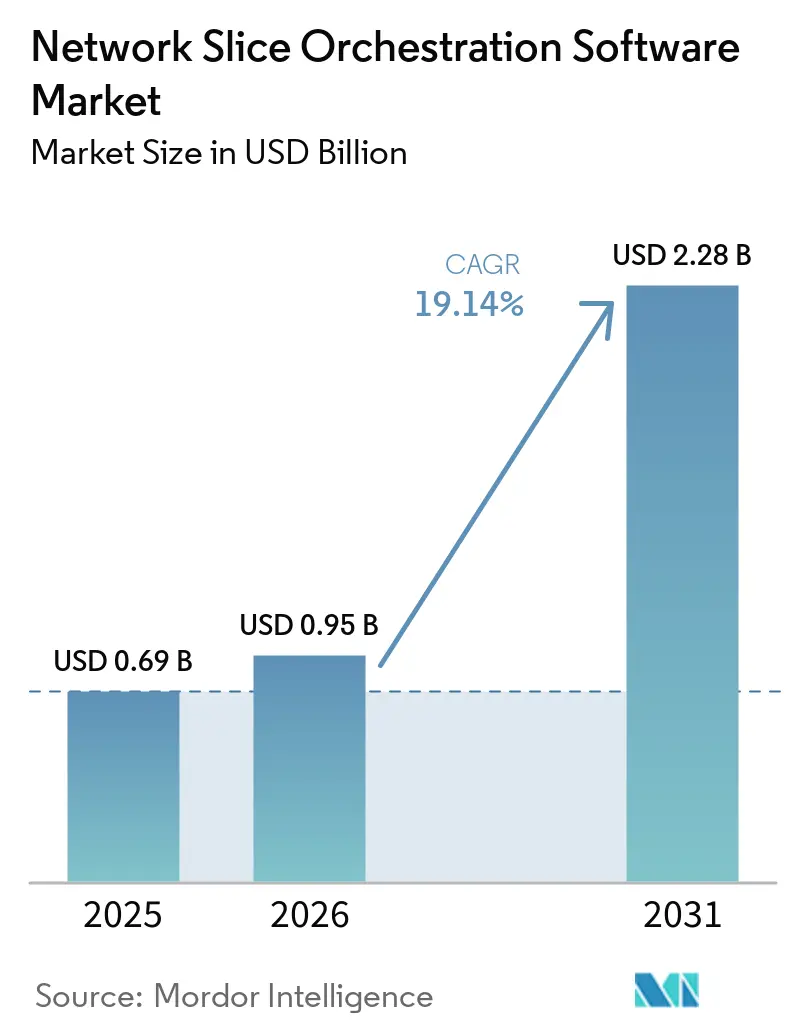
| Market Size (2026) | USD 0.95 Billion |
| Market Size (2031) | USD 2.28 Billion |
| Growth Rate (2026 - 2031) | 19.14 % |
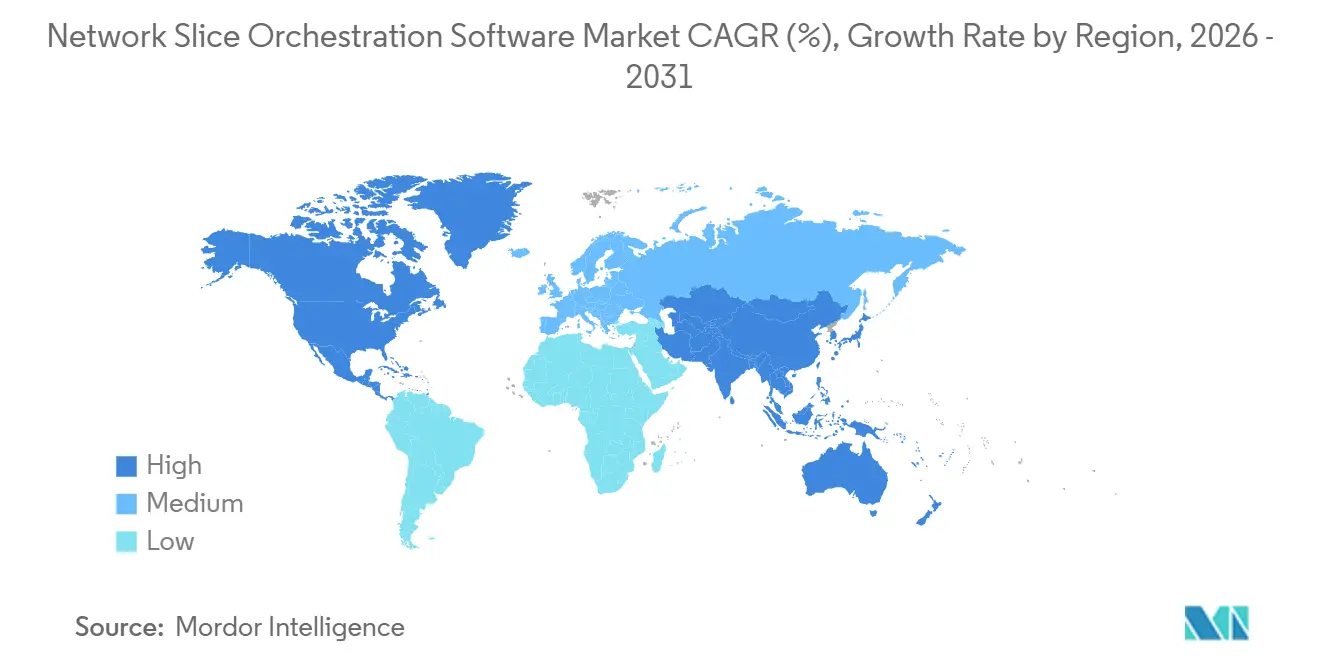
| Fastest Growing Market | North America |
| Largest Market | Asia-Pacific |
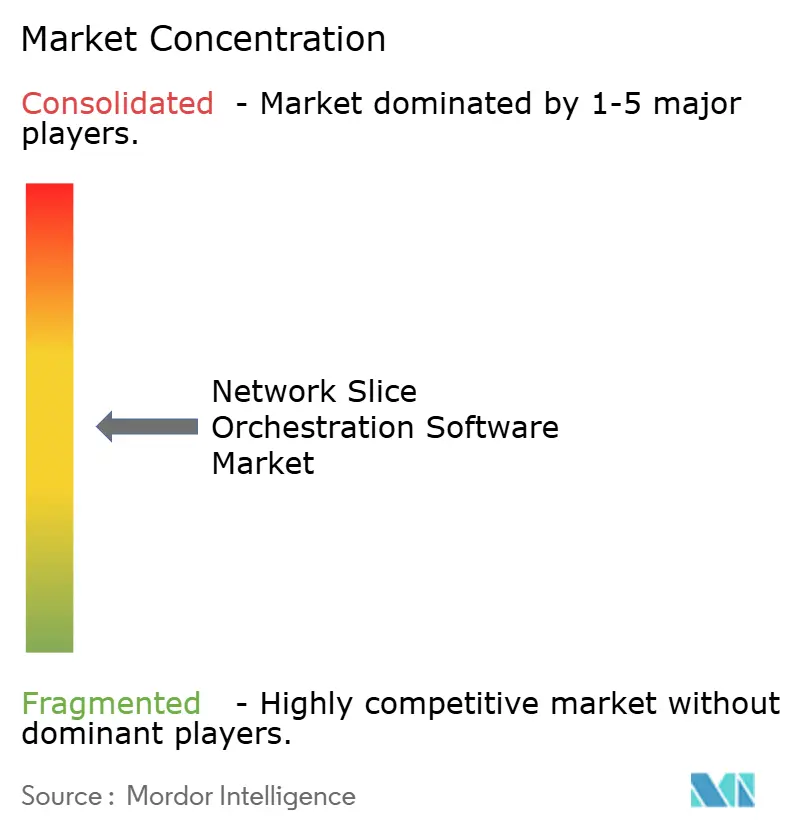
| Market Concentration | Medium |
Major Players *Disclaimer: Major Players sorted in no particular order Image © Mordor Intelligence. Reuse requires attribution under CC BY 4.0. | |
Network Slice Orchestration Software Market Analysis by Mordor Intelligence
The network slice orchestration software market size is projected to expand from USD 0.69 billion in 2025 and USD 0.95 billion in 2026 to USD 2.28 billion by 2031, registering a CAGR of 19.14% between 2026 to 2031. The shift to 5G Standalone networks is increasing the need for coordinated slice management across radio, transport, and core functions. Operators are moving investment from network-element management toward intent-based platforms that can provision and manage slices across domains. Enterprise and critical-communications requirements are making service assurance, policy control, and data sovereignty more important in purchasing decisions. Cloud-native designs are expanding deployment options, while hybrid architectures serve operators who must retain control over sensitive data. Competition is increasingly shaped by support for standards, integration capabilities, and the ability to operate in multivendor environments.
Key Report Takeaways
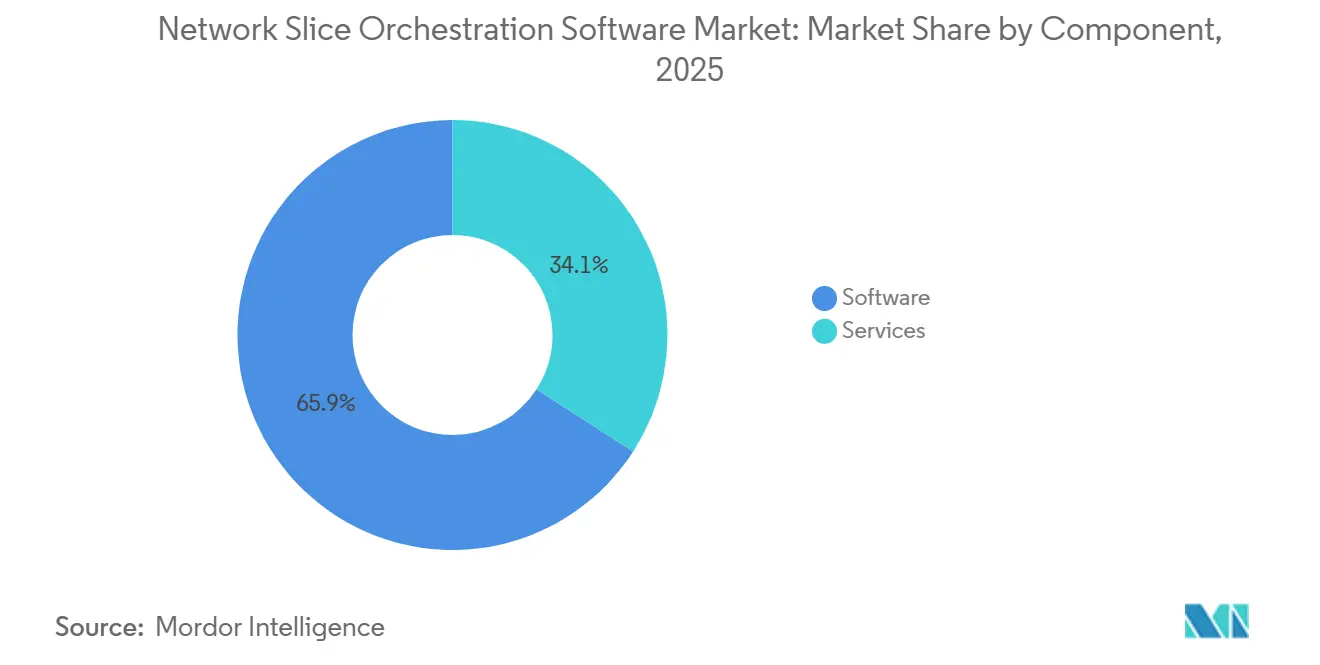
- By component, software held 65.88% of the network slice orchestration software market share in 2025, while services are projected to expand at a 20.23% CAGR through 2031.
- By deployment mode, cloud-based deployment accounted for 58.98% of the network slice orchestration software market share in 2025, while hybrid deployment is projected to expand at a 21.21% CAGR through 2031.
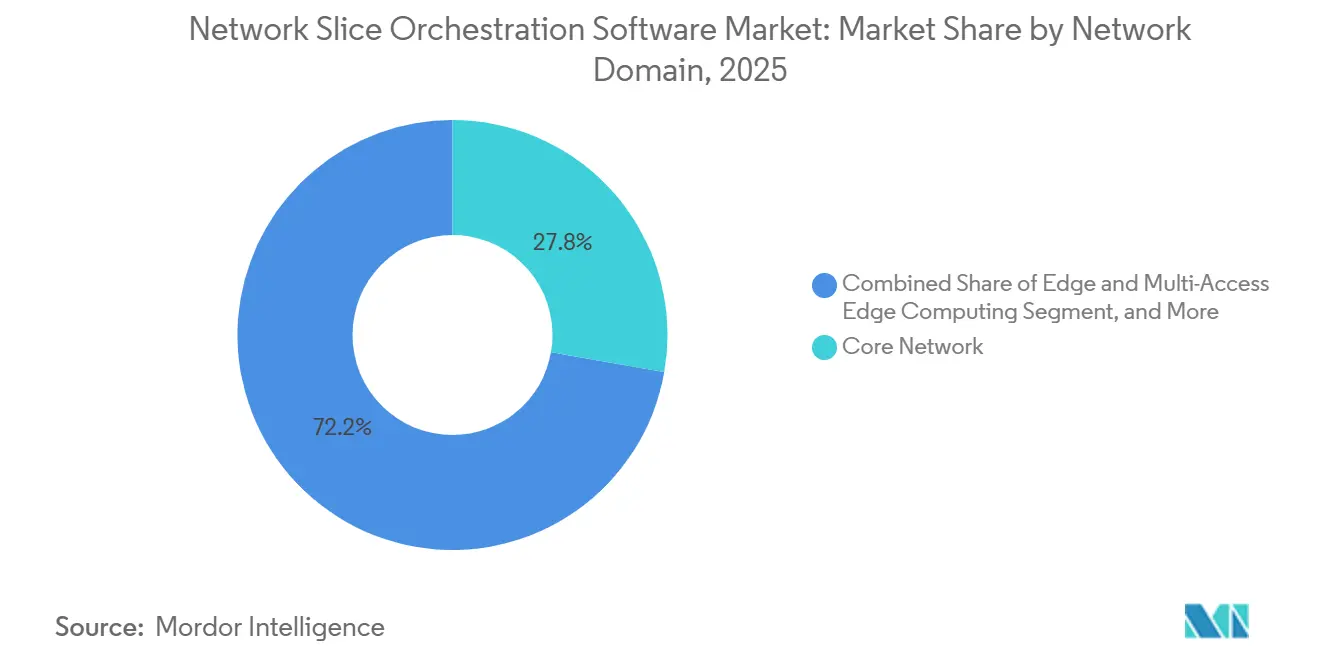
- By network domain, core network accounted for 27.76% of revenue in 2025, while edge and multi-access edge computing are projected to expand at a 20.55% CAGR through 2031.
- By application, network optimization held 31.11% of revenue in 2025, while predictive maintenance and assurance are projected to expand at a 21.09% CAGR through 2031.
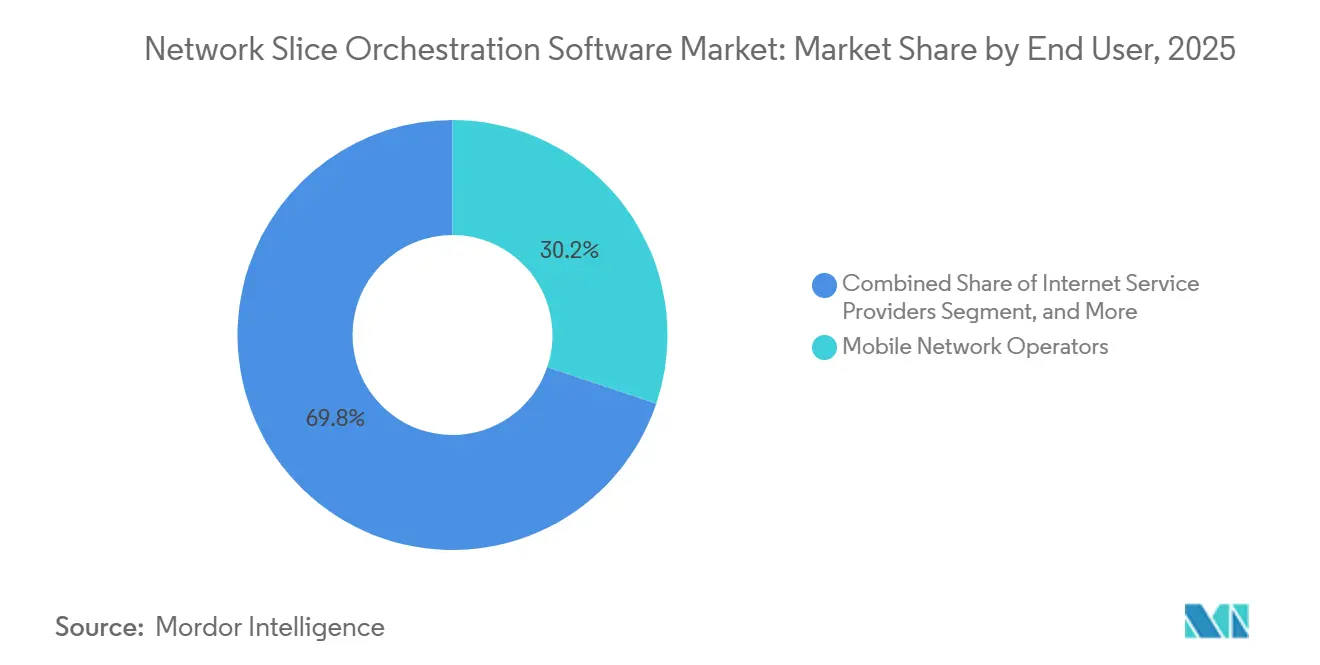
- By end user, mobile network operators held 30.17% of revenue in 2025, while enterprise IT and technology companies are projected to expand at a 21.05% CAGR through 2031.
- By geography, Asia-Pacific held 28.78% of revenue in 2025, while North America is projected to expand at a 20.87% CAGR through 2031.
Note: Market size and forecast figures in this report are generated using Mordor Intelligence’s proprietary estimation framework, updated with the latest available data and insights as of January 2026.
Market Trends and Insights
Drivers Impact Analysis of Network Slice Orchestration Software Market*
| DRIVER | (~) % IMPACT ON CAGR FORECAST | GEOGRAPHIC RELEVANCE | IMPACT TIMELINE |
|---|---|---|---|
| 5G and 6G Network Complexity | +5.5% | Global, with Asia-Pacific at the core and spillover to North America and Europe | Short term (≤ 2 years) |
| AI-Enabled Autonomous Network Operations | +4.2% | Global | Medium term (2-4 years) |
| Rising Demand for Predictive Network Assurance | +3.1% | North America and Europe | Medium term (2-4 years) |
| Cloud-Native and Multivendor Network Modernization | +2.8% | Global, with Europe and Asia-Pacific leading | Medium term (2-4 years) |
| Synthetic Traffic and Digital Spectrum Planning | +2.0% | North America and Asia-Pacific | Long term (≥ 4 years) |
| Energy-Aware Network Twin Optimization | +1.4% | Europe, with early gains in Germany and the Nordic countries | Long term (≥ 4 years) |
| Source: Mordor Intelligence | |||
5G and 6G Network Complexity Drive Slice Architecture Demand
The rollout of 5G Standalone networks is increasing the operational burden on mobile operators because slices span radio, transport, and core domains. 3GPP Release 18 established a domain-independent AI and machine-learning management framework for lifecycle functions, including slice provisioning, model training, validation, and inference. Release 19 work extends this approach toward federated learning, reinforcement learning, and live-network model deployment.[1] ETSI published its ZSM architecture framework in May 2026 to support the transition from rule-based automation to AI-driven management.[2] The network slice orchestration software market needs tools that connect these functions across several network layers and support future spectrum planning. O-RAN Alliance interface alignment, including the R1 interface for SMO and rApp interaction, is increasingly important in multivendor procurement.
AI-Enabled Autonomous Network Operations Redefine Operator Economics
Agentic AI is moving slice orchestration from scheduled automation toward systems that react to current network telemetry. ETSI’s ENI work addresses interoperable AI agents and common network ontologies across radio, core, and edge systems. Nokia and Google Cloud announced in June 2026 that six Gemini-model AI agents would be embedded in Nokia Assurance Center, targeting a 50% to 80% reduction in troubleshooting time. Huawei introduced AUTINOps at MWC 2026 with more than 20 AI agents and a Transformer-based risk prediction model. The network slice orchestration software market increasingly favors vendors that combine AI models with trusted telecom operational data. Access to multi-year operator data can improve intent interpretation and closed-loop remediation by enabling models to learn from actual network behavior.
Rising Demand for Predictive Network Assurance
Operators are adopting assurance platforms that identify anomalies before service quality declines for end users. TM Forum demonstrated its PRISM-AI Phase II Catalyst in June 2026, demonstrating agentic assurance through automated fault correlation across the business, service, and resource layers. Mavenir launched its Agentic Service Assurance Framework in June 2026, aligned with TM Forum IG1251 and IG1453, and integrating the A2A protocol.[3] Each resolved issue expands the set of conditions that slice policy engines can recognize, thereby improving later optimization. The network slice orchestration software market is gaining traction because assurance is becoming part of the same workflow as provisioning and policy control. Early users can build a service-quality advantage when connectivity commitments are contractual rather than best-effort.
Cloud-Native and Multivendor Network Modernization Accelerates Adoption
Cloud-native architectures are replacing legacy stacks and increasing the need for tools to manage containerized functions across multiple suppliers. Deutsche Telekom stated in February 2026 that its Horizontal TelCo Cloud had migrated its 5G core and several voice and messaging workloads to a cloud-native horizontal platform. The company targeted 80 workloads by the end of 2026 and planned further migration during 2027 and 2028. Nokia and Ericsson announced cross-ecosystem cooperation in March 2026, enabling rApps to be available across each company’s ecosystem via the R1 interface.[4] The network slice orchestration software market needs a common control layer for cloud-native and legacy functions, as well as synthetic traffic and energy-aware network-twin planning. Selection decisions are moving toward software quality, standards alignment, and ecosystem compatibility rather than hardware bundle depth.
Restraints Impact Analysis of Network Slice Orchestration Software Market*
| RESTRAINT | (~) % IMPACT ON CAGR FORECAST | GEOGRAPHIC RELEVANCE | IMPACT TIMELINE |
|---|---|---|---|
| High-Fidelity Modeling and GPU Infrastructure Costs | -3.2% | Global | Short term (≤ 2 years) |
| Multivendor Data and Schema Fragmentation | -2.5% | Global | Medium term (2-4 years) |
| Cybersecurity and Data-Sovereignty Exposure | -2.1% | Europe and Middle East | Medium term (2-4 years) |
| Limited Availability of Telecom-Domain AI Talent | -1.8% | South America, Middle East, and Africa | Long term (≥ 4 years) |
| Source: Mordor Intelligence | |||
High-Fidelity Modeling and GPU Infrastructure Costs Constrain Scale
High-fidelity network digital twins and real-time AI inference require substantial computing capacity. ETSI OpenSlice introduced a local large-language-model deployment option in its 2025Q4 release through the MCP Backend. The option allows smaller domain-specific models to operate with data sovereignty and less reliance on centralized computing. The network slice orchestration software market is constrained when operators cannot justify major GPU spending before service revenue is proven. The issue is especially relevant for Tier-2 and Tier-3 operators with limited capital budgets. Cybersecurity requirements and shortages of telecom-domain AI talent can add further cost and delay implementation.
Multivendor Data and Schema Fragmentation Impedes Automation
Many operator networks include equipment from multiple vendors and generations, with incompatible data models across the radio, transport, and core domains. Deutsche Telekom developed its OCAS cloud-native automation platform for CNF lifecycle management across its multivendor Horizontal TelCo Cloud. ETSI’s 2026Q2 OpenSlice release added an IETF RFC 9543-based Network Slice Service controller for standardized end-to-end transport slice management. New standards need time to reach production systems, so interoperability gains may not appear immediately. The network slice orchestration software market is affected when legacy OSS and BSS layers require manual mapping, data conversion, and approvals. Underestimated schema harmonization work can extend implementation schedules and turn a platform project into an open-ended integration cost.
*Our forecasts treat driver/restraint impacts as directional, not additive. The impact forecasts reflect baseline growth, mix effects, and variable interactions.
Network Slice Orchestration Software Market Segment Analysis
By Component:
Software Platforms Lead as Services Scale UpSoftware is estimated to account for 65.9% of the network slice orchestration software market in 2025. Operators are prioritizing orchestration engines, AI-enabled assurance tools, and policy management platforms to support 5G automation. ETSI OpenSlice’s planned 2026Q2 release is expected to introduce HypO, an open-source hyper-orchestrator designed to aggregate service offerings from independent deployments into TM Forum-compliant catalogs. This development indicates that platform capabilities are expanding across multiple domains. Vendors are embedding zero-touch provisioning and intent-based policy functions directly into core software catalogs, thereby reducing licensing complexity and accelerating the launch of new slice services. On-premises software remains important in regulated and defense environments where external hosting is not permitted. However, its relative role is expected to decline as cloud-native architectures become more established.
Services are forecast to grow at a 20.2% CAGR from 2026 to 2031, representing the fastest growth among components. Multivendor integration continues to generate demand for systems integration, managed operations, and consulting services, even as automation handles more tasks. Tier-2 and Tier-3 operators often lack the internal resources required to deploy platforms independently and are therefore more likely to procure managed slice orchestration services. This trend creates a second revenue stream for suppliers in the network slice orchestration software industry, alongside software licensing. Although services may generate lower margins than licenses, recurring service engagements can provide greater stability than periodic license renewals. This pattern also reflects the adoption cycle, as operators often purchase the platform before they can fully manage its operational complexity. Service revenue can therefore follow initial platform wins as deployment activities transition into ongoing operations.
By Deployment Mode:
Cloud-Based Leads, Hybrid Deployment AcceleratesCloud-based deployment is estimated to capture a 59.0% share of the network slice orchestration software market in 2025. This position reflects the scalability of cloud-hosted orchestration platforms and the active involvement of Amazon Web Services, Google Cloud, and Microsoft Azure in telecom software ecosystems. In June 2025, Nokia is expected to make its 5G Core and Autonomous Network Fabric available as SaaS applications on Google Cloud, on premises through Google Distributed Cloud, and in hybrid environments. These options demonstrate how established telecom suppliers are repositioning their products as cloud-native platforms. On-premises deployment remains relevant for operators with national security obligations and data-residency requirements. Cloud deployment also reduces upfront expenditure for smaller operators that procure orchestration on a subscription basis. This model enables operators to expand capacity without committing to a complete local infrastructure build and remains a key route for scaling the network slice orchestration software market.
Hybrid deployment is forecast to grow at a CAGR of 21.2% from 2026 to 2031. This model enables operators to retain latency-sensitive or sovereign functions on-site while using cloud resources for policy enforcement and AI inference during peak demand. Deutsche Telekom’s Horizontal Telco Cloud combines on-premises Kubernetes clusters with cloud-based analytics pipelines. ETSI OpenSlice is expected to introduce the GITER controller in its 2025Q4 release to support asynchronous Git-based coordination across distributed or intermittently connected environments. Such tools address operational gaps that can emerge when systems span local and cloud environments. Hybrid deployment reflects an intentional architectural choice rather than a temporary compromise. It enables operators to manage sensitive data locally while retaining access to cloud-scale analytics. This balance is particularly relevant in markets where procurement policies include sovereign AI requirements.
By Network Domain:
Core Network Anchors Spend, Edge and MEC SurgesThe core network is estimated to account for 27.8% of the network slice orchestration software market in 2025. It serves as the typical starting point for 5G Standalone slice orchestration because session management, policy control, and user-plane management are centralized within the core. The 5G Core service-based architecture supports intent-driven automation in accordance with 3GPP specifications. Consequently, many operators initiate orchestration projects in the core before extending them to radio or transport networks. Cisco’s expected Ultra Cloud Core AMF Release 2026.03 is anticipated to add dynamic network function selection via real-time, NRF-integrated capacity sharing. The release is also expected to offer all-in-one cluster deployment options that consolidate AMF roles on a single server. Radio access, transport and backhaul, and OSS/BSS orchestration also remain important network domains. OSS/BSS integration is gaining importance as operators expose slice APIs through business interfaces for enterprise users.
Edge and MEC are forecast to grow at a CAGR of 20.6% from 2026 to 2031. Private 5G applications, including industrial automation and real-time robotics, require low-latency service commitments that operators must manage close to end users. In February 2026, NEC is expected to validate its User Plane Function on second-generation Amazon Web Services Outposts racks. The company is expected to report throughput of 200 Gbps at 20% CPU utilization, supporting the feasibility of lightweight edge enforcement for enterprise deployments. Research published in Systems in 2025 is expected to show that AI-driven NFV slice orchestration aligned with ETSI MANO can reduce average latency by up to 30% and improve SLA compliance by 42% for time-sensitive 6G applications. The network slice orchestration software market benefits as edge controls become easier to deploy without specialized hardware. Demand remains linked to the pace at which private 5G deployments move from pilot projects to production operations. Factory automation and real-time robotics are particularly relevant because their service requirements increase the importance of performance commitments.

By Application:
Network Optimization Leads, Predictive Assurance AcceleratesNetwork optimization is estimated to hold a 31.1% share in 2025. The segment benefits from the established use of AI-enabled traffic steering, dynamic load balancing, and radio-frequency planning tools during the 5G rollout. Operators have deployed these processes for longer than many newer assurance workflows. Security and compliance validation is also emerging as enterprises using isolated slices require continuous verification that service boundaries remain secure. A 2025 article in the Journal of Network and Systems Management is expected to examine end-to-end slicing approaches for cybersecurity, orchestration, automation, and response in 5G and 6G systems. Network design and planning are also gaining importance as operators prepare templates for future spectrum scenarios and for campus private network services. Other applications include slice monetization, billing, and cross-operator federation. These applications may expand as slice-as-a-service models become more commercially established.
Predictive maintenance and assurance are projected to grow at a CAGR of 21.1% from 2026 to 2031. Operators are shifting from reactive remediation toward earlier fault isolation before issues affect contracted services. Nokia Assurance Center combines multivendor and multidomain assurance with AIOps and agentic AI to support closed-loop remediation. Nokia’s planned June 2026 partnership with Google Cloud is expected to add Gemini-model agents to support the investigation of complex, multi-root-cause events. The network slice orchestration software industry is increasingly focusing on workflows that prevent major service failures rather than solely improving average network performance. This distinction is important in contexts where stringent enterprise service-level agreements can result in penalties for service failures. Predictive assurance can deliver greater operational value as service commitments become more specific. It also provides the telemetry needed to support subsequent policy refinement and slice optimization.
By End User:
Mobile Operators Lead, Enterprise IT Redefines DemandMobile network operators are estimated to hold a 30.2% share in 2025. They remain the primary buyers of end-to-end platforms that coordinate radio, transport, and core network systems. In June 2025, Orange is expected to select Ericsson to automate 5G Standalone network slicing across its European affiliates. Ericsson’s service orchestration and assurance platform is expected to integrate with Orange’s Sylva-based telco cloud to support private networks, geofencing, and fixed wireless access. Communication service providers, including mobile network operators, remain the largest revenue base for the network slice orchestration software market. They are also helping shape standards through TM Forum and O-RAN Alliance activities. Internet service providers and tower companies hold smaller positions but are gaining relevance as converged access reshapes the boundary between network ownership and service management.
Enterprise IT and technology companies are forecast to grow at a CAGR of 21.1% from 2026 to 2031. This growth reflects the transition of private 5G deployments from proof-of-concept initiatives to production infrastructure. In October 2024, NEC and Cisco launched a joint end-to-end private 5G solution that combines Cisco’s 5G Standalone Core with NEC radio equipment and integration services. The solution targets logistics, warehousing, and event-management environments, where reliable connectivity directly affects operational throughput. Samsung’s CognitiV Network Operations Suite supports end-to-end SMO and RAN Intelligent Controller functions for AI-enabled slice lifecycle management. This demand expands a customer base that has historically centered on large mobile network operator procurement cycles. Enterprise buyers in the network slice orchestration software market typically have shorter decision timelines and more application-specific service requirements. These conditions incentivize suppliers to develop specialized offerings for distinct private-network environments.
Geography Analysis
APAC Network Slice Orchestration Software Market
Asia-Pacific accounted for 28.8% of the network slice orchestration software market in 2025, the largest regional share. China’s 5G Standalone rollout and mature network slicing activity in South Korea and Japan support this position. India’s mid-band 5G expansion is also increasing demand as operators manage higher subscriber and enterprise slice volumes. Japan and South Korea are advancing 6G research with government support, encouraging the adoption of platforms that can support current and future network specifications.
North America and Europe Network Slice Orchestration Software Market
North America is forecast to grow at a CAGR of 20.9% from 2026 to 2031, representing the fastest regional growth rate in the network slice orchestration software market. Enterprise private 5G deployments across manufacturing, healthcare, and logistics support regional demand. Cloud providers in the United States also facilitate the integration of slice orchestration APIs into cloud-native telecommunications products. Europe remains strategically important, with Germany, the United Kingdom, and France serving as key growth anchors. Deutsche Telekom targeted 80 cloud-native workloads by the end of 2026. In March 2026, BT Group and Ericsson expanded their 5G Core partnership to include Network Slice Selection Function and Network Exposure Function capabilities. GDPR and the EU AI Act are driving demand for local AI inference and data sovereignty, sustaining hybrid deployment models across Europe.
MEA and South America Network Slice Orchestration Software Market
The Middle East is advancing through sovereign digitalization programs and smart-city projects in Saudi Arabia and the United Arab Emirates. In February 2026, Nokia and Amazon Web Services announced an agentic AI-powered 5G Advanced slicing solution with du and Orange. The network slice orchestration software market has an emerging presence in Africa and South America; however, investment gaps, device affordability constraints, and economic conditions limit near-term procurement. MTN South Africa’s participation in Huawei’s intelligent operations forum at MWC 2026 indicates that leading African operators are evaluating AI-native orchestration approaches. Brazil leads activity in South America, while broader regional deployment remains a medium-term prospect.
Competitive Landscape
The network slice orchestration software market is moderately fragmented, with infrastructure incumbents competing against cloud-native specialists and cloud-aligned firms. Ericsson and Nokia maintain strong positions in commercial slice orchestration through their service orchestration and management and network orchestration (MANO) suites. Their March 2026 collaboration enables the mutual availability of rApps across SMO platforms through the standardized R1 interface. Huawei has a substantial presence in Asia-Pacific and selected emerging markets through its AUTINOps and Digital Twin Network capabilities. The network slice orchestration software market also presents opportunities in OSS and BSS integration, multi-operator federation, and sovereign AI functions. The 3GPP’s Network Digital Twin initiatives provide a reference point for suppliers developing these capabilities.
Cloud-native challengers can secure business in the network slice orchestration software market by offering modular products that integrate with existing infrastructure. Amazon Web Services supported Nokia’s agentic slicing initiative with du and Orange, illustrating a model in which cloud providers enable telecommunications products without assuming a direct vendor role. Nokia’s availability of Autonomous Network Fabric in software-as-a-service, on-premises, and hybrid deployment models represents another strategic move that expands customer deployment choices. This approach supports operators that require flexibility regarding latency, operating models, and data residency. Consequently, the network slice orchestration software market is becoming less dependent on suppliers that rely solely on proprietary hardware integration. Keysight’s USD 1.5 billion acquisition of Spirent in October 2025 and VIAVI’s USD 425 million acquisition of certain Spirent assets are reshaping the validation layer.
VIAVI and NVIDIA are developing GPU-accelerated RAN digital twin capabilities for pre-validation workflows, enabling continuous validation before policies are deployed in live networks. No supplier has established a decisive position across all software layers and deployment environments.
Network Slice Orchestration Software Industry Leaders
-
Nokia Corporation
-
Ericsson AB
-
Huawei Technologies Co., Ltd.
-
Microsoft Corporation
-
Cisco Systems, Inc.
- *Disclaimer: Major Players sorted in no particular order
Network Slice Orchestration Software Market Companies Covered in this Report
- Nokia Corporation
- Ericsson AB
- Huawei Technologies Co., Ltd.
- Microsoft Corporation
- Cisco Systems, Inc.
- VIAVI Solutions Inc.
- International Business Machines Corporation
- Juniper Networks, Inc.
- NEC Corporation
- Samsung Electronics Co., Ltd.
- Siemens AG
- Keysight Technologies, Inc.
- Spirent Communications plc
- VMware, Inc.
- Amazon Web Services, Inc.
- Oracle Corporation
- Mavenir Systems, Inc.
- Arista Networks, Inc.
Recent Industry Developments in Network Slice Orchestration Software Market
- July 2026: ETSI released OpenSlice 2026Q2, introducing an IETF RFC 9543-compliant Network Slice Service controller for standardized end-to-end transport slice management integrated with TeraFlowSDN's Network Slice Controller, and launched HypO, a new open-source hyper-orchestrator enabling federated, multi-domain service orchestration across independent OpenSlice deployments. The release strengthens standards-based open-source orchestration as a commercially credible alternative to proprietary platforms.
- June 2026: Nokia and Google Cloud announced an expanded partnership to embed six specialized Gemini-model AI agents into Nokia Assurance Center, targeting a 50% to 80% reduction in network troubleshooting time, and to plan a SaaS launch on Google Cloud Marketplace in September 2026. The Autonomous Network Fabric integration is further planned for Nokia's Unified Inventory, Data Suite, and Orchestration applications from late 2026 through 2027.
- June 2026: Mavenir launched its Agentic Service Assurance Framework, a TM Forum IG1251/IG1453-aligned multi-agent system that enables closed-loop fault detection, root cause analysis, and remediation across multi-vendor, multi-domain 5G networks. Integration via the A2A protocol preserves existing OSS investments while extending autonomous operations to L1 monitoring through L3 remediation.
- March 2026: Huawei officially launched AUTINOps at the 4th Intelligent Operations Forum at MWC 2026, presenting it as the industry's first AI-Native intelligent operations solution. The platform's EDNS 2.0 domain agentic model delivers over 80% risk identification accuracy and over 90% diagnostic accuracy using a Transformer-based predictive engine, supported by more than 20 AI agents covering fault management and proactive risk handling.
Global Network Slice Orchestration Software Market Report Scope
The Network Slice Orchestration Software Market Report is Segmented by Component (Software, and Services), Deployment Mode (Cloud-Based, On-Premises, and Hybrid), Network Domain (Radio Access Network, Core Network, Transport and Backhaul, Edge and Multi-Access Edge Computing, and Operations Support Systems and Business Support Systems), Application (Network Design and Planning, Network Optimization, Predictive Maintenance and Assurance, Security and Compliance Validation, and Other Applications ), End User (Communication Service Providers, Mobile Network Operators, Tower Companies, Internet Service Providers, Enterprise IT and Technology Companies, and Other End Users), and Geography (North America, South America, Europe, Asia-Pacific, Middle East and Africa). The Market Forecasts are Provided in Terms of Value (USD).
Segmentation Overview
| Software |
| Services |
| On-Premises |
| Cloud-Based |
| Hybrid |
| Radio Access Network |
| Core Network |
| Transport and Backhaul |
| Edge and Multi-Access Edge Computing |
| Operations Support Systems and Business Support Systems |
| Network Design and Planning |
| Network Optimization |
| Predictive Maintenance and Assurance |
| Security and Compliance Validation |
| Other Applications |
| Communication Service Providers |
| Mobile Network Operators |
| Tower Companies |
| Internet Service Providers |
| Enterprise IT and Technology Companies |
| Other End Users |
| North America | United States |
| Canada | |
| Mexico | |
| South America | Brazil |
| Argentina | |
| Rest of South America | |
| Europe | Germany |
| United Kingdom | |
| France | |
| Italy | |
| Rest of Europe | |
| Asia-Pacific | China |
| Japan | |
| South Korea | |
| India | |
| Rest of Asia-Pacific | |
| Middle East | Saudi Arabia |
| United Arab Emirates | |
| Rest of Middle East | |
| Africa | South Africa |
| Nigeria | |
| Rest of Africa |
| By Component | Software | |
| Services | ||
| By Deployment Mode | On-Premises | |
| Cloud-Based | ||
| Hybrid | ||
| By Network Domain | Radio Access Network | |
| Core Network | ||
| Transport and Backhaul | ||
| Edge and Multi-Access Edge Computing | ||
| Operations Support Systems and Business Support Systems | ||
| By Application | Network Design and Planning | |
| Network Optimization | ||
| Predictive Maintenance and Assurance | ||
| Security and Compliance Validation | ||
| Other Applications | ||
| By End User | Communication Service Providers | |
| Mobile Network Operators | ||
| Tower Companies | ||
| Internet Service Providers | ||
| Enterprise IT and Technology Companies | ||
| Other End Users | ||
| By Geography | North America | United States |
| Canada | ||
| Mexico | ||
| South America | Brazil | |
| Argentina | ||
| Rest of South America | ||
| Europe | Germany | |
| United Kingdom | ||
| France | ||
| Italy | ||
| Rest of Europe | ||
| Asia-Pacific | China | |
| Japan | ||
| South Korea | ||
| India | ||
| Rest of Asia-Pacific | ||
| Middle East | Saudi Arabia | |
| United Arab Emirates | ||
| Rest of Middle East | ||
| Africa | South Africa | |
| Nigeria | ||
| Rest of Africa | ||
Key Questions Answered in the Report
What is driving growth in network slice orchestration software?
The network slice orchestration software market size is projected to expand from USD 0.69 billion in 2025 and USD 0.95 billion in 2026 to USD 2.28 billion by 2031, registering a CAGR of 19.1% between 2026 and 2031. Growth is supported by 5G Standalone rollout, enterprise private 5G deployments, cloud-native modernization, and demand for automated assurance.
How large is the network slice orchestration software sector?
The sector is valued at USD 0.95 billion in 2026 and is forecast to reach USD 2.28 billion by 2031.
Which component has the leading position?
Software led with a 65.9% share in 2025, reflecting operator demand for orchestration, assurance, and policy management platforms.
Which deployment approach is growing fastest?
Hybrid deployment is forecast to expand at a 21.2% CAGR through 2031 by combining local control for sensitive functions with cloud capacity.
Which network domain is expanding most quickly?
Edge and MEC are forecast to grow at a 20.6% CAGR through 2031, supported by low-latency private 5G requirements.
Which region is expected to grow fastest?
North America is forecast to grow at a 20.9% CAGR from 2026 to 2031, supported by private 5G use in manufacturing, health care, and logistics.