
Nasal Aspirators Market Size and Share
Market Overview
| Study Period | 2020 - 2031 |
|---|---|
| Market Size (2026) | USD 1.31 Billion |
| Market Size (2031) | USD 2.21 Billion |
| Growth Rate (2026 - 2031) | 11.08 % |
| Fastest Growing Market | Asia-Pacific |
| Largest Market | North America |
| Market Concentration | Medium |
Major Players *Disclaimer: Major Players sorted in no particular order Image © Mordor Intelligence. Reuse requires attribution under CC BY 4.0. | |
Nasal Aspirators Market Analysis by Mordor Intelligence
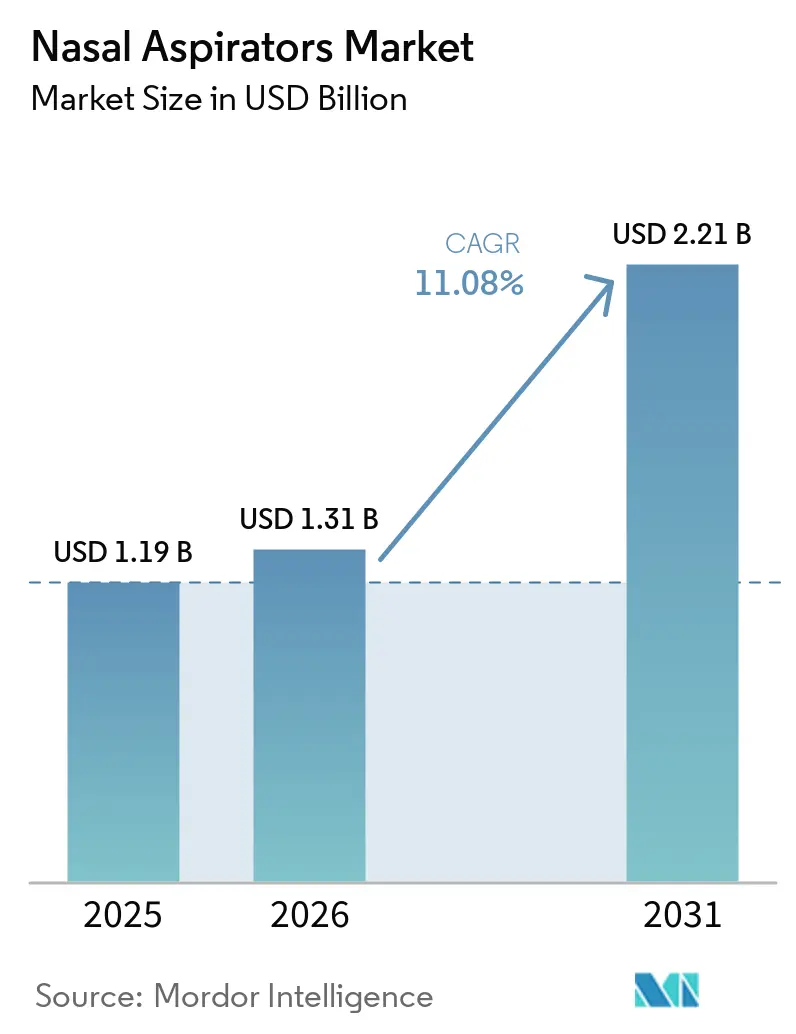
The Nasal Aspirators Market size is expected to increase from USD 1.19 billion in 2025 to USD 1.31 billion in 2026 and reach USD 2.21 billion by 2031, growing at a CAGR of 11.08% over 2026-2031.
The nasal aspirators market is supported by caregiver demand for practical congestion management at home. Routine nasal care is extending product use beyond periods of acute illness. Electric products are drawing attention because caregivers can select suction settings and recharge portable devices. Online retail is reducing the time between a care recommendation and a purchase. Brands are also seeking recurring sales from filters and silicone tips, while quality and safety communication remain central to premium positioning.
Key Report Takeaways
- By product type, manual nasal aspirators held 48.6% of the nasal aspirators market share in 2025, while electric nasal aspirators are projected to grow at an 11.8% CAGR through 2031.
- By target age, neonates and infants held 61.8% of the nasal aspirators market share in 2025, while toddlers are forecast to expand at an 11.3% CAGR through 2031.
- By end user, home care accounted for 74.2% of the nasal aspirators market share in 2025 and is projected to grow at an 11.1% CAGR through 2031.
- By application, infant congestion relief accounted for 56.7% of the nasal aspirators market share in 2025, while pediatric nasal hygiene is projected to grow at an 11.5% CAGR through 2031.
- By geography, North America held 36.5% of demand in 2025, while Asia-Pacific is forecast to grow at an 11.9% CAGR through 2031.
Note: Market size and forecast figures in this report are generated using Mordor Intelligence’s proprietary estimation framework, updated with the latest available data and insights as of January 2026.
Global Nasal Aspirators Market Trends and Insights
Drivers Impact Analysis*
| Driver | (~) % Impact on CAGR Forecast | Geographic Relevance | Impact Timeline |
|---|---|---|---|
| Increasing Infant Nasal-Hygiene Awareness | +2.1% | Global, strongest in North America and Western Europe | Medium term (2-4 years) |
| Rising Pediatric Respiratory Infections and Congestion Episodes | +2.5% | South Asia, Sub-Saharan Africa, Asia-Pacific core, with spillover to the Middle East and Africa | Short term (≤ 2 years) |
| Shift From Manual Bulbs to Controlled Electric Suction | +1.8% | North America, Europe, and East Asia | Medium term (2-4 years) |
| E-Commerce and Direct-to-Consumer Availability | +1.9% | Global, with fastest gains in Asia-Pacific and Latin America | Short term (≤ 2 years) |
| Replacement Filters, Tips, and Subscription-Led Recurring Demand | +0.9% | North America and Europe | Long term (≥ 4 years) |
| Pediatric Telehealth and At-Home Care Guidance | +0.7% | North America, Australia, and urban Asia-Pacific | Medium term (2-4 years) |
| Source: Mordor Intelligence | |||
Increasing Infant Nasal-Hygiene Awareness
Caregiver awareness is repositioning nasal care as a preventive household practice rather than an occasional response to illness. The nasal aspirators market, therefore, has a broader set of use occasions across a child’s early years. Federal telehealth guidance[1]U.S. Department of Health and Human Services, “Types of Telehealth Services for Infants and Toddlers,” Telehealth.HHS.gov for infants and toddlers includes nasal care management within remote consultations. This guidance connects home aspiration with formal care advice and makes caregiver education easier to deliver. Brands are shifting attention from short illness-season campaigns toward year-round parenting content. This approach supports repeat purchases of hygiene filters and replacement tips when the device remains visible in daily care routines.
Rising Pediatric Respiratory Infections and Congestion Episodes
Respiratory congestion continues to make nasal clearance relevant for caregivers, especially during pediatric illness episodes. The nasal aspirators market benefits when families require a simple method to manage congestion before sleep or feeding. A 2025 peer-reviewed[2]Advances in Nasal Aspirator Technology and Its Impact on Infant Nasal Health: A Comparative Analysis of Manual and Electric Devices,” Frontiers in Cellular and Infection Microbiology study described lower respiratory tract infections as a substantial global burden among children and found the greatest burden in South Asia. The same research places the need for respiratory care within a wider pediatric health context. International childhood-care guidance also recognizes nasal clearance within pediatric care pathways. This clinical context can increase caregiver confidence in properly used home devices while supporting pharmacy and online product discovery.
Shift From Manual Bulbs to Controlled Electric Suction
The move from rubber bulb syringes to controlled electrical products is changing the premium end of the nasal aspirators market. Adjustable suction gives caregivers a clearer product feature to compare at the point of purchase. FridaBaby introduced the Electric NoseFrida Pro in March 2025 at USD 79.97 with 5 suction levels and USB-C rechargeability. C-Star introduced the Merci Pot S-505 in Japan in June 2026 with up to -77 kPa suction and AC or battery operation. U.S. Food and Drug Administration 510(k) requirements and European medical-device rules favor suppliers able to demonstrate compliance and maintain post-market oversight. Those requirements can raise the expected quality level and make certified devices more compelling than unverified imports.
E-Commerce and Direct-to-Consumer Availability
Online channels make the nasal aspirators market more accessible to caregivers who need a product quickly. A telehealth recommendation can now be followed by a purchase through the same phone or computer. In China, online channels accounted for 71% of nasal aspirator unit sales by volume in 2025. This pattern shows the importance of product listings, clear instructions, and prompt delivery for the category. Major online platforms also support replenishment orders for filters and silicone tips. That model lets brands price the original device competitively while maintaining an ongoing relationship with households that need replacement supplies.
Misuse, Over-Suctioning and Nasal-Tissue Irritation Concerns
Safety concerns can limit the use of consumer devices when caregivers lack clear instructions. The nasal aspirators market faces particular scrutiny for products that offer powered suction. Children’s Health advises caregivers to limit suction to 2 to 3 times each day because overuse can worsen nasal swelling. This guidance makes usage instructions, age-appropriate tips, and clear cleaning directions important parts of product design. App-connected devices and printed protocols can help brands present a more safety-focused proposition. Hygiene and cross-contamination concerns also increase the value of washable components, single-use elements, and clear replacement schedules.
Restraints Impact Analysis*
| Restraint | (~) % Impact on CAGR Forecast | Geographic Relevance | Impact Timeline |
|---|---|---|---|
| Misuse, Over-Suctioning and Nasal-Tissue Irritation Concerns | -1.2% | Global, most pronounced in North America and Europe | Short term (≤ 2 years) |
| Low-Cost Manual Alternatives and Traditional Remedies | -0.9% | South Asia, Southeast Asia, Sub-Saharan Africa, and Latin America | Medium term (2-4 years) |
| Hygiene, Cleaning, and Cross-Contamination Concerns | -0.5% | Global | Short term (≤ 2 years) |
| Counterfeit Devices and Inconsistent Suction Performance | -0.7% | Southeast Asia, the Middle East and North Africa, and Latin America | Medium term (2-4 years) |
| Source: Mordor Intelligence | |||
Low-Cost Manual Alternatives and Traditional Remedies
Low-cost manual products remain a significant constraint on electric-device adoption in the nasal aspirators market. Manual nasal aspirators held 48.6% of demand in 2025, showing that many households continue to prioritize affordability. FridaBaby’s manual NoseFrida retailed at USD 14.99. In South Asia and Southeast Asia, saline solutions and low-cost oral-suction designs offer familiar alternatives. Unbranded bulb syringes priced below USD 2 are common in lower-surveillance channels. Electrical products must therefore demonstrate a meaningful advantage in control, ease of cleaning, and product reliability before households accept the higher initial cost.
*Our forecasts treat driver/restraint impacts as directional, not additive. The impact forecasts reflect baseline growth, mix effects, and variable interactions.
Segment Analysis
By Product Type: Electric Suction Is Raising the Value Proposition
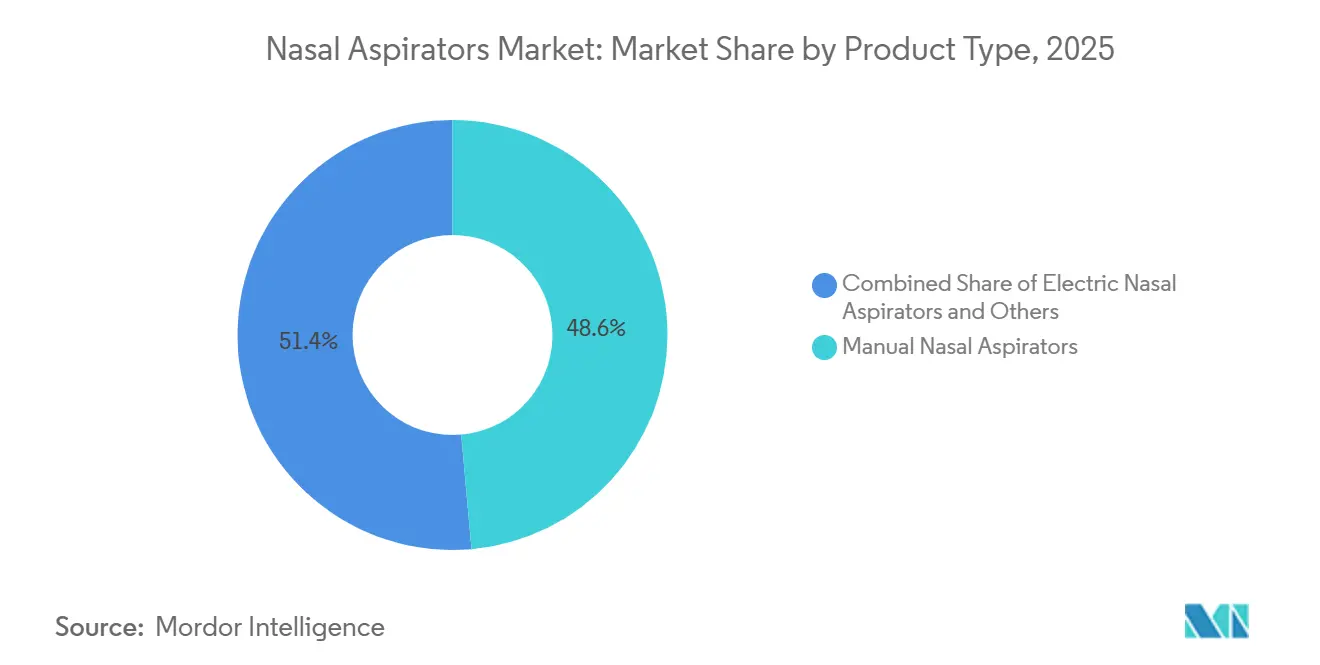
Manual nasal aspirators held 48.6% of the nasal aspirators market share in 2025. This leading position reflects the product’s low price, simple operating method, and wide availability. In China, manual products accounted for 58.7% of unit sales in 2024. Their revenue share was 35.2% in the same year, reflecting the higher prices achieved by electric products. Disposable aspirators serve a focused role in hospitals and clinics. Single-use requirements make reusable products less suitable where each patient needs a separate device. Accessories and replacement parts are becoming more important as suppliers build refill-led sales models. The nasal aspirators industry is therefore not limited to the first device purchase.
Electric nasal aspirators are forecast to grow at an 11.8% CAGR through 2031. This nasal aspirators market size expansion reflects demand for adjustable suction, compact form factors, and rechargeable power. FridaBaby’s Electric NoseFrida Pro entered the category in March 2025 with 5 suction levels and a USD 79.97 price point. C-Star’s[3]BabyTech.jp, “Seastar Unveils New Electric Nasal Aspirator Merci Pot S-505,” BabyTech.jp Merci Pot S-505 launched in June 2026 at JPY 7,980, USD 55, with up to -77 kPa suction and dual AC and battery power. These launches show how consumer products are moving toward features once associated with more specialized equipment. Palm-sized designs can reduce the perceived performance gap between home and clinical products. Competition will intensify across North America, Europe, and East Asia as more suppliers seek to pair higher control with mid-range pricing.



By Target Age: Infant Demand Is Broadening Toward Toddlers and Older Users
Neonates and infants aged 0 to 12 months held 61.8% of the nasal aspirators market share in 2025. Their need is linked to the importance of clear nasal passages during feeding and sleep. The nasal aspirators market remains centered on early childhood because caregivers often manage congestion directly at home. This age group also supports frequent use of hygiene filters and replacement tips. The resulting consumable demand can remain relevant after a single device purchase. Product labels and tip designs must remain appropriate for the smallest users. Clear age guidance helps caregivers choose between manual and electric formats. It also supports safer use when congestion management is part of routine infant care.
Toddlers are projected to record the fastest target-age CAGR of 11.3% through 2031. Parents may continue use beyond infancy when clinicians recommend aspiration for cold and respiratory-symptom management. This can lead households to move from lower-cost manual products to more powerful electric models. Children aged 4 to 12 years, adults, and elderly users remain smaller groups in the nasal aspirators industry. Adult and elderly demand is gaining attention in Japan, Germany, and South Korea for chronic rhinitis and post-surgical nasal clearance. A 2025 ClinicalTrials.gov study[4]U.S. National Library of Medicine, “Comparison of the User Experience of Four Nasal Aspirators in Infants,” ClinicalTrials.gov compares 4 consumer aspirators, including NozeBot and Braun electric models. The study indicates that evidence for home-use devices remains an active area of research. Manufacturers with products suited to multiple age groups may have a broader portfolio as this evidence develops.
By End User: Home Care Holds the Largest Demand Base
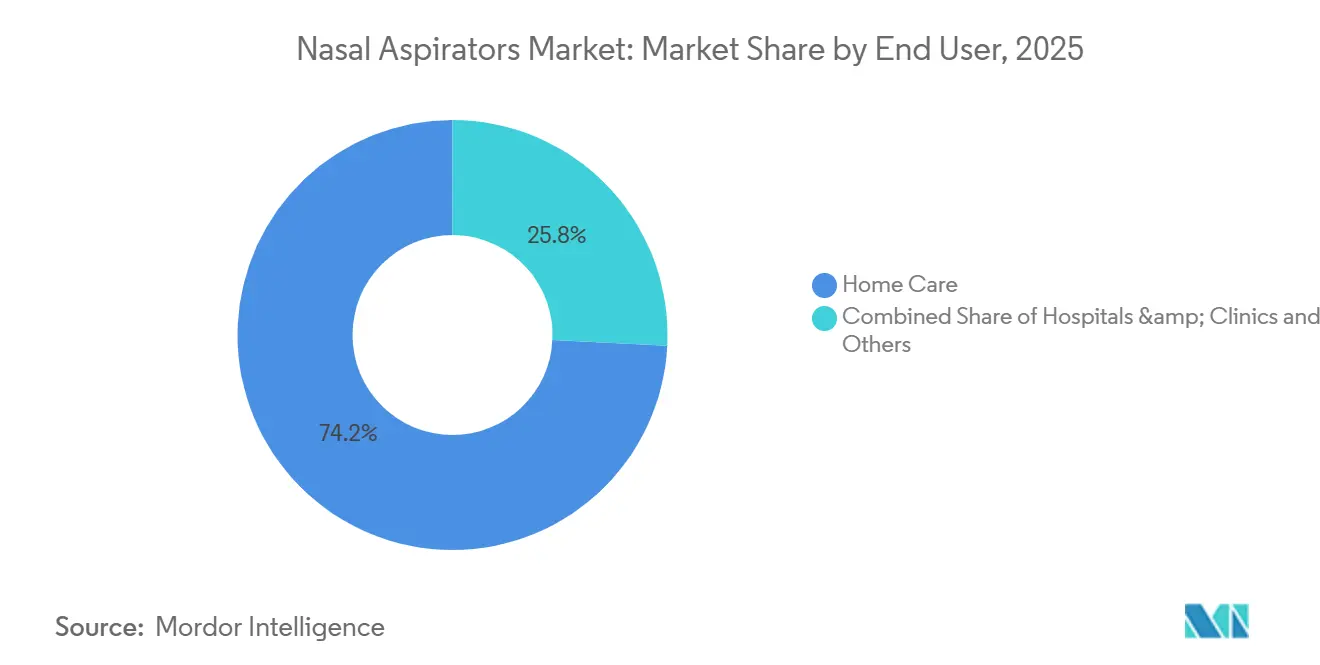
Home care accounted for 74.2% of the nasal aspirators market size by end user in 2025. It is also forecast to grow at an 11.1% CAGR through 2031. This combination shows that nasal care has moved from a clinical-adjacent activity to a common household purchase. The available price range spans manual models at USD 14.99 and electric models at USD 79.97. Online replenishment also makes it easier for households to obtain filters and tips. Telehealth guidance can reinforce home care by giving caregivers product-use information during remote consultations. The nasal aspirators market has a clear opportunity to make instructions more visible at the point of sale. This is particularly relevant for first-time parents choosing an unfamiliar device.
Hospitals and clinics are smaller end-user channels but can support higher average selling prices. These settings use clinical suction pumps and disposable products within institutional quality processes. Daycare and childcare centers remain underserved because shared-device use raises cross-contamination and liability concerns. Portable rechargeable products are creating a separate travel and remote-care use case. The Merci Pot S-505 and Nosiboo Go reflect demand for battery-dependent use away from home. Established suppliers have not yet created widely adopted institutional hygiene protocols for daycare settings. Bundled consumables and structured cleaning programs could address this limitation. Such offerings would need to balance convenience with the stricter hygiene needs of multi-user environments.
By Application: Routine Hygiene Is Extending Use Beyond Illness Episodes
Infant congestion relief held 56.7% of the nasal aspirators market share in 2025. The application remains important during colds and respiratory congestion in the first year of life. Pre-feeding and pre-sleep clearance are closely connected use cases. Pediatric guidance supports clearing nasal passages before feeding when an infant is congested. This advice can increase use during illness without requiring a separate care product. Post-illness recovery support and adult nasal care are smaller applications. They are gaining attention in South Korea and Japan, where ear, nose, and throat care is more integrated with routine health maintenance. These applications broaden the product’s role while retaining infant congestion as the largest demand base.
Pediatric nasal hygiene is forecast to grow at an 11.5% CAGR through 2031. The nasal aspirators market size for this application benefits when product use becomes less dependent on seasonal illness cycles. Regular maintenance can support a steadier revenue base across the year. Japanese brands have designed devices for noise performance below 35 dB to support nighttime use near sleeping infants. This design focus is influencing premium product launches in 2025 and 2026. Quiet operation, controlled suction, and easy cleaning are relevant when caregivers use products as part of an evening routine. Routine use can place nasal care alongside established hygiene habits in health-focused households. The resulting demand is less tied to any one respiratory illness season.
Geography Analysis
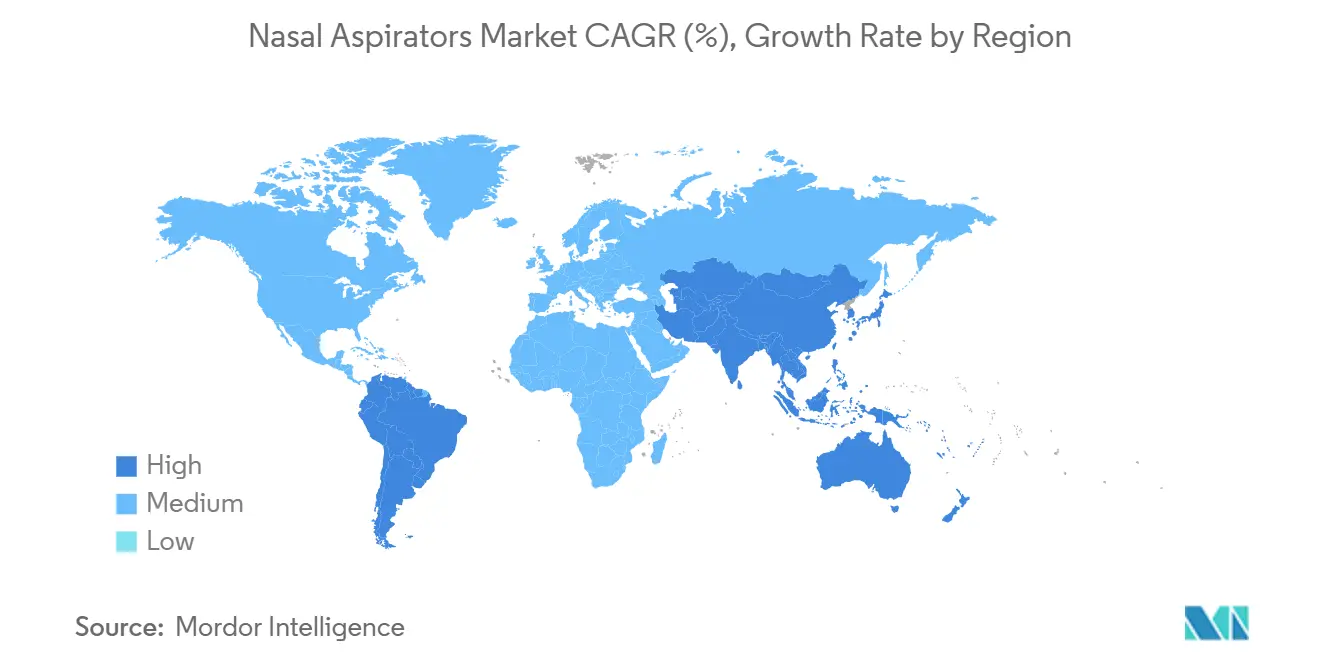
North America held 36.5% of the nasal aspirators market share in 2025. The region combines caregiver health awareness, strong brand presence, and reimbursement eligibility for some electrical products. FridaBaby held 54% of the U.S. nasal aspirator category in 2025. Canada has expanded the reach of at-home guidance through pediatric telehealth platforms. Mexico and other Latin American markets are drawing electric-product launches as urban healthcare spending rises. Import tariffs on medical devices remain a near-term constraint in those markets.
Europe is the second-largest regional demand base for the nasal aspirators market. Germany, France, and the United Kingdom form the core of regional demand. France retains a preference for manual oral-suction products through pharmacy channels. Germany has shown greater openness to electric models with saline-related features. European medical-device rules require post-market clinical surveillance for pediatric aspirators. This compliance setting favors suppliers with established evidence and notified-body relationships. B.Well Swiss AG, Béaba, Nosiboo, and Flaem Nuova are positioned around design and compliance credentials. Brazil and Argentina show early private-sector adoption through pediatric clinic recommendations. Variable safety enforcement and import costs continue to limit broader electric-product adoption across South America.
Asia-Pacific is forecast to expand at an 11.9% CAGR through 2031, the fastest regional rate in the nasal aspirators market. Rising household incomes and digital retail are supporting demand across the region. China’s online channels accounted for 71% of nasal aspirator unit sales in 2025. Electric products increased from 12.7% of category value in 2018 to 41.3% in 2024. Japan’s domestic brands emphasize precision features and noise levels below 35 dB. India presents a large volume opportunity as direct-to-consumer commerce develops. The Middle East and Africa are led by premium adoption in the Gulf Cooperation Council, while Sub-Saharan Africa relies more heavily on affordable manual products through pharmacy and nongovernmental organization channels.

Competitive Landscape
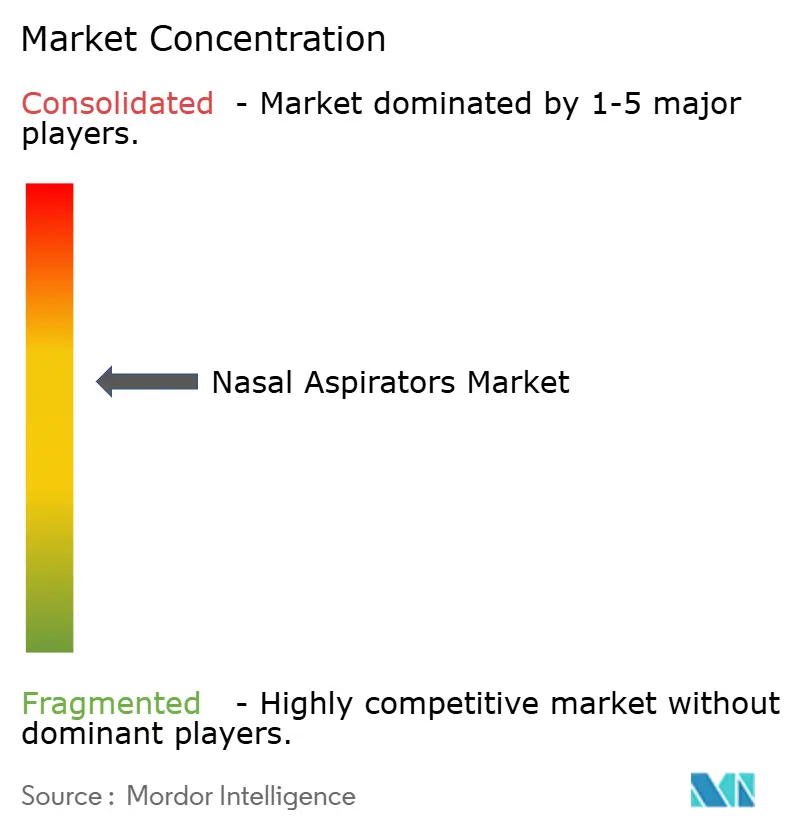
The nasal aspirators market has moderate fragmentation, though individual geographies can show winner-take-most conditions. FridaBaby held 54% of the U.S. category in 2025. Its position is supported by retail placement at Target and Walmart and by disposable hygiene filters. Nosiboo, B.Well Swiss AG, Béaba, Lanaform, Visiomed, and Flaem Nuova compete in Europe through design and compliance credentials. Chinese and Taiwanese suppliers with FDA clearances compete more directly on volume pricing. This creates price pressure in manual and entry-level electric products. Certified brands can use product reliability and safety messaging to distinguish themselves from counterfeit and inconsistent devices.
Technology and hygiene are important areas of differentiation in the premium nasal aspirators market. Nosiboo’s patented Colibri and Penguin head systems prevent mucus from entering the connecting tube without disposable filters. This design responds to a caregiver's concern about cleaning and cross-contamination. FridaBaby’s March 2025 Electric NoseFrida Pro added adjustable suction and USB-C charging. C-Star’s June 2026 Merci Pot S-505 combined portable power options with up to -77 kPa suction. These moves show the importance of control, portability, and clear use cases. Premium suppliers are also considering connectivity, real-time monitoring, and mobile applications for urban caregivers. These features may become more common in products priced from USD 80 to USD 120 by 2031.
Adult and elderly nasal hygiene remains an open area with no global category leader. Quiet devices, saline-integrated products, and travel formats address needs that larger brands have not fully standardized. The 2025 consumer-aspirator study could provide evidence that procurement organizations use in future supplier decisions. Brands with verifiable clinical evidence may have an advantage in institutional channels. Naväge launched the Advanced Nose Cleaner in September 2026 at USD 114.99 for users aged 12 and older. The product includes 3 adjustable pressure settings, a pressure sensor, USB-C charging, and a digital LED display. This launch illustrates a deliberate move toward powered adult nasal care. It also increases competitive attention on a user group that infant-focused brands have not traditionally served.
Nasal Aspirators Industry Leaders
NeilMed Pharmaceuticals Inc.
FridaBaby
Pigeon Corporation
NUK
Nosiboo
- *Disclaimer: Major Players sorted in no particular order

Recent Industry Developments
- September 2026: Naväge Nasal Care launched the Naväge Advanced Nose Cleaner at MSRP USD 114.99, with patent-pending Advanced Suction Technology, 3 adjustable pressure settings, an electronically controlled pressure sensor, USB-C rechargeability, and a digital LED display. FSA/HSA eligible and available at Walgreens, CVS, and Amazon, it is positioned for adults aged 12 and older.
- August 2026: FridaBaby launched a 32-product personal care collection for children aged 6 to 11 in Walmart stores. The expansion takes FridaBaby’s SKU count above 150 and creates cross-selling touchpoints for nasal aspirators.
- June 2026: C-Star Co., Ltd. launched the Merci Pot S-505 electric nasal aspirator in Japan at JPY 7,980, USD 55. The device weighs 290 g and delivers up to -77 kPa maximum suction pressure with AC or 4 AA battery operation.
- March 2025: FridaBaby launched the Electric NoseFrida Pro at USD 79.97 with 5 suction levels, USB-C rechargeability, up to 2 hours of battery life, and swappable silicone tips for neonatal and toddler nostrils.


Global Nasal Aspirators Market Report Scope
As per the scope of the report, nasal aspirators are medical and consumer healthcare devices designed to remove excess mucus and nasal secretions from the nasal passages, helping to relieve congestion and improve breathing. These devices are commonly used in infants and young children who are unable to clear nasal passages effectively on their own, as well as in adults requiring nasal hygiene and respiratory care. Nasal aspirators provide safe, convenient, and effective nasal clearance, supporting comfort, feeding, sleep quality, and respiratory health during colds, allergies, and other upper respiratory conditions.
The nasal aspirator market is segmented by product type into manual nasal aspirators, electric nasal aspirators, disposable nasal aspirators, accessories & replacement parts, and other product types; by target age into neonates & infants (0-12 months), toddlers (1-3 years), children (4-12 years), adults, and elderly users; by end user into home care, hospitals & clinics, daycare & childcare centers, travel & remote care, and other end users; by application into infant congestion relief, pediatric nasal hygiene, adult nasal care, pre-feeding & pre-sleep nasal clearance, and post-illness recovery support; and by geography into North America, Europe, Asia-Pacific, Middle East and Africa, and South America. The market report also covers the estimated market sizes and trends for 17 countries across major regions globally. For each segment, the market size and forecast are provided in terms of value (USD).
| Manual Nasal Aspirators |
| Electric Nasal Aspirators |
| Disposable Nasal Aspirators |
| Accessories & Replacement Parts |
| Other Product Types |
| Neonates & Infants (0-12 Months) |
| Toddlers (1-3 Years) |
| Children (4-12 Years) |
| Adults |
| Elderly Users |
| Home Care |
| Hospitals & Clinics |
| Daycare & Childcare Centers |
| Travel & Remote Care |
| Other End Users |
| Infant Congestion Relief |
| Pediatric Nasal Hygiene |
| Adult Nasal Care |
| Pre-Feeding & Pre-Sleep Nasal Clearance |
| Post-Illness Recovery Support |
| North America | United States |
| Canada | |
| Mexico | |
| Europe | Germany |
| United Kingdom | |
| France | |
| Italy | |
| Spain | |
| Rest of Europe | |
| Asia-Pacific | China |
| Japan | |
| India | |
| South Korea | |
| Australia | |
| Rest of Asia-Pacific | |
| Middle East and africa | GCC |
| South Africa | |
| Rest of Middle East and Africa | |
| South America | Brazil |
| Argentina | |
| Rest of South America |
| By Product Type | Manual Nasal Aspirators | |
| Electric Nasal Aspirators | ||
| Disposable Nasal Aspirators | ||
| Accessories & Replacement Parts | ||
| Other Product Types | ||
| By Target Age | Neonates & Infants (0-12 Months) | |
| Toddlers (1-3 Years) | ||
| Children (4-12 Years) | ||
| Adults | ||
| Elderly Users | ||
| By End User | Home Care | |
| Hospitals & Clinics | ||
| Daycare & Childcare Centers | ||
| Travel & Remote Care | ||
| Other End Users | ||
| By Application | Infant Congestion Relief | |
| Pediatric Nasal Hygiene | ||
| Adult Nasal Care | ||
| Pre-Feeding & Pre-Sleep Nasal Clearance | ||
| Post-Illness Recovery Support | ||
| By Geography | North America | United States |
| Canada | ||
| Mexico | ||
| Europe | Germany | |
| United Kingdom | ||
| France | ||
| Italy | ||
| Spain | ||
| Rest of Europe | ||
| Asia-Pacific | China | |
| Japan | ||
| India | ||
| South Korea | ||
| Australia | ||
| Rest of Asia-Pacific | ||
| Middle East and africa | GCC | |
| South Africa | ||
| Rest of Middle East and Africa | ||
| South America | Brazil | |
| Argentina | ||
| Rest of South America | ||


Key Questions Answered in the Report
What is the projected value of nasal aspirators by 2031?
The category is forecast to reach USD 2.21 billion by 2031, growing at an 11.1% CAGR from 2026.
Which nasal aspirator product type is growing fastest?
Electric nasal aspirators are projected to grow at an 11.8% CAGR through 2031, supported by adjustable suction and rechargeable designs.
Why do families use nasal aspirators at home?
Families use them to manage congestion, including before feeding and sleep, while telehealth guidance can support safe home care
Which age group accounts for the most nasal aspirator demand?
Neonates and infants aged 0 to 12 months held 61.8% of demand in 2025.
Which region is growing fastest for nasal aspirators?
Asia-Pacific is forecast to expand at an 11.9% CAGR through 2031, supported by digital retail and rising household incomes.
How can caregivers use nasal aspirators safely?
Caregivers should follow product directions and avoid overuse, as Childrens Health advises limiting suction to 2 to 3 times a day
Page last updated on:





