
N-Vinylformamide Market Size and Share
Market Overview
| Study Period | 2026 - 2031 |
|---|---|
| Market Size (2026) | USD 458.39 Million |
| Market Size (2031) | USD 620.12 Million |
| Growth Rate (2026 - 2031) | 6.23 % |
| Fastest Growing Market | Asia-Pacific |
| Largest Market | Asia-Pacific |
| Market Concentration | Medium |
Major Players *Disclaimer: Major Players sorted in no particular order Image © Mordor Intelligence. Reuse requires attribution under CC BY 4.0. | |
N-Vinylformamide Market Analysis by Mordor Intelligence
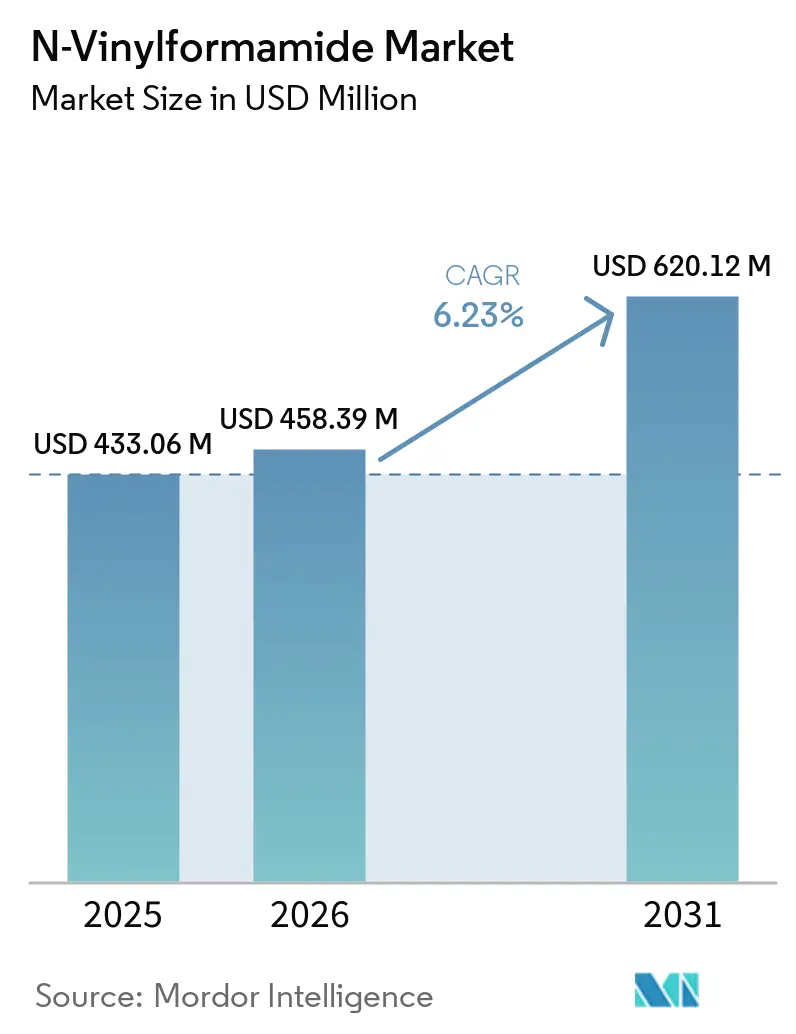
The N-vinylformamide market size is expected to increase from USD 433.06 million in 2025 to USD 458.39 million in 2026 and reach USD 620.12 million by 2031, at a CAGR of 6.23% during 2026-2031. The N-vinylformamide market serves applications that use poly(N-vinylformamide) and selectively hydrolyzed polyvinylamine, or PVAm, for their high primary amine density. Demand is moving beyond established paper applications as water treatment, specialty adhesives, coatings, and functional membranes require water-soluble polymers with specific charge characteristics. Producers are balancing higher-value purity grades against the cost and handling requirements of the monomer. Supply is becoming less dependent on Asian imports after new European capacity entered service, while feedstock exposure and storage controls continue to affect operating economics. The N-vinylformamide market also has opportunities in carbon capture membranes and redox flow batteries, although these uses remain at an early commercial stage.
Key Report Takeaways
- By purity grade, the 98.5% to 99.0% grade held 55.56% of the N-vinylformamide market share in 2025, while the above 99.0% grade is forecast to grow at a 6.97% CAGR through 2031.
- By application, paper processing accounted for 27.34% of the N-vinylformamide market size in 2025, while water treatment is forecast to grow at a 7.35% CAGR through 2031.
- By geography, Asia Pacific held 32.42% of the N-vinylformamide market share in 2025 and is forecast to grow at a 7.22% CAGR through 2031.
Note: Market size and forecast figures in this report are generated using Mordor Intelligence’s proprietary estimation framework, updated with the latest available data and insights as of January 2026.
Global N-Vinylformamide Market Trends and Insights
Drivers Impact Analysis*
| Driver | (~) % Impact on CAGR Forecast | Geographic Relevance | Impact Timeline |
|---|---|---|---|
| Industrial And Municipal Water Treatment Expansion | +1.8% | Asia-Pacific core, with spillover to the Middle East and Africa | Medium term (2-4 years) |
| NVF-Derived Polymers In Papermaking | +1.6% | Global, concentrated in Asia-Pacific and Europe | Short term (≤ 2 years) |
| High-Performance Adhesives And Coatings Demand | +1.0% | North America, Europe, and Asia-Pacific | Medium term (2-4 years) |
| Recycled Fiber And Circular Paper Systems | +0.9% | Europe and North America, expanding to Asia-Pacific | Medium term (2-4 years) |
| Functional Polymers For Batteries, Biomedical Materials, And Membranes | +0.7% | North America, Europe, and Japan | Long term (≥ 4 years) |
| Source: Mordor Intelligence | |||
Expansion of Industrial and Municipal Water Treatment
PVAm-derived flocculants and coagulants are relevant to the N-vinylformamide market because their charge density supports removal of suspended solids, colloids, and heavy-metal complexes. The chemistry can achieve this function at lower dosage than conventional polyacrylamide alternatives of comparable molecular weight. This performance supports use in municipal treatment plants and industrial facilities handling difficult wastewater streams. The input draft linked this demand to public water infrastructure programs in major Asian economies, although the associated investment figures came from non-qualifying sources and are not repeated here. PVAm can also support membrane bioreactor pretreatment by reducing colloidal fouling and extending membrane service life. This gives the N-vinylformamide market an indirect connection to wastewater equipment investment across Southeast Asia.
Growing Use of NVF-Derived Polymers in Papermaking
PVAm can act as a retention aid, strength agent, and charge-control polymer at the wet end of a paper machine. This combination allows mills to reduce the number of additives used in a process, which can simplify chemical purchasing and operation. SNF completed the ramp-up of its Dunkirk facility in 2025 to supply NVF and PVAm derivatives to European paper and water treatment customers[1]SNF Group, “SNF and Mitsubishi Chemical Forge a Groundbreaking Industrial Collaboration on NVF Technology,” SNF Group Press Release, snf.com. . The facility uses Mitsubishi Chemical technology, which strengthens local availability for mills seeking a more secure supply route. A PVAm formulation covered by US Patent 12331147 was designed to improve cationic regain properties for recycled and virgin fiber furnishes. Solenis also introduced Xelorex Plus in dry powder form, allowing mills to prepare tailored liquid PVAm solutions on site.
Demand for High-Performance Adhesives and Coatings
NVF-derived copolymers can support adhesion between dissimilar materials such as metal, plastics, paper, and film. This characteristic is relevant where bonded assemblies face repeated mechanical stress over long service periods. Construction demand is linked to adhesive-intensive prefabricated panel systems, which can replace mechanical fasteners in building programs. Waterborne and low-VOC coatings also favor water-soluble PVAm derivatives because they do not add a VOC burden to the formulation. Automotive weight-reduction programs use more mixed-material assemblies in body structures and interior trim, creating another potential use for specialty adhesives. The N-vinylformamide market can therefore benefit where performance requirements are more important than commodity adhesive pricing.
Development of Functional Polymers for Batteries, Biomedical Materials, and Membranes
PVAm has a high density of primary amine groups and can be modified for several functional polymer uses. In carbon-capture membranes, a 2024 study reported a CO₂/N₂ selectivity of 230 and CO₂ permeance of 100 GPU for a PVAm-PEGDGE composite membrane[2]“Engineering CO₂-Ultraselective Membranes: Molecularly Tailored Low-Crystallinity Polyvinylamine-PEGDGE Networks,” ACS Applied Materials & Interfaces, acs.org.. The reported selectivity was 4.6 times that of unmodified PVAm in the same research. In redox flow batteries, PVAm can form the polycationic layer of anion exchange membrane systems designed to limit vanadium-ion crossover. A 2025 Langmuir paper also examined lower-cytotoxicity PVAm variants that maintained DNA complexation performance. These applications diversify the N-vinylformamide market because their demand drivers are linked to energy, carbon management, and healthcare investment rather than paper production alone.
Restraints Impact Analysis*
| Restraint | (~) % Impact on CAGR Forecast | Geographic Relevance | Impact Timeline |
|---|---|---|---|
| Hazard Classification And Product Handling Requirements | -0.8% | Global, stronger in Europe and North America | Short term (≤ 2 years) |
| Raw-Material And Feedstock Price Volatility | -1.0% | Global | Short term (≤ 2 years) |
| Hydrolysis And Storage Process Controls | -0.6% | Global | Medium term (2-4 years) |
| Source: Mordor Intelligence | |||
Hazard Classification and Product-Handling Requirements
NVF is treated as an acute toxic substance under several chemical safety frameworks. This requires producers, importers, distributors, and users to maintain documentation, labeling, and worker training systems. The input draft referred to changes in U.S. and European chemical rules, but it relied on a non-qualifying regulatory advisory source and those claims are not reproduced. Compliance requirements can be harder for small-batch producers and specialty distributors to absorb than for larger suppliers. They may also encourage some downstream users to purchase pre-hydrolyzed PVAm solutions rather than raw NVF monomer. This can shift value addition upstream and limit addressable raw-monomer demand within the N-vinylformamide market.
Raw-Material and Feedstock Price Volatility
NVF synthesis depends on formamide and acetylene, which are exposed to energy-related changes in production costs. Formamide originates from ammonia and formic acid, while acetylene can be produced from calcium carbide. Input-cost volatility can compress margins when suppliers cannot pass higher costs through to customers. The numerical feedstock and import-price claims in the input draft came from non-qualifying commercial or company sources, so they are excluded. Concentrated production of key feedstocks can make supply diversification difficult for contract holders. This pressure is most material in standard-grade applications where the N-vinylformamide market faces greater price competition.
*Our forecasts treat driver/restraint impacts as directional, not additive. The impact forecasts reflect baseline growth, mix effects, and variable interactions.
Segment Analysis
By Purity Grade: High-Purity Grades Expand Into Specialty End-Uses
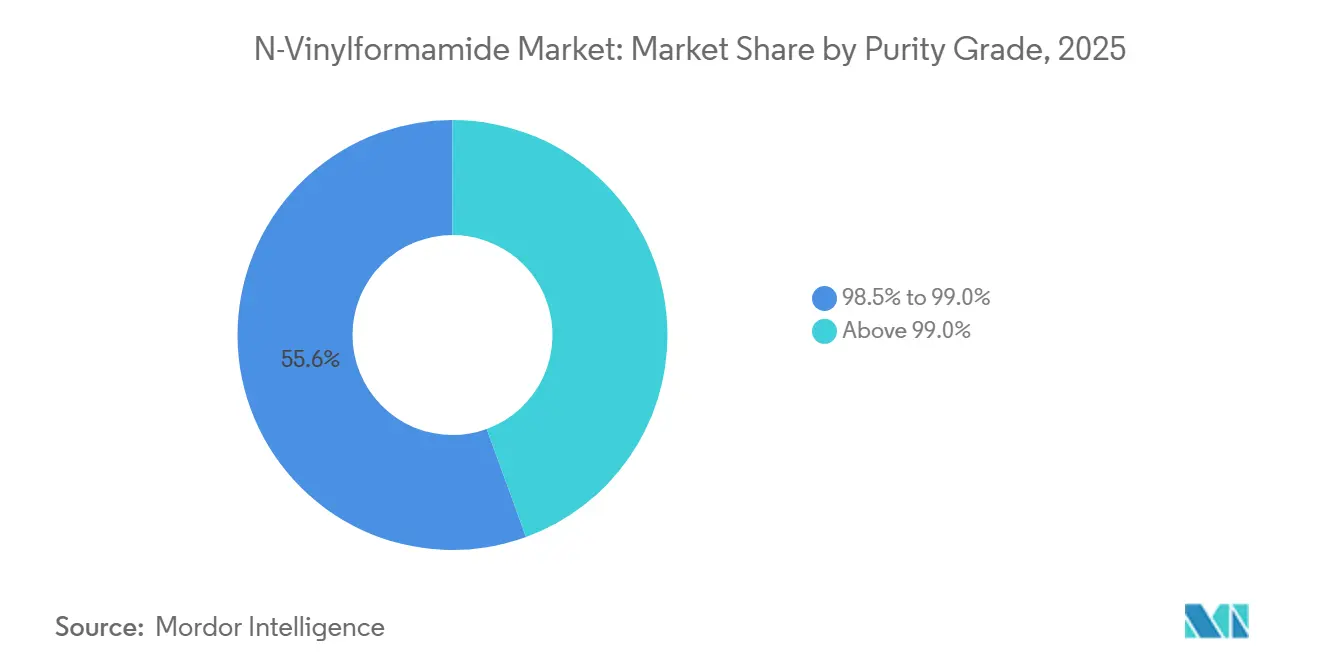
The 98.5% to 99.0% grade accounted for 55.56% of the N-vinylformamide market share in 2025. It is the primary grade for high-volume paper processing, municipal water treatment, and standard adhesive formulations. These applications generally operate within industrial residual-monomer specifications rather than the tighter requirements of specialty end uses. Its broad usability supports continued volume demand across mature applications. The segment also benefits from established processing methods and supply arrangements. Smaller producers can still compete in this tier, although they remain exposed to feedstock and logistics costs.
The above 99.0% grade is forecast to grow at a 6.97% CAGR through 2031, making it the faster-growing purity segment in the N-vinylformamide market. Adhesive and coatings formulators, battery membrane developers, and biomedical researchers seek tighter residual-monomer control for consistent polymer performance. Higher purity can improve control over the availability of amine groups for later chemical modification. Carbon-capture and redox-flow membrane work further supports demand where functional performance determines material specifications. Solenis’s dry-powder delivery model also requires a consistent polymer precursor to support on-site PVAm quality. This shifts part of the N-vinylformamide industry toward differentiated grades rather than volume-focused monomer sales.



By Application: Paper Processing Anchors Demand While Water Treatment Accelerates
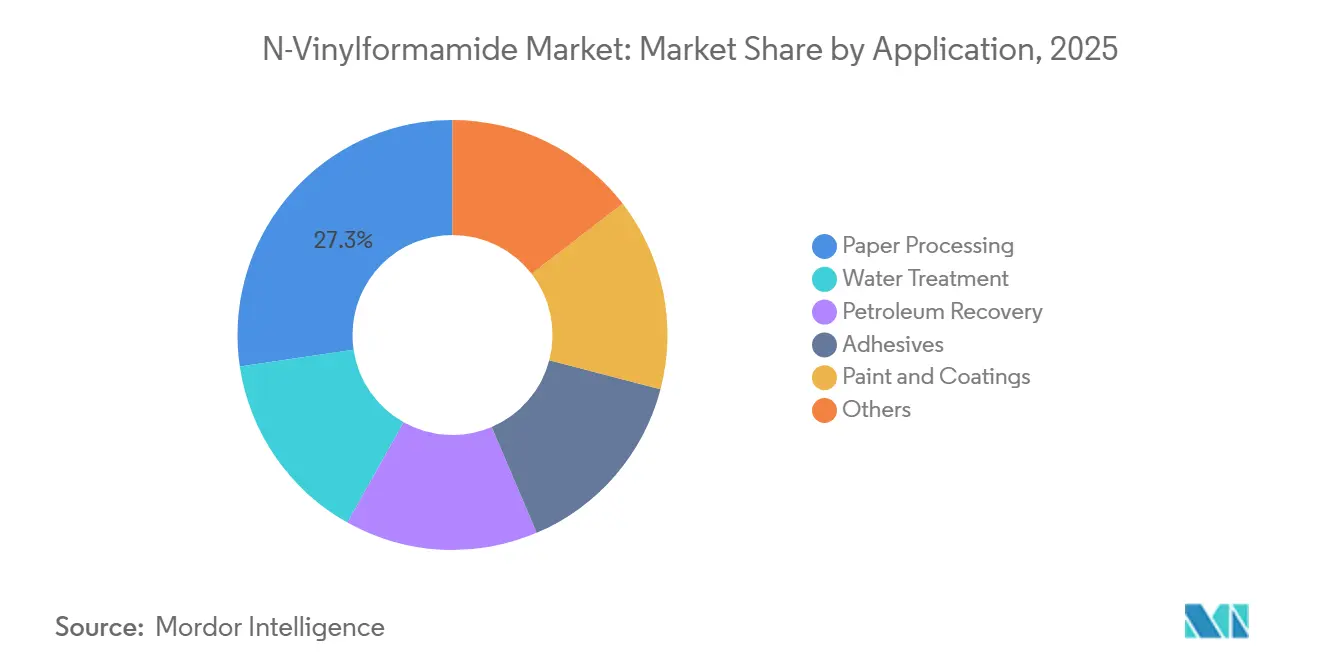
Paper processing held 27.34% of the N-vinylformamide market size in 2025, making it the largest application. PVAm performs several paper-machine functions, including retention, drainage, strength improvement, and charge control. Combining these functions can reduce the need for separate additive products at the wet end. The segment is also supported by rising use of recycled fiber in packaging grades. A study of recycled paper found that PVAm-class retention aids improved functional properties when dosed within a 0.8% to 1.0% range. Paper processing will remain a core source of demand even as the N-vinylformamide market broadens into other applications.
Water treatment is forecast to expand at a 7.35% CAGR through 2031 and is the fastest-growing application. PVAm-derived materials are used where suspended solids, colloids, and metal-bearing complexes require effective charge-based treatment. The segment is relevant to municipal wastewater, industrial effluent, and difficult high-turbidity streams. Petroleum recovery also uses NVF polymers as viscosity modifiers and mobility-control agents in saline and high-temperature reservoirs. Adhesives, paint, and coatings benefit from demand for waterborne formulations and mixed-material bonding. Textile sizing and personal care remain smaller uses, but their fiber adhesion and wash-resistance requirements can support premium pricing within the N-vinylformamide market.
Geography Analysis
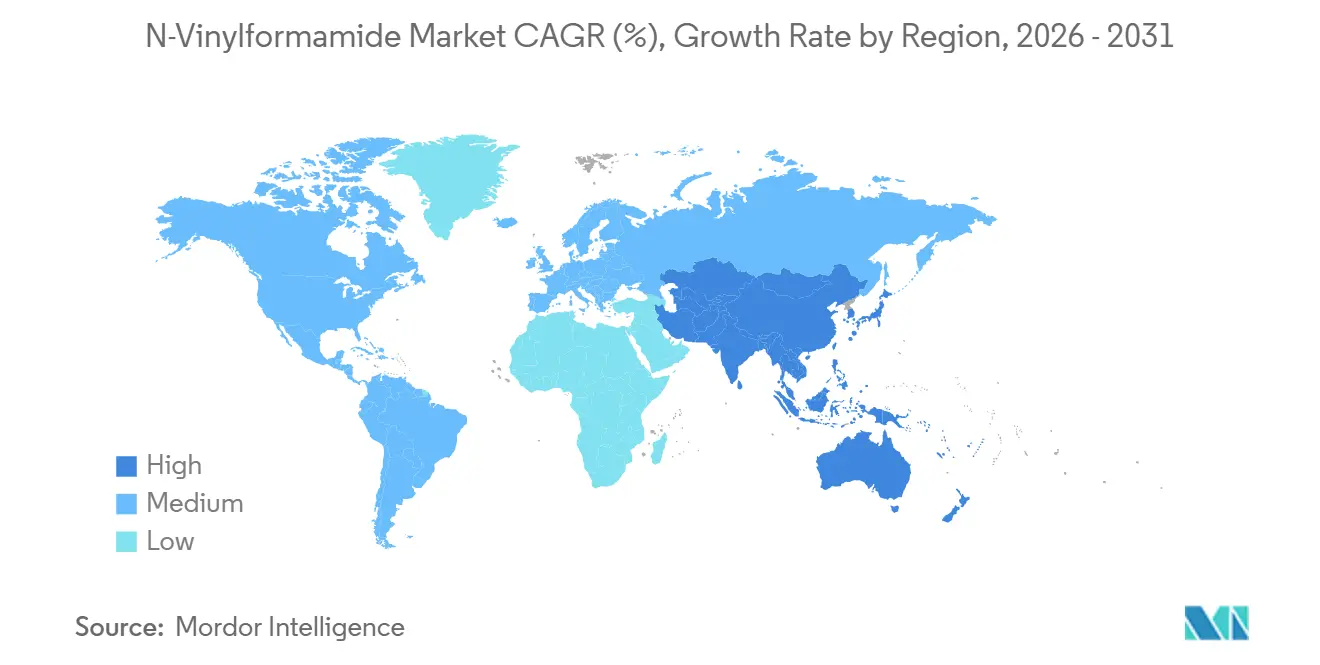
Asia Pacific held 32.42% of the N-vinylformamide market share in 2025 and is forecast to expand at a 7.22% CAGR through 2031. The region combines high-volume paper production, growing water treatment needs, and an emerging specialty polymer base. China contributes through paper mills and wastewater treatment deployment. Japan and South Korea contribute more strongly to high-purity demand because of their carbon-capture and energy-storage membrane programs. ASEAN industrial zones also create demand as wastewater requirements become more stringent. This mix of established and emerging applications gives Asia-Pacific the broadest demand base in the N-vinylformamide market.
North America and Europe retain demand through established paper-chemical procurement, water infrastructure renewal, and research activity in functional materials. SNF completed the ramp-up of its Dunkirk, France, facility in Q2 2025, strengthening European supply for paper and water treatment customers. The facility reduces dependence on imports from Asia for European mills processing recycled-fiber blends. Germany’s Rhine-Ruhr corridor remains relevant for wastewater treatment in chemical and pharmaceutical effluent streams. The United States supports high-purity consumption through specialty adhesives and coatings formulations. These regions provide technically demanding applications that favor differentiated grades in the N-vinylformamide market.
South America, the Middle East, and Africa are smaller demand pools with distinct application bases. Brazil’s pulp and paper mills can use PVAm-class retention aids as they pursue higher-quality export-grade production. Gulf countries use flocculants in desalination pretreatment and produced-water management. South Africa has demand from mining-related effluent treatment, where high-turbidity and metal-laden wastewater requires strong treatment performance. Argentina’s oilfield use is connected to petroleum recovery activity. The broader region remains an opportunity as industrial wastewater compliance requirements develop and the N-vinylformamide market gains local supply options.

Competitive Landscape
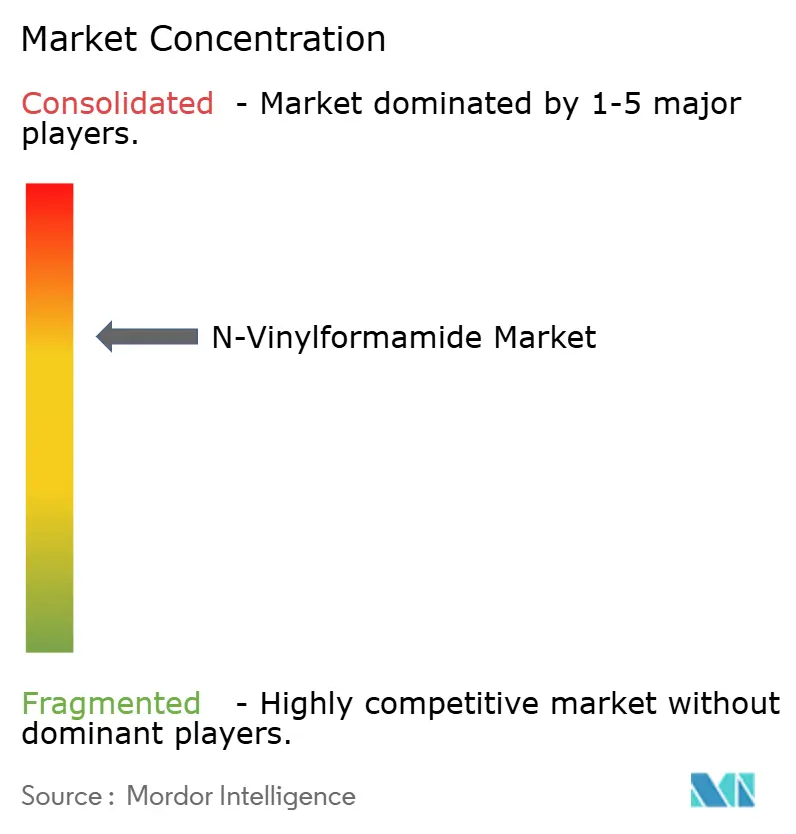
The N-vinylformamide market is moderately concentrated in monomer production and more fragmented in downstream polymer conversion and formulation. Mitsubishi Chemical pioneered commercial NVF synthesis in 1993 and retains a technology position in the field. In March 2025, Mitsubishi Chemical concluded a licensing agreement that granted SNF rights to produce NVF at its Dunkirk plant using Mitsubishi Chemical’s proprietary process. The agreement allows Mitsubishi Chemical to monetize its process technology while supporting capacity outside Japan. SNF gains a local European production route and can use its water-soluble polymer distribution capabilities to reach paper and water-treatment customers. This arrangement increases supply alternatives in the N-vinylformamide market while preserving the value of established technology.
SNF’s Dunkirk facility reached operational start-up in December 2024 and completed full ramp-up in Q2 2025. The project creates an integrated NVF-to-PVAm production base in Europe and supports local supply to paper and water treatment users. Solenis differentiates at the service layer through Xelorex Plus, a dry-powder PVAm system that supports on-site preparation of liquid product. BASF agreed in July 2024 to divest its mining flocculants business to Solenis, including Magnafloc®, Rheomax®, and Alclar® product lines. The transaction reflects a shift toward more focused specialty polymer portfolios. These moves make formulation support, reliable logistics, and application knowledge important competitive tools alongside monomer supply.
Functional polymers for energy storage and carbon capture remain open areas because no single supplier has established commercial dominance. US Patent 12269789 covers a process for obtaining bio-sourced N-vinylformamide through an alkoxy process using methanol as a protective agent. Distributed, on-site PVAm hydrolysis is another area of potential differentiation for locations without suitable liquid-product logistics. Patent activity and published membrane research show that synthetic polymer specialists can compete beyond traditional water-treatment suppliers. Smaller Chinese producers can place pricing pressure on the standard 98.5% to 99.0% grade because of lower-cost feedstock access and proximity to major demand centers. The N-vinylformamide market, therefore, separates into a price-sensitive standard grade and higher-value specialty materials with more demanding performance requirements.
N-Vinylformamide Industry Leaders
Mitsubishi Chemical Group Corporation
BASF
SNF Group
Eastman Chemical Company
Evonik Industries AG
- *Disclaimer: Major Players sorted in no particular order

Recent Industry Developments
- March 2025: SNF Group completed the full ramp-up of its N-Vinylformamide production facility at its Flocryl site in Dunkirk, France, creating 50 local jobs and establishing SNF as one of very few Western producers capable of integrated NVF-to-PVAm production. The facility uses Mitsubishi Chemical's proprietary technology to produce high-performance NVF monomers and PVAm derivatives for paper and water treatment markets, materially expanding European NVF supply capacity and reducing regional import dependence.
- March 2025: Mitsubishi Chemical Group Corporation concluded a formal licensing agreement with SNF Group, granting SNF rights to produce NVF commercially at its Dunkirk plant under Mitsubishi Chemical's proprietary process. The license converts a proprietary process monopoly into a royalty-generating intellectual property asset while enabling NVF capacity diversification beyond Japan.


Global N-Vinylformamide Market Report Scope
N-Vinylformamide (NVF) is a highly reactive, water-soluble organic chemical used as a monomer to make specialty polymers like polyvinylamine.
The N-Vinylformamide market is segmented by purity grade, application, and geography. By purity grade, the market is segmented into 98.5% to 99.0% and above 99.0%. By application, the market is segmented into water treatment, paper processing, petroleum recovery, adhesives, paints and coatings, and others. By geography, the market is segmented into Asia Pacific, North America, Europe, South America, and the Middle East and Africa. The report also covers the N-Vinylformamide market size and forecasts for the N-Vinylformamide market in 15 countries across major regions. For each segment, the market sizing and forecasts have been done on the basis of value (USD).
| 98.5% to 99.0% |
| Above 99.0% |
| Water Treatment |
| Paper Processing |
| Petroleum Recovery |
| Adhesives |
| Paint and Coatings |
| Others |
| Asia-Pacific | China |
| India | |
| Japan | |
| South Korea | |
| ASEAN Countries | |
| Rest of Asia-Pacific | |
| North America | United States |
| Canada | |
| Mexico | |
| Europe | Germany |
| United Kingdom | |
| France | |
| Italy | |
| NORDIC Countries | |
| Rest of Europe | |
| South America | Brazil |
| Argentina | |
| Rest of South America | |
| Middle East and Africa | Saudi Arabia |
| South Africa | |
| Rest of Middle East and Africa |
| By Purity Grade | 98.5% to 99.0% | |
| Above 99.0% | ||
| By Application | Water Treatment | |
| Paper Processing | ||
| Petroleum Recovery | ||
| Adhesives | ||
| Paint and Coatings | ||
| Others | ||
| By Geography | Asia-Pacific | China |
| India | ||
| Japan | ||
| South Korea | ||
| ASEAN Countries | ||
| Rest of Asia-Pacific | ||
| North America | United States | |
| Canada | ||
| Mexico | ||
| Europe | Germany | |
| United Kingdom | ||
| France | ||
| Italy | ||
| NORDIC Countries | ||
| Rest of Europe | ||
| South America | Brazil | |
| Argentina | ||
| Rest of South America | ||
| Middle East and Africa | Saudi Arabia | |
| South Africa | ||
| Rest of Middle East and Africa | ||


Key Questions Answered in the Report
What is the present and forecasted market size of the N-vinylformamide market?
The N-vinylformamide market size is USD 458.39 million in 2026 and is forecast to reach USD 620.12 million by 2031, at a 6.23% CAGR. Growth reflects demand from paper processing and water treatment, with additional potential from specialty polymer applications. The forecast period runs from 2026 to 2031. The estimate is presented in value terms.
Which application leads N-vinylformamide demand?
Paper processing led demand with a 27.34% share in 2025. PVAm supports retention, drainage, strength, and charge control in paper production, allowing mills to use one chemistry across several wet-end functions. Recycled-fiber paper grades are an important use case for these functions. This application remains the central demand base.
Which region has the largest N-vinylformamide demand?
Asia-Pacific led with 32.42% revenue share in 2025 and is projected to grow at a 7.22% CAGR through 2031. Its position combines paper production, wastewater treatment demand, and activity in battery and membrane materials. China, Japan, South Korea, and ASEAN countries each support different parts of this demand base. The region combines volume and specialty uses.
Why is high-purity N-vinylformamide important?
The above 99.0% grade supports adhesive, coating, battery membrane, and biomedical uses that require tighter residual-monomer control. It is forecast to grow at a 6.97% CAGR through 2031 as functional requirements become more important. The 98.5% to 99.0% grade remained the volume workhorse in 2025. Higher purity supports consistent polymer performance.
Page last updated on:





