
N-Butanol Market Size and Share
Market Overview
| Study Period | 2021 - 2031 |
|---|---|
| Market Size (2026) | USD 5.75 Billion |
| Market Size (2031) | USD 7.46 Billion |
| Growth Rate (2026 - 2031) | 5.33 % |
| Fastest Growing Market | Asia-Pacific |
| Largest Market | Asia-Pacific |
| Market Concentration | Medium |
Major Players *Disclaimer: Major Players sorted in no particular order Image © Mordor Intelligence. Reuse requires attribution under CC BY 4.0. | |
N-Butanol Market Analysis by Mordor Intelligence
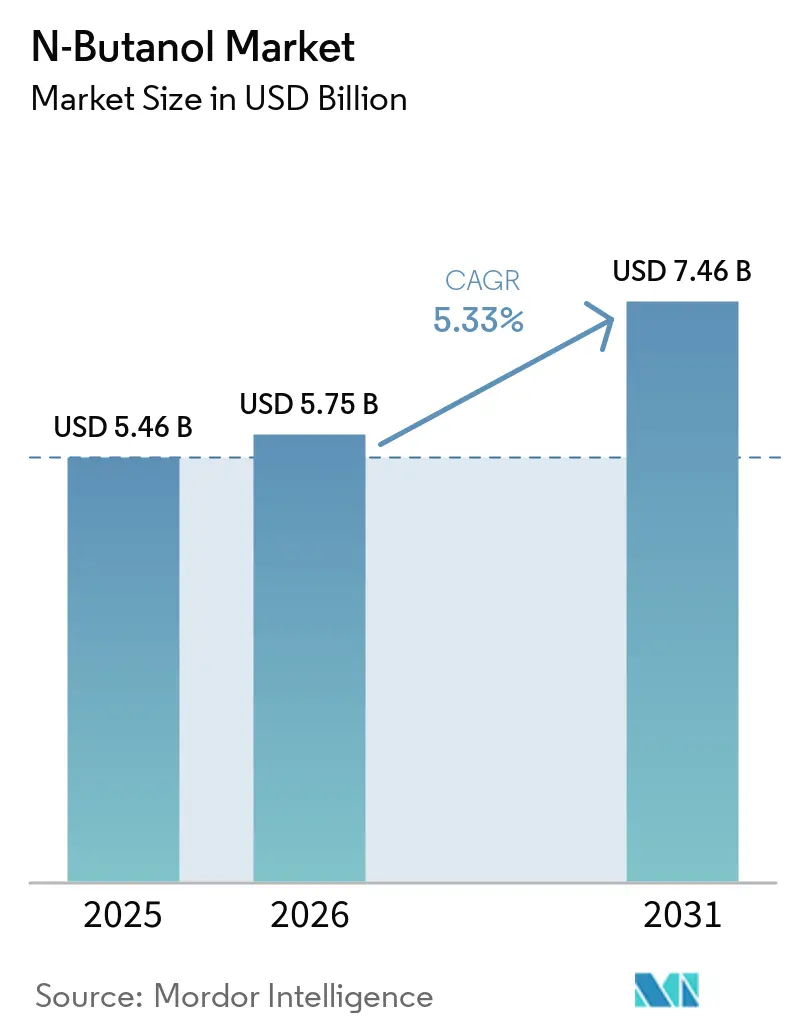
The N-Butanol Market size was valued at USD 5.46 billion in 2025 and is estimated to grow from USD 5.75 billion in 2026 to reach USD 7.46 billion by 2031, at a CAGR of 5.33% during the forecast period (2026-2031). The N-Butanol market is supported by demand from paints and coatings, derivative chemicals, and specialty solvent uses. Production economics remain closely tied to propylene and syngas because the oxo process converts propylene into n-butyraldehyde before hydrogenation produces N-Butanol. This link encourages large producers to secure feedstock, share utilities across integrated sites, and use long-term supply arrangements. The N-Butanol market also has an opportunity in higher-purity material for pharmaceutical manufacturing, where documentation and consistent specifications can support higher prices. Low-carbon production routes may create a separate offer for buyers that prioritize verified emissions performance, as BASF’s Zhanjiang site shows through its renewable-electricity-powered cracker.
Key Report Takeaways
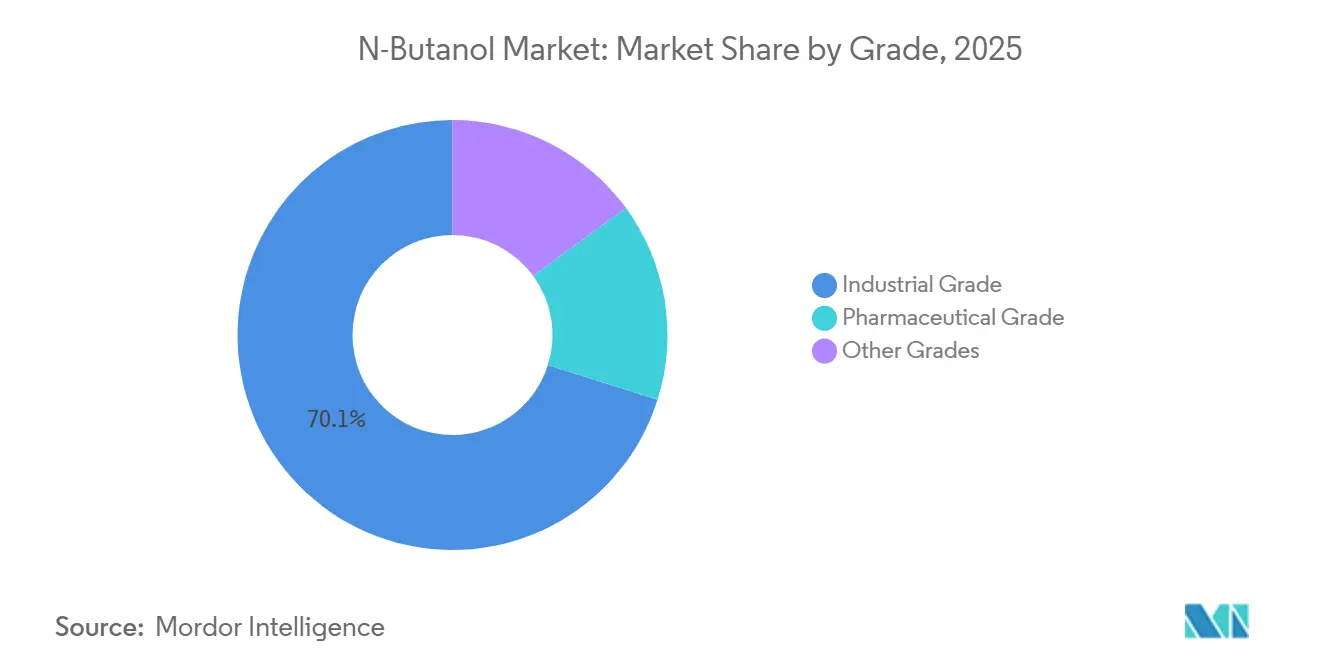
- By grade, industrial grade held 70.13% of the N-Butanol market share in 2025 and is projected to advance at a 5.87% CAGR through 2031.
- By application, butyl carboxylates held 38.84% of the N-Butanol market share in 2025, while specialty chemicals are projected to advance at a 5.93% CAGR through 2031.
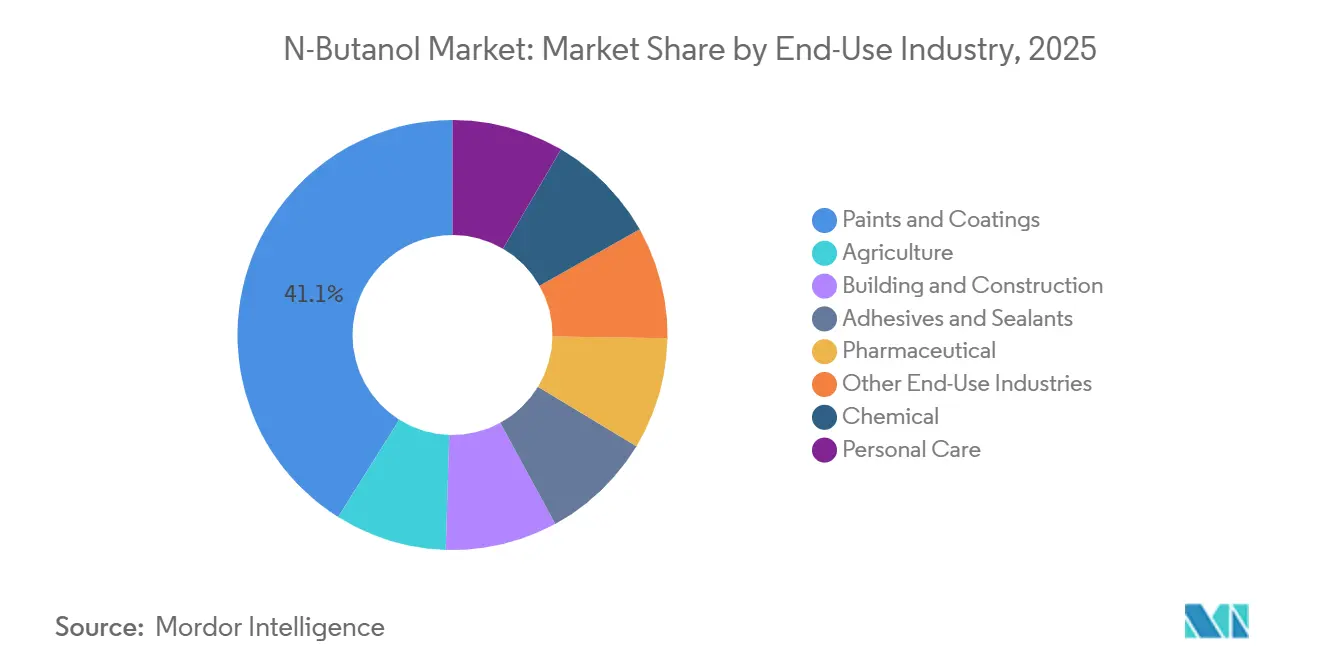
- By end-use industry, paints and coatings held 41.08% of the N-Butanol market share in 2025 and are projected to advance at a 6.28% CAGR through 2031.
- By geography, Asia-Pacific held 44.56% of the global N-Butanol market share in 2025 and is projected to advance at a 6.11% CAGR through 2031.
Note: Market size and forecast figures in this report are generated using Mordor Intelligence’s proprietary estimation framework, updated with the latest available data and insights as of January 2026.
Global N-Butanol Market Trends and Insights
Drivers Impact Analysis*
| Driver | (~) % Impact on CAGR Forecast | Geographic Relevance | Impact Timeline |
|---|---|---|---|
| Construction and Automotive Coatings Demand | +1.5% | APAC, North America & EU | Short term (≤ 2 years) |
| Expansion of Butyl Acrylate and Butyl Acetate Consumption | +1.3% | Global | Medium term (2-4 years) |
| Asia-Pacific Chemical Manufacturing Capacity Additions | +1.0% | APAC core, spillover to MEA | Medium term (2-4 years) |
| Pharmaceutical and High-Purity Solvent Applications | +0.7% | North America, EU, APAC | Long term (≥ 4 years) |
| Bio-Based and Low-Carbon Solvent Adoption | +0.4% | EU, North America | Long term (≥ 4 years) |
| Source: Mordor Intelligence | |||
Construction and Automotive Coatings Demand
Paints and coatings remain the main end-use outlet for the N-Butanol market. Construction activity in India expanded coatings demand as building, infrastructure, and renovation projects required architectural coating systems. China produced 26.1 million vehicles in 2025, supporting demand for primer, basecoat, and clearcoat formulations. Battery-electric vehicles use the same exterior body coating chemistry as internal-combustion vehicles, so the change in powertrain does not remove this source of demand. Automotive original equipment manufacturers and refinish shops continue to require consistent coating performance, which keeps demand for compatible solvents and intermediates in place. This gives the N-Butanol market exposure to both new construction and vehicle production rather than only one cyclical outlet.
Expansion of Butyl Acrylate and Butyl Acetate Consumption
Butyl acrylate and butyl acetate form the largest application group for N-Butanol consumption. Butyl acrylate is used to make acrylic latex polymers in waterborne coating systems, while butyl acetate remains a useful ester solvent in inks and industrial coatings. This means a move toward waterborne coatings does not remove all N-Butanol demand. It changes part of the demand from direct solvent use to an upstream chemical intermediate route. BASF and UPC Technology Corporation signed a memorandum of understanding in August 2024 for BASF to supply N-Butanol and 2-ethylhexanol from the Zhanjiang Verbund site to UPC’s South China plasticizer operations[1]BASF, “BASF and UPC Sign Memorandum of Understanding to Strengthen Strategic Cooperation on Plasticizer Alcohols and Catalysts,” BASF Media Release, basf.com. The arrangement shows how integrated supply can link Oxo alcohol production with downstream derivative demand in the N-Butanol market.
Asia-Pacific Chemical Manufacturing Capacity Additions
Asia-Pacific combines a large customer base with continuing investment in chemical manufacturing. New integrated sites can lower logistics requirements for regional customers and improve access to propylene, syngas, and shared utilities. BASF inaugurated its Zhanjiang Verbund site in March 2026, with a steam cracker whose main compressors use 100% renewable electricity. The site connects upstream petrochemicals with downstream value chains and gives BASF a local production base in China. Capacity additions can also increase competitive pressure when supply rises more quickly than local consumption. For the N-Butanol market, the result is likely to be stronger competition on standard grades and greater importance of operating efficiency.
Pharmaceutical and High-Purity Solvent Applications
Pharmaceutical grade N-Butanol is used as a reaction solvent, extraction medium, and crystallization vehicle in active pharmaceutical ingredient manufacturing. Its suitability depends on purity, impurity control, batch documentation, and stable quality across deliveries. Growth in active pharmaceutical ingredient production in India and China can therefore increase demand for qualified high-purity solvents. The N-Butanol market can benefit when producers have purification assets and quality systems that meet customer qualification requirements. KH Neochem Co., Ltd. identified a focus on specialty chemical applications in its 2025 reporting, an approach that aligns with the value of documentation and application support in specialized solvent supply. United States Pharmacopeia, European Pharmacopoeia, International Pharmacopoeia, World Health Organization Good Manufacturing Practice, and International Council for Harmonisation Q3C requirements raise the threshold for suppliers serving these uses.
Restraints Impact Analysis*
| Restraint | (~) % Impact on CAGR Forecast | Geographic Relevance | Impact Timeline |
|---|---|---|---|
| Propylene and Syngas Price Volatility | -1.1% | Global | Short term (≤ 2 years) |
| VOC Restrictions and Substitution by Waterborne Formulations | -0.8% | North America & EU, spillover to APAC | Medium term (2-4 years) |
| Flammability, Storage and Safe-Handling Requirements | -0.5% | Global | Long term (≥ 4 years) |
| Source: Mordor Intelligence | |||
Propylene and Syngas Price Volatility
The N-Butanol market is exposed to propylene and syngas costs because both are required in the oxo-alcohol production route. Producers that buy propylene in the merchant market has less control over its raw material costs than integrated producers. Energy supply disruption in early 2026 increased the cost of oil, gas, and related chemical feedstocks. This can compress margins when selling prices do not adjust at the same pace as input costs. Integrated sites can partly manage this exposure through captive feedstock, shared infrastructure, and contractual supply arrangements. Cost volatility can therefore influence both producer profitability and the regional competitiveness of standard grade supply.
VOC Restrictions and Substitution by Waterborne Formulations
Volatile organic compound (VOC) restrictions in North America and Europe limit direct solvent use in some coating applications. The United States Environmental Protection Agency finalized amendments to national volatile organic compound emission standards for aerosol coatings in January 2025[2]United States Environmental Protection Agency, “National Volatile Organic Compound Emission Standards for Aerosol Coatings Amendments,” Federal Register, govinfo.gov. Research published in 2025 found that substituting solvent-borne coatings with waterborne coatings reduced coating-sector total hydroxyl radical reactivity emissions by 64% for 2022. The N-Butanol market faces lower direct solvent demand as customers reformulate toward waterborne systems. However, butyl acrylate remains an input for acrylic emulsion production, which preserves an indirect route for N-Butanol consumption. Producers can reduce exposure by directing supply toward derivative applications and higher-purity uses.
*Our forecasts treat driver/restraint impacts as directional, not additive. The impact forecasts reflect baseline growth, mix effects, and variable interactions.
Segment Analysis
By Grade: Industrial Grade Dominates Both Scale and Growth
Industrial grade held 70.13% of the market share in 2025 and is projected to advance at a 5.87% CAGR through 2031. The grade is used in high-volume butyl carboxylate production, direct solvent blending, and plasticizer manufacturing. Its large role reflects the importance of cost, availability, and reliable delivery in bulk chemical applications. Paints and coatings, adhesives, and chemical intermediate manufacturing support continued consumption of this grade. Industrial grade demand is generally tied to broad downstream activity rather than specialized purity needs. Buyers in these uses generally prioritize dependable specification control, regional availability, workable logistics, and stable commercial supply terms. The N-Butanol industry depends on this demand base because it provides the main outlet for world-scale oxo-alcohol plants.
Pharmaceutical grade serves applications where solvent quality can affect yield, product purity, and production time. Customers require material that conforms to United States Pharmacopeia, European Pharmacopoeia, and International Pharmacopoeia specifications. Quality requirements under the International Council for Harmonisation Q3C and World Health Organization Good Manufacturing Practice frameworks make supplier approval more demanding. This can limit the number of qualified producers and create a wider pricing gap relative to standard industrial material. Documented analytical controls, batch certification, and validated purification are central requirements for this customer group. KH Neochem Co., Ltd.’s stated specialty focus reflects the value of applications that require technical documentation and customer qualification.



By Application: Butyl Carboxylates Lead, Specialty Chemicals Define Forward Growth
Butyl carboxylates accounted for 38.84% of the N-Butanol market size by application in 2025. This group mainly includes butyl acrylate and butyl acetate, which support coating and adhesive production. Butyl acrylate is a core monomer for waterborne acrylic latex systems. Butyl acetate provides solvency and controlled evaporation in industrial and original equipment manufacturer coating formulations. Direct solvents also remain important in coatings and inks because N-Butanol supports flow and coalescence properties. Rubber and plasticizer applications provide another established outlet through ester plasticizer production for polyvinyl chloride compounds. These outlets connect the material to both waterborne and solvent-borne formulation systems across several manufacturing sectors.
Specialty chemicals are projected to advance at a 5.93% CAGR through 2031 within the N-Butanol market. The segment includes glycol ether derivatives, synthetic ester lubricants, performance solvents, electronic chemical uses, and cleaning formulations. These uses can generate higher margins than commodity derivative pathways because they rely on performance specifications. Producers can improve their product mix by allocating capacity toward these applications when standard grade pricing becomes less favorable. Their requirements can include consistent purity, controlled evaporation, compatibility with other ingredients, and dependable supply to qualified customers. BASF’s supply cooperation with UPC illustrates how producers can pair oxo alcohol output with specific downstream customer requirements. This application mix gives suppliers a reason to maintain product quality, delivery consistency, and technical support alongside production scale.
By End-Use Industry: Paints and Coatings Lead Both Share and Growth
Paints and coatings accounted for 41.08% of the N-Butanol market size in 2025 and are projected to advance at a 6.28% CAGR through 2031. Architectural coatings benefit from construction and renovation activity in India, Southeast Asia, and the Middle East. Automotive coatings add demand from original equipment manufacturing and refinishing. The segment uses N-Butanol directly in selected formulations and indirectly through butyl acrylate and butyl acetate. Exterior coating systems continue to be needed regardless of whether a vehicle uses an internal-combustion engine or an electric powertrain. The same body panels require preparation, protective layers, color layers, and clearcoats that meet appearance and durability standards. This broad use base helps explain why paints and coatings remain central to the N-Butanol market.
Agriculture uses N-Butanol in herbicide and pesticide solvent formulations and in intermediate chemical synthesis. Building and construction also consume related materials through adhesives and sealants used in flooring, glazing, and structural assembly. Pressure-sensitive adhesive demand can increase the use of N-Butanol-derived acrylic polymers as packaging production rises. Pharmaceutical customers use high-purity solvent grades for active pharmaceutical ingredient production. Chemical end uses include glycol ethers, formates, butyrates, and acrylate monomers, each of which creates a separate consumption path. Personal care applications include nail care formulations, perfume carriers, and cosmetic solvents that require consistent material quality. Personal care, printing inks, textile auxiliaries, and cleaning products are smaller outlets, but they extend the N-Butanol market across a broad group of industrial uses.
Geography Analysis
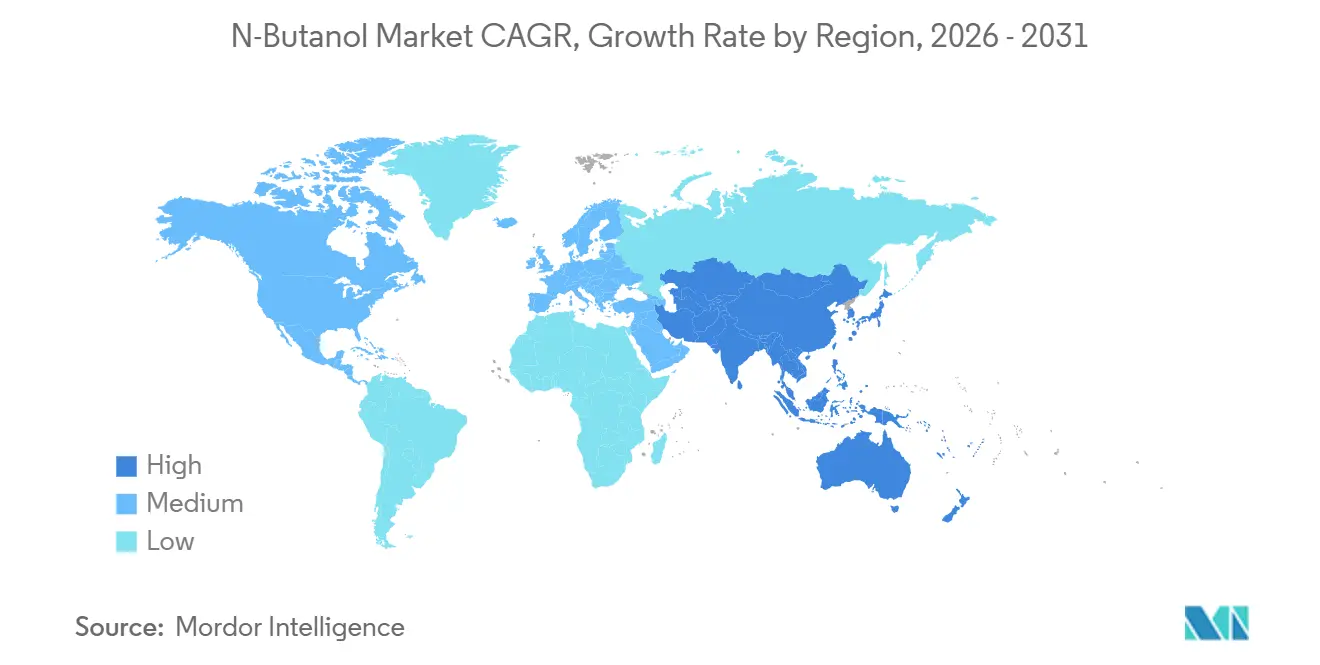
Asia-Pacific held 44.56% of the N-Butanol market share in 2025 and is projected to advance at a 6.11% CAGR through 2031. China accounts for a large share of regional demand through paints and coatings, butyl acrylate, and plasticizer production. India is expanding demand through construction activity, pharmaceutical manufacturing, and domestic chemical investment. The extension of Chinese anti-dumping duties in December 2024 protects domestic producers from competing imports from Taiwan, Malaysia, and the United States. Vietnam, Thailand, and Indonesia are additional demand centers as automotive parts production and coatings manufacturing expand. Japan and South Korea sustain higher-value demand from electronics and specialty chemical production. Their customers also require dependable quality for glycol ether derivatives and high-purity solvent applications.
North America has an established paints and coatings base, pharmaceutical grade demand, and petrochemical assets on the United States Gulf Coast. The region’s N-Butanol market faces a change in product mix as volatile organic compound rules encourage waterborne coating formulations. The January 2025 federal update on aerosol coating standards reinforces the role of regulatory requirements in formulation decisions. Direct solvent demand can decline in regulated applications, while butyl acrylate demand can remain relevant for waterborne acrylic systems. Canada and Mexico support regional consumption through coatings and adhesive manufacturing. Mexico also benefits from proximity to the United States petrochemical supply chains. These links support cross-border sourcing for customers who need regular solvent and intermediate deliveries.
Europe has a mature N-Butanol market with strong specialty chemical and coating demand. Germany, France, and the Netherlands accounted for 58% of European regional consumption. The European Union Deco Paint Directive and Registration, Evaluation, Authorisation and Restriction of Chemicals requirements have accelerated the use of waterborne technologies in decorative coatings. This reduces reliance on solvent-borne N-Butanol in some applications and increases the value of high-quality specialty material. Brazil anchors South American demand, although import dependence and currency volatility can slow purchase growth. The Middle East and Africa are developing gradually through infrastructure programs, downstream petrochemicals, coatings, and adhesives, with South Africa remaining an important African demand center. Regional buyers also assess supply security because local production and import access vary widely across these markets.

Competitive Landscape
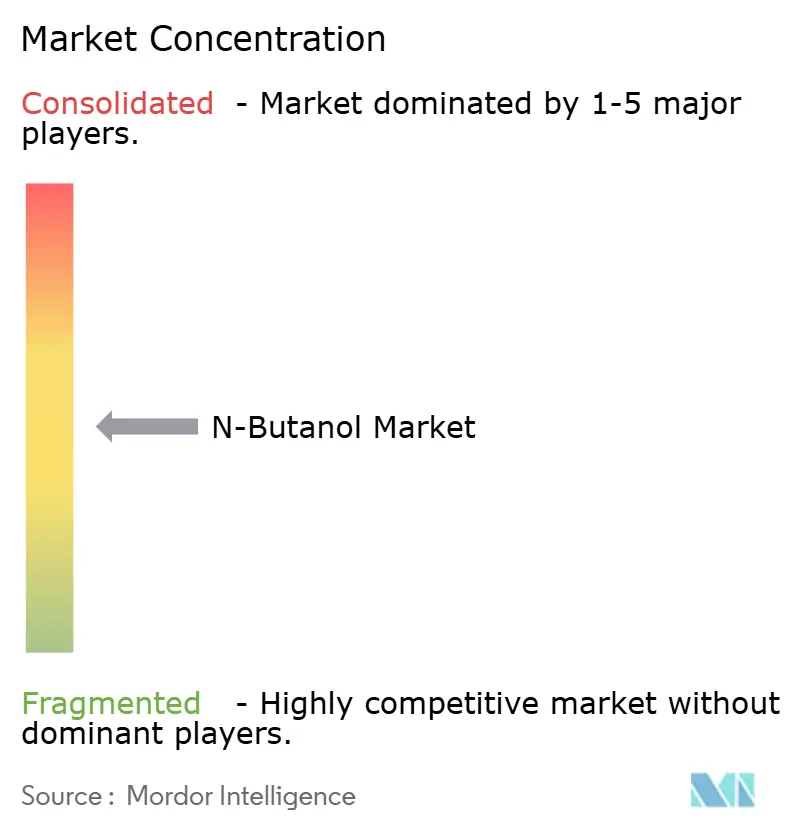
The N-Butanol market is moderately concentrated, with the top five players including BASF, Dow, OQ SAOC, SABIC, and Eastman Chemical Company. Their main advantage is the integration of propylene feedstock, syngas, utilities, and derivative production within larger petrochemical sites. This structure can reduce unit costs and help producers manage volatile raw-material prices. It also makes it harder for a standalone merchant producer to match the operating economics of a fully integrated complex. The N-Butanol market, therefore, rewards reliable feedstock access, efficient site operations, and a balanced downstream customer base.
BASF inaugurated its Zhanjiang Verbund site in March 2026 as part of an integrated investment program. The site includes a 1 million metric tons per year cracker with main compressors powered by 100% renewable electricity. BASF also agreed in August 2024 to supply N-Butanol and 2-ethylhexanol to UPC Technology Corporation’s South China plasticizer operations after the start-up of the Zhanjiang oxo-alcohol plant. These actions combine local production, lower-carbon site infrastructure, and downstream customer links. Chinese suppliers, including Wanhua, are expanding integrated petrochemical positions, while anti-dumping measures reduce external import competition. The competitive environment can place pressure on standard grades and increase the value of differentiated products. Suppliers can respond by combining operating scale with support for customers that require specialized performance or documentation.
A separate opportunity exists in pharmaceutical grade N-Butanol that carries complete documentation and in bio-based material with credible low-carbon attributes. KH Neochem Co., Ltd. has emphasized specialty chemicals in its public reporting, consistent with a strategy that uses application support and documentation to serve differentiated demand. Perstorp focuses on higher-value C8-C10 oxo alcohol and specialty chemical activities rather than direct competition in commodity N-Butanol. Grupa Azoty and INEOS have European production positions close to coatings and specialty chemical customers, although lower-cost Middle Eastern and Asian supply can create cost pressure. Sasol supplies regional and export markets from South Africa while managing domestic energy costs. Suppliers serving specialty applications must maintain quality systems, technical service, and reliable batch-to-batch performance. Competition is consequently based on feedstock integration, technical quality, regional access, and the ability to serve specialty requirements.
N-Butanol Industry Leaders
BASF
Dow
OQ SAOC
SABIC
Eastman Chemical Company
- *Disclaimer: Major Players sorted in no particular order

Recent Industry Developments
- March 2026: Eastman Chemical Company announced a USD 0.13/lb increase in Eastman N-Butyl Alcohol prices across North America and Latin America, effective March 17, 2026. The adjustment highlights continued market movement for N-Butanol used as a solvent and intermediate in coatings, resins, plasticizers, and agricultural chemicals.
- January 2026: BASF announced a USD 0.07/lb increase in North American N-Butanol prices, effective February 1, 2026, citing market conditions. The price adjustment reflects changing supply-demand conditions for N-Butanol used in coatings, solvents, resins, and chemical intermediates.


Global N-Butanol Market Report Scope
N-Butanol is a four-carbon alcohol used as a chemical intermediate, solvent, and formulation component across various industrial processes. It offers useful solvency, volatility, and compatibility properties for producing downstream chemicals and formulated products.
The N-Butanol Market is segmented by grade, application, end-use industry, and geography. By grade, the market is segmented into industrial grade, pharmaceutical grade, and other grades. By application, the market is segmented into butyl carboxylates, direct solvents, specialty chemicals, rubber and plasticizers, and other applications. By end-use industry, the market is segmented into paints and coatings, agriculture, building and construction, adhesives and sealants, pharmaceutical, chemical, personal care, and other end-use industries. The report also covers the market size and forecasts for N-Butanol in 15 countries across major regions. For each segment, the market sizing and forecasts have been done on the basis of value (USD).
| Industrial Grade |
| Pharmaceutical Grade |
| Other Grades |
| Butyl Carboxylates |
| Direct Solvents |
| Specialty Chemicals |
| Rubber and Plasticizers |
| Other Applications |
| Paints and Coatings |
| Agriculture |
| Building and Construction |
| Adhesives and Sealants |
| Pharmaceutical |
| Chemical |
| Personal Care |
| Other End-Use Industries |
| Asia-Pacific | China |
| India | |
| Japan | |
| South Korea | |
| ASEAN Countries | |
| Rest of Asia-Pacific | |
| North America | United States |
| Canada | |
| Mexico | |
| Europe | Germany |
| United Kingdom | |
| France | |
| Italy | |
| NORDIC Countries | |
| Rest of Europe | |
| South America | Brazil |
| Argentina | |
| Rest of South America | |
| Middle East and Africa | Saudi Arabia |
| South Africa | |
| Rest of Middle East and Africa |
| By Grade | Industrial Grade | |
| Pharmaceutical Grade | ||
| Other Grades | ||
| By Application | Butyl Carboxylates | |
| Direct Solvents | ||
| Specialty Chemicals | ||
| Rubber and Plasticizers | ||
| Other Applications | ||
| By End-Use Industry | Paints and Coatings | |
| Agriculture | ||
| Building and Construction | ||
| Adhesives and Sealants | ||
| Pharmaceutical | ||
| Chemical | ||
| Personal Care | ||
| Other End-Use Industries | ||
| By Geography | Asia-Pacific | China |
| India | ||
| Japan | ||
| South Korea | ||
| ASEAN Countries | ||
| Rest of Asia-Pacific | ||
| North America | United States | |
| Canada | ||
| Mexico | ||
| Europe | Germany | |
| United Kingdom | ||
| France | ||
| Italy | ||
| NORDIC Countries | ||
| Rest of Europe | ||
| South America | Brazil | |
| Argentina | ||
| Rest of South America | ||
| Middle East and Africa | Saudi Arabia | |
| South Africa | ||
| Rest of Middle East and Africa | ||


Key Questions Answered in the Report
What is the size of the N-Butanol market?
The N-Butanol market stands at USD 5.75 billion in 2026 and is projected to reach USD 7.46 billion by 2031.
What is driving demand for N-Butanol?
Paints and coatings, butyl acrylate and butyl acetate production, and specialty chemical uses support demand.
Which grade held the largest share in 2025?
Industrial grade held 70.13% of the market share in 2025.
Which application is expected to grow fastest through 2031?
Specialty chemicals are projected to advance at a 5.93% CAGR through 2031, supported by glycol ethers, synthetic ester lubricants, and performance solvents.
Page last updated on:


 Your data is secure and never sold or shared.


