
MWIR Industrial Imaging Systems Market Size and Share
Market Overview
| Study Period | 2020 - 2031 |
|---|---|
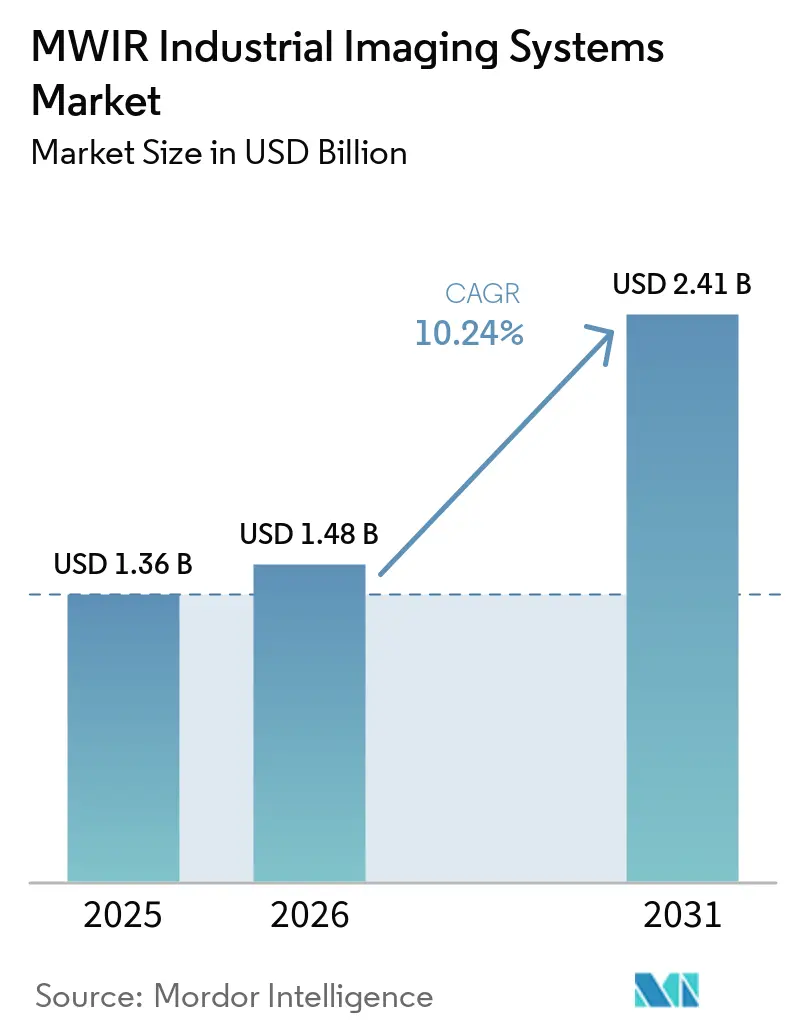
| Market Size (2026) | USD 1.48 Billion |
| Market Size (2031) | USD 2.41 Billion |
| Growth Rate (2026 - 2031) | 10.24 % |
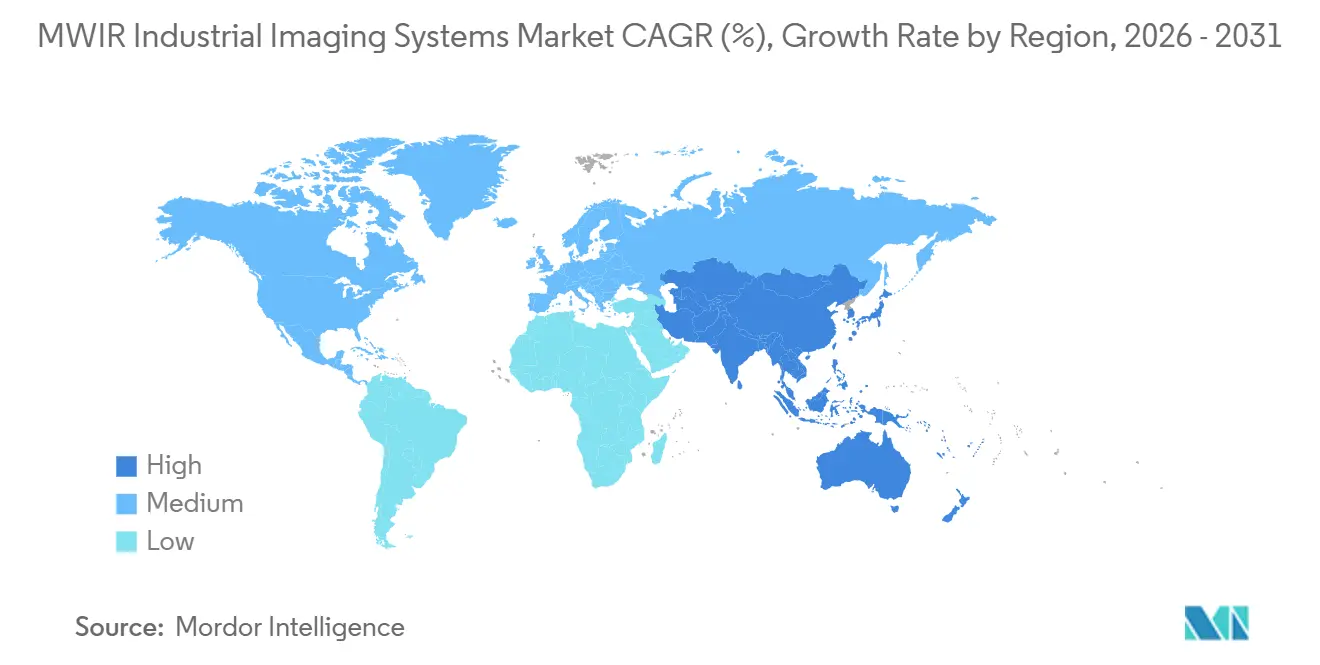
| Fastest Growing Market | Asia-Pacific |
| Largest Market | North America |
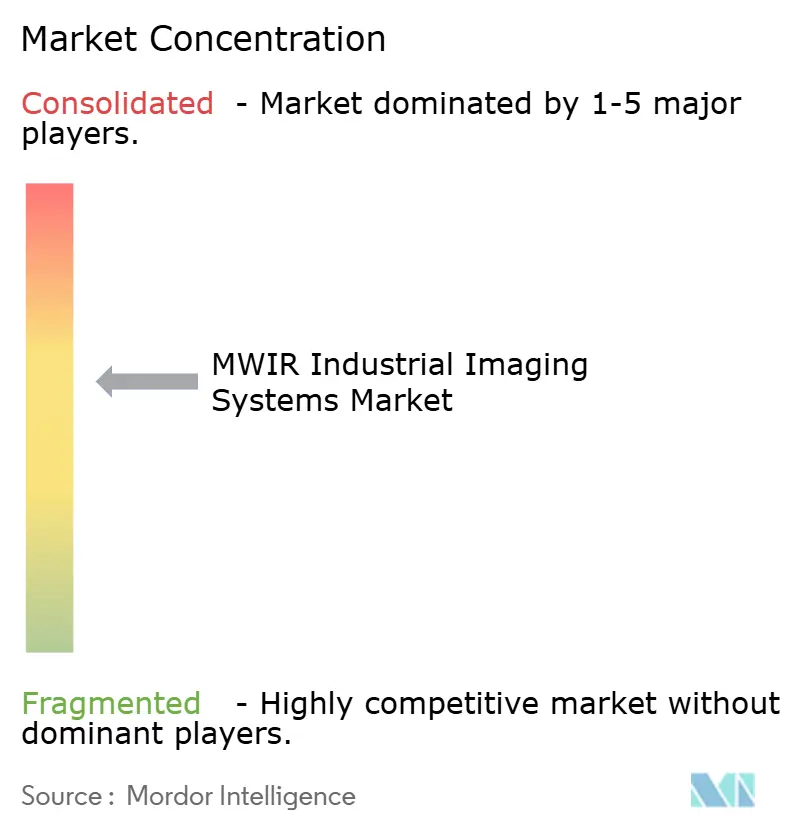
| Market Concentration | Medium |
Major Players *Disclaimer: Major Players sorted in no particular order Image © Mordor Intelligence. Reuse requires attribution under CC BY 4.0. | |
MWIR Industrial Imaging Systems Market Analysis by Mordor Intelligence
The MWIR industrial imaging systems market size was valued at USD 1.36 billion in 2025 and estimated to expand from USD 1.48 billion in 2026 to reach USD 2.41 billion by 2031, at a CAGR of 10.24% during the forecast period (2026-2031). Demand in the MWIR industrial imaging systems market is moving toward continuous thermal monitoring as manufacturers connect cameras with automated inspection and maintenance workflows. Methane measurement rules are reinforcing repeat purchases in oil, gas, and chemical facilities. Semiconductor producers are also using MWIR systems to identify defects without damaging sensitive devices. Competition is strongest in cooled detectors, while software integration gives camera suppliers a route to differentiate their offerings.
Key Report Takeaways
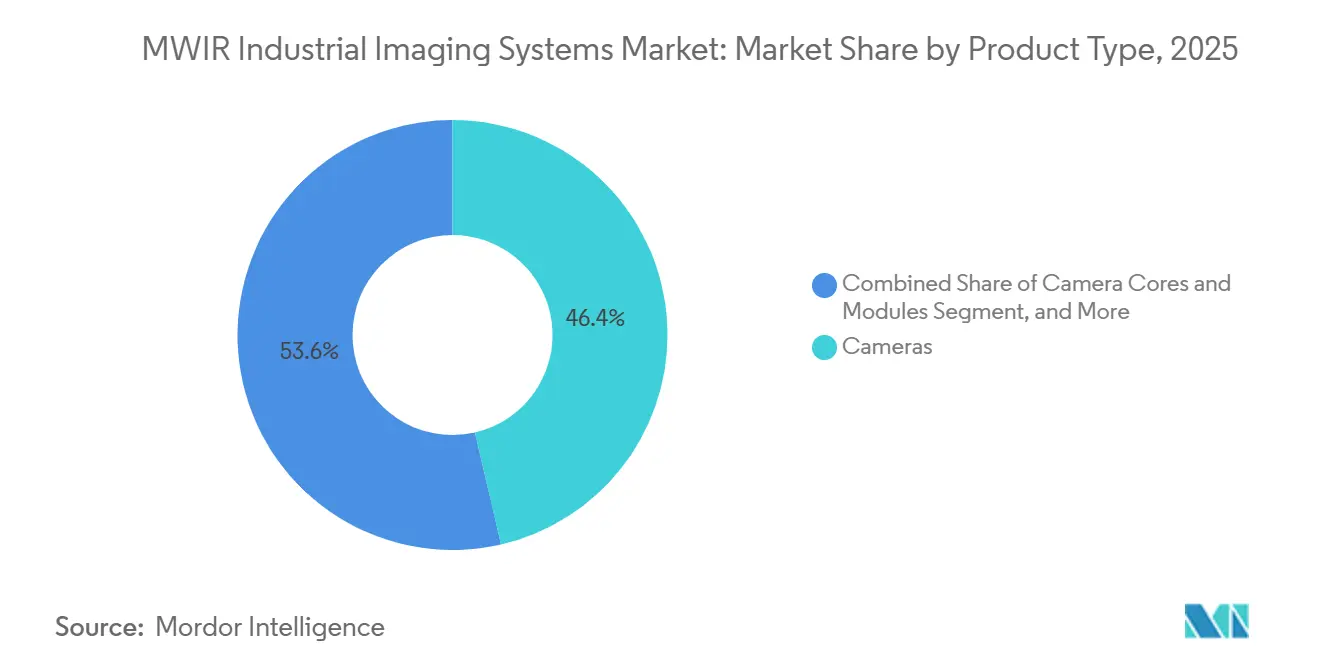
- By product type, cameras held 46.38% of the MWIR industrial imaging systems market share in 2025, while camera cores and modules are projected to expand at a 10.84% CAGR through 2031.
- By technology, cryogenically cooled systems accounted for 66.24% of global revenue in 2025, while HOT MWIR is projected to expand at a 10.67% CAGR through 2031.
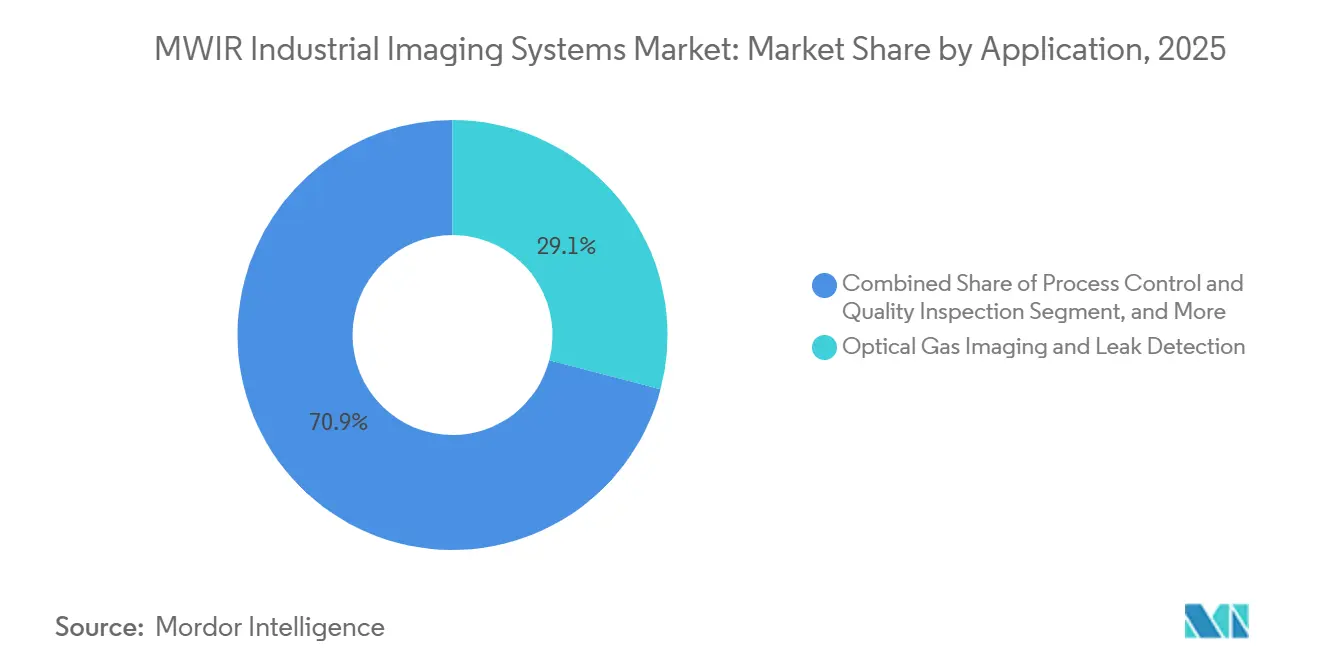
- By application, optical gas imaging and leak detection held 29.06% of the MWIR industrial imaging systems market size in 2025 and is projected to expand at a 10.88% CAGR through 2031.
- By end user, oil and gas held 28.43% of global revenue in 2025, while semiconductor and electronics is projected to expand at a 10.92% CAGR through 2031.
- By geography, North America held 36.19% of global revenue in 2025, while the Asia-Pacific MWIR industrial imaging systems market is projected to expand at an 11.12% CAGR through 2031.
Note: Market size and forecast figures in this report are generated using Mordor Intelligence’s proprietary estimation framework, updated with the latest available data and insights as of January 2026.
Global MWIR Industrial Imaging Systems Market Trends and Insights
Drivers Impact Analysis*
| Driver | (~) % Impact on CAGR Forecast | Geographic Relevance | Impact Timeline |
|---|---|---|---|
| Industrial Automation and Predictive Maintenance Adoption | +2.8% | Global, concentrated in North America, Europe, and Asia-Pacific manufacturing hubs | Medium term (2-4 years) |
| Defense and Border Surveillance Modernization | +2.3% | North America, Europe, Middle East, and Asia-Pacific defense corridors | Long term (≥ 4 years) |
| High-Temperature Process Inspection Requirements | +1.6% | North America and Europe, with spillover to the Middle East | Medium term (2-4 years) |
| AI-Enabled Thermal Analytics and IIoT Integration | +1.4% | Global, with early adoption in North America and Northeast Asia | Medium term (2-4 years) |
| Inline MWIR Monitoring for Semiconductor and Power Electronics Yield | +0.9% | Taiwan, South Korea, Japan, North America, and Europe | Short term (≤ 2 years) |
| Optical Gas Imaging for Methane and Process Leak Compliance | +0.8% | North America and Europe | Short term (≤ 2 years) |
| Source: Mordor Intelligence | |||
Industrial Automation and Predictive Maintenance Adoption
Industrial operators are shifting from scheduled checks to continuous thermal monitoring connected to fault prediction systems. A 2026 IEEE study reported 92% fault-detection accuracy for multimodal maintenance methods that used thermal imaging with convolutional and recurrent neural networks.[1]Abdullah Almutairi et al., “Multimodal Predictive Maintenance Using CNN and LSTM with Thermal Imaging,” IEEE GAST 2026 Proceedings, doi.org The same study reported a 35% reduction in maintenance costs when these workflows were deployed. This supports demand for sensors that can remain installed on production equipment rather than being used only during periodic inspections. The MWIR industrial imaging systems market is therefore seeing greater interest in camera cores and modules that original equipment manufacturers can build into production lines. Teledyne FLIR introduced the A6450 in February 2026 with a HOT MWIR detector and a 27,000-hour cooler life for continuous industrial use.
Defense and Border Surveillance Modernization
Defense customers are seeking smaller cooled MWIR payloads for surveillance, counter-unmanned aerial systems, and border operations. NATO members averaged defense spending equal to 2.2% of GDP in 2024, supporting a stronger procurement setting for advanced sensing equipment.[2]NATO, “Defense Expenditure of NATO Countries (2014-2024),” NATO, nato.int The current upgrade cycle in the MWIR industrial imaging systems market favors modules with lower size, weight, and power requirements than older systems. This enables deployment on tactical unmanned aircraft and portable equipment. Material advances in type-II superlattice detectors are supporting this transition because they can operate at higher temperatures. The MWIR industrial imaging systems market benefits when defense-led detector development also becomes available for industrial surveillance applications.
High-Temperature Process Inspection Requirements
Glass, metal, cement, and chemical plants need non-contact temperature measurement where contact sensors are impractical. MWIR sensing is well-suited to high-emissivity processes and materials with changing spectral behavior at elevated temperatures. It also allows operators to observe processes from safer stand-off distances. A recent study of industrial sensor fusion reported that integrated telemetry and sensing significantly reduced machine downtime in precision manufacturing settings. This creates a stronger case for the MWIR industrial imaging systems market for embedding thermal systems in process control rather than retaining them for final inspection. The MWIR industrial imaging systems market gains from plant investments aimed at reducing defect detection time and material scrap.
AI-Enabled Thermal Analytics and IIoT Integration
Embedded computing in the MWIR industrial imaging systems market is allowing thermal cameras to analyze radiometric information near the production asset. This reduces reliance on specialist thermography staff for each inspection decision. The 2026 IEEE research on thermal-image-based predictive maintenance supports the use of data-driven fault classification in industrial environments. Camera suppliers can use this capability to pair hardware with analytics and system integration. Such offers can create a more durable customer relationship than a single camera sale. The MWIR industrial imaging systems market is consequently becoming more attractive for suppliers that combine detector performance with usable inspection software.
Restraints Impact Analysis*
| Restraint | (~) % Impact on CAGR Forecast | Geographic Relevance | Impact Timeline |
|---|---|---|---|
| High Capital and Lifecycle Cost of Cooled MWIR Systems | -2.1% | Global, most acute in emerging markets and small and medium enterprise manufacturing | Long term (≥ 4 years) |
| Export Controls and Restricted Detector Supply | -1.2% | North America and Europe, with supply constraints in Asia-Pacific and the Middle East | Medium term (2-4 years) |
| Cryocooler Reliability and Maintenance Burden | -0.7% | Global, especially in continuous-operation facilities | Short term (≤ 2 years) |
| Limited Industrial Skills for Radiometric Data Interpretation | -0.5% | ASEAN, South America, and Africa | Medium term (2-4 years) |
| Source: Mordor Intelligence | |||
High Capital and Lifecycle Cost of Cooled MWIR Systems
Cooled MWIR equipment in the MWIR industrial imaging systems market costs 5-10 times more than comparable uncooled LWIR systems, which limits adoption in cost-sensitive facilities. Cryocoolers, optics, and readout electronics add to the initial system cost. Historical Stirling-cycle cooler refurbishment intervals of 8,000-10,000 hours have also added recurring operating expense. Newer HOT systems improve the economics but do not remove the premium for advanced focal plane arrays. Teledyne FLIR reported a 27,000-hour cooler life for its A6450, showing progress on maintenance requirements.[3]Teledyne FLIR OEM, “Teledyne FLIR OEM Expands Neutrino ISR Series with Longest-Range SX8 ISR 50-1000 Model,” Teledyne FLIR OEM News, oem.flir.com The MWIR industrial imaging systems market remains constrained where capital budgets are lower, particularly in Southeast Asia, South America, and Africa.
Export Controls and Restricted Detector Supply
US export rules in the MWIR industrial imaging systems market restrict certain cooled MWIR detector assemblies with high frame rates and low noise performance. These rules can limit sales by US suppliers in selected overseas destinations. Compliance obligations also affect re-export planning and increase transaction lead times. European programs for sovereign detector capability reflect the commercial importance of reliable regional supply. Detector manufacturers outside the United States may gain opportunities where buyers seek alternatives to controlled components. The MWIR industrial imaging systems market therefore faces a supply constraint that is shaped by both technology performance and trade compliance.
*Our forecasts treat driver/restraint impacts as directional, not additive. The impact forecasts reflect baseline growth, mix effects, and variable interactions.
Segment Analysis
By Product Type: Cameras Lead Revenue While Modules Support Embedded Deployment
Cameras accounted for 46.38% of the MWIR industrial imaging systems market in 2025. Buyers in industrial and defense settings often prefer a complete camera because it simplifies installation and operation. Camera cores and modules are projected to record the highest product CAGR of 10.84% through 2031. Automation equipment makers use these components in robotic cells, production lines, and unmanned aircraft payloads. Detectors and focal plane arrays remain a key upstream constraint because only a limited group of suppliers produces qualified InSb, HgCdTe, and T2SL devices. This gives suppliers with established detector capability an important position in the MWIR industrial imaging systems industry.
Optics and lens assemblies in the MWIR industrial imaging systems market have a lower unit value than cameras and detectors, but their supply affects system cost and delivery schedules. Germanium and chalcogenide glass sourcing can expose camera producers to concentrated supply chains. Software, analytics, and accessories represent the smallest product category by revenue. Their role is increasing because analytics can turn a hardware sale into a recurring service relationship. Edge computing also allows core modules to act as autonomous inspection devices. These changes encourage customers to evaluate a system's data capability alongside its imaging performance.



By Technology: Cooled Systems Retain Performance Leadership While HOT MWIR Advances
Cryogenically cooled systems held 66.24% of the MWIR industrial imaging systems market size in 2025. Their low noise-equivalent temperature difference supports defense, gas imaging, and demanding process monitoring tasks. HOT MWIR is projected to record the fastest technology CAGR of 10.67% through 2031. InAsSb and T2SL materials allow focal plane arrays to operate at 130-150 K. Higher operating temperatures can reduce cooler power demand, equipment size, and maintenance needs. These attributes make HOT products relevant where conventional cooled performance remains necessary.
Research published in 2025 found that InAs/InAsSb T2SL interband cascade photodetectors offered MWIR detectivity competitive with older HgCdTe technologies at high operating temperatures. This validation supports material diversification among detector suppliers. Uncooled and room-temperature MWIR remains a smaller category for applications that accept lower sensitivity. Its future depends on the commercial progress of colloidal quantum dots and other emerging detector materials. The technology mix will continue to separate performance-critical uses from cost-sensitive uses. Cooled and HOT platforms should remain central to the MWIR industrial imaging systems market where detection thresholds cannot be compromised.
By Application: Optical Gas Imaging Combines Compliance and Operational Needs
Optical gas imaging and leak detection captured 29.06% of global revenue in 2025. Oil, gas, chemical, and petrochemical operators use these systems to identify methane and volatile organic compound leaks. EPA Appendix K specifies optical gas imaging methods for leak detection under 40 CFR Part 60. The framework supports recurring field inspections at natural-gas facilities. This application is also projected to lead growth at a 10.88% CAGR through 2031. Compliance requirements and voluntary emissions programs are both supporting demand.
Predictive maintenance is another important application in the MWIR industrial imaging systems market important application because industrial users need early fault detection. Process control and quality inspection benefit from the ability of MWIR wavelengths to support thermal analysis of silicon-related devices. Electrical inspection and fault localization remain established uses. Non-destructive testing is expanding in battery cells, composite structures, and semiconductor parts. EPA guidance issued in July 2026 addressed the review of alternative methane measurement technologies. This can support a broader shift from manual surveys toward continuous and autonomous monitoring arrangements.
By End User: Oil and Gas Holds Demand Leadership While Semiconductor Use Accelerates
Oil and gas held 28.43% of the MWIR industrial imaging systems market size in 2025. The installed base in the MWIR industrial imaging systems market includes fixed and portable gas imaging systems across upstream, midstream, and downstream facilities. Regulatory inspection cycles provide recurring procurement even when broader capital spending slows. Semiconductor and electronics are projected to post the highest end-user CAGR of 10.92% through 2031. Advanced packaging, power-module testing, and thermal metrology require the localization of small defects. These requirements differentiate high-performance MWIR equipment from general-purpose thermal cameras.
InfraTec reported that STMicroelectronics implemented its E-LIT thermographic fault isolation system for chip and power module analysis. Chemicals, petrochemicals, power generation, and utilities share needs for process temperature monitoring and emissions control. General manufacturing uses these systems for maintenance and quality tasks. Aerospace and defense applications include composite inspection and turbine blade examination. Universities and research institutes provide a smaller but important customer base for testing new detector materials. Their work supports the development pipeline for commercial focal plane arrays.
Geography Analysis
North America held 36.19% of the MWIR industrial imaging systems market share in 2025. The North American MWIR industrial imaging systems market combines extensive oil and gas infrastructure, active methane regulation, and major defense sensing demand. The United States leads regional purchasing, while Canada supports demand from oil sands operations. Mexico adds an emerging base in automotive and electronics production. EPA rules provide a defined compliance setting for optical gas imaging use at oil and natural gas sites.
Asia-Pacific is projected to record the fastest regional CAGR of 11.12% through 2031. Taiwan, South Korea, and Japan are expanding semiconductor capabilities that require sensitive inspection and metrology tools. Japan also supports its use in precision manufacturing and maritime surveillance. China is a large volume opportunity, but export restrictions affect access to top-performance cooled systems. India adds demand through defense procurement and a developing semiconductor ecosystem.
The European MWIR industrial imaging systems market held the third-largest regional position in 2025. Germany, France, and the United Kingdom support industrial and defense demand through manufacturing, chemical processing, and procurement programs. France is home to Lynred, which supplies focal plane arrays to European camera makers and defense manufacturers. The Middle East is increasing gas imaging use in liquefied natural gas and upstream oil facilities. South America is anchored by Brazil's oil and gas operations, while Argentina and Chile add chemicals-related demand. Africa remains early stage, with South Africa forming its main industrial customer base.

Competitive Landscape
The MWIR industrial imaging systems market is moderately consolidated in focal plane arrays and detectors. Teledyne Technologies Incorporated, Lynred S.A.S., VIGO Photonics S.A., and AIM Infrarot-Module GmbH are important suppliers of cooled sensing components. Camera integration remains fragmented, with more than 20 active vendors offering specialized systems. This structure puts pressure on hardware margins at the camera level. Suppliers with proprietary HOT detector designs can differentiate through performance, power use, and system size. L3Harris described work on strained-layer superlattice focal plane arrays, including dual-band MWIR and LWIR formats, in 2026.
Software is an important competitive layer because many camera products include only basic radiometric processing. Suppliers that integrate analytics, digital-twin connections, or maintenance management interfaces can create more complete offerings. Compliance qualification also provides an advantage in regulated gas imaging applications. EPA's alternative test method program documents approved approaches for methane measurement technologies. Teledyne FLIR expanded its Neutrino ISR line in February 2026 with the long-range SX8 ISR 50-1000 model. This move addresses surveillance and counter-unmanned aerial system requirements alongside industrial opportunities.
VIGO Photonics is broadening its position through focal plane array production and related mid-infrared technology development. The company announced participation in MSPO 2026 with its T2SL MWIR FPA Eagle and cooled detector portfolio. It also announced mid-infrared quantum cascade laser sources for photonic integrated circuit platforms in May 2026. New analytics providers may challenge hardware suppliers by separating software value from the camera sale. Still, detector access, compliance status, and application knowledge remain important barriers for new entrants.
MWIR Industrial Imaging Systems Industry Leaders
Teledyne Technologies Incorporated
Leonardo S.p.A.
Lynred S.A.S.
L3Harris Technologies, Inc.
Exosens S.A.
- *Disclaimer: Major Players sorted in no particular order

Recent Industry Developments
- July 2026: VIGO Photonics announced its participation in MSPO 2026, showcasing the T2SL MWIR FPA "Eagle" with a pixel output rate up to 10 MHz per output, alongside its full range of cryogenically and thermoelectrically cooled detector products.
- June 2026: L3Harris Technologies presented advances in strained-layer superlattice FPA technology at the SPIE Defense and Commercial Sensing conference, including dual-band MWIR/LWIR 3K×3K format arrays and small-pitch FPA yield improvements, indicating continued capacity investment to broaden its cooled IR detector portfolio beyond legacy defense applications.
- May 2026: VIGO Photonics announced the successful development of mid-infrared quantum cascade laser sources for photonic integrated circuit platforms, broadening its vertical integration from detection to light-source manufacturing and establishing capabilities needed for advanced PIC commercialization.
- February 2026: Teledyne FLIR OEM launched the Neutrino SX8 ISR 50-1000, the longest-range model in the Neutrino ISR Series. Combining 20× continuous zoom MWIR optics with integrated electronics, the product targets mid- and long-range ISR, counter-unmanned aerial system, and border-surveillance applications, expanding Teledyne's addressable market in perimeter security.


Global MWIR Industrial Imaging Systems Market Report Scope
MWIR Industrial Imaging Systems Market refers to the production and deployment of mid-wave infrared (MWIR) cameras and imaging systems, typically operating in the 3–5 µm wavelength range, used for non-contact thermal measurement, process monitoring, and quality inspection in industrial environments. These systems include cooled and uncooled MWIR cameras, line-scan and area-scan sensors, core modules, and integrated inspection solutions for high-temperature and precision applications
The MWIR Industrial Imaging Systems Market Report is Segmented by Product Type (Cameras, Camera Cores and Modules, Detectors and Focal Plane Arrays, Optics and Lens Assemblies, and Software, Analytics, and Accessories), Technology (Cryogenically Cooled MWIR (Standard Cooled), High-Operating-Temperature (HOT) MWIR, and Uncooled / Room-Temperature MWIR), Application (Predictive Maintenance and Condition Monitoring, Process Control and Quality Inspection, Optical Gas Imaging and Leak Detection, Electrical Inspection and Fault Localization, Non-Destructive Testing and Materials Analysis, and Research, Development, and Metrology), End-User (Manufacturing, Semiconductor and Electronics, Oil and Gas, Chemicals and Petrochemicals, Power Generation and Utilities, Aerospace and Defense, Research Institutes and Universities, and Rest of Industrial End-Users), and Geography (North America, South America, Europe, Asia-Pacific, Middle East, Africa). The Market Forecasts are Provided in Terms of Value (USD).
| Cameras |
| Camera Cores and Modules |
| Detectors and Focal Plane Arrays |
| Optics and Lens Assemblies |
| Software, Analytics, and Accessories |
| Cryogenically Cooled MWIR (Standard Cooled) |
| High-Operating-Temperature (HOT) MWIR |
| Uncooled / Room-Temperature MWIR |
| Predictive Maintenance and Condition Monitoring |
| Process Control and Quality Inspection |
| Optical Gas Imaging and Leak Detection |
| Electrical Inspection and Fault Localization |
| Non-Destructive Testing and Materials Analysis |
| Research, Development, and Metrology |
| Manufacturing (General and Discrete, excluding Semiconductor and Electronics) |
| Semiconductor and Electronics |
| Oil and Gas |
| Chemicals and Petrochemicals |
| Power Generation and Utilities |
| Aerospace and Defense |
| Research Institutes and Universities |
| Rest of Industrial End-Users |
| North America | United States |
| Canada | |
| Mexico | |
| South America | Brazil |
| Argentina | |
| Chile | |
| Rest of South America | |
| Europe | Germany |
| France | |
| United Kingdom | |
| Italy | |
| Rest of Europe | |
| Asia-Pacific | China |
| Japan | |
| India | |
| South Korea | |
| Rest of Asia-Pacific | |
| Middle East | Saudi Arabia |
| United Arab Emirates | |
| Rest of Middle East | |
| Africa | South Africa |
| Nigeria | |
| Egypt | |
| Rest of Africa |
| By Product Type | Cameras | |
| Camera Cores and Modules | ||
| Detectors and Focal Plane Arrays | ||
| Optics and Lens Assemblies | ||
| Software, Analytics, and Accessories | ||
| By Technology | Cryogenically Cooled MWIR (Standard Cooled) | |
| High-Operating-Temperature (HOT) MWIR | ||
| Uncooled / Room-Temperature MWIR | ||
| By Application | Predictive Maintenance and Condition Monitoring | |
| Process Control and Quality Inspection | ||
| Optical Gas Imaging and Leak Detection | ||
| Electrical Inspection and Fault Localization | ||
| Non-Destructive Testing and Materials Analysis | ||
| Research, Development, and Metrology | ||
| By End-User | Manufacturing (General and Discrete, excluding Semiconductor and Electronics) | |
| Semiconductor and Electronics | ||
| Oil and Gas | ||
| Chemicals and Petrochemicals | ||
| Power Generation and Utilities | ||
| Aerospace and Defense | ||
| Research Institutes and Universities | ||
| Rest of Industrial End-Users | ||
| By Geography | North America | United States |
| Canada | ||
| Mexico | ||
| South America | Brazil | |
| Argentina | ||
| Chile | ||
| Rest of South America | ||
| Europe | Germany | |
| France | ||
| United Kingdom | ||
| Italy | ||
| Rest of Europe | ||
| Asia-Pacific | China | |
| Japan | ||
| India | ||
| South Korea | ||
| Rest of Asia-Pacific | ||
| Middle East | Saudi Arabia | |
| United Arab Emirates | ||
| Rest of Middle East | ||
| Africa | South Africa | |
| Nigeria | ||
| Egypt | ||
| Rest of Africa | ||


Key Questions Answered in the Report
How large was the MWIR industrial imaging systems sector?
The market was valued at USD 1.36 billion in 2025, is estimated at USD 1.48 billion in 2026, and is projected to reach USD 2.41 billion by 2031, supported by demand for thermal inspection across industrial and defense use cases.
What is driving demand for MWIR industrial imaging systems?
Continuous predictive maintenance, methane leak detection rules, high-temperature inspection, and semiconductor testing are supporting demand. These uses require sensitive thermal data in environments where visible imaging alone is insufficient for high-value assets and regulated operating conditions.
Which product category led revenue in 2025?
Cameras led with 46.38% share in 2025 because many users preferred deployment-ready systems that simplify installation, integration, and recurring inspection work.
Which technology is expanding fastest?
HOT MWIR is projected to expand at a 10.67% CAGR through 2031 as it reduces cooler power and maintenance demands while retaining the performance needed for demanding thermal imaging tasks.
Which application has the largest share?
Optical gas imaging and leak detection led with 29.06% share in 2025 and is projected to expand at a 10.88% CAGR, supported by recurring compliance surveys and emissions management programs.
Which region is expanding fastest?
Asia-Pacific is projected to expand at an 11.12% CAGR through 2031, led by semiconductor investment, industrial metrology needs, and defense modernization across major manufacturing economies.
Page last updated on:





