
Multispectral Industrial Imaging Systems Market Size and Share
Market Overview
| Study Period | 2020 - 2031 |
|---|---|
| Market Size (2026) | USD 1.18 Billion |
| Market Size (2031) | USD 1.85 Billion |
| Growth Rate (2026 - 2031) | 9.41 % |
| Fastest Growing Market | Asia-Pacific |
| Largest Market | Asia-Pacific |
| Market Concentration | Medium |
Major Players *Disclaimer: Major Players sorted in no particular order Image © Mordor Intelligence. Reuse requires attribution under CC BY 4.0. | |
Multispectral Industrial Imaging Systems Market Analysis by Mordor Intelligence
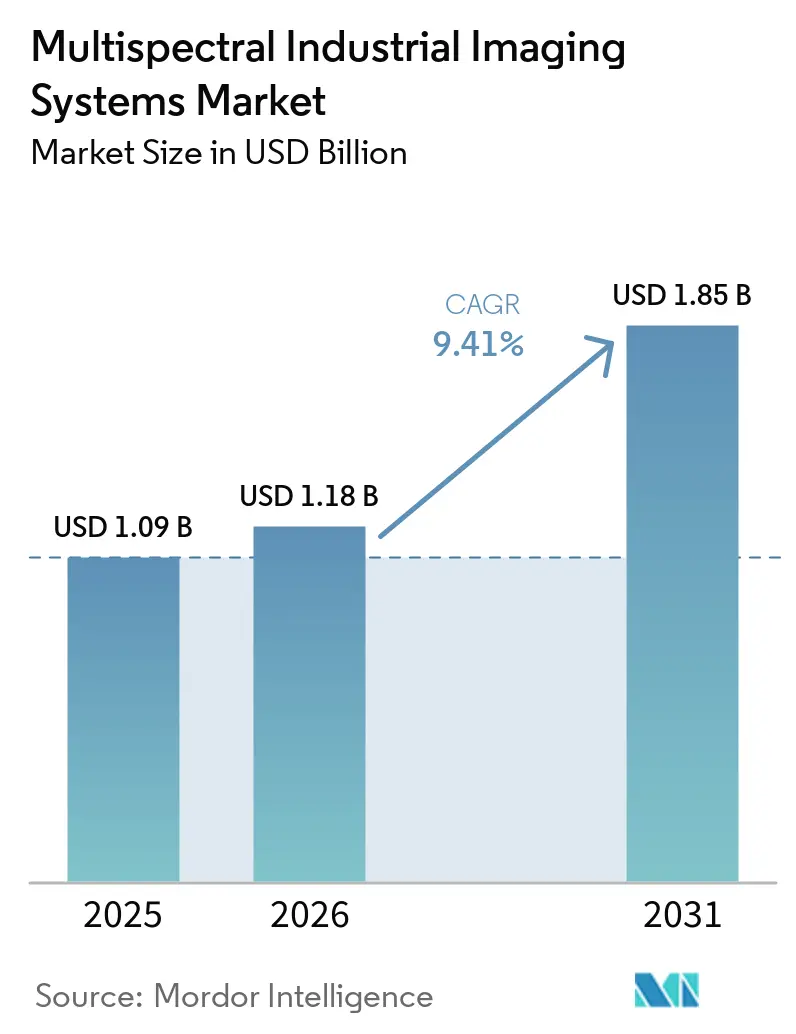
The Multispectral industrial imaging systems market size is projected to expand from USD 1.09 billion in 2025 to USD 1.18 billion in 2026, and to USD 1.85 billion by 2031, registering a CAGR of 9.41% from 2026 to 2031. Manufacturers are moving beyond RGB inspection, where material composition, chemical integrity, and subsurface features affect product compliance. This change supports inline decisions that can replace laboratory testing and manual sampling. The multispectral industrial imaging systems market is therefore increasingly relevant to operations that must identify variation before a product leaves the production line. Electronics, pharmaceuticals, food processing, recycling, mining, and battery manufacturing operate under different conditions, but all require faster, more reliable identification of material properties. Conventional cameras can show the shape and appearance of an item, while spectral systems add information that distinguishes materials with similar visual characteristics. That added capability can help quality teams identify moisture, foreign materials, coating variation, and internal defects without interrupting production.
Key Report Takeaways
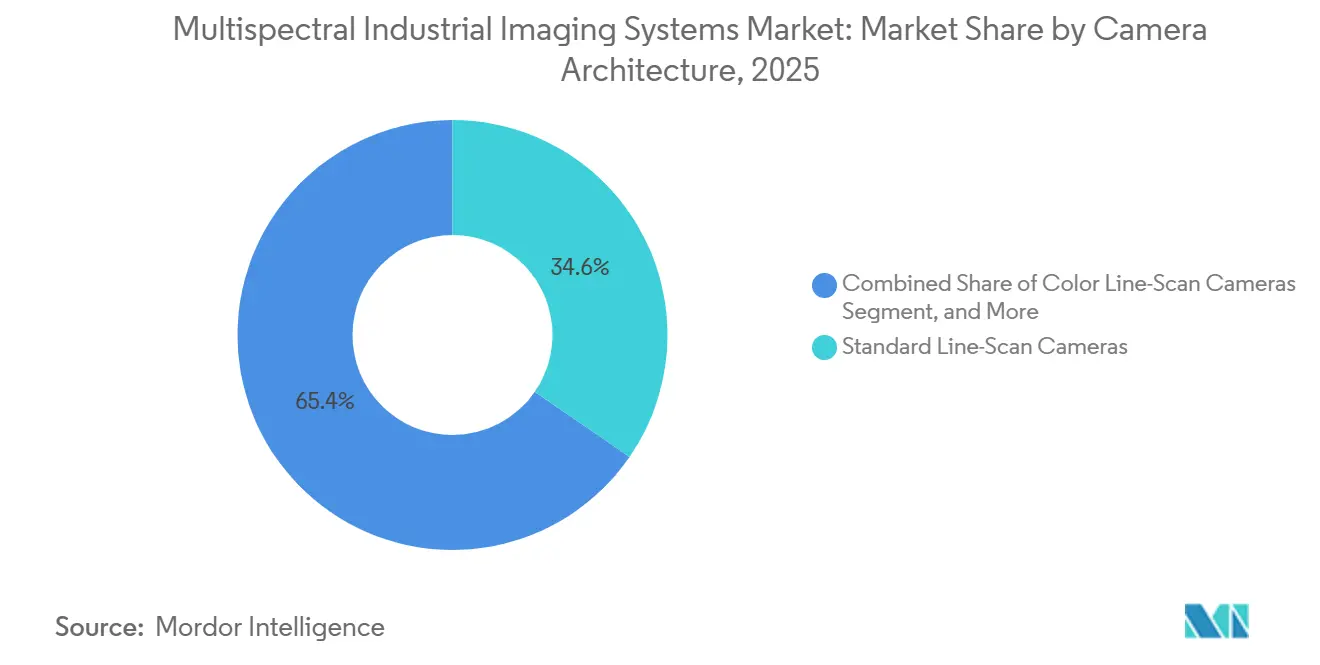
- By camera architecture, standard line-scan cameras held 34.60% of the multispectral industrial imaging systems market share in 2025, while multispectral and hyperspectral line-scan cameras are projected to expand at a 10.84% CAGR through 2031.
- By spectral range, the visible band accounted for 31.83% of the multispectral industrial imaging systems market size in 2025, while SWIR is expected to expand at a 11.26% CAGR through 2031.
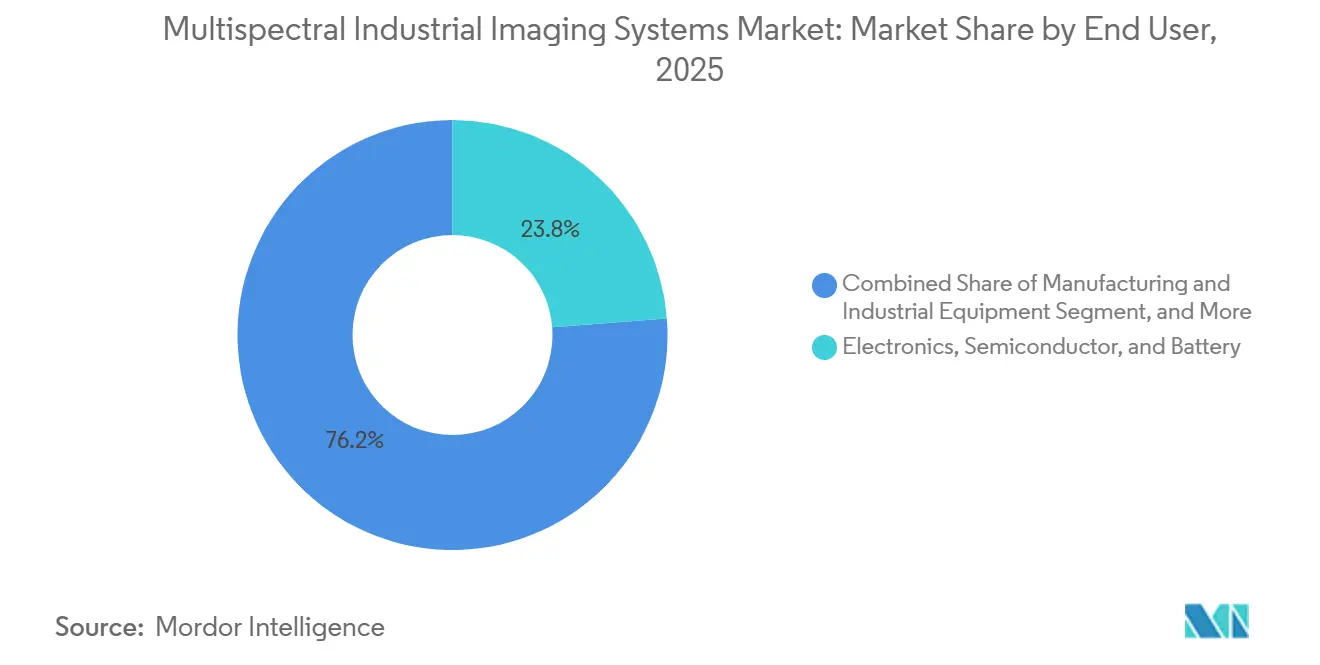
- By end user, electronics, semiconductor, and battery applications held 23.78% share in 2025, while recycling, mining, and materials are projected to grow at a 11.34% CAGR through 2031.
- By geography, Asia-Pacific held 37.42% share in 2025 and is projected to expand at a 11.18% CAGR through 2031.
Note: Market size and forecast figures in this report are generated using Mordor Intelligence’s proprietary estimation framework, updated with the latest available data and insights as of January 2026.
Market Trends and Insights
Drivers Impact Analysis of Multispectral Industrial Imaging Systems Market*
| Driver | (~) % Impact on CAGR Forecast | Geographic Relevance | Impact Timeline |
|---|---|---|---|
| Industrial Quality Inspection Automation | +3.2% | Global | Short term (≤ 2 years) |
| AI-Enabled Spectral Classification | +2.4% | Global, with concentration in North America and Asia-Pacific | Short term (≤ 2 years) |
| Semiconductor and Battery Manufacturing Inspection | +1.8% | Asia-Pacific core, spill-over to North America and EU | Medium term (2-4 years) |
| Food Safety and Material Sorting Requirements | +1.4% | Global, with early gains in EU and North America | Medium term (2-4 years) |
| Compact Snapshot Sensor Adoption | +0.9% | North America and EU | Medium term (2-4 years) |
| Spectral Sensor Cost Declines | +0.7% | Global, concentration in Asia-Pacific | Long term (≥ 4 years) |
| Source: Mordor Intelligence | |||
Industrial Quality Inspection Automation
Automated inspection is moving from pass-or-fail defect checks to material classification that identifies chemical anomalies, moisture variation, and coating inconsistencies. Modern systems can operate at line rates above 2 kHz, which supports continuous checks on high-throughput production lines. The approach allows factories to inspect the full output instead of relying on samples taken at intervals. This reduces the gaps left by traditional spot-check procedures and broadens potential deployments for the multispectral industrial imaging systems market. UniSpector, presented at CVPR 2026, demonstrated spectral-contrastive defect localization without retraining across changing industrial settings. The value proposition is therefore shifting toward reliable inference in real production conditions, not only optical specifications.
AI-Enabled Spectral Classification
AI-based classification can shorten the time needed to develop inspection models and reduce the need for facilities to employ dedicated spectroscopists. Physics-guided, self-supervised spectral transformers leverage unlabeled spectral data to enable quantification, grading, and anomaly detection in a single inference step. These models also address sensor drift, which has historically made classifiers less stable after deployment. Panasonic announced its AG-HSS10 software in August 2026, with commercial availability planned for October 2026.[1]Panasonic Corporation, “AI Inspection Software NT Series AG-HSS10,” Panasonic Newsroom Japan, news.panasonic.com The software integrates spectral acquisition and AI learning into a single platform for food processing, manufacturing, and electronics assembly. Data quality and repeatable results under changing factory conditions are becoming more important competitive factors in the multispectral industrial imaging systems market.
Semiconductor and Battery Manufacturing Inspection
Semiconductor and battery inspection is a high-value application for SWIR and multispectral equipment because missed defects can create costly yield losses. SWIR wavelengths can detect subsurface cracks, electrode misalignment, and underfill voids in semiconductor packages without destructive testing. In lithium-ion electrode stacks, separator layers block visible light but allow SWIR imaging, which enables inspection of layer alignment at production speed. These use cases link imaging demand to advanced packaging and battery production capacity. Solid-state battery development also requires tight control of layer uniformity. This requirement can sustain demand for high-speed inspection systems after the current forecast period.
Food Safety and Material Sorting Requirements
Food safety rules and recycling requirements both create demand for chemical identification without physical contact. Hyperspectral food inspection can identify pesticide residues, uneven moisture, and foreign-body contamination that conventional RGB and near-infrared cameras may not detect. In recycling, spectral unmixing has been used to measure the abundance of paper and polymer components in mixed samples with less than 1% error. This level of measurement enables more confident sorting in municipal waste streams. European producer responsibility rules and China’s waste-processing standards support investment in polymer and e-waste sorting. The resulting demand is tied to compliance needs as well as broader manufacturing investment in the multispectral industrial imaging systems market.
Restraints Impact Analysis of Multispectral Industrial Imaging Systems Market*
| Restraint | (~) % Impact on CAGR Forecast | Geographic Relevance | Impact Timeline |
|---|---|---|---|
| High Integration and Calibration Costs | -0.8% | Global, most acute in SME-heavy markets in South America and Southeast Asia | Short term (≤ 2 years) |
| Data Processing and Storage Bottlenecks | -0.6% | Global, with concentration in regions with limited edge-compute infrastructure | Medium term (2-4 years) |
| Limited Industrial Spectral Libraries | -0.3% | Global | Long term (≥ 4 years) |
| Interoperability and Standards Gaps | -0.3% | Global, with concentration in multi-vendor production environments | Medium term (2-4 years) |
| Source: Mordor Intelligence | |||
High Integration and Calibration Costs
Integration and calibration remain major barriers in the multispectral industrial imaging systems market, particularly for small- and mid-sized manufacturers with limited engineering capacity. Spectral systems need wavelength-specific lighting, calibration panels, temperature-controlled housings, and ongoing recalibration. These requirements differ from those of conventional machine-vision installations and can increase the overall project cost. Initial work on illumination, software, and classifier training can cost more than the camera hardware. This makes total ownership cost a central purchasing issue in the multispectral industrial imaging systems market. Suppliers that provide trained libraries, turnkey integration, and remote calibration support can reduce the burden on smaller factories and improve adoption.
Data Processing and Storage Bottlenecks
High-speed hyperspectral streams in the multispectral industrial imaging systems market create processing demands that standard factory information systems often cannot manage. A line-scan camera operating at 2.3 kHz with more than 100 spectral bands and 1,280 spatial pixels can produce tens of gigabytes of data each minute. Such systems require 10 GigE or fiber-optic interfaces rather than standard Gigabit Ethernet pipelines. Edge AI can reduce bandwidth needs, but it also requires FPGA or GPU processing equipment on the factory floor. Camera-level band selection, regions of interest, and data reduction can ease the issue. Wider deployment at production speed will still depend on further progress in in-sensor computing.
*Our forecasts treat driver/restraint impacts as directional, not additive. The impact forecasts reflect baseline growth, mix effects, and variable interactions.
Multispectral Industrial Imaging Systems Market Segment Analysis
By Camera Architecture:
Standard Sensors Lead, While Spectral Line-Scan Systems AccelerateStandard line-scan cameras held 34.60% share in 2025, reflecting their established use in print inspection, web processing, and surface-quality control. Their speed and simpler integration suit applications where spatial detail matters more than spectral resolution. Color line-scan systems serve mid-range food-sorting and textile-inspection needs. Time-delay integration line-scan cameras support semiconductor wafer inspection and pharmaceutical blister-pack verification. Their multi-stage charge accumulation improves signal-to-noise performance at fast conveyor speeds. Multispectral and hyperspectral line-scan cameras are projected to grow at a 10.84% CAGR from 2026 to 2031. Battery manufacturers and recycling facilities require chemical-level material differentiation at speeds that snapshot systems cannot maintain.
The multispectral industrial imaging systems market is also evolving as suppliers develop platforms tailored to specific factory tasks. JAI expanded its Wave Series in 2026 to include visible and SWIR sensitivity in a single InGaAs sensor across area-scan and line-scan configurations. The 400 nm to 1,700 nm range can remove the need for two-camera inspection arrangements. Teledyne DALSA expanded AxCIS in May 2026 with multiline CMOS contact image sensors at 1,800 dpi and scan lengths up to 1,500 mm. This design targeted wafer and battery inspection with monochrome line rates up to 80 kHz. Product development is moving away from broad hardware upgrades and toward architectures that reduce integration work for defined production tasks.



By Spectral Range:
SWIR Extends Inspection Beyond Visible Surface FeaturesThe visible band accounted for 31.83% of the multispectral industrial imaging systems market in 2025 due to its broad installed base in food color inspection, tablet verification, and general surface assessment. Visible systems remain suitable when chemical penetration below the surface is not needed. VIS-NIR systems support agricultural moisture detection and solar panel inspection across the 400-1,000 nm range. This wavelength range captures chlorophyll reflectance and silicon defect signatures. MWIR and LWIR systems are used for high-temperature process monitoring and industrial gas detection. Their higher detector costs and operating complexity limit wider use. SWIR is projected to lead growth at an 11.26% CAGR from 2026 to 2031.
SWIR’s expansion reflects both its physical capability and changing component economics. Silicon is optically transparent in the SWIR range, allowing non-contact inspection of features below the surface. This is important for semiconductor wafers and lithium-ion electrode stacks that cannot be tested destructively during production. SWIR Vision Systems offers Acuros CQD-based cameras for battery separator inspection, including full-HD imaging capable of identifying electrode misalignment beneath separator layers.[2]SWIR Vision Systems, “SWIR Imaging for Lithium-Ion Battery Assembly: Inspection Using Short Wave Infrared Imaging,” SWIR Vision Systems, swirvisionsystems.com Conventional visible cameras cannot reproduce this result simply by increasing resolution. Single-device visSWIR sensors spanning 400 nm to 1,700 nm are also reducing the boundary between visible and SWIR equipment categories.
By End User:
Electronics and Semiconductor Demand Anchors Growth, While Recycling and Mining AdvanceElectronics, semiconductor, and battery end users held 23.78% share in 2025, supported by advanced packaging and electric-vehicle battery capacity in East Asia and North America. These buyers use non-destructive imaging to assess defects that can affect device reliability and production yield. Pharmaceutical and life-sciences users apply spectral inspection to tablet coating uniformity, blister-pack seals, and active ingredient distribution. Automotive producers use it for paint, weld, and battery-module checks. Manufacturing and industrial-equipment users apply it to metal surfaces, composites, and printed electronics. Textile and paper operations use spectral imaging for color matching and fiber-blend verification. This broad base of users supports recurring demand across the multispectral industrial imaging systems market.
Recycling, mining, and materials are projected to be the fastest-growing end-user group at an 11.34% CAGR from 2026 to 2031. The multispectral industrial imaging systems market benefits from circular-economy requirements, concern over critical minerals, and the value of material-grade sorting at industrial volumes. NC State University reported in 2025 that hyperspectral imaging and spectral unmixing classified paper and plastic in mixed waste with less than 1% material-abundance estimation error. Food, beverage, and agriculture remain important users for perishable-goods assessment and foreign-body detection. ISO 22000 and the European Union Packaging and Packaging Waste Regulation support inspection investment in food processing and recycling. These compliance cycles give suppliers a demand base that is less dependent on short-term capital spending sentiment.
Geography Analysis
APAC Multispectral Industrial Imaging Systems Market
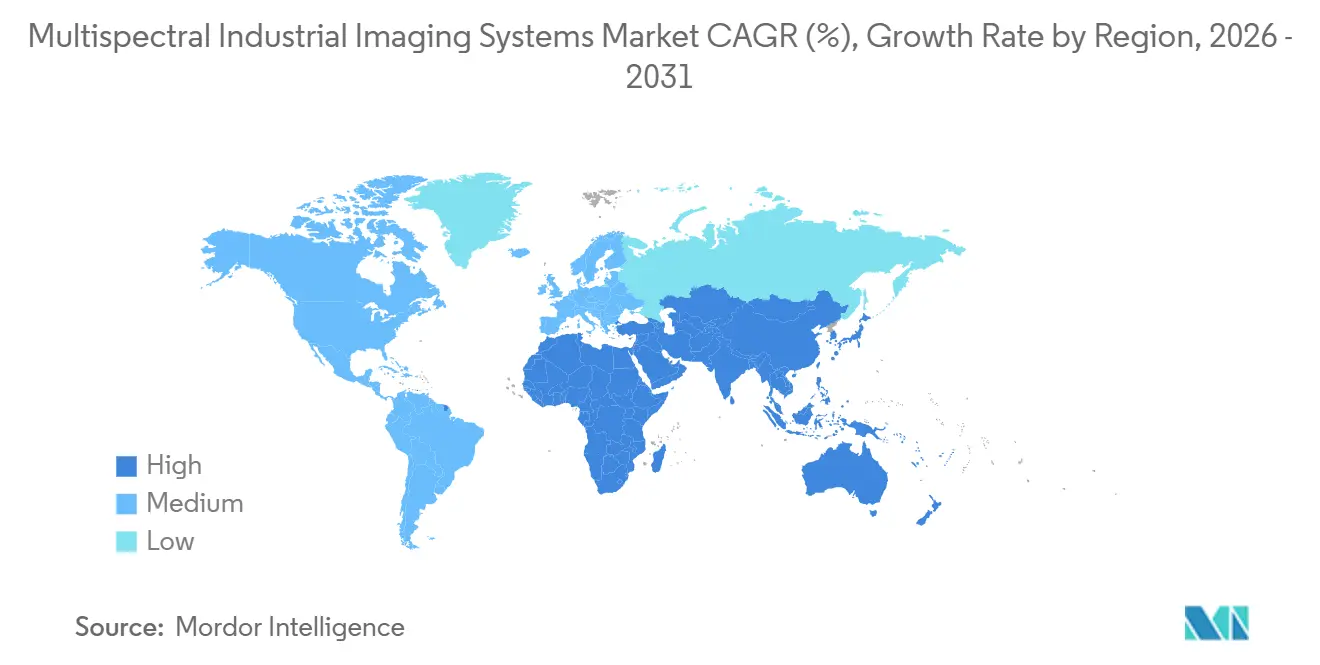
Asia-Pacific held 37.42% share in 2025 and is projected to grow at a 11.18% CAGR from 2026 to 2031, making it the leading regional base and the fastest-growing geography. China’s semiconductor self-sufficiency program supports investment in advanced packaging inspection. South Korea’s battery gigafactory expansion adds demand for electrode and cell-quality systems. Japan’s precision manufacturing base also supports the use of spectral inspection in demanding production environments. Panasonic announced the AG-HSV10M hyperspectral camera and the AG-HSS10 inspection software in 2026. The system targets food processing and electronics assembly. These factors support a large installed base of multispectral industrial imaging systems in Asia-Pacific.
North America and Europe Multispectral Industrial Imaging Systems Market
North America and Europe have distinct demand profiles within the multispectral industrial imaging systems market. In the multispectral industrial imaging systems market, North American demand is linked to pharmaceutical good manufacturing practice inspections, food-processing modernization, and battery factory construction in the United States. New facilities can incorporate inline spectral inspection during commissioning instead of adding it after construction. European deployment is concentrated in industrial automation and recycling. Germany is important in precision manufacturing, while Scandinavia hosts several hyperspectral-camera companies, including Specim, HySpex, and Norsk Elektro Optikk. Headwall Photonics acquired inno-spec GmbH in November 2025, combining inline sorting experience with pushbroom optics.[3]Headwall Photonics, “Press Releases,” Headwall Photonics, headwall.com This move added scale to its European industrial offering.
MEA and South America Multispectral Industrial Imaging Systems Market
South America, the Middle East, and Africa are developing at different rates. Brazil and Argentina are applying spectral inspection to export-oriented fruit processing, grain contamination checks, and pesticide-residue screening. These uses are linked to compliance requirements in export destinations. Chile and South Africa are piloting conveyor-based systems for ore-grade classification. A 2024 U.S. patent described multispectral and hyperspectral methods for compositional analysis through shovel-mounted imaging. Middle East installations center on petrochemical and oil-field quality monitoring using MWIR and LWIR systems. African activity is concentrated in mining locations, where rock-face characterization can improve grade control compared with conventional sampling.

Competitive Landscape
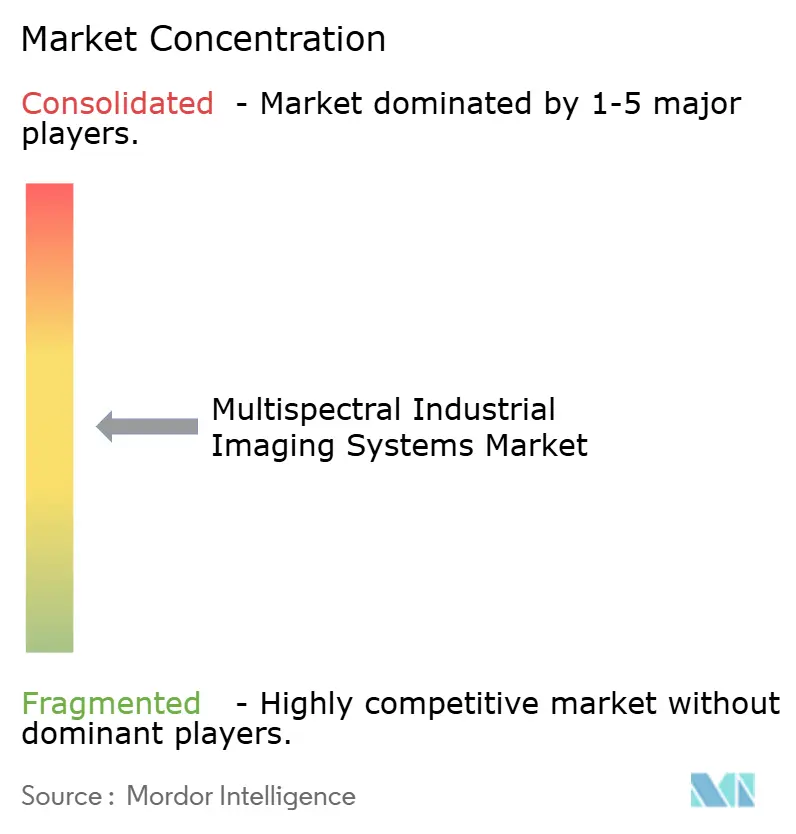
The multispectral industrial imaging systems market is moderately concentrated among European and North American specialist suppliers. Competition centers on spectral precision, calibration suited to individual applications, and integration with AI classification software. Teledyne Technologies operates across sensors, cameras, optics, and software through businesses including e2v CMOS, Judson Technologies, and Teledyne DALSA. This vertical structure can support supply continuity and greater control over system development. Independent camera suppliers face a more difficult task in matching this scope. Headwall Photonics’ acquisition of inno-spec in November 2025 combined 20 years of inline-sorting expertise with pushbroom-optics capabilities. The transaction illustrates pressure on standalone suppliers to broaden their solution offering.
Leading suppliers increasingly sell bundled systems rather than separate camera modules. A typical package combines camera hardware, calibration software, and trained classification libraries. This model can reduce the effort required by customers and make direct price competition harder. It also provides support when temperature, material batches, and illumination conditions change. The multispectral industrial imaging systems market has open areas in validated libraries for composite polymers, solid-state battery materials, and new semiconductor substrates. There is also a need for turnkey packages for smaller manufacturers that cannot design a custom spectral system. Suppliers able to make deployment more predictable can address an important adoption barrier.
Competition in the multispectral industrial imaging systems market is becoming stronger in the Asian mid-performance tier. Wuxi Specvision introduced the VSPEX17 SWIR line-scan camera for high-speed sorting, with 7,800 fps across the 900 nm to 1,700 nm range.[4]Wuxi Specvision Technology Co., Ltd., “VSPEX17 Hyperspectral Camera,” Specvision, specvision.com.cn This raises price pressure in applications with standard performance requirements. Established companies can still defend positions in advanced packaging, solid-state battery inspection, and pharmaceutical process control, where precision requirements are more demanding. Panasonic’s 2026 AG-HSS10 software launch is another example of a supplier combining imaging equipment with AI tools. JAI’s 2026 visible-SWIR single-sensor platform similarly aims to simplify multiband system design.
Multispectral Industrial Imaging Systems Industry Leaders
JAI A/S
Teledyne DALSA, Inc.
Specim, Spectral Imaging Ltd.
Headwall Photonics, Inc.
Cubert GmbH
- *Disclaimer: Major Players sorted in no particular order
Multispectral Industrial Imaging Systems Market Companies Covered in this Report
- JAI A/S
- Teledyne DALSA, Inc.
- Specim, Spectral Imaging Ltd.
- Headwall Photonics, Inc.
- Cubert GmbH
- BaySpec, Inc.
- Resonon, Inc.
- Surface Optics Corporation
- Spectral Devices Inc.
- Photon etc. Inc.
- XIMEA GmbH
- Photonfocus AG
- Torrent Photonics, Inc.
- SILIOS Technologies S.A.S.
- EVK DI Kerschhaggl GmbH
- Telops Inc.
- Diaspective Vision GmbH
- Raptor Photonics Limited
- SWIR Vision Systems, Inc.
- HinaLea Imaging Corporation
- HySpex AS
- Norsk Elektro Optikk AS

Recent Industry Developments in Multispectral Industrial Imaging Systems Market
- August 2026: Panasonic announced the AG-HSS10 AI inspection software suite, comprising NT-Train and NT-1, for commercial release in October 2026. Paired with its AG-HSV10M hyperspectral camera, the system enables AI model creation from minimal image samples via proprietary Chopped Learning and targets foreign body detection, film thickness measurement, and material classification in food processing and electronics assembly.
- June 2026: JAI expanded its Wave Series with the area-scan WAA-1300-GE-TEC, a single-sensor platform combining visible, 400 nm, and SWIR, 1,700 nm, sensitivity in a 1.3-megapixel InGaAs sensor with thermoelectric cooling, alongside 2 new SWIR line-scan cameras, WAL-1001-GE and WAL-2001-GE, with large-pixel InGaAs sensors for high signal-to-noise industrial inspection, collectively eliminating dual-camera setups for multi-band inspection.
- May 2026: Teledyne DALSA expanded its AxCIS contact image sensor family to 1,800 dpi resolution and 1,500 mm scan lengths. The multiline CMOS modules deliver monochrome line rates up to 80 kHz, native RGB rates up to 60 kHz, high dynamic range, a telecentric lens for true metrology, and SFP+ fiber-optic connectivity, targeting semiconductor wafer and battery inspection with seamless full-field coverage.
- November 2025: Headwall Photonics acquired inno-spec GmbH, a German specialist in inline industrial hyperspectral sorting with 20 years of operational history. The acquisition combined inno-spec's conveyor-integrated spectral sorting expertise with Headwall's pushbroom optics capabilities, creating an integrated offering for food sorting, recycling, and mineral processing customers.


Global Multispectral Industrial Imaging Systems Market Report Scope
The multispectral industrial imaging systems market comprises imaging technologies that capture and analyze data across multiple wavelength bands beyond the visible spectrum. These systems support industrial applications such as quality inspection, material sorting, process monitoring, and defect detection by identifying variations in material properties that conventional imaging systems may not detect.
The Multispectral Industrial Imaging Systems Market Report is Segmented by Camera Architecture (Standard Line-Scan Cameras, Color Line-Scan Cameras, Time-Delay Integration (TDI) Line-Scan Cameras, and Multispectral and Hyperspectral Line-Scan Cameras), Spectral Range (Visible, Visible + Near-Infrared (VIS-NIR), Short-Wave Infrared (SWIR), Mid-Wave Infrared (MWIR), and Long-Wave Infrared (LWIR)), End User (Manufacturing and Industrial Equipment, Food, Beverage, and Agriculture, Electronics, Semiconductor, and Battery, Automotive and Transportation, Pharmaceutical and Life Sciences, Recycling, Mining, and Materials, Textile and Paper, Research and Development Organizations, and Other End-user Industries), and Geography (North America, South America, Europe, Asia-Pacific, Middle East, and Africa). The Market Forecasts are Provided in Terms of Value (USD).
| Standard Line-Scan Cameras |
| Color Line-Scan Cameras |
| Time-Delay Integration (TDI) Line-Scan Cameras |
| Multispectral and Hyperspectral Line-Scan Cameras |
| Visible |
| Visible + Near-Infrared (VIS-NIR) |
| Short-Wave Infrared (SWIR) |
| Mid-Wave Infrared (MWIR) |
| Long-Wave Infrared (LWIR) |
| Manufacturing and Industrial Equipment |
| Food, Beverage, and Agriculture |
| Electronics, Semiconductor, and Battery |
| Automotive and Transportation |
| Pharmaceutical and Life Sciences |
| Recycling, Mining, and Materials |
| Textile and Paper |
| Research and Development Organizations |
| Other End-user Industries |
| North America | United States |
| Canada | |
| Mexico | |
| South America | Brazil |
| Argentina | |
| Chile | |
| Rest of South America | |
| Europe | Germany |
| United Kingdom | |
| France | |
| Italy | |
| Spain | |
| Rest of Europe | |
| Asia-Pacific | China |
| Japan | |
| India | |
| South Korea | |
| Australia | |
| Rest of Asia-Pacific | |
| Middle East | United Arab Emirates |
| Saudi Arabia | |
| Qatar | |
| Rest of Middle East | |
| Africa | South Africa |
| Egypt | |
| Nigeria | |
| Rest of Africa |
| By Camera Architecture | Standard Line-Scan Cameras | |
| Color Line-Scan Cameras | ||
| Time-Delay Integration (TDI) Line-Scan Cameras | ||
| Multispectral and Hyperspectral Line-Scan Cameras | ||
| By Spectral Range | Visible | |
| Visible + Near-Infrared (VIS-NIR) | ||
| Short-Wave Infrared (SWIR) | ||
| Mid-Wave Infrared (MWIR) | ||
| Long-Wave Infrared (LWIR) | ||
| By End User | Manufacturing and Industrial Equipment | |
| Food, Beverage, and Agriculture | ||
| Electronics, Semiconductor, and Battery | ||
| Automotive and Transportation | ||
| Pharmaceutical and Life Sciences | ||
| Recycling, Mining, and Materials | ||
| Textile and Paper | ||
| Research and Development Organizations | ||
| Other End-user Industries | ||
| By Geography | North America | United States |
| Canada | ||
| Mexico | ||
| South America | Brazil | |
| Argentina | ||
| Chile | ||
| Rest of South America | ||
| Europe | Germany | |
| United Kingdom | ||
| France | ||
| Italy | ||
| Spain | ||
| Rest of Europe | ||
| Asia-Pacific | China | |
| Japan | ||
| India | ||
| South Korea | ||
| Australia | ||
| Rest of Asia-Pacific | ||
| Middle East | United Arab Emirates | |
| Saudi Arabia | ||
| Qatar | ||
| Rest of Middle East | ||
| Africa | South Africa | |
| Egypt | ||
| Nigeria | ||
| Rest of Africa | ||


Key Questions Answered in the Report
What is the size of the multispectral industrial imaging systems market?
The market was USD 1.18 billion in 2026 and is projected to reach USD 1.85 billion by 2031, at a 9.41% CAGR. The estimate reflects the wider use of spectrally resolved inspection where material characteristics and subsurface features affect product compliance.
Which camera architecture leads demand?
Standard line-scan cameras led with 34.60% share in 2025, while spectral line-scan cameras are projected to grow at a 10.84% CAGR through 2031. Standard systems remain useful for fast print, web, and surface inspection, while spectral systems add chemical-level distinction for battery and recycling lines.
Why is SWIR equipment growing faster than other spectral ranges?
SWIR supports non-destructive inspection beneath silicon and battery separator layers. It is projected to expand at an 11.26% CAGR through 2031. The technology helps manufacturers inspect material alignment and internal features that visible cameras cannot assess during normal production.
Which end users are creating the strongest demand?
Electronics, semiconductor, and battery users led with 23.78% share in 2025. Recycling, mining, and materials are projected to grow fastest at 11.34% CAGR. Pharmaceutical, food, automotive, textile, paper, and broader industrial users also apply spectral imaging where inspection needs vary by material and process.
Which region is expanding fastest?
Asia-Pacific held 37.42% share in 2025 and is projected to grow at an 11.18% CAGR through 2031. Semiconductor investment in China, battery capacity in South Korea, and Japan’s precision manufacturing base support this regional position in the multispectral industrial imaging systems market.
What limits wider adoption of spectral inspection systems?
Integration, calibration, data-processing capacity, limited spectral libraries, and interoperability gaps can increase the deployment burden. Smaller manufacturers may face particular difficulty because lighting design, temperature control, software development, and ongoing calibration require resources beyond the cost of the camera itself.
Page last updated on:





