
Multi-Domain Network Orchestration Software Market Size and Share
Market Overview
| Study Period | 2020 - 2031 |
|---|---|
| Market Size (2026) | USD 4.88 Billion |
| Market Size (2031) | USD 11.19 Billion |
| Growth Rate (2026 - 2031) | 18.05 % |
| Fastest Growing Market | Asia-Pacific |
| Largest Market | North America |
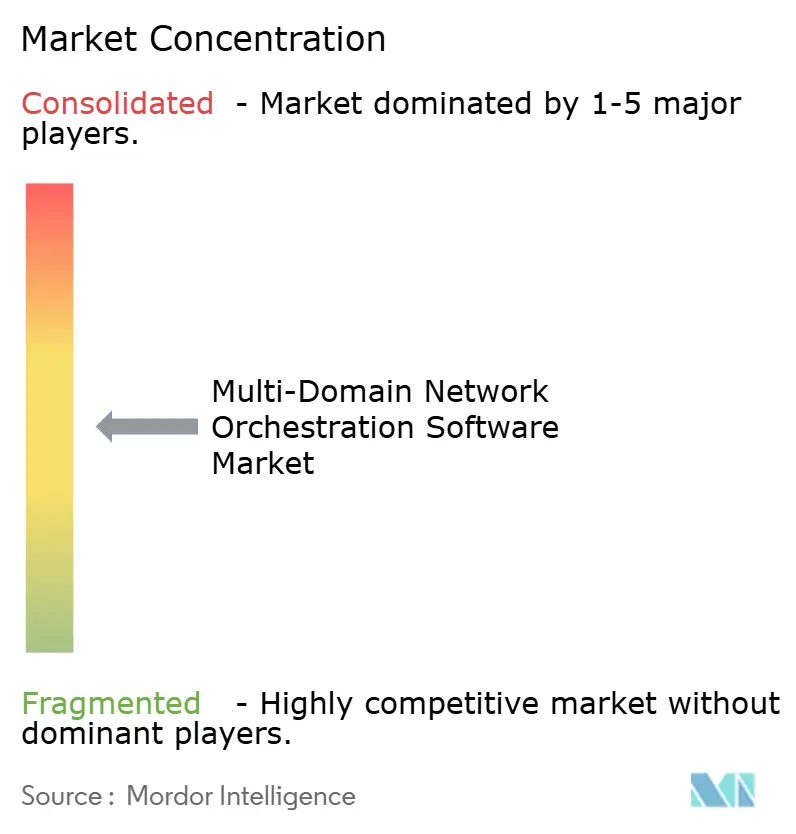
| Market Concentration | Medium |
Major Players *Disclaimer: Major Players sorted in no particular order Image © Mordor Intelligence. Reuse requires attribution under CC BY 4.0. | |
Multi-Domain Network Orchestration Software Market Analysis by Mordor Intelligence
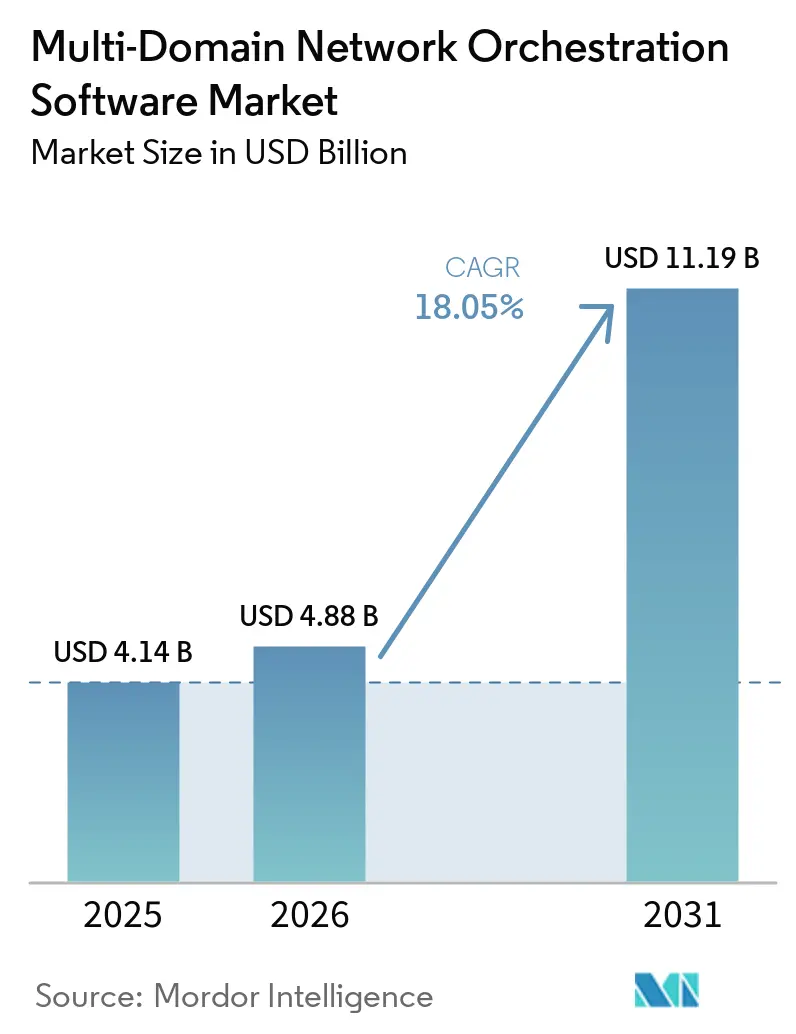
The multi-domain network orchestration software market size was valued at USD 4.14 billion in 2025 and estimated to expand to USD 11.19 billion by 2031, at a CAGR of 18.05% during the forecast period 2026-2031. Commercial 5G standalone deployments are expanding the number of services that require coordinated control across radio, transport, and core networks. The multi-domain network orchestration software market is also moving beyond back-office automation, as network slices require provisioning, assurance, and service-level management across multiple domains. Agentic AI deployments are raising expectations for real-time fault analysis and maintenance support across large device estates. Vendors are responding with cloud-based platforms, open interfaces, and managed services that support mixed network environments and provide operations teams with a more consistent view of service status, resource availability, and changes across the network. Legacy inventory records, high integration costs, and open-source alternatives continue to limit the pace at which operators can replace established systems, especially where long-lived operational processes and multiple suppliers are already embedded in service delivery and procurement, and in established operating teams.
Key Report Takeaways
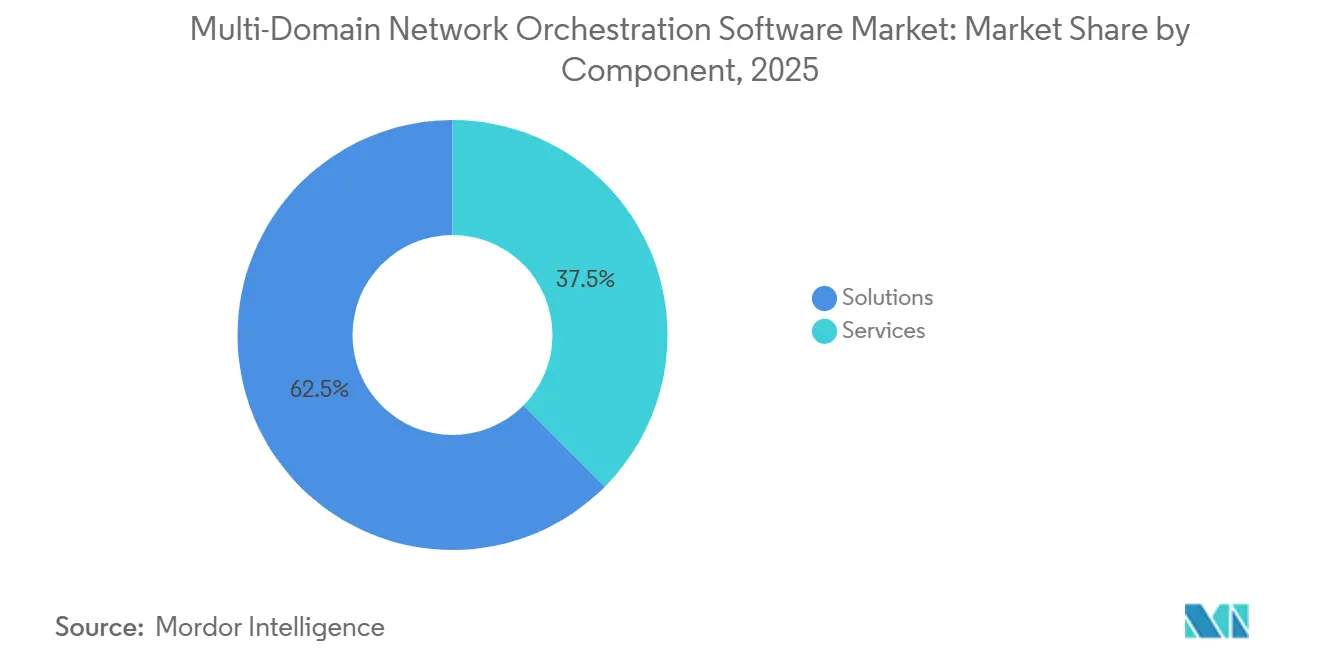
- By component, solutions held 62.54% of the multi-domain network orchestration software market share in 2025, while services are projected to expand at a 20.11% CAGR through 2031.
- By deployment, cloud held 68.11% share in 2025 and is projected to expand at a 19.67% CAGR through 2031 in the multi-domain network orchestration software market.
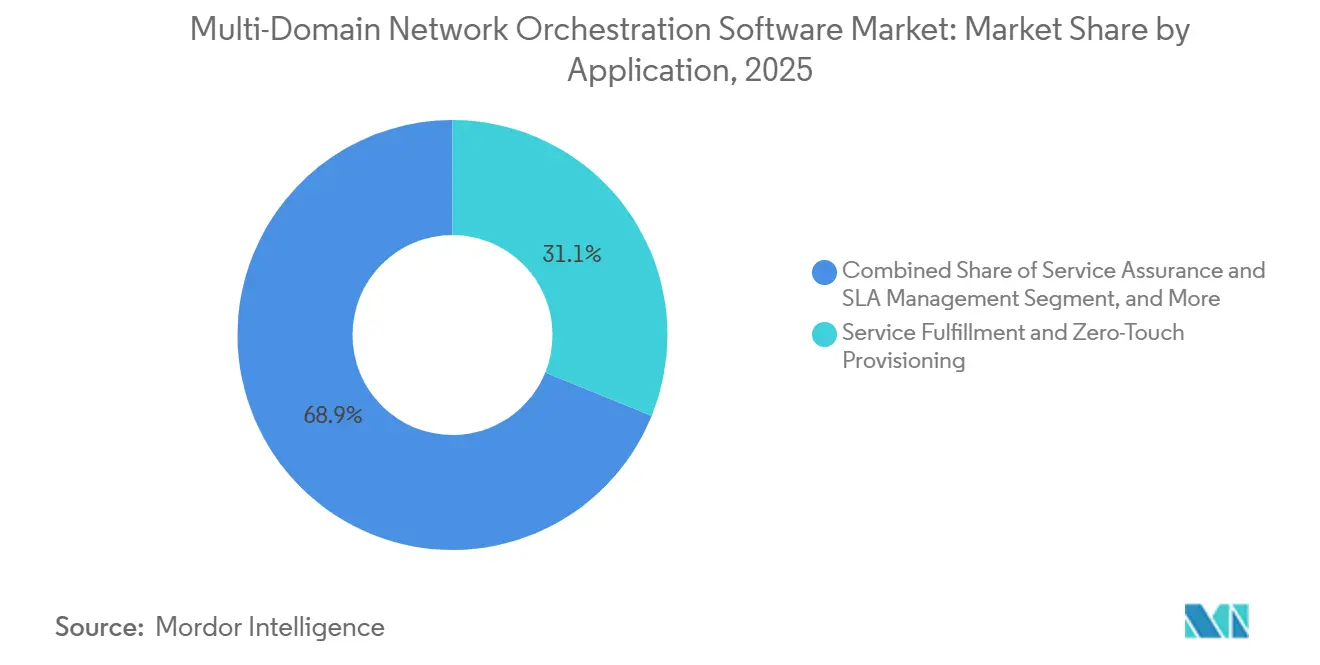
- By application, service fulfillment and zero-touch provisioning accounted for 31.12% of the multi-domain network orchestration software market size in 2025, while network slicing and slice lifecycle management are projected to expand at a 20.03% CAGR through 2031.
- By end user, mobile network operators held 29.89% share in 2025, while cloud service providers are projected to expand at a 19.76% CAGR through 2031.
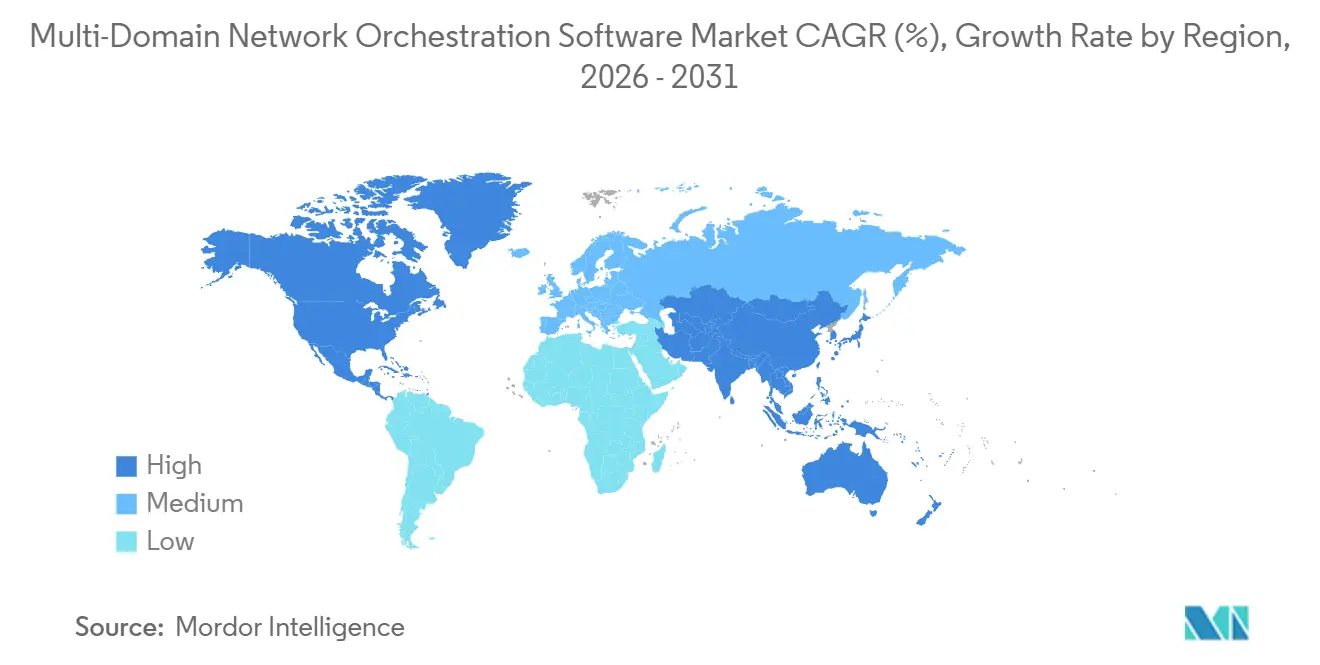
- By geography, North America held 28.77% share in 2025, while the Asia-Pacific is projected to expand at a 20.06% CAGR through 2031.
Note: Market size and forecast figures in this report are generated using Mordor Intelligence’s proprietary estimation framework, updated with the latest available data and insights as of January 2026.
Market Trends and Insights
Drivers Impact Analysis of Multi-Domain Network Orchestration Software Market*
| DRIVER | (~) % IMPACT ON CAGR FORECAST | GEOGRAPHIC RELEVANCE | IMPACT TIMELINE |
|---|---|---|---|
| 5G Standalone and Network Slicing Monetization | +5.2% | Asia-Pacific, Europe, North America | Short term (≤ 2 years) |
| AI-Enabled Closed-Loop Network Operations | +4.3% | Global, with early gains in North America and Asia-Pacific | Short term (≤ 2 years) |
| Cloud-Native and Hybrid Network Expansion | +3.5% | North America, Europe, Asia-Pacific | Medium term (2-4 years) |
| Multi-Vendor Network Complexity | +2.8% | Global, particularly Europe and the Asia-Pacific | Medium term (2-4 years) |
| Federated Inventory and Cross-Domain Data Normalization | +1.8% | Europe, North America | Medium term (2-4 years) |
| Intent-Based Service Lifecycle Automation | +1.5% | North America, Europe | Long term (≥ 4 years) |
| Source: Mordor Intelligence | |||
5G Standalone and Network Slicing Monetization
The multi-domain network orchestration software market is benefiting as 5G standalone networks make network slicing a commercial service rather than a planning concept. Ericsson reported 84 commercial differentiated-connectivity offerings based on 5G standalone network slicing in Q2 2026, compared with 65 in November 2025.[1] Each offering needs coordinated service activation, assurance, and service-level agreement enforcement across radio, transport, and core domains. Operators managing multiple live slices experience more frequent state reconciliation than with point-to-point provisioning. China Mobile, Deutsche Telekom, and OTE Group are monetizing slice-based services in enterprise and consumer settings, while OTE's Priority Pass shows how bandwidth assurance can be packaged for customers. Standards activity around cross-vendor coordination is making interoperability a more important purchase criterion for the multi-domain network orchestration software market, since operators need service workflows that can remain functional as underlying network components change.
AI-Enabled Closed-Loop Network Operations
The multi-domain network orchestration software market is broadening beyond service activation to include continuous monitoring and automated maintenance. NTT DOCOMO commercially deployed an agentic AI system in February 2026 that supports network maintenance across more than 1 million devices in real time.[2] The platform analyzes alarm and traffic data, identifies anomalies and failure points, and provides maintenance recommendations to engineers. Nokia introduced an Autonomous Networks Agent Library in June 2026 for staged automation across IP, fixed, optical, and radio access networks. These uses depend on consistent inventory, ontology, and network-state data across domains. ETSI identifies accurate digital twins as an enabling layer for dependable closed-loop intent fulfillment in hierarchical, multi-domain networks.
Cloud-Native and Hybrid Network Expansion
Cloud-native network functions pose a greater coordination challenge than earlier network virtualization because operators must manage cloud-native and virtual network functions together. The multi-domain network orchestration software market, therefore, requires tools that can coordinate several orchestrators without disrupting live operations. Deutsche Telekom documented deployment cycles of 6-12 months for Kubernetes-based frameworks in multi-vendor environments, which shows the integration work involved in cloud-native transitions.[3] Tune Talk became ASEAN's first fully cloud-native mobile network operator in February 2026 through its work with Mavenir.[4] Its planned next phase includes advanced multi-domain orchestration, offering a relevant model for operators in South and Southeast Asia. Data residency requirements in India and comparable requirements elsewhere also sustain demand for hybrid designs, even where a fully cloud-based model would otherwise be attractive.
Multi-Vendor Network Complexity
Open RAN and network disaggregation are increasing coordination needs across radio, transport, and core layers. The multi-domain network orchestration software market must address complexity across vendors within each layer and between layers. Ericsson and Nokia agreed in March 2026 to join each other's service management and orchestration marketplaces, allowing communications service providers to use and share rApps in open, multi-vendor networks. ETSI notes that, absent a unified abstraction layer, lifecycle management complexity shifts to OSS and BSS environments, raising costs and extending deployment timelines. Deutsche Telekom contributed the StratoWeave project to LF Networking in 2026, signaling continued interest in open approaches to transport-network automation. Vendors that support open interfaces and varied controller environments are better placed to serve these deployments.
Restraints Impact Analysis of Multi-Domain Network Orchestration Software Market*
| RESTRAINT | (~) % IMPACT ON CAGR FORECAST | GEOGRAPHIC RELEVANCE | IMPACT TIMELINE |
|---|---|---|---|
| Legacy Inventory Inaccuracy and Data Reconciliation | -2.3% | Global, most acute in Europe and North America | Short term (≤ 2 years) |
| High Integration and Migration Risk | -1.8% | Global | Medium term (2-4 years) |
| Autonomous-Action Governance in Production Networks | -1.2% | Global | Medium term (2-4 years) |
| Proprietary Adapters and Vendor Lock-In | -0.9% | Asia-Pacific, with global spillover | Long term (≥ 4 years) |
| Source: Mordor Intelligence | |||
Legacy Inventory Inaccuracy and Data Reconciliation
Legacy inventory inaccuracies continue to constrain the multi-domain network orchestration software market. When databases describe the same physical assets in different formats, automated workflows may trigger incorrect provisioning or remediation decisions. TM Forum's Catalyst C26.0.916 targets a 60% reduction in hybrid-network reconciliation time, an 85% improvement in discrepancy prediction accuracy, and a 40% reduction in service-level agreement breaches and order fallout. Differences between financial enterprise records and operational OSS inventories further complicate the issue, particularly when retired equipment remains recorded or new assets are not formally commissioned. Periodic site surveys cannot fully resolve this challenge because networks change daily. Operators need reliable, real-time network state data before they can deploy AI-driven automation at scale. This requirement places data correction work ahead of many planned feature deployments in the multi-domain network orchestration software market.
High Integration and Migration Risk
Integration risk slows procurement in the multi-domain network orchestration software market because operators cannot disrupt live services while replacing critical systems. Deutsche Telekom's experience with multi-vendor Kubernetes-based frameworks showed deployment cycles of 6-12 months. Existing management and orchestration frameworks can conflict with intent-based automation goals, while a complete replacement can pose service continuity risks. Operators often introduce a higher-level orchestrator while retaining older management systems. This approach protects continuity but can increase license costs and delay the operating benefits expected from automation. The resulting coexistence period favors vendors that can integrate with established OSS environments while supporting future cloud-native workflows.
*Our forecasts treat driver/restraint impacts as directional, not additive. The impact forecasts reflect baseline growth, mix effects, and variable interactions.
Multi-Domain Network Orchestration Software Market Segment Analysis
By Component:
Solutions Architectures Anchor Revenue, Services Accelerate DeliverySolutions are expected to account for 62.54% of total revenue in the multi-domain network orchestration software market in 2025. This segment includes multi-domain service orchestration platforms, domain orchestration and controller coordination tools, and inventory, discovery, and reconciliation layers. Multi-domain service orchestration platforms support service design, cross-domain decomposition, and real-time activation. Controller coordination tools translate high-level service intent into configurations that operators can use across diverse network domains. Service catalog and decomposition tools are gaining attention as operators introduce network-as-a-service products that require machine-readable service definitions.
Services are projected to expand at a 20.11% CAGR through 2031, as operators seek support for complex modernization programs. Consulting and advisory services, integration and implementation, and managed operations and support address different stages of the delivery process, from design decisions to daily operational support. Managed operations and support are becoming more important as operators transfer integration risk to vendors and seek clear accountability for service continuity. The multi-domain network orchestration software industry is placing greater value on providers that can support daily operations after implementation, while the multi-domain network orchestration software market rewards vendors that can document clear operating responsibilities throughout a deployment. ETSI notes that the lack of unified abstraction shifts the full burden of cloud-native lifecycle management to OSS and BSS teams.
By Deployment:
Cloud Leads but Hybrid Fills Sovereign and Latency GapsCloud deployment is expected to hold a 68.11% share in 2025 and expand at a 19.67% CAGR through 2031 in the multi-domain network orchestration software market. Cloud platforms reduce some on-premises capital expenditure cycles and can scale with additional network slices without requiring proportional growth in headcount. Nokia is expected to launch Autonomous Network Fabric in June 2025 with SaaS deployment on Google Cloud, on-premises deployment through Google Distributed Cloud, and hybrid options. The multi-domain network orchestration software market is using cloud delivery to support subscription-based purchasing and variable orchestration workloads. National requirements for data residency and lawful-interception compliance keep hybrid deployment relevant in markets such as India.
On-premises deployment remains important for Tier-1 operators that manage critical national infrastructure. Hybrid configurations are the fastest-expanding option within the non-cloud group because they allow operators to retain policy-sensitive workloads on-site while using cloud capacity for other orchestration tasks. Broadband Forum's MR-530-1.0.0 defines a domain-orchestrator model that can operate in cloud or on-premises environments and support an end-to-end service orchestrator. Operators are considering this model in European cable modernization and South American internet service provider programs. Therefore, the multi-domain network orchestration software industry must support deployment flexibility rather than a single operating model, and the market is likely to favor platforms that preserve this choice without splitting service workflows.
By Application:
Zero-Touch Provisioning Dominates, Network Slicing Reshapes the Growth CurveService fulfillment and zero-touch provisioning are expected to account for 31.12% of the multi-domain network orchestration software market size in 2025. Automated activation is a core requirement for any architecture that coordinates services across multiple domains, particularly when each service order must move from product definitions into several network control systems without manual rework. TM Forum's Catalyst C26.0.916 targets a 40% reduction in order fallout through AI-assisted reconciliation. Better provisioning accuracy has become a measurable commercial objective because activation failures affect service delivery and operating costs. Network slicing and slice lifecycle management are projected to expand at a CAGR of 20.03% through 2031 as commercial 5G standalone services increase.
Service assurance and service-level agreement management are being shaped by agentic AI deployments that combine monitoring, anomaly detection, and remediation in a single workflow. Huawei is expected to launch AUTINOps in March 2026 with more than 20 specialized AI agents for fault, risk, and performance management. Predictive tools are also renewing network optimization and traffic engineering by recommending paths and bandwidth allocation in real time. NEC is expected to demonstrate agentic management of the full user plane function lifecycle with AWS in February 2026, reducing work that previously took several weeks. Policy management and analytics are expanding more steadily as operators direct near-term budgets toward slice management and assurance workflows.

By End User:
Mobile Operators Lead but Cloud Providers Reset the Competitive DynamicMobile network operators are expected to account for 29.89% of demand in the multi-domain network orchestration software market in 2025. OSS and BSS modernization programs, along with the operational requirements of commercial 5G standalone services, support their spending. T-Mobile is expected to expand its partnership with Netcracker in January 2026 to move a digital wholesale platform to the cloud and support new offerings for mobile virtual network operators and partners. Fixed network operators and internet service providers are also investing in zero-touch provisioning, fault management, and service assurance to reduce truck rolls and manual activation work. Netcracker is expected to expand its engagement with Telenet in June 2026 for a B2B transformation program covering service management, orchestration, and service inventory management.
Cloud service providers are projected to expand at a CAGR of 19.76% through 2031. Their role is increasing as hyperscalers and network-cloud providers participate directly in network-as-a-service delivery. The multi-domain network orchestration software market must increasingly manage network and compute resources within a single policy framework that gives operators consistent control, visibility, and accountability across both environments. This shift increases the value of software that can apply consistent policies across computing and communications resources. Cable network operators are also modernizing service catalogs and provisioning tools in response to competition from fixed wireless and pressure to reduce the cost to serve.
Geography Analysis
North America Multi-Domain Network Orchestration Software Market
North America is expected to hold a 28.77% share in 2025 in the multi-domain network orchestration software market. Ongoing OSS and BSS modernization by major United States carriers, along with cloud-based wholesale and enterprise services, is expected to create a steady base of demand for the multi-domain network orchestration software market. T-Mobile’s planned cloud-platform expansion with Netcracker in January 2026 highlights how operators are expected to use orchestration to introduce and adapt wholesale offerings for partners and mobile virtual network operators. Canada and Mexico are adding demand through enterprise automation programs, while StratoWeave is attracting operator participation as an open-source alternative to proprietary orchestration platforms.
APAC Multi-Domain Network Orchestration Software Market
Asia-Pacific is projected to expand at a CAGR of 20.06% through 2031, the highest among regions. China Mobile, China Unicom, and China Telecom are creating substantial orchestration requirements through 5G standalone deployments and network slicing activities. China Mobile is expected to join Huawei, GSMA, and other partners in launching OpenAN at MWC Shanghai 2026, contributing initial components to LF Networking for Level 4 autonomous network work. India is increasing cloud-native 5G core deployments to meet domestic data-residency requirements, generating multi-vendor integration work. In Malaysia, Tune Talk’s cloud-native transition is influencing planning across Southeast Asia. In Japan, NTT DOCOMO is expected to use Nokia’s MantaRay AutoPilot in June 2026 to complete an intent-based radio access network optimization cycle in less than 15 minutes without manual parameter input.
EMEA and South America Multi-Domain Network Orchestration Software Market
Europe is the third-largest regional market, shaped by a fragmented carrier landscape, multi-vendor networks, and structured Open RAN programs. The Ericsson-Nokia marketplace collaboration is particularly relevant because European operators often manage hardware and software from five or more vendors within a radio domain. Telenet and BICS are expected to advance Netcracker OSS programs during 2025 and 2026. Meanwhile, the Middle East and Africa are accelerating through projects from stc Group, Huawei, and Cassava Technologies. Cassava is expected to launch an autonomous network platform in March 2026, using NVIDIA AI infrastructure to support multi-generation networks in Africa. South America is emerging as a demand pocket for hybrid fiber and mobile orchestration.
Competitive Landscape
The multi-domain network orchestration software market has a moderately concentrated top tier that includes Amdocs, Ericsson, Nokia, Netcracker (part of NEC Group), and Cisco. These providers have multi-regional reference deployments, while regional and specialist vendors focus on defined orchestration layers or customer groups. Leading vendors are building marketplaces and open application programming interfaces that attract third-party automation developers and create switching costs through workflow integration. Nokia and Ericsson are expected to advance this model through their March 2026 agreement to participate in each other’s service management and orchestration ecosystems.
Amdocs is expected to launch aOS in February 2026 as an agentic operating system for telecommunications, designed to operate above existing BSS and OSS stacks. This move is expected to place greater emphasis on AI reasoning and operational workflow quality rather than proprietary data formats, as vendors seek to make automation useful across systems that operators already use. Huawei and China Mobile are also expected to contribute orchestration components and the A2A-T software development kit to OpenAN, supporting open interoperability work through LF Networking. The multi-domain network orchestration software market has opportunities in federated multi-cloud management and satellite-to-terrestrial integration. Itential, Inmanta, and Anuta Networks are targeting infrastructure-as-code and intent translation between operator workflow tools and multi-vendor controllers.
IETF work on governance for AI-mediated autonomous network device management identifies 13 areas, including bounded autonomy, reversibility, and harm prevention, that are informing purchasing requirements in regulated North American and European environments. Vendors that can demonstrate auditable, automated actions may benefit as operators deploy agentic systems in production networks. The multi-domain network orchestration software market also faces pricing pressure as open-source projects extend baseline orchestration functions. Commercial providers are responding through AI models, managed services, deployment experience, and broader interoperability. The multi-domain network orchestration software market will continue to test whether these advantages can justify commercial licensing alongside open alternatives for future deployments.
Multi-Domain Network Orchestration Software Industry Leaders
-
Amdocs Limited
-
Nokia Corporation
-
Netcracker Technology Corporation
-
Cisco Systems, Inc.
-
Telefonaktiebolaget LM Ericsson
- *Disclaimer: Major Players sorted in no particular order
Multi-Domain Network Orchestration Software Market Companies Covered in this Report
- Amdocs Limited
- Ciena Corporation
- Cisco Systems, Inc.
- Telefonaktiebolaget LM Ericsson
- Huawei Technologies Co., Ltd.
- Nokia Corporation
- ZTE Corporation
- Netcracker Technology Corporation
- IBM Corporation
- Hewlett Packard Enterprise Company
- Juniper Networks, Inc.
- Oracle Corporation
- NEC Corporation
- Fujitsu Limited
- Rakuten Group, Inc.
- Itential, Inc.
- Inmanta NV
- Whale Cloud Technology Co., Ltd.
- Comarch S.A.
- Mavenir Systems, Inc.
- Anuta Networks, Inc.
- Red Hat, Inc.
- Broadcom Inc.
Recent Industry Developments in Multi-Domain Network Orchestration Software Market
- June 2026: Nokia advanced its autonomous networks portfolio at DTW26 in Copenhagen, releasing an Autonomous Networks Agent Library, an upgraded Autonomous Networks Suite, and AI-driven frameworks for IP, fixed, and optical networks. The upgrade enables operators to phase in agentic automation across the full network stack while maintaining live operational control of the network.
- June 2026: Huawei, China Mobile, GSMA, and partners officially launched the OpenAN project at MWC Shanghai 2026, donating initial open-source components, including the Registry Center, Orchestration Center, and A2A-T SDK, to LF Networking to accelerate the deployment of Level 4 Autonomous Networks across multi-vendor environments.
- June 2026: Netcracker expanded its engagement with Telenet in Belgium into a large-scale B2B transformation program, migrating SME and enterprise customers to Netcracker Digital BSS, covering Service Management and Orchestration and Service Inventory Management on a unified platform.
- March 2026: Ericsson and Nokia announced a multivendor SMO collaboration at MWC 2026, with Ericsson joining Nokia's SMO Marketplace and Nokia joining Ericsson's rApp Ecosystem, enabling CSPs to deploy and share rApps across both platforms in open, multivendor network environments.
Global Multi-Domain Network Orchestration Software Market Report Scope
The Multi-Domain Network Orchestration Software Market Report is Segmented by Component (Solutions [Multi-Domain Service Orchestration Platforms, Domain Orchestration and Controller Coordination, Service Catalog and Decomposition, Inventory, Discovery, and Reconciliation, and Other Solutions], and Services[Consulting and Advisory, Integration and Implementation, and Managed Operations and Support]), Deployment (Cloud, On-Premises, and Hybrid), Application (Service Fulfillment and Zero-Touch Provisioning, Service Assurance and SLA Management, Network Slicing and Slice Lifecycle Management, Network Optimization and Traffic Engineering, Fault Management and Automated Remediation, Other Application), End User (Mobile Network Operators, Fixed Network Operators, Internet Service Providers, Cloud Service Providers, Cable Network Operators, and Other End Users), and Geography (North America, South America, Europe, Asia-Pacific, Middle East and Africa). The Market Forecasts are Provided in Terms of Value (USD).
Segmentation Overview
| Solutions | Multi-Domain Service Orchestration Platforms |
| Domain Orchestration and Controller Coordination | |
| Service Catalog and Decomposition | |
| Inventory, Discovery, and Reconciliation | |
| Other Solutions | |
| Services | Consulting and Advisory |
| Integration and Implementation | |
| Managed Operations and Support |
| Cloud |
| On-Premises |
| Hybrid |
| Service Fulfillment and Zero-Touch Provisioning |
| Service Assurance and SLA Management |
| Network Slicing and Slice Lifecycle Management |
| Network Optimization and Traffic Engineering |
| Fault Management and Automated Remediation |
| Other Applications |
| Mobile Network Operators |
| Fixed Network Operators |
| Internet Service Providers |
| Cloud Service Providers |
| Cable Network Operators |
| Other End Users |
| North America | United States |
| Canada | |
| Mexico | |
| Rest of North America | |
| South America | Brazil |
| Argentina | |
| Rest of South America | |
| Europe | Germany |
| United Kingdom | |
| France | |
| Italy | |
| Russia | |
| Rest of Europe | |
| Asia-Pacific | China |
| Japan | |
| India | |
| South Korea | |
| Australia | |
| Rest of Asia-Pacific | |
| Middle East | Saudi Arabia |
| United Arab Emirates | |
| Turkey | |
| Rest of Middle East | |
| Africa | South Africa |
| Nigeria | |
| Egypt | |
| Rest of Africa |
| By Component | Solutions | Multi-Domain Service Orchestration Platforms |
| Domain Orchestration and Controller Coordination | ||
| Service Catalog and Decomposition | ||
| Inventory, Discovery, and Reconciliation | ||
| Other Solutions | ||
| Services | Consulting and Advisory | |
| Integration and Implementation | ||
| Managed Operations and Support | ||
| By Deployment | Cloud | |
| On-Premises | ||
| Hybrid | ||
| By Application | Service Fulfillment and Zero-Touch Provisioning | |
| Service Assurance and SLA Management | ||
| Network Slicing and Slice Lifecycle Management | ||
| Network Optimization and Traffic Engineering | ||
| Fault Management and Automated Remediation | ||
| Other Applications | ||
| By End User | Mobile Network Operators | |
| Fixed Network Operators | ||
| Internet Service Providers | ||
| Cloud Service Providers | ||
| Cable Network Operators | ||
| Other End Users | ||
| By Geography | North America | United States |
| Canada | ||
| Mexico | ||
| Rest of North America | ||
| South America | Brazil | |
| Argentina | ||
| Rest of South America | ||
| Europe | Germany | |
| United Kingdom | ||
| France | ||
| Italy | ||
| Russia | ||
| Rest of Europe | ||
| Asia-Pacific | China | |
| Japan | ||
| India | ||
| South Korea | ||
| Australia | ||
| Rest of Asia-Pacific | ||
| Middle East | Saudi Arabia | |
| United Arab Emirates | ||
| Turkey | ||
| Rest of Middle East | ||
| Africa | South Africa | |
| Nigeria | ||
| Egypt | ||
| Rest of Africa | ||
Key Questions Answered in the Report
What is the size of the multi-domain network orchestration software market?
The multi-domain network orchestration software market was valued at USD 4.14 billion in 2025 and is estimated to reach USD 11.19 billion by 2031.
What is driving demand for multi-domain network orchestration software?
Commercial 5G standalone services, network slicing, agentic AI operations, cloud-native functions, and multi-vendor networks are increasing the demand for coordinated orchestration.
Which deployment model leads adoption?
Cloud deployment held 68.11% share in 2025 and is projected to expand at a 19.67% CAGR through 2031, while hybrid designs remain relevant for sensitive workloads.
Which application has the highest projected CAGR?
Network slicing and slice lifecycle management are projected to expand at a 20.03% CAGR through 2031.
Which end user is expanding fastest?
Cloud service providers are projected to expand at a 19.76% CAGR through 2031 as network and computing resources are managed through common policy frameworks.
Which region has the highest projected CAGR?
Asia-Pacific is projected to expand at a 20.06% CAGR through 2031, supported by 5G standalone deployment, cloud-native core investment, and autonomous network initiatives.