
Mozambique Automotive Engine Oil Market Size and Share
Market Overview
| Study Period | 2021 - 2031 |
|---|---|
| Forecast Data Period | 2026 - 2031 |
| Base Year Market Size (2025) | 8.96 Million liters |
| Market Volume (2026) | 9.26 Million liters |
| Market Volume (2031) | 10.57 Million liters |
| Growth Rate (2026 - 2031) | 3.35 % |
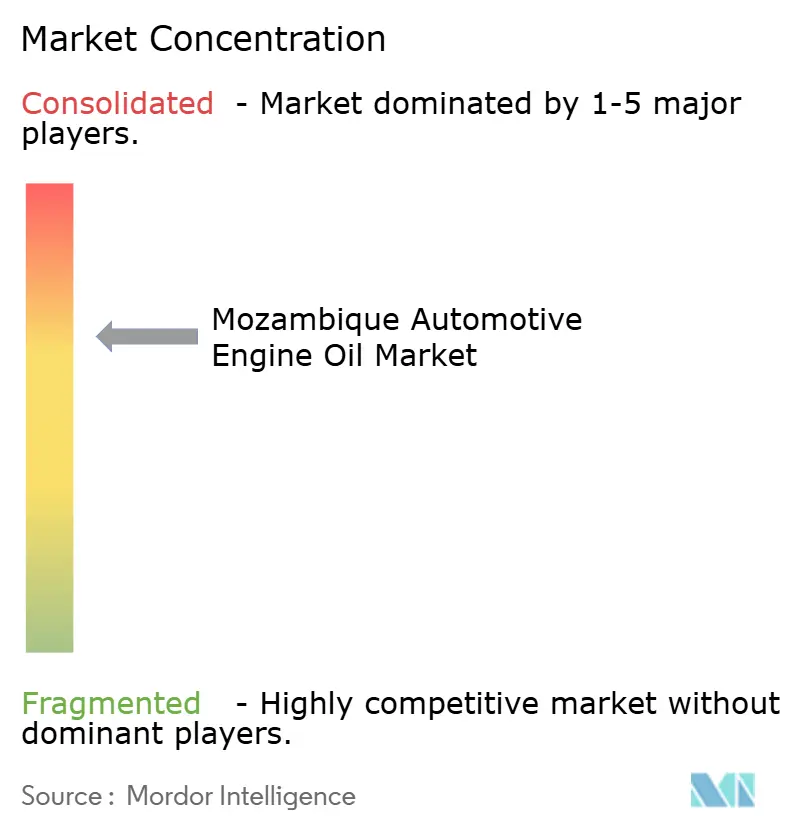
| Market Concentration | Medium |
Major Players *Disclaimer: Major Players sorted in no particular order Image © Mordor Intelligence. Reuse requires attribution under CC BY 4.0. | |
Mozambique Automotive Engine Oil Market Analysis by Mordor Intelligence
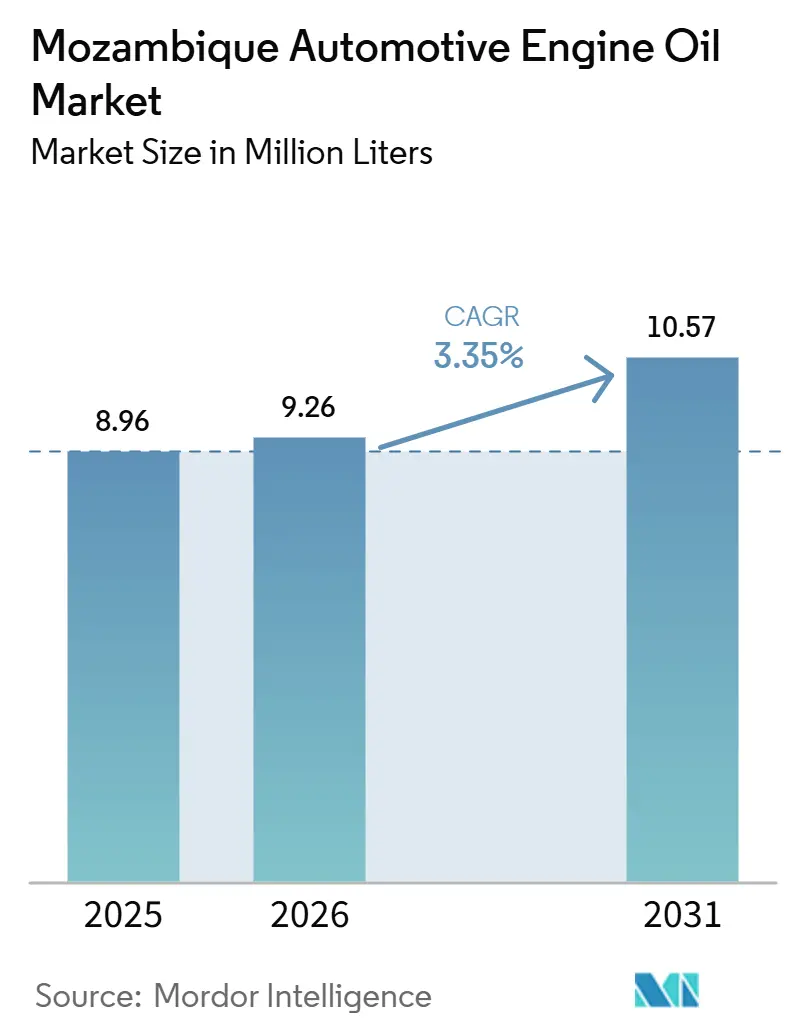
The Mozambique Automotive Engine Oil Market size grew from 8.96 million liters in 2025 to 9.26 million liters in 2026 and is forecast to reach 10.57 million liters by 2031 at 3.35% CAGR over 2026-2031. The Mozambique automotive engine oil market is being supported by a vehicle fleet that surpassed 1.3 million units in 2024, including 897,273 light vehicles, which keeps replacement demand active across the country’s core transport base. The Mozambique automotive engine oil market also benefits from road conditions that remain demanding, as 80% of the national road network was still unpaved in 2026, which raises engine wear and shortens oil drain intervals across passenger, commercial, and motorcycle applications. Growth in freight corridors, ports, liquefied natural gas (LNG) activity, and transport links is adding another layer of lubricant demand because trucks, support vehicles, and auxiliary equipment operate for longer hours under heavier loads. Product demand still leans toward mineral and standard multigrade oils because the fleet is old and heavily import-driven, while newer vehicle inflows are gradually widening room for full synthetic and low-viscosity grades within the Mozambique automotive engine oil market. Formal branded players compete through network reach, service reliability, and product assurance, yet the Mozambique automotive engine oil market remains exposed to import dependence, uneven formal distribution outside the south, and pressure from low-quality products in informal trade.
Key Report Takeaways
- By product type, passenger car motor oil held 53.54% of the Mozambique Automotive Engine Oil market size in 2025, while motorcycle engine oil is forecast to grow at a 5.09% CAGR through 2031.
- By base stock type, mineral accounted for 72.05% of the Mozambique Automotive Engine Oil market size in 2025, while full synthetic is projected to expand at a 4.87% CAGR through 2031.
- By grade, 15W-XX held 37.52% of the Mozambique Automotive Engine Oil market size in 2025, while 5W-XX is expected to grow at a 4.91% CAGR through 2031.
Note: Market size and forecast figures in this report are generated using Mordor Intelligence’s proprietary estimation framework, updated with the latest available data and insights as of January 2026.
Mozambique Automotive Engine Oil Market Trends and Insights
Drivers Impact Analysis*
| Driver | (~) % Impact on CAGR Forecast | Geographic Relevance | Impact Timeline |
|---|---|---|---|
| Rising Imports of Used Vehicles and Aging Fleet | +1.0% | National, concentrated in Maputo city and province | Short term (≤ 2 years) |
| Expansion of Mining and Logistics Sectors | +0.8% | Center-North, including Tete, Nampula, and Cabo Delgado | Medium term (2-4 years) |
| Growth in Two-Wheeler Parc in Mozambique | +0.5% | National, strongest in peri-urban and rural areas | Short term (≤ 2 years) |
| Government Rotas Estruturantes Corridor Projects | +0.6% | National across Maputo, Beira, and Nacala corridors | Medium term (2-4 years) |
| Local-Blending Incentives Under Industrial Policy 2027 | +0.4% | National, with early traction in Maputo and Beira industrial zones | Long term (≥ 4 years) |
| Source: Mordor Intelligence | |||
Rising Imports of Used Vehicles – Aging Fleet
The Mozambique automotive engine oil market continues to draw volume support from a used-vehicle base that keeps the national fleet older, more maintenance-intensive, and more dependent on regular oil replacement. Light vehicles reached 897,273 units in 2024, and the full vehicle fleet moved past 1.3 million units, which shows that the installed parc is already large enough to sustain recurring lubricant consumption even without strong new vehicle sales. This matters because older imported engines generally require shorter drain intervals, and they are also more sensitive to dust, heat, load variation, and inconsistent road quality. Road conditions reinforce that pattern because 80% of the network remains unpaved in 2026, so engines face heavier contamination and wear than they would in a more developed transport system. The practical effect is that the Mozambique automotive engine oil market keeps generating steady replacement demand from existing vehicles, and that demand remains weighted toward lower-cost mineral and multigrade products rather than premium synthetic offerings.
Expansion of Mining and Logistics Sectors
The Mozambique automotive engine oil market is also being lifted by freight, mining support, and corridor logistics activity that uses vehicles for longer periods and under harsher duty cycles. The Port of Maputo is receiving more than USD 2 billion in investment through 2033, and those upgrades are expected to raise cargo throughput and support truck traffic across the southern corridor. In parallel, the World Bank approved the TRACER SOP 2 project in June 2025 to improve connectivity, resilience, and road safety along the Nacala Corridor, which supports higher freight intensity in the center and north over time. LNG activity is another support point because Coral Norte and Rovuma-linked development work add transport, site access, and support fleet needs in Cabo Delgado. This part of the Mozambique automotive engine oil market is important because commercial fleets consume more lubricant per vehicle than passenger cars do, and they are more likely to create demand for higher-performance heavy-duty and synthetic formulations.
Growth in Two-Wheeler Parc in Mozambique
The Mozambique automotive engine oil market is gaining another layer of demand from motorcycles, which are becoming more important in local mobility and small-scale commerce. Mozambique had 100,695 registered motorcycles in 2024, and that formal count already supports a visible base for motorcycle engine oil demand across urban, peri-urban, and rural areas. The role of motorcycles goes beyond personal movement because they are also used in last-mile delivery, rural transport, and smallholder activity where road conditions limit the usefulness of larger vehicles. That means lubricant demand in this channel is regular, frequent, and less dependent on formal service stations than passenger car servicing is. In the Mozambique automotive engine oil market, brands that can reach riders, mechanics, and small workshops directly are better placed to build repeat purchase behavior. Pack size, price points, and route-to-market execution, therefore, matter almost as much as technical formulation in this segment.
Government "Rotas Estruturantes" Corridor Projects
The Mozambique automotive engine oil market is being shaped by corridor development because road and logistics investment changes where vehicles operate, how often they move, and what kind of lubricant support they require. The government launched the Mais Estradas 2031 program in 2026 with USD 2.6 billion allocated to build and rehabilitate more than 3,500 km of roads, and paved road coverage is expected to rise from 22.5% to 37.8% by 2031. The Beira Corridor also received a 2025 Public-Private Partnership (PPP) commitment for the Beira Port Access Road and Dondo Logistics Terminal, which should raise movement through a key freight gateway. The Nacala Corridor is also seeing formal connectivity support through the World Bank program approved in 2025, which strengthens regional access and reduces bottlenecks over time. Better roads should eventually reduce engine stress per trip, but the near-term effect on the Mozambique automotive engine oil market is still positive because more freight movement, broader access, and expanding industrial activity raise the number of operating hours across the fleet. This creates a wider geographic spread of demand and improves the business case for formal distributors to move beyond their traditional southern base.
Restraints Impact Analysis*
| Restraint | (~) % Impact on CAGR Forecast | Geographic Relevance | Impact Timeline |
|---|---|---|---|
| Dependence on Imported Base Oils and Lubes | -1.2% | National | Medium term (2-4 years) |
| Counterfeit/Low-Quality Products in Informal Trade | -0.8% | National, most acute in peri-urban and rural zones | Short term (≤ 2 years) |
| Limited OEM Footprint and Weak Formal Service Network | -0.6% | National, most acute outside Maputo and Beira | Medium term (2-4 years) |
| Source: Mordor Intelligence | |||
Dependence on Imported Base Oils and Lubes
The Mozambique automotive engine oil market remains structurally exposed because the country does not have domestic base oil refining capacity and relies on imported lubricant inputs. India supplied USD 827 million of petroleum oils to Mozambique in 2024, ahead of the European Union at USD 304 million and South Africa at USD 81 million, which shows how concentrated import sourcing remains. This structure passes currency pressure and logistics costs directly into distributor economics, and that weakens margin stability when the local market is price sensitive. It also creates uneven supply risk across regions because northern consumption growth depends on transport and storage systems that are less developed than those serving Maputo. The Instituto Nacional de Petróleos (INP)’s stronger mandate under the petroleum law approved in May 2026 could improve oversight and quality discipline, but it may also raise documentation and compliance requirements for importers and distributors[1]National Petroleum Institute, “Assembly of the Republic Approves New Law of Petroleum,” INP, inp.gov.mz. For the Mozambique automotive engine oil market, the result is a supply chain that can still grow but does so with cost exposure that former players cannot ignore.
Counterfeit/Low-Quality Products in Informal Trade
The Mozambique automotive engine oil market also faces a quality and trust problem because informal trade absorbs a meaningful part of demand outside the main urban service corridors. Price-sensitive consumers often buy from roadside mechanics, small workshops, and informal outlets where product verification is weaker and where low-quality alternatives can move more easily. These limits branded volume growth because genuine suppliers must defend price points while also investing in packaging, mechanic engagement, and retailer education. It also hurts product-mix improvement because customers focused on upfront cost are less likely to shift toward premium or synthetic grades even when vehicle requirements are changing. The Mozambique automotive engine oil market may see some improvement if stronger petroleum oversight leads to tighter compliance expectations, yet informal servicing depth in rural and peri-urban areas means this restraint is unlikely to disappear quickly.
*Our forecasts treat driver/restraint impacts as directional, not additive. The impact forecasts reflect baseline growth, mix effects, and variable interactions.
Segment Analysis
By Product Type: Two-Wheeler Momentum Reshapes the Long-Term Product Mix
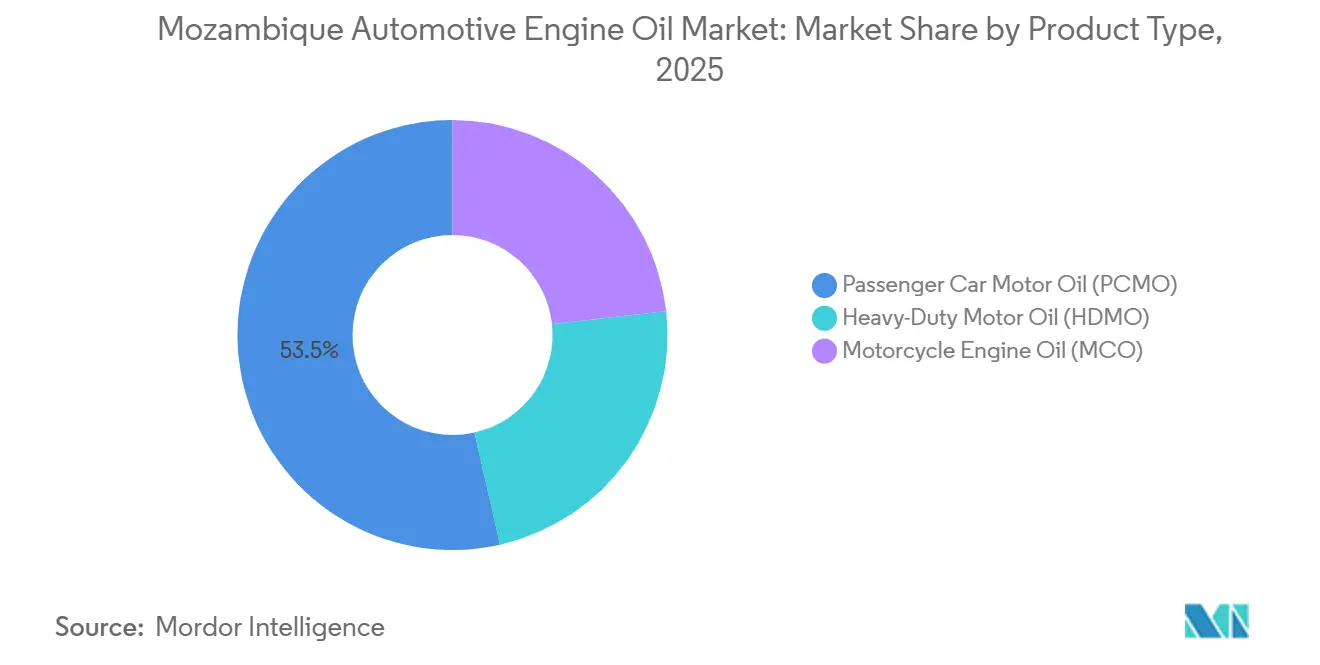
Passenger car motor oil held 53.54% of the Mozambique automotive engine oil market share in 2025, and that leadership reflected the size of the light vehicle parc rather than a temporary shift in buying behavior. Light vehicles reached 897,273 units in 2024, which kept passenger car servicing at the center of replacement volume across workshops, fuel stations, and fleet maintenance points. In the Mozambique automotive engine oil market, this segment still depends heavily on conventional mineral and standard multigrade oils because a large share of imported vehicles are older Japanese and Korean models that do not require premium formulations. That pattern keeps volumes strong but limits average realization per liter, especially where consumers compare branded oils against informal alternatives.
Motorcycle engine oil is forecast to grow at a 5.09% CAGR through 2031, which makes it the fastest-rising product line in the Mozambique automotive engine oil market. Registered motorcycles stood at 100,695 units in 2024, and the real two-wheeler base is likely broader because many vehicles operate in local transport and small commercial activity beyond the reach of the formal service network. The heavy-duty motor oil product category is also significant because 267,792 heavy commercial vehicles were already on the road in 2024, and freight corridor expansion is raising operating intensity for this fleet. This gives the Mozambique automotive engine oil industry a dual demand structure where passenger cars deliver base volume, motorcycles drive faster growth, and commercial fleets create targeted premium opportunities tied to utilization rather than simple vehicle count.



By Base Stock Type: Full Synthetic Gains as Fleet Composition Shifts
Mineral commanded 72.05% of the Mozambique automotive engine oil market share in 2025, which shows that the Mozambique automotive engine oil market is still shaped more by fleet age and affordability than by premiumization. Many vehicles entering the country are used imports, and that keeps mineral oil relevant because it matches both technical requirements and consumer spending limits. Semi-synthetic products fill the middle ground where drivers want a performance upgrade but remain sensitive to total maintenance cost. Bio-based lubricants stayed niche, even though policy attention to biofuels and domestic energy content creates a more supportive long-term backdrop for alternative formulations.
The Mozambique automotive engine oil market size for full synthetic oil is projected to grow at a 4.87% CAGR through 2031, making it the fastest-growing base stock category in the forecast period. This shift is tied to newer passenger imports on one side and commercial, LNG, and mining-linked duty cycles on the other, because both require better durability and better thermal performance than older formulations offer. In the Mozambique automotive engine oil market, full synthetic adoption is therefore less about mass consumer upgrading and more about specific parts of the fleet where operating conditions justify the higher spend. That is why product mix can improve even while mineral oil remains dominant, and why formal distributors with access to fleet accounts are better placed than purely retail-led sellers to capture this change.
By Grade: 15W-XX Holds Ground While Low-Viscosity Grades Gain Share
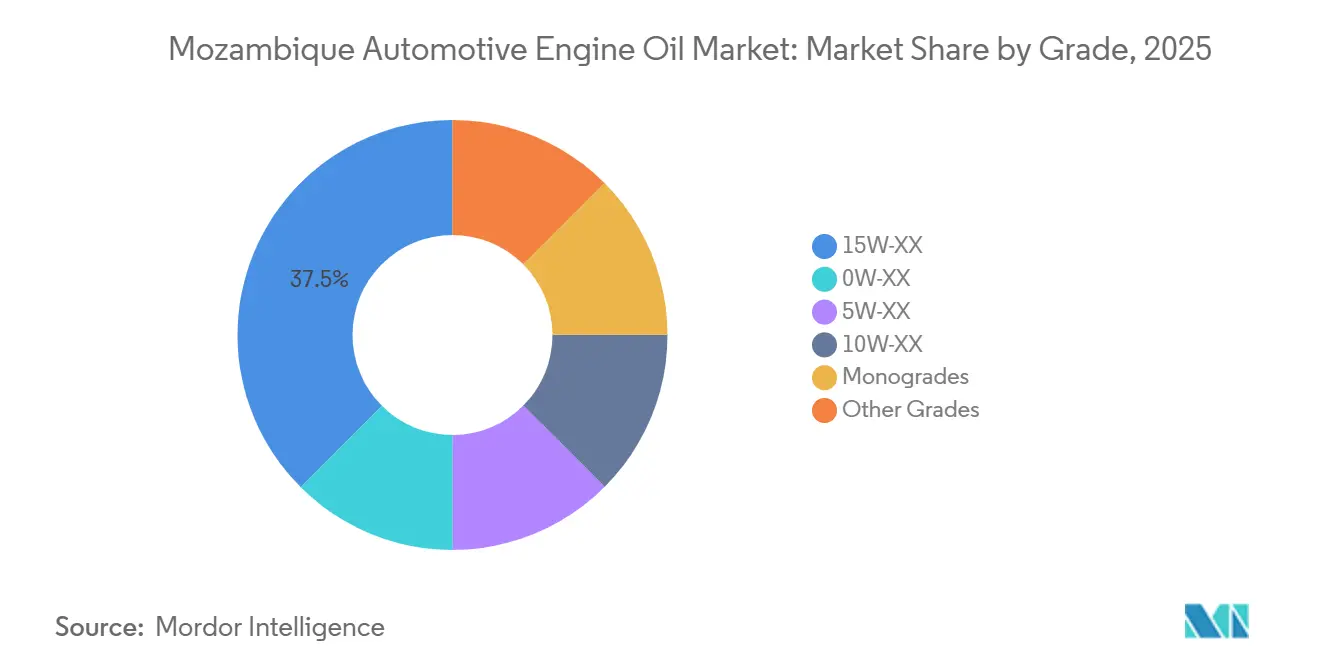
15W-XX grades led with a 37.52% share in 2025, which kept them at the center of the Mozambique automotive engine oil market by volume. Their position reflects the continued presence of older petrol and diesel engines that perform reliably with higher-viscosity formulations in hot operating conditions. They also fit well with the mineral base stock profile that still defines much of the country’s installed vehicle parc. In the Mozambique automotive engine oil market, 10W-XX grades and monogrades also retained meaningful volume because commercial vehicles, agricultural equipment, and older working fleets continue to rely on conventional viscosity choices.
The Mozambique automotive engine oil market size for 5W-XX grades is expected to grow at a 4.91% CAGR through 2031, which makes them the fastest-growing grade segment. This reflects the gradual inflow of newer compact passenger cars, especially from Japanese and Korean sources, where lower-viscosity oils align with tighter engine tolerances and fuel-economy priorities. Although 0W-XX grades are still small, they are starting to appear in higher-end passenger cars and selected corporate fleets concentrated in the south. The grade mix inside the Mozambique automotive engine oil market is therefore shifting slowly rather than abruptly, and that keeps 15W-XX important even as lower-viscosity grades gain ground year by year.
Geography Analysis
Southern Mozambique remained the core demand center in the Mozambique automotive engine oil market because Maputo city and province together accounted for 564,525 of the country’s 1.32 million registered vehicles in 2024. This concentration supports the country’s densest network of formal fuel stations, branded lubricant outlets, and managed fleet servicing points. The south also benefits from port access and stronger commercial links, which improve the flow of finished lubricants and related inventory. The Port of Maputo expansion program, with more than USD 2 billion committed through 2033, is expected to raise freight movement and extend heavy-duty lubricant demand in the same zone[2]U.S. Department of Commerce, “Mozambique Ports & Rail Market Overview and Opportunities,” Trade.gov, trade.gov. Because of this infrastructure and distribution depth, the Mozambique automotive engine oil market in the south is more resilient to informal competition than many interior districts are.
Central Mozambique serves a different role in the Mozambique automotive engine oil market because it is the freight gateway for Zimbabwe, Zambia, and Malawi through the Beira Corridor. The 2025 PPP commitment for the Beira Port Access Road and Dondo Logistics Terminal should increase heavy commercial traffic and support higher heavy-duty motor oil turnover in this region. Tete’s mining logistics and the rail-linked movement of bulk commodities keep lubricant demand tied closely to operating intensity, equipment use, and road quality. Secondary road conditions remain challenging in much of the center, which means drain intervals stay short and per-vehicle lubricant consumption remains elevated.
Northern Mozambique is one of the faster-changing parts of the Mozambique automotive engine oil market because LNG-linked development and corridor connectivity are expanding the need for commercial and support fleets. The TRACER SOP 2 (Transport Corridors for Economic Resilience Series of Projects), approved in 2025, should improve access and transport resilience along the Nacala Corridor, which strengthens the long-term case for formal distribution growth in areas still served unevenly today. LNG projects in Cabo Delgado are also raising transport and support requirements, which helps the demand case for higher-performance heavy-duty lubricants. Even so, the Mozambique automotive engine oil market in the north remains more exposed to informal trade and thinner retail coverage than the south, so growth potential is clear, but route-to-market execution remains decisive.
Competitive Landscape
The Mozambique automotive engine oil market is moderately concentrated with the top five players, including TotalEnergies, Shell plc, Engen Petroleum (PTY) LT, and BP p.l.c. (Castrol), and Puma Energy. TotalEnergies has the broadest branded retail position after expanding through the BP Mozambique network and related terminal interests, which strengthened its downstream presence in the country. Vivo Energy Mozambique has also built strong reach and was operating a 58-station nationwide network after its 2024 partnership with Camel Oil expanded 12 Maputo province locations, while it also serves as the exclusive authorized distributor of Shell lubricants in the country. Puma Energy remained another important participant with an integrated station, convenience, and airport footprint that supports both retail and B2B lubricant sales. This means the Mozambique automotive engine oil market is led by distribution reach, channel control, and branded service visibility more than by standalone manufacturing capacity inside the country.
There is still room open in the Mozambique automotive engine oil market where national brands and international specialists can grow through channels that large station networks do not fully cover. The mechanic workshop base, the peri-urban consumer, and the northern corridor user are all important because purchasing often happens outside formal station-led environments. Vivo Energy’s Shell Points of Oil Change Center model shows how service format can become a competitive tool when product quality alone is not enough to differentiate the offer. Anti-counterfeit packaging, product assurance, and direct mechanic engagement are also becoming more relevant because brands need to defend trust as much as they defend shelf space.
Regulation could slowly improve the competitive setting in the Mozambique automotive engine oil market if enforcement becomes firmer and more consistent. The petroleum law approved in May 2026 significantly strengthened the INP’s supervisory, regulatory, and sanctions authority, which could support tighter downstream compliance over time. That would favor players already operating through formal documentation, established retail networks, and recognized quality standards. Even so, the Mozambique automotive engine oil market is unlikely to become tightly consolidated soon because informal trade still serves broad parts of the country that branded distribution has not fully captured.
Mozambique Automotive Engine Oil Industry Leaders
Engen Petroleum (PTY) LTD
BP p.l.c. (Castrol)
Puma Energy
Shell plc
TotalEnergies
- *Disclaimer: Major Players sorted in no particular order

Recent Industry Developments
- May 2026: The Mozambique Assembly of the Republic approved a new petroleum law that significantly strengthened the National Petroleum Institute's (INP) supervisory, regulatory, and sanctions authority over the hydrocarbons sector. The law mandated a minimum 15% non-dilutable state participation in oil operations through ENH and at least 25% participation in domestic market commercialization, representing a structural change with downstream implications for lubricant supply chain governance and compliance.
- April 2026: The Ministry of Transport and Logistics launched the "Mais Estradas 2031" Accelerated National Road Rehabilitation and Construction Program, committing USD 2.6 billion to rehabilitate and construct over 3,500 km of national roads across all provinces by 2031. The program aimed to increase the paved road share from 22.5% to 37.8%, improving logistics corridor efficiency and vehicle operating conditions, which was expected to positively influence lubricant demand distribution across the country.


Mozambique Automotive Engine Oil Market Report Scope
Automotive engine oil is a specialized liquid lubricant designed to coat moving engine parts, minimizing friction and preventing metal-on-metal wear. It also functions as a cooling agent, cleaner, and sealant by absorbing combustion heat and trapping harmful debris. This fluid protects internal components from rust and corrosion, extending the overall lifespan of the vehicle.
The Mozambique Automotive Engine Oil Market is segmented by product type, base stock type, and grade. By product type, the market is segmented into passenger car motor oil (PCMO), heavy-duty motor oil (HDMO), and motorcycle engine oil (MCO). By base stock type, the market is segmented into mineral, semi-synthetic, full synthetic, and bio-based. By grade, the market is segmented into 15W-XX, 0W-XX, 5W-XX, 10W-XX, monogrades, and other grades. For each segment, the market sizing and forecasts have been done on the basis of volume (liters).
| Passenger Car Motor Oil (PCMO) |
| Heavy-Duty Motor Oil (HDMO) |
| Motorcycle Engine Oil (MCO) |
| Mineral |
| Semi-Synthetic |
| Full Synthetic |
| Bio-Based |
| 15W-XX |
| 0W-XX |
| 5W-XX |
| 10W-XX |
| Monogrades |
| Other Grades |
| By Product Type | Passenger Car Motor Oil (PCMO) |
| Heavy-Duty Motor Oil (HDMO) | |
| Motorcycle Engine Oil (MCO) | |
| By Base Stock Type | Mineral |
| Semi-Synthetic | |
| Full Synthetic | |
| Bio-Based | |
| By Grade | 15W-XX |
| 0W-XX | |
| 5W-XX | |
| 10W-XX | |
| Monogrades | |
| Other Grades |


Key Questions Answered in the Report
What is the size of the Mozambique automotive engine oil market?
The Mozambique automotive engine oil market stands at 9.26 million liters in 2026 and is projected to reach 10.57 million liters by 2031.
Why did mineral oil dominate lubricant demand in Mozambique in 2025?
Mineral oil held 72.05% of the market volume in 2025 because the fleet is old, heavily import-driven, and highly sensitive to maintenance costs.
Which product type is growing fastest in Mozambique?
Motorcycle engine oil is expected to grow at a 5.09% CAGR through 2031, supported by a registered motorcycle fleet of 100,695 units in 2024.
Which grade led demand in 2025?
15W-XX led with 37.52% of the market share in 2025 because it aligns with older engines and the hot operating conditions common across the country.
Page last updated on:





