
Motorsports Market Size and Share
Market Overview
| Study Period | 2022 - 2031 |
|---|---|
| Market Size (2026) | USD 11.45 Billion |
| Market Size (2031) | USD 16.17 Billion |
| Growth Rate (2026 - 2031) | 7.15 % |
| Fastest Growing Market | Middle East and Africa |
| Largest Market | Europe |
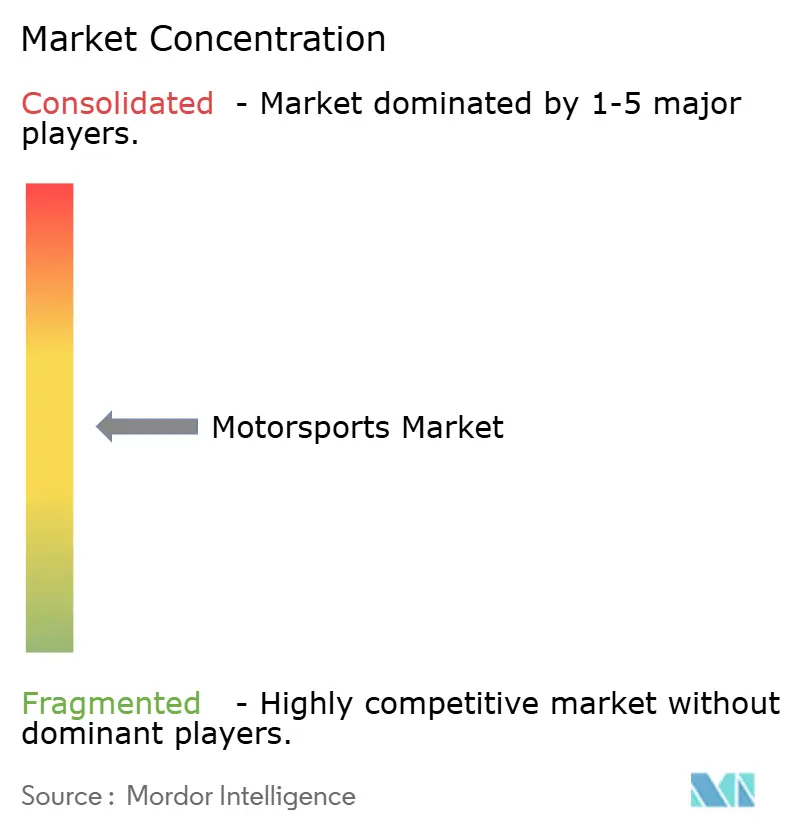
| Market Concentration | Medium |
Major Players *Disclaimer: Major Players sorted in no particular order Image © Mordor Intelligence. Reuse requires attribution under CC BY 4.0. | |
Motorsports Market Analysis by Mordor Intelligence
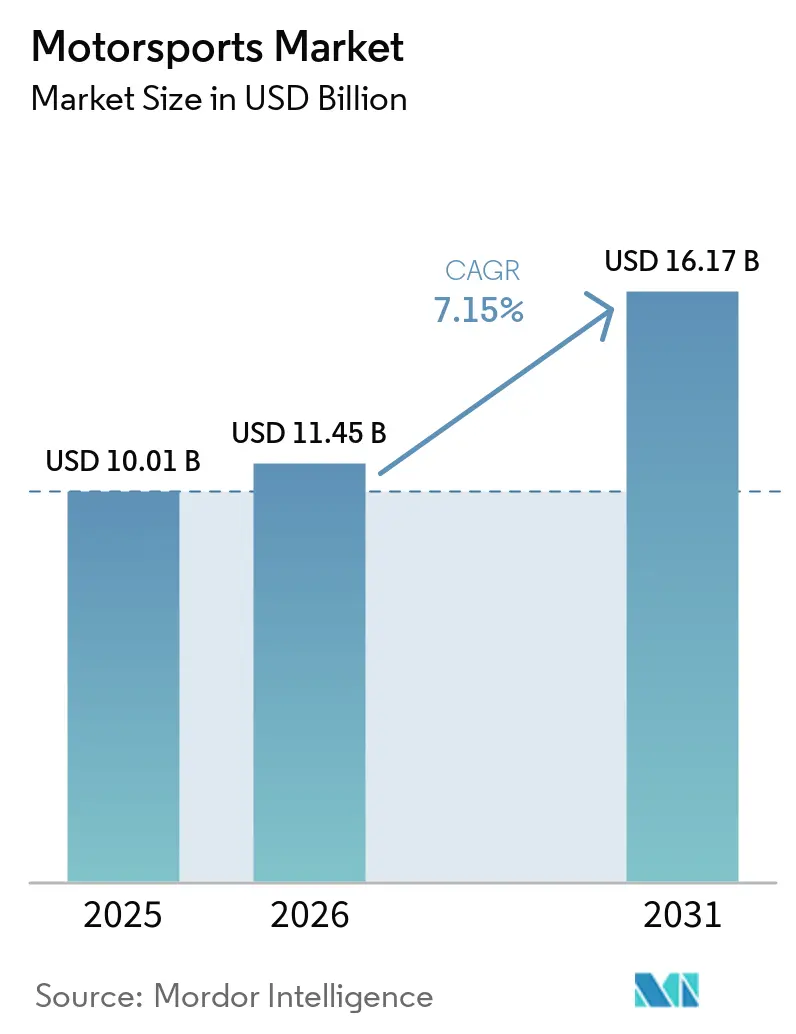
The Global Motorsports Market size is projected to be USD 10.01 billion in 2025, USD 11.45 billion in 2026, and reach USD 16.17 billion by 2031, growing at a CAGR of 7.15% from 2026 to 2031.
The Global motorsports market is expanding on the back of stronger sponsorship demand, a broader mix of paid media distribution, and sustained investment by large rights holders that are consolidating premium racing properties. Formula 1 remained the most visible commercial benchmark in 2025, reporting total revenue of USD 3.873 billion, up 14% year over year, with media rights, race promotion fees, and sponsorship advancing across its main revenue lines. The Global motorsports market is also being reshaped by audience behavior because official digital platforms, streaming access, and always-on social video now support fan demand beyond the physical circuit footprint, as seen in MotoGP’s record 632 million global fanbase in 2025. Europe continues to anchor the sport through deep promoter, team, and circuit infrastructure, while the Middle East is gaining commercial weight through recurring FIA world championship hosting and event-led sports tourism programs. A clear constraint remains cost inflation, as the FIA raised the 2026 Formula 1 cost cap to USD 215 million, keeping the upper end of the Global motorsports market attractive for major operators while making scale more important for commercial survival.[1]
Key Report Takeaways
- By motorsport type, Formula Racing held 34.72% of the global motorsports market share in 2025, while Motorcycle & Two-Wheeler Racing is forecast to expand at 7.98% CAGR through 2031.
- By revenue source, Commercial Sponsorship & Advertising accounted for 41.61% of the global motorsports market size in 2025, while Merchandising, Licensing & Gaming is projected to advance at 8.35% CAGR through 2031.
- By audience type, Digital Viewers/Television Viewers led with 82.74% in 2025 and are also projected to record the fastest growth at 7.56% CAGR through 2031.
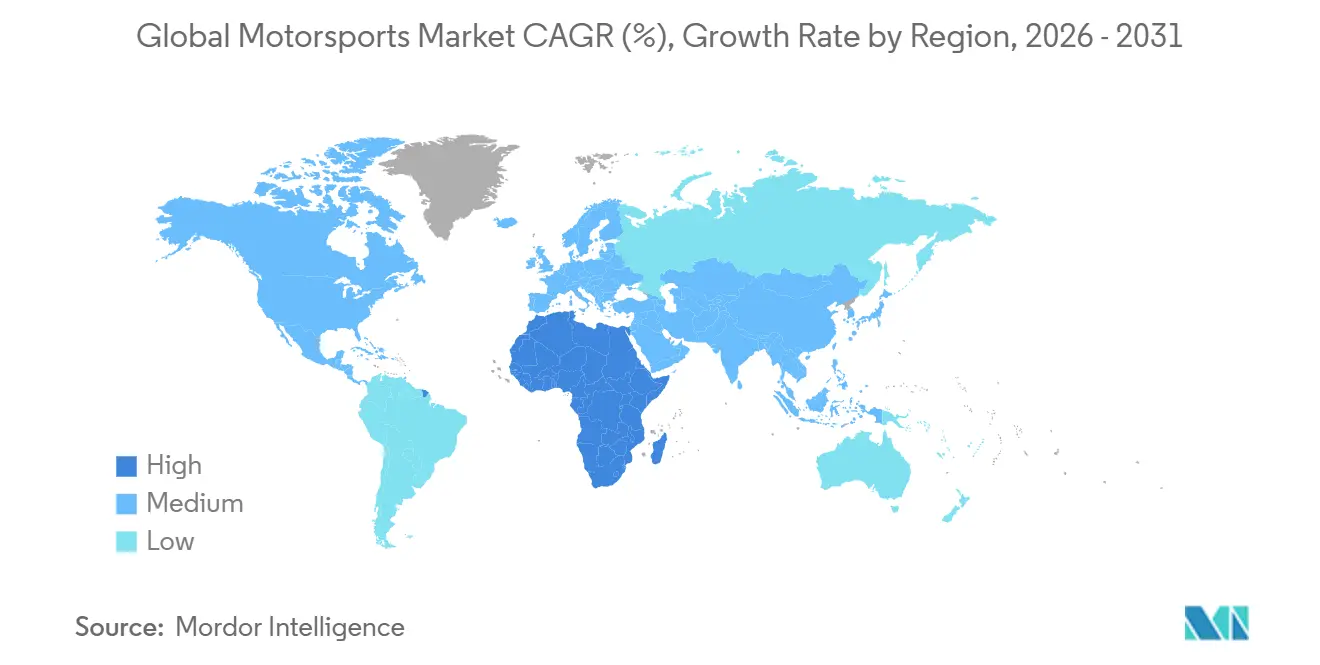
- By geography, Europe accounted for 36.47% of the global motorsports market size in 2025, while the Middle East & Africa is forecast to grow at 8.92% CAGR through 2031.
Note: Market size and forecast figures in this report are generated using Mordor Intelligence’s proprietary estimation framework, updated with the latest available data and insights as of January 2026.
Global Motorsports Market Trends and Insights
Drivers Impact Analysis*
| Drivers | (~) % Impact on CAGR Forecast | Geographic Relevance | Impact Timeline |
|---|---|---|---|
| Rising Sponsorship and Brand Activation Spend | +1.8% | Global, with North America and Europe as primary markets | Short term (≤ 2 years) |
| Expansion of Streaming, Broadcast, and Digital Rights Monetization | +1.5% | North America, Europe, Asia-Pacific, with emerging spillover into the Middle East & Africa | Short term (≤ 2 years) |
| Growth in Premium Hospitality and Experiential Ticketing | +0.7% | North America, Europe, the Middle East | Medium term (2-4 years) |
| Electrification and Sustainability-Led Series Innovation | +0.6% | Global, with early gains in Europe and the Middle East | Medium term (2-4 years) |
| Data-Driven Fan Engagement and Direct-to-Consumer Monetization | +0.5% | Global, strongest in North America and Asia-Pacific | Medium term (2-4 years) |
| Cross-Category Commercialization Across Travel, Retail, and Gaming | +0.4% | North America, Europe, Asia-Pacific | Long term (≥ 4 years) |
| Source: Mordor Intelligence | |||
Rising Global Sponsorship and Brand Activation Spend
Sponsorship strengthened its role in the Global motorsports market in 2025, when Formula 1 generated USD 840.4 million in sponsorship revenue and pushed the category above 20% of total revenue for the first time under Liberty Media ownership. That shift matters because sponsor packages are no longer limited to trackside signage and title rights, and now extend into app experiences, digital content, premium access, and measurable fan interaction. The commercial logic is reinforced by official team technology programs, such as the Scuderia Ferrari HP app relaunch with IBM WatsonX, which helped lift race-active users by 56% and content views by 62% within a year. MotoGP added further scale to the sponsorship base in 2025 by reporting a record 632 million global fans and 9% growth in television audiences per Grand Prix, expanding the branded reach across premium two-wheel racing. As a result, the Global motorsports market is attracting greater long-term sponsor interest because rights holders can now offer both reach and measurable engagement in a single commercial package.
Expansion of Paid Streaming, Broadcast, and Digital Rights Monetization
Media monetization is becoming a larger growth engine for the Global motorsports market as leading series secure longer contracts and add more distribution partners. NASCAR’s seven-year, USD 7.7 billion media rights agreement, which began in 2025, raised annual rights fees to USD 1.1 billion and brought Amazon Prime Video and Warner Bros. Discovery into the live rights mix alongside Fox and NBC. Formula 1 also deepened its broadcast visibility with official rights renewals in the United Kingdom and Ireland through 2034, and in Italy through 2032, securing two mature television markets for an extended period. MotoGP’s official digital ecosystem supports this direction, as its 2025 season closed with record global fan metrics and strong video engagement, both of which can be monetized through direct distribution and subscription models. This keeps the Global motorsports market less dependent on any single screen, and it gives promoters a wider base of recurring paid media income.
Growth in Premium Hospitality, VIP, and Experiential Ticketing
Premium attendance remains a powerful revenue layer in the Global motorsports market because large series can convert limited track capacity into high-value per-capita spending. Formula 1 reported 6.75 million total attendees across the 2025 season, up 4% year over year, indicating that live demand remained strong even as digital viewing continued to rise. Endurance racing adds similar evidence, because the 2026 24 Hours of Le Mans set a new attendance record at 350,105 spectators and confirmed that marquee events can still command destination-level demand. Premium hospitality has become more important because promoters are monetizing more than race access, and now package paddock exposure, VIP dining, corporate networking, and festival-style entertainment in a single event offer. This strengthens the Global motorsports market by boosting yield per attendee and providing sponsors and hosts with a richer environment for client entertainment and brand activation.[2]
Increased Electrification and Sustainability-Led Series Innovation
Electrification is broadening the long-term appeal of the Global motorsports market by linking performance with visible sustainability credentials. Formula E introduced its GEN4 race car for the 2026/27 season, featuring 600 kW in Attack Mode, 0 to 200 kph in 4.4 seconds, top speeds above 335 kph, and a design built from 100% recyclable materials, with at least 20% recycled carbon fiber. The same platform also uses tires made from 65% natural and recycled materials, which helps present racing technology as a test case for lower-impact materials and supply chains. Sustainability now matters on the commercial side because rights holders need formats that align with sponsor commitments, public policy expectations, and host city acceptance. This gives the Global motorsports market a broader innovation narrative and helps series defend future investment even as environmental scrutiny becomes tighter.
Restraints Impact Analysis*
| Restraints | (~) % Impact on CAGR Forecast | Geographic Relevance | Impact Timeline |
|---|---|---|---|
| High Team, Venue, and Compliance Cost Inflation | -1.0% | Global, most acute in Europe and North America | Short term (≤ 2 years) |
| Dependence on a Small Set of Elite Sponsors and Host Venues | -0.6% | Global | Medium term (2-4 years) |
| Tightening Noise, Safety, and Environmental Restrictions | -0.4% | Europe, with early effects in urban circuits | Medium term (2-4 years) |
| Fan Fatigue in Saturated Mature Racing Calendars | -0.3% | North America and Europe | Long term (≥ 4 years) |
| Source: Mordor Intelligence | |||
High Team, Venue, and Compliance Cost Inflation
Cost inflation remains one of the clearest limits on the Global motorsports market because top-level participation, circuit delivery, and regulatory compliance all require larger budgets than before. The FIA raised the 2026 Formula 1 cost cap to USD 215 million from the 2025 base level of USD 135 million after accounting for accumulated inflation and additional cost items. That change does not weaken the top end of the sport, but it does raise the commercial threshold for new entrants and smaller organizations that want to compete at a credible scale. Cost pressure also extends beyond teams, as event operators, suppliers, and host venues must bear greater operating and compliance burdens over time. For the Global motorsports market, that means growth is still possible, but it will favor operators with stronger balance sheets, better sponsor access, and more diversified revenue bases.[3]
Dependence on A Small Set of Elite Sponsors and Host Venues
The Global motorsports market still relies heavily on a narrow pool of premium sponsors and host venues, especially at the top end of international racing. Formula 1’s 2025 revenue mix shows how important this concentration can be, because media rights contributed 31.3%, race promotion fees contributed 26.7%, and sponsorship contributed 21.7% of total revenue. That revenue structure is efficient when major partners renew, but it can expose promoters if a few large buyers reduce spend, renegotiate terms, or shift to other sports properties. A similar issue applies to hosting, where flagship events depend on a limited set of circuits and destination cities that can absorb high event delivery standards. The result is that the Global motorsports market remains commercially attractive, but parts of it are still more concentrated than they appear when viewed only through audience size.
*Our forecasts treat driver/restraint impacts as directional, not additive. The impact forecasts reflect baseline growth, mix effects, and variable interactions.
Segment Analysis
By Motorsport Type: Formula racing leads while two-wheeler formats add the strongest growth pace
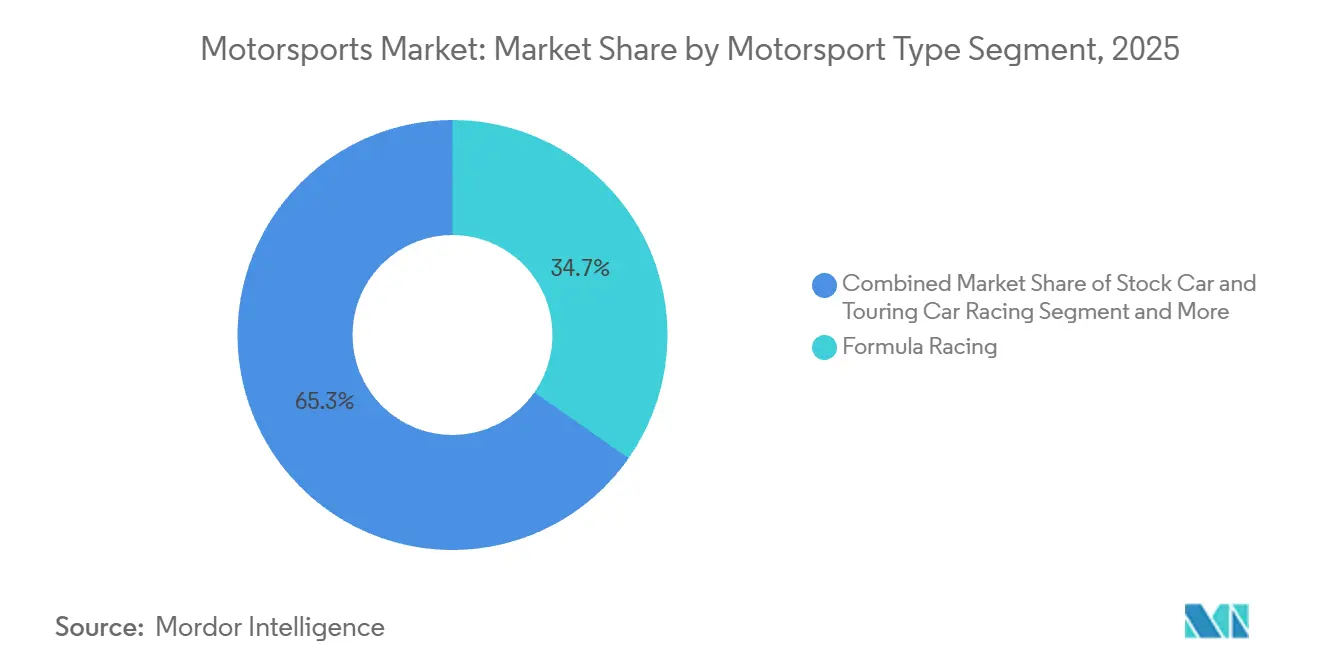
Formula Racing accounted for 34.72% of the Global motorsports market share in 2025, which reflects the commercial scale and pricing power of Formula 1 at the top of the category. Formula 1 reported USD 3.873 billion in revenue in 2025, with media rights contributing 31.3%, race promotion fees contributing 26.7%, and sponsorship contributing 21.7%, which confirms how balanced and mature the formula-led business model has become. The category remains the commercial benchmark because its revenue is spread across broadcast, hosting, sponsorship, and live attendance, rather than concentrated in a single line. It also benefits from long planning horizons, which support multi-year team agreements, stable promoter relationships, and premium sponsor pricing. Within the Global motorsports market, formula-led formats therefore continue to define the valuation logic for high-end rights, even as newer growth pockets gain ground.
Motorcycle & Two-Wheeler Racing is the fastest-growing type segment, and the Global motorsports market size for this segment is projected to expand at 7.98% CAGR through 2031. Liberty Media completed the acquisition of Dorna Sports in July 2025 for USD 4.95 billion, giving MotoGP the backing of an owner that already knows how to scale live rights, digital subscriptions, and sponsorship programs globally. MotoGP closed 2025 with revenue of USD 573 million, operating income growth of 86%, a global fanbase of 632 million, and television audience growth of 9% per Grand Prix, which shows that the format combines scale with a still-developing monetization runway. Sports car and endurance racing also improved their standing through record event demand, with the 2026 24 Hours of Le Mans drawing 350,105 spectators and supporting the case for premium long-format racing. Stock car and touring car formats remain commercially important as well, especially in North America, where NASCAR’s official move into San Diego shows that established series are still reworking their formats and location strategies to reach new urban audiences.

By Revenue Source: Sponsorship remains the base, while gaming and licensing bring the growth edge
Commercial Sponsorship & Advertising accounted for 41.61% of the Global motorsports market in 2025, making it the single largest revenue source across the supplied segmentation. Formula 1’s 2025 sponsorship revenue of USD 840.4 million shows why the category remains so important, because it combines premium pricing with room for digital extensions and multi-market partner rights. The category remains durable because brands no longer buy only logo visibility; instead, they buy access to live audiences, digital data, corporate hospitality, and branded content within the same rights package. Broadcasting and media rights remain the second core pillar, with NASCAR’s 2025 rights cycle showing that premium motorsport still commands larger checks from established broadcasters and streaming platforms. In the Global motorsports market, these two revenue lines continue to reinforce each other, as stronger audience reach increases sponsor value. In contrast, stronger sponsor ecosystems support the visibility and narrative depth that media buyers want.
Merchandising, Licensing & Gaming is the fastest-growing revenue source, projected to grow at a 8.35% CAGR through 2031. Motorsport Games said Le Mans Ultimate accounted for approximately 78% of total 2025 revenue, up sharply from 34% in the prior year, underscoring how quickly a well-positioned official game can shift the revenue mix for licensed motorsport content. This matters because gaming turns motorsport IP into a year-round commercial product rather than a weekend-only event business. Technical regulations and participation fees still add a stable contribution, but they do not offer the same scaling potential as digital licensing, consumer products, or interactive media. Across the Global motorsports market, the most valuable revenue portfolios are therefore becoming broader, with sponsorship, rights, hospitality, and gaming all working together rather than in isolation.
By Audience Type: Digital viewing dominates, while live attendance keeps premium value
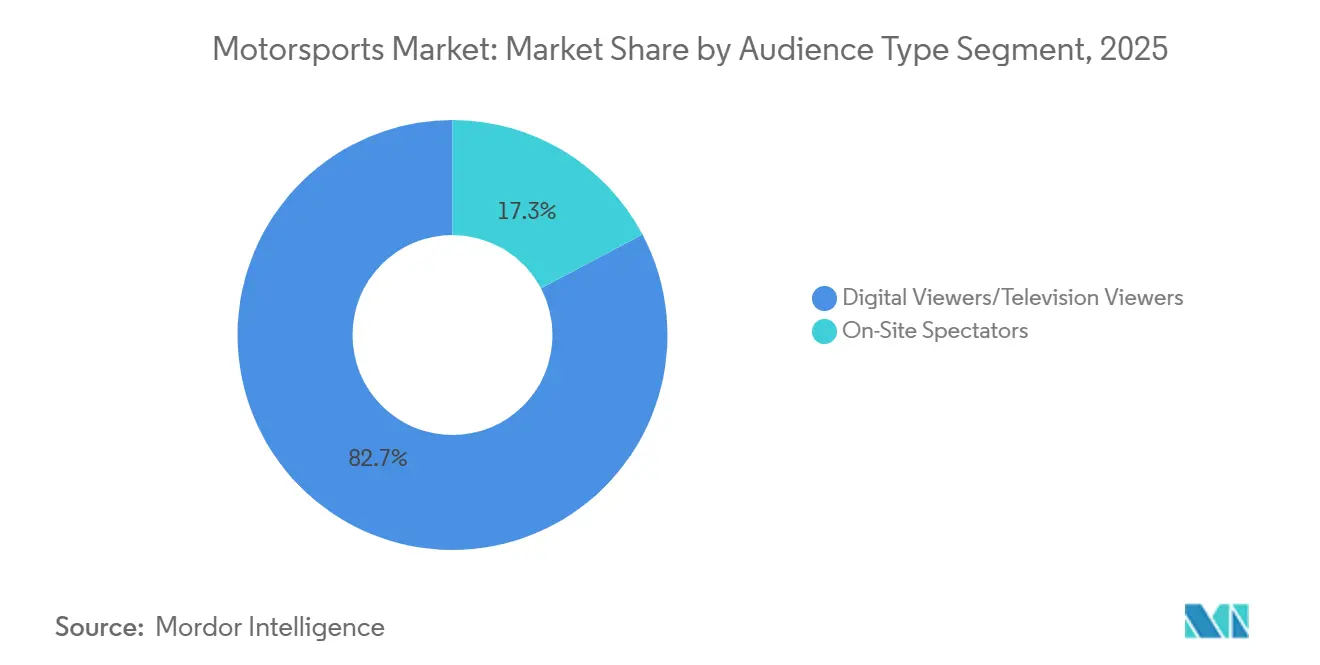
Digital Viewers/Television Viewers accounted for 82.74% of the audience mix in 2025, and this segment is also the fastest growing, with a 7.56% CAGR through 2031. MotoGP’s 2025 season clearly supports that position, with a record 632 million fans, 9% growth in television audiences per Grand Prix, a 26% rise in sprint-race viewership, and more than 1 billion minutes consumed on the official YouTube channel. Ferrari’s official mobile platform adds a second proof point, because the IBM-supported relaunch delivered a 35% rise in cumulative downloads along with major gains in active users and content consumption. These numbers show that digital growth is not only about audience scale but also about collecting first-party data, building loyalty, and creating more sellable sponsor inventory. In the Global motorsports market, digital viewing now shapes commercial planning as much as circuit attendance does.
On-site Spectators remain the smaller audience segment by count, but they continue to produce high commercial density for leading events and promoters. Formula 1 recorded 6.75 million attendees across the 2025 season, while the 2026 Le Mans weekend drew a record 350,105 spectators, which confirms that flagship events still command destination-level travel demand. Live attendance matters because it anchors the most profitable combinations of ticketing, hospitality, food and beverage, corporate hosting, and branded merchandise in one place. It also gives teams and sponsors the physical setting they need for launches, partner events, and premium customer engagement. In the Global motorsports market, the strongest business model is not digital vs. live, but digital plus live, because each channel enhances the value of the other.
Geography Analysis
Europe accounted for 36.47% of the Global motorsports market in 2025, reflecting the region’s concentration of teams, circuits, engineering talent, and promoter infrastructure. Formula 1 strengthened that position further with official broadcast renewals in the UK and Ireland through 2034 and in Italy through 2032, which protects revenue visibility in two of the sport’s most established television markets. Endurance racing added another signal in 2026, when the 24 Hours of Le Mans set a new attendance record at 350,105 spectators. Europe also benefits from a layered racing ecosystem that stretches from local and national competition through to Formula 1 and the FIA World Endurance Championship. This keeps the Global motorsports market deeply rooted in Europe, even as some of the fastest incremental growth comes from other regions.
North America remains one of the most commercially powerful regions in the Global motorsports market because it supports Formula 1, NASCAR, and IndyCar at a meaningful scale. NASCAR’s media rights structure, which began in 2025, raised annual fees to USD 1.1 billion and expanded live distribution across traditional television and streaming, underscoring the depth of the United States as a premium domestic motorsport media market. IndyCar is also expanding its city presence through the 2026 Freedom 250 in Washington, D.C., and broader 2026 schedule additions in Arlington and Markham, which signal a clear push toward new urban event demand. NASCAR’s official move into San Diego adds to this pattern and suggests that organizers want more visible city-adjacent settings rather than relying solely on legacy venue economics. South America remains smaller in scale, but its continued place on the FIA World Endurance Championship calendar helps preserve regional relevance within the wider Global motorsports market.
The Middle East & Africa is forecast to expand at 8.92% CAGR through 2031, making it the fastest-growing regional segment in the Global motorsports market. The region’s position is being built through the repeat hosting of FIA World Championship events and high-visibility investment in sports tourism, destination branding, and circuit infrastructure. Asia-Pacific remains strategically important, as MotoGP already draws large official audiences across markets where two-wheeler culture is deeply embedded in everyday mobility and popular fandom, adding long-term monetization potential after Liberty Media acquires Dorna. This creates a meaningful regional split, with Asia-Pacific offering fan scale and the Middle East offering accelerated venue and host investment. Taken together, both regions are becoming more important to the future direction of the Global motorsports market, even though Europe still holds the largest current share.
Competitive Landscape
The Global motorsports market operates with a noticeable split between promoter-led concentration and format-level diversity. Liberty Media now holds the commercial rights to both Formula 1 and MotoGP after closing the Dorna Sports acquisition in July 2025. The two series together accounted for USD 4.446 billion in 2025 revenue, based on the figures provided in the source base. That gives Liberty unusual leverage in sponsor discussions, content packaging, and long-range rights strategy at the top end of the sport. NASCAR Holdings, Penske Entertainment, and the Automobile Club de l’Ouest remain important because each controls a different format with its own audience behavior and partner ecosystem.
Strategic moves in the Global motorsports market increasingly show that competition is no longer limited to race calendars and team performance. IBM’s May 2026 rollout of new AI-powered Ferrari app features is a clear example, because it turned team digital infrastructure into a deeper fan retention and monetization tool rather than a simple information channel. Liberty Media’s acquisition of Dorna is a second example because it brings Formula 1 and MotoGP under a single commercial owner and opens the door to shared learning across media rights, sponsorship sales, and direct distribution. NASCAR’s official San Diego expansion is a third example because it shows how legacy racing properties are redesigning their location strategy to remain relevant to urban audiences and premium brand partners. Together, these moves show that competition in the Global motorsports market now includes rights ownership, digital capability, city access, and commercial storytelling.
Barriers to entry remain high in the Global motorsports market, especially when top-tier technical compliance and premium sponsor relationships are required simultaneously. The FIA’s 2026 Formula 1 cost cap of USD 215 million reinforces that reality, as even a regulated top series still demands substantial operating resources. At the same time, the market is not closed, because different racing formats still allow room for specialized operators, local promoters, and newer monetization models such as gaming and owned digital channels. That is why the competitive field remains active even when top rights are concentrated, since value can still be created through format identity, fan engagement, and targeted expansion.
Motorsports Industry Leaders
-
Liberty Media Corporation
-
NASCAR Holdings, LLC
-
Penske Entertainment Corp.
-
Dorna Sports, S.L.
-
Speedway Motorsports, LLC
- *Disclaimer: Major Players sorted in no particular order
Recent Industry Developments
- May 2026: IBM Corporation launched enhanced AI-powered features for the Scuderia Ferrari HP app using its watsonx platform; since the app's May 2025 relaunch, cumulative downloads rose 35%, average race-active users increased 56%, and content views grew 62%, establishing a measurable benchmark for AI-driven fan retention in motorsport.
- April 2026: The FIA and Formula E unveiled the GEN4 car at Circuit Paul Ricard, the world's first 100% recyclable single-seater race car, generating 600 kW in Attack Mode, capable of 0–200 kph in 4.4 seconds, and built with at least 20% recycled carbon fibre and tyres made from 65% natural and recycled materials.
- January 2026: IndyCar announced the Freedom 250 Grand Prix of Washington D.C. for August 21–23, 2026, designated by executive order as part of America's 250th anniversary celebrations, with the free-to-air street circuit event televised live on FOX Sports.
- December 2025: MotoGP closed the 2025 season with a record global fanbase of 632 million, up 12%, TV audiences up 9% per Grand Prix, and sprint-race viewership surging 26% year over year; Liberty Media’s pro-forma integration confirmed MotoGP operating income grew 86% to USD 54 million on revenue of USD 573 million.
Global Motorsports Market Report Scope
| Formula Racing |
| Stock Car & Touring Car Racing |
| Sportscar & Endurance Racing |
| Motorcycle & Two-Wheeler Racing |
| Others (Specialty & Drag Racing,Off-Road & Rally Racing) |
| Commercial Sponsorship & Advertising |
| Broadcasting & Media Rights |
| Merchandising, Licensing & Gaming |
| Technical Regulations & Participation Fees |
| Others (Hospitality & VIP Experiences, etc.) |
| On-Site Spectators |
| Digital Viewers/Television Viewers |
| North America | United States |
| Canada | |
| Mexico | |
| South America | Brazil |
| Peru | |
| Chile | |
| Argentina | |
| Rest of South America | |
| Europe | United Kingdom |
| Germany | |
| France | |
| Spain | |
| Italy | |
| BENELUX (Belgium, Netherlands, and Luxembourg) | |
| NORDICS (Denmark, Finland, Iceland, Norway, and Sweden) | |
| Russia | |
| Rest of Europe | |
| Asia-Pacific | India |
| China | |
| Japan | |
| Australia | |
| South Korea | |
| South East Asia (Singapore, Malaysia, Thailand, Indonesia, Vietnam, and Philippines) | |
| Rest of Asia-Pacific | |
| Middle East and Africa | United Arab Emirates |
| Saudi Arabia | |
| South Africa | |
| Nigeria | |
| Rest of Middle East and Africa |
| By Motorsport Type | Formula Racing | |
| Stock Car & Touring Car Racing | ||
| Sportscar & Endurance Racing | ||
| Motorcycle & Two-Wheeler Racing | ||
| Others (Specialty & Drag Racing,Off-Road & Rally Racing) | ||
| By Revenue Source | Commercial Sponsorship & Advertising | |
| Broadcasting & Media Rights | ||
| Merchandising, Licensing & Gaming | ||
| Technical Regulations & Participation Fees | ||
| Others (Hospitality & VIP Experiences, etc.) | ||
| By Audience Type | On-Site Spectators | |
| Digital Viewers/Television Viewers | ||
| By Geography | North America | United States |
| Canada | ||
| Mexico | ||
| South America | Brazil | |
| Peru | ||
| Chile | ||
| Argentina | ||
| Rest of South America | ||
| Europe | United Kingdom | |
| Germany | ||
| France | ||
| Spain | ||
| Italy | ||
| BENELUX (Belgium, Netherlands, and Luxembourg) | ||
| NORDICS (Denmark, Finland, Iceland, Norway, and Sweden) | ||
| Russia | ||
| Rest of Europe | ||
| Asia-Pacific | India | |
| China | ||
| Japan | ||
| Australia | ||
| South Korea | ||
| South East Asia (Singapore, Malaysia, Thailand, Indonesia, Vietnam, and Philippines) | ||
| Rest of Asia-Pacific | ||
| Middle East and Africa | United Arab Emirates | |
| Saudi Arabia | ||
| South Africa | ||
| Nigeria | ||
| Rest of Middle East and Africa | ||
Key Questions Answered in the Report
What is the 2031 outlook for the Global motorsports market?
The Global motorsports market is expected to reach USD 16.17 billion by 2031 from USD 11.45 billion in 2026, at a CAGR of 7.15%.
Which racing format leads revenue generation today?
Formula Racing led by motorsport type with 34.72% share in 2025, supported by Formula 1’s broad mix of media rights, race promotion, sponsorship, and live attendance.
Why is sponsorship still so important in motorsport?
Sponsorship remains the largest revenue source at 41.61% in 2025, and Formula 1 alone generated USD 840.4 million in sponsorship revenue in 2025
What is driving the rise of two-wheeler racing?
Motorcycle & Two-Wheeler Racing is the fastest-growing motorsport type at 7.98% CAGR, supported by Liberty Media’s USD 4.2 billion acquisition of Dorna and MotoGP’s 632 million fanbase in 2025.
Which region is growing the fastest?
Middle East & Africa is projected to expand at 8.92% CAGR through 2031, supported by repeat FIA championship hosting and continued sports tourism investment.
How important are digital fans to future monetization?
Digital Viewers/Television Viewers accounted for 82.74% of the audience mix in 2025 and remain the fastest-growing audience group at 7.56% CAGR, while MotoGP and Ferrari both reported strong official digital engagement growth.