
Morocco Cosmetics Market Size and Share
Market Overview
| Study Period | 2021 - 2031 |
|---|---|
| Forecast Data Period | 2026 - 2031 |
| Base Year Market Size (2025) | USD 97.21 Million |
| Market Size (2026) | USD 102.88 Million |
| Market Size (2031) | USD 139.04 Million |
| Growth Rate (2026 - 2031) | 6.21 % |
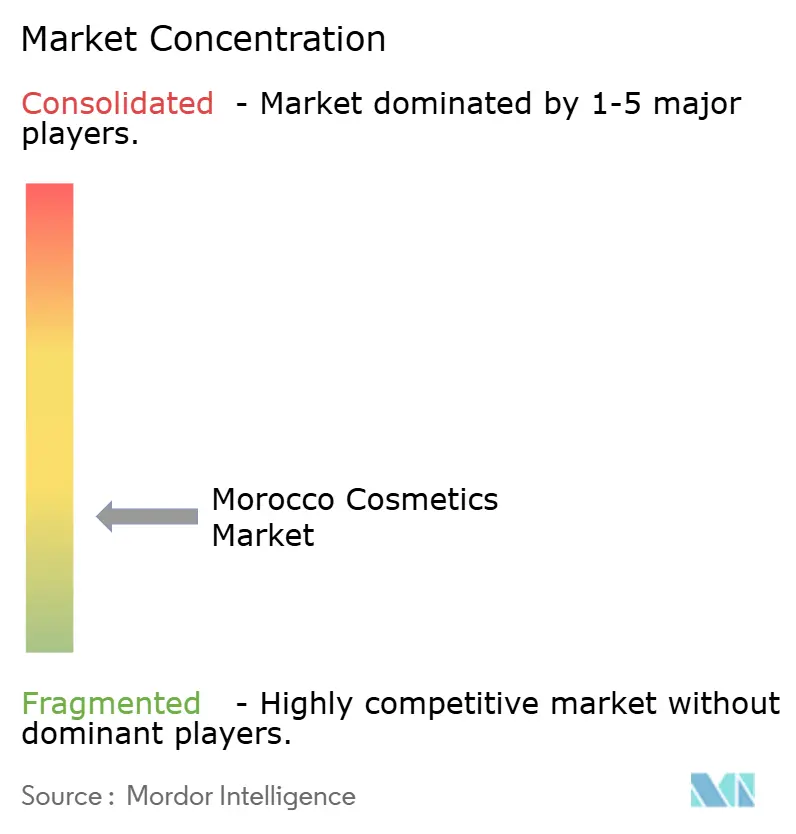
| Market Concentration | Low |
Major Players
*Disclaimer: Major Players sorted in no particular order Image © Mordor Intelligence. Reuse requires attribution under CC BY 4.0. |
|
Morocco Cosmetics Market Analysis by Mordor Intelligence
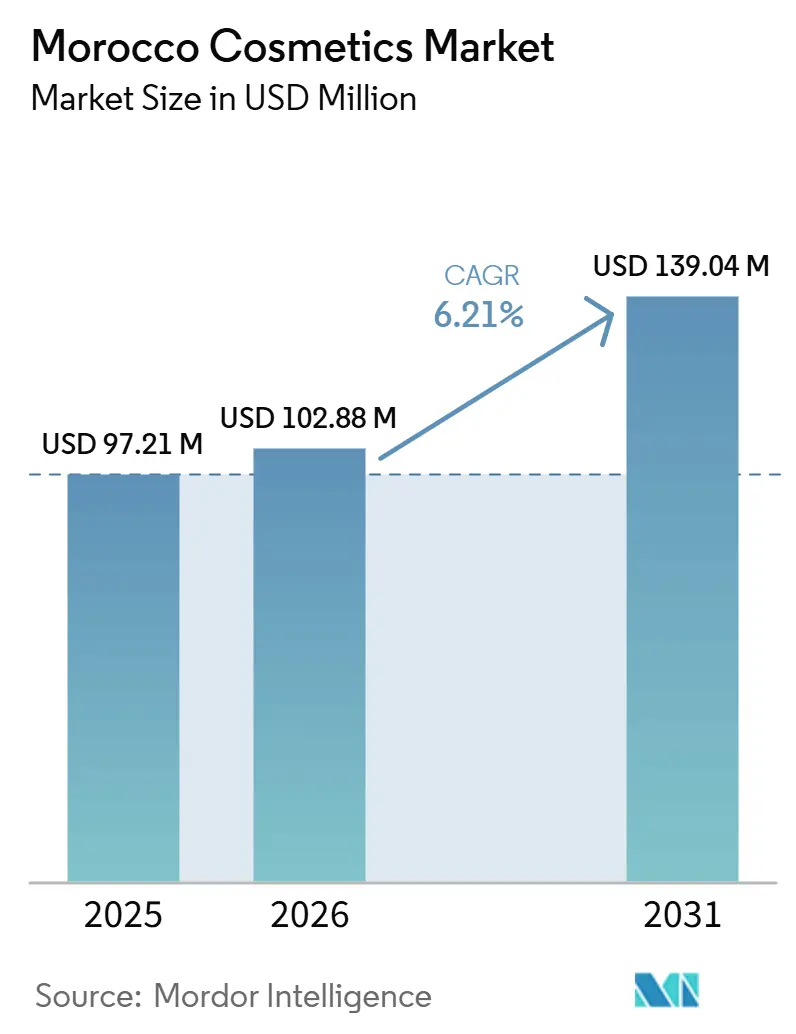
The Morocco cosmetics market size is expected to grow from USD 97.21 million in 2025 to USD 102.88 million in 2026, and is forecast to reach USD 139.04 million by 2031 at a 6.21% CAGR over 2026-2031. Growth is driven by rising urban purchasing power, tourism spending, demand for Moroccan botanical ingredients, and broader digital access. Argan oil provides domestic producers with a distinctive ingredient base, although drought and traceability gaps limit how quickly producers can translate this advantage into finished-product exports. Organized retailers are expanding distribution beyond established urban locations, while digital platforms are making national reach more attainable for compliant brands. Competition remains fragmented, as multinational companies, regional operators, and Moroccan brands occupy different positions across the value chain. The Morocco cosmetics market also faces pressure from counterfeit goods, import exposure, and the cost of complying with domestic and European product requirements.
Key Report Takeaways
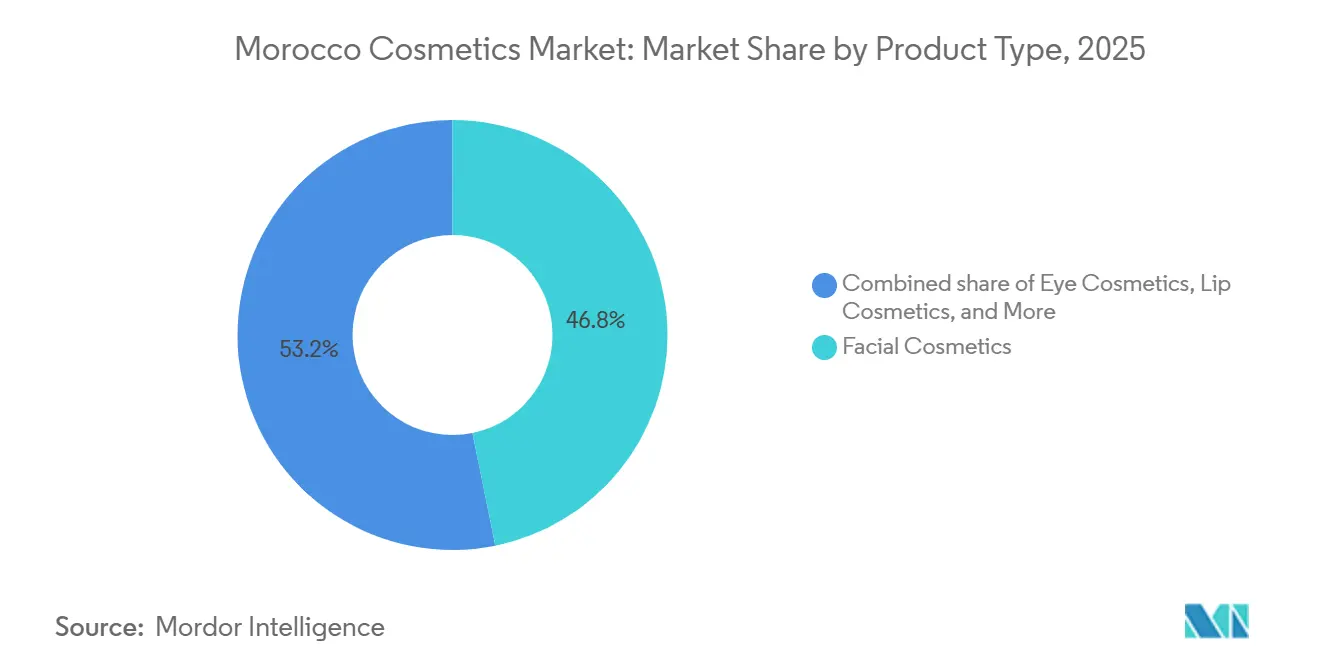
- By product type, facial cosmetics led the Morocco cosmetics market with a share of 46.81% in 2025, while eye cosmetics is anticipated to register the fastest CAGR of 7.78% during 2026-2031.
- By category, mass products led the market with a share of 78.21% in 2025, while premium products are anticipated to register the fastest CAGR of 7.14% during 2026-2031.
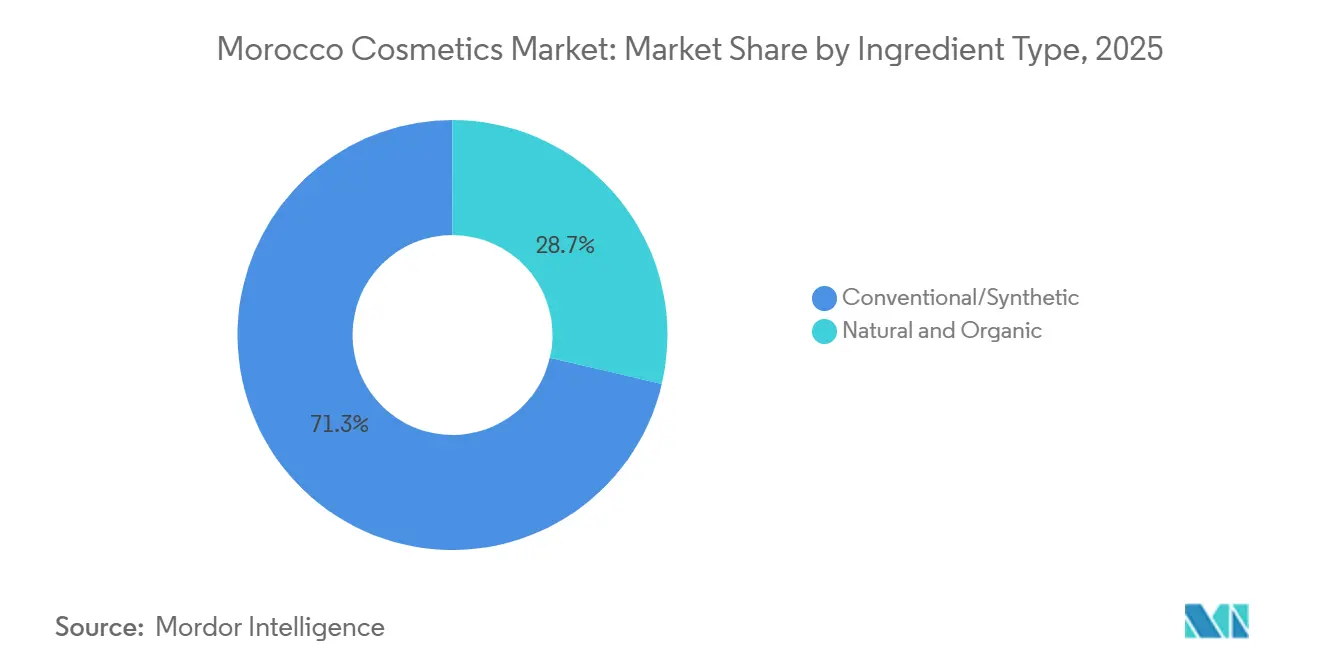
- By ingredient, conventional/synthetic led the market with a share of 71.34% in 2025, while natural and organic is anticipated to register the fastest CAGR of 7.29% during 2026-2031.
- By distribution channel, specialty stores led the market with a share of 46.82% in 2025, while online retail is anticipated to register the fastest CAGR of 7.00% during 2026-2031.
Note: Market size and forecast figures in this report are generated using Mordor Intelligence’s proprietary estimation framework, updated with the latest available data and insights as of January 2026.
Morocco Cosmetics Market Trends and Insights
Drivers Impact Analysis*
| Driver | % Impact on CAGR Forecast | Geographic Relevance | Impact Timeline |
|---|---|---|---|
| Rising disposable incomes supporting premium beauty purchases | +1.4% | Urban centers, Casablanca, Rabat, and Marrakech | Medium term (2-4 years) |
| Growing demand for natural argan oil-based cosmetics | +1.3% | Global demand, with supply centered in Souss-Massa | Long term (≥ 4 years) |
| Strong tourism sector driving beauty retail sales | +1.1% | Marrakech, Agadir, Fes, and Tangier | Short term (≤ 2 years) |
| Rapid expansion of e-commerce and omnichannel beauty brands | +0.9% | National, with early gains in Casablanca and Rabat | Short term (≤ 2 years) |
| International beauty brands expanding distribution across morocco | +0.7% | National, with an urban-first rollout | Medium term (2-4 years) |
| European union regulatory alignment enhances export competitiveness | +0.5% | Export-oriented producers targeting the European Union and Gulf Cooperation Council | Long term (≥ 4 years) |
| Source: Mordor Intelligence | |||
Rising disposable incomes supporting premium beauty purchases
Rising household incomes in major cities are expanding cosmetics demand beyond basic replacement purchases and supporting more selective trade-up behavior. Mass products continue to account for most volume, while premium products are recording the fastest category growth. This trend indicates that consumers are adding higher-priced items to their routines without fully shifting away from lower-priced ranges. Consumers purchase a familiar mass product for routine use while selecting a premium serum, treatment, or color cosmetic for a specific need. This purchasing pattern creates opportunities for brands that position products around premium ingredients while maintaining accessible price points. Specialty stores and parapharmacies are well positioned to support these products, as staff can explain ingredients, product use, suitability, and quality claims in person. This advisory role is important when consumers evaluate a basic item against a higher-priced product or a more specific formulation, as the purchase decision often depends on a clear explanation of use, expected results, ingredient quality, and the factors supporting a different price tier.
Growing demand for natural argan oil-based cosmetics
Morocco supplies more than 90% of commercial argan oil, and its argan forests cover 830,000 hectares, supported by more than 500 cooperatives that employ nearly 10,000 women. The scale of this network gives the country a recognizable ingredient base for domestic retail and export-oriented product lines. Morocco’s ingredient advantage supports pricing and brand differentiation, but it does not eliminate sourcing risks for cooperatives, processors, or finished-product brands. Long-term purchasing agreements and organic certification can help brands secure supply and meet the expectations of premium buyers in the European Union and the United States. These arrangements also give buyers clearer visibility into origin, supply terms, and the credentials attached to a finished formulation.
Strong tourism sector driving beauty retail sales
Tourism provides incremental demand for cosmetics products. These purchases complement regular domestic demand and concentrate in locations where visitors encounter local ingredients and gift-oriented retail. Morocco welcomed 18.2 million visitors in 2025, up 14% from 15.9 million in 2024, according to the Ministry of Tourism and the National Moroccan Tourism Office (ONMT) [3]Source: African Travel and Tourism Association, "Morocco posts" atta.travel. Tourist-facing specialty stores can maintain premium pricing that may be difficult to support through domestic demand alone. Their product mix can also position locally rooted goods alongside international beauty brands, increasing product discovery among visitors. Visitors who purchase locally branded products may later seek the same brands through cross-border digital retail, extending the commercial value of an in-country sale. This link between physical purchases and subsequent online interest can support brand awareness in export destinations without requiring an immediate overseas store network.
Rapid expansion of e-commerce and omnichannel beauty brands
The online retail channel is supported by broader digital purchasing adoption and the expansion of specialized beauty platforms. The channel allows consumers to compare brands, product details, and price points before purchasing. H&S Group launched Beautyforyou in September, 2025, creating a dedicated national beauty platform that carries brands such as La Roche-Posay, Garnier, CeraVe, Avon, Beiersdorf, and Vichy. The platform highlights the development of formal, specialized beauty retail beyond general online marketplaces. The Direction du Médicament et de la Pharmacie requires product registration before cosmetics reach the market, including through online channels. This requirement creates a barrier for informal sellers that lack compliant product files. Organized brands can use digital retail to reach cities with limited physical store coverage, while established brands have an incentive to make product information and fulfillment more consistent across physical and digital channels. International brands expanding their urban distribution and local retailers investing in connected stores are reinforcing the shift toward formal omnichannel operations in the Moroccan cosmetics market.
Restraints Impact Analysis*
| Restraint | (~) % Impact on CAGR Forecast | Geographic Relevance | Impact Timeline |
|---|---|---|---|
| Counterfeit cosmetics undermine consumer trust and brand value | -1.0% | National, with higher exposure in informal and unregulated channels | Short term (≤ 2 years) |
| Heavy import dependence increases product volatility | -0.9% | National | Medium term (2-4 years) |
| Stringent ingredient compliance raises product development costs | -0.7% | Export-oriented producers and the national parapharmacy channel | Long term (≥ 4 years) |
| Currency fluctuations inflate imported raw material expenses | -0.8% | National | Short term (≤ 2 years) |
| Source: Mordor Intelligence | |||
Counterfeit cosmetics undermine consumer trust and brand value
Counterfeit goods remain a direct threat to consumer safety, brand confidence, and formal retail margins. These products can closely resemble familiar brands while bypassing the quality controls, registration requirements, and supply arrangements expected from organized brands. Oversight shifted to the Ministry of Health after the dissolution of anti-fraud services, but monitoring has not kept pace with the volume of products moving through informal and digital channels. A reported enforcement action in Essaouira in July 2026, in which authorities arrested three people during an operation against substandard cosmetics conducted with the trademark owner, would indicate continued enforcement activity. However, it also highlights the reactive nature of case-by-case intervention, as a single operation cannot address products that have already moved through informal shops, social commerce, or other channels with limited routine monitoring. Legitimate operators in the Morocco cosmetics market must invest more in consumer education, authentication, and controlled distribution, which adds pressure in a price-sensitive customer base.
Heavy import dependence increases product volatility
The domestic formulation base remains limited relative to demand, exposing many companies to imported inputs, logistics costs, and exchange-rate movements. This exposure affects both established brand portfolios and smaller manufacturers that rely on imported packaging, ingredients, or finished formulations. These constraints limit local producers’ ability to replace imported formulations with scalable, certified domestic production. They also restrict the value that local companies can retain after an ingredient leaves the cooperative or early processing stage. In addition, Bank Al-Maghrib was preparing to widen the dirham’s fluctuation band in 2026, which would shift more foreign-exchange exposure to import-dependent companies. Exporters must also comply with Regulation (EC) No. 1223/2009, including safety documentation, notification, and the appointment of an EU Responsible Person. The 2026 customs requirements for digital safety information will increase documentation work, meaning smaller firms in the Moroccan cosmetics market could face rising compliance costs and import costs at the same time. Manufacturers need to manage sourcing, certification, and product documentation in an integrated way because disruption in any one area can delay access to export or formal retail channels.
*Our forecasts treat driver/restraint impacts as directional, not additive. The impact forecasts reflect baseline growth, mix effects, and variable interactions.
Segment Analysis
By Product Type: Facial Cosmetics Anchor Volume While Eye Products Accelerate
Facial cosmetics accounted for 46.81% of revenue in 2025, supported by rising beauty consciousness, increasing urbanization, and growing demand for complexion-enhancing products among young consumers. The segment is benefiting from sustained demand for foundations, BB/CC creams, concealers, face powders, and primers, as consumers prioritize long-lasting, lightweight, and skin-friendly formulations suited to Morocco's warm climate. International brands, including Maybelline New York, L'Oréal Paris, and KIKO Milano, along with regional brands, continue to broaden their facial makeup portfolios, strengthening the segment's market position.
Eye cosmetics are forecast to register the highest CAGR by product type, at 7.78%, through 2031. Segment growth is supported by the cultural emphasis on eye makeup and the increasing influence of social media beauty trends. Demand for mascaras, eyeliners, eyebrow products, and eyeshadow palettes is rising, particularly among younger consumers. Manufacturers are expanding their offerings with waterproof, smudge-proof, and long-wear formulations designed for daily use and hot weather conditions. For example, Huda Beauty, a leading Middle East-based beauty brand with a strong presence in Morocco, continues to expand its eye makeup portfolio through innovative mascaras, eyeliners, and eyeshadow collections, supporting broader consumer adoption.



By Category: Mass Scale Dominates, Premium Pace Accelerates
Mass products accounted for 78.21% of the Moroccan cosmetics market size in 2025, supported by widespread price sensitivity and broad retail access. Supermarkets, hypermarkets, and large specialty chains provide the distribution scale mass brands require. Global brands leverage established supply systems and familiar product formats to maintain availability across cities. Meanwhile, masstige offerings have emerged between low-priced products and prestige brands, particularly in specialty stores and parapharmacies. In these outlets, trained staff explain how mid-priced products differ in ingredients or performance. As a result, the Morocco cosmetics market supports a broad price ladder rather than a simple split between basic and prestige products.
Premium products are forecast to expand at a CAGR of 7.14% through 2031, outpacing the overall Morocco cosmetics market. Higher urban incomes, tourist spending in Marrakech and Agadir, and growing consumer interest in certified botanical products support this growth. Certified organic sourcing can strengthen the link between natural products and premium positioning. In February 2026, One Retail, the retail division of Moroccan conglomerate H&S Invest Holding, acquired 100% of B5 Cosmetics, the Flormar franchise holder, adding a network of more than 52 outlets across 19 cities. The transaction highlights how accessible premium and masstige formats can scale through organized store networks.
By Ingredient Type: Synthetic Holds Volume, Natural Leads Growth
Conventional/synthetic formulations retained 71.34% of revenue in 2025, supported by their cost competitiveness and reliable supply arrangements. These formulations provide flexibility and predictable performance for products sold at mass-market prices. Large brands can source these inputs through established international networks and maintain consistent volumes. Most consumers continue to require products at accessible price points, while natural alternatives may face supply constraints, particularly when they depend on argan oil and seasonal agricultural conditions. As a result, conventional formulations are expected to remain a key volume base for the Moroccan cosmetics market over the medium term.
Natural and organic ingredients are forecast to grow at a 7.29% CAGR through 2031, making them the fastest-growing ingredient type. Argan cooperative networks with Ecocert and United States Department of Agriculture organic credentials provide a supply base that premium formulators in the European Union and the United States seek. These credentials help buyers link Moroccan provenance with documented sourcing. However, the International Finance Corporation identifies traceability weaknesses as a key barrier to scaling certified natural cosmetics exports [1]Source: World Bank Group, "Morocco Country Private Sector Diagnostic " ifc.org. Stronger traceability would enable more Moroccan producers to supply finished products to premium shelves. This issue remains important for the Morocco cosmetics industry because it determines whether ingredient value stays local or is captured later through foreign processing and branding.
By Distribution Channel: Specialty Stores Lead, Online Retail Disrupts
Specialty stores accounted for 46.82% of revenue in 2025, as they combine product variety, consultation, and brand presentation. Their curated assortments provide an experience that general mass retailers do not offer. Supermarkets and hypermarkets continue to capture routine purchases of established mass brands, while pharmacies and parapharmacies remain relevant for dermocosmetics, as pharmacist recommendations influence consumer decisions. Direct-selling networks also continue to retain customers, although they are shifting toward broader retail availability. Dislog Group’s acquisition of Avon Morocco in June 2025 is expected to move Avon from a direct-sales-only model to wider multichannel distribution.
Online retail is forecast to grow at a CAGR of 7.00% through 2031, the highest rate among distribution channels. Formal registration rules apply to online sellers as well as physical stores, while compliant brands can use e-commerce to reach second-tier and third-tier cities without building a full store network. Informal resellers face higher barriers, so digital growth favors brands that can maintain product documentation and reliable fulfillment in the Morocco cosmetics market.
Geography Analysis
The Moroccan cosmetics market exhibits clear regional demand dynamics shaped by urbanization, income levels, tourism activity, retail infrastructure, and consumer purchasing behavior. The Casablanca–Rabat corridor remains the country’s largest cosmetics market, supported by high population density, stronger purchasing power, and an established network of modern retail outlets, shopping malls, beauty specialty stores, and e-commerce platforms. Consumers in these cities drive strong demand for premium skincare, makeup, and international beauty brands, reinforcing the region’s position as Morocco’s primary cosmetics consumption hub.
Marrakech, Agadir, and Tangier are developing as high-growth markets, supported by expanding tourism, rising disposable incomes, and continued urbanization. Luxury hotels, spas, and beauty salons, together with sustained demand from residents and international tourists, are driving sales of premium cosmetics, fragrances, and natural beauty products formulated with Moroccan ingredients such as argan oil and rose extracts.
Affordable and mass-market cosmetic products continue to lead in smaller cities and rural regions, where traditional retail channels, pharmacies, and local beauty stores remain key distribution points. However, improving internet penetration, the expansion of supermarket chains, and the rapid growth of e-commerce platforms are broadening access to branded cosmetics across underserved regions, supporting nationwide market expansion.
Competitive Landscape
The Morocco cosmetics market remains fragmented, with multinational, regional, and domestic participants competing across price points and channels. L’Oréal, Unilever, Beiersdorf, Procter & Gamble, Shiseido, Clarins, and Yves Rocher maintain strong brand recognition, broad product portfolios, and established marketing and supply capabilities. Flormar, Oriflame, and Cosnova address the accessible premium and masstige segments. Moroccan brands, including Bikor Makeup, Botanica Natural Products, Les Sens de Marrakech, Nectarome, and GOLD COSMETIC, differentiate their offerings through local ingredients and cultural relevance. These brands can build credibility around argan, rose water, and ghassoul clay, where international brands have less direct provenance. Certified organic finished-product exports and specialty retail in second-tier cities remain expansion opportunities for local firms.
Distribution consolidation is expected to shape competitive strategy. Dislog Group completed its 100% acquisition of Avon Morocco in June 2025, giving it responsibility for Avon’s commercial development across distribution channels. One Retail acquired B5 Cosmetics in February 2026 and incorporate the Flormar network into an omnichannel and digital transformation plan. These actions will allow local groups to control more of the retail, distribution, and customer relationship chain. Beautyforyou adds a national digital channel for several global brands. As a result, the Morocco cosmetics market is becoming more organized across formal channels, although its overall company structure remains dispersed.
The Cosmetech Valley Cluster aims to strengthen domestic production capabilities, from argan extraction to finished products. Data Management Platform documentation and Moroccan National Office for Food Safety certification establish formal market access requirements, favoring companies with organized compliance systems. Digital-native Moroccan brands can still use social commerce to reach urban buyers, but they must meet the same product and channel requirements to achieve sustainable scale.
Morocco Cosmetics Industry Leaders
-
Beiersdorf
-
Johnson & Johnson
-
L'Oréal S.A.
-
Unilever PLC
-
Procter & Gamble Company
- *Disclaimer: Major Players sorted in no particular order

Recent Industry Developments
- February 2026: One Retail, the retail arm of H&S Invest Holding, acquired 100% of B5 Cosmetics, the exclusive Flormar franchise holder in Morocco. The acquisition included a network of more than 50 outlets across 19 cities, along with plans to expand e-commerce and the supply chain.
- September 2025: H&S Group launched Beautyforyou, a dedicated national beauty e-commerce platform. The platform offers international brands, including La Roche-Posay, Garnier, CeraVe, Avon, Beiersdorf, and Vichy, among others.
- June 2025: Dislog Group completed its 100% acquisition of Avon Beauty Products SARLU, the Moroccan subsidiary of the global cosmetics leader Avon Cosmetics, transitioning Avon Morocco from a direct-selling-only model to a broader multichannel retail distribution strategy.


Morocco Cosmetics Market Report Scope
Cosmetic products are formulations applied to the face, eyes, lips, and nails to enhance or alter appearance by adding color, definition, or coverage. These products include foundation, concealer, powder, blush, eyeshadow, eyeliner, mascara, lipstick, lip gloss, and nail polish, and are primarily used for beautification rather than skincare or therapeutic purposes.
The Morocco cosmetics market is segmented by product type, category, ingredient type, and distribution channel. By product type, the market is segmented into facial cosmetics, eye cosmetics, lip cosmetics, and nail make-up cosmetics. By category, the market is segmented into premium and mass. By ingredient type, the market is segmented into natural and organic, and conventional/synthetic. By distribution channel, the market is segmented into supermarkets/hypermarkets, online retail, specialty stores, and other channels. The market forecasts are provided in terms of value (USD).
| Facial Cosmetics |
| Eye Cosmetics |
| Lip Cosmetics |
| Nail Make-up Products |
| Premium |
| Mass |
| Natural and Organic |
| Conventional/Synthetic |
| Supermarkets/Hypermarkets |
| Online Retail |
| Specialty Stores |
| Other Channels |
| By Product Type | Facial Cosmetics |
| Eye Cosmetics | |
| Lip Cosmetics | |
| Nail Make-up Products | |
| By Category | Premium |
| Mass | |
| By Ingredient Type | Natural and Organic |
| Conventional/Synthetic | |
| By Distribution Channel | Supermarkets/Hypermarkets |
| Online Retail | |
| Specialty Stores | |
| Other Channels |


Key Questions Answered in the Report
What is the current and future size of the Morocco cosmetics market?
The Morocco cosmetics market was valued at USD 97.21 million in 2025 and is estimated to reach USD 102.88 million in 2026. The market is projected to grow to USD 139.04 million by 2031, registering a CAGR of 6.21% during 2026–2031.
Which product type segment held the largest share of the Morocco cosmetics market in 2025?
The facial cosmetics segment held the largest market share in 2025, accounting for 46.81% of total market revenue.
Which category segment dominated the Morocco cosmetics market in 2025?
Mass dominated the market in 2025, representing 78.21% of total market revenue.
Which ingredient type accounted for the largest market share in 2025?
The conventional/synthetic ingredient segment led the market, holding a 71.34% share in 2025
Which distribution channel held the largest share of the Morocco cosmetics market in 2025?
Specialty stores were the leading distribution channel, accounting for 46.82% of the market in 2025.
Page last updated on:





