
Modern Methods Of Construction (MMC) Market Size and Share
Market Overview
| Study Period | 2021 - 2032 |
|---|---|
| Market Size (2027) | USD 313.24 Billion |
| Market Size (2032) | USD 442.69 Billion |
| Growth Rate (2027 - 2032) | 7.16 % |
| Fastest Growing Market | Asia-Pacific |
| Largest Market | North America |
| Market Concentration | Medium |
Major Players *Disclaimer: Major Players sorted in no particular order Image © Mordor Intelligence. Reuse requires attribution under CC BY 4.0. | |
Modern Methods Of Construction (MMC) Market Analysis by Mordor Intelligence
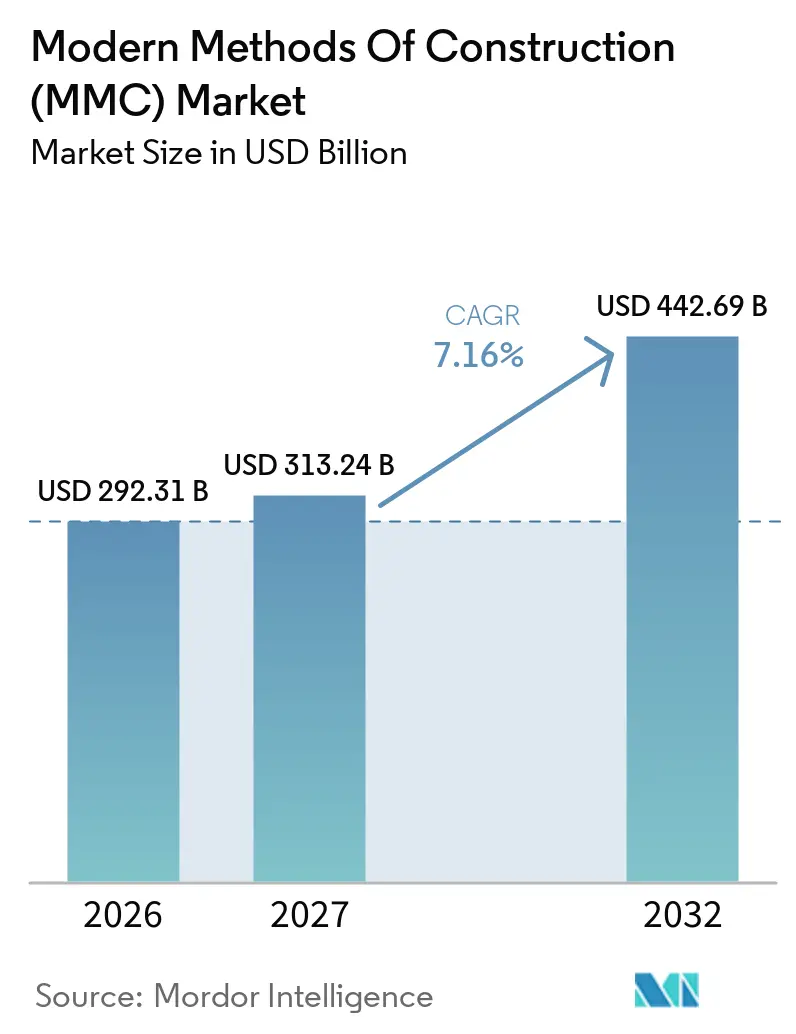
The Modern Methods Of Construction Market size is expected to grow from USD 292.31 billion in 2026 to USD 313.24 billion in 2027 and is forecast to reach USD 442.69 billion by 2032 at 7.16% CAGR over 2027-2032. The modern methods of construction market is supported by housing shortages, construction workforce constraints, and public procurement programs that favor factory-built delivery. Buyers are increasingly selecting construction methods during the project briefing stage, as panelized, volumetric, hybrid, and additive systems have distinct logistics, cost, and design requirements. Design for Manufacture and Assembly (DfMA) and building information modeling (BIM) are gaining importance in procurement processes because they link design activities with factory production. The market also benefits when public programs provide manufacturers with a more visible order pipeline. However, variations in permitting requirements, factory investment needs, and transportation limitations remain significant constraints, particularly in regions with less-developed procurement and inspection systems.
Key Report Takeaways
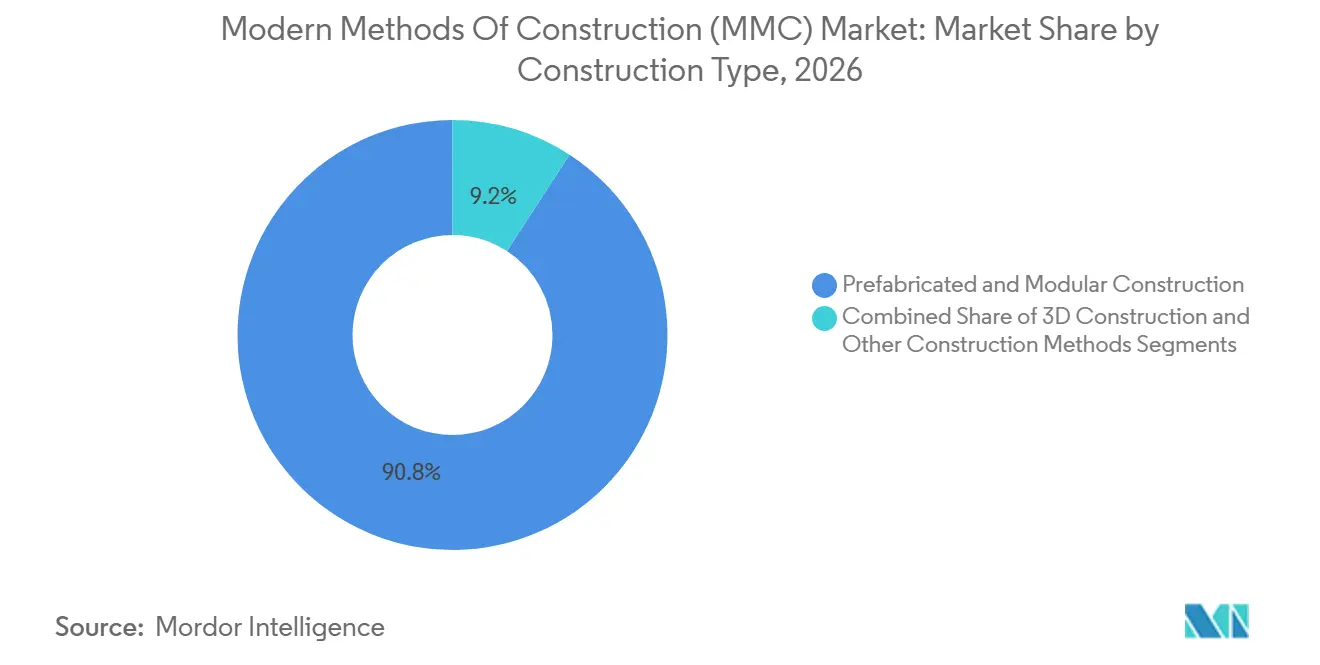
- By construction type, prefabricated and modular construction held 90.84% of the modern methods of construction market share in 2026, while 3D construction is forecast to grow at a 35.45% CAGR through 2032.
- By material type, concrete held 40.2% of the modern methods of construction market size in 2026, while timber is forecast to grow at a 7.89% CAGR through 2032.
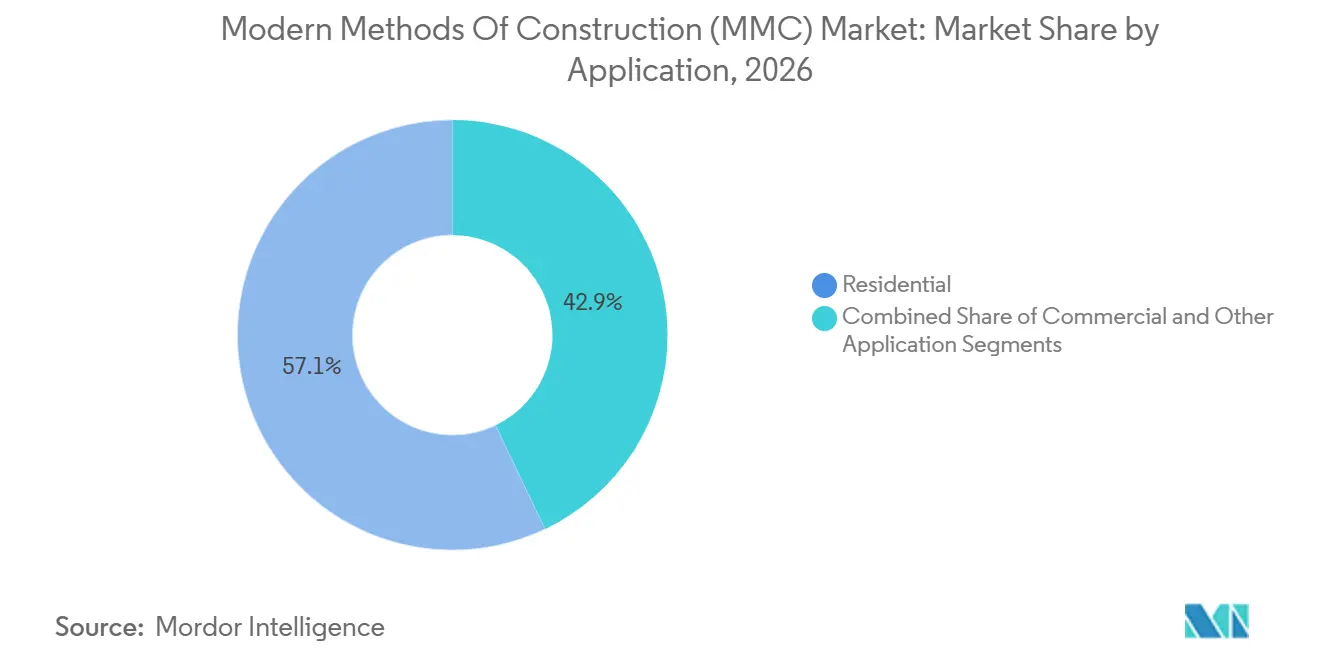
- By application, residential construction accounted for 57.1% of the modern methods of construction market size in 2026, while commercial construction is forecast to grow at an 8.01% CAGR through 2032.
- By geography, North America held 33.2% of the modern methods of construction market in 2026, while Asia-Pacific is forecast to grow at an 8.65% CAGR through 2032.
Note: Market numbers in this report are based on Mordor Intelligence's proprietary estimation framework, which combines nine months of actuals with Q4 projections for base year 2026.
Global Modern Methods Of Construction (MMC) Market Trends and Insights
Drivers Impact Analysis*
| Drivers | (~) % Impact on CAGR Forecast | Geographic Relevance | Impact Timeline |
|---|---|---|---|
| Housing Shortages and Urbanization Demand | +2.1% | Global, concentrated in North America, the United Kingdom, India, and Southeast Asia | Short term (≤ 2 years) |
| Construction Labor Scarcity and Productivity Gaps | +1.5% | Global, most acute in North America, Europe, and Japan | Short term (≤ 2 years) |
| Public Procurement and Affordable Housing Programs | +1.2% | North America, the United Kingdom, Australia, Ireland, and the Gulf Cooperation Council | Medium term (2-4 years) |
| Carbon and Energy-Efficiency Building Requirements | +0.9% | European Union, North America, Japan, and Australia | Medium term (2-4 years) |
| Factory-Based Quality, Schedule Certainty, and Waste Reduction | +0.7% | Global, strongest in high labor-cost markets | Long term (≥ 4 years) |
| Standardized BIM-to-Factory and DfMA Workflows | +0.5% | Europe, Asia-Pacific, and North America | Long term (≥ 4 years) |
| Source: Mordor Intelligence | |||
Housing Shortages and Urbanization-Driven Demand
Housing deficits are increasing the relevance of faster delivery methods in the modern methods of construction market. The U.S. Chamber of Commerce estimated a housing shortfall of 4.5 million to 4.7 million homes in 2025, highlighting the scale of unmet demand across the construction system[1]. In Ireland, the Department of Housing reported that 69% of homes in scheme developments were expected to use modern methods of construction between July and December 2025. Timber-frame systems accounted for 61% of these planned homes, linking public housing activity with factory-based production. China’s 2026 urban renewal plan called for the renovation of 115,000 older urban residential communities and the broader use of prefabricated interiors. Smaller infill sites and concerns about neighborhood disruption further support the adoption of methods that reduce on-site construction activity.
Construction Labor Scarcity and Site-Productivity Gaps
Labor availability remains a key factor driving developers and contractors to adopt off-site systems in the modern methods of construction market. Associated Builders and Contractors estimates that the U.S. construction industry will require 349,000 net new workers in 2026 and 456,000 in 2027[2]. The Associated General Contractors of America found that 92% of surveyed hiring firms were unable to fill open positions in 2025, while 45% experienced project delays due to labor shortages. Research published by the National Renewable Energy Laboratory in 2025 reported year-over-year growth in the adoption of panelized and modular construction. Factory-based work can provide year-round employment and reduce reliance on scarce on-site trades, giving cities an additional reason to support manufacturing capacity.
Public Procurement and Affordable-Housing Programs
Public procurement provides manufacturers with a clearer order pipeline, supporting investment in the modern methods of construction market. The United Kingdom’s Affordable Homes Programme requires 25% of funded housing projects to use modern methods of construction[3]. Ireland’s Housing Action Plan 2025–2030 targets the delivery of 300,000 new homes by 2030 and supports 3D volumetric pathfinder projects in Limerick and Wexford. Canada’s Build Canada Homes is expected to issue a request for information in February 2026 to establish a national registry of prequalified modern methods of construction suppliers. Germany is expected to secure EUR 4 billion in 2026 to accelerate housing delivery, prioritizing timber and modular construction approvals. Recurring procurement requirements offer greater value than single-project awards, as factories require dependable production volumes to operate efficiently.
Carbon, Energy-Efficiency, and ESG-Linked Building Requirements
Building regulations and reporting requirements increasingly favor documented material use and factory-based quality control in the modern methods of construction market. The recast Energy Performance of Buildings Directive requires European Union member states to transition building stocks toward very low energy performance. A 2025 peer-reviewed life cycle assessment study found that modular construction can reduce embodied carbon per square foot by up to 54% compared with traditional construction. China’s 2026 carbon-peaking assessment framework incorporates low-carbon construction indicators into local government evaluations. These requirements increase the importance of verified information on materials, energy performance, and waste during project selection. When appropriately designed and documented, factory-based production can provide more controlled records of these inputs.
Restraints Impact Analysis*
| Restraints | (~) % Impact on CAGR Forecast | Geographic Relevance | Impact Timeline |
|---|---|---|---|
| Fragmented Permitting, Certification, and Municipal Building Codes | -1.5% | United States, Canada, and parts of the Asia-Pacific | Short term (≤ 2 years) |
| High Upfront Factory Investment and Utilization Risk | -1% | Global, most severe in emerging and mid-tier markets | Medium term (2-4 years) |
| Transport, Craneage, and Last-Mile Logistics Constraints | -0.7% | Global, acute in dense urban and remote-site contexts | Medium term (2-4 years) |
| Limited Design Flexibility and Perceived Aesthetic Trade-Offs | -0.4% | Mature markets with high design-quality expectations | Long term (≥ 4 years) |
| Source: Mordor Intelligence | |||
Fragmented Permitting, Certification, and Municipal Building Codes
Different approval processes can reduce the time savings buyers expect from the modern methods of construction market. The National Institute of Building Sciences and the American Institute of Architects are expected to report in 2025 that off-site construction programs operate differently across 39 U.S. states. These differences include inspection authority, program scope, and the extent of local overrides. Colorado, Kentucky, Montana, Rhode Island, Texas, and Vermont are expected to enact reforms in 2025 to streamline parts of the process. However, manufacturers serving multiple states may still face overlapping compliance requirements. Canada’s CSA Group has identified duplicate inspections as a barrier to adopting prefabricated housing. Better coordination between factory and local inspections is essential for projects to retain their schedule advantage.
High Upfront Factory Investment and Utilization Risk
Factory production requires significant capital investment before unit sales begin, creating a major barrier in the modern methods of construction market. Cost pressures intensify when production schedules do not generate sufficient volume. Wesfarmers and Built Group are expected to form Built Living in May 2026, supported by up to USD 100 million in initial equity from Wesfarmers to develop a precast facility in Western Australia. This project illustrates the level of upfront funding required for a large-scale facility before it can serve a sustained market. The facility is intended to support medium- and high-rise residential projects and target production of more than 2,000 apartments annually. Demand commitments from public programs can reduce utilization risk by providing manufacturers with a clearer basis for planning staffing, material procurement, and capacity. Operators without such commitments must bear the risk that fixed factory costs will exceed the contribution generated by orders.
*Our forecasts treat driver/restraint impacts as directional, not additive. The impact forecasts reflect baseline growth, mix effects, and variable interactions.
Segment Analysis
By Construction Type: Prefabricated and Modular Systems Lead; 3D Construction Grows Quickly
Prefabricated and modular construction is expected to account for 90.84% of the total market value in 2026, underpinning the modern methods of construction market across residential, commercial, and infrastructure projects. Panelized systems include structural insulated panels, timber-frame panels, and light-gauge steel panels. These systems align with familiar on-site construction sequences and impose lower transportation requirements than fully volumetric modules. In Ireland, 69% of homes in scheme developments are expected to use modern methods of construction in the second half of 2025, with timber-frame construction accounting for 61% of these planned units. This trend supports continued demand for systems that combine factory-based production with conventional foundations and final on-site assembly. Volumetric units remain important for projects with repetitive layouts and tight delivery schedules that justify a higher level of off-site completion. Hybrid designs combine factory-built rooms or cores with panelized exterior elements when projects require greater design flexibility.
3D construction is projected to grow at a CAGR of 35.45% through 2032, the fastest growth rate among construction types in the modern methods of construction market. In February 2025, the International Code Council is expected to announce the first proposed ICC 1150 standard for 3D automated construction technology for concrete walls. The proposed standard is intended to provide developers and officials with a more defined framework for assessing concrete printing systems. Japan is expected to complete a two-story, 3D-printed reinforced-concrete residence in Miyagi Prefecture in November 2025. The building is expected to meet regular permit and completion inspection requirements. A 2025 study published by Springer Nature is expected to report material waste reductions of up to 60% and construction time reductions of up to 50% through 3D printing. Adoption will remain dependent on code acceptance, suitable project designs, and contractor capabilities. Consequently, the segment is expected to grow from a small base, while established modular systems continue to account for the majority of market spending.

By Material Type: Concrete Maintains Scale; Timber Gains from Low-Carbon Requirements
Concrete is projected to account for 40.2% of the modern methods of construction market in 2026. Precast concrete supports high-density and high-rise projects across the market. Its leading position also reflects mature supply chains for precast elements, coordinated design processes, quality control, and managed delivery. In August 2026, Elematic Group is expected to sign an agreement with Jiangxi Kesen Construction to establish a hollow-core slab plant in Guangdong. The plant is intended to produce 800,000 square meters of precast components annually for the Greater Bay Area. Glass serves prefabricated façade applications, while steel and light-gauge steel provide structural frames for modular buildings. Other materials, including autoclaved aerated concrete and composites, serve more specialized structural or insulation applications. Concrete is likely to remain central to projects shaped by infrastructure and high-rise requirements. In residential construction, timber is gaining attention as project teams place greater emphasis on lifecycle emissions.
Timber is forecast to grow at a CAGR of 7.89% through 2032, making it the fastest-growing material category in the modern methods of construction market. Engineered wood products, such as cross-laminated timber and glued laminated timber, expand timber’s application in larger and more complex buildings. A systematic review expected in 2025 is projected to find that replacing steel with timber can avoid 2.3 kilograms of carbon dioxide per kilogram of wood, while replacing concrete with timber can avoid 1.4 kilograms of carbon dioxide per kilogram of wood. Germany’s Federal Association of Prefabricated Construction is expected to report that prefabricated timber homes will represent 26.5% of approved single- and two-family homes in 2025. This share is projected to reach 26.7% in the first half of 2026. Corporate Scope 3 reporting requirements in Europe are increasing the relevance of verified material information in procurement decisions. Timber’s growth will depend on supply consistency, code acceptance, structural design capabilities, and project-level economics.
By Application: Residential Holds the Largest Position; Commercial Demand Broadens Use
Residential construction accounted for 57.1% of the modern methods of construction market share in 2026. Social housing programs, affordability pressures, and the need for faster project delivery support its leading position in the market. The United Kingdom’s Procurement for Housing framework requires a pre-manufactured value of more than 55% for Homes England-funded projects, embedding factory production into the contractual structure of eligible residential developments. Sekisui House plans to deliver 20,000 homes annually in the United States through its Shawood brand. The company reported that 96% of its new detached homes met or exceeded Japan’s Zero Energy Home standards in the fiscal year ended March 2025, demonstrating how standardized production can support consistent building performance. Single-family panelized and modular systems remain relevant in the United States, Canada, and Japan, while mid-rise volumetric residential buildings are gaining traction within the category.
Commercial construction is forecast to grow at a CAGR of 8.01% through 2032, the fastest rate among application categories. Data centers, hospitality facilities, pharmaceutical manufacturing plants, and mixed-use developments value factory precision and reliable project completion schedules. By the first quarter of 2026, CIMC Modular Building had provided manufacturing and delivery services for artificial intelligence and cloud computing projects with a combined computing capacity exceeding 300 megawatts. The company identified its Malaysia project as an ultra-large prefabricated modular data center. In January 2026, Modulex acquired a majority stake in Merit Industrialised Construction. Merit has experience in hospitals, life sciences, and cleanrooms—commercial environments that place a high value on controlled construction processes. Other applications include industrial, institutional, energy, and infrastructure projects, which benefit when factory production and site preparation proceed concurrently.
Geography Analysis
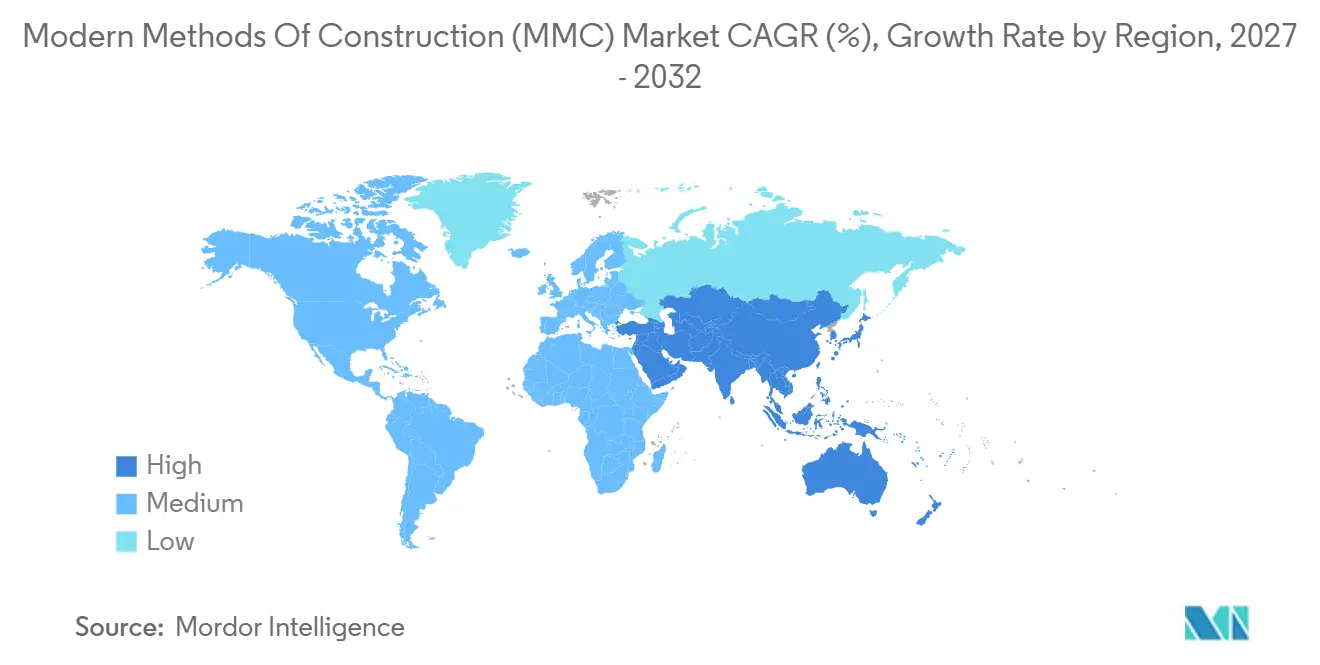
North America is projected to account for 33.2% of the global market value in 2026. The regional modern methods of construction market is shaped by housing shortages, workforce constraints, and extensive manufacturing networks. Canada is expected to launch Build Canada Homes in September 2025 and request information from modern methods of construction suppliers in February 2026. The program indicates that federal policy recognizes the need to develop domestic manufacturing capacity. Associated Builders and Contractors estimates that the U.S. construction industry will require 349,000 net new workers in 2026. State-level reforms in the United States, including Colorado’s changes to modular-home permitting and inspections, can reduce administrative burdens. Mexico is experiencing growth in industrial and residential modular construction activity, although its formal supply chain remains less developed than those in the United States and Canada.
Europe represents a significant share of the modern methods of construction market, with Germany, the United Kingdom, and France among the most active countries. Prefabricated timber homes in Germany accounted for 26.5% of approved single- and two-family homes in 2025 and are expected to reach 26.7% in the first half of 2026. Federal housing acceleration funding prioritizes faster approvals for timber and modular projects. The United Kingdom’s affordable housing program provides manufacturers with an institutional source of residential project demand. Laing O’Rourke is expected to expand its Explore Park facility in August 2026, supported by a GBP 17.2 billion order book. PORR and Moderna are expected to establish a joint venture in April 2026 to develop concrete prefabrication capabilities in Central and Eastern Europe. Environmental reporting requirements also increase the importance of verifiable material and project information for regional buyers.
Asia-Pacific is projected to grow at a CAGR of 8.65% through 2032, representing the fastest regional growth rate in the modern methods of construction market. China and India offer substantial housing demand, while Japan and South Korea have advanced industrialized construction capabilities. China’s prefabricated building exports are projected to reach USD 27.9 billion in the first half of 2026, compared with USD 19.3 billion in the first half of 2025. Wesfarmers and Built Living are developing manufacturing capacity in Australia for medium- and high-rise precast residential buildings. The facility is intended to support the construction of more than 2,000 apartments annually. SIBS and LINQ Modular are expected to announce a collaboration in February 2026 to deliver at least 1,500 modular units annually across projects in the Middle East. AG&P Industrial and Pragati Infra Solutions are also expected to announce a USD 100 million joint venture to establish an advanced modular engineering, procurement, and construction facility in Andhra Pradesh.
Competitive Landscape
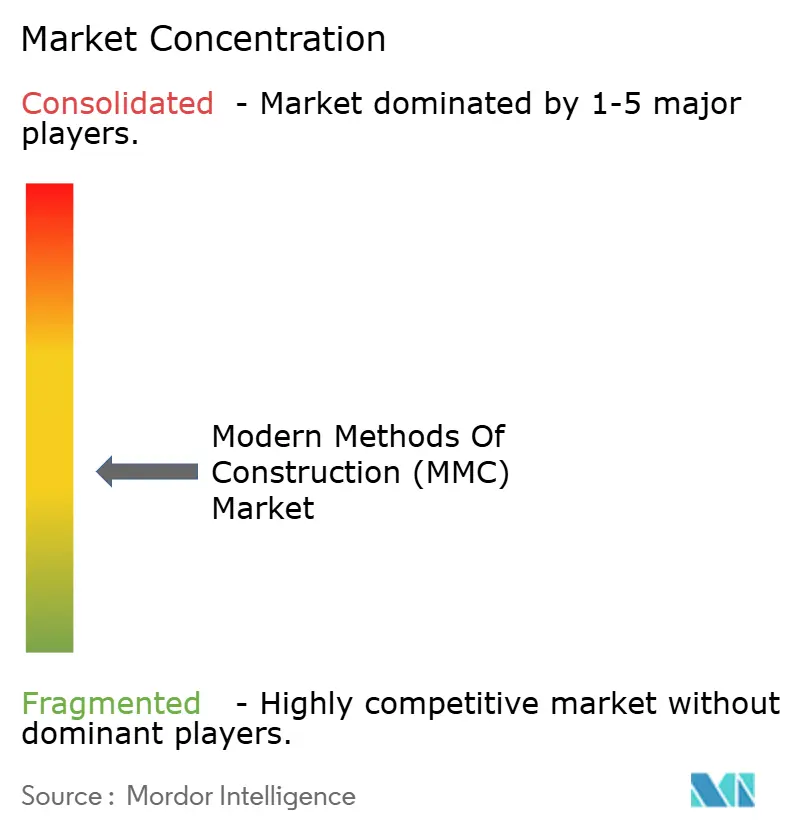
The global modern methods of construction market is moderately fragmented, with no single company accounting for more than a low single-digit share of total market value. Japanese industrialized homebuilders, large engineering and construction contractors, and dedicated modular platforms operate under different business models. Sekisui House and Daiwa House integrate land development, factory production, and after-sales services, while applying elements of this model in overseas markets. Major contractors, including Skanska, Laing O’Rourke, Bouygues Construction, Balfour Beatty, Bechtel, and Fluor, deploy modular capabilities as part of their broader project delivery operations. Dedicated modular suppliers, such as ATCO, WillScot Holdings, Modulaire Group, CIMC Modular Building, Red Sea International, Wernick Group, and Guerdon, focus on capacity utilization, asset deployment, and geographic expansion. This mix of companies makes factory capacity, customer relationships, project execution capabilities, and regulatory knowledge key competitive factors. It also creates significant variations in opportunities across building types and regions.
Companies are expanding manufacturing capacity and pursuing acquisitions to strengthen project coverage. MODUS Structures is expected to complete its acquisition of ROC Modular in September 2026, combining institutional and government-sector experience with affordable housing and multifamily capabilities in Canada. Everus Construction Group is expected to complete its USD 295 million acquisition of Epsilon Industries in September 2026 to expand its modular mechanical and electrical infrastructure systems capabilities. Laing O’Rourke plans to add 3,200 square meters of off-site manufacturing capacity at Explore Park by August 2026. These initiatives demonstrate how companies are building scale through both owned manufacturing assets and specialized capabilities. They also reflect demand from data centers, advanced manufacturing, health care, housing, and infrastructure projects. Companies with visible project pipelines are better positioned to support the fixed costs associated with factory operations.
Technology and compliance are becoming increasingly important differentiators in the modern methods of construction market. Sekisui House uses artificial intelligence-assisted quality control in its Japanese production lines and is transferring this approach to its operations in the United States and the Association of Southeast Asian Nations. The company has reported that the approach reduced construction timelines by 30%. Modular data centers and mid-rise residential projects remain segments in which manufacturing supply and demand are not fully aligned. LINQ Modular’s Dubai Municipality license for modular buildings of up to ground floor plus six floors demonstrates how regulatory readiness can enable entry into new markets. European Technical Assessment certification is also becoming increasingly important for market access in the European Union. Smaller companies, including Guerdon, KLEUSBERG, and Clayton Homes, can maintain regional positions through local customer relationships and proximity to project sites.
Modern Methods Of Construction (MMC) Industry Leaders
-
Sekisui House, Ltd.
-
Daiwa House Industry Co., Ltd.
-
Skanska AB
-
Laing O’Rourke
-
ATCO Ltd.
- *Disclaimer: Major Players sorted in no particular order
Recent Industry Developments
- September 2026: MODUS Structures Inc. completed the acquisition of ROC Modular Inc. (Canada), creating one of Canada's largest modular builders with 460-plus employees and approximately 260,000 sq ft of manufacturing space across three Alberta facilities, combining MODUS's institutional and government experience with ROC's affordable housing and multi-family capabilities.
- August 2026: SEKISUI Canada Modular Solutions Inc. announced a CAD 15 million investment to establish a Burlington, Ontario manufacturing hub producing steel-frame modular units for residential, educational, and commercial sectors, drawing on over 50 years of Japanese modular expertise.
- May 2026: Wesfarmers and Built Group established the 50:50 Built Living joint venture, committing up to USD 100 million in Wesfarmers equity for Australia's first advanced manufacturing facility for medium- and high-rise residential precast concrete in Western Australia, targeting 2,000-plus apartments annually at approximately 20% lower cost and 50% faster delivery than conventional construction.
Global Modern Methods Of Construction (MMC) Market Report Scope
| Prefabricated & Modular Construction | Panelized Systems | Structural Insulated Panels (SIPs) |
| Timber / Wood Frame Panels | ||
| Light Gauge Steel (LGS) Panels | ||
| Others | ||
| Volumetric Modules | Steel-Framed Volumetric Modules | |
| Timber-Framed Volumetric Modules | ||
| Concrete (Precast/Monolithic) Volumetric Modules | ||
| Others | ||
| Hybrid Modular Construction | ||
| 3D Construction | Extrusion Method | |
| Power Bonding Method | ||
| Others | ||
| Other Construction Methods | ||
| Concrete |
| Glass |
| Metal |
| Timber |
| Other Material Type |
| Residential |
| Commercial |
| Other Application (Industrial, Institutional, Energy and Utilities, Infrastructure) |
| North America | United States | |
| Canada | ||
| Mexico | ||
| Europe | Germany | |
| United Kingdom | ||
| France | ||
| Italy | ||
| Spain | ||
| Russia | ||
| Rest of Europe | ||
| Asia - Pacific | China | |
| India | ||
| Japan | ||
| South Korea | ||
| Australia | ||
| Rest of Asia - Pacific | ||
| South America | Brazil | |
| Argentina | ||
| Chile | ||
| Peru | ||
| Rest of South America | ||
| Middle East and Africa | Middle East | United Arab Emirates |
| Saudi Arabia | ||
| Turkey | ||
| Rest of Middle East | ||
| Africa | South Africa | |
| Nigeria | ||
| Rest of Africa | ||
| By Construction Type | Prefabricated & Modular Construction | Panelized Systems | Structural Insulated Panels (SIPs) |
| Timber / Wood Frame Panels | |||
| Light Gauge Steel (LGS) Panels | |||
| Others | |||
| Volumetric Modules | Steel-Framed Volumetric Modules | ||
| Timber-Framed Volumetric Modules | |||
| Concrete (Precast/Monolithic) Volumetric Modules | |||
| Others | |||
| Hybrid Modular Construction | |||
| 3D Construction | Extrusion Method | ||
| Power Bonding Method | |||
| Others | |||
| Other Construction Methods | |||
| By Material Type | Concrete | ||
| Glass | |||
| Metal | |||
| Timber | |||
| Other Material Type | |||
| By Application | Residential | ||
| Commercial | |||
| Other Application (Industrial, Institutional, Energy and Utilities, Infrastructure) | |||
| By Geography | North America | United States | |
| Canada | |||
| Mexico | |||
| Europe | Germany | ||
| United Kingdom | |||
| France | |||
| Italy | |||
| Spain | |||
| Russia | |||
| Rest of Europe | |||
| Asia - Pacific | China | ||
| India | |||
| Japan | |||
| South Korea | |||
| Australia | |||
| Rest of Asia - Pacific | |||
| South America | Brazil | ||
| Argentina | |||
| Chile | |||
| Peru | |||
| Rest of South America | |||
| Middle East and Africa | Middle East | United Arab Emirates | |
| Saudi Arabia | |||
| Turkey | |||
| Rest of Middle East | |||
| Africa | South Africa | ||
| Nigeria | |||
| Rest of Africa | |||
Key Questions Answered in the Report
What is the forecast value of modern methods of construction by 2032?
The sector is projected to reach USD 442.7 billion by 2032, expanding at a 7.16% CAGR from 2027.
Which construction type holds the largest share?
Prefabricated and modular construction leads with 90.85% of value in 2026, while 3D construction has the fastest forecast growth at 35.45% CAGR.
Why are off-site building systems gaining adoption?
Housing shortages, labor constraints, public procurement requirements, and the need for documented energy and material performance are key factors.
Which material is growing fastest in factory-built construction?
Timber is forecast to grow at a 7.89% CAGR through 2032, supported by engineered wood capability and carbon reporting requirements.
Which application leads to demand for modern methods of construction?
Residential construction holds 57.1% of the value in 2026, supported by social housing, affordability needs, and faster delivery requirements.
Which region is forecast to grow fastest?
Asia-Pacific is forecast to expand at an 8.65% CAGR through 2032, supported by housing demand and established manufacturing capability.