
Mobile Operating Tables Market Size and Share
Market Overview
| Study Period | 2020 - 2031 |
|---|---|
| Market Size (2026) | USD 1.42 Billion |
| Market Size (2031) | USD 1.74 Billion |
| Growth Rate (2026 - 2031) | 4.11 % |
| Fastest Growing Market | Asia-Pacific |
| Largest Market | North America |
| Market Concentration | Medium |
Major Players *Disclaimer: Major Players sorted in no particular order Image © Mordor Intelligence. Reuse requires attribution under CC BY 4.0. | |
Mobile Operating Tables Market Analysis by Mordor Intelligence
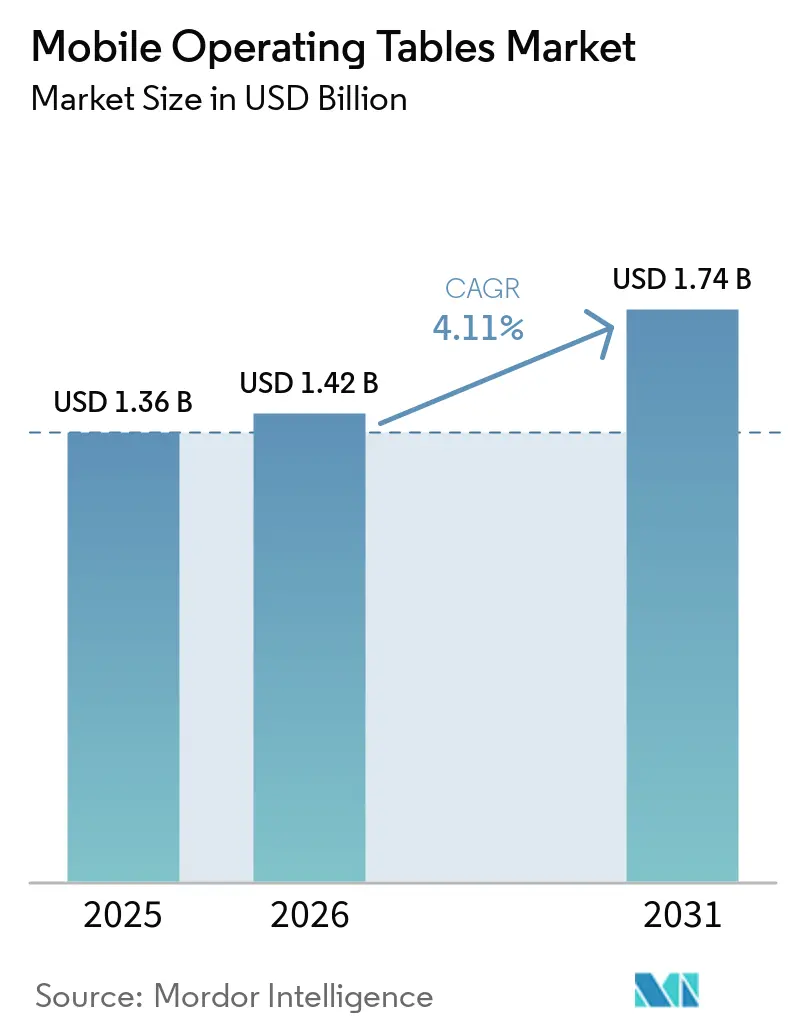
The Mobile Operating Tables Market size is expected to increase from USD 1.36 billion in 2025 to USD 1.42 billion in 2026 and reach USD 1.74 billion by 2031, growing at a CAGR of 4.11% over 2026-2031.
The mobile operating tables market is supported by replacement demand in hospitals and by the expansion of outpatient surgical capacity. Demand is also moving toward tables that support robotic procedures, imaging access, and more controlled patient positioning. Suppliers are responding with connected functions that provide equipment-status information and service support. Hospital buyers increasingly evaluate the table as part of a wider operating-room workflow instead of as a stand-alone purchase. This approach favors suppliers that can combine table design, clinical compatibility, training, and service access.
Key Report Takeaways
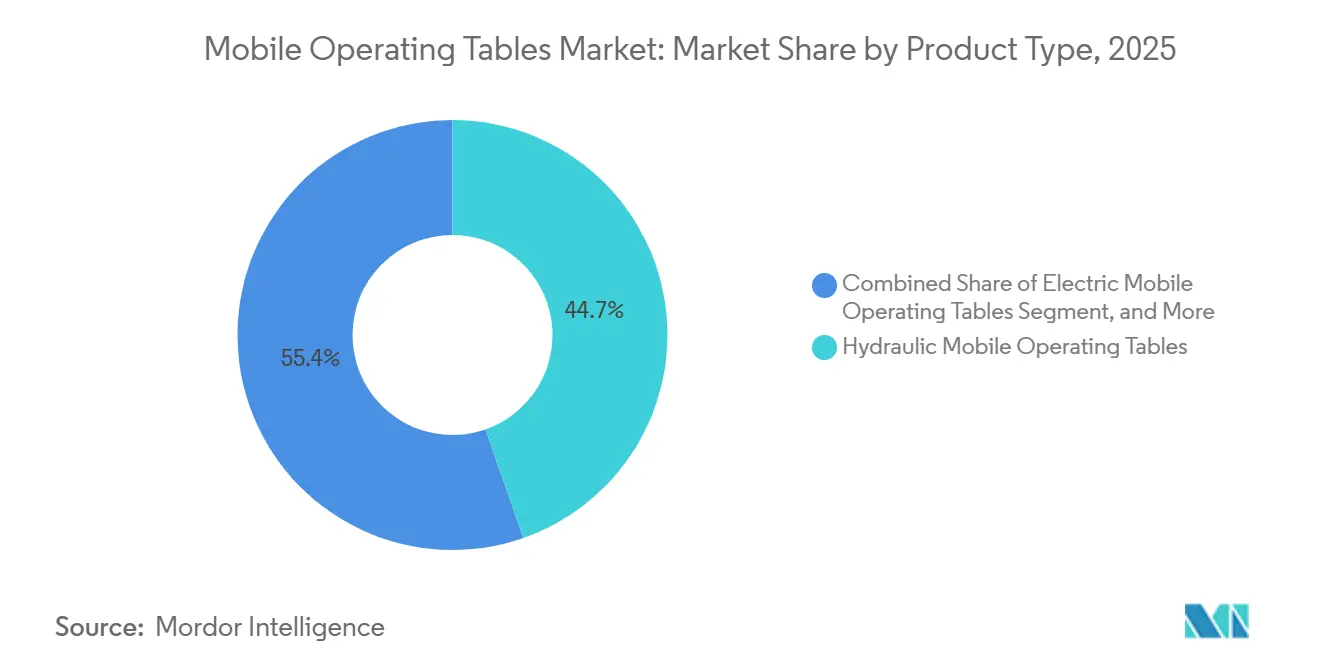
- By product type, hydraulic tables held 44.65% revenue share in 2025, while electro-hydraulic tables are forecast to expand at a 6.43% CAGR through 2031.
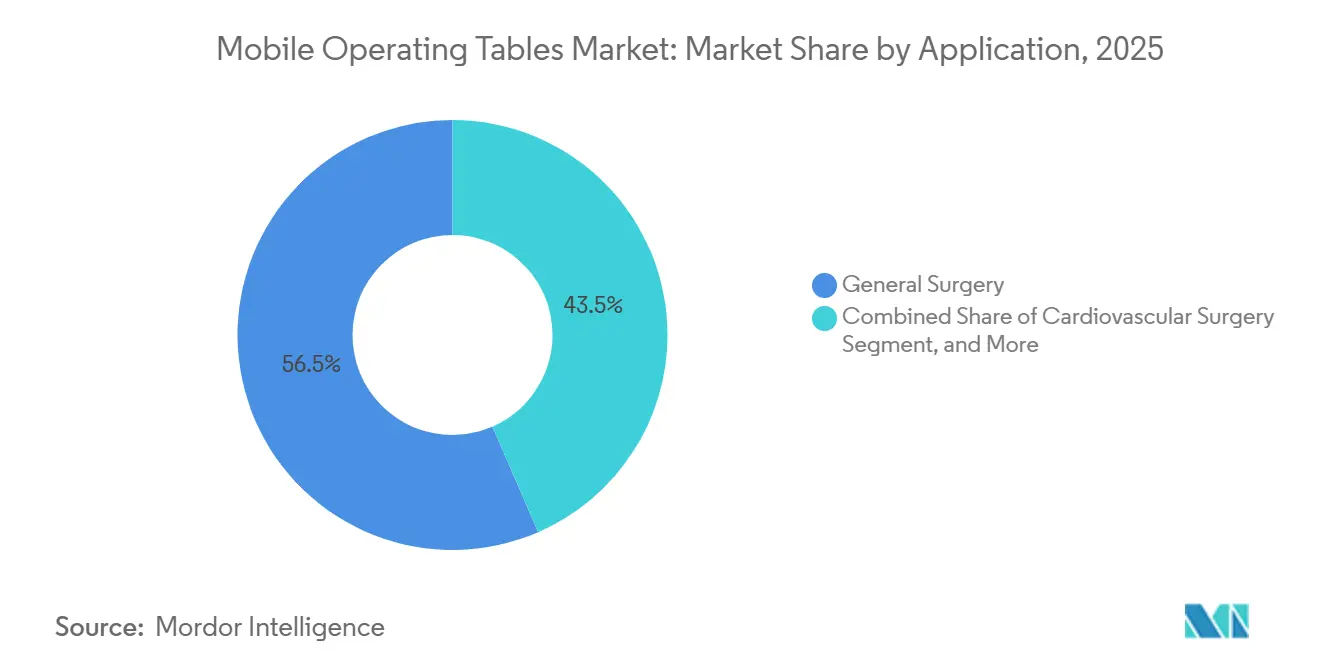
- By application, general surgery held 56.53% revenue share in 2025, while gynecological surgery is forecast to expand at a 7.82% CAGR through 2031.
- By end user, hospitals held 61.76% revenue share in 2025, while ambulatory surgical centers are forecast to expand at a 7.54% CAGR through 2031.
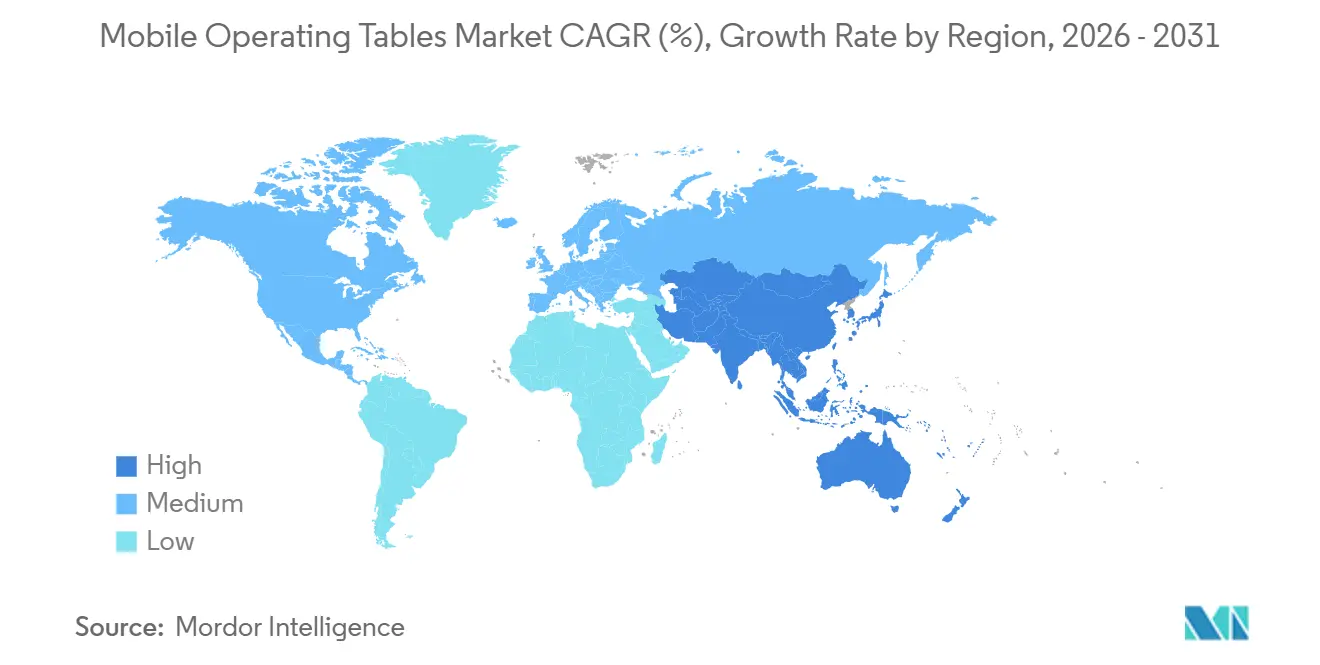
- By geography, North America held 40.43% revenue share in 2025, while Asia-Pacific is forecast to expand at a 5.87% CAGR through 2031.
Note: Market size and forecast figures in this report are generated using Mordor Intelligence’s proprietary estimation framework, updated with the latest available data and insights as of January 2026.
Global Mobile Operating Tables Market Trends and Insights
Drivers Impact Analysis*
| Driver | (~) % Impact on CAGR Forecast | Geographic Relevance | Impact Timeline |
|---|---|---|---|
| Rising Surgical Volumes and Unmet Surgical Demand | +1.70% | Global | Short term (≤ 2 years) |
| Growth of Minimally Invasive, Image-Guided and Robotic Surgery | +1.20% | Global, led by North America and Europe | Medium term (2-4 years) |
| Expansion of Ambulatory Surgical Centers | +0.80% | North America and Asia-Pacific | Medium term (2-4 years) |
| Hospital Modernization and Replacement of Legacy Tables | +0.60% | Global, led by North America and Europe | Short term (≤ 2 years) |
| Battery-Powered Mobility for Power-Constrained Operating Rooms | +0.40% | Asia-Pacific and Middle East and Africa | Medium term (2-4 years) |
| Connected-Table Service Telemetry and Predictive Maintenance | +0.30% | North America and Europe | Long term (≥ 4 years) |
| Source: Mordor Intelligence | |||
Rising Surgical Volumes and Unmet Surgical Demand
Surgical demand is increasing the need for adaptable operating-room capacity. Hospitals that manage several surgical specialties need equipment that can support different patient positions and clinical workflows. Mobile tables can be moved between rooms when scheduling priorities change. This supports more flexible use of installed surgical space. New capacity projects also create opportunities to replace equipment that is nearing the end of its useful life. The Mobile operating tables market benefits when providers seek to improve room availability without building separate specialty facilities.
Growth of Minimally Invasive, Image-Guided, and Robotic Surgery
Robotic and image-guided surgery is raising the functional requirements for operating tables. An international expert consensus published in 2025 identified operating-table motion knowledge and position optimization as important competencies for robotic surgical teams. A 2026 prospective hysterectomy study assessed da Vinci X, Versius, and Hugo robotic systems in minimally invasive procedures. These procedures require reliable access, stable positioning, and space for robotic docking. Product specifications, therefore, matter more when a hospital invests in a robotic platform. The mobile operating tables market gains from tables that can adapt to the positioning needs of minimally invasive and robotic surgery.
Expansion of Ambulatory Surgical Centers
Ambulatory surgical centers are increasing demand for operating-room equipment outside traditional hospital sites. These providers emphasize room turnover, practical layouts, and equipment that can serve more than 1 procedure type. Getinge and Zimmer Biomet announced a partnership in July 2025 to provide Getinge operating-room capital products to Zimmer Biomet ambulatory surgical center customers. The offering combines surgical equipment, operating-room integration, and lighting with implants and surgical robotics. This model illustrates why equipment vendors are combining products around clinical workflows. The mobile operating tables market can benefit when outpatient buyers use integrated procurement programs.
Hospital Modernization and Replacement of Legacy Tables
Hospital modernization supports demand for new table systems and related operating-room equipment. Replacement decisions often occur when hospitals renovate rooms, install new imaging equipment, or add robotics capability. Table selection can then be linked to the layout and future use of the entire surgical suite. UC Davis Health planned a USD 107.3 million project to modernize 24 end-of-life operating rooms in 2024, based on materials submitted to the University of California Board of Regents[1]University of California Board of Regents, “Medical Campus Operating Room Integration Modernization Project,” University of California, universityofcalifornia.edu. Such projects show the scale at which clinical infrastructure can enter a replacement cycle. The mobile operating tables market is supported when hospitals coordinate capital equipment decisions with long-term clinical planning.
Restraints Impact Analysis*
| Restraint | (~) % Impact on CAGR Forecast | Geographic Relevance | Impact Timeline |
|---|---|---|---|
| High Capital Cost of Advanced Mobile Operating Tables | -0.80% | Global, most acute in Asia-Pacific and South America | Short term (≤ 2 years) |
| Shortage of Trained Operating-Room Personnel | -0.50 | North America and Europe | Short term (≤ 2 years) |
| Actuator, Controller and Electronics Lead-Time Exposure | -0.30 | Global, concentrated in Asia-Pacific supply chains | Medium term (2-4 years) |
| Reprocessing, Battery and Sensor Complexity | -0.20% | Global | Medium term (2-4 years) |
| Source: Mordor Intelligence | |||
High Capital Cost of Advanced Mobile Operating Tables
Advanced tables require a higher capital commitment than basic hydraulic models. Imaging compatibility, powered movements, programmable positions, and connected functions add to product complexity. Providers with limited budgets may retain older equipment for longer periods. The pressure is stronger when buyers depend on imported equipment and lack financing options. This can preserve demand for established hydraulic and manual systems in lower-budget settings. The mobile operating tables market, therefore, has different upgrade rates across hospital tiers and geographic markets.
Shortage of Trained Operating-Room Personnel
Operating-room staffing constraints can reduce room utilization and delay equipment replacement. The Health Resources and Services Administration projected a U.S. shortage of 267,330 full-time registered nurses by 2028, according to the American Association of Colleges of Nursing. The same source reported an 8.6% U.S. acute-care registered-nurse vacancy rate in 2026[2]American Association of Colleges of Nursing, “Nursing Shortage Fact Sheet,” AACN, aacnnursing.org. Underused rooms can make buyers postpone spending on nonessential capital equipment. Staffing pressure can also increase the value placed on equipment that is simple to position, monitor, and maintain. The mobile operating tables market faces slower replacement decisions where workforce gaps persist.
*Our forecasts treat driver/restraint impacts as directional, not additive. The impact forecasts reflect baseline growth, mix effects, and variable interactions.
Segment Analysis
By Product Type: Hydraulic Tables Lead While Electro-Hydraulic Models Drive New Requirements
Hydraulic tables held 44.65% of the mobile operating tables market share in 2025. Their position reflects reliability in high-load settings and a substantial installed base at established hospitals. These tables also have lower maintenance complexity than more advanced powered systems. Many facilities retain them because they remain appropriate for routine surgical procedures. Their continued use reflects replacement timing as well as clinical preference. This provides a stable base for the mobile operating tables industry.
Electro-hydraulic tables are forecast to expand at a 6.43% CAGR from 2026 to 2031. Their value proposition includes controlled powered movement and compatibility with advanced surgical workflows. Getinge describes the Maquet Corin as a guided mobile surgical table with simultaneous multidirectional adjustments and capacity for up to 30 personalized user sequences. The product offers a load capacity of up to 545 kg and can provide Trendelenburg or reverse Trendelenburg adjustment of up to 45 degrees. Electric tables are also relevant to ambulatory surgery centers that need compact powered positioning. Manual, pneumatic, and hybrid products remain useful where simplicity, budget, and power-resilience needs guide buying decisions.



By Application: General Surgery Leads While Gynecology Grows Fastest
General surgery accounted for 56.53% of the mobile operating tables market size by application in 2025. The application includes a large volume of procedures with varying patient-positioning requirements. Hospitals use these tables across standard, laparoscopic, and increasingly robotic procedures. This keeps versatility important even in what may appear to be a mature application. Orthopedic and trauma surgery also requires stable patient support and access to imaging equipment. The mobile operating tables market share held by general surgery reflects the broad use of tables across these recurring surgical workflows.
Gynecological surgery is forecast to expand at a 7.82% CAGR from 2026 to 2031. Robotic hysterectomy procedures require careful patient positioning, including Trendelenburg positioning when clinically appropriate. The 2026 COMPAR-HYST study compares robotic approaches for minimally invasive hysterectomy and keeps workflow standardization relevant to these procedures[3]Authors of the COMPAR-HYST Study, “Da Vinci X, Versius, and Hugo RAS in Minimally Invasive Robotic-Assisted Hysterectomy,” Surgical Endoscopy, springer.com. The operating table must support the clinical team's access requirements during docking and surgery. Cardiovascular, neurological, and urological applications also require different levels of radiolucency, tilt range, and lateral stability. ENT, bariatric, and ophthalmology procedures extend table use beyond conventional operating-room settings.
By End User: Hospitals Retain Scale While Ambulatory Surgical Centers Expand Faster
Hospitals held 61.76% of the mobile operating tables market size by end user in 2025. High-acuity procedures and complex surgical cases remain concentrated in hospital facilities. Academic centers and large community hospitals are important buyers of fully featured table systems. Their operating rooms often need equipment that works with imaging, robotics, and specialty accessories. Regional hospitals can form an important market for mid-tier electro-hydraulic products. These needs sustain hospital leadership in the mobile operating tables industry.
Ambulatory surgical centers are forecast to expand at a 7.54% CAGR from 2026 to 2031. Buyers in this setting prioritize efficient workflows, space use, and the ability to serve outpatient procedures. Getinge states that more than 22.5 million procedures are performed in U.S. ambulatory surgical centers each year. The partnership with Zimmer Biomet shows how suppliers can target this segment through a combined equipment offering. Specialty clinics and diagnostic centers form smaller end-user groups that can use modular and lower-cost table configurations. Pain management, interventional radiology, and outpatient orthopedics are relevant settings for this equipment.
Geography Analysis
North America held 40.43% of the mobile operating tables market share in 2025. The region combines high surgical spending, a mature ambulatory surgery center system, and continued investment in operating-room technology. Hospitals in the United States are significant buyers of connected, imaging-compatible, and specialty table configurations. Established suppliers benefit from service coverage and existing clinical relationships. The mobile operating tables market in North America also benefits from replacement demand as health systems renovate operating rooms.
Outpatient care is an important part of regional procurement patterns. Getinge and Zimmer Biomet began their ambulatory surgery center partnership in the United States, with plans to offer the combined portfolio in additional regions. The arrangement responds to an outpatient setting where room efficiency and procedure-specific equipment packages are important. Canada and Mexico also contribute to demand as outpatient surgery capacity develops. Suppliers must meet the clinical, service, and regulatory expectations of providers throughout the region.
Europe remains an important region for technically advanced surgical equipment. Buyers place emphasis on ergonomic design, product durability, and clinical customization. The European regulatory environment favors companies with established quality and documentation systems. European manufacturers retain positions in specialty applications and regional hospital accounts. The region also supplies advanced products to other markets through established distribution networks. The mobile operating tables market is supported by modernization programs in large public and private hospital systems.
Asia-Pacific is forecast to expand at a 5.87% CAGR from 2026 to 2031. Hospital construction, healthcare capacity additions, and equipment modernization support demand across the region. China and India are important because of their expanding surgical infrastructure. Japan, South Korea, and Australia support demand for higher-specification equipment in robotic and image-guided procedures. Getinge launched the Maquet Corin table, Maquet Ezea light, and Fluoptics imaging solutions in Singapore in 2024. The launch presented the Corin as Getinge's first connected operating table and included service data and usage statistics functions. Price sensitivity and import costs can still affect purchase timing in parts of Asia-Pacific, the Middle East and Africa, and South America.

Competitive Landscape
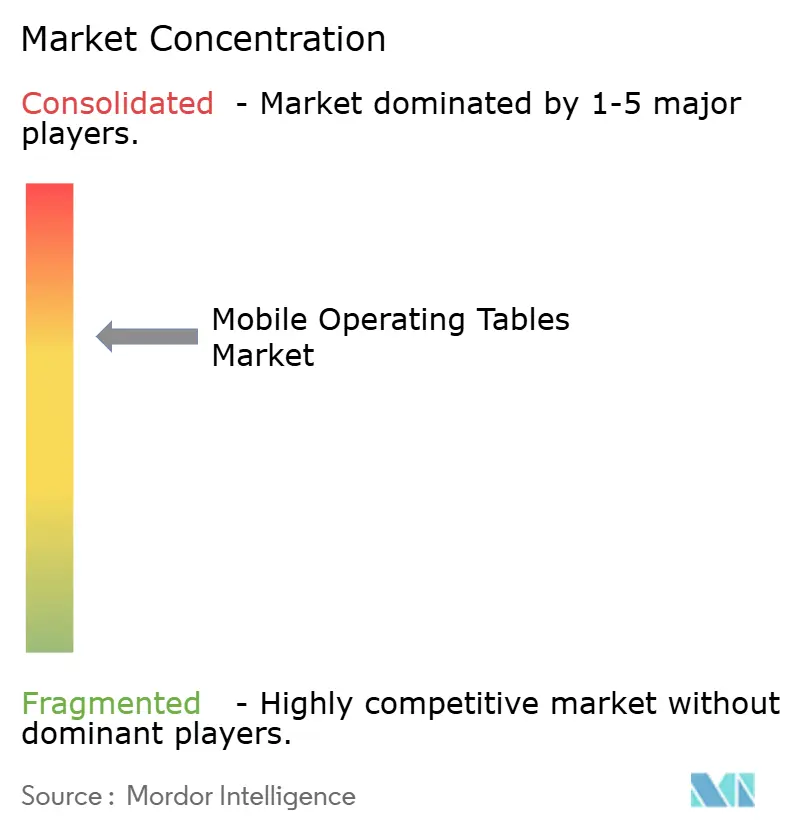
The mobile operating tables market is moderately concentrated. Getinge, Stryker, and STERIS have broad surgical portfolios and strong access to major hospital accounts. Getinge competes through connected table functions and operating-room workflow capabilities. Its Maquet Corin table provides collision detection, overload detection, and tipping prevention functions. These features address equipment protection, patient safety, and day-to-day usability. The company also provides FleetView functions for service data, battery status, maintenance scheduling, and remote troubleshooting.
Stryker competes through patient-positioning systems and imaging-compatible operating-room products. STERIS focuses on infection-control integration, durable equipment, and high-throughput surgical settings. European specialists such as Merivaara, Lojer, medifa-hesse, Famed Zywiec, Alvo Medical, and UFSK-International offer specialty configurations and regional clinical support. Their role is strongest where buyers need clinical customization without the pricing of global suppliers. Chinese suppliers are increasingly relevant in price-sensitive export markets. The mobile operating tables market remains open to suppliers that can balance functional performance with accessible pricing and service coverage.
Baxter presented the AAT XR mobile surgical table for spine procedures at the AORN Global Surgical Conference in April 2026. Baxter states that the product can rotate 180 degrees without removing the patient and has a maximum patient weight capacity of 650 lb with the flat top installed. It also has controls at the head column and on a remote control. Getinge's ambulatory surgery center alliance with Zimmer Biomet is a second example of a portfolio strategy. Getinge's connected-table service offering is a third example of competition based on service access as well as hardware. The mobile operating tables market will favor suppliers that can support clinical workflow, maintenance, and equipment availability together.
Mobile Operating Tables Industry Leaders
STERIS Corporation
Getinge AB
Baxter International Inc.
Mizuho OSI, Inc.
Stryker
- *Disclaimer: Major Players sorted in no particular order

Recent Industry Developments
- April 2026: Baxter showcased the AAT XR mobile surgical table for spine procedures at the AORN Global Surgical Conference. The table supports 180-degree rotation without patient removal, a maximum weight capacity of 650 lb with the flat top installed, a lithium-ion battery, and a minimum height of 22 inches.
- July 2025: Getinge and Zimmer Biomet announced a strategic partnership for ambulatory surgery centers. Zimmer Biomet will distribute Getinge operating-room capital products, including surgical equipment, operating-room integration, and lighting, to its ambulatory surgery center customers.
- April 2024: Getinge South Asia Pacific introduced the Maquet Corin operating table, the Maquet Ezea operating light, and Fluoptics fluorescence imaging solutions in Singapore. Getinge described Corin as its first connected operating table.


Global Mobile Operating Tables Market Report Scope
According to the report’s scope, mobile operating tables are adjustable, portable surgical tables equipped with wheels for easy mobility, used to facilitate various surgical procedures in different locations within healthcare facilities. They offer versatile positioning options to accommodate different surgical needs.
The mobile operating tables market is segmented into product type, application, end user, and geography. By product type, the market is segmented into hydraulic mobile operating tables, electric mobile operating tables, electro-hydraulic mobile operating tables, manual mobile operating tables, pneumatic mobile operating tables, and hybrid mobile operating tables. By application, the market is segmented into general surgery, orthopedic and trauma surgery, cardiovascular surgery, neurosurgery, gynecological surgery, urological surgery, and other applications. By end user, the market is segmented into hospitals, ambulatory surgical centers, specialty clinics, diagnostic centers, and other end users. By geography, the market is segmented into North America, Europe, Asia-Pacific, the Middle East and Africa, and South America. The report also covers the estimated market sizes and trends for 17 countries across major regions globally. The report offers values (USD) for all the above segments.
| Hydraulic Mobile Operating Tables |
| Electric Mobile Operating Tables |
| Electro-Hydraulic Mobile Operating Tables |
| Manual Mobile Operating Tables |
| Pneumatic Mobile Operating Tables |
| Hybrid Mobile Operating Tables |
| General Surgery |
| Orthopedic and Trauma Surgery |
| Cardiovascular Surgery |
| Neurosurgery |
| Gynecological Surgery |
| Urological Surgery |
| Other Applications |
| Hospitals |
| Ambulatory Surgical Centers |
| Specialty Clinics |
| Diagnostic Centers |
| Other End Users |
| North America | United States |
| Canada | |
| Mexico | |
| Europe | Germany |
| United Kingdom | |
| France | |
| Italy | |
| Spain | |
| Rest of Europe | |
| Asia-Pacific | China |
| Japan | |
| India | |
| Australia | |
| South Korea | |
| Rest of Asia-Pacific | |
| Middle East and Africa | GCC |
| South Africa | |
| Rest of Middle East and Africa | |
| South America | Brazil |
| Argentina | |
| Rest of South America |
| By Product Type | Hydraulic Mobile Operating Tables | |
| Electric Mobile Operating Tables | ||
| Electro-Hydraulic Mobile Operating Tables | ||
| Manual Mobile Operating Tables | ||
| Pneumatic Mobile Operating Tables | ||
| Hybrid Mobile Operating Tables | ||
| By Application | General Surgery | |
| Orthopedic and Trauma Surgery | ||
| Cardiovascular Surgery | ||
| Neurosurgery | ||
| Gynecological Surgery | ||
| Urological Surgery | ||
| Other Applications | ||
| By End User | Hospitals | |
| Ambulatory Surgical Centers | ||
| Specialty Clinics | ||
| Diagnostic Centers | ||
| Other End Users | ||
| Geography | North America | United States |
| Canada | ||
| Mexico | ||
| Europe | Germany | |
| United Kingdom | ||
| France | ||
| Italy | ||
| Spain | ||
| Rest of Europe | ||
| Asia-Pacific | China | |
| Japan | ||
| India | ||
| Australia | ||
| South Korea | ||
| Rest of Asia-Pacific | ||
| Middle East and Africa | GCC | |
| South Africa | ||
| Rest of Middle East and Africa | ||
| South America | Brazil | |
| Argentina | ||
| Rest of South America | ||


Key Questions Answered in the Report
What is the outlook for mobile operating tables through 2031?
The mobile operating tables market is projected to rise from USD 1.42 billion in 2026 to USD 1.74 billion by 2031, at a 4.11% CAGR.
Which product type has the largest share?
Hydraulic tables held 44.65% revenue share in 2025. Their reliability and large installed base continue to support demand.
Which application is growing fastest?
Gynecological surgery is forecast to expand at a 7.82% CAGR through 2031, supported by the positioning needs of robotic procedures.
Why are robotic procedures important for table suppliers?
Robotic teams need controlled positioning, reliable access, and operating-room layouts that support docking and clinical workflows.
What role do ambulatory surgical centers play?
Ambulatory surgical centers are the fastest-growing end-user segment at a 7.54% CAGR and favor efficient, flexible equipment configurations.
Which region is growing fastest?
Asia-Pacific is forecast to expand at a 5.87% CAGR through 2031, supported by healthcare capacity growth and operating-room modernization.
Page last updated on:





