
Mobile DRAM Market Size and Share
Market Overview
| Study Period | 2020 - 2031 |
|---|---|
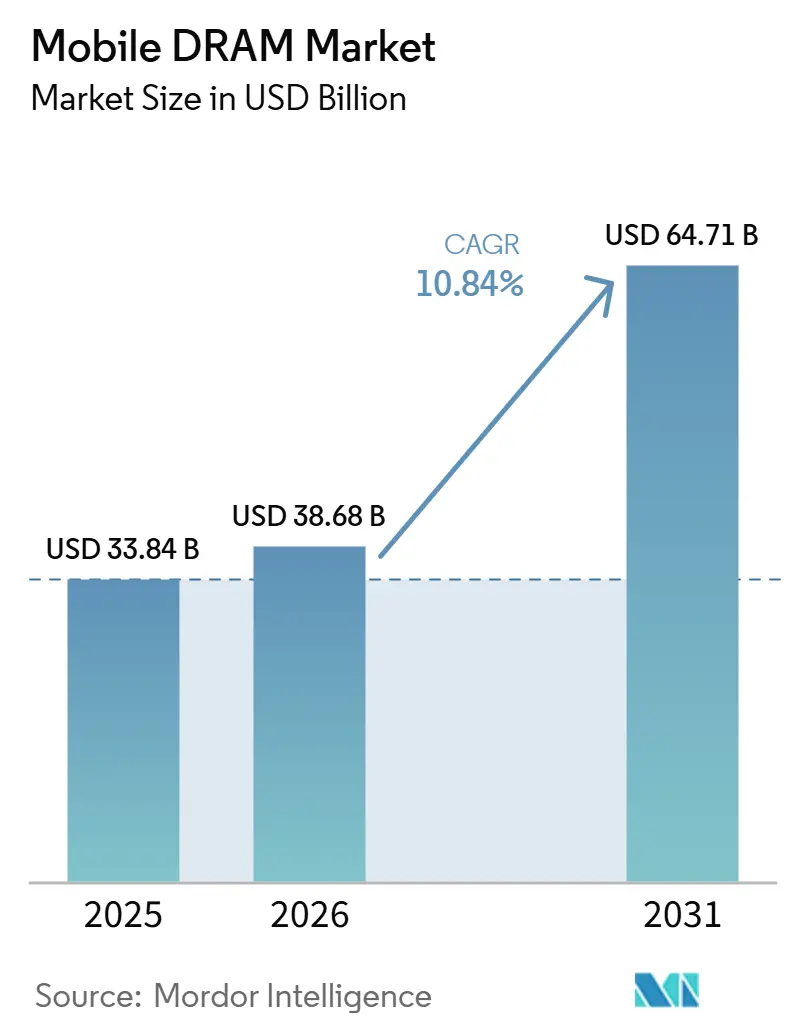
| Market Size (2026) | USD 38.68 Billion |
| Market Size (2031) | USD 64.71 Billion |
| Growth Rate (2026 - 2031) | 10.84 % |
| Fastest Growing Market | Asia-Pacific |
| Largest Market | Asia-Pacific |
| Market Concentration | High |
Major Players *Disclaimer: Major Players sorted in no particular order Image © Mordor Intelligence. Reuse requires attribution under CC BY 4.0. | |
Mobile DRAM Market Analysis by Mordor Intelligence
The mobile DRAM market size stood at USD 33.84 billion in 2025 and is forecast to reach USD 64.71 billion by 2031, growing at a CAGR of 10.84% from 2026 to 2031. Demand is rising as on-device AI is driving higher LPDDR content requirements in flagship smartphones, premium tablets, and adjacent edge devices that need more memory bandwidth and better power efficiency. Supply is also being reshaped as advanced wafer capacity is redirected toward AI server memory, tightening LPDDR availability, lifting contract prices, and lengthening delivery schedules across key programs. The August 2025 LPDDR6 standard and the early 2026 wave of product validation have shortened the normal technology transition cycle, increasing the value of early qualification wins in premium device roadmaps. At the same time, weaker smartphone unit production in 2026 is widening the gap between revenue growth and shipment growth, especially in entry- and mid-range devices that still rely on LPDDR4X. Competition remains concentrated, and that concentration gives the leading suppliers room to protect margins while deciding how much capacity to allocate across mobile devices, automotive systems, and AI server demand.
Key Report Takeaways
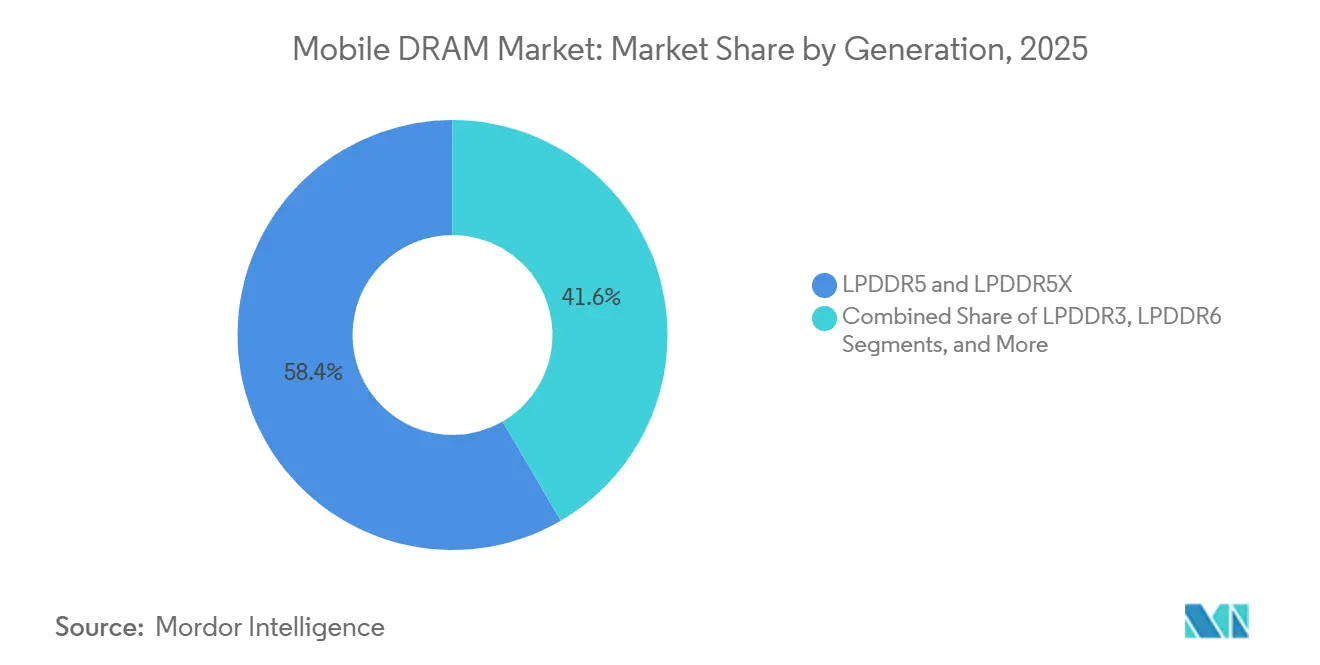
- By generation, LPDDR5 and LPDDR5X led the mobile DRAM market with a 57.8% revenue share in 2025, while LPDDR6 is forecast to expand at a 12.9% CAGR through 2031.
- By package capacity, 8 GB to 16 GB accounted for 47.7% of the mobile DRAM market size in 2025, while above 16 GB is advancing at a 13% CAGR through 2031.
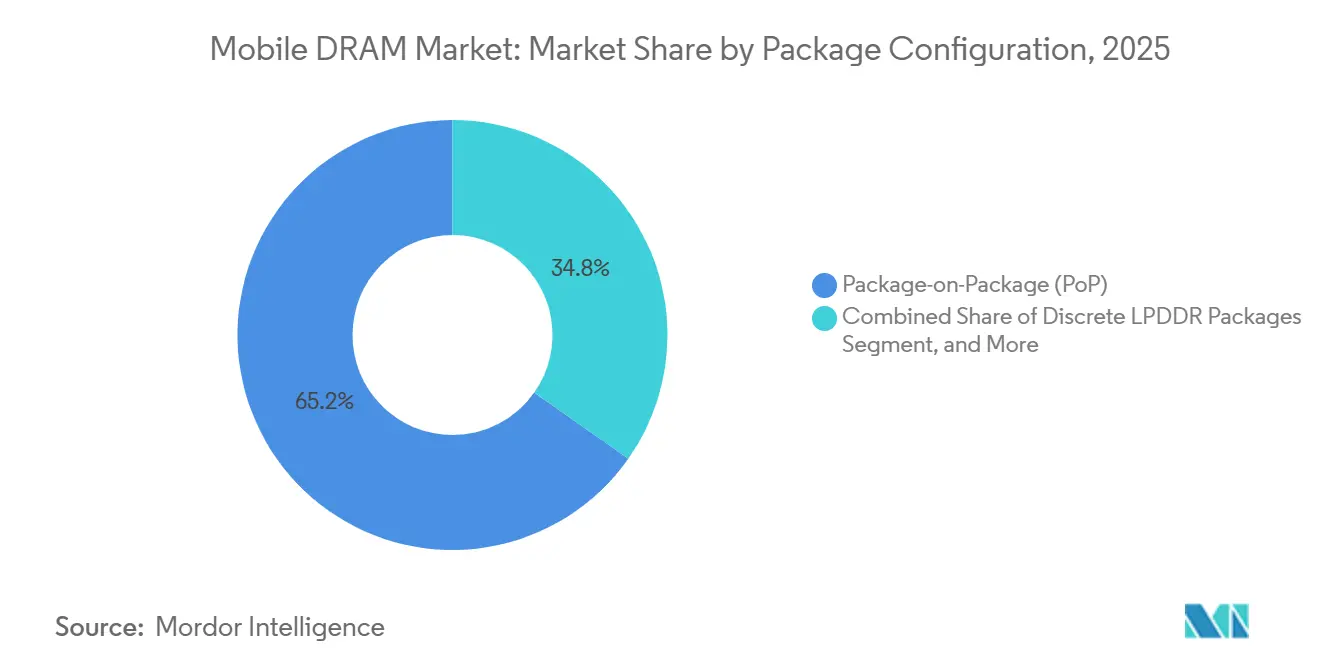
- By package configuration, Package-on-Package held 65.2% of the mobile DRAM market in 2025, while System-in-Package recorded the highest projected CAGR of 12.8% through 2031.
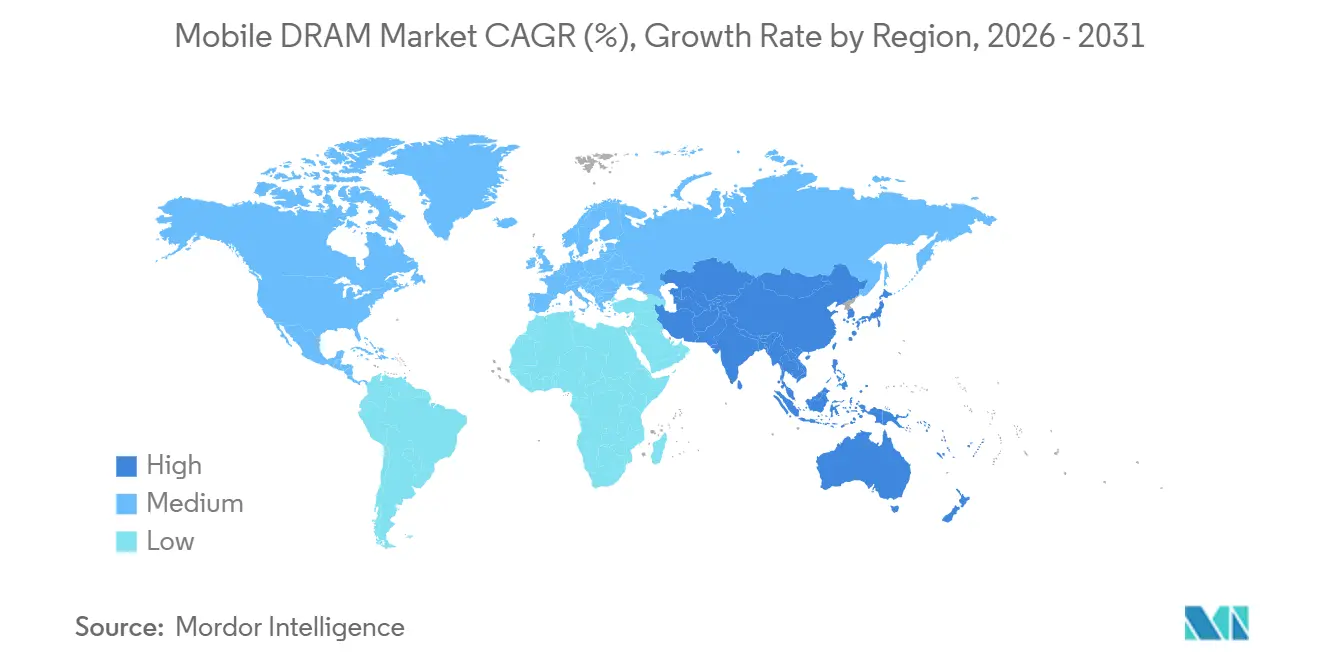
- By geography, Asia-Pacific captured 61.1% of the mobile DRAM market share in 2025 and is projected to grow at an 11.5% CAGR through 2031.
Note: Market size and forecast figures in this report are generated using Mordor Intelligence’s proprietary estimation framework, updated with the latest available data and insights as of January 2026.
Market Trends and Insights
Drivers Impact Analysis of Mobile DRAM Market*
| Driver | (~) % Impact on CAGR Forecast | Geographic Relevance | Impact Timeline |
|---|---|---|---|
| AI Smartphones Increasing Per-Device LPDDR Demand | +3.5% | Global, led by Asia Pacific, China, South Korea, and India | Short term (≤ 2 years) |
| LPDDR Expansion Into AI Servers | +2.8% | Global, led by North America and Asia Pacific | Short term (≤ 2 years) |
| 5G Premiumization Raising LPDDR Demand | +1.8% | Asia Pacific, South America, Middle East and Africa | Medium term (2-4 years) |
| LPDDR4X Scarcity Forcing Refresh to Higher Generations | +1.2% | Global, led by Asia Pacific and China | Short term (≤ 2 years) |
| Software-Defined Vehicles and Automotive LPDDR Demand | +0.8% | Global, with early gains in Germany, Japan, and China | Medium term (2-4 years) |
| Ultra-Thin Notebooks and AI PCs | +0.5% | North America, Europe, and Asia Pacific | Medium term (2-4 years) |
| Source: Mordor Intelligence | |||
AI Smartphones Increasing Per-Device LPDDR Demand
The mobile DRAM market is seeing a clear rise in per-device memory demand as on-device AI moves from headline features into shipping products across the premium smartphone tier. Flagship configurations averaged 12 GB in 2025, and those same platforms are moving toward 18 GB by 2028 as generative AI tasks, real-time image processing, and always-on neural features require a larger and faster local memory pool. This shift matters because AI features depend on sustained high-bandwidth access and low power draw, not only on raw capacity, so suppliers that improve both speed and efficiency are better placed to capture premium programs. SK hynix said its 1c LPDDR6, validated in March 2026, delivers 33% faster data processing and 20% better power efficiency than LPDDR5X at speeds above 10.7 Gbps, directly targeting smartphones and tablets built for on-device AI workloads.[1]SK hynix, “SK hynix Develops 1c LPDDR6, 6th-Generation 10nm-Class DRAM,” SK hynix Newsroom, news.skhynix.com The result is a wider performance and pricing gap between premium AI phones and legacy entry devices, making the mobile DRAM market more polarized than during earlier DRAM generation transitions.
LPDDR Expansion Into AI Servers
The mobile DRAM market is also expanding beyond handsets as LPDDR architectures move into AI server and accelerator designs that prioritize bandwidth and power efficiency over older DDR-centric configurations. AWS adopted LPDDR5X in its Arm-based Graviton4 server chip, and Microsoft integrated LPDDR5X into its Arm-based Cobalt 100 processor because it can materially reduce power use while increasing bandwidth relative to DDR5. Intel's Crescent Island AI inference GPU uses 160 GB of LPDDR5X, and Qualcomm's AI200 and AI250 server accelerators support up to 768 GB of LPDDR, which shows that mobile memory design expertise now has a direct path into data center hardware. Demand from NVIDIA's Vera Rubin platform alone was estimated at 6 billion GB of LPDDR in 2027, slightly above the combined smartphone LPDDR procurement of Apple and Samsung that year, underscoring how quickly this new demand pool is scaling. Because this demand source did not exist in mainstream mobile planning a few years ago, it is tightening wafer allocation and raising the strategic value of suppliers that can qualify products for both device and server environments.
5G Premiumization Raising LPDDR Demand
The mobile DRAM market is gaining another lift from 5G premiumization, especially in South and Southeast Asia, where device specifications are moving up faster than long-term average selling prices. 5G modem workloads create a higher practical bandwidth floor than 4G-era devices, which is pushing more mid-tier and upper-mid-tier designs toward LPDDR5X even before full on-device AI adoption becomes standard. That shift is not limited to AI smartphones, so the demand base is widening in countries where generative AI features are still early, but network capability is already improving. The JEDEC LPDDR6 framework, published in August 2025, added channel-level power management and reliability features that support new 5G chipset programs entering design cycles in 2025 and 2026. This keeps the mobile DRAM market on a broader upgrade path, as network evolution alone is driving memory content higher across multiple device tiers.
LPDDR4X Scarcity Forcing Refresh To Higher Generations
The mobile DRAM market is also being supported by a forced refresh cycle, as LPDDR4X becomes harder to source from major suppliers and loses its former role as a stable-volume product. Samsung moved away from new LPDDR4X orders, and that change is putting pressure on smartphone brands whose entry and mid-range programs still rely on LPDDR4X-compatible system-on-chip designs. LPDDR4X still represented 42% of total mobile DRAM bit output in 2025, so its decline is large enough to affect pricing, allocation, and purchasing decisions across the wider contract market. CXMT partly filled the gap by shipping LPDDR4X into supply chains linked to Xiaomi, OPPO, vivo, Transsion, and Lenovo, which changed the balance in the legacy-generation tier faster than the incumbents expected. This squeeze is pushing some mid-range programs toward LPDDR5X sooner than planned, while lower-cost devices remain in a specification holding pattern that limits unit upside.
Restraints Impact Analysis of Mobile DRAM Market*
| Restraint | (~) % Impact on CAGR Forecast | Geographic Relevance | Impact Timeline |
|---|---|---|---|
| HBM and DDR5 Allocation Crowding Out LPDDR Wafer Capacity | -1.2% | Global, with acute impact in South Korea and Taiwan | Short term (≤ 2 years) |
| High Supplier Concentration Amplifying Supply Risk | -0.8% | Global | Long term (≥ 4 years) |
| Advanced Node Yield and Qualification Challenges | -0.6% | South Korea, Taiwan, and the United States | Medium term (2-4 years) |
| Smartphone Cost Pressure Slowing Upgrade Cycle | -0.9% | Global, concentrated in Asia Pacific mid-range markets | Medium term (2-4 years) |
| Source: Mordor Intelligence | |||
HBM And DDR5 Allocation Crowding Out LPDDR Wafer Capacity
The biggest near-term brake on the mobile DRAM market is that HBM and DDR5 are taking wafer space that would otherwise support LPDDR output for smartphones, tablets, and related edge platforms. HBM production carries a 3-to-1 wafer capacity trade-off compared to standard DRAM, so each incremental HBM push tightens LPDDR availability even as nominal LPDDR demand conditions improve. SK hynix reached near-produce-and-ship inventory status in late 2025, while LPDDR5X delivery times stretched to 26 to 39 weeks across parts of the supply chain, underscoring how narrow the available cushion had become. New fab additions from Samsung's Pyeongtaek complex and SK hynix's expansion pipeline are not expected to bring structural relief before 2027, so the early part of the forecast period remains exposed to allocation pressure. This keeps prices firm and delays volume realization, allowing the mobile DRAM market to grow in value faster than in physical shipments.
Smartphone Cost Pressure Slowing Upgrade Cycle
Smartphone cost pressure is the second major restraint on the mobile DRAM market because rising LPDDR contract prices are reaching brands before end-user demand has fully recovered across several mid-tier geographies. Global smartphone production is projected to decline by more than 10% year over year in 2026, and memory inflation is one of the main reasons brand profitability is coming under pressure. Many entry- and mid-range devices cannot easily migrate to LPDDR5X because their system-on-chip platforms were designed around LPDDR4X compatibility and lower memory cost assumptions. That leaves vendors choosing between expensive legacy supply and a broader redesign that is hard to justify in price-sensitive markets where consumers resist meaningful price increases. The result is a slower upgrade cycle in South Asia and South America, where vendors have less room to pass higher component costs on to buyers.
*Our forecasts treat driver/restraint impacts as directional, not additive. The impact forecasts reflect baseline growth, mix effects, and variable interactions.
Mobile DRAM Market Segment Analysis
By Generation:
LPDDR5X Anchors Revenue While LPDDR6 Moves Into Early CommercializationLPDDR5 and LPDDR5X held 57.8% of the mobile DRAM market size in 2025, which kept this generation at the center of revenue even before LPDDR6 reached commercial scale. Their position reflects the fact that flagship smartphones, AI PCs, and emerging AI server designs already treat this generation as the working bandwidth baseline for advanced workloads. LPDDR4X still accounted for 42% of total bit output in 2025, but Samsung's exit from new supply is shifting the revenue center of gravity away from legacy products and toward newer nodes. The August 2025 JEDEC framework also set a common compliance floor, which made it harder for older generations to stay relevant in premium chipset road maps.
LPDDR6 is the fastest-growing generation at a 12.9% CAGR through 2031, and that pace reflects how quickly high-end device and platform designs are preparing for the next shift in memory performance. SK hynix presented a 1c LPDDR6 design at IEEE ISSCC 2026 with 14.4 Gb/s per pin, 33% higher bandwidth, and more than 20% better energy efficiency than LPDDR5X, which strengthens its early position in the next wave of flagship qualifications. Samsung presented a 12nm-class LPDDR6 architecture at the same conference with 12.8 Gb/s per pin and a 21% power efficiency improvement, and it later sent LPDDR6X samples to Qualcomm, which shows how quickly the competitive bar is moving.[2]Woongrae Kim et al., “A 16Gb 12.8Gb/s LPDDR6 SDRAM With 12-DQ/Sub-Channel Wide NRZ Signaling and Enhanced Reliability by Per-Row Activation Counting and Meta-Data Scheme,” IEEE International Solid-State Circuits Conference, doi.org LPDDR3 now has only limited relevance in legacy embedded and industrial use cases, so the mobile DRAM market is increasingly defined by the migration path from LPDDR4X to LPDDR5X and then to LPDDR6.



By Package Capacity:
Density Migration Raises The Memory Floor Across Premium And Emerging AI DevicesThe 8 GB to 16 GB tier held 47.7% of the mobile DRAM market share in 2025 because 12 GB was already common in flagship phones and 8 GB was becoming the practical floor for AI-capable mid-range devices. This range remains the broadest revenue pool because it balances cost, power efficiency, and enough headroom for premium user experiences without forcing the highest package complexity. Samsung began mass production of 0.65 mm LPDDR5X packages in 2024 for 12 GB and 16 GB configurations, which supported thinner device designs without giving up density.[3]Samsung Electronics, “Samsung Electronics Begins Mass Production of Industry’s Thinnest LPDDR5X DRAM Packages for On-Device AI,” Samsung Global Newsroom, news.samsung.com Its roadmap toward 24 GB and 32 GB modules shows that packaging density, not only process shrink, is driving the next step in memory content growth.
The above 16 GB tier is growing fastest at a 13% CAGR through 2031, and the mobile DRAM market size for this tier is moving up as AI inference workloads demand larger local memory pools. Demand is also being lifted by AI server deployments that specify 64 GB to 512 GB of LPDDR per compute node and by automotive compute systems that continue to add memory-heavy software functions. The 4 GB to 8 GB tier still matters in cost-sensitive 5G devices, but its growth is slowing because AI feature sets are gradually raising the effective floor for competitive mid-range smartphones. Configurations below 4 GB remain present in wearables and some internet of things products, yet they now sit at the edge of mainstream relevance in the mobile DRAM industry.
By Package Configuration:
Package-On-Package Leads Today While System-In-Package Gains Ground In Higher Integration DesignsPackage-on-Package represented 65.2% of the mobile DRAM market size by configuration in 2025, which shows how important vertical integration remains in compact smartphone designs where board space is constrained. Its lead came from strong adoption in flagship handsets, where close processor and memory placement helps save space, support higher data rates, and maintain familiar manufacturing flows. SK hynix addressed PoP's thermal weakness in 2025 by introducing High-K Epoxy Molding Compound, which improved thermal conductivity by 3.5 times and reduced vertical thermal resistance by 47%. That improvement matters because AI workloads raise thermal stress long before handset form-factor limits can be relaxed.
System-in-Package is the fastest-growing configuration, with a 12.8% CAGR through 2031, and is gaining ground as memory, logic, and storage require tighter integration within a single module. Automotive centralized compute platforms and AI edge devices are the main growth engines because they prioritize density, thermal balance, and power efficiency over the older smartphone-first assembly model. A 2026 patent filing described 3D DRAM integration into a standard DRAM SiP, targeting bandwidth of 4 GB/s to 60 GB/s, pointing to a credible path to higher-density, higher-bandwidth designs over time. Multi-Chip Packages and discrete packages still serve wearables, industrial systems, and long-lifecycle use cases where cost, field replaceability, or certification needs matter more than maximum integration.
Geography Analysis
APAC Mobile DRAM Market
Asia-Pacific held 61.1% of the mobile DRAM market share in 2025 and is projected to grow at an 11.5% CAGR through 2031, which keeps the region at the center of both supply and demand. South Korea remains the core production base through Samsung's Pyeongtaek complexes and SK hynix's M15X and planned M17 expansion path, while China is building its role through CXMT's LPDDR5X ramp and wider domestic qualification. CXMT reached a 7.7% share of the global DRAM market in the fourth quarter of 2025, according to data cited in its 2026 IPO prospectus, which confirmed a structural change below the leading supplier group. Taiwan adds a critical packaging layer because its ecosystem supports both Package-on-Package and System-in-Package integration programs for global customers across advanced mobile designs. Micron broke ground on a JPY 1.5 trillion (USD 9.3 billion) Hiroshima expansion in July 2026, and the project included up to JPY 500 billion (USD 3.1 billion) in support from Japan's Ministry of Economy, Trade and Industry, which reinforces Japan's role as a secondary regional anchor.
North America and Europe Mobile DRAM Market
North America's position in the mobile DRAM market is shaped more by technology road maps and hyperscaler demand than by current production share. Micron said it plans to invest more than USD 250 billion in United States manufacturing through 2035 and aims for 40% of its DRAM output to come from domestic fabs, although major new mobile-relevant supply will arrive after 2027. Europe is more demand driven, with software-defined vehicles and advanced driver assistance systems pulling LPDDR5X into centralized cockpit and compute platforms. Compliance requirements under automotive safety and cybersecurity frameworks give European demand a steadier base than consumer electronics cycles alone.
South America, APAC and MEA Mobile DRAM Market
In the rest of the world, the mobile DRAM market remains tied mainly to smartphone adoption and 5G rollout rather than to local chip production. South America, the Middle East and Africa, and parts of South Asia are still consumer demand centers, so their memory content trend depends heavily on what global handset brands can source at workable price points. CXMT's LPDDR4X and LPDDR5 products have already entered Android supply chains that serve these regions, including brands with strong positions in sub-Saharan Africa. Gulf markets are also starting to add automotive memory demand as electric vehicle imports bring more ADAS-equipped models that rely on LPDDR5X-class in-vehicle memory.

Competitive Landscape
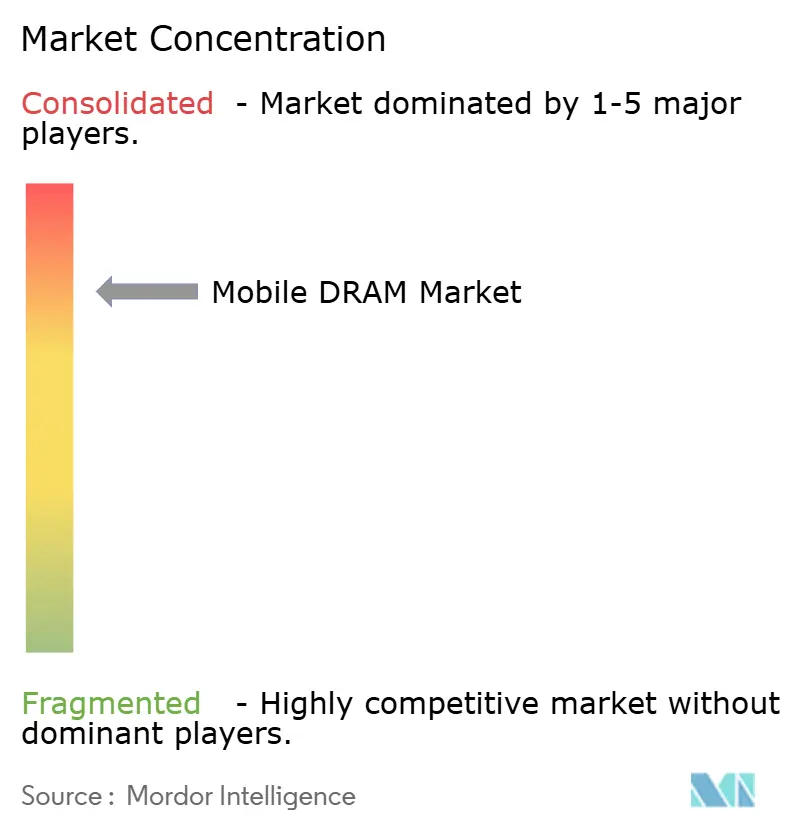
The mobile DRAM market remains structurally consolidated, with Samsung Electronics, SK hynix, and Micron Technology accounting for well over 90% of global revenue. That structure has been durable because capital needs, process-node complexity, and long customer qualification cycles make credible entry very difficult for any challenger. In 2026, the main contest is centered on who commercializes LPDDR6 first at scale and who wins the earliest flagship design slots for the 2027 premium device cycle. SK hynix completed the first development certification for a 16 GB LPDDR6 on its 1c process in March 2026 and targeted shipments in the second half of 2026, thereby claiming early technology leadership. Samsung responded by positioning LPDDR6 and LPDDR6X for next-generation AI edge systems and advancing samples to Qualcomm, showing that memory leadership is already being marketed around future application pull rather than current unit volumes alone.
The mobile DRAM market is also seeing a meaningful shift below the top 3, as CXMT moves from a domestic catch-up player to a visible fourth supplier in legacy and transitional products. Its 2026 IPO filing valued a CNY 29.5 billion (USD 4.3 billion) offering and cited a 7.7% global DRAM share in the fourth quarter of 2025, while also showing more than 30% penetration in non-Huawei Android brand supply chains in China. This matters most in the mid-tier segment, where LPDDR4X shortages and cost pressure make buyers more willing to qualify alternative suppliers that can offer continuity. Two areas still offer clear open space, automotive-grade LPDDR and LPDDR use in AI servers, because neither area has a single supplier with the same cross-regional strength seen in smartphones.
Packaging is becoming almost as important as process technology in the mobile DRAM market, especially as bandwidth, thermal limits, and module density converge in future device designs. Samsung was reported in May 2026 to be developing a Multi-Stacked Fan-Out Wafer-Level Packaging approach that could improve bandwidth by 15% to 30% and raise stack capacity by more than 1.5 times in future designs. JEDEC's April 2026 SOCAMM2 work also points to a wider role for LPDDR-derived memory in AI server systems, which can reward suppliers that bridge mobile and infrastructure qualification paths. Export controls on CXMT are slowing its expansion toward 250,000 wafers per month by the end of 2025, rather than the earlier 300,000 target, but they are not stopping its move into higher-specification products.
Mobile DRAM Industry Leaders
Samsung Electronics Co., Ltd.
SK hynix Inc.
Micron Technology, Inc.
ChangXin Memory Technologies, Inc.
Nanya Technology Corporation
- *Disclaimer: Major Players sorted in no particular order
Mobile DRAM Market Companies Covered in this Report
- Samsung Electronics Co., Ltd.
- SK hynix Inc.
- Micron Technology, Inc.
- ChangXin Memory Technologies, Inc.
- Nanya Technology Corporation
- Integrated Silicon Solution, Inc.
- Elite Semiconductor Microelectronics Technology Inc.
- AP Memory Technology Corporation
- Etron Technology, Inc.

Recent Industry Developments in Mobile DRAM Market
- July 2026: Samsung Electronics and SK hynix announced a combined investment commitment of KRW 800 trillion (USD 518 billion) to build a new semiconductor manufacturing cluster in South Korea's Honam region, targeting a doubling of the country's memory chip production capacity within 5 years.
- July 2026: Micron Technology broke ground on a JPY 1.5 trillion (USD 9.3 billion) expansion of its Hiroshima fabrication facility, with equipment delivery scheduled for the second half of 2028. Japan's Ministry of Economy, Trade and Industry pledged up to JPY 500 billion (USD 3.1 billion) in subsidies. Micron also commenced mass production of its 1γ 16 Gb LPDDR5X at Hiroshima for leading smartphone OEMs in fiscal Q3 2026.
- July 2026: CXMT entered the final stages of its CNY 29.5 billion (USD 4.3 billion) IPO on Shanghai's STAR Market. Its 2026 Q1 revenue reached CNY 50.8 billion (USD 7.3 billion), a 719% year-over-year increase, with Omdia data cited in the prospectus placing its global DRAM market share at 7.7% in Q4 2025, primarily driven by LPDDR products.
- April 2026: JEDEC previewed LPDDR6 specification enhancements and introduced the SOCAMM2 standard for AI server memory applications, formally extending LPDDR6's addressable scope to AI inference edge computing and data center deployment.


Global Mobile DRAM Market Report Scope
The Mobile DRAM market comprises low-power dynamic random-access memory (LPDRAM) devices designed to deliver high memory bandwidth with low power consumption for mobile and power-constrained computing platforms.
The Mobile DRAM Market Report is Segmented by Generation (LPDDR3, LPDDR4 and LPDDR4X, LPDDR5 and LPDDR5X, and LPDDR6), Package Capacity (Up to 4 GB, 4 GB to 8 GB, 8 GB to 16 GB, and Above 16 GB), Package Configuration (Discrete LPDDR Packages, Package-on-Package (PoP), Multi-Chip Packages (MCP), and System-in-Package (SiP)), and Geography (North America, Europe, Asia-Pacific, and Rest of the World). The Market Forecasts are Provided in Terms of Value (USD).
| LPDDR3 |
| LPDDR4 and LPDDR4X |
| LPDDR5 and LPDDR5X |
| LPDDR6 |
| Up to 4 GB |
| 4 GB to 8 GB |
| 8 GB to 16 GB |
| Above 16 GB |
| Discrete LPDDR Packages |
| Package-on-Package |
| Multi-Chip Packages (MCP) |
| System-in-Package (SiP) |
| North America | |
| Europe | |
| Asia-Pacific | China |
| Japan | |
| South Korea | |
| Taiwan | |
| Rest of Asia-Pacific | |
| Rest of the World |
| By Generation | LPDDR3 | |
| LPDDR4 and LPDDR4X | ||
| LPDDR5 and LPDDR5X | ||
| LPDDR6 | ||
| By Package Capacity | Up to 4 GB | |
| 4 GB to 8 GB | ||
| 8 GB to 16 GB | ||
| Above 16 GB | ||
| By Package Configuration | Discrete LPDDR Packages | |
| Package-on-Package | ||
| Multi-Chip Packages (MCP) | ||
| System-in-Package (SiP) | ||
| By Geography | North America | |
| Europe | ||
| Asia-Pacific | China | |
| Japan | ||
| South Korea | ||
| Taiwan | ||
| Rest of Asia-Pacific | ||
| Rest of the World | ||


Key Questions Answered in the Report
What is the current size and outlook for mobile DRAM?
The mobile DRAM market stood at USD 33.8 billion in 2025 and is forecast to reach USD 64.7 billion by 2031 at a 10.8% CAGR from 2026 to 2031.
Why is on-device AI changing memory demand in smartphones?
On-device AI raises both capacity and bandwidth needs. Flagship memory configurations averaged 12 GB in 2025 and are moving toward 18 GB by 2028 as AI workloads become heavier.
Which generation is leading revenue today, and which one is growing fastest?
LPDDR5 and LPDDR5X led revenue with a 57.8% share in 2025, while LPDDR6 is the fastest-growing generation with a 12.9% CAGR through 2031.
Which package capacity band matters most in mobile devices?
The 8 GB to 16 GB tier held the largest share at 47.7% in 2025 because it balances cost, performance, and enough memory headroom for premium and AI-capable phones.
Why is Asia -Pacific dominant in this space?
Asia-Pacific held 61.1% share in 2025 and remains the fastest-growing region because it combines South Korea's fabrication scale, China's supply expansion through CXMT, Taiwan's packaging base, and Japan's ongoing investment activity.
What is the biggest risk to near-term growth?
The biggest near-term risk is wafer allocation pressure from HBM and DDR5, which is crowding out LPDDR capacity and extending delivery times even as demand from AI phones and AI servers rises.
Page last updated on:





