
Miso Market Size and Share
Market Overview
| Study Period | 2027 - 2032 |
|---|---|
| Market Size (2027) | USD 0.89 Billion |
| Market Size (2032) | USD 1.17 Billion |
| Growth Rate (2027 - 2032) | 6.90 % |
| Fastest Growing Market | Europe |
| Largest Market | Asia-Pacific |
| Market Concentration | Medium |
Major Players *Disclaimer: Major Players sorted in no particular order Image © Mordor Intelligence. Reuse requires attribution under CC BY 4.0. | |
Miso Market Analysis by Mordor Intelligence
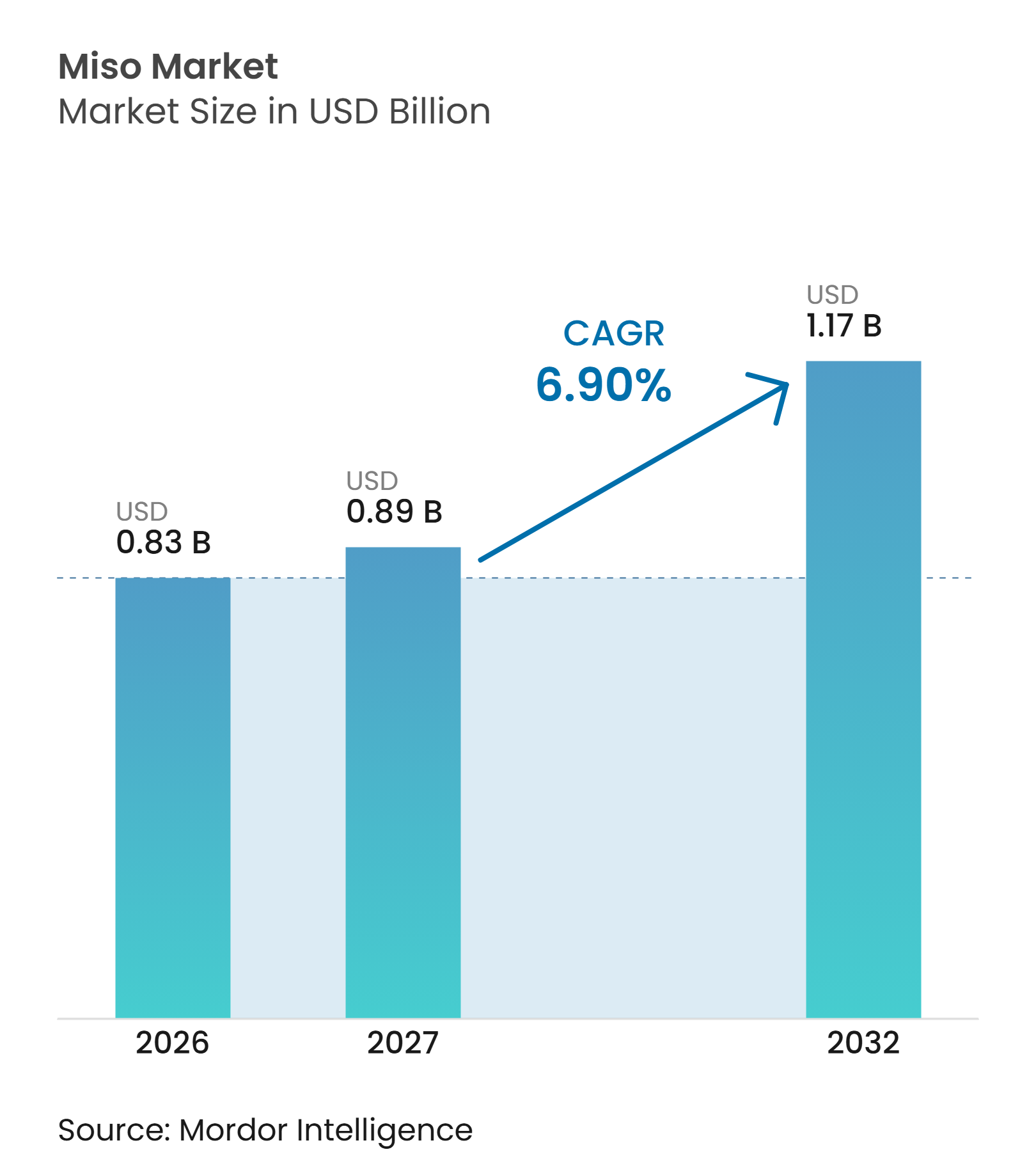
The miso market size is expected to increase from USD 0.83 billion in 2026 to USD 0.89 billion in 2027 and reach USD 1.17 billion by 2032, growing at a CAGR of 6.90% over 2027–2032. Growth is supported by rising global demand for fermented and traditional foods, increasing consumer interest in plant-based and protein-rich products, and the growing popularity of Japanese cuisine across international markets. White miso accounts for the largest product-type share at 40.70% in 2026, reflecting its versatility in soups, dressings, sauces, and marinades, while red miso is projected to be the fastest-growing product category at a CAGR of 7.40%. Rice-based miso dominates ingredient demand with a 58.00% share, whereas soybean-based miso is expected to record the fastest growth at 7.20%. Paste remains the leading form, accounting for 92.00% of the market, while powder is projected to grow fastest at 7.60%, supported by its convenience, longer storage potential, and suitability for packaged food applications. Asia-Pacific holds the largest regional share at 61.80%, supported by established consumption patterns and traditional production capabilities, while Europe is expected to be the fastest-growing region at 7.50% as international cuisine adoption and demand for fermented food ingredients expand.
Key Report Takeaways
- By product type, white miso accounted for the largest share of the miso market size at 40.70% in 2026, while red miso is forecast to grow fastest at a 7.40% CAGR over 2027–2032.
- By ingredient, rice-based miso dominated with a 58.00% market share in 2026, while soybean-based miso is projected to record the fastest growth at a 7.20% CAGR over 2027–2032.
- By form, paste accounted for the largest share at 92.00% in 2026, while powdered miso is expected to grow fastest at a 7.60% CAGR over 2027–2032.
- Among geographies, Asia-Pacific led with a 61.80% share of the miso market in 2026, while Europe is forecast to grow fastest at a 7.50% CAGR over 2027–2032.
Note: Market numbers in this report are based on Mordor Intelligence's proprietary estimation framework, which combines nine months of actuals with Q4 projections for base year 2026.
Market Trends and Insights
Drivers Impact Analysis of Miso Market*
| Driver | (~) % Impact on CAGR Forecast | Geographic Relevance | Impact Timeline |
|---|---|---|---|
| Rising global demand for fermented and traditional foods | +1.0% | Global, particularly Asia-Pacific, where fermented foods are deeply established, and North America and Europe, where interest in traditional fermented products is expanding | Medium term (2–4 years) |
| Growing consumer preference for plant-based and protein-rich food products | +0.8% | Global, particularly North America and Europe, supported by demand for plant-based food ingredients and alternative protein sources | Medium term (2–4 years) |
| Increasing popularity of Japanese cuisine and Asian food culture | +0.7% | Global, particularly North America and Europe, where Japanese restaurants, Asian foodservice, and international cuisine adoption are expanding | Long term (More than 4 years) |
| Rising demand for natural and clean-label food ingredients | +0.6% | Global, particularly North America and Europe, where demand for minimally processed and naturally fermented ingredients is increasing | Medium term (2–4 years) |
| Growing application of miso in soups, sauces, marinades, and ready-to-eat meals | +0.5% | Global, particularly Asia-Pacific and North America, supported by foodservice applications and the incorporation of miso into packaged food formulations | Medium term (2–4 years) |
| Increasing innovation in organic, low-sodium, and specialty miso products | +0.4% | Global, particularly North America, Europe, and Japan, where manufacturers are developing differentiated miso formulations for health-conscious consumers | Long term (More than 4 years) |
| Source: Mordor Intelligence | |||
Rising Global Demand for Fermented and Traditional Foods
Growing interest in traditional and fermented foods is creating opportunities for miso as a naturally fermented seasoning with an established culinary heritage. The Japan Ministry of Agriculture, Forestry and Fisheries (MAFF) identifies miso and soy sauce as important fermented seasonings in Japanese food culture and highlights their long-standing use in regional cuisines. Miso production involves fermenting steamed soybeans with koji and salt, with rice, barley, and soybean koji contributing to different product varieties [1]. Fermentation also produces distinctive umami characteristics through the breakdown of soybean proteins and other components. As consumers explore traditional food preparation methods and fermented ingredients from different cultures, miso offers manufacturers opportunities to expand beyond conventional Japanese dishes into international food applications. Its established heritage, distinctive flavor profile, and versatility support its positioning across traditional and contemporary food categories.
Growing Consumer Preference for Plant-Based and Protein-Rich Food Products
Increasing interest in plant-based diets and alternative protein sources is supporting demand for soybean-based fermented foods, including miso. The Japan Ministry of Agriculture, Forestry and Fisheries identifies soybeans as an important source of protein and highlights their extensive use in traditional Japanese food products, including miso, tofu, natto, and soy milk [2]. Miso contains soybean-derived proteins and other nutritional components, while fermentation contributes to the development of peptides and amino acids that influence its nutritional and sensory properties. This creates opportunities for manufacturers to position miso as a plant-derived seasoning that complements vegetarian meals, vegetable-based dishes, soups, and protein-focused food formulations. The growing incorporation of plant-based ingredients into packaged foods and foodservice menus also provides opportunities for miso manufacturers to reach consumers seeking alternatives to conventional animal-derived ingredients.
Increasing Popularity of Japanese Cuisine and Asian Food Culture
The growing international popularity of Japanese cuisine is expanding opportunities for traditional ingredients such as miso across restaurants, foodservice establishments, and retail markets. The Japan Ministry of Agriculture, Forestry and Fisheries reports that Japanese cuisine received UNESCO Intangible Cultural Heritage recognition in 2013 and that more than 150,000 Japanese restaurants were operating overseas as of 2021 [3]. The ministry also identifies rising overseas demand for fermented products such as miso and soy sauce, supported by increasing interest in Japanese food culture and healthy eating. As international consumers become more familiar with Japanese dishes, miso benefits from its established role in soups, broths, sauces, and traditional preparations. The expansion of Japanese restaurants and Asian foodservice concepts also introduces miso to new consumer groups, encouraging its adoption in international recipes and commercially prepared food products.
Rising Demand for Natural and Clean-Label Food Ingredients
Growing preference for natural ingredients, transparent product labelling, and simpler food formulations is creating opportunities for traditionally fermented products such as miso. The Centre for the Promotion of Imports from developing countries (CBI), an agency of the Netherlands Ministry of Foreign Affairs, identifies clean-label preferences and demand for natural ingredients as important trends influencing the European food industry [4]. Miso is produced using relatively familiar ingredients, including soybeans, koji derived from rice or barley, and salt, providing manufacturers with opportunities to develop products aligned with consumer interest in recognisable ingredient compositions. Organic certification and ingredient traceability can further support product differentiation in premium food categories. Japan's MAFF maintains Organic Japanese Agricultural Standards (JAS) covering organic processed foods, providing a recognised framework for manufacturers targeting organic product categories [5]. These developments create opportunities for organic, traditionally fermented, and minimally formulated miso products, particularly in markets with established demand for clean-label foods.
Restraints Impact Analysis of Miso Market*
| Restraint | (~) % Impact on CAGR Forecast | Geographic Relevance | Impact Timeline |
|---|---|---|---|
| High sodium content and growing health concerns associated with excessive salt consumption | −0.8% | Global, particularly North America and Europe, where public-health initiatives promoting sodium reduction influence food formulation and purchasing preferences | Medium term (2–4 years) |
| Limited consumer awareness of miso in emerging markets | −0.6% | Global, particularly South America, the Middle East and Africa, and non-Asian markets where familiarity with traditional fermented seasonings remains relatively limited | Long term (More than 4 years) |
| Price volatility and supply constraints of soybeans and other raw materials | −0.5% | Global, particularly Japan and other Asian manufacturing markets, as well as import-dependent producers in North America and Europe | Medium term (2–4 years) |
| Shorter shelf life and storage requirements of certain traditional miso products | −0.4% | Global, particularly export-oriented markets and regions with longer distribution routes, where temperature management and storage conditions can increase handling complexity | Short term (Less than 2 years) |
| Source: Mordor Intelligence | |||
High Sodium Content and Growing Health Concerns Associated with Excessive Salt Consumption
Miso production traditionally involves salt as an essential ingredient in the fermentation process, contributing to flavour development, microbial control, and product preservation. However, its relatively high sodium content can create challenges among consumers seeking to reduce dietary salt intake. The World Health Organization (WHO) recommends limiting sodium consumption to less than 2,000 mg per day for adults and identifies excessive sodium intake as a major risk factor for elevated blood pressure and cardiovascular diseases. These recommendations may influence purchasing decisions among health-conscious consumers and encourage food manufacturers to reconsider the sodium content of fermented seasonings. Although reduced-sodium miso formulations provide opportunities to address these concerns, lowering salt levels requires careful control of fermentation conditions, microbial activity, and product quality. Manufacturers must therefore balance traditional fermentation characteristics with changing nutritional expectations.
Limited Consumer Awareness of Miso in Emerging Markets
Limited familiarity with miso and its traditional culinary applications can restrict market penetration in regions where Japanese and other East Asian food cultures have a relatively smaller consumer base. Unlike commonly used seasonings such as tomato sauces, stock cubes, and conventional spice blends, miso may require additional consumer education regarding its fermented origin, flavour profile, preparation methods, and suitability for different recipes. The Japan Ministry of Agriculture, Forestry and Fisheries (MAFF) identifies overseas promotion of traditional Japanese food culture and the expansion of international demand as important areas for developing exports of Japanese agricultural and food products. However, consumer familiarity and availability of specialised retail products can vary considerably across international markets. This creates challenges for manufacturers entering emerging markets, where limited product knowledge and established preferences for familiar seasonings can slow initial adoption. Producers may need to invest in product demonstrations, foodservice partnerships, recipe education, and localised formulations to improve acceptance.
*Our forecasts treat driver/restraint impacts as directional, not additive. The impact forecasts reflect baseline growth, mix effects, and variable interactions.
Miso Market Segment Analysis
By Product Type:
White Miso Leads While Red Miso Expands FasterIn 2026, white miso accounted for an estimated 40.70% of the Miso Market, making it the leading product type. Its position reflects its mild, slightly sweet flavour profile and versatility across soups, dressings, sauces, marinades, and other food preparations. White miso is commonly fermented for a shorter duration than darker varieties, resulting in a lighter colour and less intense flavour. Meanwhile, red miso is projected to record the fastest growth, at an estimated CAGR of 7.40% through 2032. Its stronger, saltier, and more pronounced umami characteristics support applications in hearty soups, broths, marinades, and flavour-intensive dishes. Growing international interest in Japanese cuisine also creates opportunities for red miso beyond traditional Asian food applications.
Mixed miso combines different miso varieties to achieve balanced flavour profiles, allowing manufacturers to develop products with varying levels of sweetness, saltiness, and fermentation intensity. Barley miso represents another traditional category, particularly relevant to regional Japanese cuisines, while other varieties include specialty formulations differentiated by fermentation methods and regional production practices. However, manufacturers across product categories need to maintain fermentation consistency, ingredient quality, and distinctive flavour characteristics. The ability to balance traditional production methods with evolving culinary applications will remain important for expanding miso consumption.
By Ingredient:
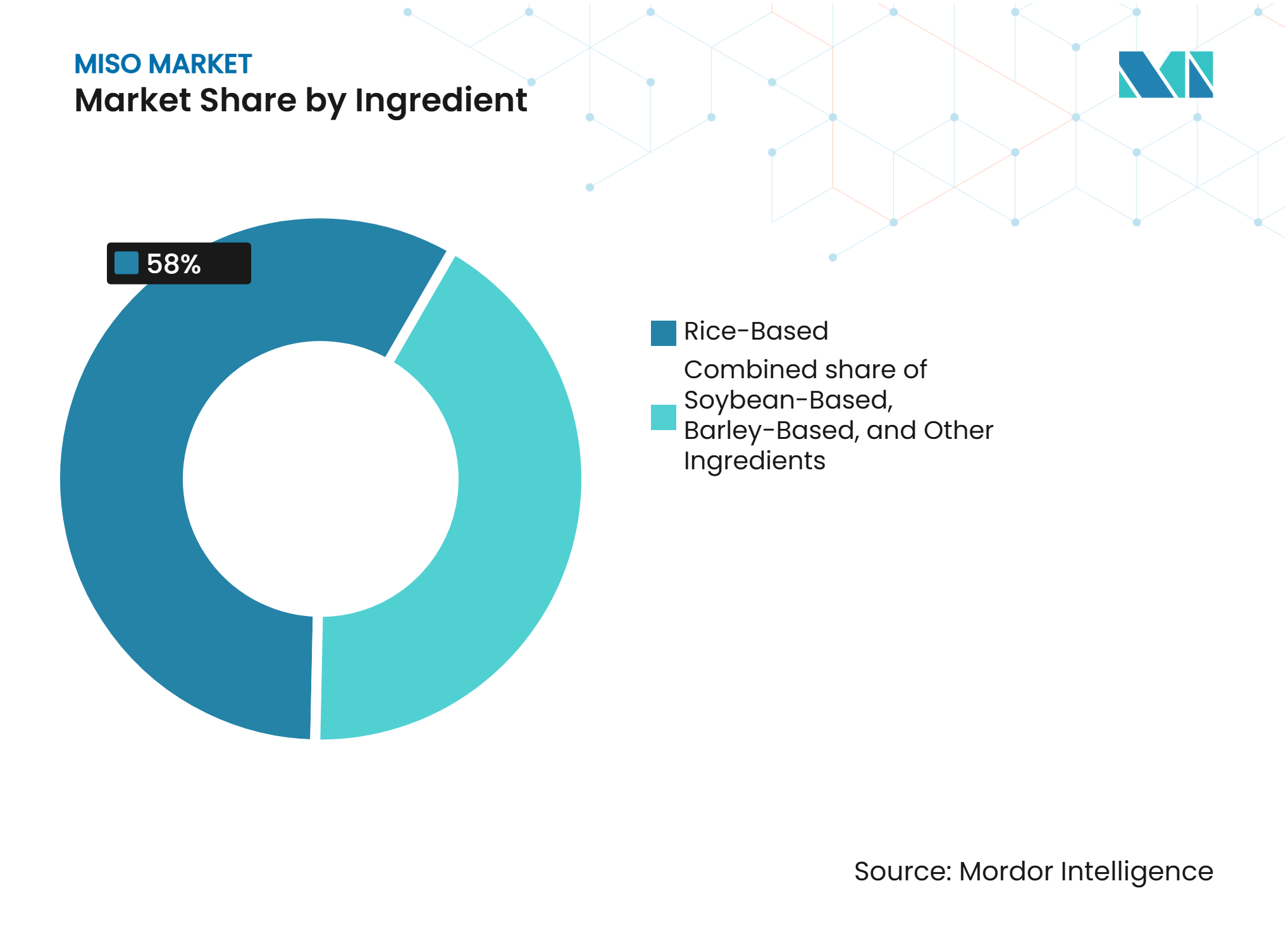
Rice-Based Miso Dominates While Soybean-Based Miso Expands FasterIn 2026, rice-based miso accounted for an estimated 58.00% of the Miso Market, making it the leading ingredient category. Its position reflects the established use of rice koji in traditional Japanese miso production, where fermented rice provides enzymes that support the breakdown of soybean proteins and starches during fermentation. Rice-based formulations are used across several varieties, including white, red, and mixed miso, with differences in fermentation duration and ingredient proportions influencing their final flavour characteristics. Meanwhile, soybean-based miso is projected to record the fastest growth, at an estimated CAGR of 7.20% through 2032. These formulations offer distinctive flavour profiles and align with traditional fermentation practices that use soybeans as the primary substrate. Their growth opportunities are supported by interest in traditional fermented foods and the wider adoption of plant-derived ingredients.
Barley-based miso represents another established category, using barley koji to develop distinctive aromatic and flavour characteristics. Other ingredients include alternative grains and specialised formulations developed through regional production techniques. However, manufacturers across ingredient categories need to manage raw-material quality, fermentation conditions, and consistency in flavour development. The ability to secure reliable supplies of soybeans, rice, and barley while maintaining traditional product characteristics will remain important for market expansion.


By Form:
Paste Dominates While Powder Expands FasterIn 2026, paste accounted for an estimated 92.00% of the Miso Market, making it the dominant product form. Its position reflects the traditional consumption of miso as a fermented paste used in soups, sauces, dressings, marinades, and other culinary preparations. Paste formulations retain the characteristic texture, moisture content, and flavour profile associated with conventional miso products, making them suitable for household consumption as well as foodservice and industrial applications. Meanwhile, powdered miso is projected to record the fastest growth, at an estimated CAGR of 7.60% through 2032. Its growth potential is supported by convenience in handling, easier incorporation into dry seasoning blends, and suitability for instant soups, packaged meals, snack seasonings, and industrial food formulations. Powdered formats can also offer advantages in transportation and storage compared with certain refrigerated paste products.
Liquid miso and other specialised forms serve applications requiring easier incorporation into sauces, dressings, marinades, and ready-to-use food preparations. These formats provide manufacturers with opportunities to address specific formulation and convenience requirements across foodservice and packaged food categories. However, processing methods must preserve the characteristic fermented flavour and functional properties of miso. Manufacturers that improve product stability, ease of use, and formulation compatibility can strengthen the adoption of alternative formats while maintaining the established demand for traditional paste.
Geography Analysis
North America Miso Market
North America represents an important market for miso, supported by growing international interest in Japanese cuisine, established Asian food retail networks, and expanding applications of fermented seasonings in packaged foods and foodservice. The United States is a major destination for Japanese miso exports. According to Japan External Trade Organization (JETRO) data, Japan exported approximately 6,183 metric tons of miso to the United States in 2024, representing a 24.2% increase in export volume compared with 2023. Canada also recorded imports of approximately 1,232 metric tons from Japan in 2024, reflecting growing demand for Japanese fermented products . These established trade relationships create opportunities for manufacturers to expand white, red, and specialty miso offerings through supermarkets, Asian grocery stores, restaurants, and food manufacturing applications.
Asia-Pacific Miso Market
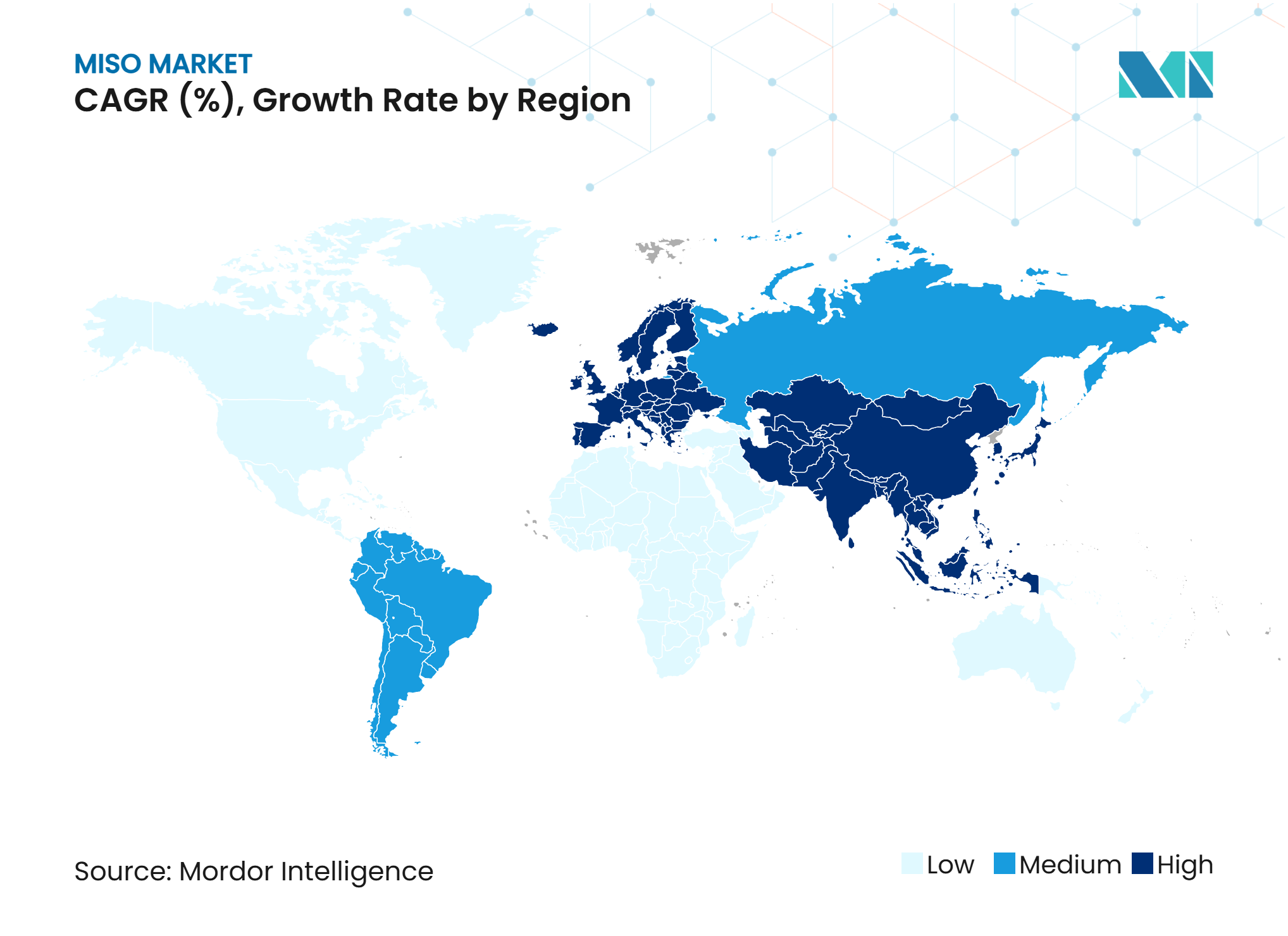
Asia-Pacific accounted for an estimated 61.80% of the Miso Market in 2026, making it the largest regional market. Japan represents the region's established production and consumption centre, supported by traditional fermentation practices and the widespread use of miso in soups, sauces, and other food preparations. China, South Korea, and other Asian markets contribute to regional demand through established consumption of fermented soybean products and traditional seasonings. According to JETRO, Japan exported approximately 1,812 metric tons of miso to South Korea and 1,269 metric tons to China in 2024, demonstrating established regional trade relationships . These connections support opportunities for traditional and specialty miso products, although manufacturers need to account for differences in local culinary preferences, product formulations, and price sensitivity.
Europe Miso Market
Europe is projected to be the fastest-growing regional market, with an estimated CAGR of 7.50% over 2027–2032. Growth opportunities are supported by increasing interest in Japanese cuisine, demand for fermented food ingredients, and the expansion of international foodservice offerings. The Netherlands, the United Kingdom, Germany, and France represent important destinations for Japanese miso exports. According to JETRO, Japan exported approximately 1,240 metric tons of miso to the Netherlands, 1,588 metric tons to the United Kingdom, 816 metric tons to Germany, and 1,029 metric tons to France in 2024 . These trade relationships create opportunities for manufacturers to expand traditional rice-based, barley-based, organic, and specialty miso products through specialty food retailers, supermarkets, restaurants, and food ingredient distribution networks.
Competitive Landscape
Market Concentration

The Miso Market includes traditional Japanese miso manufacturers, fermented food companies, specialist producers, and international food brands competing through product quality, fermentation expertise, ingredient sourcing, product innovation, and distribution reach. Companies have varying levels of exposure to miso through traditional miso pastes, blended varieties, instant miso products, seasonings, and broader fermented food portfolios. Established Japanese manufacturers can leverage traditional production knowledge and strong domestic distribution networks, while international and specialist brands can target overseas consumers through organic, specialty, and plant-based product offerings.
Competitive strategies in the Miso Market focus on expanding product portfolios, developing different miso varieties, and adapting traditional formulations to changing consumer preferences. For example, Marukome offers a range of miso products, including white, red, and blended miso, alongside instant miso soup products, while Hikari Miso markets traditional miso pastes and organic varieties. South River Miso Company and American Miso Company cater to specialist markets through traditionally fermented and specialty miso products. These strategies allow manufacturers to differentiate through fermentation methods, ingredient selection, product variety, and organic positioning. Companies are also addressing demand for convenient formats and differentiated formulations, including powdered and other specialty miso products.
Sourcing and distribution remain important competitive considerations in the Miso Market. Manufacturers with access to reliable supplies of soybeans, rice, barley, koji cultures, and salt can support consistent production quality and manage raw-material procurement risks. Established companies such as Marukome and Hikari Miso serve multiple international markets through retail and foodservice product ranges, while specialist producers such as South River Miso Company differentiate through organic ingredients, traditional fermentation methods, and specialty varieties. Marukome's portfolio also spans paste, liquid, and powdered miso, reflecting the availability of different formats for household, foodservice, and food-processing applications.
Miso Industry Leaders
-
Marukome Co., Ltd.
-
Hikari Miso Co., Ltd.
-
Kikkoman Corporation
-
Hanamaruki Foods Inc.
-
Miyasaka Jozo Co., Ltd.
- *Disclaimer: Major Players sorted in no particular order
Miso Market Companies Covered in this Report
- Marukome Co., Ltd.
- Hikari Miso Co., Ltd.
- Hanamaruki Foods Inc.
- Miyasaka Jozo Co., Ltd.
- Marusan-Ai Co., Ltd.
- Yamato Soysauce & Miso Co., Ltd.
- Yamaki Co., Ltd.
- Saikyo-Miso Co., Ltd.
- Masuya Miso Co., Ltd.
- Yamagen Jozo Co., Ltd.
- Shinshu Miso Co., Ltd.
- Hatcho Miso Kakukyu Co., Ltd.
- Maruya Hatcho Miso Co., Ltd.
- Ishii Miso Co., Ltd.
- Takeya Miso Co., Ltd.
- Kikkoman Corporation
- Clearspring Ltd.
- Eden Foods, Inc.
- South River Miso Company
- American Miso Company
Recent Industry Developments in Miso Market
- October 2026: Hikari Miso Co., Ltd. launched the 2026 edition of its “Miso Nouveau, Hatsunari,” a limited-quantity, naturally fermented miso made using a seasonal first-of-the-season concept. The product features a younger fermentation profile with a fresh, fruity taste, expanding the company's premium and specialty miso portfolio.
- July 2026: Tokai Gakuen University, Naka-Nihon EXIS, Mie Railway, and Sato Jozo Co., Ltd. collaborated to commercialize “Kurumimiso,” a specialty miso product incorporating walnuts and cheese. Developed with a focus on Nagoya-style flavors, health-conscious ingredients, and shelf life, the product was introduced at the Toyota-Ugokou Service Area in Japan from July 18, 2026.
- June 2026: Hikari Miso Co., Ltd. introduced “CRAFT MISO NAMA-KOJI Precious,” a limited-edition, once-a-year miso produced using freshly harvested Japanese rice and soybeans. The product features a fresh, fruity flavor and juicy texture, with 25% less salt than the company's standard products. The launch strengthened the company's premium fermented miso portfolio and expanded its specialty offerings.
- March 2026: Hikari Miso Co., Ltd. launched “CRAFT MISO TOROMI” and “DASHI KAORU MISO” across Japanese retail outlets. CRAFT MISO TOROMI introduced a pourable liquid miso format designed for convenient cooking, dressings, and seasoning, while DASHI KAORU MISO combined red and white miso with single-origin bonito and kombu stock. The launches expanded the company's product portfolio across liquid and blended miso formats.
Global Miso Market Report Scope
For this study, the Miso Market is defined as the sales value of commercially produced miso, a traditional fermented paste made primarily from soybeans, rice, barley, salt, and koji culture. The market covers different product types, including white miso, red miso, mixed miso, barley miso, and other miso types, segmented by ingredient into soybean-based, rice-based, barley-based, and other ingredients. By form, the market is categorized into paste, powder, liquid, and other forms. The market is analyzed across North America, Europe, Asia-Pacific, South America, and the Middle East and Africa, with country-level coverage in Asia-Pacific, including Japan, China, South Korea, and the rest of Asia-Pacific. Market sizing and forecasts are presented in value terms (USD) across the defined product types, ingredients, forms, and geographies.
Segmentation Overview
| White Miso |
| Red Miso |
| Mixed Miso |
| Barley Miso |
| Other Miso Types |
| Soybean-Based |
| Rice-Based |
| Barley-Based |
| Other Ingredients |
| Paste |
| Powder |
| Liquid |
| Other Forms |
| North America | |
| Europe | |
| Asia-Pacific | Japan |
| China | |
| South Korea | |
| Rest of Asia-Pacific | |
| South America | |
| Middle East and Africa |
| By Product Type | White Miso | |
| Red Miso | ||
| Mixed Miso | ||
| Barley Miso | ||
| Other Miso Types | ||
| By Ingredient | Soybean-Based | |
| Rice-Based | ||
| Barley-Based | ||
| Other Ingredients | ||
| By Form | Paste | |
| Powder | ||
| Liquid | ||
| Other Forms | ||
| By Geography | North America | |
| Europe | ||
| Asia-Pacific | Japan | |
| China | ||
| South Korea | ||
| Rest of Asia-Pacific | ||
| South America | ||
| Middle East and Africa | ||
Key Questions Answered in the Report
What is the projected size of the Miso Market?
The Miso Market is estimated at USD 0.83 billion in 2026 and is projected to reach USD 1.17 billion by 2032, registering a CAGR of 6.90% over 2027–2032.
Which product type holds the largest share of the Miso Market?
White Miso is the largest product type segment, accounting for 40.70% of the Miso Market share in 2026, supported by its mild flavor profile and widespread use in soups, sauces, dressings, and marinades.
Which ingredient segment dominates the Miso Market?
Rice-Based Miso dominates the ingredient segment, accounting for 58.00% of the market share in 2026. Its established role in traditional miso fermentation and production supports its leading position.
Which region dominates the Miso Market, and which segment is expected to grow fastest?
Asia-Pacific dominates the Miso Market, accounting for 61.80% of the global market share in 2026. By segment, Powder is expected to be the fastest-growing form, followed by Europe at 7.50% among regions.