
Miniature Circuit Breaker (MCB) and Molded Case Circuit Breaker (MCCB) Market Size and Share
Market Overview
| Study Period | 2022 - 2032 |
|---|---|
| Market Size (2027) | USD 3.32 Billion |
| Market Size (2032) | USD 5.02 Billion |
| Growth Rate (2027 - 2032) | 8.62 % |
| Fastest Growing Market | Asia-Pacific |
| Largest Market | Asia-Pacific |
| Market Concentration | Medium |
Major Players *Disclaimer: Major Players sorted in no particular order Image © Mordor Intelligence. Reuse requires attribution under CC BY 4.0. | |
Miniature Circuit Breaker (MCB) and Molded Case Circuit Breaker (MCCB) Market Analysis by Mordor Intelligence
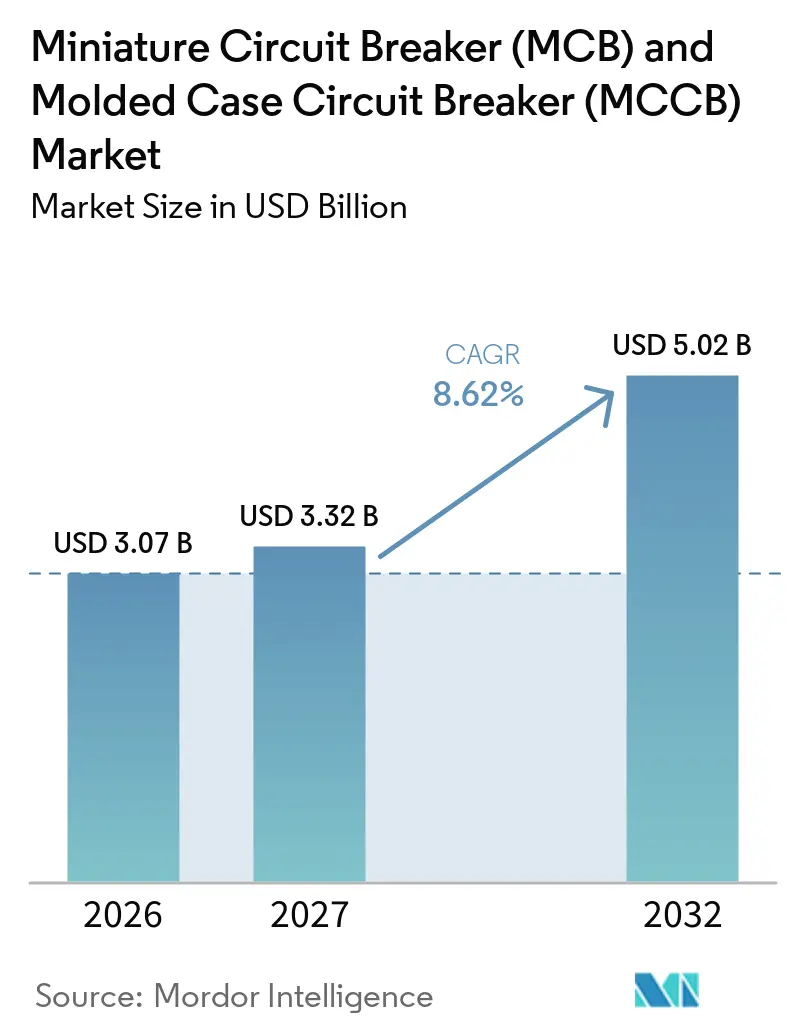
The Miniature Circuit Breaker (MCB) and Molded Case Circuit Breaker (MCCB) Market size is projected to be USD 3.07 billion in 2026, USD 3.32 billion in 2027, and reach USD 5.02 billion by 2032, growing at a CAGR of 8.62% from 2027 to 2032. The miniature circuit breakers market is supported by replacement of aging distribution assets, wider use of renewable power, electric vehicle charging, and new data center construction. These uses require higher current ratings, more precise fault protection, and connected monitoring functions. Suppliers are placing greater emphasis on digital trip units, arc-flash detection, cybersecurity, and predictive maintenance rather than competing only on device price. The miniature circuit breakers market also benefits from recurring replacement demand because contacts and thermal components can wear before an entire switchboard require renewal. Volatile costs for copper, silver contacts, and electronics remain a constraint because approved material changes can require a lengthy product requalification process.
Key Report Takeaways
- By type, miniature circuit breakers held a 52.5% global share in 2026 and are forecast to grow at a 10.3% CAGR through 2032.
- By rated current, the 76 A–250 A class held 28.3% global share in 2026, while the 251 A–800 A class is forecast to grow at an 8.9% CAGR through 2032.
- By end use, residential and commercial applications accounted for 39.2% of global revenue in 2026, while power utilities are projected to expand at a 9.1% CAGR through 2032.
- By geography, Asia-Pacific held 31.1% global share in 2026 and is forecast to grow at a 9.4% CAGR through 2032.
Note: Market numbers in this report are based on Mordor Intelligence's proprietary estimation framework, which combines nine months of actuals with Q4 projections for base year 2026.
Market Trends and Insights
Drivers Impact Analysis of Miniature Circuit Breaker (MCB) and Molded Case Circuit Breaker (MCCB) Market*
| Driver | (~) % Impact on CAGR Forecast | Geographic Relevance | Impact Timeline |
|---|---|---|---|
| Grid Modernization and Replacement of Aging Distribution Assets | +2.1% | Global, concentrated in North America, Europe, and Asia-Pacific | Long term (≥ 4 years) |
| Renewable Energy, Storage, and EV Charging Deployment | +1.8% | Global, led by Asia-Pacific, Europe, and North America | Short term (≤ 2 years) |
| Data Center, Smart Building, and Industrial Electrification Expansion | +1.5% | North America, Asia-Pacific, and Europe | Medium term (2-4 years) |
| Digital Monitoring and Predictive Maintenance Adoption | +1% | North America, Europe, and developed Asia-Pacific markets | Long term (≥ 4 years) |
| Bidirectional Fault Protection for Distributed Energy Resources | +0.8% | Global, with early gains in North America and Europe | Medium term (2-4 years) |
| Compact, Modular, Higher-Capacity Protection for Constrained Panels | +0.7% | North America, Europe, and Asia-Pacific data centers and industrial sites | Medium term (2-4 years) |
| Source: Mordor Intelligence | |||
Grid Modernization and Replacement of Aging Distribution Assets
The miniature circuit breakers market receives durable support from the replacement of aging distribution equipment. U.S. investor-owned electric companies planned nearly USD 208 billion in grid investment during 2025 to improve reliability and support economic growth.[1] The European Commission stated that European Union distribution networks need EUR 730 billion and transmission networks need EUR 477 billion in investment through 2040.[2] These programs raise demand for protection equipment in substations, feeder upgrades, and low-voltage boards. For the miniature circuit breakers market, this work favors suppliers that can meet utility specifications and support installed products over long replacement cycles. Individual breakers can require replacement before the surrounding switchboard reaches the end of its operating life, which supports recurring purchases through established service and aftermarket channels.
Renewable Energy, Energy Storage, and EV Charging Deployment
The miniature circuit breakers market is changing as renewable generation and electric vehicle charging increase the complexity of low-voltage power flows. Fast chargers above 350 kW create sharp current demand and require higher-curve protective devices, along with careful thermal design for nearby breakers.[3] Utility-scale solar increasingly uses 1,500 V DC systems, where interruption of a DC arc requires equipment designed for the duty rather than a standard AC configuration.[4] China’s distributed photovoltaic capacity was expected to exceed 400 GW, adding protection requirements at inverter and panel interfaces. Battery storage tie-in points also create more frequent bidirectional flows. In the miniature circuit breakers market, this creates demand for protection arrangements that can coordinate faults in both directions and move installations toward devices with suitable DC and bidirectional ratings.
Data Center, Smart Building, and Industrial Electrification Expansion
The miniature circuit breakers market is gaining higher-value demand from data centers, connected buildings, and industrial electrification. American Electric Power raised its 5-year capital plan to USD 72 billion in October 2025 to serve large-load data center customers. High-density liquid-cooled racks require short protection paths and tighter fault-clearing performance. These requirements favor higher-rated molded case devices and products with advanced coordination features. For the miniature circuit breakers market, this shifts purchasing toward equipment availability, monitoring, and remote operating capability in installations with limited downtime tolerance. Space limits in data centers and industrial panels also favor compact, modular products that can provide more protection functions within a smaller footprint.
Digital Monitoring and Predictive Maintenance Adoption
Digital monitoring creates a higher-value product opportunity within the miniature circuit breakers market. A National Instruments energy case study reported USD 400 million in lifecycle savings over 20 years from condition-based maintenance, including fewer forced outages and longer breaker life. Research published in 2025 found that embedded circuit breaker monitoring systems using heterogeneous computing and wireless connectivity achieved 90% classification accuracy for early degradation detection. Smart breakers use sensors, communications interfaces, and local analytics to support condition-based maintenance instead of fixed service intervals. In the miniature circuit breakers market, a single smart-breaker installation can also lead to upgrades across the wider distribution board because gateways and monitoring software are usually deployed at panel level. This expands the value of each installation beyond a like-for-like replacement and favors suppliers able to provide compatible devices, software, and cybersecurity features.
Restraints Impact Analysis of Miniature Circuit Breaker (MCB) and Molded Case Circuit Breaker (MCCB) Market*
| Restraint | (~) % Impact on CAGR Forecast | Geographic Relevance | Impact Timeline |
|---|---|---|---|
| Volatile Copper, Silver-Alloy Contact, and Electronic-Component Costs | -1.2% | Global, most acute in North America and Europe | Short term (≤ 2 years) |
| High Retrofit Complexity and Interoperability Constraints in Legacy Panels | -0.9% | North America and Europe | Medium term (2-4 years) |
| Low-Cost Competition and Price Sensitivity in Emerging Markets | -0.8% | Asia-Pacific, South America, Middle East, and Africa | Short term (≤ 2 years) |
| High Initial Cost of Advanced Electronic and Connected Breakers | -0.7% | Global, most acute in price-sensitive emerging markets | Medium term (2-4 years) |
| Source: Mordor Intelligence | |||
Volatile Copper, Silver-Alloy Contact, and Electronic-Component Costs
Material volatility constrains the miniature circuit breakers market by making pricing and inventory decisions more difficult for suppliers. Silver reached a record near USD 49.57 per ounce in October 2025 after a prolonged period of supply deficit. Silver is used in low-resistance contact sets, especially in higher-specification products. Copper, silver-alloy contacts, and electronic components all affect the cost base of Miniature Circuit Breaker (MCB) and Molded Case Circuit Breaker (MCCB) manufacturing. For the miniature circuit breakers market, substituting contact material is not a quick remedy because IEC 60947-2 and UL 489 approvals require full requalification, which can take 12-18 months. This delay limits a manufacturer’s ability to respond to short-term input-price movements and can pressure margins in contracts with fixed selling prices.
High Retrofit Complexity and Interoperability Constraints in Legacy Panels
Retrofit complexity can delay replacement purchases in the miniature circuit breakers market, particularly in North America and Europe. Older distribution boards often require changes to bus bars, terminal blocks, or mounting rails when individual devices are replaced. These added works make a simple equipment swap impractical in many installations. Commercial building owners can defer electrical upgrades when they compete with tenant improvement budgets or wait for lease renewal periods. Process sites can also require coordinated firmware and settings changes across their protection hierarchy when a breaker tier is modernized. Across the miniature circuit breakers market, price-sensitive buyers in emerging markets may choose lower-cost products, while the high initial price of connected breakers can further slow adoption where the immediate maintenance benefit is not clear.
*Our forecasts treat driver/restraint impacts as directional, not additive. The impact forecasts reflect baseline growth, mix effects, and variable interactions.
Miniature Circuit Breaker (MCB) and Molded Case Circuit Breaker (MCCB) Market Segment Analysis
By Type:
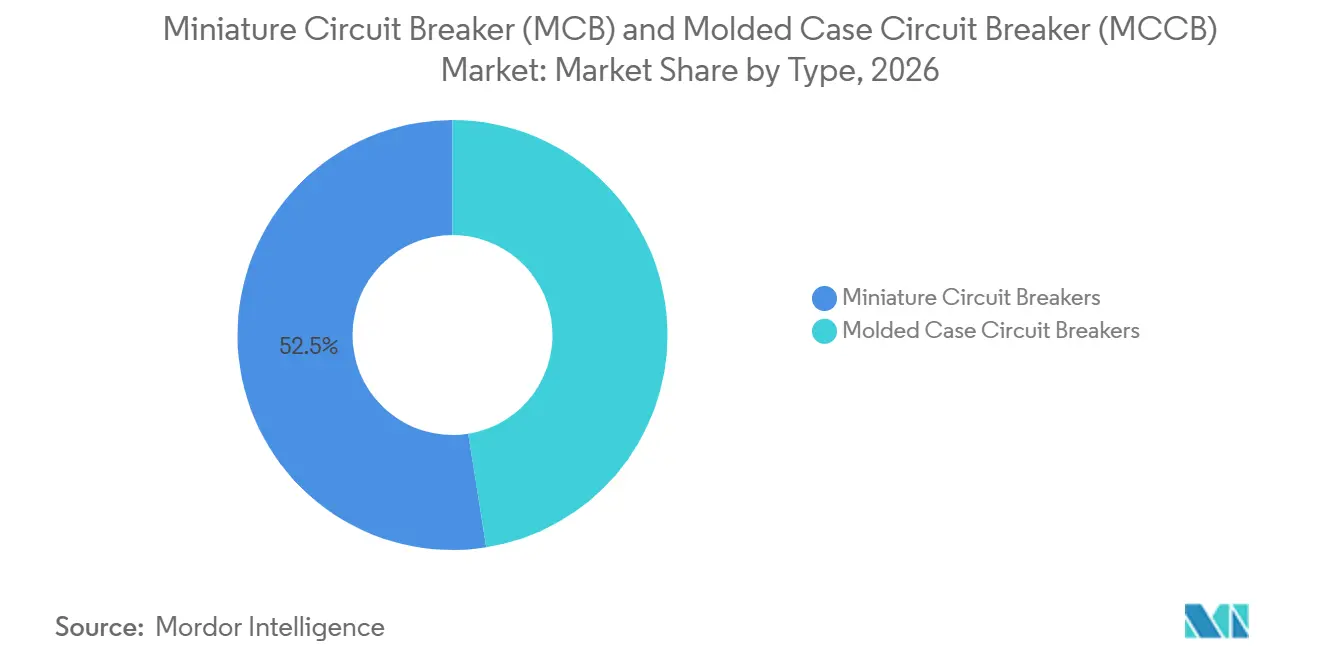
MCB Volume Leadership Coexists with Higher-Value MCCB DemandMiniature circuit breakers held 52.5% of global value in 2026. Their position reflects their use in residential panels, light-commercial distribution boards, and modular low-voltage assemblies in every major region. Standardized formats under International Electrotechnical Commission (IEC) 60898-1 support broad use for branch-circuit protection in both new buildings and replacement work. This compatibility helps contractors use established panel designs and supports dependable demand across a large installed base. China requires intelligent electrical fire-monitoring circuits in new public buildings, which supports smart MCB adoption alongside conventional products. In India, rooftop solar systems and Level 2 home chargers each add dedicated 20 A - 40 A circuit requirements. These additions increase the number of protective devices needed per residential installation and support demand for devices with the appropriate protection curve and coordination.
Molded case circuit breakers represented the remaining 47.5% of the miniature circuit breakers market size in 2026. This category is gaining value from digital trip units, remote monitoring interfaces, and higher breaking capacities. Commercial buildings, industrial facilities, renewable substations, and large charging sites need protection beyond the typical capability of smaller residential devices. These applications place importance on coordination, interrupting capacity, and the ability to accommodate larger electrical loads, especially where several loads are concentrated within a single distribution board. They also require equipment that can be integrated with the monitoring and control arrangements used at larger facilities, where uninterrupted operation, prompt isolation of faults, and equipment protection during abnormal operating conditions are operational requirements. Schneider Electric launched the EasyPact CVS range in May 2025 for 800A–1,600A applications, with breaking capacity of 36–70 kA and 3-pole and 4-pole configurations. The release illustrates the supplier focus on higher-capacity commercial and industrial installations. The mix shift toward digitally enabled, higher-rated products can raise revenue per unit even where volumes are lower than in MCB applications.

By Rated Current:
Mid-Range Volumes Lead While Higher Ratings Grow FasterThe 76 A - 250 A class held 28.3% global value share in 2026. It serves commercial distribution boards, light-industrial panels, and renewable energy collection substations. The category is a practical middle range for applications that require more capacity than residential circuits but not the highest industrial ratings. Its broad installed base makes it important for replacement as well as new construction demand. Equipment specifications in this range are influenced by short-circuit performance, the required number of poles, and the ability to use digital trip units. Contractors and panel builders use the range across varied building and industrial settings, which spreads demand across multiple customer groups. These factors support continued demand across commercial and light-industrial installations.
The 251A - 800A tier is projected to grow at an 8.9% CAGR through 2032, making it the fastest-growing rated-current segment. The miniature circuit breakers market size for this range benefits from AI data center pods, large charging systems, and industrial electrification projects with higher power density. American Electric Power’s increase in planned capital spending to USD 72 billion shows how large-load connections are expanding the need for higher-capacity distribution equipment. The range is also relevant, where a distribution board must protect multiple high-load circuits in a limited footprint. The sub-20A and 21A - 75A tiers retain volume in homes and light-commercial buildings where single-phase systems are common. Products above 800 A remain a smaller but important category for utility substations and new high-capacity feeders. Eaton extended its Power Defense 600 VDC line across the full portfolio in 2025, showing the importance of DC-rated higher-current devices in solar, storage, and data center applications
By End Use:
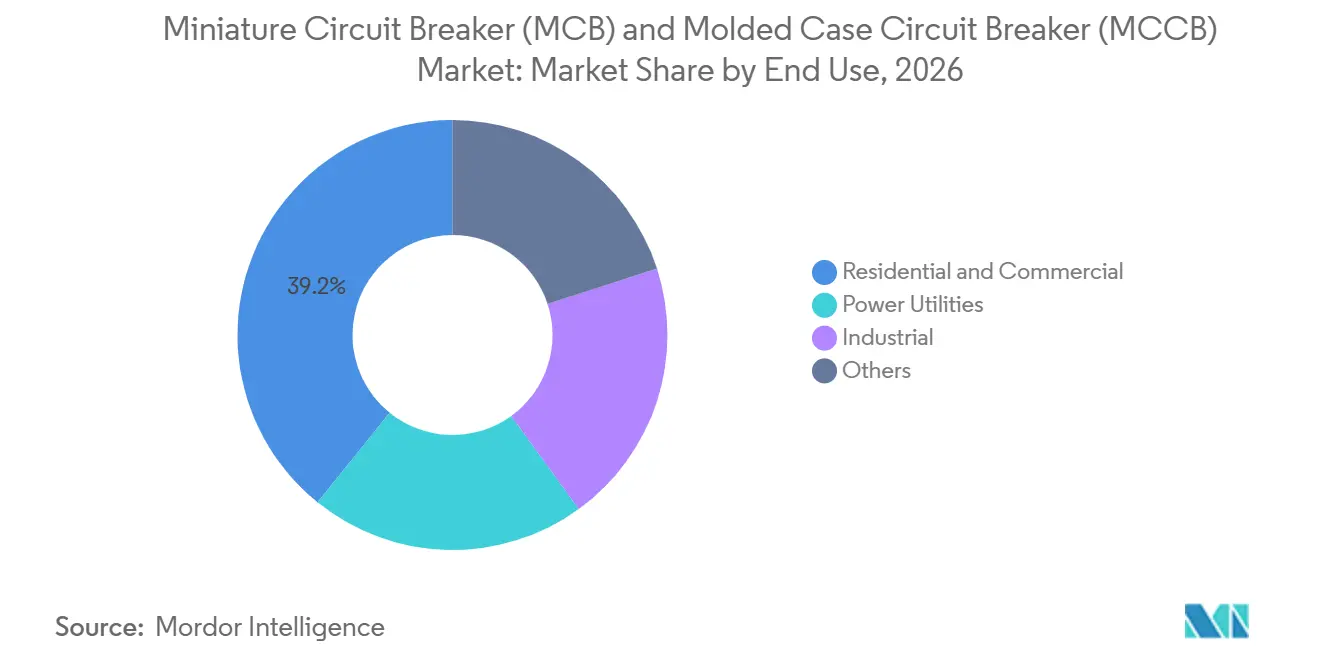
Residential and Commercial Demand Anchors Volume While Utilities Grow FastestResidential and commercial uses accounted for 39.2% of the miniature circuit breakers market size in 2026. Housing construction in India, Vietnam, and Indonesia supports demand for basic protection devices. Renovation-driven panel upgrades in Europe and North America add replacement demand in established building stocks. China’s building requirements for smart electrical monitoring in new commercial construction also support upgrades to intelligent MCBs. Residential solar installations and home charging equipment add circuit requirements beyond traditional household loads. Building owners and installers therefore need devices that fit common panel designs while providing appropriate protection for new electrical loads. These uses maintain the segment’s large installed base while increasing the need for suitable protective coordination.
Power utilities are forecast to grow at a 9.1% CAGR through 2032. The miniature circuit breakers market is supported in this segment by grid replacement programs and new protection needs at renewable substations and distribution feeders. IRENA stated that annual grid investment of USD 670 billion is required from 2025 to 2030 to support renewable energy targets. Distributed energy resources can make traditional overcurrent settings insufficient because power can flow in both directions. This requires utilities to review protection coordination as generation, storage, and new loads connect to their networks. It can also shorten the review cycle for installed protection equipment when network conditions change faster than conventional replacement schedules. Industrial users also support demand through manufacturing electrification and compliance with IEC 61439 for low-voltage switchgear assemblies. The others category includes data centers, transportation, and telecommunications, where new digital infrastructure can increase the need for high-specification protection products.
Geography Analysis
APAC Miniature Circuit Breaker (MCB) and Molded Case Circuit Breaker (MCCB) Market
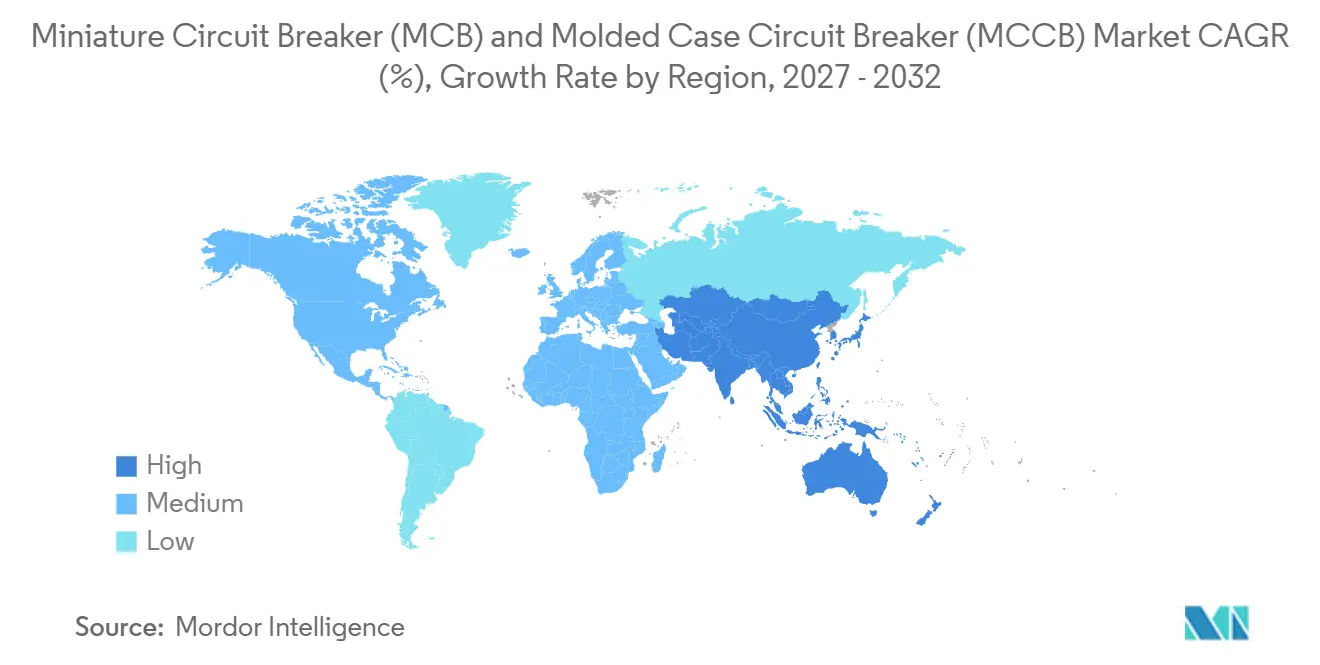
Asia-Pacific held 31.1% of the miniature circuit breakers market share in 2026 and is forecast to grow at a 9.4% CAGR through 2032. China’s smart-panel conversion, India’s construction and rural electrification activity, and Southeast Asia’s industrial-zone development support the regional outlook. China’s standard low-voltage circuit breaker categories are near maturity, while intelligent products are gaining attention alongside demand from India’s rural grid extensions, rooftop solar, and manufacturing investment. Hager expanded its Indonesian distribution through an agreement with Wira Elektrik covering Bandung, Semarang, Surabaya, and Bali. This activity shows why manufacturers are strengthening local routes to panel builders and electrical contractors.
North America and Europe Miniature Circuit Breaker (MCB) and Molded Case Circuit Breaker (MCCB) Market
North America is a high-value part of the miniature circuit breakers market because projects tend to require higher specification grades. Edison Electric Institute (EEI) member companies planned nearly USD 208 billion in 2025 grid investment, while several U.S. utilities increased capital plans to address data center electricity demand. These investments support MCCB demand at substations and advanced MCB demand in commercial and hyperscale data center panels. Europe also has a long-term demand base from grid renewal and renewable integration. The European Commission’s 2025 guidance calls for anticipatory grid investment and supports distribution planning, while the United Kingdom’s BS 7671 requirements and industrial retrofit activity in Germany, France, Poland, and Italy support demand for suitable short-circuit ratings.
MEA and South America Miniature Circuit Breaker (MCB) and Molded Case Circuit Breaker (MCCB) Market
South America, the Middle East, and Africa have demand profiles that differ from mature markets. Brazil and Argentina have project-level demand from renewable energy and industrial expansion, while Saudi Arabia’s Vision 2030 program supports data center and industrial infrastructure investment. ALKHALEFAH has built automated MCB and MCCB production lines as part of an electrical equipment manufacturing localization effort, while Egypt, Morocco, South Africa, and the United Arab Emirates have demand from utility grid construction and industrial-zone development. Price sensitivity in these regions favors cost-competitive Asian products in standard classes, while premium European products remain more relevant for demanding applications.
Competitive Landscape
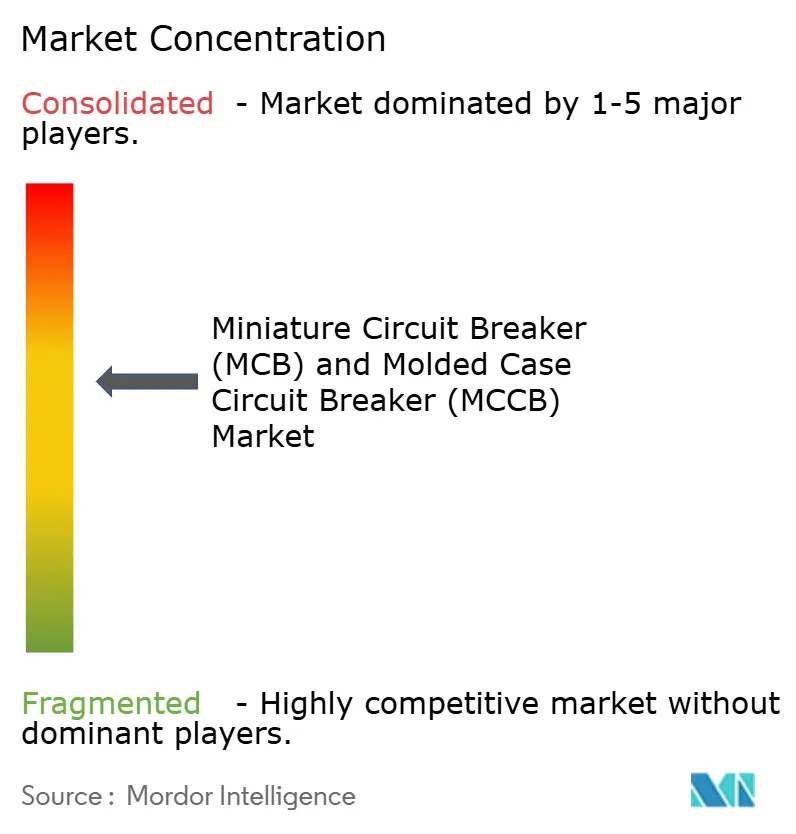
The premium tier of the MCB and MCCB market is moderately concentrated. Schneider Electric, ABB, Siemens, Eaton, and Mitsubishi Electric together accounted for an estimated 52.3% of value share in 2025, although their combined position has weakened as Chinese manufacturers expanded in the sub-1,000 V category. Leading suppliers are responding through connected protection platforms rather than unit-price competition. ABB launched SACE Emax 3 globally in July 2025 with IEC 62443 Security Level 2 certification and integrated arc-flash detection. The product targets applications where cyber-hardened power protection is important, including data centers and critical facilities.
Siemens announced SENTRON ECPD in March 2026 as a semiconductor-based device that combines up to 10 conventional protection functions, uses 80% less installation space, and trips 1,000 times faster than electromechanical alternatives. This type of product gives suppliers a way to serve high-availability industrial and data center installations. Schneider Electric’s 2025 EasyPact CVS release addressed the need for higher current ratings in commercial and industrial installations. Competition is moving toward protection capacity, equipment intelligence, monitoring integration, and cybersecurity. Compliance with IEC 62443 and IEC 60947-2 favors companies with the engineering resources to develop, test, and maintain certified product ranges.
White space remains in bidirectional DC protection for battery storage and photovoltaic tie-in applications. Many existing products are adapted from AC designs rather than designed specifically for DC arc behavior. SCHURTER acquired a majority stake in Biaodi in May 2026 to strengthen its portfolio in e-mobility, energy storage, and data center applications. CHINT is expanding its international presence through manufacturing-localization partnerships, while NOARK Electric competes with more price-accessible alternatives in mid-tier specifications.
Miniature Circuit Breaker (MCB) and Molded Case Circuit Breaker (MCCB) Industry Leaders
-
Schneider Electric SE
-
ABB Ltd.
-
Siemens AG
-
Eaton Corporation plc
-
Mitsubishi Electric Corporation
- *Disclaimer: Major Players sorted in no particular order
Miniature Circuit Breaker (MCB) and Molded Case Circuit Breaker (MCCB) Market Companies Covered in this Report
- ABB Ltd.
- CG Power and Industrial Solutions Limited
- CHINT Group
- Eaton Corporation plc
- Fuji Electric Co., Ltd.
- General Electric Company
- Hager Group
- Havells India Limited
- HD HYUNDAI ELECTRIC CO., LTD.
- Hitachi Energy Ltd.
- Larsen and Toubro Limited
- Legrand SA
- LS ELECTRIC Co., Ltd.
- Mitsubishi Electric Corporation
- NOARK Electric
- Rockwell Automation, Inc.
- Schneider Electric SE
- Siemens AG
- Terasaki Electric Co., Ltd.
- WEG S.A.
Recent Industry Developments in Miniature Circuit Breaker (MCB) and Molded Case Circuit Breaker (MCCB) Market
- May 2026: Swiss component specialist SCHURTER acquired a majority stake in Biaodi, a Chinese high-voltage circuit protection manufacturer, to strengthen its portfolio in e-mobility, energy storage, and data center applications.
- October 2025: ABB launched its MNS low-voltage switchgear integrated with the SACE Emax 3 air circuit breaker for AI-ready data centers, showcased at Data Center World Asia in Singapore, featuring an expanded power quality analyzer and IEC 62443 SL2 cybersecurity certification.
- September 2025: ABB unveiled SACE® Emax 3 to the U.S. market at the NECA convention in Chicago, positioning the world’s first IEC 62443 SL2-certified air circuit breaker for AI data centers, advanced manufacturing, and multi-source power environments.
- July 2025: ABB officially launched the SACE Emax 3 globally in Kuala Lumpur, Malaysia, the world’s first air circuit breaker with IEC 62443 SL2 cybersecurity certification and fully integrated arc-flash detection, targeting data centers, hospitals, and airports.
Global Miniature Circuit Breaker (MCB) and Molded Case Circuit Breaker (MCCB) Market Report Scope
A Miniature Circuit Breaker (MCB) is an automatic low-voltage electrical switch designed to protect low-current circuits (typically under 100A to 125A) from damage caused by overloads or short circuits. It features a fixed, non-adjustable tripping mechanism. A Molded Case Circuit Breaker (MCCB) is an electrical protection device housed in an insulated molded case that handles higher current ratings (ranging from 16A to 2500A and above) and features adjustable trip settings to provide protection against overloads, short circuits, and elevated temperatures in commercial and industrial applications.
The global MCB and MCCB market is segmented by type, rated current, end use, and geography. By type, the market is segmented into miniature circuit breakers (MCBs) and molded case circuit breakers (MCCBs). By rated current, the market is segmented into up to 20A, 21A–75A, 76A–250A, 251A–800A, and above 800A. By end use, the market is segmented into power utilities, industrial, residential and commercial, and other applications. The report also covers the market size and forecasts for the global MCB and MCCB market across 26 countries in key regions. For each segment, the market sizing and forecasts have been provided on the basis of value (USD).
Segmentation Overview
| Miniature Circuit Breakers |
| Molded Case Circuit Breakers |
| Up to 20A |
| 21A-75A |
| 76A-250A |
| 251A-800A |
| Above 800A |
| Power Utilities |
| Industrial |
| Residential and Commercial |
| Others |
| North America | United States |
| Canada | |
| Mexico | |
| Europe | Germany |
| France | |
| Italy | |
| Spain | |
| United Kingdom | |
| Poland | |
| Russia | |
| Rest of Europe | |
| Asia-Pacific | China |
| India | |
| Japan | |
| South Korea | |
| Australia | |
| Indonesia | |
| Vietnam | |
| Thailand | |
| Rest of Asia-Pacific | |
| South America | Brazil |
| Argentina | |
| Chile | |
| Rest of South America | |
| Middle East and Africa | Saudi Arabia |
| United Arab Emirates | |
| Egypt | |
| South Africa | |
| Morocco | |
| Rest of Middle East and Africa |
| By Type | Miniature Circuit Breakers | |
| Molded Case Circuit Breakers | ||
| By Rated Current | Up to 20A | |
| 21A-75A | ||
| 76A-250A | ||
| 251A-800A | ||
| Above 800A | ||
| By End Use | Power Utilities | |
| Industrial | ||
| Residential and Commercial | ||
| Others | ||
| By Geography | North America | United States |
| Canada | ||
| Mexico | ||
| Europe | Germany | |
| France | ||
| Italy | ||
| Spain | ||
| United Kingdom | ||
| Poland | ||
| Russia | ||
| Rest of Europe | ||
| Asia-Pacific | China | |
| India | ||
| Japan | ||
| South Korea | ||
| Australia | ||
| Indonesia | ||
| Vietnam | ||
| Thailand | ||
| Rest of Asia-Pacific | ||
| South America | Brazil | |
| Argentina | ||
| Chile | ||
| Rest of South America | ||
| Middle East and Africa | Saudi Arabia | |
| United Arab Emirates | ||
| Egypt | ||
| South Africa | ||
| Morocco | ||
| Rest of Middle East and Africa | ||
Key Questions Answered in the Report
What is the projected value of the miniature circuit breakers sector by 2032?
The miniature circuit breakers market is projected to reach USD 5.02 billion by 2032, growing at an 8.62% CAGR from 2027.
Which product type has the largest share of circuit breaker demand?
Miniature circuit breakers held 52.5% share in 2026, supported by their widespread use in homes, light-commercial buildings, and low-voltage panels.
Which current rating is expected to grow the fastest?
The 251A - 800A rated-current category is projected to grow at an 8.9% CAGR through 2032 because of data centers, charging infrastructure, and industrial electrification.
Why are power utilities important for circuit breaker suppliers?
Power utilities are forecast to grow at a 9.1% CAGR through 2032 as operators replace aging equipment and add protection at renewable substations and distribution feeders.
Which region has the strongest growth outlook?
Asia-Pacific is forecast to grow at a 9.4% CAGR through 2032, supported by smart-panel conversion in China, Indian electrification, and Southeast Asian industrial development.
What is limiting adoption of connected circuit breakers?
Material-cost volatility, retrofit complexity, price-sensitive demand, and the higher initial price of advanced connected devices can slow purchasing decisions.