
Middle East and Africa Mobile Homes Market Size and Share
Market Overview
| Study Period | 2020 - 2031 |
|---|---|
| Forecast Data Period | 2026 - 2031 |
| Base Year Market Size (2025) | USD 0.44 Billion |
| Market Size (2026) | USD 0.49 Billion |
| Market Size (2031) | USD 0.78 Billion |
| Growth Rate (2026 - 2031) | 9.74 % |
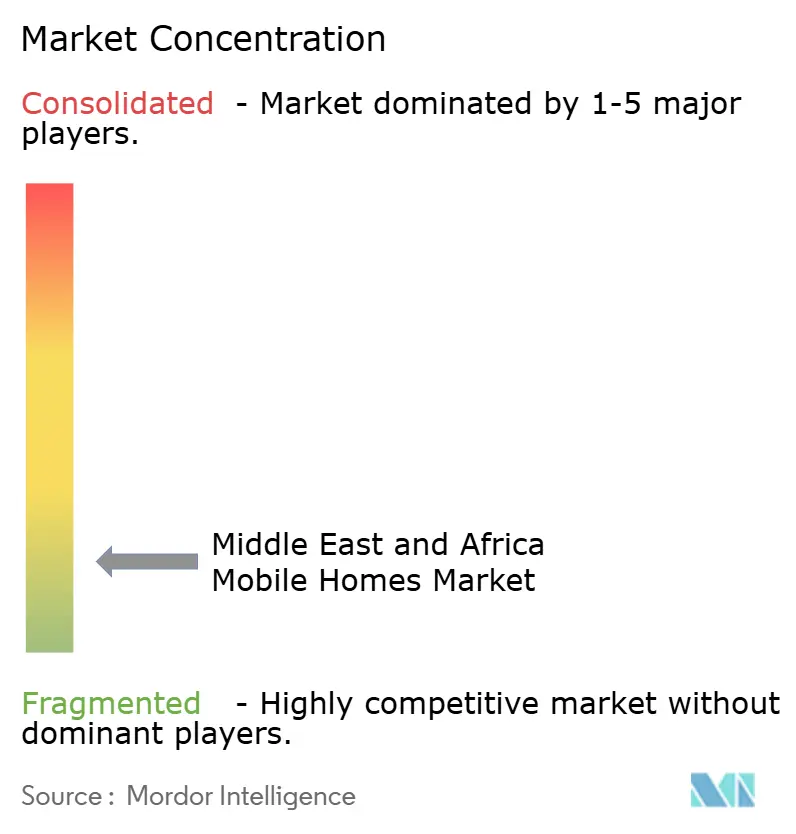
| Market Concentration | Low |
Major Players *Disclaimer: Major Players sorted in no particular order Image © Mordor Intelligence. Reuse requires attribution under CC BY 4.0. | |
Middle East and Africa Mobile Homes Market Analysis by Mordor Intelligence
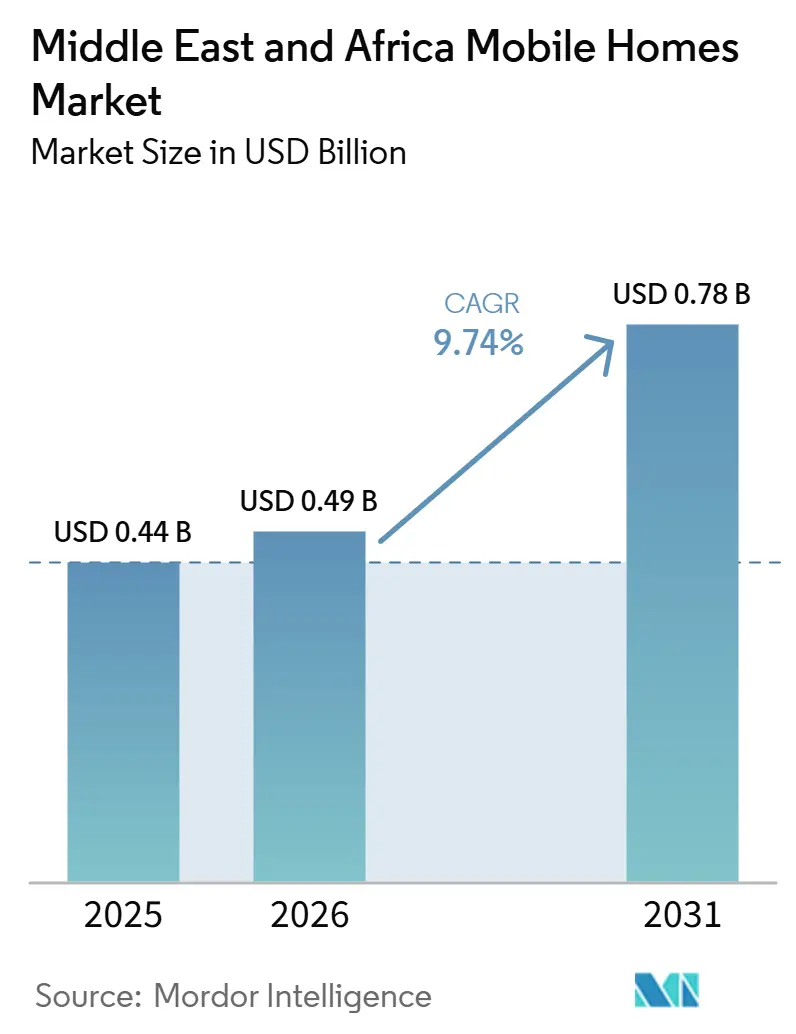
The Middle East and Africa mobile homes market size is projected to expand from USD 0.44 billion in 2025 and USD 0.49 billion in 2026 to USD 0.78 billion by 2031, registering a CAGR of 9.74% between 2026 and 2031.
Government housing programs, large construction projects, and demand for remote accommodation support this expansion. Factory-built units help buyers control delivery schedules when site labor is limited. Demand also comes from tourism projects that need lower-impact accommodation in remote locations. Procurement requirements increasingly favor suppliers that can meet insulation, safety, and certification standards. Logistics costs, uneven approvals, and difficult weather conditions will continue to limit project economics in parts of the region.
Key Report Takeaways
- By product type, single-section homes held 61.20% of the Middle East and Africa mobile homes market share in 2025, while the others category is forecast to grow at an 11.96% CAGR through 2031.
- By material, steel-based construction accounted for 46.80% of the Middle East and Africa mobile homes market size in 2025, while composite and other materials are projected to advance at an 11.42% CAGR through 2031.
- By application, single-family housing captured 57.90% of the Middle East and Africa mobile homes market share in 2025, while the others applications segment is forecast to expand at a 12.18% CAGR through 2031.
- By geography, Saudi Arabia held 27.60% of revenue in 2025, while the United Arab Emirates is projected to record an 11.38% CAGR through 2031.
Note: Market size and forecast figures in this report are generated using Mordor Intelligence’s proprietary estimation framework, updated with the latest available data and insights as of January 2026.
Middle East and Africa Mobile Homes Market Trends and Insights
Drivers Impact Analysis*
| Drivers | (~) % Impact on CAGR Forecast | Geographic Relevance | Impact Timeline |
|---|---|---|---|
| Government-Backed Affordable Housing and Giga Projects Drive Mobile Home Demand | +2.8% | Saudi Arabia, Egypt, United Arab Emirates, South Africa | Short term (≤ 2 years) |
| Faster Construction and Reduced Site Labor Requirements Accelerate Adoption | +2.0% | Middle East and Africa, with greater relevance in Saudi Arabia and the United Arab Emirates | Medium term (2-4 years) |
| Remote Workforce and Mining Accommodation Increase Mobile Home Demand | +1.5% | Sub-Saharan Africa, Saudi Arabia, Oman | Medium term (2-4 years) |
| Energy-Efficient and Climate-Resilient Housing Supports Market Growth | +1.0% | Gulf states, Egypt | Long term (≥ 4 years) |
| Digital Design, BIM, and Factory Automation Improve Manufacturing Efficiency | +0.8% | United Arab Emirates, Saudi Arabia, South Africa | Medium term (2-4 years) |
| Growing Tourism and Eco-Lodging Developments Increase Demand for Mobile Homes | +0.7% | Saudi Arabia, United Arab Emirates, South Africa, Zanzibar | Short term (≤ 2 years) |
| Source: Mordor Intelligence | |||
Government-Backed Affordable Housing and Giga Projects Drive Mobile Home Demand
Government procurement is an important and recurring source of demand for the mobile homes market in the Middle East and Africa. Saudi Arabia’s homeownership program targets 70% homeownership by 2030 and requires large-scale housing delivery across planned communities[1]Ministry of Municipal and Rural Affairs and Housing, “Homeownership Program,” Ministry of Municipal and Rural Affairs and Housing, momrah.gov.sa. This setting favors standardized units that can be manufactured before site work is complete and delivered against fixed program schedules. Egypt’s Housing for All Egyptians program has also supported demand for repeatable residential formats, particularly where public delivery agencies need consistent layouts across several sites[2]Egyptian Ministry of Housing, Utilities and Urban Communities, “Ministry of Housing, Utilities and Urban Communities,” Egyptian Ministry of Housing, Utilities and Urban Communities, mhuc.gov.eg. Large development programs can give manufacturers clearer production schedules, larger order volumes, and a stronger basis for investing in controlled factory capacity. Suppliers still need to meet local specifications, manage delivery windows, maintain capacity for projects that require large quantities within short periods, and coordinate procurement, transport, installation, and site acceptance across multiple locations without undermining the cost savings that underpin the modular model.
Faster Construction and Reduced Site Labor Requirements Accelerate Adoption
Shorter construction schedules strengthen the case for the Middle East and Africa mobile homes market, where project owners face strict handover dates. Offsite production allows structural work, interior fit-out, procurement, and site preparation to progress simultaneously rather than sequentially. This reduces the number of workers needed at the project location and can reduce exposure to labor availability constraints. Group AMANA stated that its DuBox delivery at the Amaala Staff Village reduced construction time by 30% and onsite workforce by 35%. China Harbour Engineering Company completed the hoisting of prefabricated components for 1,894 villas in the Sedra Project in Riyadh during 2026, using its dedicated local production facility. These examples show why developers value predictable delivery, controlled factory work, and fewer site interfaces when projects face labor constraints or delay penalties, while also allowing developers to sequence civil works, utility connections, and final handover activities with a clearer view of when completed units will arrive.
Remote Workforce and Mining Accommodation Increase Mobile Home Demand
Remote work sites require housing that can be installed quickly, operated safely, and relocated when project needs change. The Middle East and Africa mobile homes market serves mining, infrastructure, energy, and industrial locations with limited existing utilities and limited permanent housing. Karmod delivered a 2,000-person prefabricated camp for a gold-mining operation in Liberia in 2025[3]Anadolu Agency, “Turkish Prefab Builder Karmod Installs 2,000-Person Mining Camp in Liberia,” Anadolu Agency, aa.com.tr. The project used 32 dormitory blocks totaling 15,500 square meters, demonstrating the scale to which modular accommodation can be scaled in a remote setting. Such projects need accommodation, sanitation, dining, offices, and support facilities within tightly managed construction windows. Modular formats can provide those functions in coordinated packages while allowing operators to adjust room layouts as workforce numbers, site phases, and operating requirements change, which helps project owners avoid committing to permanent structures before the duration and scale of a remote operation are fully settled.
Energy-Efficient and Climate-Resilient Housing Supports Market Growth
High heat, moisture, dust, and coastal corrosion raise the performance requirements for mobile homes across the region. The Middle East and Africa mobile homes market, therefore, benefits from demand for units with consistent insulation, sealed joints, and controlled factory installation. A 2025 study of residential buildings in the United Arab Emirates found that combined passive and active design measures could reduce heating, ventilation, and air-conditioning energy use by 20% to 40%. Better thermal envelopes can reduce operating costs for workforce and hospitality projects that require continuous cooling. Saudi building requirements and the United Arab Emirates’ sustainability framework increase attention to energy performance at the design and procurement stage. Composite panels and coated steel systems are relevant where buyers need thermal resistance, corrosion protection, and more dependable long-term performance, particularly when a unit must operate in exposed desert, coastal, or high-humidity conditions that can shorten the useful life of standard materials.
Restraints Impact Analysis*
| Restraints | (~) % Impact on CAGR Forecast | Geographic Relevance | Impact Timeline |
|---|---|---|---|
| Cross-Border Transportation and Heavy Module Logistics Increase Project Costs | -1.2% | Sub-Saharan Africa, Rest of the Middle East and Africa | Medium term (2-4 years) |
| High Factory Investment and Capacity Utilization Risks Limit Market Expansion | -0.9% | Middle East and Africa, with greater relevance in Sub-Saharan Africa | Long term (≥ 4 years) |
| Fragmented Building Codes and Approval Processes Delay Project Development | -0.7% | Egypt, South Africa, the rest of the Middle East, and Africa | Medium term (2-4 years) |
| Extreme Heat, Sand, Humidity, and Corrosion Increase Design and Maintenance Challenges | -0.5% | Gulf states, North Africa | Long term (≥ 4 years) |
| Source: Mordor Intelligence | |||
Cross-Border Transportation and Heavy Module Logistics Increase Project Costs
Transport is a material cost constraint for the Middle East and Africa mobile homes market, especially outside major ports and urban corridors. Completed modules require suitable roads, route permits, cranes, escorts, and heavy-haul equipment capable of handling their size and weight. These requirements are less available in parts of West and Central Africa, where inland connections can be uneven. The Liberia camp supplied by Karmod was manufactured in Türkiye and shipped via the Port of Monrovia before being transported inland to the mining site. Freight, handling, and last-mile delivery can weaken the cost advantage of a factory-built unit, particularly for smaller projects with limited order volumes. Producers can respond through local assembly, smaller panelized systems, regional inventory, or logistics partnerships close to demand centers. However, each response requires planning before the contract is awarded and does not remove the need to secure reliable routes, loading capacity, and local installation support.
High Factory Investment and Capacity Utilization Risks Limit Market Expansion
A modular factory requires significant capital before it can achieve efficient production volumes and competitive unit costs. The Middle East and Africa mobile homes market favors producers that have anchor contracts, a steady order pipeline, and the financial capacity to manage uneven project cycles. China Harbour Engineering Company’s Sedra facility in Riyadh covers 200,000 square meters and uses automated production systems to support large residential deliveries. Smaller manufacturers may struggle to fund comparable plants, secure suitable land, or keep their production lines fully utilized between major contracts. A delayed, reduced, or canceled contract can leave fixed costs spread across fewer units and put pressure on margins. This gives established contractors and locally connected manufacturers an advantage in government, housing, and infrastructure tenders that require proven capacity, because they are more likely to demonstrate plant availability, financing, delivery references, quality controls, and the ability to absorb the operational risk of a large order.
*Our forecasts treat driver/restraint impacts as directional, not additive. The impact forecasts reflect baseline growth, mix effects, and variable interactions.
Segment Analysis
By Product Type: Single-Section Homes Lead and Others Segment Grow Fastest
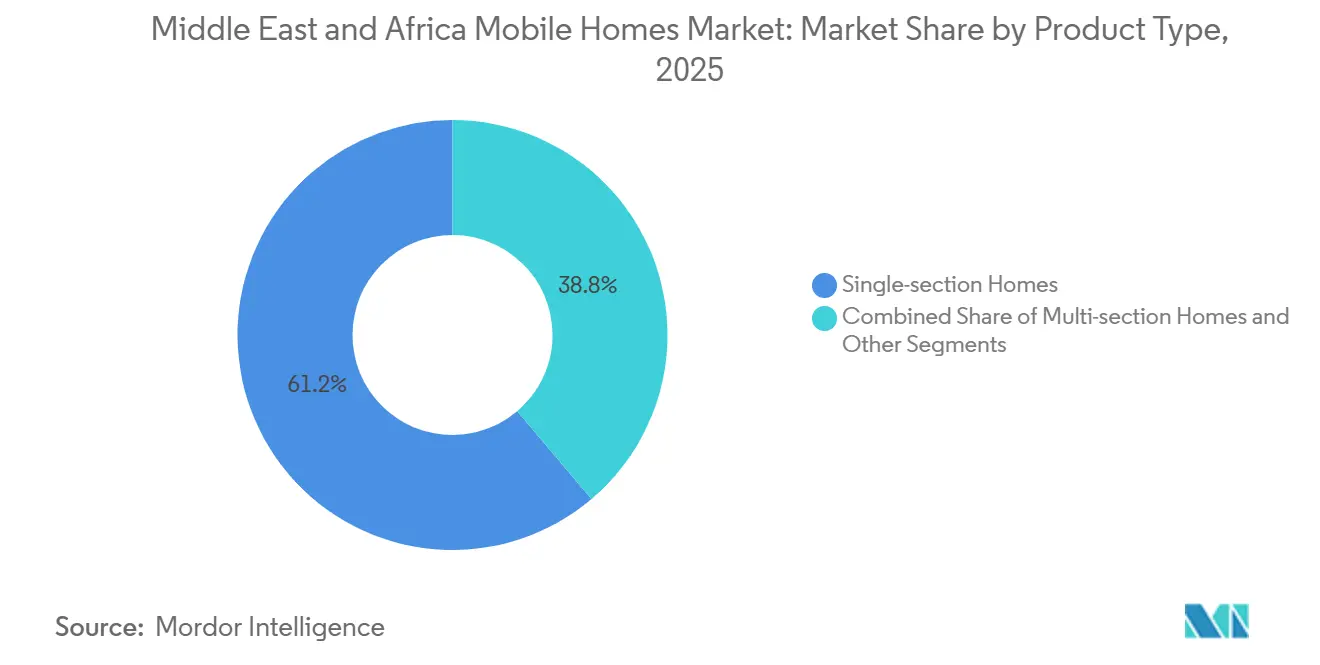
Single-section homes held 61.20% of revenue in 2025, making them the largest product category in the Middle East and Africa mobile homes market. Their lower unit cost and simpler transport profile support use in affordable housing and worksite accommodation. A single-section unit can often be delivered with fewer transport and installation requirements than a larger multi-section structure. This matters where roads, lifting equipment, or site access remain constrained. Multi-section homes serve buyers who need larger residential layouts and have access to suitable installation sites. They remain relevant in South Africa and in projects where land availability supports larger home footprints.
The others category, which includes volumetric modular homes, panelized units, and container-based homes, is forecast to grow at an 11.96% CAGR from 2026 to 2031. This growth reflects demand from worker housing, temporary facilities, tourism sites, and emergency accommodation. Volumetric units suit projects that need rapid deployment and consistent internal finishes. Panelized systems reduce shipping volume and can be assembled with smaller site teams. Container-based formats remain useful for short-duration facilities and remote work areas. The Middle East and Africa mobile homes industry is likely to use a wider mix of formats as buyers balance transport costs against installation speed.



By Material: Steel-Based Construction Holds the Largest Position While Composite and Other Materials Expand
Steel-based construction accounted for 46.80% of revenue in the Middle East and Africa mobile homes market in 2025. Steel offers structural strength and is widely used for units exposed to wind, heat, and repeated relocation. It is also compatible with standardized fabrication lines and modular frames. Timber-based construction retains a role in selected residential applications, particularly where local supply and contractor familiarity are established. Concrete-based construction is relevant for permanent workforce housing and larger projects that require fire resistance and robust structures. Material choice still depends on transport conditions, maintenance needs, local codes, and the expected life of the unit.
Composite and other materials are forecast to grow at an 11.42% CAGR through 2031. Fiber-reinforced polymer panels and insulated hybrid systems can address thermal performance and corrosion concerns. The Middle East and Africa mobile homes market is responding to greater demand for factory-installed insulation and durable exterior finishes. The 2025 United Arab Emirates energy study showed the value of integrated envelope and cooling measures in hot climates. Composite systems can reduce weight compared with some conventional structures. Their adoption will depend on whether buyers accept the higher initial cost in return for lower energy use and maintenance needs.
By Application: Single-Family Housing Anchors Demand While Other Applications Advance
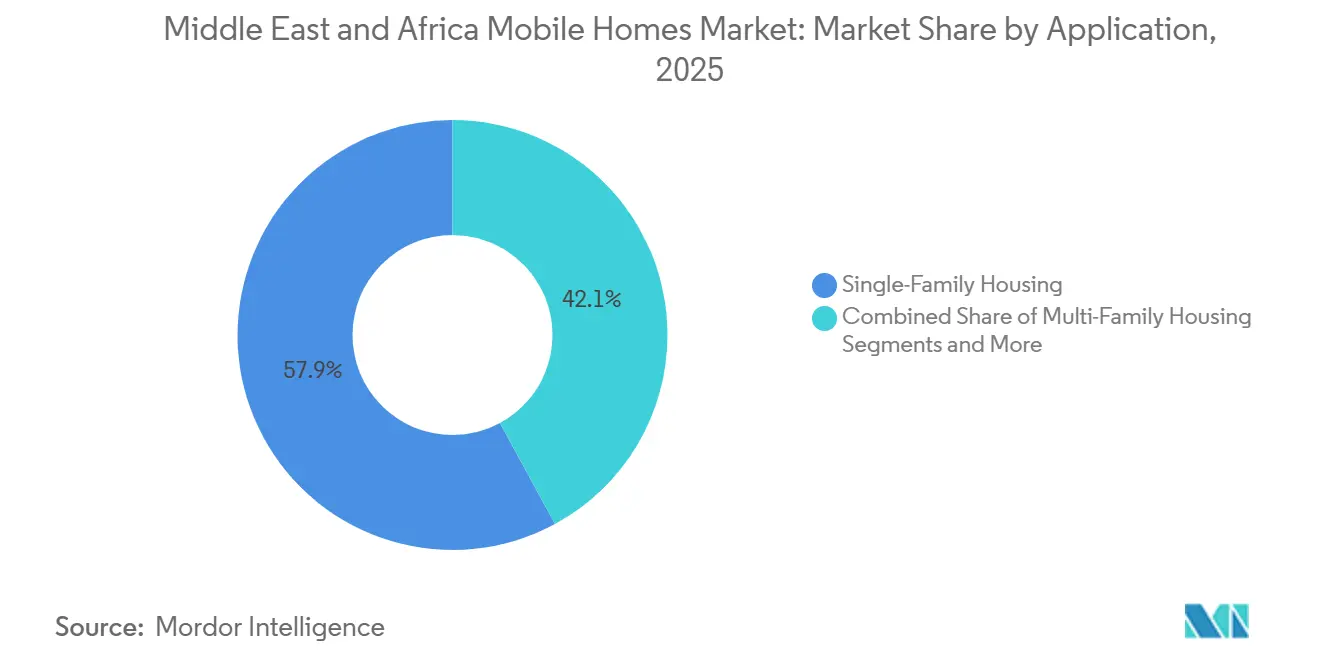
Single-family housing accounted for 57.90% of the value in the Middle East and Africa mobile homes market in 2025. Government housing programs in Saudi Arabia and Egypt support demand for repeatable unit designs. These programs can reduce design variation and improve production planning for suppliers. Egypt’s housing authorities continue to develop large residential programs for a broad range of households. Multi-family housing is relevant in higher-density corridors, where modular construction can reduce disruption at urban sites. The application also supports phased installation for projects that must maintain access around active developments.
The others application segment is projected to grow at a 12.18% CAGR from 2026 to 2031. It includes workforce housing, disaster relief, student accommodation, senior living, eco-lodging, and container-based units. Remote industrial operations need facilities that can be expanded, maintained, and relocated with limited site infrastructure. Karmod’s 2025 mine camp project in Liberia demonstrates the continued need for large worksite accommodation. Low-impact hospitality concepts also support demand for units that limit permanent construction at sensitive sites. The Middle East and Africa mobile homes market will benefit when project owners prioritize speed, mobility, and standardized accommodation.
Geography Analysis
Saudi Arabia held 27.60% of revenue in 2025 and remained the largest national market in the Middle East and Africa mobile homes market. Large housing plans and major construction projects create demand for worker accommodation and standardized residential units. National procurement requirements also encourage suppliers to develop local capability and certification. The country offers larger contract opportunities than many other markets in the region. This can support investment in factories, design teams, and local supply chains. It also makes supplier qualification and project execution capacity particularly important.
The United Arab Emirates is projected to grow at an 11.38% CAGR through 2031, the fastest rate among the countries covered. Developers in the country place greater emphasis on digital planning, quality control, and energy performance. These requirements favor suppliers whose factory processes can document specifications. The Middle East and Africa mobile homes market also finds opportunities in hospitality and staff housing linked to tourism expansion. South Africa and Egypt remain important African demand centers. South Africa draws demand from mining accommodation and portable buildings, while Egypt’s housing programs support standardized residential supply.
The Rest of the Middle East and Africa grouping includes smaller Gulf markets, North African locations, and sub-Saharan mining areas. Industrial accommodation, humanitarian needs, and selective tourism investment shape the mobile homes market in this part of the Middle East and Africa. Karmod installed a 450-person worker camp in Tunisia’s Gafsa mining basin in 2025. The project included 9 structures across 2,560 square meters and was installed within 30 days. Demand varies sharply by site conditions and local approval processes. Suppliers that can adapt logistics, design, and after-sales service to local conditions are better positioned to win these projects.
Competitive Landscape
The Middle East and Africa mobile homes market is fragmented, with numerous regional manufacturers, local assemblers, and portable-building suppliers competing across different countries and end-use applications. Competition varies by geography, project type, and customer requirements rather than being concentrated among a few dominant players. Red Sea International Company is an established participant in Saudi Arabia, operating across modular buildings, remote facilities, and related construction services. AMANA, through its DuBox business, has developed volumetric concrete modules for large-scale projects in Saudi Arabia, while Karmod has supplied workforce accommodation and provided services for mining projects across several African markets. Kwikspace and other local providers compete by offering portable units supported by local installation and maintenance services. Competitive differentiation is based on manufacturing quality, certification, production capacity, project references, delivery capability, and the ability to execute projects in remote or logistically challenging locations.
Manufacturers are increasingly strengthening local production capabilities and integrating design, fabrication, and installation activities to improve delivery efficiency. AMANA completed 1,404 volumetric concrete studios across 27 buildings at the Amaala Staff Village during 2026, while China Harbour Engineering Company established a dedicated manufacturing facility in Riyadh to support the Sedra Project and completed hoisting work for 1,894 villas during the same year. These investments improve local manufacturing capacity and reduce reliance on imported modules, while digital design and production workflows help manufacturers coordinate engineering changes before fabrication begins. Even so, the market remains fragmented because regional manufacturers and local assemblers continue to compete effectively in country-specific projects by leveraging local relationships, flexible production, and responsive project execution.
Demand for composite materials, energy-efficient mobile homes, and lower-impact accommodation solutions is creating opportunities for manufacturers with specialized products and technical capabilities. Compliance with Saudi standards and other national building regulations is becoming increasingly important for high-value contracts, encouraging suppliers to strengthen quality assurance, product testing, and local service networks. At the same time, smaller regional manufacturers continue to compete through customized layouts, faster maintenance support, proximity to project sites, and established local customer relationships. As a result, the Middle East and Africa mobile homes market is expected to remain fragmented, with competitive advantage determined by execution capability, manufacturing reliability, regulatory compliance, and customer support rather than by dominance of a limited number of suppliers.
Middle East and Africa Mobile Homes Industry Leaders
Red Sea International Company
Technical Supplies and Services Co. LLC (TSSC Group)
DuBox
Kwikspace Modular Buildings
Afripanel
- *Disclaimer: Major Players sorted in no particular order

Recent Industry Developments
- July 2026: EcoModular, operated by Ascotway Limited in Ireland, signed a definitive Combination and Share Exchange Agreement to acquire a 60% interest in Modul Consult and a 20% interest in IDS Build. Modul Consult provides modular design, engineering, and manufacturing services from Latvia. IDS Build is an integrated development, project management, and modular construction platform based in Riyadh, with active operations in Saudi Arabia, the United Arab Emirates, and Türkiye. The transaction provides EcoModular with a link between European manufacturing capabilities and delivery capacity in the Gulf Cooperation Council region. The combined platform is intended to serve large projects and residential developments in the region.
- June 2026: Group AMANA, through its modular subsidiary DuBox, announced the completion of Red Sea Global's Amaala Staff Village in Saudi Arabia, with 1,404 pre-finished volumetric concrete modular studios installed across 27 buildings. The project recorded a 30% reduction in construction time, 35% reduction in on-site workforce, a 70% improvement in health, safety, and environmental (HSE) metrics, and over 2.5 million safe person-hours with zero Lost Time Injuries. AMANA deployed digital HSE tools, geotagged inspections, and structured site practices throughout. The project establishes the most rigorously documented modular construction benchmark yet reported in the MEA region and positions DuBox's volumetric concrete module system as the reference method for large-scale giga-project staff accommodation.
- February 2026: LINQ Modular, the prefabricated construction division of ALEC Holdings in the United Arab Emirates, entered a strategic collaboration with SIBS AB of Sweden. The partnership is intended to deliver at least 1,500 modular units each year for residential, commercial, and hospitality projects in the Middle East. SIBS brings industrial production experience from a global portfolio of 7,000 apartments. LINQ contributes its Dubai Municipality modular construction license, which permits the delivery of buildings up to ground floor plus 6 floors in Dubai. The partnership expands the availability of industrialized building supplies for projects in the United Arab Emirates.


Middle East and Africa Mobile Homes Market Report Scope
The Middle East and Africa Mobile Homes Market Report is Segmented by Product Type (Single-Section Homes, Multi-Section Homes, and Others), by Material (Timber-Based Construction, Steel-Based Construction and More), by Application (Single-Family Housing, Multi-Family Housing, and More), and by Country (United Arab Emirates, Saudi Arabia, South Africa, Egypt, and More). The Market Forecasts are Provided in Terms of Value (USD).
| Single-section Homes |
| Multi-section Homes |
| Others (Volumetric Modular Homes, Panelized Mobile Homes, and Container-based Mobile Homes) |
| Timber-Based Construction |
| Steel-Based Construction |
| Concrete-Based Construction |
| Composite and Other Materials |
| Single-Family Housing |
| Multi-Family Housing |
| Commercial, Hospitality, and Institutional Buildings |
| Others (Disaster Relief and Temporary Housing, Student and Senior Housing, Workforce Housing, and Container-based Mobile Homes) |
| United Arab Emirates |
| Saudi Arabia |
| South Africa |
| Egypt |
| Rest of Middle East and Africa |
| By Product Type | Single-section Homes |
| Multi-section Homes | |
| Others (Volumetric Modular Homes, Panelized Mobile Homes, and Container-based Mobile Homes) | |
| By Material | Timber-Based Construction |
| Steel-Based Construction | |
| Concrete-Based Construction | |
| Composite and Other Materials | |
| By Application | Single-Family Housing |
| Multi-Family Housing | |
| Commercial, Hospitality, and Institutional Buildings | |
| Others (Disaster Relief and Temporary Housing, Student and Senior Housing, Workforce Housing, and Container-based Mobile Homes) | |
| By Country | United Arab Emirates |
| Saudi Arabia | |
| South Africa | |
| Egypt | |
| Rest of Middle East and Africa |


Key Questions Answered in the Report
What is the projected value of the Middle East and Africa mobile homes market by 2031?
The Middle East and Africa mobile homes market is projected to reach USD 0.78 billion by 2031, growing at a 9.74% CAGR from 2026.
Which product type leads mobile home demand in the Middle East and Africa?
Single-section homes led with 61.20% of revenue in 2025 because they are simpler to transport and suit standardized housing needs.
Which material is expected to grow fastest in mobile home construction?
Composite and other materials is projected to grow at an 11.42% CAGR through 2031, supported by demand for thermal and corrosion performance.
Why are modular homes used for workforce accommodation in the region?
They can be installed quickly at remote sites and provide housing, sanitation, dining, and office facilities in a single coordinated delivery.
Which country has the largest demand base for mobile homes in the Middle East and Africa?
Saudi Arabia accounted for 27.60% of revenue in 2025, supported by housing programs and major construction projects.
What limits the use of factory-built units in remote African locations?
Cross-border freight, inland transport, limited heavy-haul equipment, and local approval requirements can increase total project costs.
Page last updated on:





