
Middle East and Africa Hydroponics Market Size and Share
Market Overview
| Study Period | 2021 - 2031 |
|---|---|
| Forecast Data Period | 2026 - 2031 |
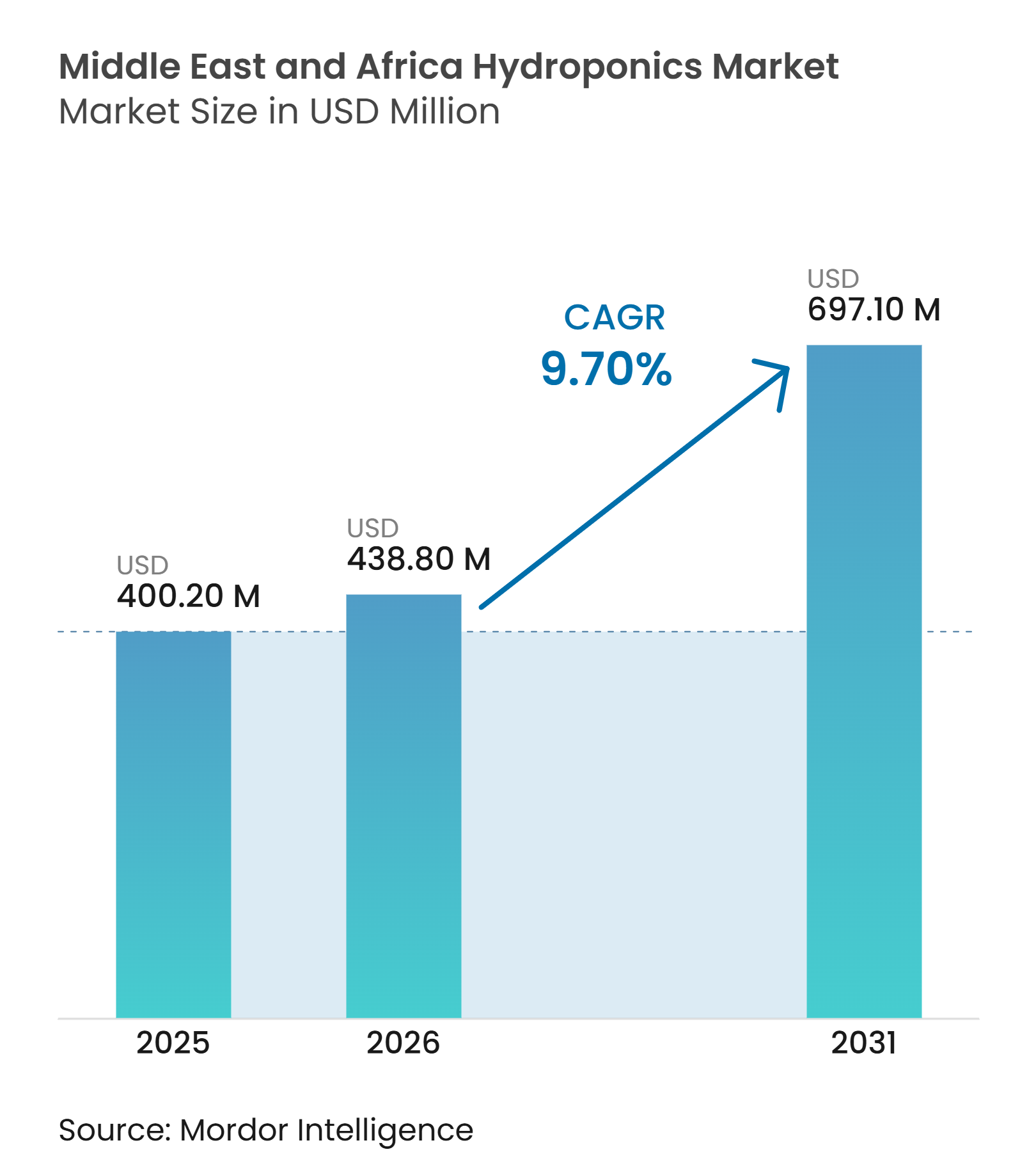
| Base Year Market Size (2025) | USD 400.20 Million |
| Market Size (2026) | USD 438.80 Million |
| Market Size (2031) | USD 697.10 Million |
| Growth Rate (2026 - 2031) | 9.70 % |
| Market Concentration | Medium |
Major Players *Disclaimer: Major Players sorted in no particular order Image © Mordor Intelligence. Reuse requires attribution under CC BY 4.0. | |
Middle East and Africa Hydroponics Market Analysis by Mordor Intelligence
The Middle East and Africa hydroponics market size was valued at USD 400.20 million in 2025 and estimated to grow from USD 438.80 million in 2026 to reach USD 697.10 million by 2031, at a CAGR of 9.7% during the forecast period (2026-2031). Water constraints, food-security priorities, and demand for reliable local produce support the market. Gulf governments treat controlled crop production as part of domestic food supply planning, thereby supporting investment in commercial farms that can maintain local harvests during periods when imported produce faces higher logistics costs or slower deliveries. The Food and Agriculture Organization of the United Nations reported in 2025 that the East and North Africa include 8 of the world’s 10 most water-stressed countries, while agriculture uses 85% of available freshwater. This setting favors recirculating production systems in which water use can be monitored, nutrients can be delivered consistently, and a portion of the water stream can be reused across successive crop cycles. The market also faces high cooling costs, financing constraints, and uneven access to specialized skills across African and Gulf locations, which can delay construction and increase the cost of daily operations in the hydroponics market in the Middle East and Africa, especially for newer farms without established operating procedures.
Key Report Takeaways
- By production system, greenhouse hydroponics held 54% of hydroponic output in 2025, while container farms are the fastest segment with a forecast CAGR of 10.1% through 2031.
- By crop type, tomatoes held a 37% share of the Middle East and Africa hydroponics market size in 2025, while leafy greens are the fastest segment with a forecast CAGR of 23% through 2031.
- By equipment, irrigation components and pumps held 39.5% of deployment in 2025, while lighting systems are the fastest segment with a forecast CAGR of 14.2% through 2031.
- By production scale, large commercial farms held 44% of output in 2025, while small farms are the fastest segment with a forecast CAGR of 13.4% through 2031.
- By geography, the Middle East sub-region held 30% of the Middle East and Africa hydroponics market share in 2025, while Africa is forecast to be the fastest sub-region at a CAGR of 13.5% through 2031.
Note: Market size and forecast figures in this report are generated using Mordor Intelligence’s proprietary estimation framework, updated with the latest available data and insights as of January 2026.
Market Trends and Insights
Drivers Impact Analysis of Middle East and Africa Hydroponics Market*
| Driver | (~) % Impact on CAGR Forecast | Geographic Relevance | Impact Timeline |
|---|---|---|---|
| Water scarcity and closed-loop water efficiency | +2.5% | Middle East and Africa, with highest intensity in the United Arab Emirates and Saudi Arabia | Long term (≥ 4 years) |
| Food-security and import-substitution investment | +2.0% | United Arab Emirates and Saudi Arabia, with relevance across Kenya and Rest of Africa | Medium term (2-4 years) |
| Year-round local fresh-produce demand | +1.5% | Middle East and Africa, with lower intensity in Rest of Africa | Short term (≤ 2 years) |
| Automation, climate control, and precision nutrient delivery | +1.2% | United Arab Emirates, Saudi Arabia, South Africa, and Kenya | Medium term (2-4 years) |
| Farm-as-a-service and build-operate-transfer models | +0.8% | Kenya, Rest of Africa, United Arab Emirates, and Saudi Arabia | Medium term (2-4 years) |
| Solar-powered hydroponics for energy and water resilience | +0.6% | Middle East and Africa | Long term (≥ 4 years) |
| Source: Mordor Intelligence | |||
Water Scarcity and Closed-Loop Water Efficiency
Water scarcity makes controlled hydroponic production commercially relevant across the Middle East and Africa hydroponics market. The Food and Agriculture Organization of the United Nations stated that, in 2025, it projected a 50% decline in renewable water availability per person by 2050 as population and agricultural demand increase[1]. DAVA Agricultural Company stated in 2025 that its glass greenhouse systems use up to 80% less water than soil-based cultivation. Such performance can improve the economics of local produce in areas where groundwater availability is limited, and water charges raise the cost of conventional cultivation, particularly for farms supplying cities with limited nearby agricultural land. In Kenyan arid and semi-arid areas, contained growing systems can also provide a year-round option when rainfall patterns limit conventional output, although commercial results still depend on training, energy access, and reliable crop marketing.
Food-Security and Import-Substitution Investment
Food-security policy supports the hydroponics market in the Middle East and Africa by integrating hydroponic production into national supply planning and providing farm investment with a direct policy rationale in water-constrained importing economies. Saudi Arabia’s Vision 2030 framework identifies agricultural development and food security as national priorities. Saudi Arabia’s Agricultural Development Fund approved SAR 1.5 billion (USD 400 million) in 2023 for domestic vegetable and food production. The United Arab Emirates National Food Security Strategy 2051 also places local crop production among its priorities. These frameworks improve the case for farm projects that serve local retailers, catering operators, and institutional buyers, since local production can be linked directly to national supply objectives rather than only premium consumer demand. They can also support preferred access to agricultural finance, suitable land, and long-term supply arrangements for qualifying producers, giving established operators a clearer route to add capacity than import-focused produce distributors.
Year-Round Local Fresh-Produce Demand
Demand for traceable and locally grown produce supports commercial hydroponic output in urban Gulf markets, where the Middle East and Africa hydroponics market connects local harvest schedules with retailer and food-service purchasing needs. Local farms can reduce dependence on import routes that may be disrupted by weather, logistics constraints, or regional instability. Saudi Arabia historically depended on imports for up to 85% of specific vegetable categories, which provides context for policies that encourage locally controlled production. The Middle East and Africa hydroponics market, therefore, benefits when customers place value on continuity of supply alongside product quality. In South Africa, hydroponic lettuce has also reached wider retail channels rather than remaining limited to specialist outlets. Shoprite Holdings recognized Eldorado Fresh as its 2025 Fresh Produce Supplier of the Year, citing its hydroponic supply partnership. This retail adoption broadens the commercial base for high-volume leafy-green production by creating recurring demand that can support regular harvest planning, cold-chain coordination, and more predictable use of indoor and greenhouse capacity.
Automation, Climate Control, and Precision Nutrient Delivery
Automation is central to farm operations where temperature, humidity, light, and nutrient conditions must be managed continuously. Gulf summer temperatures above 45°C lead to high cooling demand in greenhouse facilities. Pure Harvest Smart Farms uses Iyris SecondSky roofing at its Haradh operation to reduce heat stress and support light diffusion. Emirates Bustanica operates 27 modular growing rooms across 27,000 square meters, using digital controls to monitor growing conditions. These systems allow operators to standardize crop conditions across large facilities and maintain production records. Better records can also give lenders and farm owners stronger evidence on operating performance during financing discussions, especially when projects must demonstrate stable yields and controlled use of energy, water, and nutrient inputs.
Restraints Impact Analysis of Middle East and Africa Hydroponics Market*
| Restraint | (~) % Impact on CAGR Forecast | Geographic Relevance | Impact Timeline |
|---|---|---|---|
| High upfront capital and financing payback risk | -1.50% | Highest in Kenya and Rest of Africa, with moderate relevance in the United Arab Emirates | Long term (≥ 4 years) |
| Cooling-energy intensity and grid reliability | -1.20% | United Arab Emirates and Saudi Arabia, with high relevance in Rest of Africa | Short term (≤ 2 years) |
| Cascade-failure risk in recirculating systems under extreme heat | -0.70% | Saudi Arabia, United Arab Emirates, and Rest of Middle East | Medium term (2-4 years) |
| Limited localization of specialist inputs, skills, and operating protocols | -0.60% | Kenya and Rest of Africa, with relevance in Rest of Middle East and South Africa | Long term (≥ 4 years) |
| Source: Mordor Intelligence | |||
High upfront capital and financing payback risk
Hydroponic farm development requires substantial investment in structures, water systems, cooling equipment, packing areas, and technical management. This requirement limits entry into the hydroponics market in the Middle East and Africa, especially where long-term agricultural lending is scarce. Kenya and other African markets may face a higher risk because specialized debt funding is less widely available. Financing needs continue after a facility begins operating because expansion requires additional production infrastructure. Pure Harvest Smart Farms sought more than USD 100 million for expansion financing in 2024, showing the recurring capital needs of multi-site hydroponic development[2]. Long payback periods can narrow the investor base when project revenue is not supported by secure offtake agreements or public financing, because investors must assess technical execution risk alongside the normal uncertainty of fresh-produce demand.
Cooling-energy intensity and grid reliability
Cooling costs can form a fixed part of operating expenses at Gulf hydroponic facilities. Extreme outdoor temperatures require continuous control of enclosed production areas, particularly for lettuce, herbs, and other temperature-sensitive crops. Energy efficiency cannot eliminate the minimum cooling load required to protect crops during summer conditions. Power interruptions can also cause crop losses when temperature or water circulation fails during a growing cycle. The Middle East and Africa hydroponics market must therefore account for grid stability and backup power during site selection and financial planning. Solar backup and energy-management systems can reduce exposure, but they require additional capital and ongoing maintenance. These constraints favor operators with the capital and technical capacity to design resilient production systems, including backup power, water circulation safeguards, and monitoring procedures that can limit losses during equipment interruptions.
*Our forecasts treat driver/restraint impacts as directional, not additive. The impact forecasts reflect baseline growth, mix effects, and variable interactions.
Middle East and Africa Hydroponics Market Segment Analysis
By Production System:
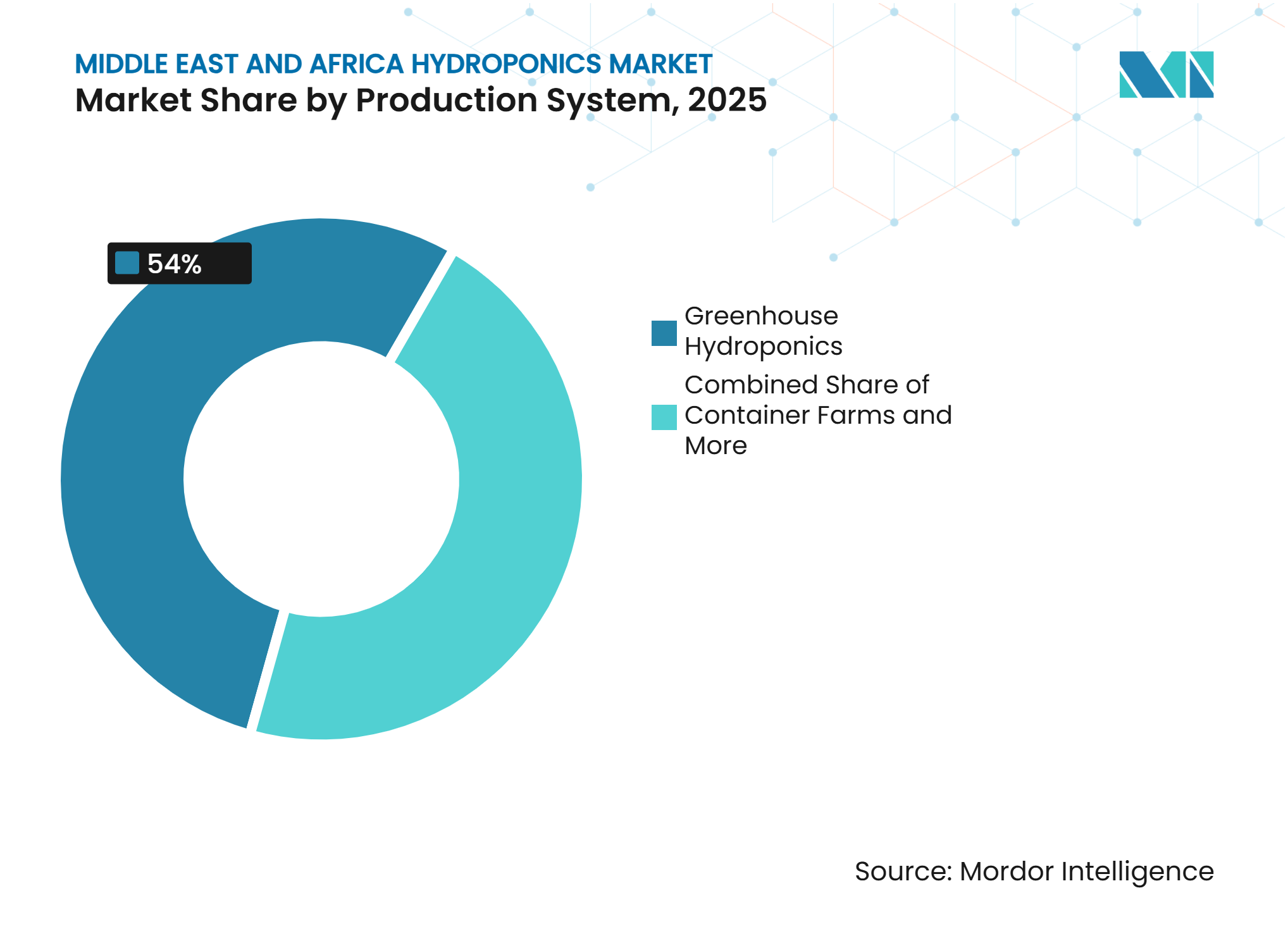
Greenhouse Hydroponics Anchors Commercial ScaleGreenhouse hydroponics held 54% of output in 2025, making it the largest production system in the Middle East and Africa hydroponics market. Glass and polycarbonate structures fit the needs of commercial farms that require protection from heat, dust, and variable outdoor conditions. The format supports tomatoes, cucumbers, peppers, lettuce, and herbs under managed irrigation and climate settings. It also aligns with the large-farm model used by Gulf producers that serve retail, catering, and food-service customers, because a single managed facility can supply several customer channels with standardized grades and scheduled deliveries. Greenhouse systems can use natural light, which reduces the need for fully artificial lighting compared with indoor vertical farms.
Indoor vertical farms occupy a higher-specification position because they rely on controlled lighting and enclosed rooms. Emirates Bustanica produces leafy greens in an indoor vertical facility in Dubai, covering 330,000 square feet[3]. Container farms are forecast to be the fastest production system, with a CAGR of 10.1% during 2026-2031. Their modular design suits locations where permanent construction, land tenure, or initial capital create barriers for larger projects. A 2025 World Food Program-funded pilot in Isiolo County involved 80 farmers using polytunnel hydroponics and reported stronger yields and income than conventional methods. The different adoption paths reflect the region’s varied investment capacity, climate conditions, and farm ownership structures, with permanent greenhouses more suitable for institutional projects and modular units more suitable for phased or distributed deployment.



By Crop Type:
Tomatoes Lead Revenue, Leafy Greens AccelerateTomatoes held 37% of crop output in 2025 and remain the largest crop category in the Middle East and Africa hydroponics market. The crop meets high-volume food-service and retail demand, particularly in Gulf cities, where local supply can reduce reliance on imports. Tomatoes are well-suited to drip irrigation and substrate systems used in commercial greenhouses. Commercial tomato production also requires consistent performance in grading, packing, and delivery, particularly when farms seek to serve buyers beyond their immediate local area. The development showed that commercial hydroponic output from Saudi Arabia can reach export markets when production quality and logistics requirements are met, adding a potential outlet beyond domestic consumption for farms with reliable volume and packing capabilities.
Cucumbers and peppers remain important in greenhouse crop portfolios because they suit protected-culture systems and established local consumption patterns. Herbs and microgreens serve hospitality, food-service, and higher-value retail channels that seek consistent quality and short delivery times. Leafy greens are forecast to be the fastest crop segment, with a CAGR of 23% during 2026-2031. Emirates Bustanica states that it produces more than 1 million kilograms of leafy greens each year using 95% less water than conventional agriculture. Short crop cycles and frequent harvesting can support more regular sales than longer-cycle fruiting crops, which can help operators adjust planting schedules to retailer orders and reduce the revenue gap between successive harvest periods. In South Africa, Eldorado Fresh’s supply relationship with Shoprite shows that lettuce can reach mainstream retail at scale.
By Equipment:
Irrigation Infrastructure Underpins the Operational CoreIrrigation components and pumps accounted for 39.5% of equipment deployment in 2025, making them the largest equipment category used in commercial production. These systems manage water and nutrient delivery, which directly affects crop health, yield quality, and water efficiency. Pumps, channels, emitters, and flow controls must operate reliably throughout the crop cycle. A failure in nutrient delivery can damage an entire batch and cause losses that are difficult to recover from. This makes irrigation infrastructure a core operating priority rather than a peripheral farm input, as precise and dependable circulation supports both resource efficiency and the uniformity required by grocery, hospitality, and catering buyers.
Climate systems are also essential in Gulf facilities because protected cultivation requires ongoing temperature management. Automation and control systems allow farm teams to monitor growing conditions remotely and manage several zones with consistent settings. Lighting systems are forecast to be the fastest equipment category, with a CAGR of 14.2% during 2026-2031. A 2025 scientific study by Tunisian researchers reported efficiency gains from photovoltaic-powered light-emitting diode lighting and connected environmental monitoring in a hydroponic greenhouse. Structural components, including channels, nutrient film technique trays, and racking, remain necessary as facilities add production capacity. Equipment decisions influence farm performance, but equipment sales are not included in the value of hydroponically produced crops, since the sector measures commercial agricultural output rather than the revenue of input and technology suppliers.
By Production Scale:
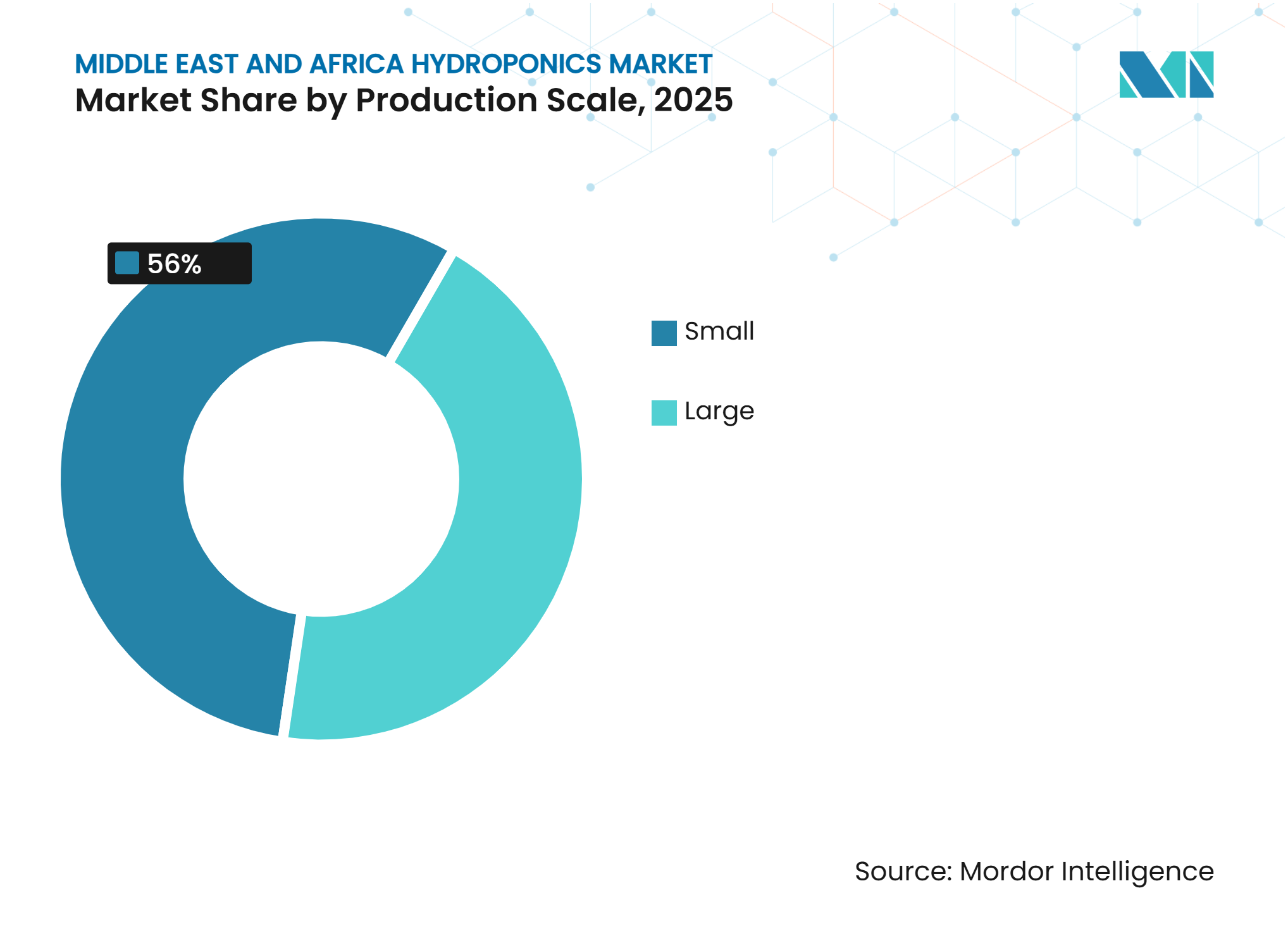
Large Farms Dominate but Small Operations Close the GapLarge commercial farms held 44% of output in 2025, making them the largest production-scale segment. Their scale supports centralized packing, cold-chain links, larger crop volumes, and dedicated technical teams. These farms can negotiate more favorable terms for nutrients, growing media, climate systems, and logistics, while centralized technical teams can apply common operating procedures across a larger planted area. The Middle East and Africa hydroponics market includes several institutional-scale projects in the Gulf, where food-security priorities support large protected farms. DAVA Agricultural Company operates 85 hectares of glass hydroponic greenhouses in Al-Kharj and reported daily output of 135 tonnes in 2025.
Medium farms provide an important route to commercial production when capital for large facilities is unavailable. They often supply retailers and food-service businesses through distributors rather than through direct national contracts. Small farms are forecast to be the fastest scale segment, with a CAGR of 13.4% during 2026-2031. Farm-as-a-Service and build-operate-transfer arrangements can reduce the capital and technical barriers faced by smaller owners. Mishkat Agritech Farms offers 3-7-year offtake agreements that commit to purchasing partner-farm output at predefined prices. This type of arrangement can give smaller facilities a route to technical support and more predictable revenue, helping owners focus on production while the service provider manages crop standards, buyer relationships, and agreed commercial terms.

Geography Analysis
The Middle East sub-region accounted for 30% of commercial hydroponic output in 2025, making it the largest geographic grouping. Saudi Arabia was its dominant production base, is supported by state-backed investment in glass greenhouse production and food-security priorities. Saudi Vision 2030 identifies agricultural development and food security as national priorities. Saudi Arabia historically depended on imports for up to 85% of specific vegetable categories, which supports the case for local controlled production. The United Arab Emirates reinforces the Gulf’s technology position through Emirates Bustanica’s indoor vertical farm in Dubai. Speedex International LLC, operating as UNS Farms, launched a 10,000-square-meter hydroponic tomato facility in Al Ain in May 2026, aligned with the United Arab Emirates National Food Security Strategy 2051.
The integration of hydroponic assets into established food producers is becoming more visible in Saudi Arabia. National Agricultural Development Co. signed an agreement in July 2026 to acquire Pure Harvest Smart Farms’ Haradh facility for SAR 85 million, USD 22.7 million. This transaction places a commercial hydroponic facility within the ownership of an established food producer. The Rest of the Middle East also shows early investment activity through proposed projects and financing initiatives in Bahrain and Qatar. These markets remain smaller than Saudi Arabia and the United Arab Emirates, but they can support compact production formats and local distribution. Water pricing reform and tighter groundwater extraction rules in Gulf countries further improve the economic case for closed-loop cultivation. The effect is strongest where conventional local production faces water limits and import dependence remains high.
Africa is forecast to be the fastest-growing sub-region, with a CAGR of 13.5% during 2026-2031. South Africa is the continent’s most mature hydroponic produce economy because established farms supply large retail channels. Eldorado Fresh operates 50 hectares of hydroponic lettuce and supplies Shoprite through a commercial partnership. Kenya combines rising demand for urban produce with the adoption of Farm-as-a-Service and hydroponic pilots in arid counties. A World Food Program-funded 2025 pilot in Isiolo County involved 80 farmers and reported stronger crop yields and income than conventional methods. The Rest of Africa is attracting greenfield interest, including a phased hydroponic greenhouse project announced for Otavi, Namibia. South Africa’s retail integration, Kenya’s service-model deployment, and investment-led projects elsewhere create a broader base for African growth.
Competitive Landscape
Market Concentration
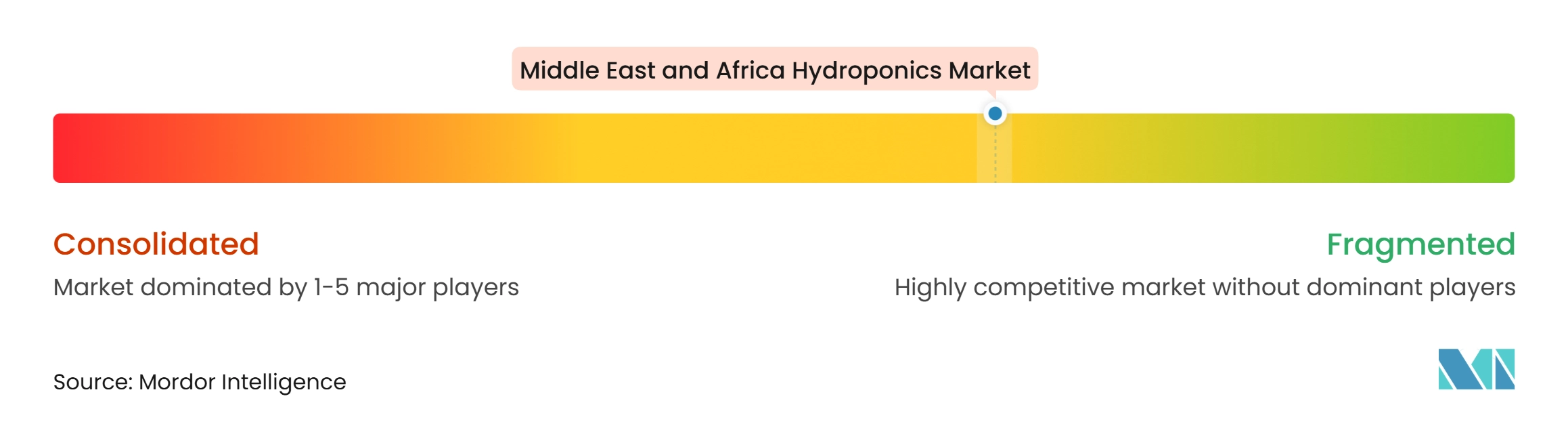
The Middle East and Africa hydroponics market has low to moderate concentration because production is distributed among Gulf greenhouse operators, indoor growers, and African commercial farms. DAVA Agricultural Company, Pure Harvest Smart Farms, and Emirates Flight Catering Co. LLC, operating as Emirates Bustanica, are among the leading producers in terms of operational scale and output. DAVA’s 85-hectare Al-Kharj facility is the region’s largest hydroponic project, with a reported daily production of 135 tonnes in 2025. Emirates Bustanica has an indoor vertical format that supports high-volume leafy-green supply in the United Arab Emirates. South African producers differentiate through established retail relationships and year-round delivery capability.
Scale expansion and service models create different competitive approaches. DAVA announced in 2025 that its Taif project would add 350 hectares of planned glass greenhouse capacity and target 1,000 tonnes of daily fresh produce output by 2030. Pure Harvest Smart Farms has adopted a Farm-as-a-Service approach that combines its production expertise with local partners' asset ownership. Mishkat Agritech Farms uses long-term offtake structures to help farm owners sell output under more predictable terms. These models address different limits on growth, including balance-sheet exposure, operator capability, and access to reliable buyers.
Emirates Flight Catering acquired Bustanica in full in February 2024, bringing the Dubai indoor vertical facility under direct local ownership. Speedex International LLC, operating as UNS Farms, launched a 10,000-square-meter hydroponic tomato facility in Al Ain in May 2026, targeting an annual output of 150,000 kilograms. Arable Grow specializes in leafy greens and herbs for premium restaurants and retail outlets in Riyadh. The competitive field also includes Saudi Greenhouses Management and Agri. Marketing Co., Geap Group, Dream Farm Saudi Arabia, Emirates Hydroponics Farms, The Green System, HYPOFARM, and Sokovo Nature Farms. Competitive advantage rests on reliable crop quality, water management, climate resilience, customer access, and the ability to finance continued capacity additions, rather than on a single common production configuration across all countries.
Middle East and Africa Hydroponics Industry Leaders
-
DAVA Agricultural Company
-
Pure Harvest Smart Farms
-
Emirates Flight Catering Co. LLC (Emirates Bustanica)
-
Eldorado PTY Ltd
-
Saudi Greenhouses Management and Agri. Marketing Co.
- *Disclaimer: Major Players sorted in no particular order
Middle East and Africa Hydroponics Market Companies Covered in this Report
- Emirates Flight Catering Co. LLC (Emirates Bustanica)
- Saudi Greenhouses Management and Agri. Marketing Co.
- Mishkat Agritech Farms
- Speedex International LLC (UNS Farms)
- Geap Group (Geap Farms LLC)
- Eldorado PTY Ltd
- Madron Farming
- Dream Farm, Saudi Arabia
- DAVA Agricultural Company
- The Green System
- Emirates Hydroponics Farms
- Pure Harvest Smart Farms
- Arable Grow
- HYPOFARM
- Sokovo Nature Farms
Recent Industry Developments in Middle East and Africa Hydroponics Market
- May 2026: Speedex International LLC, operating as UNS Farms, launched a 10,000-square-meter hydroponic tomato facility in Al Ain that targets 150,000 kilograms of annual tomato output.
- January 2026: Emirates Bustanica presented an expanded food-service solutions portfolio at Gulfood 2026 for retail, hospitality, and catering partners.
- February 2024: Emirates Flight Catering fully acquired Bustanica, the Dubai indoor vertical hydroponic farm with annual leafy-green production above 1 million kilograms.
Middle East and Africa Hydroponics Market Report Scope
The hydroponics market encompasses soilless crop cultivation systems in which plants are grown using nutrient solutions, with or without an inert medium, across commercial and smaller-scale controlled environments.
Scope exclusions: We exclude aquaponics and soil-based greenhouse or open-field cultivation, even if similar crops are produced.
The Middle East and Africa Hydroponics Market Report is Segmented by Production System (Greenhouse Hydroponics, Indoor Vertical Farms, and Container Farms), by Crop Type (Leafy Greens, Tomatoes, Cucumbers, Peppers, Herbs and Microgreens), by Equipment (Lighting Systems, Irrigation Components and Pumps, Climate Systems, Automation and Control Systems and Structural Components), by Production Scale (Large, Medium, Small), and by Geography (UAE, Saudi Arabia, Rest of Middle East, South Africa, Kenya, and Rest of Africa). The Market Forecasts are Provided in Terms of Value (USD).
Segmentation Overview
| Greenhouse Hydroponics |
| Indoor Vertical Farms |
| Container Farms |
| Leafy Greens |
| Tomatoes |
| Cucumbers |
| Peppers |
| Herbs and Microgreens |
| Lighting Systems |
| Irrigation Components and Pumps |
| Climate Systems |
| Automation and Control Systems |
| Structural Components |
| Large |
| Medium |
| Small |
| Middle East | United Arab Emirates |
| Saudi Arabia | |
| Rest of Middle East | |
| Africa | South Africa |
| Kenya | |
| Rest of Africa |
| By Production System | Greenhouse Hydroponics | |
| Indoor Vertical Farms | ||
| Container Farms | ||
| By Crop Type | Leafy Greens | |
| Tomatoes | ||
| Cucumbers | ||
| Peppers | ||
| Herbs and Microgreens | ||
| By Equipment | Lighting Systems | |
| Irrigation Components and Pumps | ||
| Climate Systems | ||
| Automation and Control Systems | ||
| Structural Components | ||
| By Production Scale | Large | |
| Medium | ||
| Small | ||
| By Geography | Middle East | United Arab Emirates |
| Saudi Arabia | ||
| Rest of Middle East | ||
| Africa | South Africa | |
| Kenya | ||
| Rest of Africa | ||
Key Questions Answered in the Report
What is the projected growth rate for hydroponics in the Middle East and Africa?
The sector is projected to grow at a 9.7% CAGR from 2026 to 2031.
Which production system leads hydroponic output in the region?
Greenhouse hydroponics led with 54% of output in 2025 because it supports commercial scale and managed growing conditions.
Which crop is growing fastest in regional hydroponics?
Leafy greens are forecasted to grow at a 23% CAGR from 2026 to 2031.
What limits commercial hydroponic expansion in Africa and the Gulf?
High capital requirements, cooling costs, grid reliability, and shortages of specialist operating skills limit project expansion.