
Middle East and Africa Dumpsters Market Size and Share
Market Overview
| Study Period | 2021 - 2032 |
|---|---|
| Forecast Data Period | 2027 - 2032 |
| Base Year Market Size (2026) | USD 0.45 Billion |
| Market Size (2027) | USD 0.48 Billion |
| Market Size (2032) | USD 0.67 Billion |
| Growth Rate (2027 - 2032) | 6.90 % |
| Market Concentration | Low |
Major Players *Disclaimer: Major Players sorted in no particular order Image © Mordor Intelligence. Reuse requires attribution under CC BY 4.0. | |
Middle East and Africa Dumpsters Market Analysis by Mordor Intelligence
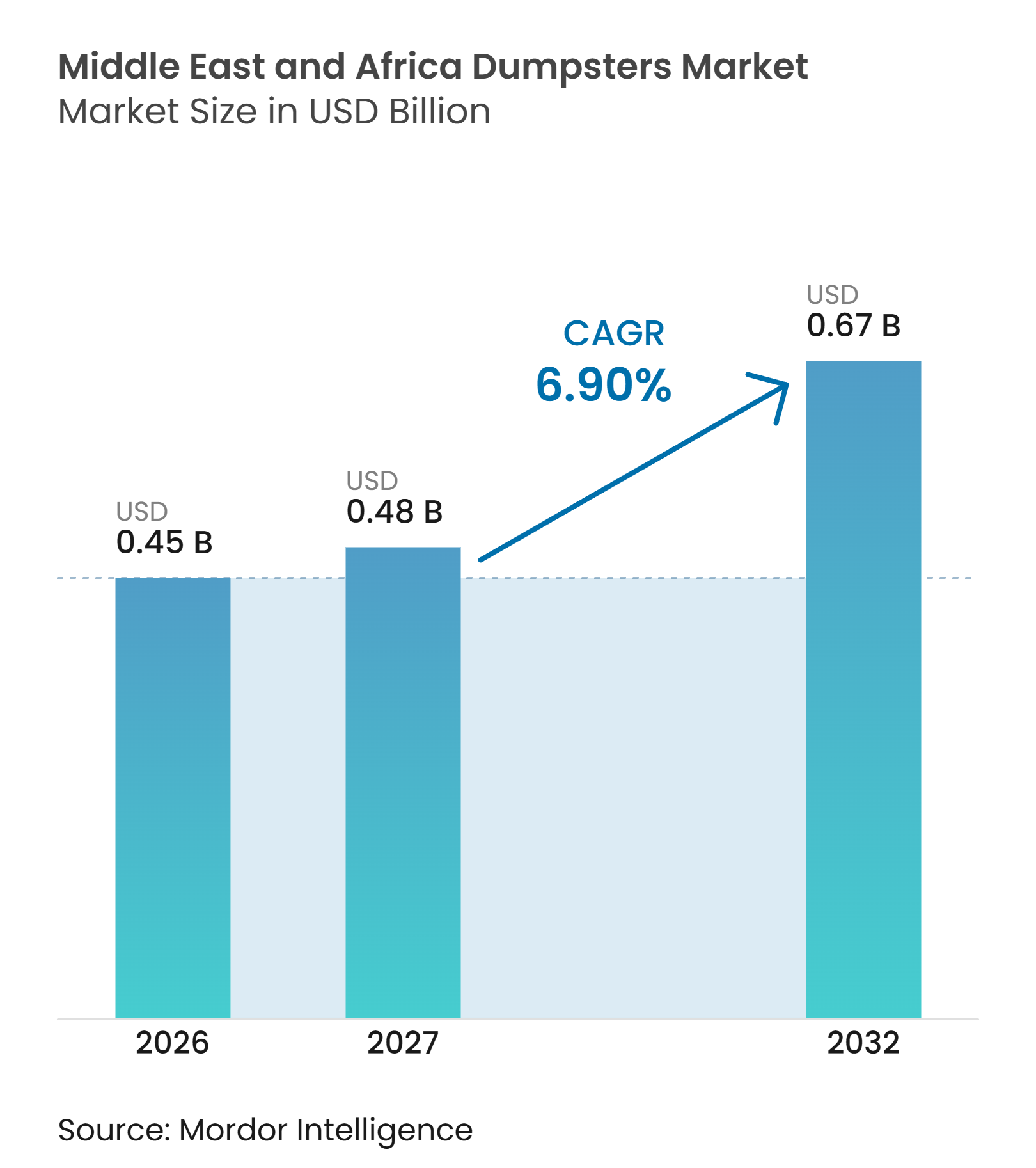
The Middle East And Africa Dumpsters Market size is expected to grow from USD 0.45 billion in 2026 to USD 0.48 billion in 2027 and is forecast to reach USD 0.67 billion by 2032 at 6.90% CAGR over 2027-2032.
Urban growth, formal waste collection, and large construction programs are increasing the need for standardized waste containers across the region. Saudi Arabia’s technical standards are making compliance a more important factor in public procurement, which favors suppliers with certified products and local service capacity. The Gulf construction pipeline supports demand during both building activity and the later operating life of completed facilities. Rental and leasing are also becoming more relevant because contractors, event operators, and hospitality businesses often need containers for limited periods rather than permanent ownership. Input-cost volatility remains a constraint for fabricators, particularly where long-term contracts do not allow price changes.
Key Report Takeaways
- By dumpster type, detachable bulk waste containers held 38% of the Middle East and Africa dumpsters market share in 2026 and are projected to grow at a 7.9% CAGR through 2032.
- By end-user, waste collection and hauling companies held 27% in 2026, while dumpster rental and leasing companies are forecast to record a 7.8% CAGR through 2032.
- By waste type, general and mixed non-hazardous solid waste accounted for 34% of the Middle East and Africa dumpsters market size in 2026, while construction and demolition waste is projected to advance at an 8.4% CAGR through 2032.
- By bin size, 10-to-20-cubic-yard bins held 25% of the Middle East and Africa dumpsters market size in 2026, while the 20-to-30-cubic-yard category is expected to grow at an 8.1% CAGR through 2032.
- By geography, Saudi Arabia held 22% in 2026, while the United Arab Emirates is forecast to grow at an 8.5% CAGR through 2032.
Note: Market numbers in this report are based on Mordor Intelligence's proprietary estimation framework, which combines nine months of actuals with Q4 projections for base year 2026.
Market Trends and Insights
Drivers Impact Analysis of Middle East and Africa Dumpsters Market*
| Driver | (~) % Impact on CAGR Forecast | Geographic Relevance | Impact Timeline |
|---|---|---|---|
| Urban Collection Formalization and Municipal Container Replacement | +1.8% | Saudi Arabia, Egypt, Nigeria, South Africa, United Arab Emirates | Short term (≤ 2 years) |
| Construction and Infrastructure Pipeline | +1.5% | Saudi Arabia, United Arab Emirates, Qatar, GCC-wide | Short term (≤ 2 years) |
| Tightening Landfill Diversion and Waste-Handling Rules | +1.2% | GCC core, Egypt, South Africa | Medium term (2-4 years) |
| Industrial, Logistics, and Hospitality Expansion | +0.9% | United Arab Emirates, Saudi Arabia, Qatar | Medium term (2-4 years) |
| Heat and Sand Driving Corrosion-Resistant Replacement Demand | +0.7% | GCC core, coastal Middle East and Africa | Medium term (2-4 years) |
| Local-Tender Requirements Raising Regional Manufacturing and Spare-Parts Demand | +0.5% | Saudi Arabia, United Arab Emirates, GCC-wide | Medium term (2-4 years) |
| Source: Mordor Intelligence | |||
Urban Collection Formalization and Municipal Container Replacement
Waste collection is moving from informal or inconsistent practices toward regulated systems in major Middle East and African cities. The Gulf cities such as Riyadh, Doha, and Abu Dhabi generate more than 1.5 kg of waste per resident each day, which creates an ongoing need for reliable collection assets. Saudi Arabia published 14 standards and technical guidelines in August 2025 under its Waste Management Law. These guidelines cover container siting, design, waste classification, and operator licensing. They make dimensional compatibility, color coding, and lifting interfaces relevant in municipal purchasing decisions. The resulting replacement cycle is likely to be strongest where older fleets cannot meet the new specifications.
Construction and Infrastructure Pipeline
Construction sites need multiple containers for excavation material, demolition debris, packaging waste, and daily worker activity. The demand does not end when a project is completed because hospitals, stadiums, industrial facilities, and housing developments need permanent collection systems after opening. Saudi Arabia’s fixed delivery dates for Riyadh Expo 2030 and the FIFA World Cup 2034 make some project schedules less flexible. This supports demand in the Middle East and Africa dumpsters market for detachable, hook-lift, skip-lift, and roll-off units during the development period. Qatar and the United Arab Emirates add geographic breadth through energy, aviation, tourism, commercial, and logistics development.
Tightening Landfill Diversion and Waste-Handling Rules
Waste diversion targets are increasing the number of containers needed at each site because separate material streams require separate storage. Saudi Arabia’s national waste system identifies landfill diversion goals of 82% by 2035 and 90% by 2040.[1] Dubai Municipality launched Circle Dubai in October 2025 with a goal of diverting all waste types from landfill by 2041.[2] The program includes 17 strategic projects and supports source sorting across residential, commercial, and industrial locations. Suppliers that provide color-coded and modular containers can address the functional requirements of separate organic, recyclable, and residual waste streams.
Industrial, Hospitality, and Local Supply Expansion
Logistics parks, factories, hotels, and event facilities create regular waste flows that require collection equipment throughout their operating lives. Warehouses and distribution centers need containers that can handle packaging waste and connect with the lifting systems used by waste haulers. Hotels and food-service facilities need covered, washable, and odor-controlled equipment for food and organic waste. High heat, sand, and coastal humidity also shorten the useful life of standard steel containers in parts of the Gulf. Saudi local-content requirements also favor fabricators that can provide domestically made equipment and local spare parts for government-related contracts.[3]
Restraints Impact Analysis of Middle East and Africa Dumpsters Market*
| Restraint | (~) % Impact on CAGR Forecast | Geographic Relevance | Impact Timeline |
|---|---|---|---|
| Low Disposal Fees and Uneven Enforcement of Waste Rules | -1.5% | Sub-Saharan Africa, lower-income Middle East markets | Medium term (2-4 years) |
| Steel, Polymer, Freight, and Imported Component Cost Volatility | -1.2% | Global supply chains, Middle East and Africa importers | Short term (≤ 2 years) |
| Fragmented Municipal Contracts and Non-Standard Lifting Interfaces | -0.8% | Middle East and Africa-wide, smaller municipalities | Medium term (2-4 years) |
| Seasonal Utilization Peaks in Tourism and Event Hubs | -0.5% | United Arab Emirates, Saudi Arabia, Qatar, Bahrain | Short term (≤ 2 years) |
| Source: Mordor Intelligence | |||
Low Disposal Fees and Uneven Enforcement of Waste Rules
Low disposal fees reduce the financial incentive for generators to invest in compliant waste equipment. This issue is most visible where municipal authorities absorb collection costs without passing those costs to property owners, contractors, or industrial operators. Procurement then becomes dependent on public budgets rather than a predictable service requirement. The supplied material identifies uneven enforcement and limited institutional capacity as barriers in Nigeria and other lower-income markets. South African municipal funding constraints can also delay planned replacement cycles. The UAE’s National Agenda for Integrated Waste Management includes a proposed minimum landfill disposal fee, which would reduce incentives that favor noncompliant disposal practices.
Steel, Polymer, Freight, and Imported Component Cost Volatility
Steel, polymer, freight, and insurance costs make pricing difficult for manufacturers that depend on imported inputs. According to an industry association, there was a 17% increase in the producer price index for steel mill products during 2025, which raised fabrication and component expenses. Polymer price changes also affect plastic bin bodies, lids, and related components. Fixed-price contracts can leave producers exposed when input prices rise after a tender is awarded. This issue is more acute in price-sensitive municipal contracts that lack escalation clauses. Local production can reduce some freight exposure, but it does not fully remove dependence on global steel and resin markets. Additionally, exchange rate fluctuations can increase the landed cost of imported steel sheets, plastic resins, hydraulic components, and specialized fittings, particularly in emerging markets. Smaller manufacturers often have limited bargaining power when negotiating bulk material purchases and face difficulties passing higher costs to municipal authorities and waste collection companies. These pressures can increase working-capital requirements, encourage higher raw-material inventory levels, and delay investments in manufacturing capacity. Consequently, sustained input-cost volatility can reduce profit margins, limit competitive pricing flexibility in tenders, and slow the replacement of aging dumpster fleets.
*Our forecasts treat driver/restraint impacts as directional, not additive. The impact forecasts reflect baseline growth, mix effects, and variable interactions.
Middle East and Africa Dumpsters Market Segment Analysis
By Dumpster Type:
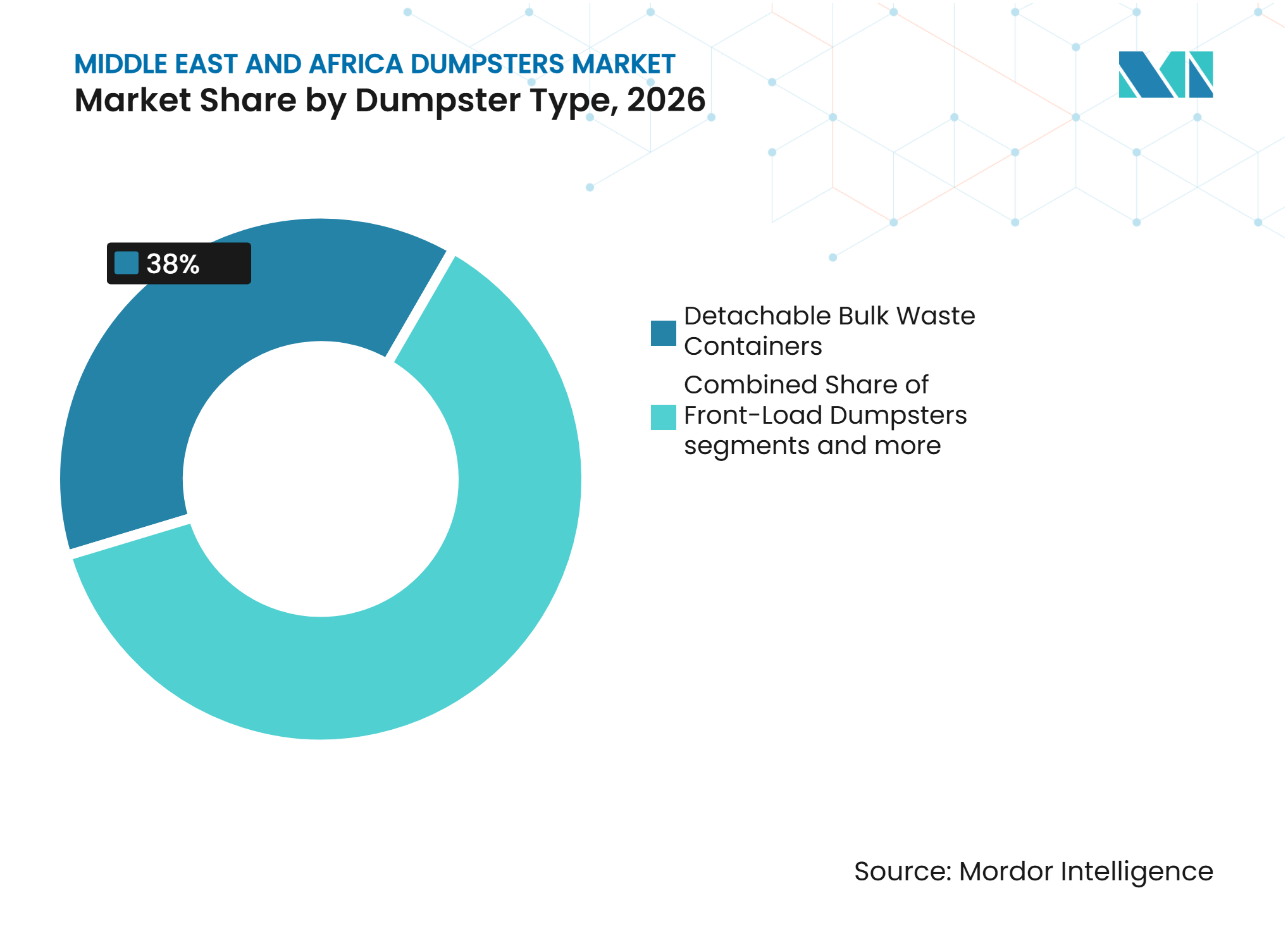
Detachable Containers Support Large-Project CollectionDetachable bulk waste containers accounted for 38% of the Middle East and Africa dumpsters market size in 2026 and are forecast to expand at a 7.9% CAGR through 2032. Their leading position reflects their use in construction, demolition, industrial handling, and high-volume collection. Hook-lift, skip-lift, cable-hoist, and roll-off formats allow operators to move heavy material efficiently between a site and a disposal or recovery facility. They are commonly used on major project sites in the Middle East and Africa dumpsters market where debris volumes exceed the capacity of smaller stationary units. Dubai Municipality’s construction and demolition waste guidance sets requirements for compliant collection and transportation at registered sites.
Front-load containers remain important for commercial properties and residential blocks because they work with established collection routes. Rear-load containers have a role in narrower streets and older dense commercial areas where front access is less practical. These formats serve different collection conditions rather than directly replacing detachable units. Municipal fleets and private haulers also consider lifting compatibility when selecting a container type. This makes standard interfaces as important as volume capacity in many purchases. Other specialized containers continue to address sanitation and controlled waste storage needs.



By End-User:
Haulers Lead While Rental Demand ExpandsWaste collection and hauling companies held 27% of regional demand in 2026. Private collection contracts in Saudi Arabia, the United Arab Emirates, and South Africa require fleets of containers that match vehicle lifting systems. Haulers therefore buy standardized equipment for defined service areas and collection routes. Municipalities and public authorities remain an important buyer group, especially where regulatory standards shape new tenders. Dubai’s 2026 implementing bylaw for its waste management law specifies obligations for building owners and waste collection operators.
Dumpster rental and leasing companies are expected to grow at a 7.8% CAGR through 2032. Contractors, event managers, and hospitality operators often favor rental because their waste volumes are temporary or variable. This model shifts a portion of the Middle East and Africa dumpster market spending from a single equipment purchase to recurring fleet use. Construction and demolition contractors still purchase heavy-duty units directly when regular use justifies ownership. Commercial buyers such as hospitals, malls, campuses, and hotels seek covered and odor-controlled containers. Industrial companies and recycling operators maintain demand for large-capacity equipment that can manage bulk materials.
By Waste Type:
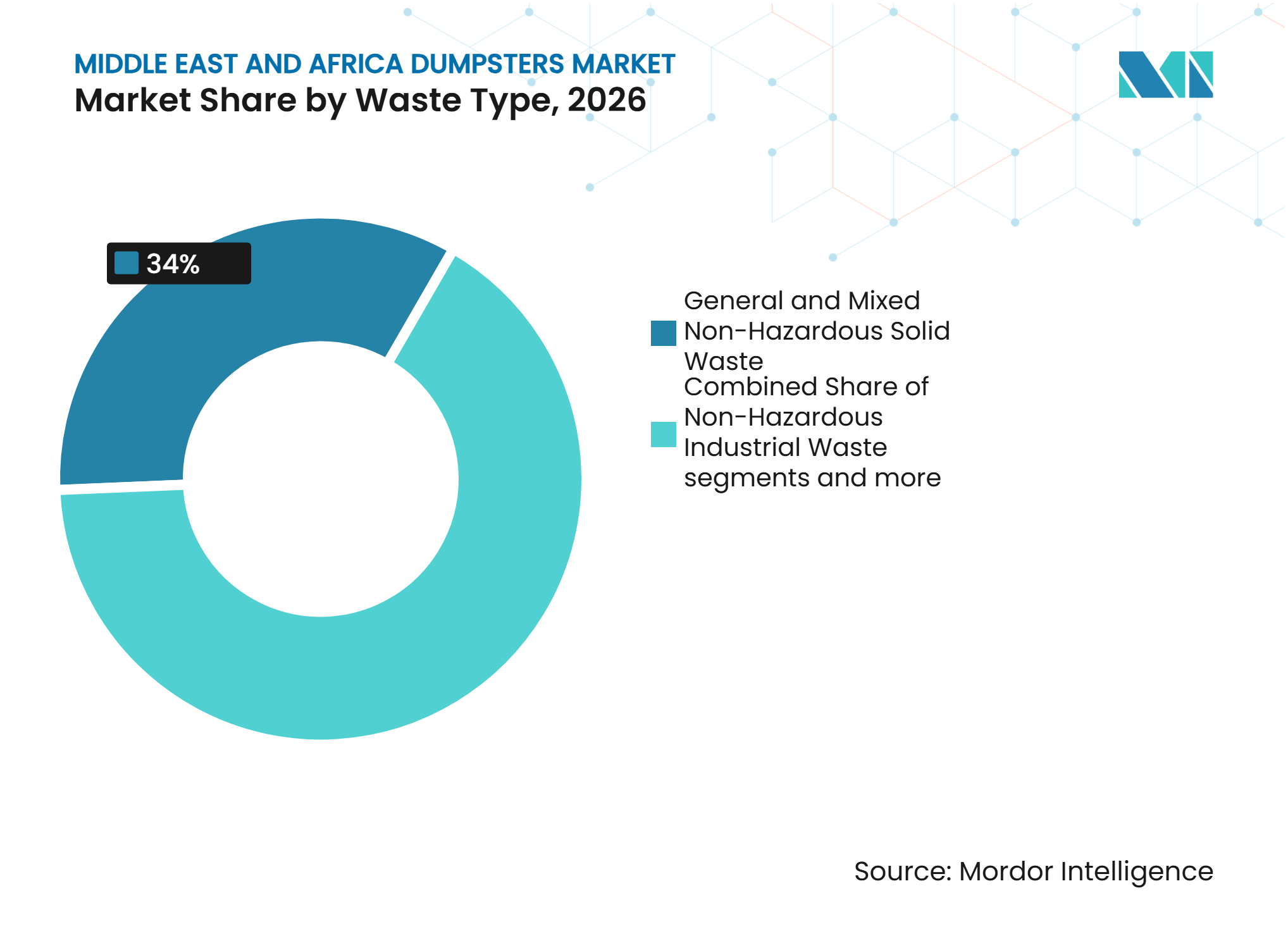
Construction and Demolition Waste Has the Fastest GrowthGeneral and mixed non-hazardous solid waste represented 34% of regional demand in 2026. This stream has broad demand because it covers residential, commercial, and institutional sites across the region. Construction and demolition waste is forecast to grow at an 8.4% CAGR through 2032. Excavation, demolition, fit-out work, and packaging from large construction projects support this outlook. Detachable containers are especially suited to these materials because of their capacity and transport flexibility.
Recyclable materials are creating additional demand as collection systems separate paper, cardboard, plastics, glass, and metals. Dubai Municipality’s mandatory waste segregation guidance requires segregation at source in the specified settings. Organic waste requires enclosed, sealed, and washable equipment to support hygiene and collection quality. Dubai’s organic-waste guidelines specify waterproof brown containers and tight-fitting lids for collection points. Non-hazardous industrial waste offers a steady requirement in expanding industrial zones. Bulky waste and site-cleanout material generate more seasonal demand during fit-out and deep-cleaning periods.

By Bin Size:
Mid-Capacity Units Lead, and Larger Units Grow FasterThe 10-to-20-cubic-yard category held 25% of regional demand in 2026. It fits many commercial collection routes and construction sites across the Middle East and Africa dumpster market with regular daily debris volumes. This range balances capacity with the handling needs of common collection vehicles. Saudi Arabia’s container placement guide provides dimensional and clearance requirements for public areas and high-density developments. Such requirements encourage operators to use approved container sizes and placement practices.
The 20-to-30-cubic-yard segment is forecast to expand at an 8.1% CAGR through 2032. Large construction sites and logistics facilities can produce daily material volumes that make smaller containers less efficient. Units of up to 3 cubic yards and 3-to-6 cubic yards remain relevant where space is limited, especially at hotels and interior commercial locations. The 6-to-10-cubic-yard range serves medium-sized commercial developments and food manufacturing facilities. Units of 30-to-40 cubic yards and above 40 cubic yards are concentrated in demolition, bulk industrial activity, and large events. Hajj operations also create short-duration demand for high-capacity collection equipment under specific waste controls.
Geography Analysis
Saudi Arabia
Saudi Arabia held 22% of the Middle East and Africa dumpsters market share in 2026. The Kingdom has the region’s most extensive framework for container standards, service-provider licensing, and waste-management compliance. MWAN’s 2025 standards and technical guidelines increase the importance of certified designs in municipal and industrial tenders. The national system links waste management priorities with diversion targets and wider environmental policy. Large development programs require containers during construction and after facilities are occupied. Local-content rules can also encourage public buyers to select domestic fabricators with accessible parts and maintenance support. This combination of standards, construction activity, and domestic procurement requirements gives suppliers a reason to maintain a local manufacturing and service presence.
United Arab Emirates
The United Arab Emirates is forecast to grow at an 8.5% CAGR through 2032. Dubai’s circular waste program and the national agenda for integrated waste management promote more organized treatment and source separation. Circle Dubai aims to divert all waste types from landfill by 2041 and places collection practices within a wider set of 17 strategic projects. Dubai’s waste management law and its 2026 implementing bylaw provide a legal basis for container and operator requirements. The country’s logistics, commercial, and hospitality facilities add ongoing packaging, food, and organic waste volumes. Smart collection features, including fill-level monitoring and route optimization, are becoming relevant in advanced municipal programs. Suppliers able to combine durable container designs with compatible identification and monitoring systems can address these procurement needs.
Africa and Smaller GCC Markets
Qatar’s energy, aviation, and tourism development supports near-term requirements for construction and operational waste collection. Kuwait, Oman, and Bahrain contribute smaller but steady demand through national development plans, logistics activity, and waste-processing projects. Egypt’s policy direction supports greater sorting and collection capacity through its Waste Management Law and Extended Producer Responsibility framework. Nigeria’s plastic restrictions and collection enforcement activity indicate a tighter operating environment for formal waste systems. South Africa’s producer-responsibility rules and diversion objectives support segregation-ready equipment, although municipal funding can slow replacement in secondary cities. Regulatory conditions therefore vary considerably across these markets. Suppliers serving the Middle East and Africa dumpsters market need flexible product ranges and local service models rather than a uniform regional approach.
Competitive Landscape
Market Concentration
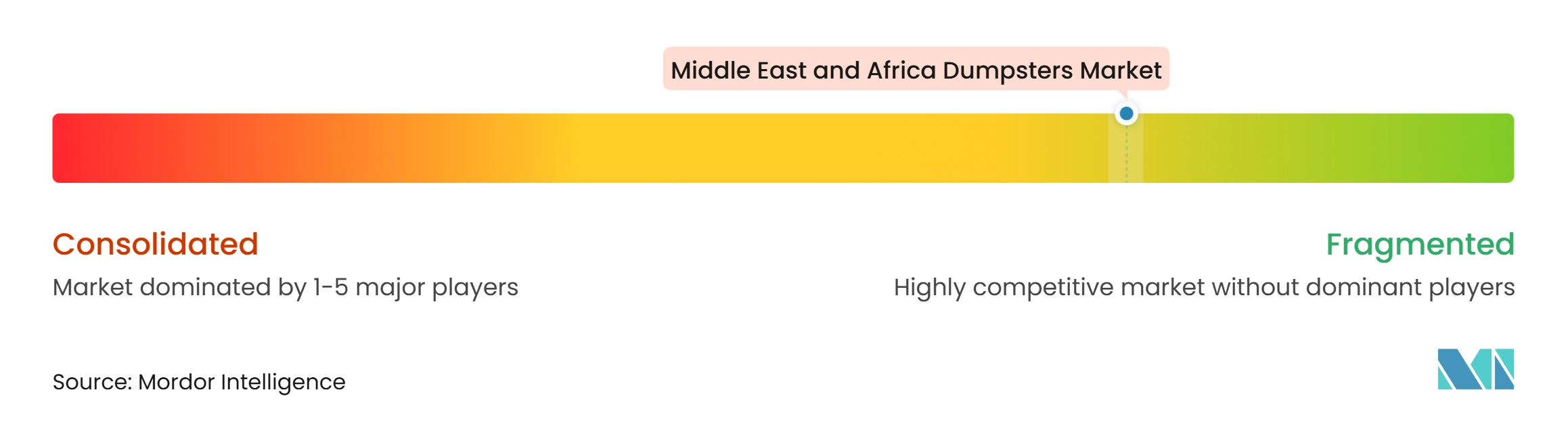
The Middle East and Africa dumpsters market exhibits a low level of market concentration, with local fabricators, importers, distributors, and regional suppliers serving different country groups. Saudi-based producers focus on the Kingdom’s municipal, industrial, and project-related tenders. United Arab Emirates distributors connect buyers with imported European and Asian container brands. South African manufacturers supply industrial and municipal customers in Sub-Saharan markets. Compliance with container dimensions, materials, and lifting interfaces is becoming an important competitive requirement in formal tenders. Suppliers that can support certified products and local spare parts are better positioned in the Middle East and Africa dumpsters market as procurement specifications become more detailed.
Saudi local-content measures are changing the choice between imported and locally fabricated equipment. The Local Content and Government Procurement Authority requires factories to submit a periodic industrial scan for inclusion on the mandatory national products list. This favors suppliers that can document local production and provide support after delivery. Saudi Aramco has also reported 145 agreements and memoranda of understanding worth USD 9 billion at its 2025 IKTVA forum, illustrating the broader policy focus on domestic supply chains. In Dubai, the 2026 waste management bylaw creates enforceable container criteria across sectors. These changes make compliance capabilities and service coverage more valuable than a simple low-price offer.
Smart-container features offer a developing area of competition in municipal and smart-city procurement. RFID identification, fill-level sensors, and digital traceability can support collection planning where cities are investing in monitoring and route management. Corrosion-resistant designs are also relevant in coastal and high-temperature locations. Galvanized steel, stainless steel, and durable coatings can reduce the replacement needs of containers exposed to humidity, salt, and sand. Regional gaps remain in standardized hook-lift interfaces, affordable segregation equipment, and designs that can be repaired locally.
Middle East and Africa Dumpsters Industry Leaders
-
SeaTrail
-
Al Khoory Industries
-
Beringer Middle East FZC
-
Egbert Taylor Middle East LLC
-
German Distribution and POWER Bear
- *Disclaimer: Major Players sorted in no particular order
Middle East and Africa Dumpsters Market Companies Covered in this Report
- SeaTrail
- Al Khoory Industries
- Beringer Middle East FZC
- Egbert Taylor Middle East LLC
- German Distribution and POWER Bear
- Al Shirawi Equipment Company LLC
- AHR Group
- Crateco Pack LLC
- The Saudi Drum Factory (SRCO)
- Al-Babtain Factory for Metal Industries
- KALD International Metal Industries Factory
- Alarabat
- Wasaet Alnqil Factory for Metal Products
- Saleh Abdulaziz Al-Rashed and Sons Company
- Active Metal Factory
- Bulkmatech
- JJ Fabrications
- Duncanmec
- WasteServ
- EnviroServ
- Agiville Industries Limited
Recent Industry Developments in Middle East and Africa Dumpsters Market
- October 2026: Dubai's Administrative Resolution No. (34) of 2026, issuing the implementing bylaw of Law No. (18) of 2024 on waste management, came into force. The bylaw defines hazardous waste container specifications, including chemical-resistance requirements, color-coding standards, and weather-resistance mandates, establishing enforceable container procurement criteria across all sectors in Dubai.
- October 2025: Dubai Municipality launched Circle Dubai, a comprehensive waste diversion roadmap targeting 100% landfill diversion by 2041, backed by 17 strategic projects across nine sectors. The initiative mandates 100% source sorting in residential areas. It introduces smart collection technologies, including fill-level monitoring and route optimization, materially expanding the specification requirements for container deployments across the emirate.
- October 2025: Saudi Arabia's Local Content and Government Procurement Authority announced a requirement for all factories to submit a periodic industrial scan through the Industry platform, effective December 1, 2025, as a prerequisite for inclusion on the mandatory national products list. This move strengthens local procurement obligations for waste containers across government and state-owned enterprise contracts.
- August 2025: Saudi Arabia's Ministry of Environment, Water, and Agriculture published all 14 approved standards and technical guidelines for the Waste Management Law in the official gazette. The guidelines cover container siting, design standards, waste classification, and operator licensing, creating a comprehensive technical framework that replaces legacy municipal specifications.
Middle East and Africa Dumpsters Market Report Scope
The Middle East and Africa Dumpsters Market Report is segmented by Dumpster Type (Front-Load Dumpsters, Rear-Load Dumpsters, and More), by End-User/Buyer (Waste Collection and Hauling Companies, and More), by Waste Type (General and Mixed Non-Hazardous Solid Waste, and More), by Bin Size (Up to 3 Cubic Yards, and More), and by Geography (Saudi Arabia, Qatar, and More). The Market Forecasts are Provided in Terms of Value (USD).
Segmentation Overview
| Front-Load Dumpsters | |
| Rear-Load Dumpsters | |
| Detachable Bulk Waste Containers | Cable-Hoist / Rail Roll-Off Containers |
| Hook-Lift Containers | |
| Skip-Lift / Chain-Lift Containers | |
| Other Detachable Container Configurations | |
| Other Dumpster Types |
| Waste Collection and Hauling Companies | |
| Dumpster Rental and Leasing Companies | |
| Municipalities and Public Waste Authorities | |
| Construction, Demolition and Infrastructure Contractors | |
| Commercial and Institutional Establishments | Retail and Shopping Centers |
| Hospitality, Restaurants and Food Service | |
| Offices and Commercial Buildings | |
| Healthcare and Educational Institutions | |
| Real Estate and Facility Management Companies | |
| Other Commercial and Institutional Establishments | |
| Industrial and Manufacturing Companies | |
| Recycling and Material Recovery Companies | |
| Other Direct Buyers |
| General and Mixed Non-Hazardous Solid Waste |
| Construction and Demolition (C&D) Waste |
| Recyclable Waste (Paper, Cardboard, Plastics, Glass and Metals) |
| Organic and Green Waste (Food, Yard, Landscape and Horticultural Waste) |
| Non-Hazardous Industrial Waste |
| Bulky Waste and Cleanout Materials |
| Other Non-Hazardous Waste |
| Up to 3 Cubic Yards |
| 3 to 6 Cubic Yards |
| 6 to 10 Cubic Yards |
| 10 to 20 Cubic Yards |
| 20 to 30 Cubic Yards |
| 30 to 40 Cubic Yards |
| Above 40 Cubic Yards |
| Saudi Arabia |
| United Arab Emirates |
| Qatar |
| Kuwait |
| Oman |
| Bahrain |
| South Africa |
| Egypt |
| Nigeria |
| Rest of Middle East |
| By Dumpster Type | Front-Load Dumpsters | |
| Rear-Load Dumpsters | ||
| Detachable Bulk Waste Containers | Cable-Hoist / Rail Roll-Off Containers | |
| Hook-Lift Containers | ||
| Skip-Lift / Chain-Lift Containers | ||
| Other Detachable Container Configurations | ||
| Other Dumpster Types | ||
| By End-User/Buyer | Waste Collection and Hauling Companies | |
| Dumpster Rental and Leasing Companies | ||
| Municipalities and Public Waste Authorities | ||
| Construction, Demolition and Infrastructure Contractors | ||
| Commercial and Institutional Establishments | Retail and Shopping Centers | |
| Hospitality, Restaurants and Food Service | ||
| Offices and Commercial Buildings | ||
| Healthcare and Educational Institutions | ||
| Real Estate and Facility Management Companies | ||
| Other Commercial and Institutional Establishments | ||
| Industrial and Manufacturing Companies | ||
| Recycling and Material Recovery Companies | ||
| Other Direct Buyers | ||
| By Waste Type | General and Mixed Non-Hazardous Solid Waste | |
| Construction and Demolition (C&D) Waste | ||
| Recyclable Waste (Paper, Cardboard, Plastics, Glass and Metals) | ||
| Organic and Green Waste (Food, Yard, Landscape and Horticultural Waste) | ||
| Non-Hazardous Industrial Waste | ||
| Bulky Waste and Cleanout Materials | ||
| Other Non-Hazardous Waste | ||
| By Bin Size (Capacity) | Up to 3 Cubic Yards | |
| 3 to 6 Cubic Yards | ||
| 6 to 10 Cubic Yards | ||
| 10 to 20 Cubic Yards | ||
| 20 to 30 Cubic Yards | ||
| 30 to 40 Cubic Yards | ||
| Above 40 Cubic Yards | ||
| By Geography | Saudi Arabia | |
| United Arab Emirates | ||
| Qatar | ||
| Kuwait | ||
| Oman | ||
| Bahrain | ||
| South Africa | ||
| Egypt | ||
| Nigeria | ||
| Rest of Middle East | ||
Key Questions Answered in the Report
What is the projected value of the Middle East and Africa dumpsters sector by 2032?
The Middle East and Africa dumpsters market is projected to reach USD 0.67 billion by 2032, growing at a 6.9% CAGR from 2027.
Which dumpster type has the largest share in the Middle East and Africa?
Detachable bulk waste containers lead with a 38% share in 2026 and are also forecast to grow at a 7.9% CAGR through 2032.
Why are waste-container standards important in Saudi Arabia?
Saudi Arabia’s 2025 technical standards address container design, siting, waste classification, and operator licensing, which can require fleet upgrades.
Which end-user category is expanding fastest?
Dumpster rental and leasing companies are expected to grow at a 7.8% CAGR through 2032 as temporary projects favor flexible access to equipment.
What waste stream is growing fastest in the region?
Construction and demolition waste is forecast to expand at an 8.4% CAGR through 2032 because of sustained project activity.
Which country is expected to grow fastest through 2032?
The United Arab Emirates is forecast to grow at an 8.5% CAGR, supported by logistics, commercial, hospitality, and waste-diversion initiatives.