
Middle East and Africa Data Center Water Management Market Size and Share
Market Overview
| Study Period | 2021 - 2032 |
|---|---|
| Forecast Data Period | 2027 - 2032 |
| Base Year Market Size (2026) | USD 0.34 Billion |
| Market Size (2027) | USD 0.39 Billion |
| Market Size (2032) | USD 0.67 Billion |
| Growth Rate (2027 - 2032) | 11.43 % |
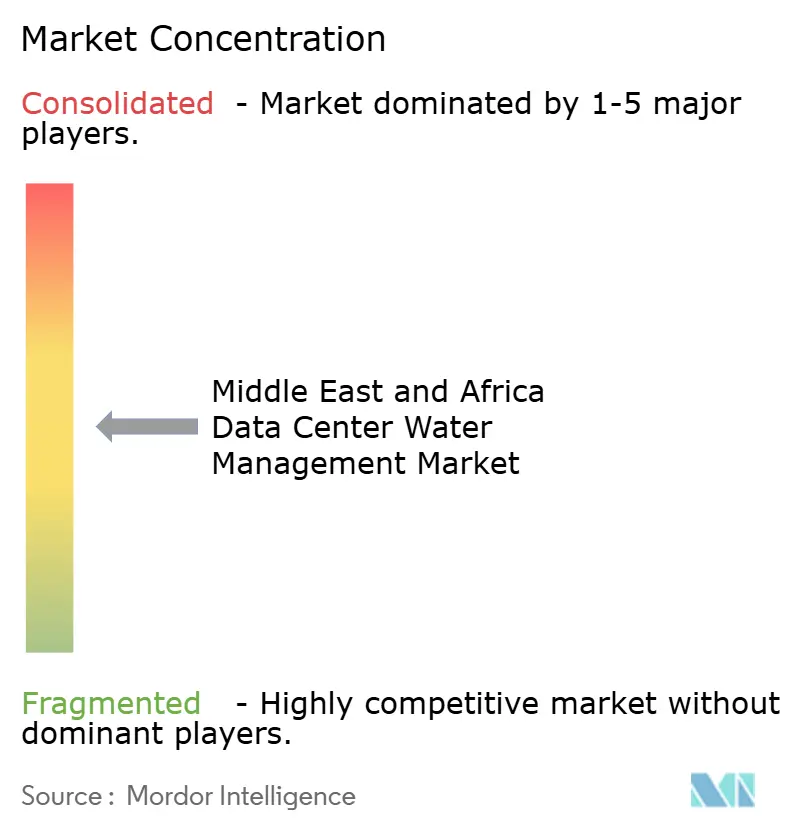
| Market Concentration | Medium |
Major Players *Disclaimer: Major Players sorted in no particular order Image © Mordor Intelligence. Reuse requires attribution under CC BY 4.0. | |
Middle East and Africa Data Center Water Management Market Analysis by Mordor Intelligence
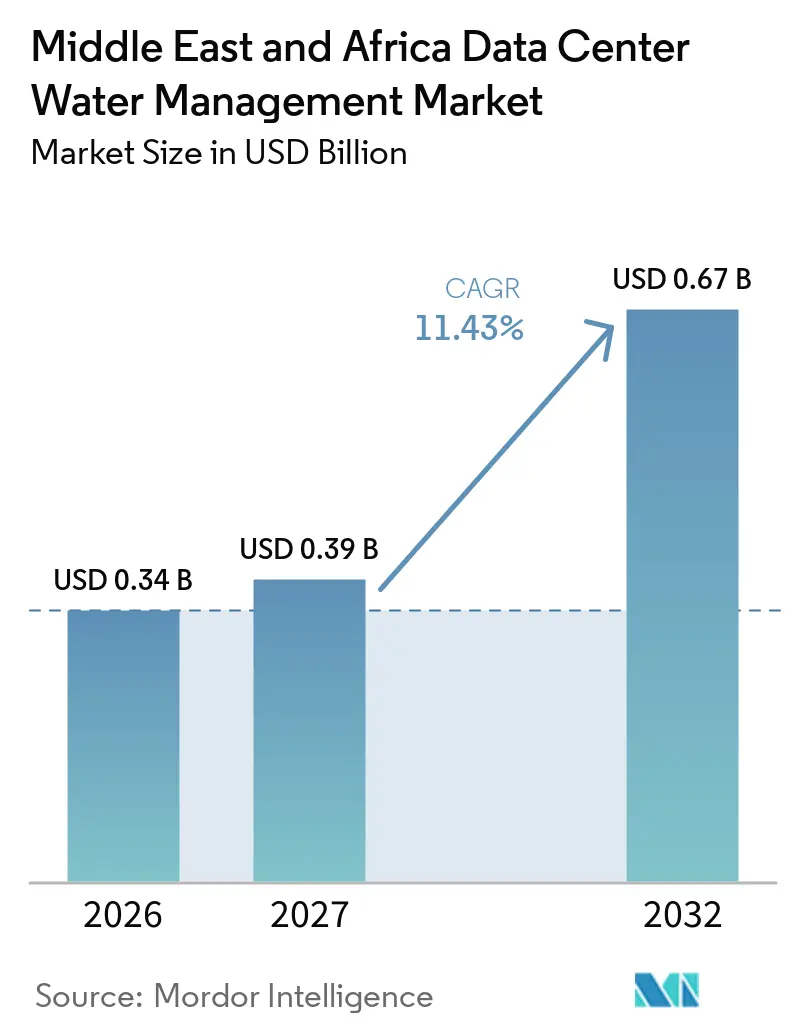
The Middle East and Africa data center water management market size is projected to expand from USD 0.34 billion in 2026 and USD 0.39 billion in 2027 to USD 0.67 billion by 2032, registering a CAGR of 11.43% between 2027 to 2032. The Middle East and Africa data center water management market is being shaped by denser AI workloads, which require tighter cooling-water control and reliable monitoring. Large projects in the United Arab Emirates and Saudi Arabia are moving water treatment, reuse, and reporting closer to core facility design requirements. Operators also face higher exposure to water availability, water quality, and community concerns, especially where desalinated or reclaimed water is used. These conditions favor suppliers that can combine treatment equipment with measurement, automation, and ongoing services. Procurement is increasingly influenced by finance and customer reporting requirements as well as by facility operations.
Key Report Takeaways
- By solution type, water treatment and quality monitoring systems held 22.87% of the Middle East and Africa data center water management market share in 2026, while water recycling and reuse management systems are projected to expand at an 11.89% CAGR through 2032.
- By water management application, cooling system water management accounted for 37.26% of the market in 2026, while water recycling and reuse is projected to expand at an 11.92% CAGR through 2032.
- deployment model, on-premises systems held 50.98% of the market in 2026, while cloud-based water management systems are projected to expand at a 12.14% CAGR through 2032.
- By service type, system installation and integration services held 37.23% of the market in 2026, while managed water management services are projected to expand at an 11.97% CAGR through 2032.
- By data center size, hyperscale data centers held 40.98% of the market in 2026 and are projected to expand at a 12.16% CAGR through 2032.
- By data center type, cloud service providers held 34.78% of the market in 2026 and are projected to expand at a 12.24% CAGR through 2032.
- By geography, the United Arab Emirates held 39.11% of the Middle East and Africa data center water management market share in 2026, while Saudi Arabia is projected to expand at a 12.31% CAGR through 2032.
Note: Market numbers in this report are based on Mordor Intelligence's proprietary estimation framework, which combines nine months of actuals with Q4 projections for base year 2026.
Market Trends and Insights
Drivers Impact Analysis of Middle East and Africa Data Center Water Management Market*
| Driver | (~) % Impact on CAGR Forecast | Geographic Relevance | Impact Timeline |
|---|---|---|---|
| AI and High-Density Workloads Increasing Cooling-Water Management Requirements | +2.8% | Global, with concentrated impact in United Arab Emirates and Saudi Arabia hyperscale zones | Short term (≤ 2 years) |
| Expansion of Hyperscale and Colocation Capacity Across GCC and Africa | +2.2% | GCC core, with spillover to South Africa, Egypt, and East Africa | Medium term (2-4 years) |
| GCC Water-Security Programs Accelerating Closed-Loop Cooling | +1.7% | United Arab Emirates, Saudi Arabia, and Qatar | Medium term (2-4 years) |
| Rising Water Tariffs and Desalination Costs Improving Reuse Economics | +1.5% | Saudi Arabia, United Arab Emirates, Kuwait, and Oman | Short term (≤ 2 years) |
| Treated Sewage Effluent and Non-Potable Water Becoming Viable Data Center Inputs | +1.2% | United Arab Emirates, Saudi Arabia, and early adoption in Qatar | Medium term (2-4 years) |
| Water Stewardship Metrics Entering Data Center Procurement and Financing Decisions | +0.8% | Global mandate, with stronger compliance pressure in GCC and South Africa | Long term (≥ 4 years) |
| Source: Mordor Intelligence | |||
AI and High-Density Workloads Increasing Cooling-Water Management Requirements
High-density AI designs place far greater demands on cooling systems than conventional server configurations. This shift supports direct-to-chip liquid cooling and immersion designs that need careful water chemistry management. High-salinity makeup water can increase the need for corrosion control and biofouling prevention in these systems. Research on direct-to-chip cooling identifies microbial films as a material thermal resistance risk, making biological control important for stable performance.[1] The Middle East and Africa data center water management market therefore benefits from demand for monitoring, treatment, and managed services around liquid cooling loops. This demand is most visible in the United Arab Emirates and Saudi Arabia, where high-density facilities are being developed.
Expansion of Hyperscale and Colocation Capacity Across GCC and Africa
The Middle East and Africa data center water management market is supported by a large pipeline of hyperscale and colocation capacity across the Gulf and Africa. Major AI campus plans in the United Arab Emirates and Saudi Arabia are raising demand for water systems that are designed alongside power and cooling assets. Each new AI-ready facility requires metering, treatment, recycling, and reporting systems. South Africa, Kenya, Egypt, and Nigeria are also attracting cloud and colocation investment, although their procurement needs differ from those of Gulf hyperscale sites. A 2025 dataset covering 41 African countries found that 8 of 11 selected countries used less water per unit of AI computing than the global average, partly because their electricity systems had lower water intensity. Suppliers with modular products and local service models can address the more distributed development pattern across African markets.
GCC Water-Security Programs Accelerating Closed-Loop Cooling
Water-security policies are making closed-loop cooling and water measurement more relevant to new data center projects. Saudi Arabia’s Ministry of Environment, Water and Agriculture has linked digital transformation and water security objectives with its Vision 2030 water-sector agenda.[2] Qatar’s use of non-potable water for district cooling also provides a framework for lower-freshwater cooling designs. The Middle East and Africa data center water management market gains as operators prepare evidence of water efficiency before requirements become stricter. These steps support procurement for advanced metering, leak detection, treatment, and reuse infrastructure. ISO 14001 alignment can also support enterprise and government customer requirements for environmental management.
Rising Water Tariffs and Desalination Costs Improving Reuse Economics
Water costs strengthen the case for reuse systems where facilities depend on purchased water or desalination. Saudi industrial water tariffs in Jubail and Yanbu were revised to SAR 8.04/m³ in December 2025, equivalent to USD 2.14/m³ using the stated SAR/USD rate of 3.75. Treated sewage effluent was priced at SAR 3.00/m³, equivalent to USD 0.80/m³, at Saudi industrial parks in the supplied evidence. This cost difference makes onsite treatment more relevant for closed-loop cooling applications. The Middle East and Africa data center water management market also benefits where reuse improves the predictability of operating costs. Equipment vendors can respond with staged treatment packages that allow facilities to add capacity as water demand rises.
Restraints Impact Analysis of Middle East and Africa Data Center Water Management Market*
| Restraint | (~) % Impact on CAGR Forecast | Geographic Relevance | Impact Timeline |
|---|---|---|---|
| High Upfront Cost of Membrane Treatment and Zero-Liquid-Discharge Systems | -0.9% | GCC and South Africa, with the greatest pressure on mid-size colocation and enterprise facilities | Short term (≤ 2 years) |
| Limited Advanced Water-Systems Skills Outside Tier-One Data Center Hubs | -0.6% | Rest of Africa, smaller GCC markets, and Egypt | Medium term (2-4 years) |
| Intermittent Municipal Supply and Water-Quality Variability at Emerging Sites | -0.4% | Sub-Saharan Africa, Egypt, and secondary Saudi and United Arab Emirates cities | Medium term (2-4 years) |
| Corrosion and Biofouling Risk in Desalinated and Reclaimed-Water Loops | -0.3% | Global, with highest operating impact in GCC | Short term (≤ 2 years) |
| Source: Mordor Intelligence | |||
High Upfront Cost of Membrane Treatment and Zero-Liquid-Discharge Systems
Upfront investment remains a material barrier for advanced water treatment at smaller facilities. Full zero-liquid-discharge systems can achieve 95-99% recovery, but the supplied evidence places capital costs at USD 3-8 million for typical data center-scale applications.[3] The same evidence places operating costs at USD 5-15 per thousand gallons treated. Standard reverse-osmosis configurations cost USD 100,000-500,000, but still require specialised feasibility assessment. This is more difficult for colocation operators in Africa and secondary Gulf markets because smaller facilities capture fewer scale benefits. High salinity in Gulf water supplies can further require specialised materials and chemical programs.
Limited Advanced Water-Systems Skills Outside Tier-One Data Center Hubs
The shortage of experienced designers, commissioning teams, and operators can delay advanced water projects outside the largest hubs. Direct-to-chip cooling with alternative water sources requires process engineering, cooling chemistry, and building management system integration. South Africa’s Department of Water and Sanitation stated in a 2026 parliamentary response that data centers are treated as industrial water users under standard licensing arrangements. The response also indicated that sector monitoring capacity remains early in its development beyond major urban centers. This can delay commissioning in locations such as Egypt, Kenya, and smaller Gulf markets. Managed service contracts can reduce the burden on end users, but suppliers must first build local delivery networks.
*Our forecasts treat driver/restraint impacts as directional, not additive. The impact forecasts reflect baseline growth, mix effects, and variable interactions.
Middle East and Africa Data Center Water Management Market Segment Analysis
By Solution Type:
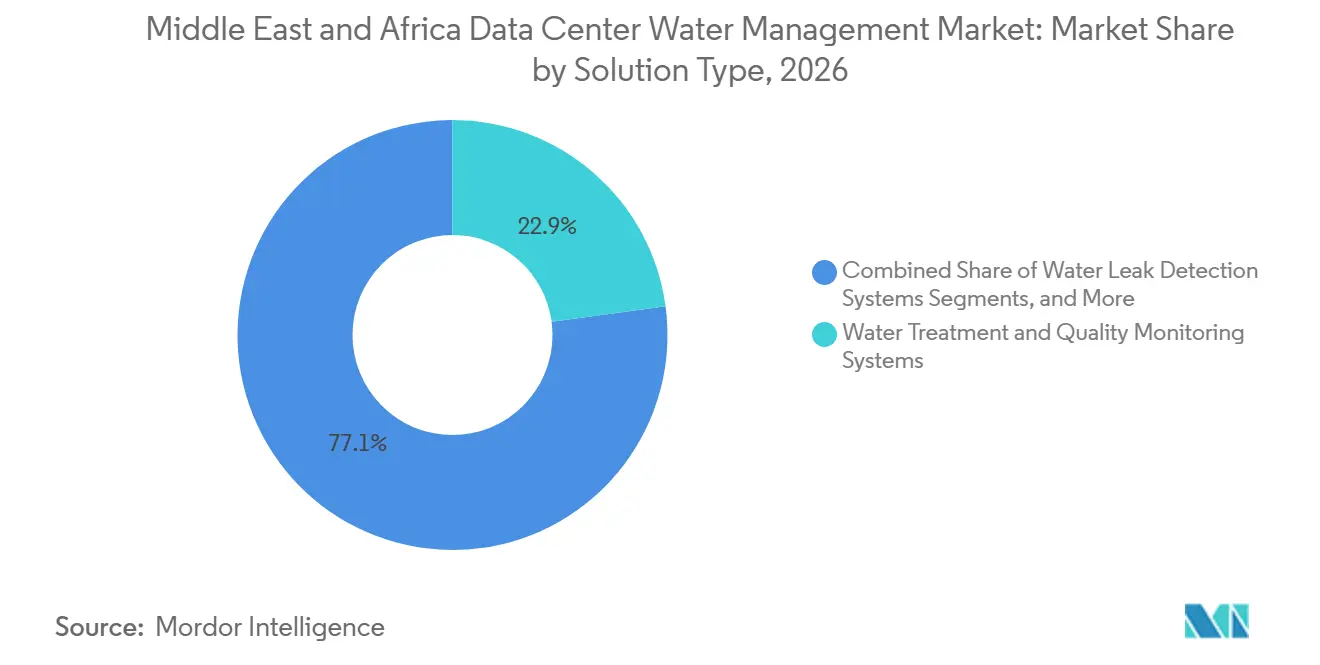
Recycling Systems Gain Ground as Potable Water Costs RiseWater treatment and quality monitoring systems held 22.87% of the Middle East and Africa data center water management market size in 2026. These systems provide corrosion inhibition, scale control, and biofouling prevention for water-intensive cooling operations. Water monitoring and metering systems support Water Usage Effectiveness reporting and provide data for operating dashboards. Leak detection is also becoming more relevant in new campuses and retrofit projects because coolant incidents can harm high-value equipment. Water treatment remains a baseline requirement regardless of the facility’s size or cooling design, which keeps the Middle East and Africa data center water management market tied to everyday operating reliability as well as new construction.
Water recycling and reuse management systems are projected to expand at an 11.89% CAGR through 2032. Rising tariffs and water-security requirements are increasing the appeal of conditioning non-potable sources for cooling. Water management software and analytics platforms are serving as an integration layer for treatment, metering, and leak detection data. Ecolab introduced a cooling management solution for AI and high-performance computing data centers in May 2025, with real-time coolant monitoring and liquid cooling reliability features. Suppliers that combine software with operating support can move from periodic maintenance toward condition-based intervention.

By Water Management Application:
AI Cooling Loads Drive System UpgradesCooling system water management accounted for 37.26% of the Middle East and Africa data center water management market size in 2026. High ambient temperatures in GCC locations make cooling water management central to availability and operating continuity. Cooling systems need well-managed water quality to reduce scale, corrosion, and biological fouling. This application also includes the equipment and processes that maintain stable cooling-water supply. High-density AI equipment makes failures in these systems more consequential.
Water recycling and reuse is projected to expand at an 11.92% CAGR through 2032. A 2026 study modeled 4,775 data centers and 57,547 wastewater treatment plants and found that using treated municipal effluent for cooling could conserve 1,300 million m³ of freshwater annually at national scale. Water supply, distribution, and wastewater management remain important supporting applications. Leak prevention and consumption reporting are also gaining attention as large customers require verified water-withdrawal and Water Usage Effectiveness data. These applications are likely to become more structured as policy requirements develop beyond the United Arab Emirates and Qatar, giving the Middle East and Africa data center water management market a wider base of repeat operational demand.
By Deployment Model:
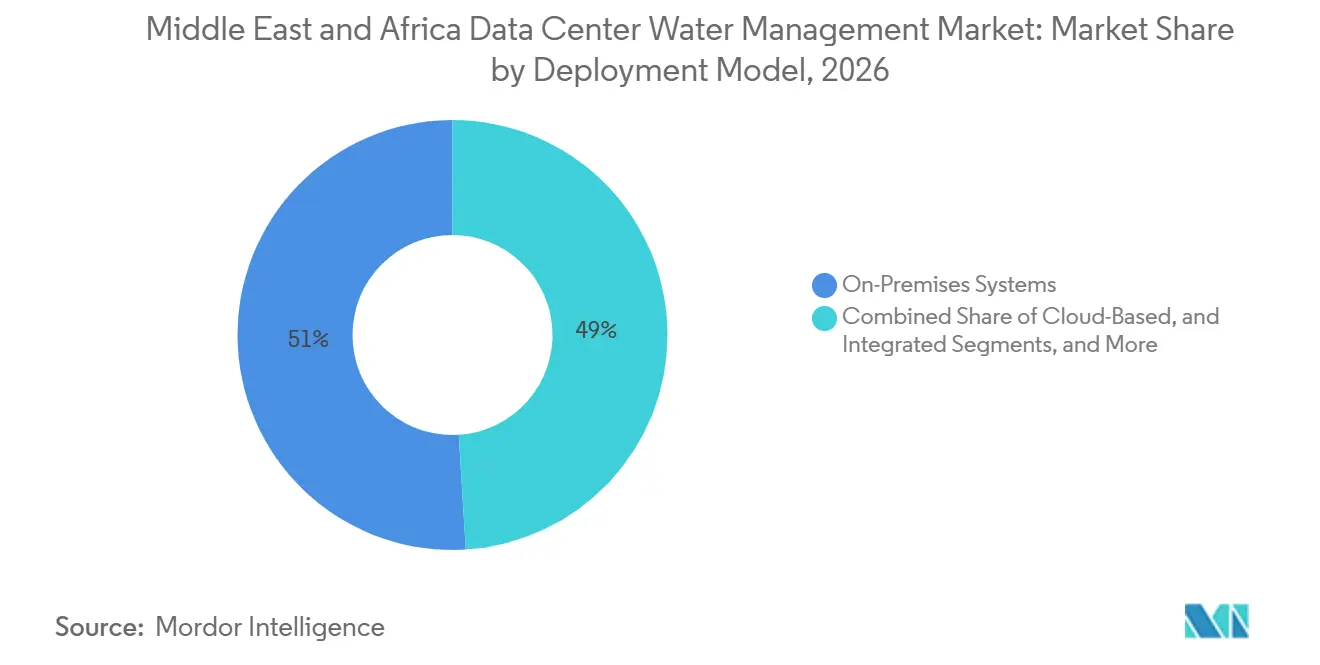
Cloud Tools Challenge On-Premises DominanceOn-premises systems held 50.98% of the deployment mix in 2026. Existing building management systems and local control preferences support this position, particularly at sovereign cloud and government facilities. Local deployment can help operators manage access to sensitive operational data. It also provides direct control over process equipment at a single site. These factors preserve demand for on-premises architecture in established data centers and leave the Middle East and Africa data center water management market with an important installed-base opportunity.
Cloud-based systems are projected to expand at a 12.14% CAGR through 2032. They can help multi-site operators compare water performance across locations and identify facilities that require attention. Cloud platforms can also support predictive maintenance by combining sensor data with service workflows. Hybrid systems are emerging in new hyperscale projects, with local process controls linked to central analytics and reporting. Grundfos reported that its distributed pumping and smart-control systems can reduce cooling energy consumption by up to 54% compared with conventional centralized systems.
By Service Type:
Operators Shift From Installation to Managed ServicesSystem installation and integration services accounted for 37.23% of service revenue in 2026. Advanced water infrastructure requires substantial engineering work when it is added to facilities designed around generic cooling systems. Installation teams must connect treatment equipment, monitoring devices, controls, and cooling assets. This work can be particularly demanding during retrofits, where downtime must be minimized. The Middle East and Africa data center water management market therefore retains a meaningful installation services component.
Managed water management services are projected to expand at an 11.97% CAGR through 2032. Operators are outsourcing continuous monitoring, water chemistry management, and compliance reporting where internal skills are limited. Monitoring and maintenance services also support warranty requirements for high-value liquid cooling equipment. Water audits are becoming more relevant in infrastructure due diligence and customer reporting. Ecolab stated that it helped customers conserve more than 885 billion liters of water across industries in 2024. Performance-based contracts can make these services more attractive when they link fees with measurable operating outcomes.
By Data Center Size:
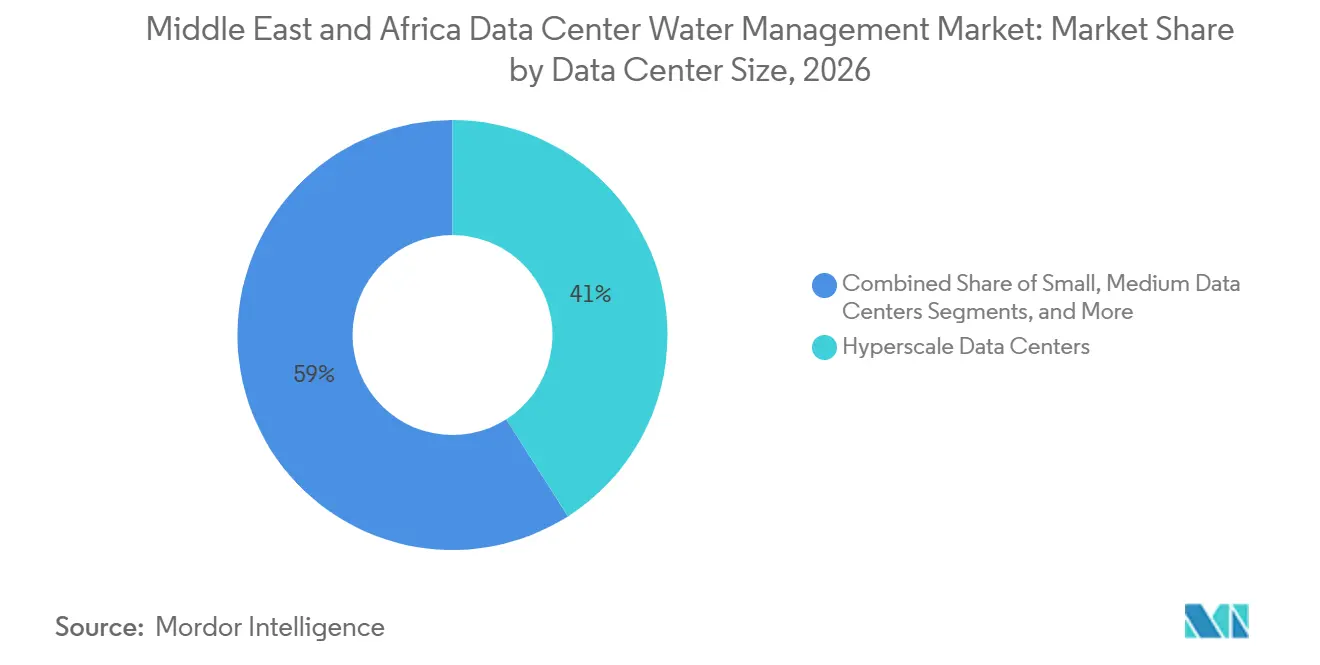
Hyperscale Operators Define the AgendaHyperscale data centers held 40.98% of the market in 2026. They are also projected to expand at a 12.16% CAGR through 2032. Their water systems must manage large daily volumes, high cooling loads, and extensive pipe networks. Operators use high cycles of concentration to limit makeup-water demand and need comprehensive leak detection. This combination makes hyperscale facilities the leading source of complex water-management requirements.
Large data centers also represent an important installed base across South Africa, Egypt, and secondary United Arab Emirates cities. Medium and small facilities are more visible in distributed digital markets such as Kenya, Nigeria, and Israel. These sites can face tighter capital constraints and less specialist engineering capacity. Modular equipment can help smaller facilities begin with lower initial investment and add treatment capacity as workloads rise. Suppliers that only offer full-scale systems may have less reach in these emerging locations.
By Data Center Type:
Cloud Providers Set Water Management StandardsCloud service providers held 34.78% of the Middle East and Africa data center water management market in 2026. They are projected to expand at a 12.24% CAGR through 2032. Their large AI campuses in the United Arab Emirates and Saudi Arabia create substantial requirements for treatment, reuse, monitoring, and reporting. Public water commitments also encourage procurement of systems that can produce auditable performance data. This makes cloud providers important standard setters for the broader value chain.
Colocation providers often align their water performance programs with the expectations of anchor hyperscale tenants. Enterprise and edge data centers may have fewer internal resources for complex water-system operations. These users can be natural customers for managed water services from full-service suppliers. Government and institutional facilities also respond to national water-reuse objectives. Saudi Arabia’s Ministry of Environment, Water and Agriculture has identified green data centers with closed-loop systems as a demonstration of water-sector digital transformation.
Geography Analysis
United Arab Emirates
The United Arab Emirates accounted for 39.11% of the Middle East and Africa data center water management market share in 2026. Its position reflects a deep hyperscale project pipeline and a concentration of advanced AI infrastructure. The country’s data center buildout supports demand for integrated cooling, treatment, and reporting systems. Khazna is piloting treated sewage effluent for cooling at facilities in the country. Tabreed’s Green Financing Framework commits it to increase water efficiency by at least 20% through treated sewage effluent integration across its United Arab Emirates cooling plants.
Saudi Arabia
Saudi Arabia is projected to record a 12.31% CAGR through 2032. The December 2025 water-tariff revision in Jubail and Yanbu supports the case for onsite treatment and treated sewage effluent reuse. Ecolab and the Saudi Water Authority signed a December 2025 memorandum covering water circularity solutions across data centers, refineries, and heavy industry.
Qatar
Qatar has an existing non-potable water framework for district cooling, which can support lower-freshwater cooling designs. Israel has experience in water recycling and membrane technology that can support niche product opportunities in the regional sector.
South Africa, and Rest of Middle East And Africa
South Africa had 63 operating data centers in 2026, up from 57 in March 2025, according to the supplied evidence. The Department of Water and Sanitation classifies data centers as industrial water users and applies water-use efficiency conditions through licensing. Carnegie Mellon University Africa’s 2025 research found that lower-water-intensity electricity grids can strengthen the case for data center siting when abstraction limits and community engagement are built into project design. Operators developing facilities in Uganda, Ethiopia, and Côte d’Ivoire will need solutions designed for municipal supply variability and seasonal water-quality changes.
Competitive Landscape
The Middle East and Africa data center water management market has a multi-tier structure. Global water technology specialists compete for hyperscale and enterprise contracts, while regional engineering firms provide installation and maintenance for smaller operators. Veolia, Ecolab, Xylem, and Grundfos are among the companies with relevant treatment, monitoring, pumping, and service capabilities. Their technical depth is particularly relevant where operators need systems that can manage high temperatures, saline water, and demanding cooling conditions. Regional colocation and telecom operators also influence supplier selection because they increasingly build water capabilities into facility specifications.
Veolia stated that it is targeting more than EUR 1 billion in annual revenue from data centers and chip production by 2030. In April 2026, Veolia announced a partnership with Amazon to develop reclaimed-water solutions for data center cooling. In May 2025, the company secured USD 750 million in water-technology contracts across energy and semiconductor applications. Schneider Electric’s acquisition of Motivair expands its ability to offer liquid cooling alongside wider thermal-management systems.
Ecolab is developing its data center water-management position through smart water, monitoring, and managed-service offerings.Grundfos provides intelligent pumping and local control systems for data center cooling infrastructure. Johnson Controls expanded the availability of the YORK YVAM air-cooled magnetic-bearing chiller in the Middle East in April 2025, a product positioned for zero on-site water use and ambient temperatures up to 55°C. The principal opportunity is in mid-size African facilities, where standard packages must account for variable municipal supply and limited local engineering resources. Digital platforms that link remote monitoring, automated chemical dosing, and regulatory reporting can help operators show compliance without maintaining specialist teams at every site.
Middle East and Africa Data Center Water Management Industry Leaders
-
Veolia Environnement S.A.
-
Ecolab Inc.
-
Schneider Electric SE
-
Johnson Controls International plc
-
Grundfos Holding A/S
- *Disclaimer: Major Players sorted in no particular order
Middle East and Africa Data Center Water Management Market Companies Covered in this Report
- Veolia Environnement S.A.
- Ecolab Inc.
- Schneider Electric SE
- Johnson Controls International plc
- Grundfos Holding A/S
- Aquatech International LLC
- Xylem Inc.
- ABB Ltd.
- Siemens AG
- Vertiv Group Corp.
- Carrier Global Corporation
- Daikin Industries, Ltd.
- Alfa Laval AB
- Rittal GmbH & Co. KG
- Stulz GmbH
- Khazna Data Centers
- Digital Realty Trust, Inc.
- Equinix, Inc.
- Gulf Data Hub
- Africa Data Centres
- Teraco Data Environments (Pty) Ltd
- Raxio Group
- MEEZA QSTP LLC
- Ooredoo Q.P.S.C.
- Saudi Telecom Company
- DataVolt Information Technology Company
- Moro Hub
- Liquid Intelligent Technologies
- Rack Centre Limited
- Open Access Data Centres
Recent Industry Developments in Middle East and Africa Data Center Water Management Market
- October 2026: DCD Connect MENA, Dubai: Industry leaders from Johnson Controls, Datavolt, and JLL convened for a major session on MENA's cooling and water efficiency dilemma, examining the transition from air-based to liquid and direct-to-chip cooling and the adoption of recycled water under AI-driven rack densities, reflecting how water management has moved to the center of operational strategy in the region.
- April 2026: Veolia partnered with Amazon Web Services to develop reclaimed water solutions for data center cooling, combining Veolia's water treatment expertise with AI-enabled process optimisation. The initiative strengthens Veolia's position as the leading water reuse integrator for hyperscale data center operators globally.
- April 2026: Johnson Controls spotlighted thermal management and waste heat recovery strategies for data centers in a product and strategy briefing, highlighting cooling's 30-40% share of total data center energy use and the IEA's projections for rising power demand as the primary driver for water-efficient cooling investment.
- December 2025: Khazna Data Centers acquired a 225,000 m² land plot in Dammam, Saudi Arabia, to develop up to 200 MW of AI-ready data center capacity, marking the company's first facility in the Kingdom. The modular, high-performance design was specified to support GPU clusters for AI and hyperscale workloads, a scale of operation that will require dedicated onsite water treatment and closed-loop cooling management infrastructure.
Middle East and Africa Data Center Water Management Market Report Scope
The Middle East and Africa Data Center Water Management Market comprises technologies and services that help data center operators monitor, manage, conserve, and optimize water use across facility operations. It focuses on improving water efficiency, reducing wastage, supporting sustainable cooling practices, ensuring water quality, and meeting environmental compliance requirements. The market enables organizations to enhance operational resilience, lower resource consumption, and achieve sustainability goals through advanced monitoring, automation, analytics, and water conservation strategies, supporting the growing demand for environmentally responsible and resource-efficient digital infrastructure.
The Middle East and Africa Data Center Water Management Market Report is Segmented by Solution Type (Water Monitoring and Metering Systems, Water Leak Detection Systems, Water Usage Optimization and Control Systems,Water Recycling and Reuse Management Systems,Water Treatment and Quality Monitoring Systems, and Water Management Software and Analytics), Water Management Application (Cooling System Water Management, Water Supply and Distribution Management, Wastewater Management, Water Recycling and Reuse, Leak Prevention and Detection, and Water Consumption Reporting and Optimization), Deployment Model (On-Premises Systems, Cloud-Based Systems, and Integrated and Hybrid Systems), Service Type (System Installation and Integration, Monitoring and Maintenance, Water Auditing and Efficiency Consulting, and Managed Water Management Services), Data Center Size (Small, Medium, Large, and Hyperscale), Data Center Type (Colocation, Cloud Service Providers (CSPs), Enterprise and Edge, and Government and Institutional Data Centers), and Geography (United Arab Emirates, Saudi Arabia, Qatar, South Africa, Egypt, Israel, and Rest of Africa). The Market Forecasts are Provided in Terms of Value (USD).
Segmentation Overview
| Water Monitoring and Metering Systems |
| Water Leak Detection Systems |
| Water Usage Optimization and Control Systems |
| Water Recycling and Reuse Management Systems |
| Water Treatment and Quality Monitoring Systems |
| Water Management Software and Analytics |
| Cooling System Water Management |
| Water Supply and Distribution Management |
| Wastewater Management |
| Water Recycling and Reuse |
| Leak Prevention and Detection |
| Water Consumption Reporting and Optimization |
| On-Premises Systems |
| Cloud-Based Systems |
| Integrated and Hybrid Systems |
| System Installation and Integration |
| Monitoring and Maintenance |
| Water Auditing and Efficiency Consulting |
| Managed Water Management Services |
| Small Data Centers |
| Medium Data Centers |
| Large Data Centers |
| Hyperscale Data Centers |
| Colocation Data Centers |
| Cloud Service Providers |
| Enterprise and Edge Data Centers |
| Government and Institutional Data Centers |
| United Arab Emirates | Saudi Arabia |
| Qatar | |
| South Africa | |
| Egypt | |
| Israel | |
| Rest of Africa |
| By Solution Type | Water Monitoring and Metering Systems | |
| Water Leak Detection Systems | ||
| Water Usage Optimization and Control Systems | ||
| Water Recycling and Reuse Management Systems | ||
| Water Treatment and Quality Monitoring Systems | ||
| Water Management Software and Analytics | ||
| By Water Management Application | Cooling System Water Management | |
| Water Supply and Distribution Management | ||
| Wastewater Management | ||
| Water Recycling and Reuse | ||
| Leak Prevention and Detection | ||
| Water Consumption Reporting and Optimization | ||
| By Deployment Model | On-Premises Systems | |
| Cloud-Based Systems | ||
| Integrated and Hybrid Systems | ||
| By Service Type | System Installation and Integration | |
| Monitoring and Maintenance | ||
| Water Auditing and Efficiency Consulting | ||
| Managed Water Management Services | ||
| By Data Center Size | Small Data Centers | |
| Medium Data Centers | ||
| Large Data Centers | ||
| Hyperscale Data Centers | ||
| By Data Center Type | Colocation Data Centers | |
| Cloud Service Providers | ||
| Enterprise and Edge Data Centers | ||
| Government and Institutional Data Centers | ||
| By Middle East and Africa | United Arab Emirates | Saudi Arabia |
| Qatar | ||
| South Africa | ||
| Egypt | ||
| Israel | ||
| Rest of Africa | ||
Key Questions Answered in the Report
What is the size of the Middle East and Africa data center water management market?
The sector is projected to expand from USD 0.34 billion in 2026 and USD 0.39 billion in 2027 to USD 0.67 billion by 2032, at an 11.43% CAGR.
What is driving demand for data center water management in the Middle East and Africa?
AI workloads, liquid cooling, hyperscale construction, reuse requirements, and higher water costs are increasing demand for treatment, monitoring, and recycling systems.
Which solution type leads spending on data center water management?
Water treatment and quality monitoring systems led with 22.87% share in 2026 because cooling systems need corrosion, scale, and biofouling control.
Which deployment model is expanding most quickly?
Cloud-based water management systems are projected to expand at a 12.14% CAGR through 2032 as multi-site operators use centralized analytics and reporting.
Which country leads regional demand for data center water solutions?
The United Arab Emirates led with 39.11% share in 2026, supported by its hyperscale pipeline and treated sewage effluent initiatives.
Why are managed water services becoming more important?
Managed services are projected to expand at an 11.97% CAGR through 2032 because many operators need ongoing water chemistry, monitoring, and compliance support.