
Middle East and Africa Data Center Testing, Inspection, and Certification Market Size and Share
Market Overview
| Study Period | 2021 - 2032 |
|---|---|
| Forecast Data Period | 2027 - 2032 |
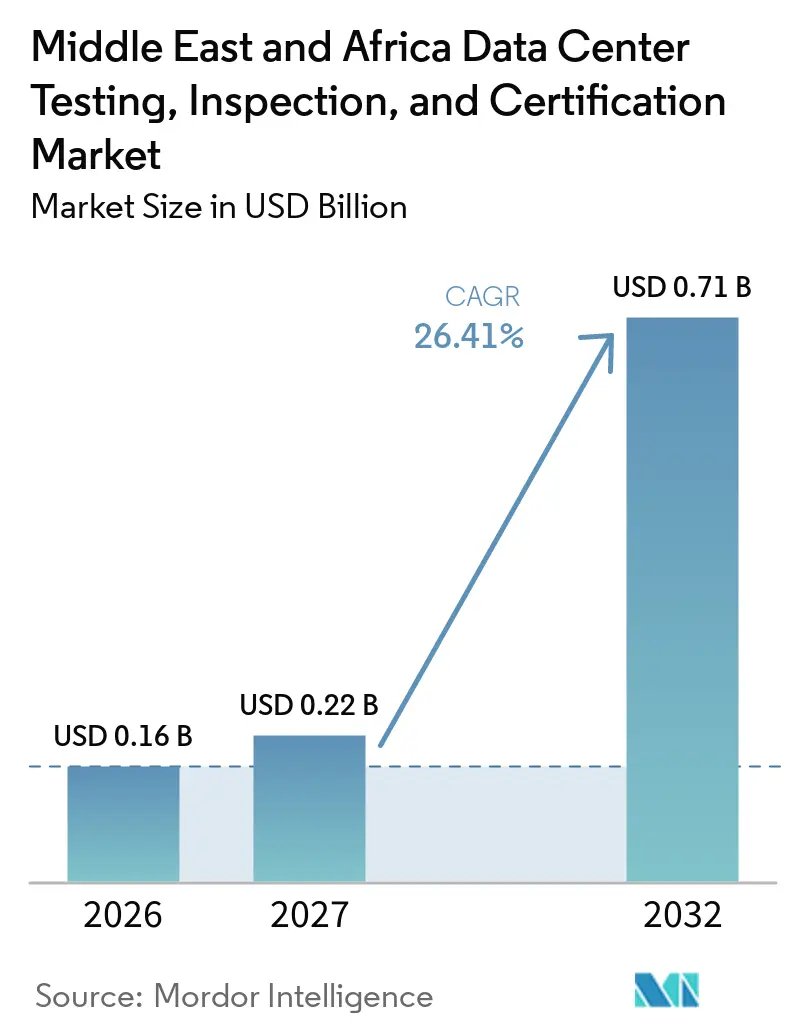
| Base Year Market Size (2026) | USD 0.16 Billion |
| Market Size (2027) | USD 0.22 Billion |
| Market Size (2032) | USD 0.71 Billion |
| Growth Rate (2027 - 2032) | 26.41 % |
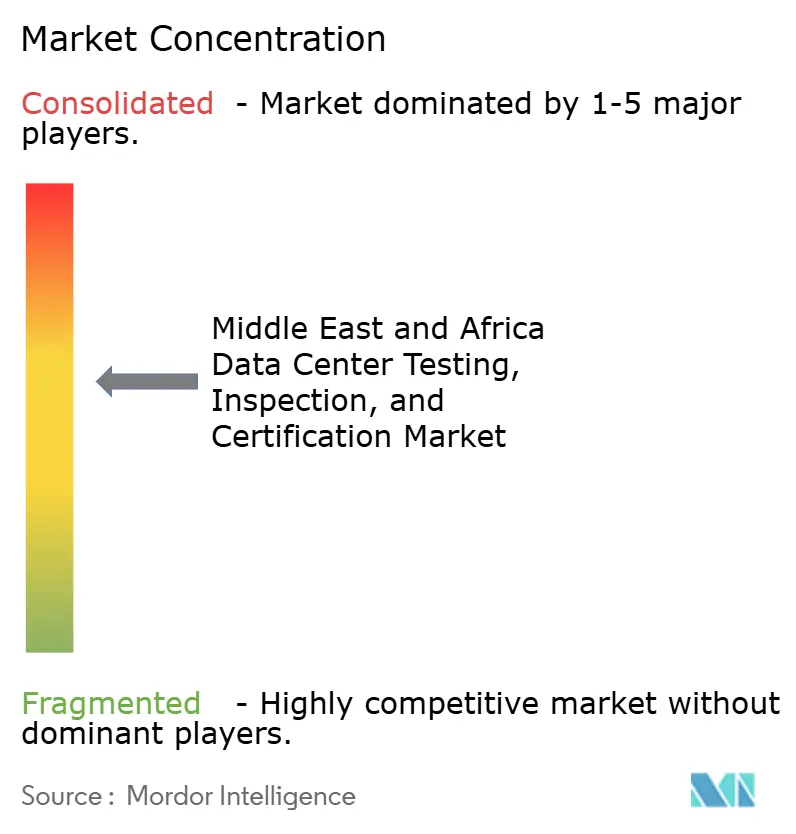
| Market Concentration | Medium |
Major Players *Disclaimer: Major Players sorted in no particular order Image © Mordor Intelligence. Reuse requires attribution under CC BY 4.0. | |
Middle East and Africa Data Center Testing, Inspection, and Certification Market Analysis by Mordor Intelligence
The Middle East and Africa data center testing, inspection, and certification market size is valued at USD 0.16 billion in 2026 and is projected to reach USD 0.71 billion by 2032, expanding at a CAGR of 26.41% during 2027-2032. The Middle East and Africa data center testing, inspection, and certification market is supported by sovereign AI programs, hyperscale construction, and national digital infrastructure projects that require independent verification before a facility is energized. Commissioning and assurance are becoming planned project requirements rather than late-stage checks, especially where operators need to demonstrate performance, resilience, data-handling controls, and a clear record of how critical systems were tested before handover. Demand is strongest where cloud, colocation, and government workloads are concentrated, while the need for specialized commissioning personnel can delay delivery and make experienced multidisciplinary teams a significant part of a project’s delivery capacity. Suppliers are therefore extending their services from construction testing into recurring compliance reviews, operational recertification, and cybersecurity assurance, allowing them to remain engaged as a facility moves from design and construction into active service. This creates opportunities for providers that can deploy accredited teams across several countries, coordinate evidence from many contractors, assess dependencies between power, cooling, fire, security, and control systems, maintain complete handover records for owners and tenants, support consistent operation after energization, and address the testing demands created by high-density AI equipment.
Key Report Takeaways
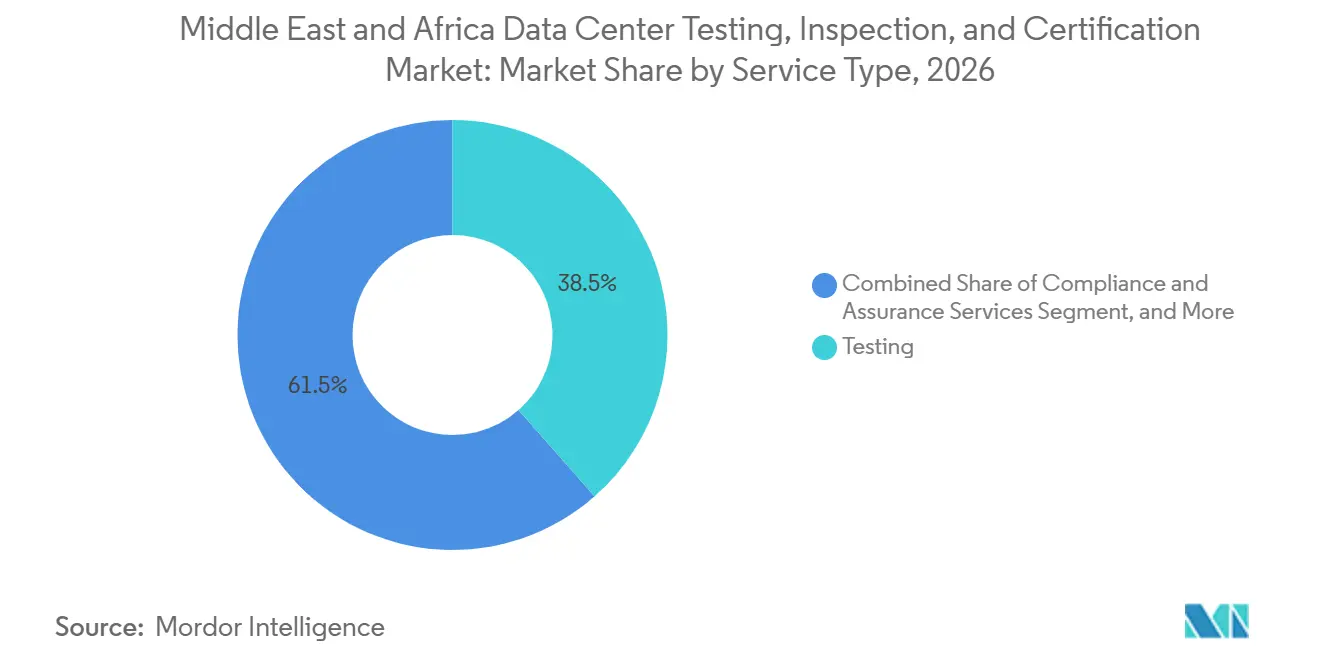
- By service type, testing held 38.50% of the Middle East and Africa data center testing, inspection, and certification market share in 2026, while compliance and assurance services are projected to expand at a 26.81% CAGR through 2032.
- By data center lifecycle, construction, installation, and commissioning held 58.50% revenue share in 2026, while operations, maintenance, and recertification are projected to expand at a 26.88% CAGR through 2032.
- By infrastructure system, electrical infrastructure held 37.50% revenue share in 2026, while IT, network, and cybersecurity infrastructure are projected to expand at a 26.92% CAGR through 2032.
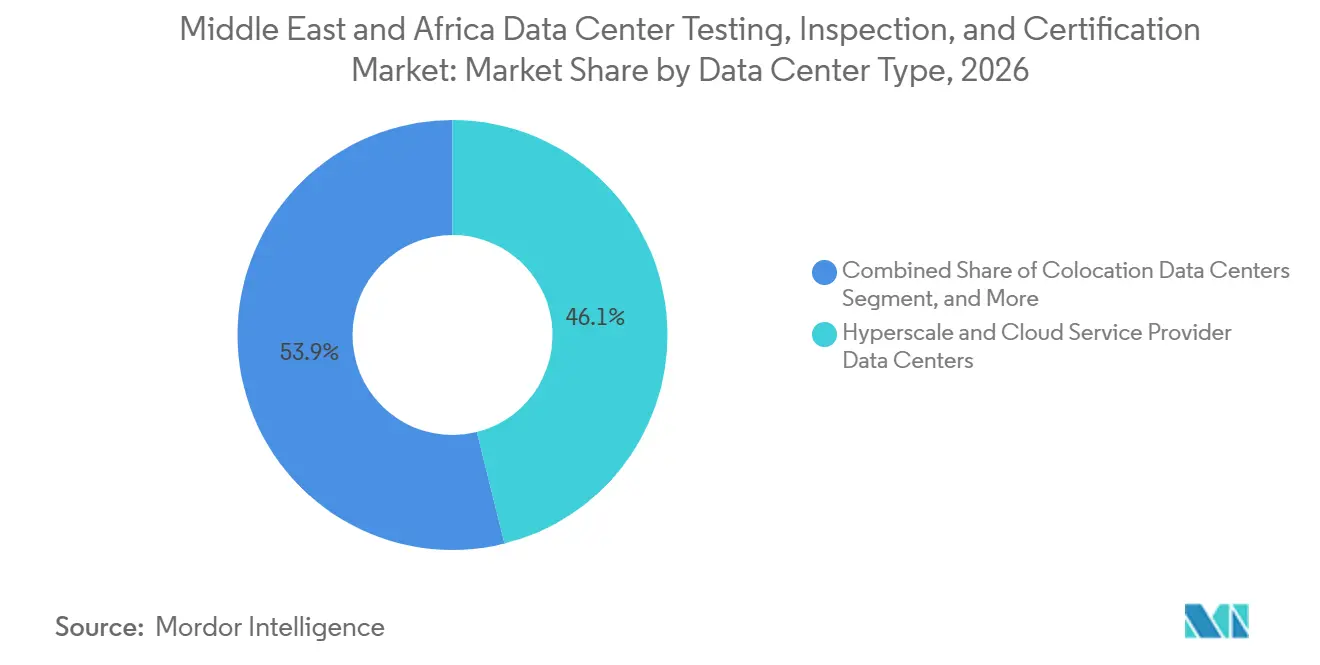
- By data center type, hyperscale and cloud service provider data centers held 46% revenue share in 2026 and are projected to expand at a 27.13% CAGR through 2032.
- By tier type, Tier 3 held 57.52% revenue share in 2026, while Tier 4 is projected to expand at a 26.98% CAGR through 2032.
- By geography, the UAE held 35.34% revenue share in 2026, while Egypt is projected to expand at a 27.24% CAGR through 2032.
Note: Market numbers in this report are based on Mordor Intelligence's proprietary estimation framework, which combines nine months of actuals with Q4 projections for base year 2026.
Middle East and Africa Data Center Testing, Inspection, and Certification Market Trends and Insights
Drivers Impact Analysis*
| Driver | (~) % Impact on CAGR Forecast | Geographic Relevance | Impact Timeline |
|---|---|---|---|
| AI-Ready Data Center Capacity Expansion | +4.2% | UAE, Saudi Arabia, Egypt, South Africa | Short term (≤ 2 years) |
| Sovereign Cloud and Data Residency Mandates | +3.8% | UAE, Saudi Arabia, broader GCC | Short term (≤ 2 years) |
| Hyperscale and Colocation Investment in GCC and Africa | +3.2% | GCC core, spill-over to South Africa, Nigeria, Egypt | Medium term (2-4 years) |
| Rising Power, Cooling, and Resilience Assurance Requirements | +2.7% | GCC-wide, sub-Saharan Africa | Medium term (2-4 years) |
| High-Density GPU Cooling Validation Complexity | +2.1% | UAE, Saudi Arabia | Short term (≤ 2 years) |
| Cross-Border Interconnection and Carrier-Neutrality Certification | +1.5% | UAE, Egypt, South Africa | Long term (≥ 4 years) |
| Source: Mordor Intelligence | |||
AI-Ready Data Center Capacity Expansion Accelerates Commissioning-Phase TIC Demand
AI-ready facilities require independent commissioning, electrical verification, and integrated systems testing before they can enter service. This requirement places the Middle East and Africa data center testing, inspection, and certification market closer to the design and construction timetable for each large project. Khazna Data Centers announced plans in October 2025 to add more than 1 GW of hyperscale capacity across several countries by 2030. Such projects require testing work across electrical distribution, cooling, fire systems, and integrated controls before customer equipment is installed. Providers are increasingly engaged early because an unresolved commissioning issue can postpone energization and affect the delivery timetable. The Middle East and Africa data center testing, inspection, and certification market also benefits as AI facilities introduce dense equipment layouts that require more detailed validation than traditional enterprise sites.
Sovereign Cloud and Data Residency Mandates Create Compliance-Verified Facility Requirements
Sovereign cloud deployments increase the need for documentation that links a facility’s physical controls to its operating requirements. This supports recurring review work after the initial construction and commissioning phase has ended. Microsoft announced in October 2025 that Microsoft 365 Copilot would use in-country data processing within UAE data centers.[1] The program was developed with the UAE Cyber Security Council and Dubai Electronic Security Center, showing how cloud delivery is being paired with local governance requirements. A design review alone does not demonstrate that a live facility continues to meet security, availability, and operational controls. The Middle East and Africa data center testing, inspection, and certification market can therefore gain recurring assignments for assurance reviews, operational evidence, and compliance documentation.
Hyperscale and Colocation Investment in GCC and Africa Expands Full-Lifecycle TIC Scope
Hyperscale and colocation projects use structured acceptance steps that begin before the site is handed to the operator. Factory acceptance testing, site acceptance testing, and integrated systems testing are important controls because large facilities cannot rely on individual equipment checks alone. This makes the Middle East and Africa data center testing, inspection, and certification market more dependent on full-lifecycle delivery capabilities. The Africa Data Centre Association reported 249 operational data centers across the continent in February 2026.[2] That installed base creates continued requirements for inspection, recertification, and operational assurance alongside new construction work. Providers that combine regional coverage with specialized commissioning staff can address both the greenfield pipeline and the expanding installed base.
Rising Power, Cooling, and Resilience Assurance Requirements Reshape Testing Scope
High ambient temperatures and demanding operating conditions make local validation important for facilities in the Gulf and other parts of the region. Operators need to verify performance across power, cooling, water, and resilience systems instead of relying only on standard equipment ratings. SGS described data center services that cover factory acceptance testing, site acceptance testing, fire safety inspection, and compliance documentation.[3] The World Economic Forum has also identified resource optimization and resilience as central issues for MENA data center and AI infrastructure planning. These requirements widen the scope of work within the Middle East and Africa data center testing, inspection, and certification market beyond a simple final sign-off. They also increase the value of providers that can test real operating scenarios, including equipment failures and changing loads.
Restraints Impact Analysis*
| Restraint | (~) % Impact on CAGR Forecast | Geographic Relevance | Impact Timeline |
|---|---|---|---|
| Shortage of Qualified Mission-Critical Engineering and Cybersecurity Talent | -2.4% | GCC-wide, sub-Saharan Africa | Short term (≤ 2 years) |
| Fragmented National Compliance and Accreditation Requirements | -1.8% | MEA-wide | Medium term (2-4 years) |
| High Cost of Independent TIC for Smaller Facilities | -1.3% | Sub-Saharan Africa primarily | Long term (≥ 4 years) |
| Geopolitical Disruption to Specialist Equipment, Assessors, and Project Schedules | -1.1% | MEA-wide | Short term (≤ 2 years) |
| Source: Mordor Intelligence | |||
Shortage of Qualified Mission-Critical Engineering and Cybersecurity Talent Constrains TIC Throughput
The supply of people who can lead integrated testing on complex facilities remains limited. The shortage can extend project schedules because providers must secure specialists before the most time-sensitive stage of delivery. The Africa Data Center Association has highlighted the need to develop data center skills as capacity expands across the continent. The constraint is more severe where a project needs experience in high-density power systems, liquid cooling, cybersecurity controls, and Tier-related requirements at the same time. It limits the number of assignments that a provider can complete concurrently, even when customer demand is strong. The Middle East and Africa data center testing, inspection, and certification market will depend on training, retention, and cross-border workforce mobility to reduce this constraint.
Fragmented National Compliance and Accreditation Requirements Multiply Certification Overheads
Providers working across the region must manage separate national requirements for infrastructure standards, audit records, and assessor qualifications. This can require a team to adapt its documentation and inspection process for each country. The resulting administrative work is particularly difficult for operators that serve smaller enterprise, edge, or regional colocation sites. Those facilities have less scale to absorb fixed compliance costs than a large hyperscale campus. The Middle East and Africa data center testing, inspection, and certification market may therefore develop at different speeds across countries even where construction activity is comparable. Wider alignment of standards and accreditation practices would improve the ability of providers to reuse established processes across the region.
*Our forecasts treat driver/restraint impacts as directional, not additive. The impact forecasts reflect baseline growth, mix effects, and variable interactions.
Segment Analysis
By Service Type: Compliance Mandates Reshape the Revenue Mix
Testing held 38.51% of the Middle East and Africa Data Center TIC Market share in 2026. The segment covers electrical verification, HVAC validation, fire suppression testing, and integrated systems work during construction. Testing remains the first major engagement for a new data center because equipment cannot be accepted solely on the basis of supplier specifications. Each system must perform under the conditions in which it will operate with other systems. Higher rack densities also require more detailed checks of power quality, coolant circulation, and thermal response. The Middle East and Africa data center testing, inspection, and certification market size for testing is supported by greenfield construction across hyperscale and colocation sites. The service is closely connected to commissioning because operators need evidence that the completed facility can be energized safely. Testing providers also need to coordinate with designers, contractors, equipment vendors, and facility teams. This coordination makes established procedures and local presence important competitive factors.
Inspection and certification support construction quality control and conformance with recognized frameworks. These services include reviews related to Uptime Institute Tier Standards and ISO/IEC 27001 requirements. Compliance and assurance services are projected to expand at a 26.81% CAGR through 2032 as live facilities require continuing audit evidence. The demand comes from sovereign cloud deployments, operational sustainability reviews, and cybersecurity assurance requirements rather than only from new projects. BSI Group launched its Mark of Trust in January 2026 as a modular certification framework aligned with ISO/IEC 22237-1. Its availability, protection, energy, and sustainability modules show how providers can organize recurring certification work around several facility outcomes. This service mix gives the Middle East and Africa data center testing, inspection, and certification industry a larger recurring component. It also makes client relationships less dependent on the timing of a single construction project.

By Data Center Lifecycle: Construction Phase Dominates, Operations Phase Gains Commercial Weight
Construction, installation, and commissioning accounted for 58.53% of the Middle East and Africa data center testing, inspection, and certification market share in 2026. This phase includes factory acceptance testing, site acceptance testing, fire safety inspections, and the final checks completed before energization. Greenfield projects require substantial third-party activity because a fault discovered late can affect the completion of several interdependent systems. The work is also concentrated in a limited period, which places pressure on available technical teams. Providers must verify the installation against approved designs and test the facility as an operating whole. The Middle East and Africa data center testing, inspection, and certification market size for this lifecycle phase reflects the large number of facilities under development across the GCC. Commissioning has become more complex as facilities use more redundant electrical and cooling configurations. It also requires detailed records that owners can use during handover and later compliance reviews. Strong planning at the design stage can reduce the risk of late rework during this phase.
Pre-construction and design services are becoming more relevant as operators seek to avoid problems that would delay commissioning. Khazna’s planned 100 MW Ajman facility received Uptime Institute Tier III Certification of Design Documents in February 2026. This shows that Tier-related requirements can be incorporated before construction rather than addressed after the facility is built. Operations, maintenance, and recertification are projected to expand at a 26.88% CAGR through 2032. Facilities completed in 2025 and 2026 will require repeat inspections and operational sustainability reviews as they move into service. Retrofit and modernization work also needs renewed testing when sites adopt liquid cooling or revise their design parameters. These activities broaden the Middle East and Africa data center testing, inspection, and certification market beyond construction-only engagements. They create work throughout a facility’s operating life, even when the pace of new construction varies.
By Infrastructure System: Electrical Integrity Anchors TIC Spend, Cybersecurity Verification Accelerates
Electrical infrastructure held 37.56% of the Middle East and Africa data center testing, inspection, and certification market share in 2026. Utility interconnection approvals, switchgear verification, UPS load-bank testing, and generator certification are core requirements before a data center can operate. Electrical systems carry the first responsibility for continuity because all mechanical and IT systems depend on stable power. The need for redundant feeders and resilient UPS configurations adds further work for independent assessors. Inspectors must confirm equipment installation, protection settings, load performance, and the links between primary and backup systems. The Middle East and Africa data center testing, inspection, and certification market size for electrical infrastructure remains substantial because these checks apply to every facility type. Work can begin with component testing but must continue through site acceptance and integrated systems testing. Operators also need clear evidence that the power system meets design and regulatory expectations. This makes electrical verification a stable source of demand across both new and existing sites.
Mechanical, cooling, and fire-safety systems require more specialized work as AI equipment changes the thermal profile of a data hall. Direct liquid cooling installations need validation of coolant delivery, thermal performance, water quality, and failover responses. Structural, building, and physical security inspections remain connected to construction quality control and site protection requirements. IT, network, and cybersecurity infrastructure are projected to expand at a 26.92% CAGR through 2032, making this the fastest-growing infrastructure system segment. The growing focus on network and cybersecurity controls reflects the operational sensitivity of sovereign, cloud, and AI workloads. It requires TIC providers to connect physical resilience testing with evidence on information security management. The Middle East and Africa data center testing, inspection, and certification industry is therefore expanding its technical scope across both facility infrastructure and digital controls.
By Data Center Type: Hyperscale Facilities Concentrate TIC Spend and Drive Protocol Innovation
Hyperscale and cloud service provider data centers held 46.11% of the Middle East and Africa data center testing, inspection, and certification market share in 2026. The same segment is projected to expand at a 27.13% CAGR through 2032. These facilities concentrate spending because they apply verification requirements from design review through operational sustainability. Their scale also increases the number of electrical, cooling, control, and security interfaces that must be tested together. Hyperscale operators usually apply formal acceptance procedures before equipment can support customer workloads. The Middle East and Africa data center testing, inspection, and certification market size associated with this segment is therefore high on a per-site basis. Independent providers must be able to manage documentation from several contractors and specialist suppliers. They must also maintain the technical depth to test complex systems without delaying the construction schedule. This segment drives changes in testing procedures that later influence colocation and enterprise facilities.
Colocation sites remain a steady source of demand because operators need reliable infrastructure to serve cloud-provider and enterprise tenants. Tier III Certification of Constructed Facility can be an important commercial requirement for facilities seeking those tenants. Enterprise data centers are expanding more slowly as organizations move selected workloads to cloud or colocation platforms. However, enterprises still need independent testing for critical in-house systems that remain operational. Edge and modular data centers form a smaller but developing niche within the Middle East and Africa data center testing, inspection, and certification market. Prefabricated units need factory-level integrated testing before shipment and site-level checks after installation. Uptime Institute’s TIER-Ready Program for Prefabricated and Modular Data Centers provides a reference point for this type of facility. The category may benefit as distributed deployments require repeatable verification across several smaller sites. It also creates opportunities for providers that can standardize tests while accounting for local conditions.
By Tier Type: Tier 3 Is the Commercial Standard, Tier 4 Momentum Builds in Mission-Critical Sectors
Tier 3 held 57.52% of the Middle East and Africa data center testing, inspection, and certification market share in 2026. Concurrently maintainable Tier III architecture offers a balance between availability expectations and regional construction budgets. This makes it a common requirement for hyperscale and colocation investment across the GCC. Tier III certification requires the facility to demonstrate that maintenance can occur without interrupting critical operations. The result is sustained demand for design review, construction inspection, systems testing, and structured supporting documentation. The Middle East and Africa data center testing, inspection, and certification market size for Tier 3 work is also linked to the needs of cloud tenants that require dependable service levels. Uptime Institute lists more than 4,300 certifications issued globally, which shows the broad use of its certification framework. The standard gives owners, tenants, and assessors a common basis for evaluating facility resilience. It also helps providers define the evidence required across the project lifecycle.
Tier 1 and Tier 2 facilities support enterprise and edge deployments where a concurrently maintainable architecture is not necessary. Their TIC requirements are usually focused on construction commissioning and basic compliance inspection. Tier 4 is projected to expand at a 26.98% CAGR through 2032 as some government, financial, logistics, and port-related operations seek fault-tolerant facilities. AD Ports Group reported that its Khalifa Port Data Center achieved Uptime Institute Tier IV Certification of Constructed Facility. The example establishes a high resilience benchmark for infrastructure that supports trade and logistics operations. Tier 4 projects require more intensive validation because fault tolerance must be proven across redundant systems. This supports a specialized portion of the Middle East and Africa data center testing, inspection, and certification market. It also raises the value of assessors with experience in complex integrated testing and high-availability operations.
Geography Analysis
The UAE held 35.34% of the Middle East and Africa Data Center TIC market share in 2026, making it the region’s largest hub for high-value TIC engagements serving cloud, colocation, government, and enterprise facilities. Dubai’s free-zone ecosystem and carrier-dense connectivity support colocation and enterprise activity, while Abu Dhabi’s sovereign AI and government cloud projects create a separate need for data-residency verification, security evidence, and compliance audits. Microsoft’s October 2025 decision to provide in-country processing for Microsoft 365 Copilot in UAE data centers illustrates how local cloud delivery can be linked with national digital governance requirements. Saudi Arabia is the second-largest geography, with an expanding pipeline of carrier-neutral and cloud-oriented sites that require design review, construction testing, and coordinated project documentation. The scale and speed of UAE and Saudi projects can place pressure on the availability of regional commissioning teams, particularly when large electrical, cooling, and control systems must be validated together before energization.
Egypt is projected to expand at a 27.24% CAGR through 2032, the fastest rate among the regional geographies. Its role as a subsea cable landing hub creates demand for carrier-neutrality certification and cross-border interconnection assurance, which differs from the facility commissioning work that dominates many GCC projects. These conditions favor providers with experience in both data center infrastructure and network-related controls, since reliable interconnection is a central element of the operating model. South Africa remains the most mature certification location in sub-Saharan Africa, supported by a base of Tier III and Tier IV certified constructed facilities in Johannesburg. The Middle East and Africa data center testing, inspection, and certification market can draw on this established base as it supports data center construction and operational assurance across neighboring markets.
Nigeria offers a significant but operationally difficult opportunity because AI-ready capacity plans can create demand for power, cooling, and resilience testing while grid reliability and the shallow pool of local specialists can limit project margins and extend schedules. Qatar, Oman, Bahrain, Kenya, and Morocco are also generating a wider pipeline beyond the UAE-Saudi axis, where even smaller facilities may require third-party verification to satisfy owners, financiers, and tenants. Geographic expansion depends on providers being able to deploy qualified personnel, adapt to separate national requirements, and maintain consistent delivery quality across facilities with very different operating conditions. The regional opportunity is therefore not limited to the largest markets, since each completed site can create subsequent inspection, recertification, and operational assurance work.
Competitive Landscape
The Middle East and Africa Data Center TIC market is moderately concentrated among multinational providers with broad accreditation capabilities, including SGS SA, Bureau Veritas SA, Intertek Group plc, TÜV Rheinland AG, and TÜV SÜD AG. These firms compete through their technical credentials, multinational teams, and ability to link design review, testing, inspection, certification, and compliance work across a facility’s lifecycle. SGS presented a data center service framework that covers factory acceptance testing, site acceptance testing, fire safety inspection, and compliance documentation across its UAE, Saudi Arabia, Bahrain, Morocco, and Djibouti footprint. SGS Major providers benefit when a customer needs a single organization able to assess connected electrical, mechanical, fire, control, and documentation requirements without disrupting a tightly scheduled construction program. Local engineering firms and specialist commissioning agents remain relevant where regional knowledge, construction-stage relationships, and focused technical support are important.
Competitive strategies are moving toward digital commissioning methods and specialized service offers that can make handover work more transparent for owners and contractors. SGS introduced its System Start-up Matrix methodology in February 2026 to provide real-time visibility during data center commissioning and reduce handover risk. BSI Group launched its Mark of Trust in January 2026 and first certified UAE EPC contractor BK Gulf LLC against its availability and protection module, creating a defined certification offer around availability, protection, energy, and sustainability. These approaches help providers seek recurring audit and recertification assignments after a facility has moved beyond construction. They also show that competitive differentiation depends on workflow visibility and structured assurance frameworks, not only on the number of inspectors available.
RINA S.p.A. and Applus+ Services can compete by building skills in liquid cooling and IT infrastructure assurance that major generalists have not fully standardized for the region. Uptime Institute has a distinct role because it issues Tier Certifications that shape the design, testing, and handover protocols used in many facilities. The competitive field therefore includes certification authorities that establish requirements and TIC providers that help owners prepare evidence against them. The need for cross-border accreditation and qualified specialists favors larger regional networks, while construction-phase contracts and narrow technical disciplines leave room for smaller firms.
Middle East and Africa Data Center Testing, Inspection, and Certification Industry Leaders
-
SGS SA
-
Bureau Veritas SA
-
Intertek Group plc
-
TÜV SÜD AG
-
DEKRA SE
- *Disclaimer: Major Players sorted in no particular order
Recent Industry Developments
- October 2026: Zain's regional data center THE BUNKER in Jordan received Tier III Gold Operational Sustainability Certification from Uptime Institute, marking the expansion of operational-phase TIC beyond the Gulf into Levant markets and establishing a recurring recertification revenue cycle.
- August 2026: MTN Group and UAE-based investor Tarek Al Ashram announced the formation of Africa Data Hub Holding Limited, targeting 150 MW of AI-ready data center capacity across South Africa and Nigeria in a first phase, directly creating a commissioning and TIC pipeline across two of Sub-Saharan Africa's largest markets.
- June 2026: Vertiv signed a framework agreement with Edge-Serve, IRCL, and Saudi Electricity Project Development Company (PDC) for converged AI-ready infrastructure across the UAE and Saudi Arabia, signaling large-scale power and cooling deployment requiring multi-site independent testing, inspection, and commissioning validation.
- April 2026: Khazna Data Centers earned Uptime Institute Tier III Certification of Constructed Facility for its Ibn Battuta Data Center DXB9 Phase 1 in Dubai. With 22 of its 30 UAE facilities now Tier III certified, Khazna represents the most extensive Uptime certification portfolio in MEA.
Middle East and Africa Data Center Testing, Inspection, and Certification Market Report Scope
The Middle East and Africa Data Center TIC Market comprises third-party services that verify the safety, performance, reliability, and compliance of data center infrastructure across the region, from design review and commissioning through ongoing operations and modernization.
The Middle East and Africa Data Center Testing, Inspection, and Certification Market Report is Segmented by Service Type (Testing, Inspection, Certification, and Compliance), Data Center Lifecycle (Pre-Construction and Design, Construction, Installation and Commissioning, Operations, Maintenance and Recertification, and Retrofit and Modernization), Infrastructure System (Electrical Infrastructure, Mechanical, Cooling and Fire-Safety Infrastructure, Structural, Building and Physical Security Systems, and IT, Network and Cybersecurity Infrastructure), Data Center Type (Hyperscale and Cloud Service Provider Data Centers, Colocation, Enterprise, Edge and Modular), Tier (1 and 2, 3, 4), and Geography (Saudi Arabia, United Arab Emirates, South Africa, Nigeria, Egypt, and Rest of Middle East and Africa). The Market Forecasts are Provided in Terms of Value (USD).
| Testing |
| Inspection |
| Certification |
| Compliance and Assurance Services |
| Pre-Construction and Design |
| Construction, Installation and Commissioning |
| Operations, Maintenance and Recertification |
| Retrofit and Modernization |
| Electrical Infrastructure |
| Mechanical, Cooling and Fire-Safety Infrastructure |
| Structural, Building and Physical Security Systems |
| IT, Network and Cybersecurity Infrastructure |
| Hyperscale and Cloud Service Provider Data Centers |
| Colocation Data Centers |
| Enterprise Data Centers |
| Edge and Modular Data Centers |
| Tier 1 and Tier 2 |
| Tier 3 |
| Tier 4 |
| Saudi Arabia |
| United Arab Emirates |
| South Africa |
| Nigeria |
| Egypt |
| Rest of Middle East and Africa |
| By Service Type | Testing |
| Inspection | |
| Certification | |
| Compliance and Assurance Services | |
| By Data Center Lifecycle | Pre-Construction and Design |
| Construction, Installation and Commissioning | |
| Operations, Maintenance and Recertification | |
| Retrofit and Modernization | |
| By Infrastructure System | Electrical Infrastructure |
| Mechanical, Cooling and Fire-Safety Infrastructure | |
| Structural, Building and Physical Security Systems | |
| IT, Network and Cybersecurity Infrastructure | |
| By Data Center Type | Hyperscale and Cloud Service Provider Data Centers |
| Colocation Data Centers | |
| Enterprise Data Centers | |
| Edge and Modular Data Centers | |
| By Tier Type | Tier 1 and Tier 2 |
| Tier 3 | |
| Tier 4 | |
| By Geography | Saudi Arabia |
| United Arab Emirates | |
| South Africa | |
| Nigeria | |
| Egypt | |
| Rest of Middle East and Africa |
Key Questions Answered in the Report
What is the size of the Middle East and Africa data center testing, inspection, and certification market?
The market is valued at USD 0.16 billion in 2026 and is projected to reach USD 0.71 billion by 2032 at a 26.41% CAGR during 2027-2032.
What is driving demand for data center testing and certification in the Middle East and Africa?
AI-ready construction, sovereign cloud requirements, hyperscale investment, and higher resilience requirements are increasing demand for independent verification.
Which service has the largest share in the Middle East and Africa data center TIC sector?
Testing leads service type revenue with a 38.50% share in 2026, supported by electrical, HVAC, fire suppression, and integrated systems work.
Which type of data center creates the strongest demand for TIC services?
Hyperscale and cloud service provider facilities held 46% revenue share in 2026 and are projected to expand at a 27.13% CAGR through 2032.
Which geography is expanding fastest in this regional sector?
Egypt is projected to expand at a 27.24% CAGR through 2032, supported by its role as a subsea cable landing hub and interconnection location.