
Middle East and Africa Data Center Water Treatment and Recycling Market Size and Share
Market Overview
| Study Period | 2021 - 2032 |
|---|---|
| Forecast Data Period | 2027 - 2032 |
| Base Year Market Size (2026) | USD 0.36 Billion |
| Market Size (2027) | USD 0.42 Billion |
| Market Size (2032) | USD 0.87 Billion |
| Growth Rate (2027 - 2032) | 15.91 % |
| Market Concentration | Medium |
Major Players *Disclaimer: Major Players sorted in no particular order Image © Mordor Intelligence. Reuse requires attribution under CC BY 4.0. | |
Middle East and Africa Data Center Water Treatment and Recycling Market Analysis by Mordor Intelligence
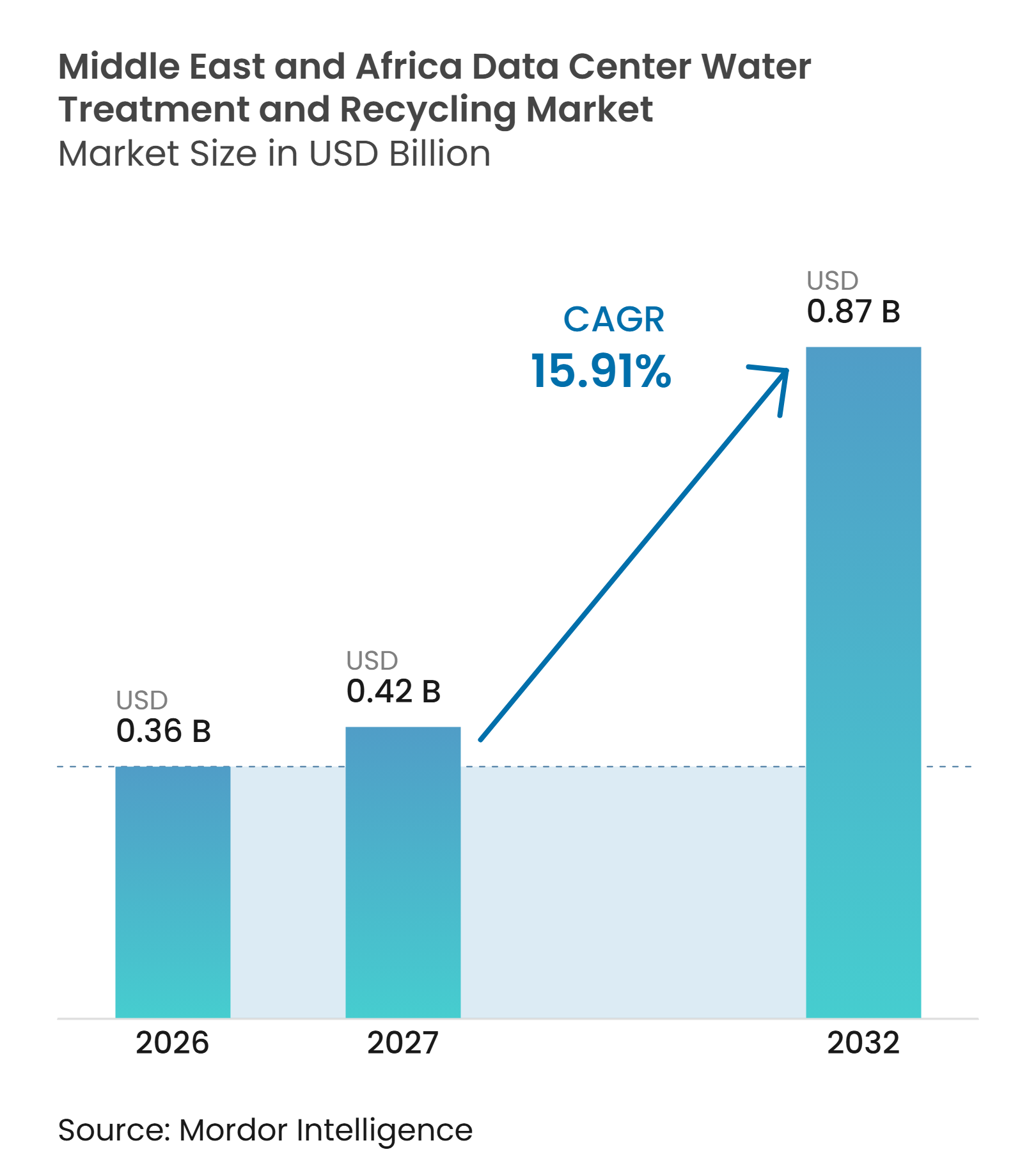
The Middle East and Africa data center water treatment and recycling market size is projected to expand from USD 0.36 billion in 2026 to USD 0.42 billion in 2027, and to USD 0.87 billion by 2032, registering a CAGR of 15.91% between 2027 and 2032. The Middle East and Africa data center water treatment and recycling market is being shaped by hotter operating conditions, tighter water availability, and data center construction across the region. Water quality has become part of facility design because desalinated and municipal supplies can contain dissolved solids that affect cooling equipment, necessitating management of scale, corrosion, and biological control before these conditions disrupt efficient heat rejection and create avoidable maintenance demands for operators. National water reuse programs are also moving treatment decisions closer to procurement and site planning, since the choice of municipal, reclaimed, or other supply can influence piping requirements, storage design, treatment technology, and long-term operating responsibilities. Providers that combine treatment equipment, chemical programs, monitoring, and field services are better placed to serve complex projects, as operators seek reliable documentation, clear accountability, and practical support when cooling-water conditions change. This favors longer service contracts and on-site recycling systems as new facilities enter operation across the region and within planned campus developments and regional technology hubs. It also creates demand for companies that can connect water treatment decisions to cooling-system design, operational reporting, technician support, and the water-efficiency goals that guide new regional infrastructure projects, while maintaining stable water quality amid changing site conditions and varying cooling configurations.
Key Report Takeaways
- By treatment technology, reverse osmosis held a 25.62% revenue share in 2026 in the Middle East and Africa data center water treatment and recycling market, while membrane bioreactors are projected to expand at a 16.12% CAGR through 2032.
- By water source, municipal water held a 35.63% revenue share in 2026, while reclaimed municipal wastewater is projected to expand at a 16.17% CAGR through 2032.
- By treatment application, cooling tower makeup water treatment held 36.71% revenue share in 2026, while water recycling and reuse is projected to expand at a 16.24% CAGR through 2032.
- By solution type, water treatment equipment held 35% revenue share in 2026, while operation and maintenance services are projected to expand at a 16.39% CAGR through 2032.
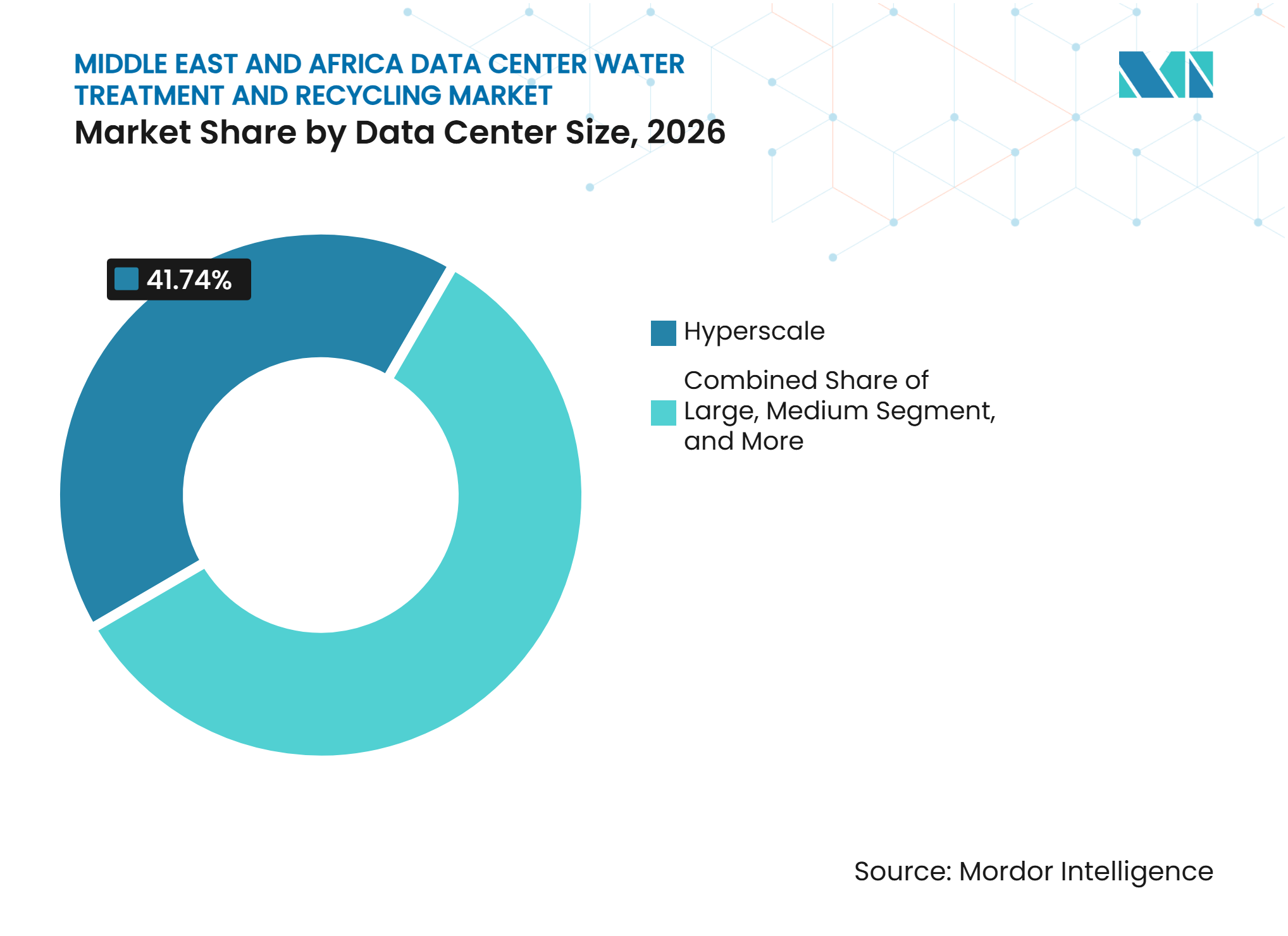
- By data center size, hyperscale facilities held 41.74% of the Middle East and Africa data center water treatment and recycling market share in 2026 and are projected to expand at a 16.28% CAGR through 2032.
- By data center type, colocation facilities held 41.12% revenue share in 2026, while enterprise and edge deployments are projected to expand at a 16.18% CAGR through 2032.
- By geography, the UAE held a 25.64% revenue share in 2026, while Saudi Arabia is projected to expand at a 16.47% CAGR through 2032.
Note: Market numbers in this report are based on Mordor Intelligence's proprietary estimation framework, which combines nine months of actuals with Q4 projections for base year 2026.
Market Trends and Insights
Drivers Impact Analysis of Middle East and Africa Data Center Water Treatment and Recycling Market*
| Driver | (~) % Impact on CAGR Forecast | Geographic Relevance | Impact Timeline |
|---|---|---|---|
| Hyperscale and AI Data Center Expansion | +4.5% | Global, concentrated in UAE and Saudi Arabia | Short term (≤ 2 years) |
| Rising Water Stress in Gulf Data Center Hubs | +3.2% | GCC core, spill-over to Egypt and South Africa | Medium term (2-4 years) |
| Higher Rack Density Increasing Cooling-Water Treatment Requirements | +2.1% | UAE and Saudi Arabia hyperscale campuses | Short term (≤ 2 years) |
| Expansion of Treated Sewage Effluent and Non-Potable Water Networks | +1.6% | Saudi Arabia and UAE, early adoption in Qatar | Medium term (2-4 years) |
| National Digital Infrastructure and Data Sovereignty Programs | +1.3% | Saudi Arabia, UAE, South Africa, Egypt | Medium term (2-4 years) |
| Water-Positive Procurement and Customer Sustainability Requirements | +0.9% | Colocation and cloud operators in UAE and globally | Long term (≥ 4 years) |
| Source: Mordor Intelligence | |||
Hyperscale and AI Data Center Expansion
The Middle East and Africa data center water treatment and recycling market benefits when hyperscale projects include water systems in their original facility design. Large AI deployments place greater heat loads on cooling equipment and increase the operational importance of stable water chemistry. Procurement teams increasingly seek one accountable provider for design, equipment, chemical supply, and operations. This approach supports integrated treatment contracts instead of separate purchases of individual components, simplifying project accountability and giving operators one provider to manage performance across several connected water systems. It also rewards suppliers that can demonstrate local engineering capacity before a site reaches commissioning. Managed-service agreements can provide vendors with recurring work after a large facility starts operation.
Rising Water Stress in Gulf Data Center Hubs
Water scarcity makes water efficiency a facility planning issue in Gulf data center hubs. Saudi Arabia and the UAE depend substantially on desalinated supply, which raises the operating value of recovering and reusing water. The Middle East and Africa data center water treatment and recycling market therefore benefits from systems that reduce withdrawals and improve water quality for cooling. On-site recycling can also support sustainability requirements applied to major projects and financing arrangements. Vendors with documented water use effectiveness improvements can strengthen their qualifications for large campus projects. The need to manage water and energy together raises the value of treatment programs that operate reliably over long periods, provide clear operating data, and help facilities address water use without creating new energy or maintenance burdens.
Higher Rack Density Increasing Cooling-Water Treatment Requirements
Higher rack density changes the water conditions that cooling systems must manage. Greater heat loads can raise evaporation in cooling towers, concentrate dissolved minerals, and increase the need for blowdown control. Direct-to-chip liquid cooling also requires careful management of pH, oxygen, glycol, and microbial activity. These needs support monitoring systems that can adjust dosing across open and closed cooling loops. Ecolab introduced 3D TRASAR Technology for Direct-to-Chip Liquid Cooling in the Middle East in August 2025 to monitor temperature, pH, and flow rates in real time. Suppliers that can connect water treatment platforms with facility controls can reduce commissioning risk for operators.
Expansion of Treated Sewage Effluent and Non-Potable Water Networks
Saudi Arabia and the UAE are expanding the use of treated sewage effluent, also known as TSE, to reduce demand for potable water. Saudi Arabia has set a Vision 2030 target for full reuse of treated urban wastewater.[1] This direction makes TSE conditioning more relevant to new data center projects that can access non-potable networks. TSE can carry variable dissolved solids, organic material, and micropollutants, so it often needs several treatment stages before entering sensitive cooling equipment. Membrane bioreactors, advanced disinfection, reverse osmosis, and monitoring systems can be combined to address these conditions. The resulting projects favor providers with design and operating capability across the entire treatment train, from source-water assessment and pretreatment through membrane operation, residual handling, and service reporting.
Restraints Impact Analysis of Middle East and Africa Data Center Water Treatment and Recycling Market*
| Restraint | (~) % Impact on CAGR Forecast | Geographic Relevance | Impact Timeline |
|---|---|---|---|
| Limited Purple-Pipe Infrastructure for Reclaimed Water | -1.6% | GCC core, particularly Saudi Arabia and UAE industrial zones | Medium term (2-4 years) |
| High Integration Complexity Across Cooling and Water Systems | -1.1% | Global, most pronounced at MEA colocation facilities | Short term (≤ 2 years) |
| Reliability and Quality Concerns Around Alternative Water Sources | -0.8% | Gulf states and Egypt, seasonal TSE quality variability | Medium term (2-4 years) |
| Absence of Harmonized Data Center Water-Use Standards | -0.6% | MEA-wide, contrasting with emerging EU Energy Efficiency Directive frameworks | Long term (≥ 4 years) |
| Source: Mordor Intelligence | |||
Limited Purple-Pipe Infrastructure for Reclaimed Water
TSE volumes do not always reach data center locations because dedicated distribution networks remain limited in many Gulf areas. Operators outside connected industrial zones may need private pipeline links or other costly infrastructure before using reclaimed water. This preserves demand for reverse osmosis, softening, and chemical treatment of municipal supply in the near term. It also slows the shift from potable supply even when reuse policies encourage non-potable procurement. The Middle East and Africa data center water treatment and recycling market can benefit from this interim demand, but it also depends on future network expansion. As utilities extend TSE service toward technology parks, more sites can adopt recycling systems without carrying the full connection cost, allowing procurement teams to consider reuse earlier in the design process.
High Integration Complexity Across Cooling and Water Systems
Hyperscale facilities may combine evaporative towers, closed chilled-water loops, and direct-to-chip cooling manifolds. Each system has different treatment needs, and the control platforms can use different communication protocols. Custom integration can add engineering work and increase the risk of delays during commissioning. Smaller facilities often lack dedicated water engineering teams and may prefer outsourced operations instead of equipment ownership. Colocation sites face additional complexity because tenant workloads can change the cooling demand across a shared facility. Providers with proven integration experience and trained local technicians have an advantage where reliable commissioning is a key selection factor, because the operator can avoid coordinating several contractors when a water or cooling issue occurs.
*Our forecasts treat driver/restraint impacts as directional, not additive. The impact forecasts reflect baseline growth, mix effects, and variable interactions.
Middle East and Africa Data Center Water Treatment and Recycling Market Segment Analysis
By Treatment Technology:
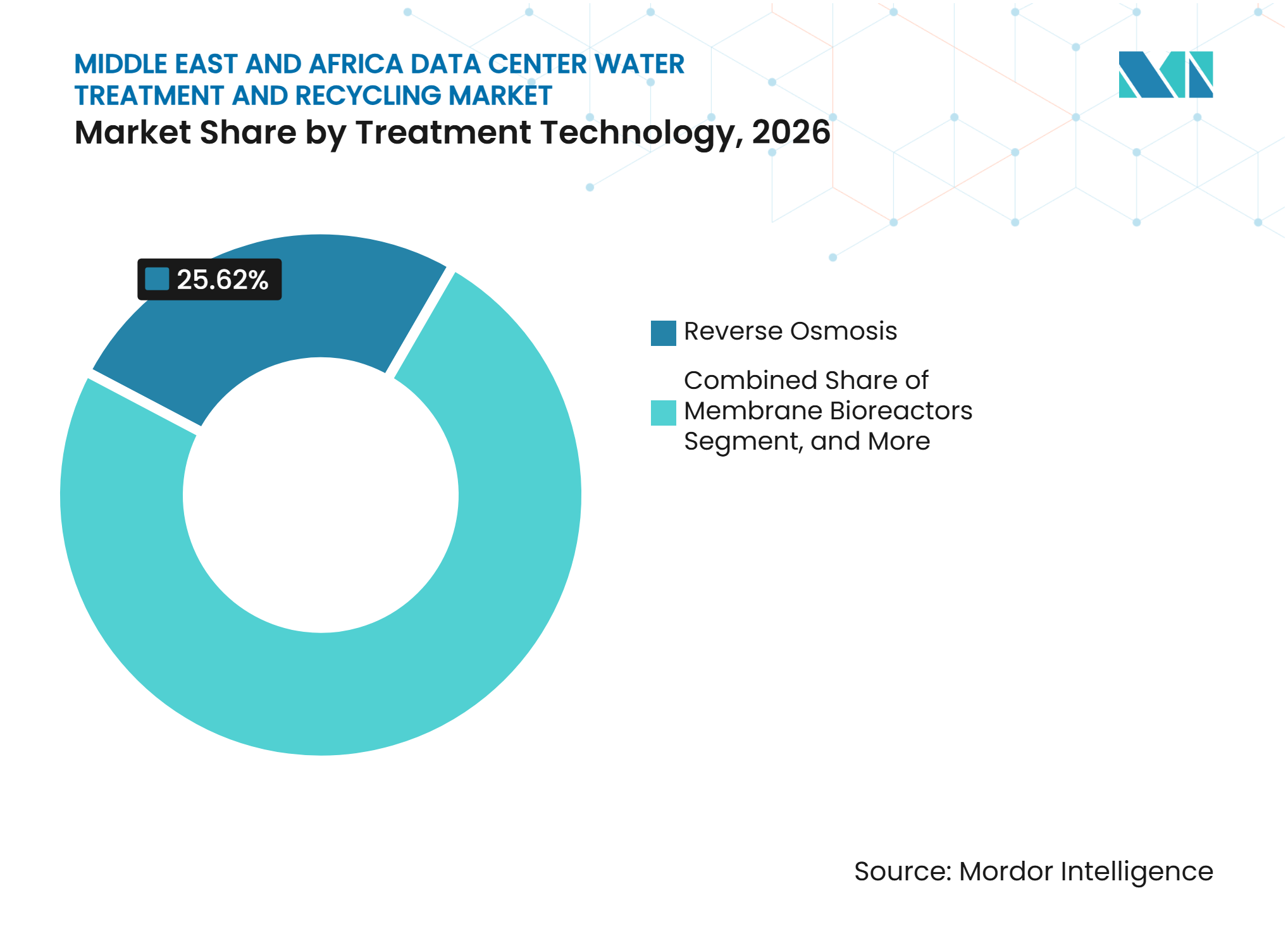
Reverse Osmosis Anchors Demand as Membrane Innovation AcceleratesReverse osmosis accounted for 25.62% revenue share in 2026 because it prepares high-total-dissolved-solids water for cooling circuits. Desalinated and municipal supplies can require this treatment before they enter sensitive facility systems. Filtration and ultrafiltration commonly serve as upstream stages for reverse osmosis, removing suspended matter that can shorten membrane life and weaken consistent treatment performance. This pairing creates opportunities for vendors to supply packaged treatment systems rather than isolated equipment. The Middle East and Africa data center water treatment and recycling market can therefore reward solutions that simplify membrane protection and routine operating control. Ion exchange and water softening remove calcium and magnesium, which supports hardness control in high-density cooling loops. Chemical treatment and disinfection remain essential for Legionella management in open cooling towers and support recurring demand under ASHRAE 188 and local health requirements.
Membrane bioreactors are projected to expand at a 16.12% CAGR through 2032 as operators build wastewater recycling loops for cooling reuse. These systems can support the recovery of process water where site conditions allow. Electrodeionization has a role in closed-loop and direct-to-chip applications that need high-purity water. It can reduce the chemical regeneration waste associated with conventional ion exchange. The technology mix is moving toward systems that connect membrane bioreactors, reverse osmosis, and electrodeionization in sequence. This shift raises the engineering threshold for suppliers and places greater weight on vendors that can operate multi-stage systems over time, maintain stable output quality, and respond promptly when water conditions change.



By Water Source:
Municipal Withdrawals Face Reuse-First Pressure in a Water-Stressed RegionMunicipal water held 35.63% revenue share in 2026 because many operating sites were designed around reliable municipal supply. Retrofitting these sites for TSE intake can require changes to piping, storage, and pretreatment systems. Groundwater use is restricted in many Gulf locations by salinity, while some South African facilities require iron, manganese, and hardness removal. Industrial recycled water can serve certain data centers located within industrial parks that share utility infrastructure. Surface-water use remains limited across much of the region because availability and quality vary by location. These differences mean water source selection remains a site-level engineering decision, shaped by local utility access, feedwater quality, storage needs, and the condition of cooling equipment already in place. For the Middle East and Africa data center water treatment and recycling market, this diversity makes site assessment central to system selection.
Reclaimed municipal wastewater is projected to expand at a 16.17% CAGR through 2032 as Saudi Arabia and the UAE encourage non-potable water for cooling. Saudi Arabia's national wastewater reuse objective gives this transition a strong policy foundation.[2] Reclaimed water requires more adaptive treatment than a stable municipal feed because its quality can change. Operators may need flexible membrane, disinfection, and dosing systems to maintain cooling-water standards. This supports demand for real-time monitoring and treatment programs that respond to changes in feedwater quality, helping operators maintain stable cooling conditions while avoiding unnecessarily high chemical use. The Middle East and Africa data center water treatment and recycling industry is therefore moving toward higher-value conditioning of alternative feedstocks.
By Treatment Application:
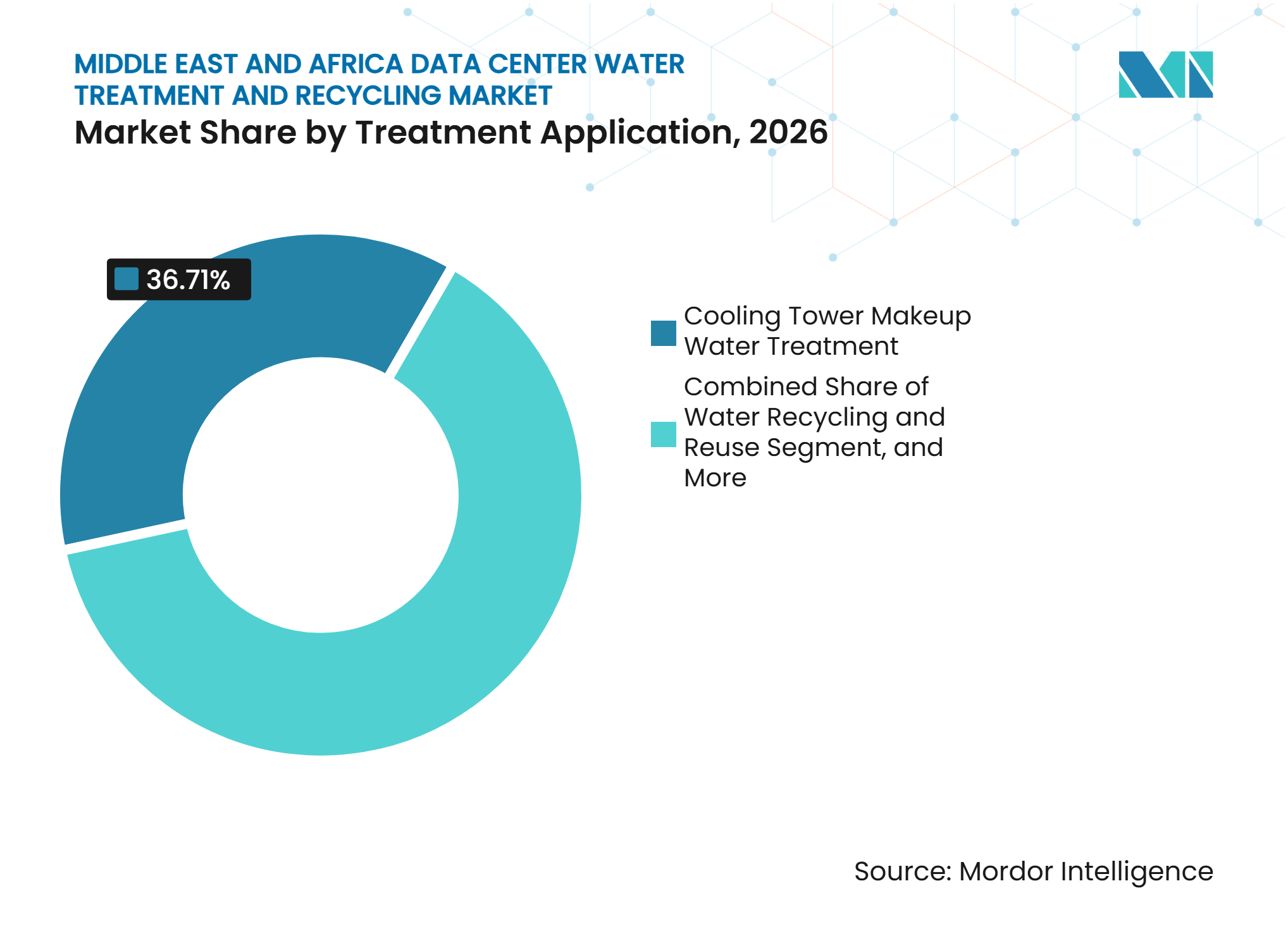
Cooling Tower Makeup Treatment Leads but Recycling Closes the GapCooling tower makeup water treatment held 36.71% of revenue in 2026, the largest application position in the Middle East and Africa data center water treatment and recycling market. Evaporative cooling remains common at operating Gulf facilities. High ambient temperatures and mineral content can limit cycles of concentration before scale risk rises. Operators then need more makeup water and close control of chemical dosing, because poor control can increase scale formation, corrosion exposure, and interruptions to cooling performance. Closed-loop chilled-water treatment is more specialized because it must address corrosion inhibition, oxygen scavenging, and pH control. Boiler and heat-rejection treatment also supports recurring chemical demand at sites that use backup generators and humidification systems.
Water recycling and reuse is projected to expand at a 16.24% CAGR through 2032 as operators seek to reduce dependence on desalinated municipal water. Zero liquid discharge systems can recover process water and reduce liquid discharge. Gradiant states that its zero liquid discharge systems target 99% process-water recovery for selected data center projects.[3] Recycling can improve the position of a facility in sustainability-linked financing processes while reducing discharge management needs. Compliance requirements still provide a baseline for chemical treatment across applications. The Middle East and Africa data center water treatment and recycling market consequently retains a recurring need for testing, dosing, and service documentation. The combination of recurring compliance demand and recycling investment supports a resilient application mix, with routine treatment needs continuing alongside larger investments in water recovery and concentrate management.

By Solution Type:
Equipment Leads Revenue as Service Contracts Gain Commercial TractionWater treatment equipment held 35% of revenue in 2026, reflecting spending on reverse osmosis membranes, membrane bioreactors, filtration skids, and electrodeionization units. Equipment demand is closely tied to the commissioning of large data centers. This makes the segment dependent on the timing of capacity additions in the UAE and Saudi Arabia. The Middle East and Africa data center water treatment and recycling market is therefore closely tied to the construction schedules of large new facilities. Monitoring and control systems are becoming more relevant as operators use sensors to optimize dosing and document compliance. Treatment plant design and engineering can create earlier engagement with customers by assessing source-water quality, TSE access, and discharge conditions. Water treatment chemicals provide a recurring revenue stream because consumption follows cooling-system run time, water quality, operating temperatures, and the control requirements of individual cooling loops.
Operation and maintenance services are projected to expand at a 16.39% CAGR through 2032. Small and medium facilities in South Africa, Egypt, and Tier-2 Gulf cities may not maintain internal water engineering teams. Outsourced programs can give these facilities access to testing, dosing, emergency response, and reporting without building a dedicated staff. Ecolab's 2025 deployment of real-time cooling monitoring illustrates the move from periodic manual checks toward continuous oversight. The Middle East and Africa data center water treatment and recycling market gives service-oriented vendors an opportunity to build installed-base relationships. Regional technician coverage and response times can be as important as the equipment specification for these contracts, especially when operators need rapid corrective action to protect cooling availability.
By Data Center Size:
Hyperscale Facilities Define Market Volume and Treatment ComplexityHyperscale facilities held 41.74% of revenue in 2026 and are projected to expand at a 16.28% CAGR through 2032. Their scale concentrates treatment investment, water-management planning, and complex integration needs at a single facility class. Large campuses need early assessment of source-water chemistry, reclaimed-water network access, and discharge restrictions. Suppliers that contribute at the design stage can compete for equipment and service work later in the project. Large data centers retain an important role, but AI investment is concentrating more capacity in very large facilities. Hyperscale treatment contracts can be sizable but are often awarded among a limited group of qualified providers, since buyers look for proven engineering processes, local execution, and clear operational accountability.
Small and medium facilities create a different commercial opportunity for the Middle East and Africa data center water treatment and recycling market. They often need packaged systems, chemical supply, monitoring, and managed services rather than complex custom treatment plants. Enterprise deployments in South Africa, Oman, and Egypt can support this service-led demand. These sites may not justify dedicated internal expertise for water chemistry and compliance. Their contracts can aggregate into a meaningful recurring revenue base for suppliers with regional delivery capacity. The size split therefore shapes whether vendors emphasize project engineering or scalable field service, and it can influence how they organize sales, technician staffing, spare parts, and ongoing customer support.
By Data Center Type:
Colocation Leads as Enterprise and Edge Segments ExpandColocation facilities held 41.12% of revenue in 2026 because shared infrastructure concentrates water treatment demand at high-throughput sites. Operators must meet their own environmental reporting commitments and the water stewardship expectations of tenants. Real-time chemistry optimization can be valuable where several tenants use the same cooling infrastructure. Cloud providers represent a growing customer group as they develop owned regional capacity. Colocation operators generally prioritize integration capability, uptime assurance, and documented performance. These requirements support suppliers that can combine equipment with ongoing monitoring and service, while providing clear records of performance, water quality, and maintenance actions for demanding tenant environments.
Enterprise and edge deployments are projected to expand at a 16.18% CAGR through 2032 as data sovereignty requirements encourage in-country processing. Many edge facilities use air-cooled or hybrid systems, which limits but does not remove the need for water conditioning. Their spending can focus on potable-water treatment, monitoring, and limited cooling-water management. Enterprise operators often favor simple operating models, competitive pricing, and responsive local service. This creates a separate route to market from the one used for colocation projects, where technical integration and large shared cooling loads normally guide the purchasing decision. The Middle East and Africa data center water treatment and recycling market can gain from the expansion of regional field coverage into Africa and the Levant.
Geography Analysis
UAE
The UAE held 25.64% of the Middle East and Africa data center water treatment and recycling market share in 2026. Its position is supported by 56 active data centers, an established utility setting, and a growing group of service providers. New hyperscale facilities are adopting closed-loop recycling approaches that align with the UAE Net Zero 2050 Strategic Initiative. Moro Hub inaugurated Phase 2 of its solar-powered data center in Dubai in January 2025, advancing a buildout planned to exceed 100 MW. Saudi Arabia is projected to expand at a 16.47% CAGR through 2032 as its digital infrastructure program supports major capacity additions.
Saudi Arabia
Saudi Arabia's treated wastewater reuse objective creates a clear long-term direction for water procurement and treatment design. New facilities can increasingly consider non-potable supply as TSE systems develop near industrial and technology areas, though each project will still need to confirm quality requirements, storage capacity, connection arrangements, and treatment specifications.
Qatar
Qatar also has experience using non-potable water for district cooling, which can inform comparable data center applications. Israel's developed water recycling ecosystem can provide relevant technical experience for nearby markets facing similar water constraints.
South Africa
South Africa has a different profile because drought cycles and municipal supply variability drive demand for resilient pretreatment, disinfection, and on-site storage, rather than the desalination-led operating conditions that shape many Gulf projects. Its operators can also use closed-loop chilled-water systems and free-air cooling where site conditions support those designs.
Egypt
Egypt is developing as a connectivity hub around Cairo, supported by its role in subsea cable networks and national digital infrastructure plans. Limited freshwater availability can increase the relevance of wastewater treatment and groundwater conditioning for cooling.
Rest of the Middle East and Africa
In Oman, SUEZ received a 15-year performance-based contract with NAMA Water Services in June 2026 covering water and wastewater services, 22 wastewater treatment plants, and 400 km of TSE distribution networks. Bahrain has an established financial-services data center base, while Kenya and Nigeria are earlier-stage locations for deployment. The Middle East and Africa data center water treatment and recycling market will vary widely across these locations because water networks, facility pipelines, and local service capacity differ. Water treatment demand nevertheless remains closely linked to the development of new data center capacity and supporting utility infrastructure, including the availability of non-potable networks, local engineering resources, and reliable maintenance support.
Competitive Landscape
Market Concentration
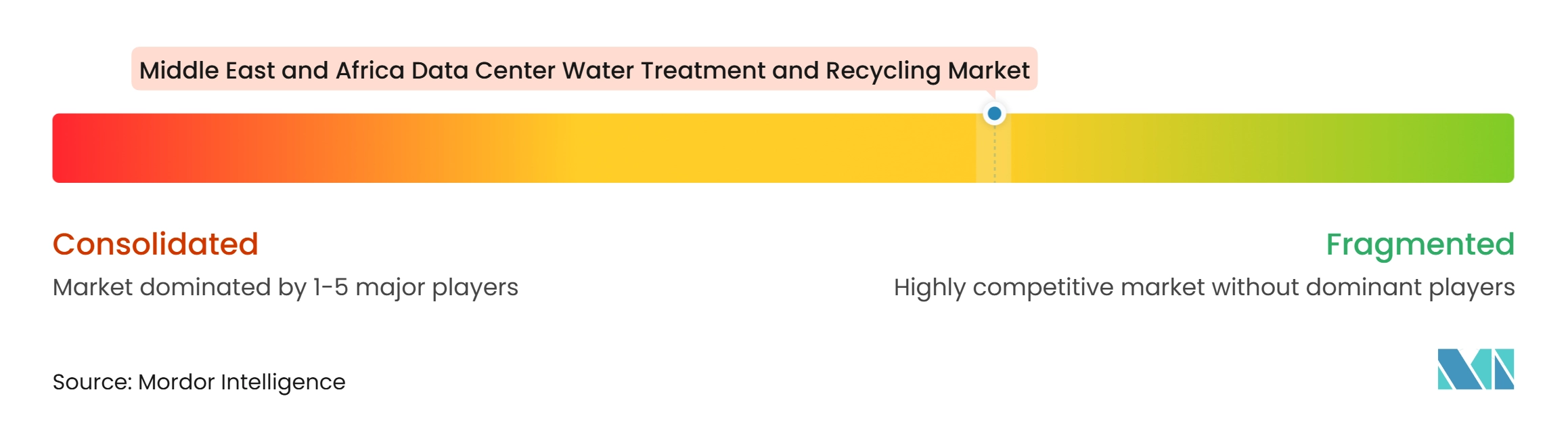
The Middle East and Africa data center water treatment and recycling market is moderately fragmented because global environmental services providers, membrane specialists, chemical suppliers, and regional service firms operate at different stages of the treatment lifecycle. Veolia, Ecolab, and Gradiant are among the visible companies competing for integrated water-management work. Membrane suppliers such as Toray Industries and DuPont de Nemours compete on durability and salt rejection for high-total-dissolved-solids feedwater. Chemical treatment providers serve recurring operating needs through dosing programs and monitoring. Local qualifications and field-service capacity remain important because data center projects need responsive support after commissioning. This structure leaves room for specialist providers while making large projects attractive to companies with broad technical portfolios, established field teams, and the ability to accept operational responsibility after installation.
Veolia collaborated with Amazon in April 2026 to develop reclaimed-water solutions for data center cooling that use treatment engineering and AI-enabled optimization. Veolia also signed a USD 500 million agreement in September 2025 for a large industrial wastewater reuse project at Jubail Industrial City, using AnoxKaldnes MBBR, ZeeWeed membranes, and ActifloCarb technology. Gradiant launched its HyperSolved platform in May 2026, combining treatment technologies, CURE Chemicals, and SmartOps AI for cooling-water optimization. Ecolab deployed its 3D TRASAR technology for direct-to-chip liquid cooling in the Middle East in August 2025. These actions show that treatment, chemicals, data, and operations are increasingly being offered together.
The most open opportunity is in TSE pretreatment and greenfield hyperscale design, where customers need coordinated membrane, recycling, and operating systems. No single supplier is identified as controlling the end-to-end design, build, and operation of multi-stage membrane systems across the region. Providers with Saudi Water Partnership Company experience or Dubai Electricity and Water Authority supplier qualifications can hold an advantage over international companies without local delivery records. Measurable water-use effectiveness improvements can also support procurement decisions when customers must document water stewardship, allowing technical teams to connect treatment results with broader facility reporting and procurement requirements. Suppliers that provide regional technicians and digital performance evidence can differentiate beyond equipment specifications, particularly where a buyer needs clear proof that water systems can support uptime and environmental reporting goals.
Middle East and Africa Data Center Water Treatment and Recycling Industry Leaders
-
Veolia Environnement S.A.
-
Ecolab Inc.
-
SUEZ S.A.
-
Xylem Inc.
-
Aquatech International LLC
- *Disclaimer: Major Players sorted in no particular order
Middle East and Africa Data Center Water Treatment and Recycling Market Companies Covered in this Report
- Veolia Environnement S.A.
- Ecolab Inc.
- SUEZ S.A.
- Xylem Inc.
- Aquatech International LLC
- Kurita Water Industries Ltd.
- Pentair plc
- DuPont de Nemours, Inc.
- Toray Industries, Inc.
- Alfa Laval AB
- BWT Holding GmbH
- Gradiant Corporation
- Ovivo Inc.
- Solenis LLC
- DataVolt Information Technology Company
- Khazna Data Centers Limited
- Gulf Data Hub
- Moro Hub
- Gulf Cryo Holding RSC Limited
- ENGIE S.A.
- Johnson Controls International plc
- Vertiv Holdings Co
- Schneider Electric SE
- Trane Technologies plc
Recent Industry Developments in Middle East and Africa Data Center Water Treatment and Recycling Market
- September 2026: Gradiant secured a major turnkey water and wastewater contract for one of the world's largest hyperscalers' AI data center campus in West Texas, delivering potable water supply and full wastewater treatment under a zero-discharge-to-surface-water design mandate on an accelerated timeline, reinforcing the company's position in high-constraint hyperscale water infrastructure.
- September 2026: Veolia signed three agreements with Saudi companies, including Ma'aden and Khazeen, to expand cooperation in industrial water treatment, wastewater reuse, waste management and integrated water-energy services. The Ma'aden collaboration specifically targets improved industrial water treatment and reuse. These partnerships strengthen the regional water-treatment ecosystem serving industrial and potentially data-center infrastructure.
- June 2026: SUEZ, in consortium with National Trading Company and National Energy Center, was awarded a 15-year performance-based O&M contract by NAMA Water Services in Oman worth EUR 2.0 billion (USD 2.18 billion), covering water and wastewater services for 2.3 million people across Muscat and the Sharqiyah governorates, including 22 wastewater treatment plants and 400 km of TSE distribution networks, the largest water services contract SUEZ has secured in the Middle East.
- April 2026: Veolia partnered with Amazon to develop reclaimed water solutions for data center cooling, combining water treatment engineering with AI-enabled optimization to advance closed-loop water reuse and reduce freshwater abstraction at data center facilities.
Middle East and Africa Data Center Water Treatment and Recycling Market Report Scope
The Middle East and Africa (MEA) Data Center Water Treatment and Recycling Market refers to the regional market for technologies, equipment, chemicals, and services used to treat, condition, and recycle water within data centers across the Middle East and Africa, primarily for cooling systems, liquid-cooling loops, and wastewater management.
The Middle East and Africa Data Center Water Treatment and Recycling Market Report is Segmented by Treatment Technology (Filtration and Ultrafiltration, Reverse Osmosis, Ion Exchange and Water Softening, Electrodeionization, Chemical Treatment and Disinfection, Membrane Bioreactors, and Other Water Treatment Technologies), Water Source (Municipal Water, Groundwater, Surface Water, Reclaimed Municipal Wastewater, Industrial Recycled Water, and Other Alternative Water Sources), Treatment Application (Cooling Tower Makeup Water Treatment, Chilled Water and Closed-Loop Water Treatment, Boiler and Heat Rejection System Water Treatment, Wastewater Treatment, Water Recycling and Reuse, and Zero Liquid Discharge and Concentrate Management), Solution Type (Water Treatment Equipment, Water Treatment Chemicals, Water Quality Monitoring and Control Systems, Treatment Plant Design and Engineering, and Operation and Maintenance Services), Data Center Size (Small, Medium, Large, and Hyperscale), Data Center Type (Colocation, Cloud Service Providers, and Enterprise and Edge), and Geography (Saudi Arabia, United Arab Emirates, South Africa, Israel, Qatar, Egypt, and Rest of the Middle East and Africa). The Market Forecasts Are Provided in Terms of Value (USD).
Segmentation Overview
| Filtration and Ultrafiltration |
| Reverse Osmosis |
| Ion Exchange and Water Softening |
| Electrodeionization |
| Chemical Treatment and Disinfection |
| Membrane Bioreactors |
| Other Water Treatment Technologies |
| Municipal Water |
| Groundwater |
| Surface Water |
| Reclaimed Municipal Wastewater |
| Industrial Recycled Water |
| Other Alternative Water Sources |
| Cooling Tower Makeup Water Treatment |
| Chilled Water and Closed-Loop Water Treatment |
| Boiler and Heat Rejection System Water Treatment |
| Wastewater Treatment |
| Water Recycling and Reuse |
| Zero Liquid Discharge and Concentrate Management |
| Water Treatment Equipment |
| Water Treatment Chemicals |
| Water Quality Monitoring and Control Systems |
| Treatment Plant Design and Engineering |
| Operation and Maintenance Services |
| Small |
| Medium |
| Large |
| Hyperscale |
| Colocation |
| Cloud Service Providers |
| Enterprise and Edge |
| Saudi Arabia |
| United Arab Emirates |
| South Africa |
| Israel |
| Qatar |
| Egypt |
| Rest of the Middle East and Africa |
| By Treatment Technology | Filtration and Ultrafiltration |
| Reverse Osmosis | |
| Ion Exchange and Water Softening | |
| Electrodeionization | |
| Chemical Treatment and Disinfection | |
| Membrane Bioreactors | |
| Other Water Treatment Technologies | |
| By Water Source | Municipal Water |
| Groundwater | |
| Surface Water | |
| Reclaimed Municipal Wastewater | |
| Industrial Recycled Water | |
| Other Alternative Water Sources | |
| By Treatment Application | Cooling Tower Makeup Water Treatment |
| Chilled Water and Closed-Loop Water Treatment | |
| Boiler and Heat Rejection System Water Treatment | |
| Wastewater Treatment | |
| Water Recycling and Reuse | |
| Zero Liquid Discharge and Concentrate Management | |
| By Solution Type | Water Treatment Equipment |
| Water Treatment Chemicals | |
| Water Quality Monitoring and Control Systems | |
| Treatment Plant Design and Engineering | |
| Operation and Maintenance Services | |
| By Data Center Size | Small |
| Medium | |
| Large | |
| Hyperscale | |
| By Data Center Type | Colocation |
| Cloud Service Providers | |
| Enterprise and Edge | |
| By Geography | Saudi Arabia |
| United Arab Emirates | |
| South Africa | |
| Israel | |
| Qatar | |
| Egypt | |
| Rest of the Middle East and Africa |
Key Questions Answered in the Report
What is the size of the Middle East and Africa data center water treatment and recycling market?
The market is projected at USD 0.36 billion in 2026 and USD 0.87 billion by 2032, with a 15.91% CAGR from 2027 to 2032. Demand is linked to cooling-water treatment, recycling systems, and ongoing water-management services.
Which treatment technology leads regional demand?
Reverse osmosis led with 25.62% revenue share in 2026 because it treats high-total-dissolved-solids municipal and desalinated water before cooling use. It also forms part of wider treatment trains used to protect cooling equipment.
Why is reclaimed water becoming important for data centers in the Middle East and Africa?
Reclaimed municipal wastewater is projected to expand at a 16.17% CAGR through 2032 as non-potable water policies and reuse infrastructure gain attention. The shift requires adaptive treatment where feedwater quality varies.
Which application is expanding most quickly?
Water recycling and reuse is projected to expand at a 16.24% CAGR through 2032, supported by the need to reduce freshwater withdrawals and manage discharge. Recovery systems can also support wider water stewardship objectives.
Which country is expected to expand most quickly through 2032?
Saudi Arabia is projected to expand at a 16.47% CAGR through 2032, supported by digital infrastructure development and wastewater reuse policy. Treatment demand is expected to follow capacity additions and water-network development.
What capabilities matter most for suppliers serving data centers?
Suppliers need treatment engineering, chemical programs, real-time monitoring, and regional operation and maintenance coverage to support complex cooling systems. Local technicians and documented performance are important for continuous operation, particularly for sites where treatment errors could affect cooling reliability, service obligations, or water-efficiency reporting.