
Middle East and Africa Commercial Greenhouse Market Size and Share
Market Overview
| Study Period | 2021 - 2031 |
|---|---|
| Forecast Data Period | 2026 - 2031 |
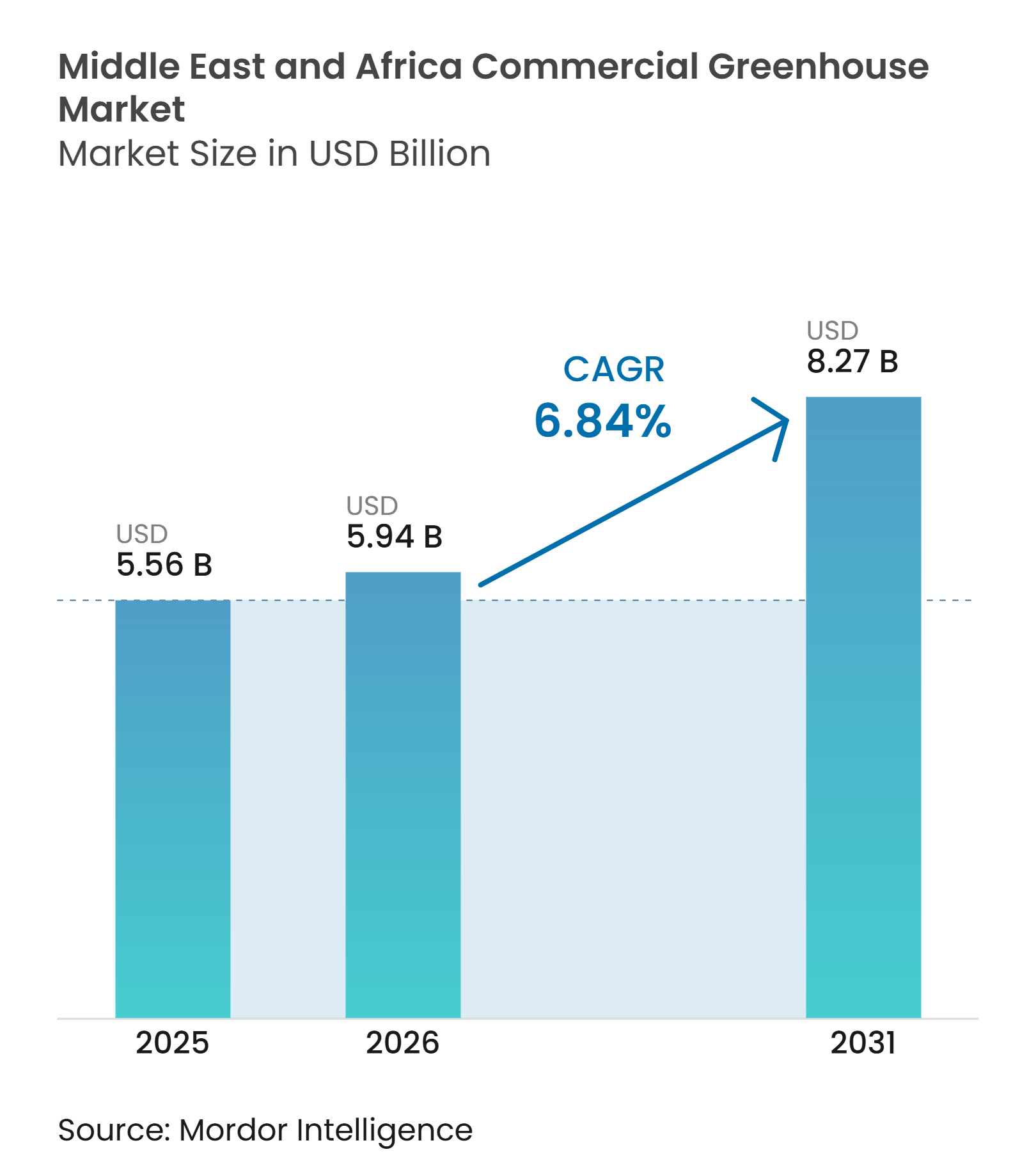
| Base Year Market Size (2025) | USD 5.56 Billion |
| Market Size (2026) | USD 5.94 Billion |
| Market Size (2031) | USD 8.27 Billion |
| Growth Rate (2026 - 2031) | 6.84 % |
| Market Concentration | Low |
Major Players *Disclaimer: Major Players sorted in no particular order Image © Mordor Intelligence. Reuse requires attribution under CC BY 4.0. | |
Middle East and Africa Commercial Greenhouse Market Analysis by Mordor Intelligence
The Middle East and Africa commercial greenhouse market size was valued at USD 5.56 billion in 2025 and is estimated to grow from USD 5.94 billion in 2026 to reach USD 8.27 billion by 2031, at a CAGR of 6.84% during the forecast period (2026-2031). Food-security programs are directing capital toward protected cultivation, particularly in Gulf Cooperation Council countries, where reliable local produce has strategic value. Commercial projects increasingly combine greenhouse structures with climate controls, water management, and digital operating systems. This favors suppliers that can deliver integrated facilities and provide local commissioning support. Water efficiency, heat management, and access to skilled operators will shape project returns across the region. The Middle East and Africa commercial greenhouse market also faces higher operating costs, where cooling, desalination, and backup electricity are necessary.
Key Report Takeaways
- By equipment type, structural components were the largest segment with 24% of the Middle East and Africa commercial greenhouse market share in 2025, while climate control and automation software is the fastest segment at a 10.8% CAGR during 2026-2031.
- By crop type, fruits and vegetables were the largest segment with 68% share in 2025, while herbs and microgreens is the fastest segment at an 11.5% CAGR during 2026-2031.
- By greenhouse type, plastic-film greenhouses were the largest segment with 52% share in 2025, while hybrid and semi-closed greenhouses is the fastest segment at a 12.6% CAGR during 2026-2031.
- By cultivation technology, hydroponic cultivation was the largest segment with 58% share in 2025, while hybrid and vertical integration technologies is the fastest segment at a 13.8% CAGR during 2026-2031.
- By end user, commercial growers were the largest segment with 89% share in 2025, while research and educational institutes is the fastest segment at a 10.2% CAGR during 2026-2031.
- By geography, the Middle East was the largest regional segment with 60% share in 2025 and the fastest regional segment at a 7.4% CAGR during 2026-2031.
Note: Market size and forecast figures in this report are generated using Mordor Intelligence’s proprietary estimation framework, updated with the latest available data and insights as of January 2026.
Market Trends and Insights
Drivers Impact Analysis of Middle East and Africa Commercial Greenhouse Market*
| Driver | (~) % Impact on CAGR Forecast | Geographic Relevance | Impact Timeline |
|---|---|---|---|
| Year-round and out-of-season fresh produce supply | +1.5% | Brazil and Chile | Short term (≤ 2 years) |
| Water-efficient production in water-stressed zones | +1.0% | Chile, semi-arid Brazil, and Argentina | Medium term (2-4 years) |
| Demand for consistent, traceable, higher-quality produce | +1.0% | Chile and export-oriented Brazil | Short term (≤ 2 years) |
| Modernization through automation, precision irrigation, and data management | +1.2% | Brazil and Chile | Medium term (2-4 years) |
| Climate-resilient production under weather volatility | +0.8% | Chile, Argentina, and semi-arid Brazil | Long term (≥ 4 years) |
| Public programs, research partnerships, and technology transfer | +0.5% | Brazil and Argentina | Long term (≥ 4 years) |
| Source: Mordor Intelligence | |||
National Food-Security and Import-Resilience Programs
National food-security policies are moving from planning into direct commercial investment across Gulf markets. In July 2026, KUBO Greenhouse Projects B.V. signed contracts with Amtar Al Khair Agricultural Crops Company for a 45-hectare greenhouse zone in Jazan, Saudi Arabia. The USD 160 million project received support from Saudi Arabia’s Ministry of Environment, Water and Agriculture and the Agricultural Development Fund. It uses KUBO’s Ultra-Clima semi-closed concept for tomato production and includes a local employment component. This type of state-backed project provides the commercial greenhouse market in the Middle East and Africa with a reference case for larger private investments. It also raises the importance of suppliers that combine engineering, operations, and workforce development[1].
Chronic Water Scarcity and Limited Arable Land
Water scarcity makes resource-efficient cultivation central to greenhouse investment decisions across the region. A 2026 study using primary data from 35 farms in the United Arab Emirates found that closed-loop hydroponic systems reduced nutrient consumption for tomatoes by up to 66% and cooling-water use by up to 33% compared with open-loop alternatives. These results make water management a commercial consideration rather than a secondary design feature. The Food and Agriculture Organization of the United Nations identified closed-loop fertigation and hydroponics as relevant tools for protected agriculture in Gulf Cooperation Council countries. It also reported that agriculture accounts for more than 56% of total water use in the region while contributing less than 1% to gross domestic product. The Middle East and Africa commercial greenhouse market, therefore, places greater value on systems that reduce recurring water and nutrient inputs.
Extreme Heat and Seasonal Climate Volatility
Extreme temperatures require greenhouse designs that can protect crop output without excessive energy use. Research published by the International Center for Agricultural Research in the Dry Areas in 2026 examined facilities in Oman and the United Arab Emirates. It found that insect-proof netting combined with solar-powered root-zone cooling extended cucumber production into early August. The approach reduced water consumption by 85% and energy consumption by 90% in the reported trial. These results support demand for climate-specific ventilation, shading, cooling, and cover materials. The Middle East and Africa commercial greenhouse market is likely to favor suppliers that can show performance under high heat and variable seasonal conditions.
Urban, Hospitality, and Retail Demand for Local Premium Produce
Urban buyers need a consistent supply of vegetables, leafy greens, herbs, and premium crops near major consumption centers. This demand supports commercial greenhouse projects that can deliver predictable quality and year-round availability. Hotels, restaurants, and retailers can value local supply where imported produce faces transport time and handling risks. The driver is most visible in the United Arab Emirates, Saudi Arabia, and Qatar, where controlled cultivation can serve dense urban demand. It also supports smaller premium-crop facilities in Morocco and South Africa. The Middle East and Africa commercial greenhouse market benefits when commercial buyers can match controlled production with stable local off-take arrangements.
Restraints Impact Analysis of Middle East and Africa Commercial Greenhouse Market*
| Restraint | (~) % Impact on CAGR Forecast | Geographic Relevance | Impact Timeline |
|---|---|---|---|
| High upfront costs and limited finance for climate-controlled facilities | -1.80% | Sub-Saharan Africa, with secondary relevance in North Africa and the Levant | Medium term (2-4 years) |
| Cooling, desalination, and backup-power intensity | -1.20% | GCC core and North Africa, with early stress in Riyadh, Dubai, and Doha | Long term (≥ 4 years) |
| Climate-design mismatch and accelerated material degradation | -0.70% | Middle East core, with spillover to North and East Africa | Medium term (2-4 years) |
| Imported components, weak after-sales support, and skills gaps | -0.80% | Sub-Saharan Africa, with secondary relevance in North Africa | Long term (≥ 4 years) |
| Source: Mordor Intelligence | |||
High Upfront Costs and Limited Finance for Climate-Controlled Facilities
High capital requirements limit the number of growers who can invest in advanced greenhouse systems. High-tech installations require funding for structures, climate equipment, irrigation, automation, and commissioning. In Morocco, support from the Fonds de Développement Agricole has included subsidies of up to 40% for high-tech greenhouse projects. This support can reduce the financing burden for growers who meet program requirements. Comparable subsidy structures remain limited across many Sub-Saharan African markets. The Middle East and Africa commercial greenhouse market has a narrower pool of buyers, where lenders cannot support long-term greenhouse assets.
Cooling, Desalination, and Backup-Power Intensity
Cooling, desalination, and backup power needs can increase the lifetime cost of a commercial greenhouse. Facilities in hot and arid markets need climate systems that operate through long periods of high ambient temperature. Desalination can link irrigation costs directly to energy prices. Backup power also becomes important in areas with less reliable grid supply. The May 2025 Silal and Shouguang Vegetable Industry Group project includes photovoltaic-glass greenhouse technology, which is relevant to reducing part of this exposure. The Middle East and Africa commercial greenhouse market remains sensitive to the site-specific balance between energy cost, water supply, and crop value.
*Our forecasts treat driver/restraint impacts as directional, not additive. The impact forecasts reflect baseline growth, mix effects, and variable interactions.
Middle East and Africa Commercial Greenhouse Market Segment Analysis
By Equipment Type:
Structural Investment Supports a Shift Toward Connected OperationsStructural components held 24% of the Middle East and Africa commercial greenhouse market share in 2025, making them the largest equipment segment. Structures create the base for glazing, frames, trusses, screening, cooling, irrigation, lighting, and automation. Regional conditions require closer attention to wind loads, sand exposure, and thermal cycling. This increases the value of engineering choices that are well-suited to the intended site. Climate control and automation software is the fastest-growing equipment segment, forecast to grow at a 10.8% CAGR during 2026-2031. The result is a commercial transition from initial structure spending toward tools that support day-to-day operating decisions.
Cooling and ventilation systems remain central where high temperatures affect crop conditions and energy use. Irrigation and fertigation equipment is also important because water efficiency directly affects greenhouse operating costs. Light-emitting diode grow lighting can help facilities extend productive hours while managing fixture heat. Screening and shading systems support climate control by limiting solar load at critical times. In June 2026, Batenburg Techniek N.V. presented the Hoogendoorn 360° ecosystem, which combines IIVO climate control, LetsGrow.com analytics, and Intelligent Assistance. The system shows how suppliers are combining data, climate control, and analytics in a connected greenhouse operating model.
By Crop Type:
Staple Production Leads While Premium Crops Grow FasterFruits and vegetables accounted for 68% of the market share in 2025, making them the largest crop segment in the commercial greenhouse market in the Middle East and Africa. Tomatoes, cucumbers, lettuce, and peppers match the local food-supply priorities of major Gulf markets. Controlled production can make output more consistent, where open-field weather creates supply risk. In 2026, Dava Agricultural’s hydroponic facilities in Al Kharj produced 135 tons of tomatoes per day. The company supplied 13% of Saudi domestic tomato consumption at the reported output level. This shows the role that large greenhouse sites can play in local staple production.
Herbs and microgreens are the fastest-growing crop segment, with an 11.5% CAGR during 2026-2031. Their growth reflects demand from hotels, restaurants, and retailers for fresh products with consistent quality. Local greenhouse production can reduce delivery time for crops with limited shelf life. Flowers and ornamentals remain relevant in Kenya and Ethiopia, where quality consistency supports established export activity. Strawberries and berries are also used in export-oriented cultivation programs in Israel, Morocco, and Kenya. Seedlings and propagation crops support the supply of planting material for commercial greenhouse expansion.
By Greenhouse Type:
Plastic Film Leads While Semi-Closed Designs Expand FastestPlastic-film greenhouses held 52% share in 2025, making them the largest greenhouse-type segment. Their lower entry cost makes them suitable for a wide range of commercial growers in the Middle East and Africa. Film structures are used for tomato, cucumber, and pepper production in Morocco’s established greenhouse corridors. They can also support stepwise upgrades in African markets where growers move from open-field cultivation. The format remains commercially relevant where full-glass structures are not financially viable. The Middle East and Africa commercial greenhouse market, therefore, retains a large base of cost-focused structural demand.
Hybrid and semi-closed greenhouses are the fastest-growing greenhouse-type segment, with a 12.6% CAGR during 2026-2031. This design supports tighter control of heat, ventilation, and water recirculation than simpler structures. Van der Hoeven Horticultural Projects B.V. deployed its ModulAIR semi-closed concept at Armela Farms in Abu Dhabi for year-round lettuce production. The facility covers 30,000 square meters and uses continuous recirculation with full climate automation. The project illustrates the commercial case for semi-closed systems in a desert setting. Glass and rigid polycarbonate greenhouses continue to serve higher-performance and mid-tier requirements, respectively
By Cultivation Technology:
Hydroponics Leads While Hybrid Integration AdvancesHydroponic cultivation held 58% share in 2025, making it the largest cultivation technology segment. Closed-loop systems fit the need to manage water, nutrients, and growing conditions in arid climates. An International Center for Agricultural Research in the Dry Areas study published in 2025 found that solar-powered closed hydroponic systems in Al Dhaid achieved water-use efficiency of 27.1 kilograms per cubic meter. The study also reported yields above 7 kilograms per square meter. These results exceeded the cited regional open-field benchmark of 3 to 6 kilograms per cubic meter. The commercial greenhouse market in the Middle East and Africa uses this type of evidence to assess water-efficient production systems [2].
Hybrid and vertical integration technologies are the fastest-growing cultivation segment, with a 13.8% CAGR during 2026-2031. These systems can add layers within greenhouse structures in areas where land near urban markets is more valuable. A 2026 study of a solar-powered hydroponic system in Jordan reported water reductions of 24.8% to 37.9% and yield improvements of 30.4% to 106.6% compared with soil-based cultivation. The study provides a relevant comparison of arid-zone commercial facilities. Soil and substrate systems remain important for growers transitioning from open fields. Coco coir and rockwool can serve as intermediate options before a full hydroponic conversion.
By End User:
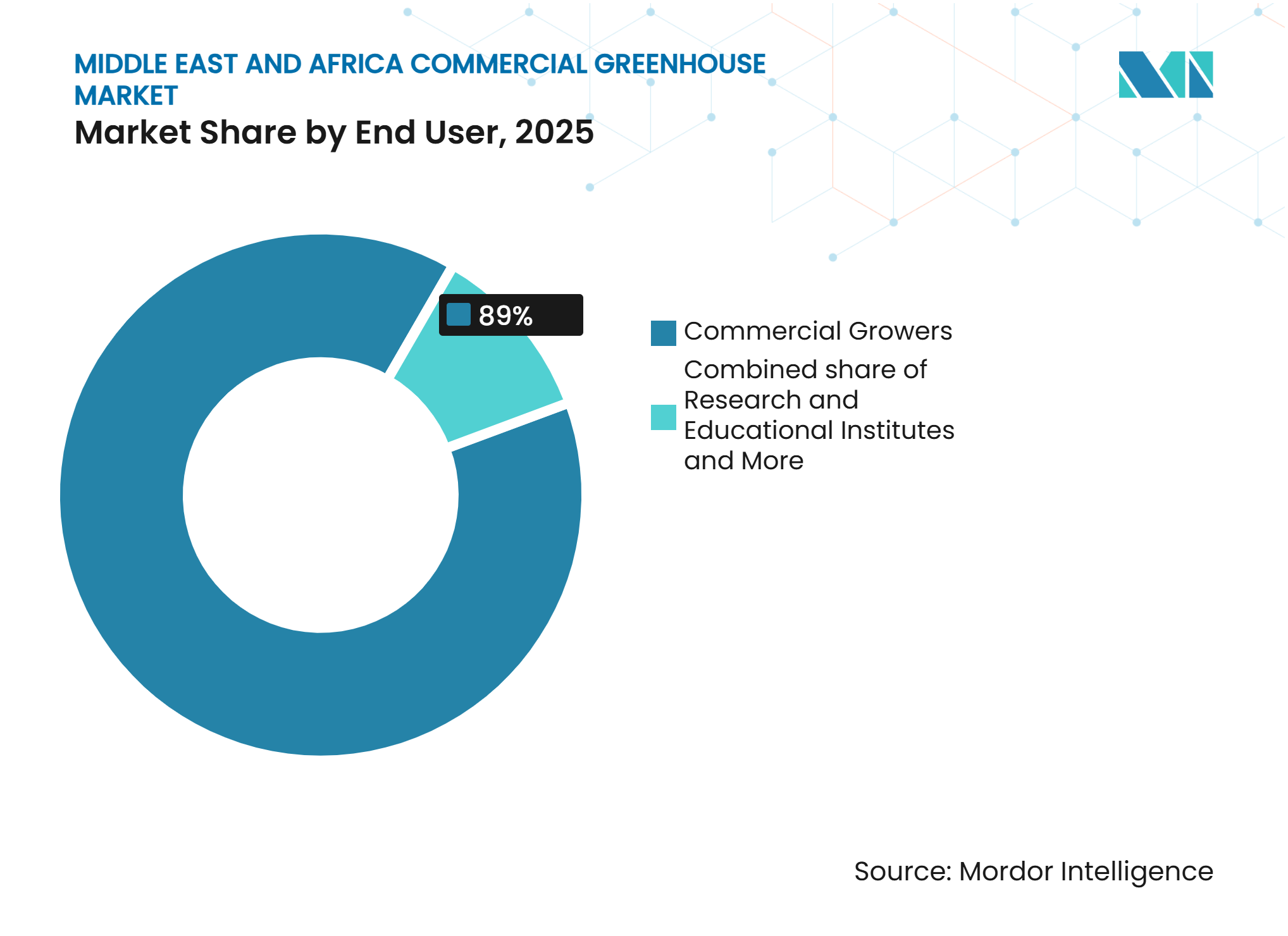
Commercial Growers Lead While Institutes Build SkillsCommercial growers held 89% share in 2025, making them the largest end-user segment. They account for most new greenhouse capacity because they operate production facilities intended for commercial crop sales. Large growers can procure complete packages that include structures, irrigation, climate control, and cultivation systems. KUBO Greenhouse Projects B.V. and Netafim Ltd. address this need through integrated delivery capabilities. Smaller growers in Morocco, Kenya, and South Africa can adopt greenhouse systems in stages. This widens the customer base beyond large state-backed projects.
Research and educational institutes are the fastest-growing end-user segment, with a 10.2% CAGR during 2026-2031. These facilities support training, demonstrations, and local testing of commercial production practices. The Grootvlei Climate Smart Horticulture Centre launched in South Africa in January 2026, will enroll 75 agripreneurs in commercial greenhouse management. This provides greenhouse equipment suppliers with a venue for operational training and technology demonstrations. Institutional sites can help develop the operators and technicians needed by later commercial facilities. Retail garden centers and nurseries remain the smallest end-user segment and serve ornamental and potted-plant demand.



Geography Analysis
The Middle East held a 60% share in 2025 and is the fastest-growing regional segment, with a 7.4% CAGR during 2026-2031. Saudi Arabia is a major destination for new protected-cultivation investment. In July 2026, KUBO Greenhouse Projects B.V. signed a contract for a 45-hectare Jazan greenhouse zone in Saudi Arabia. The project uses semi-closed greenhouse technology for tomato production and has public financing support. The United Arab Emirates also combines capital investment with facilities that test new greenhouse operating models. In May 2025, Silal and Shouguang Vegetable Industry Group announced a 100,000-square-meter Al Ain agritech hub featuring photovoltaic-glass greenhouses, crop management technology, and robotic harvesting.
Israel combines a developed domestic greenhouse base with an export role in greenhouse technology. Its commercial agrivoltaic greenhouse, launched under the European Union-funded Renewable Energy for Agriculture and Circular Economy Project, with support from Israel’s Ministry of Agriculture, shows an energy-food integration model. Qatar has invested in desert-adapted hydroponic systems to support food-security objectives. Oman and Kuwait are also developing greenhouse activity within national food-security programs. Bahrain has less scope for large installations because of its limited land area. The Middle East and Africa commercial greenhouse market is supported by these national programs but project designs vary widely by country[3].
Africa has different commercial conditions across its subregions. Morocco has established greenhouse production areas and public support for modernization through the Fonds de Développement Agricole. Its programs can provide subsidies of up to 40% for high-tech greenhouse projects. Egypt serves export crop production where greenhouse use can support quality consistency. South Africa has a more advanced Sub-Saharan base and added a training facility through the 2026 Grootvlei launch. Kenya, Ethiopia, Nigeria, and other African markets have longer-term commercial potential but face greater finance, service, and skills constraints.
Competitive Landscape
Market Concentration
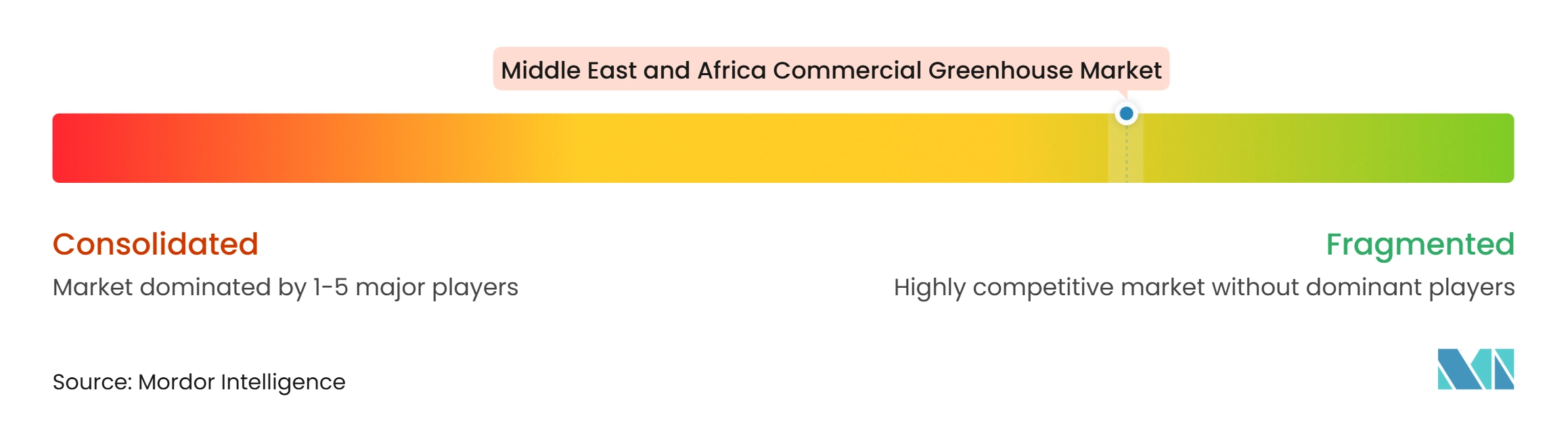
The Middle East and Africa commercial greenhouse market has a concentration score of 3 out of 10 because suppliers compete through project-specific procurement, and no combined top-player share was provided. European turnkey specialists compete with regional operators that offer local access and proximity in after-sales support. KUBO Greenhouse Projects B.V., Van der Hoeven Horticultural Projects B.V., Certhon Build B.V., Bom Group, Netafim Ltd., Priva Holding B.V., Hoogendoorn Growth Management, and Bosman Van Zaal B.V. operate across structures, equipment, and integrated systems. Ardigo, Elite Agro Holding, DC7 Holding, Econoheat (Pty) Ltd, GreenCon, Agrolt Solutions Private Limited, and Debets Schalke B.V. serve relevant local or specialist needs. Competition depends on technical delivery, product reliability, local support, and the ability to address water and energy conditions.
Technology integration is becoming more important as greenhouses incorporate automation, irrigation, and climate management. In June 2026, Batenburg Techniek N.V. presented the Hoogendoorn 360° ecosystem, linking IIVO climate control, LetsGrow.com analytics, and Intelligent Assistance. The launch shows a move toward connected systems rather than separate equipment purchases. In May 2025, Priva Holding B.V. engaged with Saudi Arabia’s Ministry of Investment as part of its regional activity. In 2025, Priva also pursued a joint market-entry strategy with Udeumji Farm for Dubai and Saudi Arabia. These moves show that suppliers seek influence before individual greenhouse procurement decisions.
Regional service capability remains a significant point of competition. Suppliers with local commissioning teams can help customers manage installation, training, maintenance, and system adjustments. In July 2026, KUBO’s Jazan contract included a local employment component within a 45-hectare greenhouse development. In January 2026, the Grootvlei center added a training route for commercial greenhouse management in South Africa. These examples support suppliers that combine technology with practical operating support. The Middle East and Africa commercial greenhouse industry has room for firms that can link imported technology specifications with reliable regional service coverage.
Middle East and Africa Commercial Greenhouse Industry Leaders
-
Orbia Advance Corporation, S.A.B. de C.V. (Netafim Ltd.)
-
Arvesta (Van der Hoeven Horticultural Projects B.V.)
-
KUBO Greenhouse Projects B.V.
-
Debets Schalke B.V.
-
DENSO Corporation (Certhon Build B.V.)
- *Disclaimer: Major Players sorted in no particular order
Middle East and Africa Commercial Greenhouse Market Companies Covered in this Report
- KUBO Greenhouse Projects B.V.
- Arvesta (Van der Hoeven Horticultural Projects B.V.)
- DENSO Corporation (Certhon Build B.V.)
- Atrium Agri B.V. (Bom Group)
- Orbia Advance Corporation, S.A.B. de C.V. (Netafim Ltd.)
- Priva Holding B.V. (Priva Horticulture B.V.)
- Batenburg Techniek N.V. (Hoogendoorn Growth Management)
- Green Innovators B.V. (Bosman Van Zaal B.V.)
- Debets Schalke B.V.
- GreenCon
- Agrolt Solutions Private Limited
- Ardigo
- Elite Agro Holding (Elite Agro Projects)
- DC7 Holding (United Orient Agricultural Company)
- Econoheat (Pty) Ltd
Recent Industry Developments in Middle East and Africa Commercial Greenhouse Market
- July 2026: KUBO Greenhouse Projects B.V. signed contracts with Amtar Al Khair Agricultural Crops Company for a 45-hectare greenhouse zone in Jazan Province, Saudi Arabia, deploying the Ultra-Clima semi-closed concept for tomato production with water-use reduction of up to 75% and over 2,000 local jobs expected. The USD 160 million project is supported by Saudi Arabia’s Ministry of Environment, Water and Agriculture and the Agricultural Development Fund.
- January 2026: Eskom, the Government of the Netherlands, and the Mpumalanga provincial government officially launched the Grootvlei Climate Smart Horticulture Centre in South Africa. Holland Green Tech, Bosman Van Zaal, and Van der Hoeven developed the center to enroll 75 agripreneurs in a commercial greenhouse management program under Eskom’s Just Energy Transition Program.
- May 2025: Silal and China’s Shouguang Vegetable Industry Group signed a strategic partnership to develop a 100,000-square-meter agritech hub in Al Ain, United Arab Emirates. Shouguang Vegetable Industry Group invested more than AED 120 million (USD 32.7 million), and the facility integrates photovoltaic-glass greenhouses, artificial intelligence-driven crop management, and robotic harvesting.
Middle East and Africa Commercial Greenhouse Market Report Scope
The Middle East And Africa Commercial Greenhouse Market report is segmented by equipment type (heating systems, cooling and ventilation systems, LED grow lighting, irrigation and fertigation systems, climate control and automation software, screening and shading systems, and structural components [glazing systems and frames and trusses]), crop type (fruits and vegetables [tomatoes, cucumbers, lettuce and leafy greens, peppers, and strawberries and berries], flowers and ornamentals [cut flowers and potted plants and bedding plants], herbs and microgreens, and cannabis and specialty crops [medical cannabis and seedlings and propagation crops]), greenhouse type (glass greenhouses, plastic-film greenhouses, rigid polycarbonate greenhouses, and hybrid and semi-closed greenhouses), cultivation technology (hydroponic [nutrient film technique, deep water culture, and drip hydroponics], non-hydroponic soil and substrate [soil-based and coco coir and rockwool substrate], and hybrid and vertical integration), and end user (commercial growers, research and educational institutes, and retail garden centers and nurseries) and by geogrphy (Middle East and Africa). The market forecasts are provided in terms of value (USD).
Segmentation Overview
| Heating Systems | |
| Cooling and Ventilation Systems | |
| LED Grow Lighting | |
| Irrigation and Fertigation Systems | |
| Climate Control and Automation Software | |
| Screening and Shading Systems | |
| Structural Components | Glazing Systems |
| Frames and Trusses |
| Fruits and Vegetables | Tomatoes |
| Cucumbers | |
| Lettuce and Leafy Greens | |
| Peppers | |
| Strawberries and Berries | |
| Flowers and Ornamentals | Cut Flowers |
| Potted Plants and Bedding Plants | |
| Herbs and Microgreens | |
| Cannabis and Specialty Crops | Medical Cannabis |
| Seedlings and Propagation Crops |
| Glass Greenhouses |
| Plastic-Film Greenhouses |
| Rigid Polycarbonate Greenhouses |
| Hybrid and Semi-Closed Greenhouses |
| Hydroponic | Nutrient Film Technique |
| Deep Water Culture | |
| Drip Hydroponics | |
| Non-Hydroponic Soil and Substrate | Soil-Based |
| Coco Coir and Rockwool Substrate | |
| Hybrid and Vertical Integration |
| Commercial Growers |
| Research and Educational Institutes |
| Retail Garden Centers and Nurseries |
| Middle East | United Arab Emirates |
| Saudi Arabia | |
| Qatar | |
| Kuwait | |
| Oman | |
| Bahrain | |
| Israel | |
| Rest of Middle East | |
| Africa | Egypt |
| South Africa | |
| Nigeria | |
| Kenya | |
| Morocco | |
| Algeria | |
| Ethiopia | |
| Rest of Africa |
| By Equipment Type | Heating Systems | |
| Cooling and Ventilation Systems | ||
| LED Grow Lighting | ||
| Irrigation and Fertigation Systems | ||
| Climate Control and Automation Software | ||
| Screening and Shading Systems | ||
| Structural Components | Glazing Systems | |
| Frames and Trusses | ||
| By Crop Type | Fruits and Vegetables | Tomatoes |
| Cucumbers | ||
| Lettuce and Leafy Greens | ||
| Peppers | ||
| Strawberries and Berries | ||
| Flowers and Ornamentals | Cut Flowers | |
| Potted Plants and Bedding Plants | ||
| Herbs and Microgreens | ||
| Cannabis and Specialty Crops | Medical Cannabis | |
| Seedlings and Propagation Crops | ||
| By Greenhouse Type | Glass Greenhouses | |
| Plastic-Film Greenhouses | ||
| Rigid Polycarbonate Greenhouses | ||
| Hybrid and Semi-Closed Greenhouses | ||
| By Cultivation Technology | Hydroponic | Nutrient Film Technique |
| Deep Water Culture | ||
| Drip Hydroponics | ||
| Non-Hydroponic Soil and Substrate | Soil-Based | |
| Coco Coir and Rockwool Substrate | ||
| Hybrid and Vertical Integration | ||
| By End User | Commercial Growers | |
| Research and Educational Institutes | ||
| Retail Garden Centers and Nurseries | ||
| By Geography | Middle East | United Arab Emirates |
| Saudi Arabia | ||
| Qatar | ||
| Kuwait | ||
| Oman | ||
| Bahrain | ||
| Israel | ||
| Rest of Middle East | ||
| Africa | Egypt | |
| South Africa | ||
| Nigeria | ||
| Kenya | ||
| Morocco | ||
| Algeria | ||
| Ethiopia | ||
| Rest of Africa | ||
Key Questions Answered in the Report
What is the 2026 value of the Middle East and Africa commercial greenhouse market?
The sector was estimated at USD 5.9 billion in 2026.
Which commercial greenhouse crop segment is the largest in the region?
Fruits and vegetables were the largest crop segment, with 68% share in 2025.
Which greenhouse format is expanding the fastest in the region?
Hybrid and semi-closed greenhouses are forecast to grow at a 12.6% CAGR during 2026-2031.
Which region leads commercial greenhouse demand in the Middle East and Africa?
The Middle East held 60% share in 2025 and is forecast to grow at a 7.4% CAGR during 2026-2031.