
Middle East and Africa Chemical Processing Pumps Market Size and Share
Market Overview
| Study Period | 2022 - 2032 |
|---|---|
| Forecast Data Period | 2027 - 2032 |
| Base Year Market Size (2026) | USD 41.15 Million |
| Market Size (2027) | USD 42.69 Million |
| Market Size (2032) | USD 51.27 Million |
| Growth Rate (2027 - 2032) | 3.73 % |
| Market Concentration | Medium |
Major Players *Disclaimer: Major Players sorted in no particular order Image © Mordor Intelligence. Reuse requires attribution under CC BY 4.0. | |
Middle East and Africa Chemical Processing Pumps Market Analysis by Mordor Intelligence
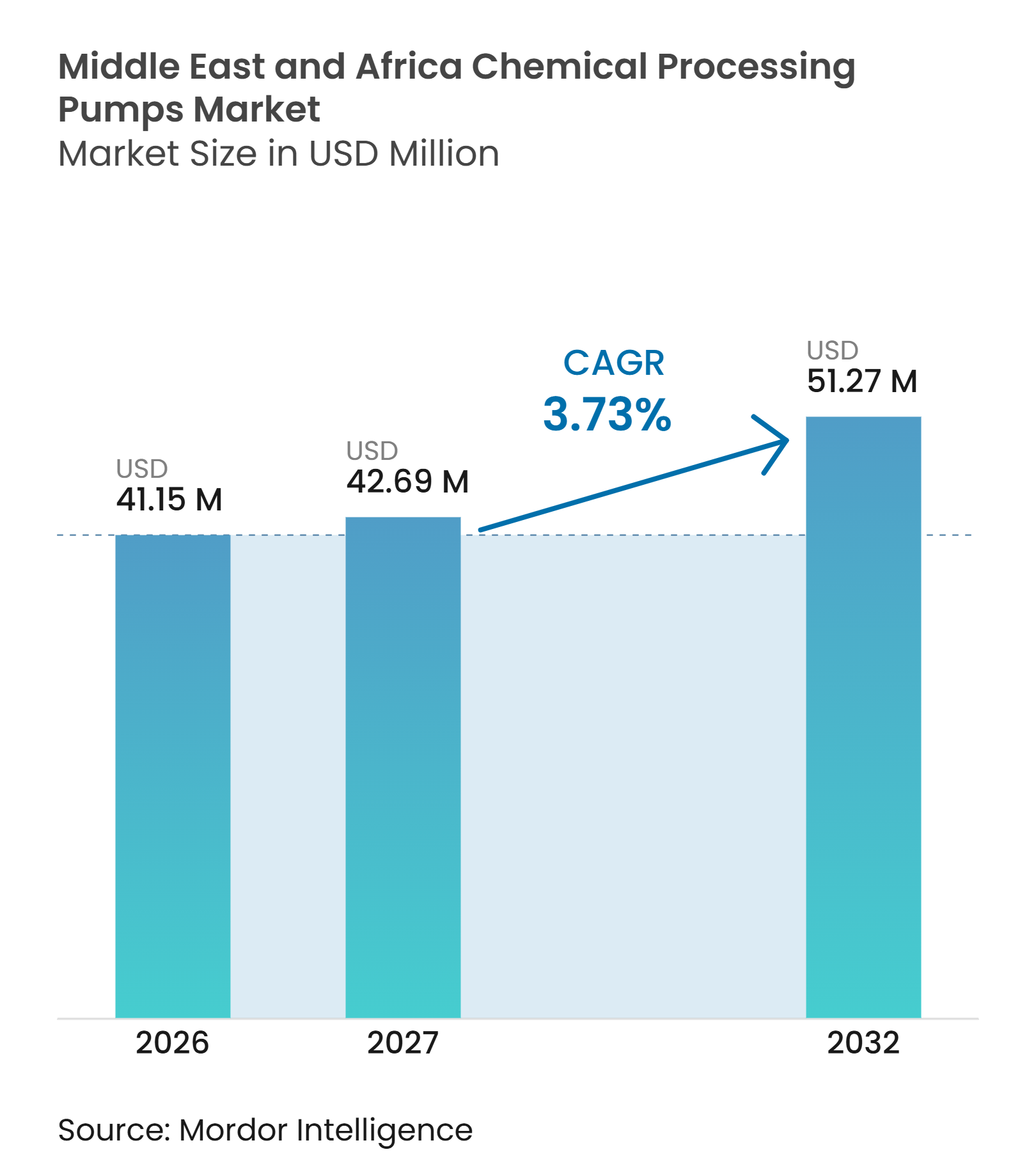
The Middle East And Africa Chemical Processing Pumps Market size was valued at USD 41.15 million in 2026 and is estimated to grow from USD 42.69 million in 2027 to reach USD 51.27 million by 2032, at a CAGR of 3.73% during the forecast period (2027-2032). Demand is supported by investment in reverse-osmosis desalination, industrial water reuse, petrochemicals, and mineral processing across the region. Saudi Arabia remains the largest source of project demand because water, refinery, and chemical investments are being executed at the same time. The United Arab Emirates offers the fastest country growth as the TA’ZIZ chemicals complex moves from construction into long-term operation. Suppliers that can meet technical specifications, provide local service, and support project qualification are better placed than companies competing only on equipment price. Localization programs and tighter hazardous service standards are also changing how buyers select equipment.
Key Report Takeaways
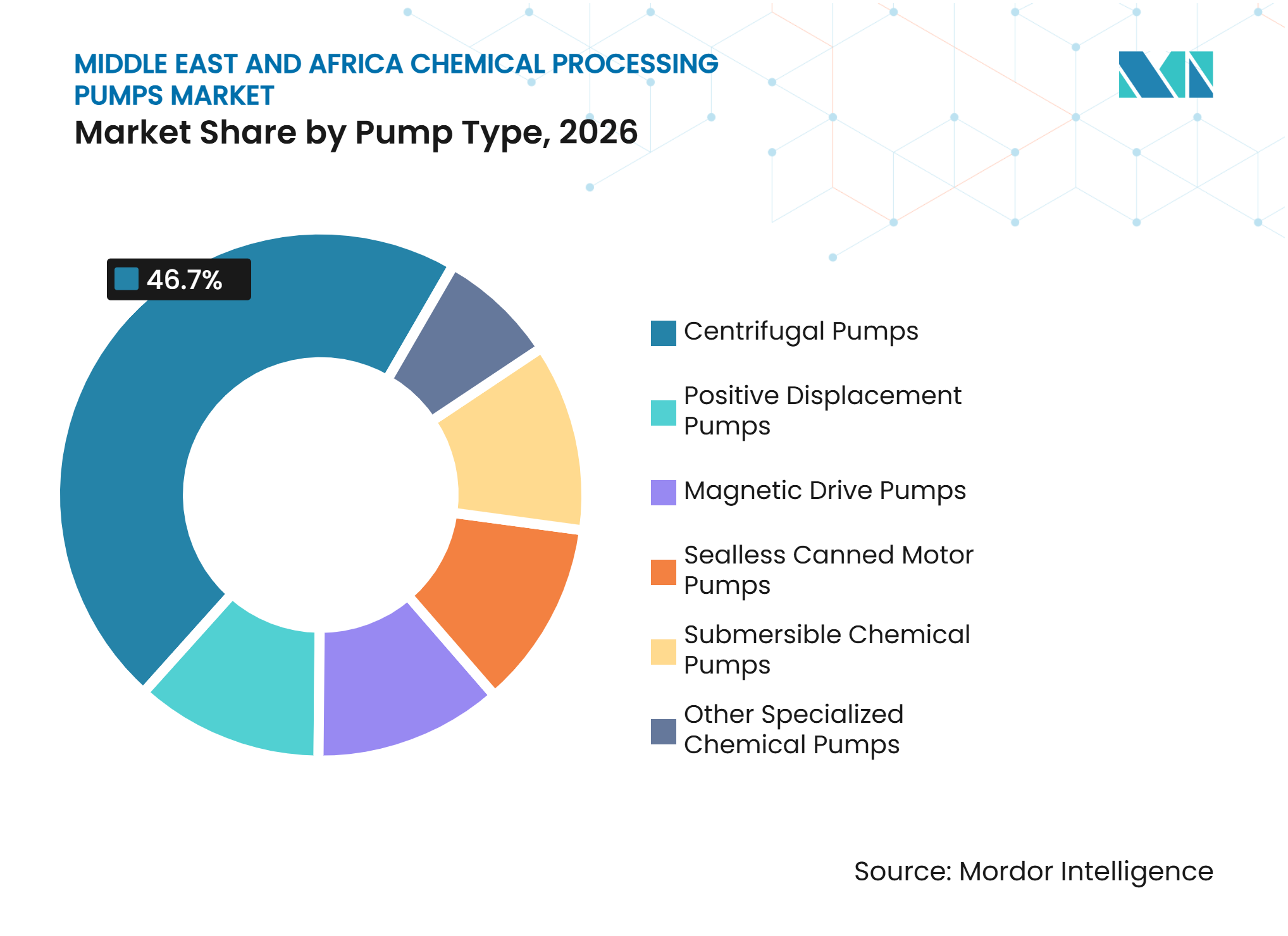
- By pump type, centrifugal pumps held 46.7% of regional revenue in 2026, while magnetic drive pumps are projected to grow at a CAGR of 3.9% through 2032.
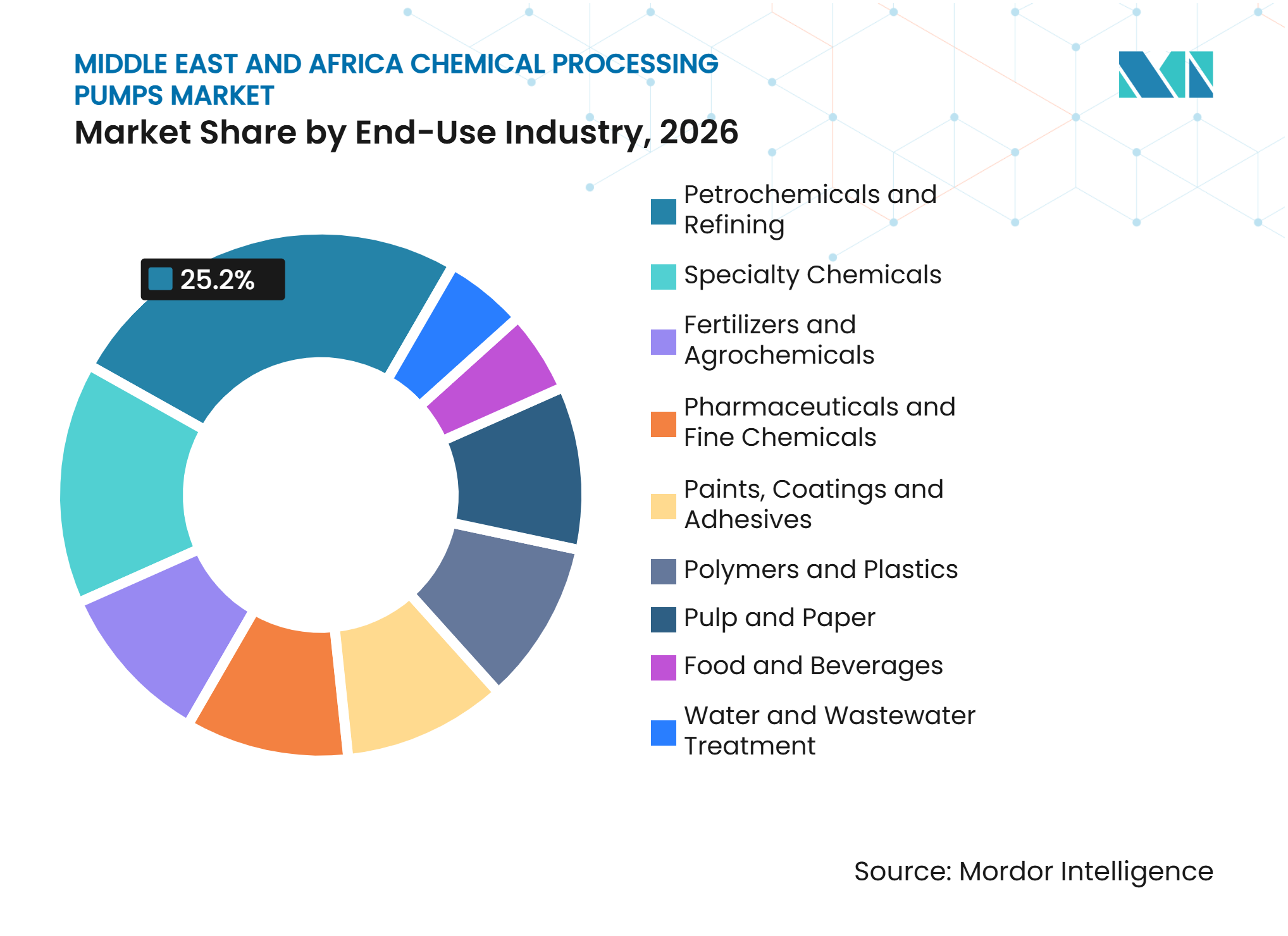
- By end-use industry, petrochemicals and refining held 25.2% of regional revenue in 2026, while pharmaceuticals and fine chemicals are forecast to grow at a 4.3% CAGR through 2032.
- By geography, Saudi Arabia held 34.1% of the regional market in 2026, while the United Arab Emirates is projected to grow at a CAGR of 3.8% through 2032.
Note: Market numbers in this report are based on Mordor Intelligence's proprietary estimation framework, which combines nine months of actuals with Q4 projections for base year 2026.
Market Trends and Insights
Drivers Impact Analysis of Middle East and Africa Chemical Processing Pumps Market*
| Driver | (~) % Impact on CAGR Forecast | Geographic Relevance | Impact Timeline |
|---|---|---|---|
| Desalination and Water-Reuse Capacity Expansion | +1.1% | Saudi Arabia, UAE, Egypt, Morocco | Medium term (2-4 years) |
| Petrochemical and Specialty-Chemical Capacity Additions | +0.8% | Saudi Arabia, UAE, Qatar | Medium term (2-4 years) |
| Brownfield Reliability and Pump-System Retrofit Demand | +0.5% | Saudi Arabia, UAE, South Africa | Short term (≤ 2 years) |
| Hazardous-Area and Zero-Leakage Specification Adoption | +0.4% | GCC-wide, spill-over to Egypt | Medium term (2-4 years) |
| Saudi Water-Technology Localization and Local-Content Requirements | +0.4% | Saudi Arabia primarily | Long term (≥ 4 years) |
| Mining, Phosphate and Battery-Metal Processing Expansion | +0.4% | Saudi Arabia, Morocco, South Africa, Egypt | Long term (≥ 4 years) |
| Source: Mordor Intelligence | |||
Desalination and Water-Reuse Capacity Expansion
Saudi Arabia is converting major desalination assets from multi-stage flash systems to reverse-osmosis technology. The Saudi Water Authority signed a USD 650 million financing agreement in June 2025 for the Jubail Phase I and Khobar Phase II conversion program, with Khobar Phase II operating at 670,852 cubic meters per day.[1] The projects require high-pressure centrifugal equipment and chemical-feed systems for anti-scalant and disinfection service. That requirement extends beyond the pump population linked to new capacity because a conversion replaces operating equipment and changes chemical dosing arrangements. Saudi Arabia has also identified high-pressure pumps as a water-sector commodity for future localization. Morocco adds another source of demand because OCP Nutricrops is expanding fertilizer output using desalinated process water and renewable energy. These programs keep water treatment at the center of the Middle East and Africa chemical processing pumps market through 2032.
Petrochemical and Specialty-Chemical Capacity Additions
GCC chemical producers expanded capacity in 2025 and retained a sizable investment pipeline through 2029.[2] TA’ZIZ awarded contracts for a 1.8 million-ton-per-year methanol plant and a PVC–ethylene dichloride (EDC)–vinyl chloride monomer (VCM) complex at Ruwais, creating demand across corrosive transfer, chemical injection, condensate recovery, and seawater cooling service.[3] These greenfield facilities need complete equipment specifications before operations begin, rather than only selective replacement units. API 610 and ISO 5199 requirements make quality, documentation, and lifecycle support more important in these orders. Saudi Arabia’s Advanced Petrochemical Company complex began operating in 2025, while the SATORP Amiral expansion remains under execution. This project pipeline supports the Middle East and Africa chemical processing pumps market and sustains later demand for spares and maintenance.
Hazardous-Area and Zero-Leakage Specification Adoption
Gulf Cooperation Council (GCC) operators are raising technical requirements for equipment used with hazardous chemicals. API published the 13th edition of API 610 in 2026, updating rotordynamics, seal-chamber dimensions, and auxiliary piping requirements for centrifugal pumps. The update encourages operators to review pump designs and supporting systems in both new projects and installed facilities. Flowserve introduced the INNOMAG TB-MAG Dual Drive in March 2025 as a sealless magnetic-drive pump with independent secondary containment.[4] The product was later recognized with the 2025 Vaaler Award for Fluid Flow. These developments make magnetic-drive equipment a more credible option for acrylonitrile, hydrofluoric acid, and other hazardous-fluid duties. They also support the shift toward solutions that reduce leakage risk in the Middle East and Africa chemical processing pumps market.
Mining, Phosphate, and Battery-Metal Processing Expansion
Mining and fertilizer processing add a long-term demand source for slurry, acid-transfer, and dosing equipment. Ma’aden is expanding phosphate capacity through Phosphate 3 and has stated a target of 9 million tons of annual output. Saudi Arabia also announced a rare-earths refinery arrangement with MP Materials and the U.S. Department of Defense in November 2025. These facilities need pumps that can handle phosphoric acid, sulfuric acid, slurries, and mineral-process streams. Morocco’s Jorf Lasfar investment and OCP Nutricrops capacity program reinforce the regional need for corrosion-resistant process equipment. South Africa remains relevant because its established mining base requires maintenance and replacement activity across platinum, gold, and chrome operations. Mining investment broadens the Middle East and Africa chemical processing pumps market beyond oil, gas, and water applications.
Restraints Impact Analysis of Middle East and Africa Chemical Processing Pumps Market*
| Restraint | (~) % Impact on CAGR Forecast | Geographic Relevance | Impact Timeline |
|---|---|---|---|
| Alloy, Elastomer and Imported-Component Cost Volatility | -0.4% | Global, with acute impact on APAC-sourced imports to MEA | Short term (≤ 2 years) |
| Compressed-Air Energy Penalty and Electric-Diaphragm Substitution | -0.3% | Global, spill-over to MEA industrial facilities | Medium term (2-4 years) |
| Skilled Service-Capacity Gaps Outside Major Industrial Hubs | -0.2% | Sub-Saharan Africa, remote MEA sites | Long term (≥ 4 years) |
| Counterfeit Spares and Non-Compliant Low-Cost Imports | -0.2% | UAE, broader GCC, North Africa | Short term (≤ 2 years) |
| Source: Mordor Intelligence | |||
Alloy, Elastomer, and Imported-Component Cost Volatility
Chemical processing equipment for aggressive fluids uses duplex stainless steel, Hastelloy, titanium, PTFE, and PVDF. Prices for these materials respond to metals markets, energy inputs, trade changes, and currency movements. KSB reported EUR 84 million equivalent to USD 92.45 million in negative currency translation effects on 2025 order intake, partly linked to movements in USD, INR, and BRL. Project budgets for desalination and petrochemical contracts are often fixed well before equipment is delivered. A manufacturer that cannot adjust prices may face pressure on margins when component costs rise during project execution. Smaller specialty suppliers are more exposed where sourcing depends on European or Japanese components. This makes procurement discipline and local inventory important for suppliers serving the Middle East and Africa chemical processing pumps market.
Compressed-Air Energy Penalty and Electric-Diaphragm Substitution
Air-operated double-diaphragm pumps remain common in corrosive transfer and batch applications. Their use is challenged where compressed-air generation consumes substantially more electricity than direct electric drive solutions. Warren Rupp states that electric-operated double-diaphragm pumps can deliver significant energy savings in suitable operating conditions. IDEX introduced the Cognito electric-operated double-diaphragm range for oil and gas, chemical transfer, pharmaceutical, and coatings applications. The substitution risk is concentrated in new specifications because installed air systems are less easily replaced. Service coverage also remains uneven outside large industrial centers, which can limit uptime at remote sites. Counterfeit spare parts and non-compliant low-cost equipment create additional risks where supply-chain controls are weak, favoring suppliers with documented parts, trained technicians, and direct support channels.
*Our forecasts treat driver/restraint impacts as directional, not additive. The impact forecasts reflect baseline growth, mix effects, and variable interactions.
Middle East and Africa Chemical Processing Pumps Market Segment Analysis
By Pump Type:
Centrifugal Pumps Retain Their Lead While Magnetic Drive Pumps Gain GroundCentrifugal pumps held 46.7% of the Middle East and Africa chemical processing pumps market share in 2026. Their position reflects their suitability for high-flow, continuous duties in desalination, refinery cooling water, and large water-treatment facilities. These applications make up a large share of the installed equipment base in Saudi Arabia and the United Arab Emirates. API 610 requirements strengthen the importance of hydraulic performance, seal design, materials selection, testing, and documentation. Centrifugal platforms will therefore remain central to projects that need large liquid volumes moved at consistent rates.
Positive displacement pumps remain important where a process needs controlled flow, high pressure, or a fluid with higher viscosity. They are used for chemical injections, metering, specialty chemical transfer, and desalination post-treatment. Sealless canned-motor pumps continue to address high-hazard duties where containment is essential. Magnetic drive pumps are forecast to grow at 3.9% CAGR through 2032, faster than the overall Middle East and Africa chemical processing pumps market. Flowserve’s 2025 secondary-containment design gives operators another option where risk reduction and maintenance access influence the selection.



By End-Use Industry:
Petrochemicals and Refining Lead Demand While Pharmaceuticals and Fine Chemicals AcceleratePetrochemicals and refining held 25.2% of the regional market in 2026. Jubail, Yanbu, and Ruwais concentrate refinery and cracker capacity that requires pumps for feed handling, cooling water, condensate, chemicals, and utilities. The APC Propane Dehydrogenation (PDH) facility started operations in 2025, while the Saudi Aramco Total Refining and Petrochemical Company (SATORP) Amiral expansion continues under execution. Each operating complex creates an aftermarket requirement for seals, spare parts, repair, and reliability services. Water and wastewater treatment and fertilizers and agrochemicals add demand for corrosion-resistant materials and chemical dosing systems.
Pharmaceuticals and fine chemicals are projected to grow at 4.3% CAGR through 2032. The segment benefits from investments in active pharmaceutical ingredient production and from local manufacturing strategies in Egypt and Saudi Arabia. High-purity operations require diaphragm, dosing, and positive displacement pumps that support accurate transfer and cleaning procedures. Compliance with European Union Good Manufacturing Practice (EU-GMP) and World Health Organization standards raises the value of materials traceability and hygienic design. TA’ZIZ development is also relevant for polymers and plastics becauseits Polyvinyl Chloride (PVC) and caustic soda facilities will require corrosive-duty equipment after commissioning.

Geography Analysis
Saudi Arabia
Saudi Arabia held 34.1% of the Middle East and Africa chemical processing pumps market share in 2026. The country combines reverse-osmosis conversion, petrochemical additions, mining investment, and local-content requirements within one industrial program. The Saudi Press Agency reported that the Shuaibah Phase 3 conversion uses reverse osmosis and reduces energy consumption, providing an operating model for other water facilities. The Saudi Water Authority’s financing program for Jubail Phase I and Khobar Phase II adds another large equipment cycle. ITT completed a second expansion phase at its Dammam manufacturing facility during 2025, showing that suppliers are adding local capability rather than relying solely on imports. Localization guidance identifies high-pressure pumps as a target product category, which increases the importance of in-country assembly, testing, and service. These factors create a more structured procurement environment for the regional market.
United Arab Emirates
The United Arab Emirates is forecast to grow at 3.8% CAGR through 2032. Its demand is linked closely to the TA’ZIZ program at Ruwais, where methanol and PVC-EDC (Ethylene Dichloride)-VCM (Vinyl Chloride Monomer) plants are under development. Abu Dhabi National Oil Company (ADNOC) and TAQA signed a 27-year utilities agreement in 2026, signaling long-term operational support for the Ruwais facilities. AquaChemie Global Chemicals opened an advanced chemicals facility at KEZAD in 2025, strengthening the local supply base that serves ADNOC. The United Arab Emirates demand profile favors corrosive-duty service in PVC intermediates, caustic soda, and specialty chemicals. This supports magnetic-drive and sealless equipment where process safety and fluid containment affect lifecycle costs in the Middle East and Africa chemical processing pumps market.
North Africa and Sub-Saharan Africa
Egypt, Morocco, South Africa, and the wider African cluster offer different demand patterns for the Middle East and Africa chemical processing pumps market. Egypt is expanding pharmaceutical manufacturing and phosphate-related processing, which require accurate metering, diaphragm, and high-purity equipment. Morocco’s fertilizer programs depend on desalinated water and acid-service operations that require corrosion-resistant centrifugal and positive displacement units. South Africa’s mining base supports ongoing demand for slurry and chemical-transfer solutions, while the Weir-Olayan arrangement positions Weir to support mining growth in Saudi Arabia as well. The Rest of Middle East and Africa cluster is commonly served through distributors and local service partners. Availability of trained technicians and genuine spares has greater importance at remote locations because delays can extend outages. Food and beverages, wastewater treatment, and emerging battery-materials processing offer additional demand, but supplier coverage and compliance capability remain decisive.
Competitive Landscape
Market Concentration
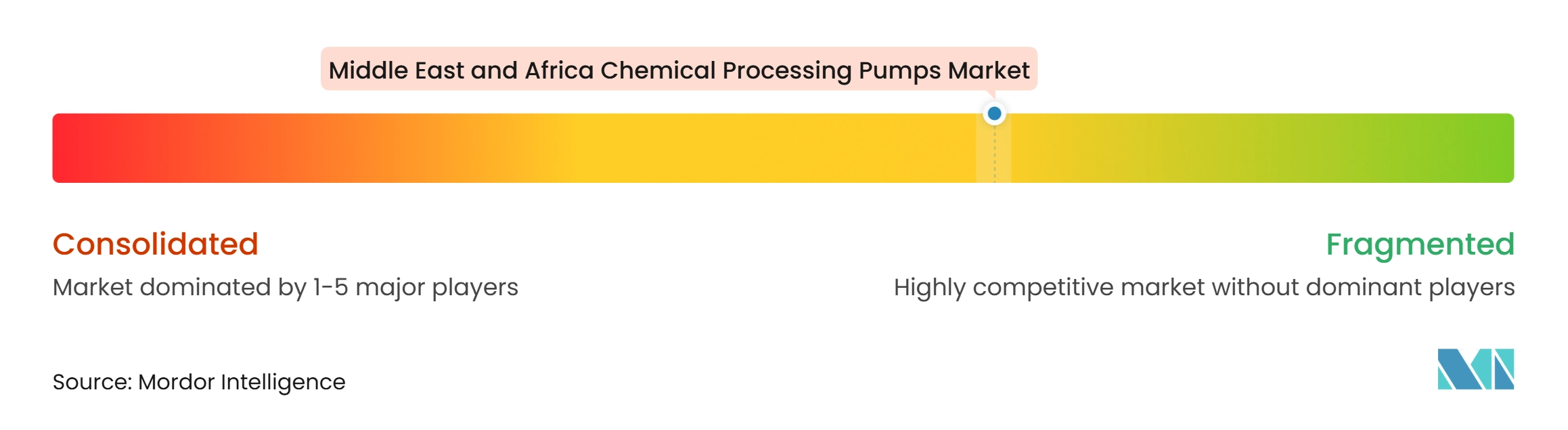
The Middle East and Africa chemical processing pumps market is moderately consolidated in large specification-driven projects. Flowserve, Sulzer, KSB, and ITT compete for petrochemical, desalination, and industrial water orders where compliance, engineering support, and local service capability determine eligibility. Smaller specialists such as LEWA, ProMinent, and NETZSCH compete more directly in metering, dosing, slurry, and positive displacement applications. KSB reported strong growth in its Middle East and Africa regions during 2025, including 7% growth in order intake and 7.6% growth in sales revenue. Large international suppliers retain an advantage where operators require API 610, ISO 5199, ATEX, or IECEx compliance. Their installed bases also help secure service and parts demand after the project is completed in the Middle East and Africa chemical processing pumps market.
Manufacturing and service investments show how competition is shifting toward local execution. ITT expanded its Dammam site during 2025, improving its ability to provide engineering, manufacturing, and testing for the Saudi market. Sulzer acquired Davies & Mills in Bahrain in January 2025, broadening its rotating-equipment maintenance presence in the region. Sulzer also signed a five-year corporate procurement agreement with Saudi Aramco in April 2026 for centrifugal pumps, spare parts, and aftermarket services. Flowserve’s 2025 sealless magnetic-drive launch addresses hazardous-fluid service, where process safety creates a clear technical barrier. These moves indicate that service speed, qualification, and specialized equipment are becoming as important as base pump supply.
Specialized dosing and metering applications leave room for companies that can serve pharmaceutical and specialty chemical projects. Digital condition monitoring is another opportunity because large pump fleets require reliability support after commissioning. Counterfeit parts and low-cost non-compliant imports remain a risk for authorized suppliers, especially in service and spares channels, reinforcing buyer demand for direct parts traceability and trained field support.
Middle East and Africa Chemical Processing Pumps Industry Leaders
-
Flowserve Corporation
-
Sulzer Ltd.
-
Grundfos Holding A/S
-
KSB SE & Co. KGaA
-
Xylem Inc.
- *Disclaimer: Major Players sorted in no particular order
Middle East and Africa Chemical Processing Pumps Market Companies Covered in this Report
- Alfa Laval AB
- Dover Corporation
- EBARA Corporation
- Flowserve Corporation
- Grundfos Holding A/S
- IDEX Corporation
- ITT Inc.
- IWAKI Co., Ltd.
- KSB SE & Co. KGaA
- LEWA GmbH
- Lutz-JESCO GmbH
- NETZSCH Pumps & Systems
- PCM Group
- ProMinent GmbH
- Ruhrpumpen Group
- SEKO S.p.A.
- SPX FLOW, Inc.
- Sulzer Ltd.
- The Weir Group PLC
- Xylem Inc.
Recent Industry Developments in Middle East and Africa Chemical Processing Pumps Market
- July 2026: ITT Inc. completed its USD 4.775 billion acquisition of SPX FLOW, Inc., with the deal closing on March 2, 2026. ITT’s Industrial Process segment was renamed Flow Technologies on the same day, with SPX FLOW’s industrial, chemical, energy, and food-and-beverage pump and mixing technology portfolio now integrated. SPX FLOW delivered revenue of more than USD 1.3 billion in 2025 with 14% organic order growth. The combined platform significantly strengthens ITT’s position in Middle East and Africa (MEA) chemical processing pump markets.
- November 2025: ITT Inc. completed the second phase of its approximately USD 25 million expansion at its Industrial Process manufacturing facility in Dammam, Saudi Arabia, doubling the site’s footprint to approximately 30,000 square meters.
- November 2025: Saudi Arabia earmarked USD 15 billion to triple phosphate production, with Ma’aden targeting 9 million metric tons per annum through its Phosphate 3 expansion, with Phase 1 on track for commissioning. The company secured a gas allocation for its Phosphate 4 project, equivalent to roughly 75% capacity growth relative to current nameplate output within 5 years, and also announced a binding term sheet with U.S. firm MP Materials and the U.S. Department of Defense to establish a rare earths refinery in the Kingdom.
- October 2025: ADNOC Logistics & Services and TA’ZIZ signed a 50-year agreement to build, own, and operate a dedicated chemicals port at the TA’ZIZ Industrial Chemicals Zone in Al Ruwais, valued at over USD 300 million, scheduled for completion by Q4 2026. This infrastructure commitment cements Ruwais as a long-duration demand anchor for specialty chemical process pumps well beyond 2030.
Middle East and Africa Chemical Processing Pumps Market Report Scope
A chemical processing pump is a specialized mechanical device designed to transfer corrosive, toxic, abrasive, high-temperature, or high-purity fluids within chemical, petrochemical, pharmaceutical, and wastewater treatment plants.
Middle East and Africa chemical processing pumps market is segmented by pump type, end-use industry, and geography. By pump type, the market is segmented into centrifugal pumps, positive displacement pumps, magnetic drive pumps, sealless canned motor pumps, submersible chemical pumps, and other specialized chemical pumps. By end-use industry, the market is segmented into specialty chemicals, petrochemicals and refining, fertilizers and agrochemicals, pharmaceuticals and fine chemicals, paints, coatings and adhesives, polymers and plastics, pulp and paper, food and beverages, and water and wastewater treatment. The report also covers the market size and forecasts for the Middle East and Africa chemical processing pumps market across 5 key countries. For each segment, the market sizing and forecasts have been provided on the basis of value (USD).
Segmentation Overview
| Centrifugal Pumps |
| Positive Displacement Pumps |
| Magnetic Drive Pumps |
| Sealless Canned Motor Pumps |
| Submersible Chemical Pumps |
| Other Specialized Chemical Pumps |
| Specialty Chemicals |
| Petrochemicals and Refining |
| Fertilizers and Agrochemicals |
| Pharmaceuticals and Fine Chemicals |
| Paints, Coatings and Adhesives |
| Polymers and Plastics |
| Pulp and Paper |
| Food and Beverages |
| Water and Wastewater Treatment |
| Saudi Arabia |
| United Arab Emirates |
| Egypt |
| South Africa |
| Morocco |
| Rest of Middle East and Africa |
| By Pump Type | Centrifugal Pumps |
| Positive Displacement Pumps | |
| Magnetic Drive Pumps | |
| Sealless Canned Motor Pumps | |
| Submersible Chemical Pumps | |
| Other Specialized Chemical Pumps | |
| By End-Use Industry | Specialty Chemicals |
| Petrochemicals and Refining | |
| Fertilizers and Agrochemicals | |
| Pharmaceuticals and Fine Chemicals | |
| Paints, Coatings and Adhesives | |
| Polymers and Plastics | |
| Pulp and Paper | |
| Food and Beverages | |
| Water and Wastewater Treatment | |
| By Geography | Saudi Arabia |
| United Arab Emirates | |
| Egypt | |
| South Africa | |
| Morocco | |
| Rest of Middle East and Africa |
Key Questions Answered in the Report
What is the forecast for chemical processing pumps in the Middle East and Africa?
The regional value is projected to reach USD 51.27 million by 2032, expanding at a 3.73% CAGR from 2027 to 2032.
Which pump type leads regional demand?
Centrifugal pumps led with 46.7% share in 2026 because desalination, refineries, and water treatment need high-volume continuous operation.
Which technology is expected to grow fastest?
Magnetic drive pumps are forecast to grow at 3.9% CAGR through 2032 as hazardous-fluid operators adopt stronger containment and zero-leakage specifications.
Why is Saudi Arabia the largest regional buyer?
Saudi Arabia held 34.1% share in 2026 due to reverse-osmosis conversion, petrochemical projects, mining investment, and localization requirements.
What end-use segment is growing fastest?
Pharmaceuticals and fine chemicals are forecast to grow at 4.3% CAGR through 2032, supported by regional active pharmaceutical ingredient manufacturing.
What should suppliers prioritize in the region?
Suppliers should prioritize qualification, local service, genuine spare parts, hazardous-service compliance, and support for water and chemical projects.