
Middle East 5G Core Network Market Size and Share
Market Overview
| Study Period | 2020 - 2031 |
|---|---|
| Forecast Data Period | 2026 - 2031 |
| Base Year Market Size (2025) | USD 0.39 Billion |
| Market Size (2026) | USD 0.48 Billion |
| Market Size (2031) | USD 1.25 Billion |
| Growth Rate (2026 - 2031) | 21.10 % |
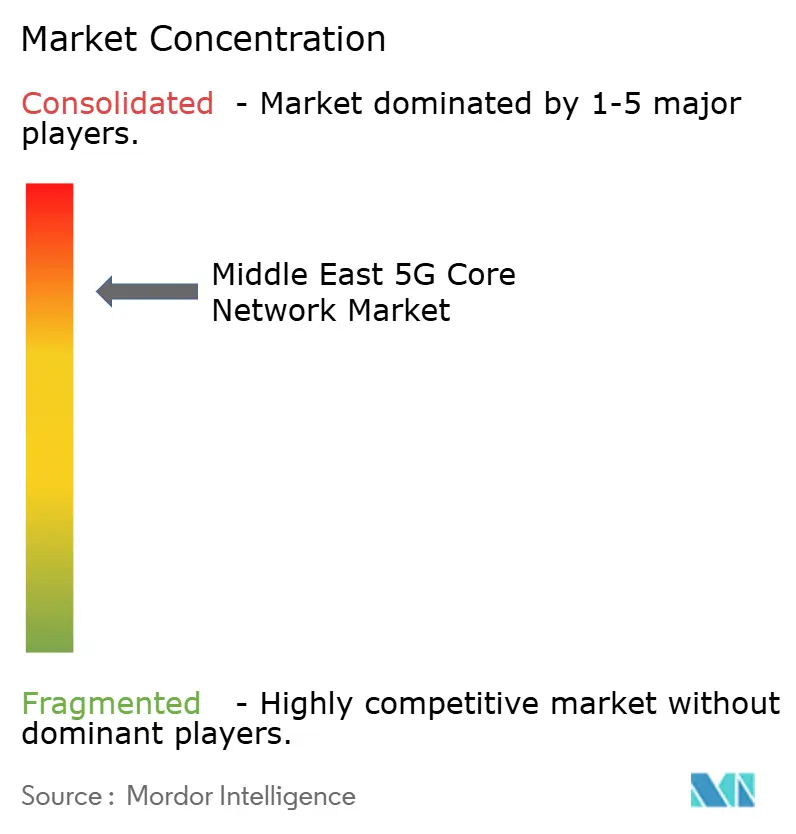
| Market Concentration | High |
Major Players *Disclaimer: Major Players sorted in no particular order Image © Mordor Intelligence. Reuse requires attribution under CC BY 4.0. | |
Middle East 5G Core Network Market Analysis by Mordor Intelligence
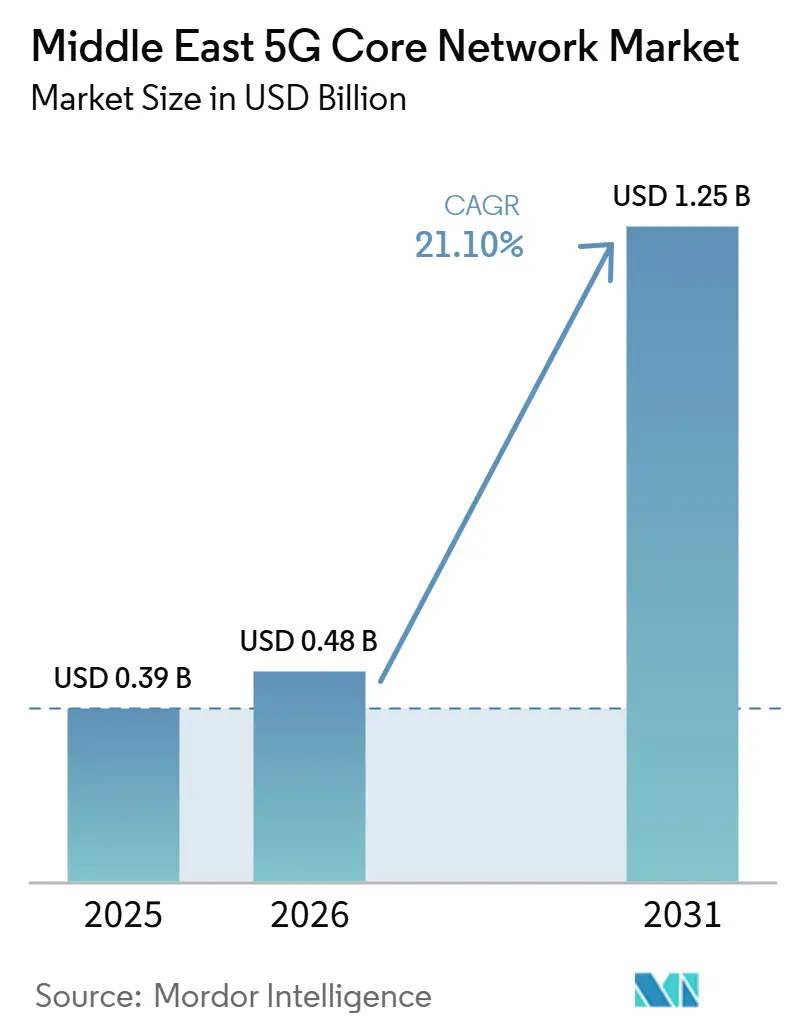
The Middle East 5G Core Network Market size was valued at USD 0.39 billion in 2025 and estimated to expand from USD 0.48 billion in 2026 to reach USD 1.25 billion by 2031, at a CAGR of 21.10% during the forecast period (2026-2031). The investment focus has shifted from broad 5G radio coverage toward the software layer that supports programmable services. Gulf operators are moving toward standalone cores to support differentiated connectivity, lower latency, and enterprise services. National digital programs are reinforcing demand because public agencies, industrial operators, and infrastructure projects require secure, locally controlled connectivity. Data residency rules are also directing operators toward on-premise and hybrid architectures rather than fully public cloud deployments. The Middle East 5G Core Network Market, therefore, offers vendors opportunities in core software, orchestration, integration, managed services, and enterprise-focused deployment models.
Key Report Takeaways
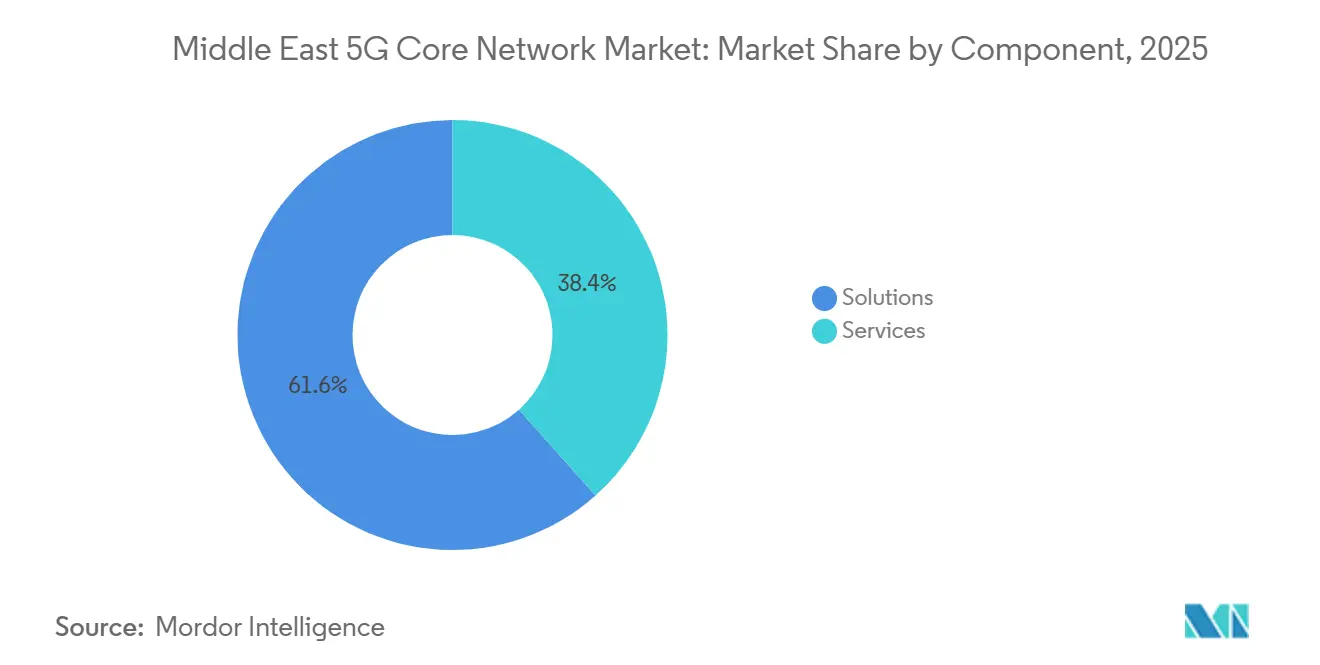
- By component, solutions held 61.59% of the Middle East 5G Core Network Market share in 2025, while services are projected to expand at a 22.90% CAGR through 2031.
- By deployment model, on-premise and dedicated deployments accounted for 50.32% of revenue in 2025, while hybrid and telco edge cloud are projected to expand at a 25.89% CAGR through 2031.
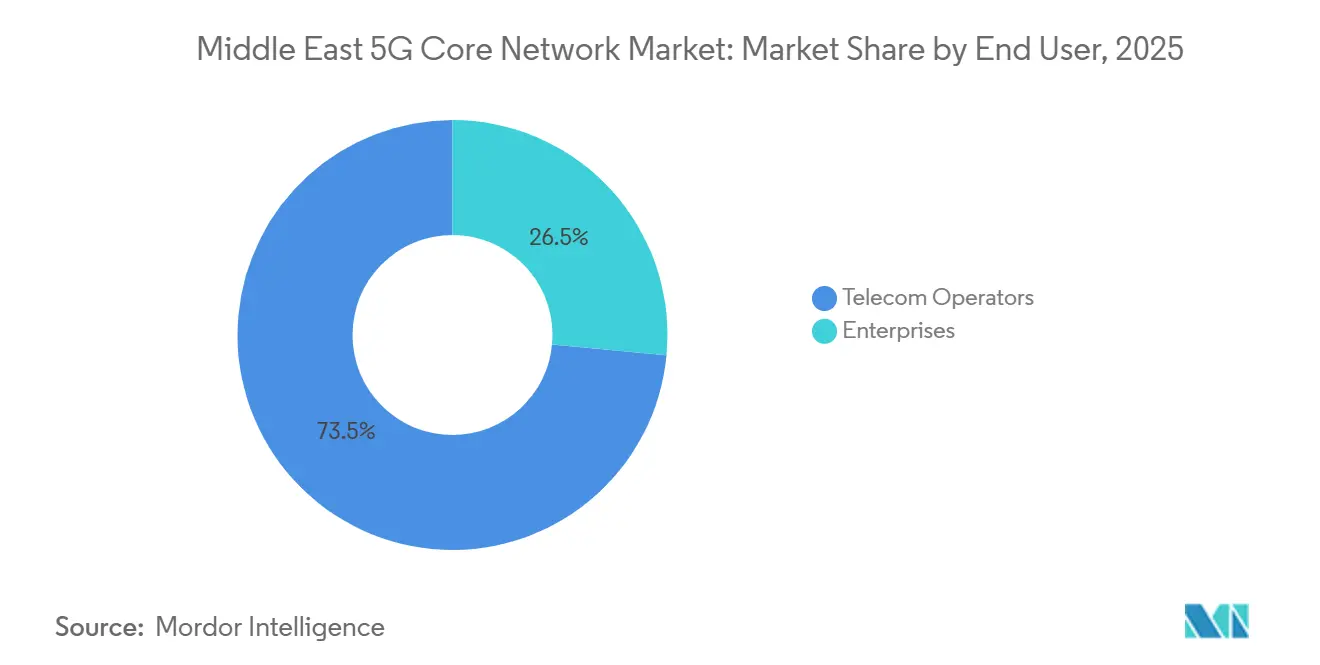
- By end user, telecom operators held 73.50% of revenue in 2025, while enterprises are projected to expand at a 24.11% CAGR through 2031 in the Middle East 5G core network market.
- By network function, the user plane function accounted for 21.00% of revenue in 2025, while the network exposure function is projected to expand at a 26.65% CAGR through 2031 in the Middle East 5G core network market.
- By country, Saudi Arabia accounted for 46.66% of revenue in 2025, while the UAE is projected to expand at a 22.98% CAGR through 2031.
Note: Market size and forecast figures in this report are generated using Mordor Intelligence’s proprietary estimation framework, updated with the latest available data and insights as of January 2026.
Middle East 5G Core Network Market Trends and Insights
Drivers Impact Analysis*
| DRIVER | (~) % IMPACT ON CAGR FORECAST | GEOGRAPHIC RELEVANCE | IMPACT TIMELINE |
|---|---|---|---|
| Accelerated 5G Standalone Core Deployments Across Gulf Operator Networks | +4.5% | Saudi Arabia and the UAE are core, with spillover to Qatar, Kuwait, and Oman | Short term (≤2 years) |
| Rising Demand for Network Slicing in Enterprise and Government Use Cases | +3.5% | UAE and Qatar are leading, with Saudi Arabia scaling up | Short term (≤2 years) |
| Government-Led Digital Transformation and National 5G Sovereignty Programs | +3.1% | Saudi Arabia and the UAE primarily, with GCC-wide alignment | Medium term (2–4 years) |
| Expansion of Cloud-Native Core Architectures for Agile Service Launches | +2.5% | UAE and Saudi Arabia are core, extending to the Rest of the Middle East | Medium term (2–4 years) |
| Private 5G Adoption in Industrial Zones, Ports, and Smart City Projects | +2.0% | Saudi Arabia, the UAE, Oman, and Qatar logistics and industrial hubs | Medium term (2–4 years) |
| Increasing Voice over New Radio (VoNR) and Low-Latency Service Requirements | +1.4% | UAE leading, Saudi Arabia following, with GCC-wide demand | Short term (≤2 years) |
| Source: Mordor Intelligence | |||
Accelerated 5G Standalone Core Deployments Across Gulf Operator Networks
Gulf operators have moved standalone 5G from limited trials to wider commercial deployments. This shift requires investment in packet core software, subscriber data management, automation, and cloud infrastructure. The Middle East 5G Core Network Market benefits from a standalone architecture, which supports capabilities that non-standalone networks cannot provide in the same way. These include network slicing, voice over new radio, and more direct service differentiation for enterprise customers. The five-year agreement signed by stc Group and Ericsson in December 2025 covered 5G standalone, 5G Advanced, massive MIMO, cloud-native platforms, managed services, and third-party integration.[1] The agreement shows that core modernization is being treated as a multiyear operating priority rather than a short equipment refresh.
Rising Demand for Network Slicing in Enterprise and Government Use Cases
Network slicing allows operators to offer dedicated connectivity characteristics to users with different operational needs. Manufacturing sites, ports, public safety agencies, and energy operations can require predictable performance rather than best-effort mobile access. This requirement supports the Middle East 5G Core Network Market because slicing depends on standalone core functions and automated policy control. Nokia and Ooredoo Qatar agreed in February 2025 to modernize a full standalone core with slicing and AI-ML integration for ports, mining, and natural gas applications.[2] The deployment connects core investment to sectors that already have large operational footprints across Gulf economies. The commercial case becomes stronger when a single network can support distinct service requirements for industrial, public, and consumer users.
Government-Led Digital Transformation and National 5G Sovereignty Programs
Government programs are shaping both the pace and technical direction of core network investment. Saudi Arabia’s national platform identifies the adoption of emerging technologies as part of its broader digital agenda.[3] Public programs in smart cities, logistics, manufacturing, and government services create demand for secure private connectivity. These use cases often require control over data processing and network functions within national borders. The Middle East 5G Core Network Market is therefore linked to public procurement priorities and operator capital expenditure. Government-backed demand also provides suppliers with a path to participate in projects that require long planning cycles and specialized compliance capabilities.
Expansion of Cloud-Native Core Architectures for Agile Service Launches
Operators are adopting containerized and service-based core designs to shorten software release cycles. These designs can separate software upgrades from dedicated hardware replacement programs. Mavenir and e& UAE announced a multiyear partnership in March 2025 for a converged cloud-native packet core across 4G, 5G non-standalone, and 5G standalone networks.[4] The approach includes automation and orchestration, which are needed as operators manage several network functions across distributed locations. Cloud-native deployment can improve the speed of service introduction, but it also increases the need for systems integration and operational assurance. This makes software platforms and specialist services important parts of the Middle East 5G Core Network Market.
Restraints Impact Analysis*
| RESTRAINT | (~) % IMPACT ON CAGR FORECAST | GEOGRAPHIC RELEVANCE | IMPACT TIMELINE |
|---|---|---|---|
| High Complexity of Multi-Vendor Core Integration and Interoperability | -2.2% | GCC-wide, most acute outside Saudi Arabia and the UAE | Medium term (2–4 years) |
| Dependence on Skilled 5G Core Engineering and Cybersecurity Talent | -1.9% | MENA-wide, acute in Oman, Kuwait, Bahrain, and smaller markets | Long term (≥4 years) |
| Delayed Monetization of Standalone 5G Use Cases in Price-Sensitive Markets | -1.4% | Rest of the Middle East outside the GCC | Medium term (2–4 years) |
| Stringent Data Residency and Telecom Sovereignty Requirements | -1.1% | Saudi Arabia and the UAE are primary, with effects in Qatar and Bahrain | Short term (≤2 years) |
| Source: Mordor Intelligence | |||
High Complexity of Multi-Vendor Core Integration and Interoperability
A multi-vendor architecture can reduce dependence on a single supplier, but it also adds testing and operational overhead. Operators must verify that core functions, radio networks, orchestration platforms, and security controls work together in live conditions. Standards provide a common framework, yet interface differences can still require extensive bilateral validation. This extends deployment schedules and raises the cost of each new supplier relationship. The Middle East 5G Core Network Market may therefore favor vendors with existing local integration records and established operator teams. This preference can reinforce incumbent positions when operators prioritize a tested delivery model over an unproven integration path. Smaller operators face a greater burden because they have fewer specialized engineering resources for complex verification work.
Dependence on Skilled 5G Core Engineering and Cybersecurity Talent
Cloud-native core operations require specialists with expertise in both telecom and software infrastructure. Teams must manage containers, lifecycle automation, security controls, subscriber functions, and service assurance. This combination is difficult to build quickly, particularly for operators in smaller national markets. Talent shortages can delay the conversion of capital commitments into commercial services. The result is greater reliance on managed services, external integration support, and vendor-led operations. This restraint increases the value of long-term support arrangements within the Middle East 5G Core Network Market while limiting the pace of independent deployment. It also raises the importance of knowledge transfer and training programs within vendor contracts.
*Our forecasts treat driver/restraint impacts as directional, not additive. The impact forecasts reflect baseline growth, mix effects, and variable interactions.
Segment Analysis
By Component: Solutions Anchor Revenue While Services Gain Momentum
Solutions are expected to capture 61.59% of component revenue in the Middle East 5G core network market in 2025. This position reflects spending on packet-core software, network function virtualization infrastructure, and orchestration platforms. Operators require these capabilities as they shift from radio-led 5G rollouts to standalone service delivery. The Middle East 5G Core Network Market reflects this transition, as solutions enable the practical delivery of standalone services. Packet-core software remains central because it supports the shift from hardware-bound functions to containerized network services. Orchestration platforms are also gaining importance as operators manage distributed functions and multiple suppliers.
Services are projected to expand at a 22.90% CAGR through 2031. Operators need integration and deployment services when they introduce standalone cores into existing multi-vendor environments. Consulting, support, and maintenance can become recurring requirements after the initial implementation. The stc Group agreement with Ericsson included advanced managed services and third-party integration, illustrating the shift toward longer commercial relationships. Demand for integration services is especially important in the Rest of the Middle East, where operators may lack large in-house teams for core verification. Services, therefore, support implementation continuity, while solutions remain the larger revenue base.
By Deployment Model: On-Premises Leads While Hybrid and Telco Edge Cloud Advances
On-premises and dedicated deployments are expected to account for 50.32% of the Middle East 5G Core Network Market size in 2025. Operators use this model to address data residency requirements and maintain control over critical network functions. Mission-critical enterprise users also require low latency and locally managed data paths. A dedicated model can place user-plane processing closer to an enterprise site or an operator edge location. This design supports local processing without requiring operators to distribute every control function.
Hybrid and telco edge cloud is projected to expand at a 25.89% CAGR through 2031. The model allows operators to retain core control functions onshore while distributing user plane functions where workloads require shorter response times. It is particularly relevant to ports, industrial zones, logistics facilities, and smart-city projects. Ericsson and e& UAE agreed in October 2025 to modernize the operator’s core using a cloud-native dual-mode solution in a hybrid configuration. Hybrid architecture offers a practical balance between local compliance requirements and the operational advantages of distributed cloud functions.
By End User: Telecom Operators Lead While Enterprises Accelerate
Telecom operators are expected to capture 73.50% of end-user revenue in the Middle East 5G core network market in 2025. They remain the main buyers because they own nationwide mobile networks and the core infrastructure that supports subscribers. Their standalone core investments create the foundation for slicing, private 5G, network APIs, and voice over new radio. Operators are also changing their commercial role by offering digital connectivity services to enterprise customers. This shift makes operator capital expenditure a direct driver of the wider ecosystem.
Enterprises are projected to expand at a 24.11% CAGR through 2031. Demand spans manufacturing, energy and utilities, transportation and logistics, public safety, and smart-city operations. Enterprises need dedicated connectivity for automation, data exchange, monitoring, and critical operational processes. Omantel’s June 2026 private 5G standalone deployment at the Port of Salalah uses a dedicated core and supports crane automation and logistics data exchange. The project shows how managed private networks can support complex industrial and transport facilities. Enterprise adoption provides an avenue for operators to monetize core functions beyond consumer mobile services.
By Network Function: UPF Leads While NEF Supports API Monetization
The user plane function is expected to have the largest share of network functions in 2025, at 21.00%. It is a data-plane function that processes traffic for subscriber connections, enterprise workloads, and network slices. The region’s preference for on-premises and hybrid-edge deployment supports its position. Operators can place user plane instances across data centers, enterprise premises, and edge sites to meet locality and latency needs. This distribution can require separate licensing, management, and service assurance for each deployment.
The network exposure function is projected to expand at a 26.65% CAGR in the Middle East 5G core network market through 2031. It enables controlled exposure of network capabilities through interfaces that enterprise developers can use. The function supports commercial models that link network slicing, application requirements, and policy automation. Ooredoo Qatar’s 2025 standalone core modernization includes network slicing and AI-ML integration for ports, mining, and natural gas applications. The Middle East 5G Core Network Market can benefit as operators use these functions to create services for industry-specific applications. API-based service delivery may become more relevant as enterprise demand shifts from connectivity alone to operational integration.
Geography Analysis
Saudi Arabia is expected to account for 46.66% of regional revenue in 2025. This position reflects the scale of national digital investment, broad telecom activity, and demand from smart city, industrial, and logistics projects. The country’s digital economy agenda continues to support large infrastructure programs that require advanced connectivity. The December 2025 agreement between stc Group and Ericsson is expected to cover standalone 5G, cloud-native platforms, managed services, and integration. These programs position Saudi Arabia as the region’s largest near-term source of demand for operator and enterprise core.
The UAE is projected to expand at a 22.98% CAGR through 2031 in the Middle East 5G core network market. Competition among operators has supported commercial activity around standalone 5G services, including voice over new radio and network slicing. The Middle East 5G Core Network Market benefits from this activity because commercial launches require ongoing core software and operational support. du is expected to commercially launch 5G voice over new radio in February 2025, following handset compatibility certification for its standalone network. e& UAE is also expected to enter separate cloud-core partnerships with Mavenir and Ericsson during 2025. This pattern indicates a market in which operators use multiple technology relationships to support new service models. This approach supports the Middle East 5G Core Network Market by creating demand for interoperable software, integration, and operational support.
The Rest of the Middle East remains at an earlier stage of deployment, but activity is spreading across Qatar, Kuwait, Oman, Bahrain, and other markets. Ooredoo Qatar’s February 2025 agreement with Nokia is expected to cover its voice core, packet core, subscriber data management, and data center fabric. Zain Kuwait and Rakuten Symphony are expected to sign a memorandum of understanding in May 2025 for a cloud-native Open RAN deployment, with Zain providing 5G standalone core and data center infrastructure. In Oman, private 5G deployments at ports and industrial facilities provide a practical starting point for broader adoption of standalone cores. Bahrain and smaller markets are likely to advance as enterprise use cases, coverage, and spectrum frameworks mature.
Competitive Landscape
The Middle East 5G Core Network Market is dominated by Ericsson, Nokia, Huawei, and ZTE, which have established relationships with major regional operators. Incumbent suppliers benefit from their installed networks, local teams, and ability to support large-scale deployments. Ericsson and Nokia focus on cloud-native architecture, standalone core modernization, and managed services. Huawei retains strong relationships with regional operators, while ZTE remains active in cloud-native and Open RAN-related projects as customers reduce dependence on a single full-stack vendor. This preference shapes the Middle East 5G Core Network Market by increasing attention to open interfaces, integration capabilities, and supplier-specific strengths.
e& UAE’s partnerships show how this competitive approach is developing. Its March 2025 agreement with Mavenir is expected to cover a converged cloud-native packet core across 4G, 5G non-standalone, and 5G standalone networks. Its October 2025 arrangement with Ericsson is expected to address cloud-native dual-mode core modernization in a hybrid configuration. These parallel arrangements suggest that operators may select suppliers for specific functional layers rather than assign the entire architecture to one vendor. This approach creates targeted opportunities for challengers, but integration requirements remain a major barrier.
Specialist suppliers are pursuing enterprise private-network and sovereign-cloud opportunities rather than only competing for national carrier cores. Oracle and Ooredoo Qatar are expected to announce a collaboration in February 2026 to provide sovereign AI and cloud services from Ooredoo data centers for government and enterprise users. Nokia and Ooredoo Qatar’s core agreement also links standalone capabilities to ports, mining, and natural gas applications. Compliance with standards and local data requirements remains important in procurement decisions. Vendors that combine cloud-native functions, integration capability, and onshore deployment options are better positioned to address regional demand. The Middle East 5G Core Network Market remains sensitive to supplier credibility because core networks support essential public and commercial services.
Middle East 5G Core Network Industry Leaders
-
Nokia Corporation
-
Telefonaktiebolaget LM Ericsson (publ)
-
Huawei Technologies Co., Ltd.
-
Samsung Electronics Co., Ltd.
-
ZTE Corporation
- *Disclaimer: Major Players sorted in no particular order
Recent Industry Developments
- June 2026: Omantel partnered with the Port of Salalah to deploy Oman's first managed private 5G Standalone network at a port facility, providing a dedicated 5G SA private core, ruggedized CPE, and 600 SIMs under a fully managed 99.9% availability commitment. The deployment supports crane automation and real-time logistics data exchange and establishes a private 5G template for Oman's ports, logistics hubs, and industrial zones in alignment with Oman Vision 2040.
- May 2026: AD Ports Group and e& UAE completed the deployment of an AI-ready, high-capacity terrestrial digital backbone spanning over 1,000 kilometers across Abu Dhabi's maritime and logistics assets, enabling ultra-low-latency streaming of sensor data, video feeds, and IoT signals for real-time machine learning and automated decision-making across the group's port infrastructure.
- March 2026: Nokia and Amazon Web Services unveiled an industry-first agentic AI-powered 5G Advanced network slicing solution at Mobile World Congress 2026, with UAE operator du among the first to explore live network deployment using Nokia's 5G AirScale base stations and MantaRay Service Management and Orchestration with Amazon Bedrock AI for intent-based, dynamically adjusting slice management.
- February 2026: Ooredoo Qatar selected Oracle Alloy to deliver sovereign AI and cloud services from its own data centers for Qatar's government and enterprise sectors, meeting data-residency requirements while providing access to Oracle Cloud Infrastructure's 200-plus AI and cloud services portfolio.
Middle East 5G Core Network Market Report Scope
The Middle East 5G Core Network Market Report is Segmented by Component (Solutions [Packet-Core Software. NFV Infrastructure, and Orchestration and Management], and Services [Integration and Deployment, Consulting and Advisory, Support and Maintenance]), Deployment Model (On-Premises/Dedicated, Public Cloud, and Hybrid and Telco Edge Cloud), End-User (Telecom Operators, and Enterprises [Manufacturing, Energy and Utilities, Transportation and Logistics, Public Safety and Emergency, and Smart Cities and Municipalities]), Network Function (Network Exposure Function, User Plane Function, Application Function, Unified Data Management, Session Management Function, Network Slice Selection Function, Policy Control Function, Network Repository Function, Authentication Server Function, and Access and Mobility Management), and Country (Saudi Arabia, United Arab Emirates, and Rest of Middle East). The Market Forecasts are Provided in Terms of Value (USD).
| Solutions | Packet-Core Software |
| NFV Infrastructure | |
| Orchestration and Management | |
| Services | Integration and Deployment |
| Consulting and Advisory | |
| Support and Maintenance |
| On-Premise/Dedicated |
| Public Cloud |
| Hybrid and Telco Edge Cloud |
| Telecom Operators | |
| Enterprises | Manufacturing |
| Energy and Utilities | |
| Transportation and Logistics | |
| Public Safety and Emergency | |
| Smart Cities and Municipalities |
| Network Exposure Function (NEF) |
| User Plane Function (UPF) |
| Application Function (AF) |
| Unified Data Management (UDM) |
| Session Management Function (SMF) |
| Network Slice Selection Function (NSSF) |
| Policy Control Function (PCF) |
| Network Repository Function (NRF) |
| Authentication Server Function (AUSF) |
| Access and Mobility Management Function (AMF) |
| Saudi Arabia |
| United Arab Emirates |
| Rest of Middle East |
| By Component | Solutions | Packet-Core Software |
| NFV Infrastructure | ||
| Orchestration and Management | ||
| Services | Integration and Deployment | |
| Consulting and Advisory | ||
| Support and Maintenance | ||
| By Deployment Model | On-Premise/Dedicated | |
| Public Cloud | ||
| Hybrid and Telco Edge Cloud | ||
| By End-User | Telecom Operators | |
| Enterprises | Manufacturing | |
| Energy and Utilities | ||
| Transportation and Logistics | ||
| Public Safety and Emergency | ||
| Smart Cities and Municipalities | ||
| By Network Function | Network Exposure Function (NEF) | |
| User Plane Function (UPF) | ||
| Application Function (AF) | ||
| Unified Data Management (UDM) | ||
| Session Management Function (SMF) | ||
| Network Slice Selection Function (NSSF) | ||
| Policy Control Function (PCF) | ||
| Network Repository Function (NRF) | ||
| Authentication Server Function (AUSF) | ||
| Access and Mobility Management Function (AMF) | ||
| By Country | Saudi Arabia | |
| United Arab Emirates | ||
| Rest of Middle East | ||
Key Questions Answered in the Report
What is the Middle East 5G core network market size?
The Middle East 5G Core Network Market was valued at USD 0.39 billion in 2025 and is estimated at USD 0.48 billion in 2026. It is forecast to reach USD 1.25 billion by 2031.
What is driving 5G core investment in the Middle East?
Standalone deployment, network slicing, government digital programs, cloud-native architecture, and private 5G use cases are supporting demand.
Which deployment model leads to regional spending?
On-premises and dedicated deployments accounted for 50.32% of revenue in 2025, reflecting data residency and low-latency requirements.
Which end users are expanding fastest?
Enterprises are projected to expand at a 24.11% CAGR through 2031, supported by demand from industrial, logistics, energy, and public-sector users.
Which country accounted for the largest share in 2025?
Saudi Arabia accounted for 46.66% of revenue in 2025, supported by national digital, smart-city, industrial, and logistics programs.
Which network function has the highest projected CAGR?
The network exposure function is projected to expand at a 26.65% CAGR through 2031 as operators develop API-based enterprise services.