
Microplate Washers Market Size and Share
Market Overview
| Study Period | 2020 - 2031 |
|---|---|
| Market Size (2026) | USD 657.49 Million |
| Market Size (2031) | USD 870.04 Million |
| Growth Rate (2026 - 2031) | 5.76 % |
| Fastest Growing Market | Asia Pacific |
| Largest Market | North America |
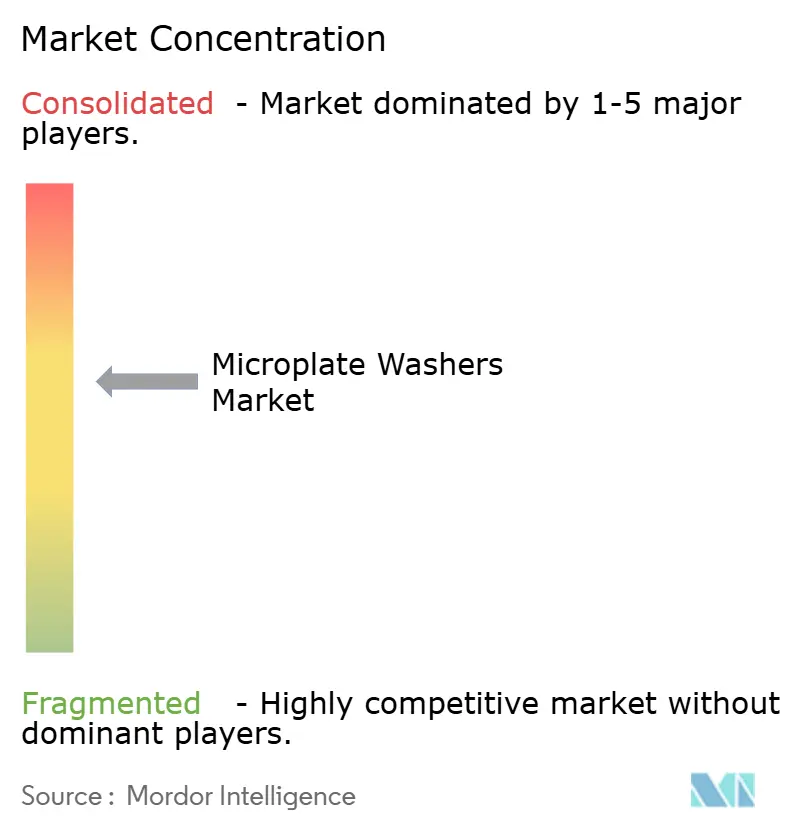
| Market Concentration | Medium |
Major Players *Disclaimer: Major Players sorted in no particular order Image © Mordor Intelligence. Reuse requires attribution under CC BY 4.0. | |
Microplate Washers Market Analysis by Mordor Intelligence
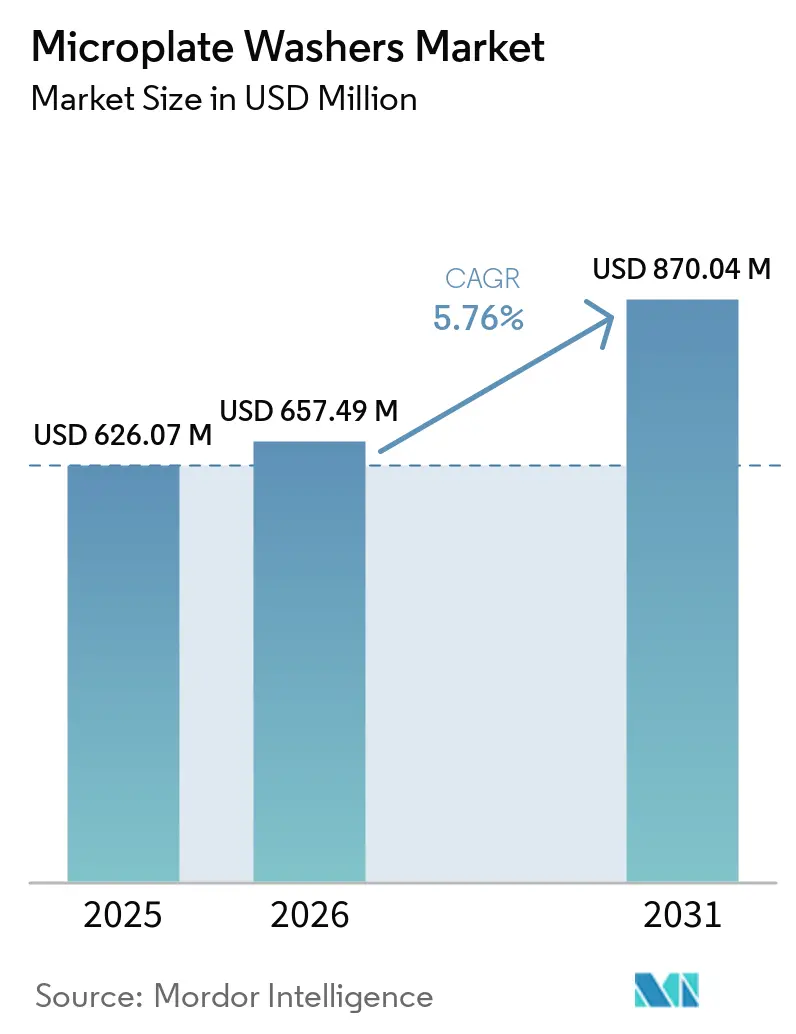
The Microplate Washers Market size is expected to grow from USD 626.07 million in 2025 to USD 657.49 million in 2026 and is forecast to reach USD 870.04 million by 2031 at 5.76% CAGR over 2026-2031.
Demand is shifting from manual to automated plate washing as laboratories move to 384- and 1536-well formats that cannot be processed reliably by hand. Automated washers keep residual volumes below 5 µL, delivering sub-5% coefficient-of-variation and protecting expensive reagents in high-density plates. Hospital, reference, and pharmaceutical laboratories are prioritizing middleware-connected automation to remove manual transcription errors that cost an average 10-person lab up to USD 150,000 per year. Regulatory momentum is reinforcing capital purchases: EU IVDR requires CE-IVD-marked washers, and North American laboratories expect ISO 15189 accreditation criteria to tighten by 2028. Meanwhile, magnetic bead-based workflows are opening new application clusters in genomics and proteomics, broadening the functional scope of washers well beyond classical ELISA.
Key Report Takeaways
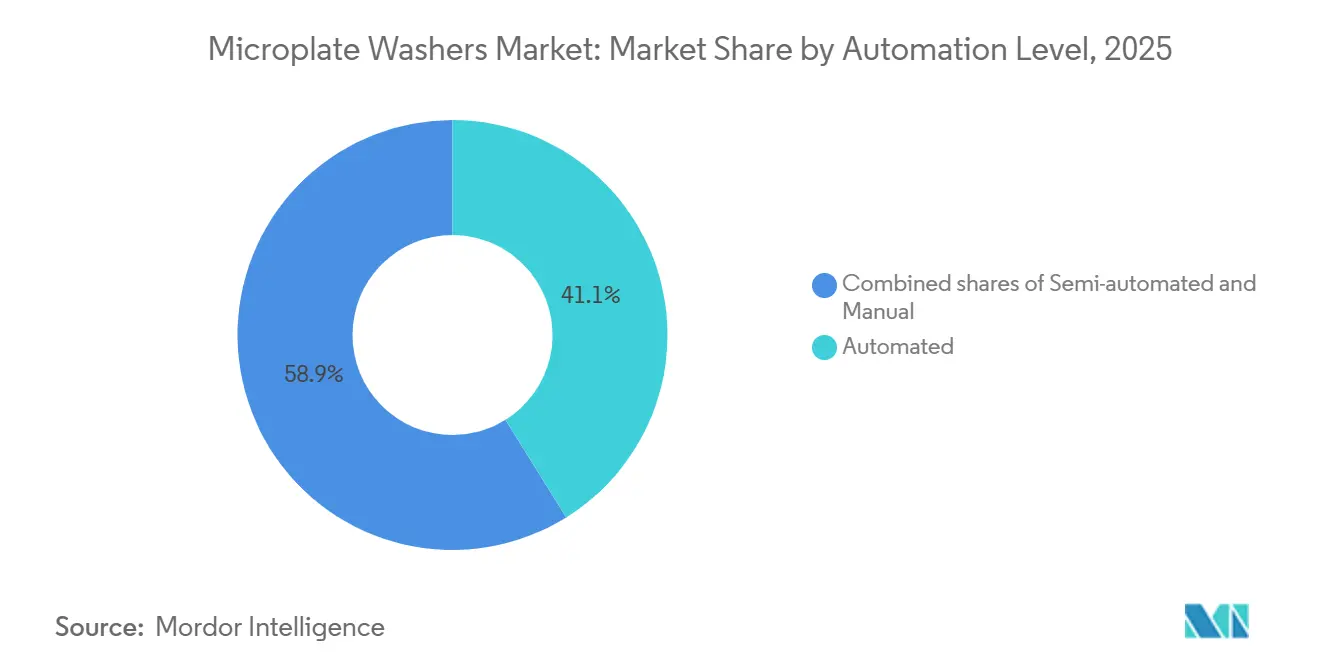
- By automation level, automated systems held 41.12% of the microplate washers market share in 2025 and are advancing at a 7.13% CAGR through 2031.
- By application, ELISA and immunoassays led with a 48.23% revenue share in 2025, while cell-based assays are projected to expand at a 7.09% CAGR to 2031.
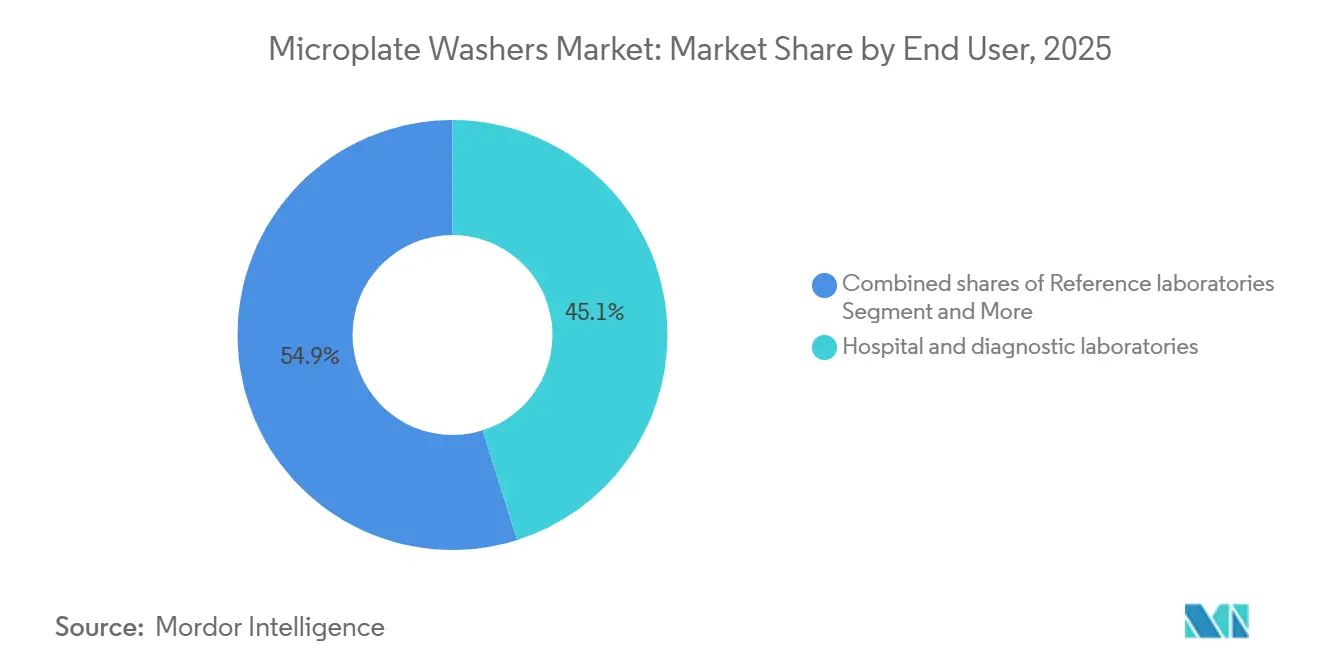
- By end user, hospital and diagnostic laboratories accounted for 45.13% of demand in 2025; reference laboratories record the steepest growth, pacing at 8.51% CAGR through 2031.
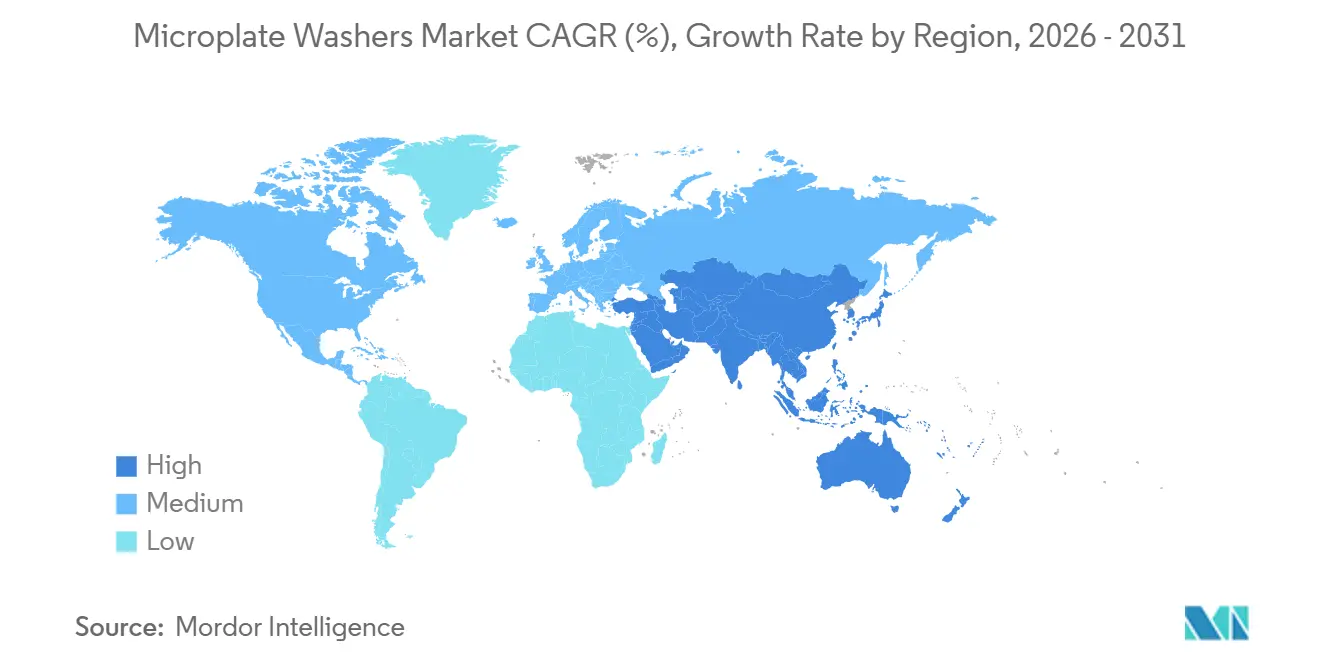
- By geography, North America retained 47.13% share of the microplate washers market size in 2025, whereas Asia-Pacific is the fastest-growing region at 7.19% CAGR through 2031.
Note: Market size and forecast figures in this report are generated using Mordor Intelligence’s proprietary estimation framework, updated with the latest available data and insights as of January 2026.
Market Trends and Insights
Drivers Impact Analysis of Microplate Washers Market*
| Driver | (~) % Impact on CAGR Forecast | Geographic Relevance | Impact Timeline |
|---|---|---|---|
| Growth in ELISA/immunoassay testing volumes in clinical and research labs | +1.2% | Global, with concentration in North America and Europe | Medium term (2-4 years) |
| Rising lab automation and high-throughput screening adoption in pharma/biotech | +1.5% | North America, Europe, APAC developed markets | Short term (≤ 2 years) |
| Shift toward higher-density plates requiring precision washing | +0.9% | Global, led by pharmaceutical R&D hubs | Medium term (2-4 years) |
| Expansion of life sciences R&D funding and installed base refresh cycles | +0.8% | North America, Europe, China | Long term (≥ 4 years) |
| Magnetic bead-based workflows expanding washer use cases | +0.7% | Global, early adoption in proteomics centers | Medium term (2-4 years) |
| EU IVDR/quality compliance pushing CE-IVD-capable washers in diagnostics | +0.6% | Europe, spillover to export-oriented manufacturers in APAC | Short term (≤ 2 years) |
| Source: Mordor Intelligence | |||
Growth in ELISA/Immunoassay Testing Volumes in Clinical and Research Labs
Chronic-disease surveillance and infectious-disease monitoring are expanding ELISA plate throughput across hospital and translational laboratories. Multiplex kits measuring up to 40 analytes per well heighten the need for wash consistency; automated systems reduce inter-assay variability from 12% to below 5%[1]. Middleware-controlled plate washers are now integrated into laboratory information systems, eliminating manual data entry errors that historically drove rework costs above USD 70,000 per lab each year.
Rising Lab Automation and High-Throughput Screening Adoption in Pharma/Biotech
Top pharmaceutical groups embed washers inside robotic screening cells to compress discovery cycles and save reagents. Tecan recorded CHF 311.9 million in revenue in the third quarter of 2024, citing strong liquid-handling demand[2]. Bio-Rad’s clinical-diagnostics arm grew 6.5% to USD 393.1 million in the same period, confirming that assay volume directly translates into washer utilization. Payback periods for automated washers range from 6–12 months in pharmaceutical QC, driven by reagent savings when 96-well assays migrate to 1536-well plates.
Shift Toward Higher-Density Plates Requiring Precision Washing
Moving a 1 million-compound screen from 96-well to 1536-well plates cuts plate consumption from 10,000 to 650 units, saving over 90% on plasticware. Corning and Greiner supply plates down to 2 µL working volume, pushing washer vendors to develop 384-channel manifolds with pressure feedback[3]. Automated washers compatible with 1536-well formats trim assay-development time by up to 40% because manual techniques cannot aspirate residual volumes below 5 µL without disturbing cell monolayers.
Expansion of Life-Sciences R&D Funding and Installed-Base Refresh Cycles
The European Union has earmarked EUR 8.2 billion of Horizon Europe for health research from 2021–2027. Japan’s AMED requested JPY 124.5 billion for the fiscal year 2025 to advance translational projects. In contrast, the United States National Institutes of Health requested USD 47.2 billion for fiscal year 2026, down from USD 50.1 billion a year earlier, curbing capital budgets at universities. Hospitals and reference laboratories are offsetting federal softness; Quest Diagnostics set USD 350-400 million for 2024 capital expenditures, including automation hardware.
Restraints Impact Analysis of Microplate Washers Market*
| Restraint | (~) % Impact on CAGR Forecast | Geographic Relevance | Impact Timeline |
|---|---|---|---|
| High acquisition and maintenance costs for advanced automated washers | -0.8% | Global, acute in price-sensitive APAC and MEA markets | Short term (≤ 2 years) |
| Skills/training gaps to optimize wash protocols and reduce assay variability | -0.5% | Developing APAC, MEA, and South America | Medium term (2-4 years) |
| Lack of protocol standardization increases reproducibility risks | -0.4% | Global, particularly impacting multicenter clinical trials in North America and Europe | Medium term (2-4 years) |
| Fragmented after-sales/service networks in developing regions | -0.3% | MEA (especially sub-Saharan Africa), South America rural areas, developing APAC | Long term (≥ 4 years) |
| Source: Mordor Intelligence | |||
High Acquisition and Maintenance Costs for Advanced Automated Washers
A fully automated 384-channel washer costs USD 25,000–60,000, with annual service contracts adding another 10-15%. Funding pressure is visible in academia, where NIH obligations fell 34% versus 2024, shrinking equipment-grant pools. Leasing mitigates upfront cash but raises five-year ownership cost by 15–20%. Chinese suppliers such as Autobio and Kehua now ship sub-USD 15,000 units with local service centers, loosening the price barrier in resource-sensitive regions.
Skills/Training Gaps to Optimize Wash Protocols and Reduce Assay Variability
Sub-Saharan Africa faces a persistent shortage of biomedical engineers; parts shipments often exceed 90 days, increasing downtime and user frustration. A 2024 survey across 50 clinical labs showed 40% used default wash parameters, raising false-positive rates by 15%. Remote-diagnostics-enabled washers from Tecan and Thermo Fisher now upload performance logs for cloud-based troubleshooting, removing up to 40% of on-site visits in regions with thin service coverage.
*Our forecasts treat driver/restraint impacts as directional, not additive. The impact forecasts reflect baseline growth, mix effects, and variable interactions.
Microplate Washers Market Segment Analysis
By Automation Level:
Precision Driving Premium AdoptionAutomated platforms captured 41.12% of 2025 revenue and will advance at 7.13% CAGR over 2026-2031. Robotic loaders paired with 384-channel manifolds complete a wash cycle on a 1536-well plate in 90 seconds, enabling screening centers to log over 100,000 data points daily. The microplate washers market share for semi-automated units is sliding as their higher operator-touch time clashes with quality-control protocols in GMP-regulated environments. Manual devices remain entrenched where capital budgets are thin and maintenance infrastructure is sparse, especially in rural Latin America and MEA, but their variability above 15% in proficiency tests is driving gradual replacement by entry-level automation.
Cost dynamics are shifting as Chinese vendors introduce automated models just above USD 10,000, undercutting Western incumbents by up to 40%. Hospitals processing 200-500 plates weekly find that semi-automated washers earn payback within 18 months through reagent savings and lower rework rates. However, reference and pharma labs value end-to-end automation that integrates with laboratory information systems; middleware connectivity now ranks second only to residual volume specification in many tenders.

By Application:
Cell-Based Assays Outpacing Traditional ELISAELISA and immunoassays dominated with 48.23% revenue in 2025, equal to USD 316 million. Yet the fastest trajectory belongs to cell-based assays, climbing at 7.09% CAGR as organoid and CAR-T protocols mature. Miniaturized multiplex ELISAs, which test up to 40 cytokines per well, accelerate biomarker programs but place stringent demands on wash precision to contain carryover. Automated washers equipped with adjustable aspiration pressures meet these needs, pushing single-lab reproducibility above 95%.
Bead-based assays are expanding inside proteomics and genomics pipelines, using magnetic separation to enrich targets rapidly. Vacuum-filtration washers servicing filter-plate assays represent a smaller niche but post steady demand as antibody-purification throughput rises in contract biologics manufacturing.
By End User:
Reference Labs Accelerating Equipment RefreshHospitals and diagnostic centers generated 45.13% of revenue in 2025, underpinned by infectious-disease and chronic-condition ELISAs. Yet reference laboratories, which process more than 1,000 plates a day, show the steepest growth at 8.51% CAGR. Quest Diagnostics is allocating up to USD 400 million for automation in 2024, aiming to shorten turnaround and reduce transcription errors. Pharmaceutical and biotech companies embed washers into discovery lines, leveraging reagent savings above 90% when miniaturizing to 1536-well formats.
Academic institutes face constrained budgets after NIH’s 2026 request dropped to USD 47.2 billion. To cope, universities are pooling resources into core facilities, favoring high-capacity washers that can service multiple departments. Leasing programs with bundled service are gaining ground, smoothing cash flow while aligning replacement cycles with funding windows.
Geography Analysis
North America Microplate Washers Market
North America generated 47.13% of 2025 revenue, reflecting dense installed bases and early IVDR-aligned upgrades even before European deadlines. U.S. academic spending is softening due to reduced NIH appropriations, yet private labs offset the gap through large automation budgets. Middleware integration that satisfies emerging ISO 15189 criteria is guiding specification sheets in Canadian and U.S. hospital systems alike.
Europe Microplate Washers Market
Europe holds the second-largest slice, driven by the mandatory shift to CE-IVD washers under EU IVDR. Laboratories in Germany, France, and the United Kingdom began accelerated replacement during 2024 to avoid accreditation risk. Horizon Europe grants continue to fund translational projects that require validated immunoassay platforms, supporting steady washer demand in public research.
APAC Microplate Washers Market
Asia-Pacific is the expansion hotspot at 7.19% CAGR. Developed economies such as Taiwan and Japan boast hospital-automation penetration. Government incentive schemes in China and India now subsidize laboratory robotics, propelling local makers such as Mindray and Autobio. Sub-USD 15,000 automated models shorten payback to two fiscal years, tipping procurement decisions in favor of automation even in mid-tier provincial hospitals.
MEA and South America Microplate Washers Market
South America and Middle East & Africa account for modest shares but present latent upside once service-network hurdles recede. Parts delays exceeding 90 days in sub-Saharan Africa push owners toward manual systems, but cloud-monitored washers are starting to reduce on-site technical visits significantly. Local distributors that stock spare parts and provide multi-brand training enjoy a competitive edge in both regions.
Competitive Landscape
The microplate washers industry shows moderate fragmentation. Five multinationals, Tecan, Molecular Devices (Danaher), Thermo Fisher Scientific, Bio-Rad Laboratories, and Agilent Technologies (BioTek), anchor the premium tier with portfolios that bundle washers, readers, dispensers, and analytical software. Tecan’s CHF 45.7 million R&D spend over the first nine months of 2024 financed manifold upgrades and cloud diagnostics. Danaher continues to cross-sell SpectraMax readers with AquaMax washers, leveraging its USD 3.5 billion life-sciences revenue base.
Chinese manufacturers such as Mindray, Autobio Diagnostics, and Shanghai Kehua Bio-Engineering are mounting price-led offensives. Mindray’s Q3 2024 revenue rose 11.3% to CNY 10.27 billion as the firm rolled out CE-IVD-certified washers priced below USD 15,000. Local service footprints and bundled reagent contracts are helping these vendors gain share in price-sensitive hospitals across Asia, South America, and Africa.
White-space innovation centers on filter-plate and magnetic-bead assays. Thermo Fisher’s KingFisher line dominates bead-based workflows, while Berthold Technologies introduced a vacuum-filtration washer in June 2024 aimed at filter-plate protein purification. Cloud-connected maintenance platforms are becoming a pivotal differentiator; Tecan and Thermo Fisher report 30–40% fewer field-service trips when remote diagnostics are active, a value proposition that resonates in regions with scarce technical staffing.
Microplate Washers Industry Leaders
-
Tecan Group
-
Danaher Corporation
-
Thermo Fisher Scientific
-
Bio-Rad Laboratories
-
Agilent Technologies
- *Disclaimer: Major Players sorted in no particular order
Microplate Washers Market Companies Covered in this Report
- Accuris Instruments
- Agilent Technologies
- Autobio Diagnostics
- Awareness Technology
- Berthold Technologies
- BIOBASE
- Bio-Rad Laboratories
- Biosan
- CAPP / AHN Biotechnologie
- Caretium Medical Instruments
- Danaher
- Erba Mannheim
- Hudson Robotics
- HUMAN Diagnostics
- Mindray
- Perlong Medical
- Shanghai Kehua Bio-Engineering (KHB)
- Tecan Group
- Thermo Fisher Scientific
Recent Industry Developments in Microplate Washers Market
- March 2026: Thermo Fisher expanded its global footprint by opening a new Bay Area Cryo-EM Drug Discovery Center and a new distribution center in Ireland to better support the growing demand for lab automation equipment.
- May 2025: Tecan expanded its North Carolina factory by 15,000 sq ft to raise North American output 25% and cut custom-system lead times to 10 weeks
- February 2025: Bio-Rad released the QX ONE Droplet Digital PCR System with integrated washing, targeting clinical QC workflows.
Global Microplate Washers Market Report Scope
As per the scope of the report, microplate washers are automated laboratory instruments designed to clean microplates by dispensing wash buffers into wells and subsequently aspirating the liquid. This process is vital for ensuring accurate assay results, particularly in high-throughput environments like clinical diagnostics and pharmaceutical research, as it effectively removes unbound substances and reagents that could otherwise interfere with subsequent measurements.
The microplate washers market is segmented by automation level, application, end users, and geography. Based on automation level, the market is segmented into automated, semi-automated, and manual. Based on applications, the market is segmented into ELISA / immunoassays, cell-based assays, bead-based assays (magnetic/sepharose), and filter-plate assays (e.g., vacuum filtration). By end users, the market is segmented into hospital & diagnostic laboratories, reference laboratories, pharmaceutical & biotechnology companies, and academic & research institutes. By geography, the market is segmented into North America, Europe, Asia-Pacific, the Middle East & Africa, and South America. The market report also covers the estimated market sizes and trends for 17 countries across major regions globally. For each segment, the market size and forecast are provided in terms of value (USD).
Segmentation Overview
| Automated |
| Semi-automated |
| Manual |
| ELISA / Immunoassays |
| Cell-based assays |
| Bead-based assays |
| Filter-plate assays |
| Hospital & diagnostic laboratories |
| Reference laboratories |
| Pharmaceutical & biotechnology companies |
| Academic & research institutes |
| North America | United States |
| Canada | |
| Mexico | |
| Europe | Germany |
| United Kingdom | |
| France | |
| Italy | |
| Spain | |
| Rest of Europe | |
| Asia-Pacific | China |
| India | |
| Japan | |
| South Korea | |
| Australia | |
| Rest of Asia-Pacific | |
| Middle East and Africa | GCC |
| South Africa | |
| Rest of Middle East and Africa | |
| South America | Brazil |
| Argentina | |
| Rest of South America |
| By Automation Level | Automated | |
| Semi-automated | ||
| Manual | ||
| By Application | ELISA / Immunoassays | |
| Cell-based assays | ||
| Bead-based assays | ||
| Filter-plate assays | ||
| By End User | Hospital & diagnostic laboratories | |
| Reference laboratories | ||
| Pharmaceutical & biotechnology companies | ||
| Academic & research institutes | ||
| By Geography | North America | United States |
| Canada | ||
| Mexico | ||
| Europe | Germany | |
| United Kingdom | ||
| France | ||
| Italy | ||
| Spain | ||
| Rest of Europe | ||
| Asia-Pacific | China | |
| India | ||
| Japan | ||
| South Korea | ||
| Australia | ||
| Rest of Asia-Pacific | ||
| Middle East and Africa | GCC | |
| South Africa | ||
| Rest of Middle East and Africa | ||
| South America | Brazil | |
| Argentina | ||
| Rest of South America | ||
Key Questions Answered in the Report
How big is the microplate washers market, and how fast is it growing?
The market was worth USD 657.49 million in 2026, and analysts expect it to climb to USD 870.04 million by 2031, which works out to an annual growth rate of 5.76%.
Which type of washer is most popular?
Fully automated washers lead the pack, holding 41.12% of sales in 2025.
What parts of the market are expanding the fastest?
On the application side, cell-based assays are sprinting ahead at 7.09% a year due to organoid, 3-D culture, and CAR-T testing needs
Which region is seeing the quickest gains?
Asia-Pacific is adding volume fastest, about 7.19% a year. Hospitals in Taiwan and Japan are already highly automated, and developing countries in the region are racing to catch up, often with budget-friendly Chinese equipment