
Microfiber-Shedding Suppression Coatings Market Size and Share
Market Overview
| Study Period | 2021 - 2031 |
|---|---|
| Market Size (2026) | USD 105.64 Million |
| Market Size (2031) | USD 149.07 Million |
| Growth Rate (2026 - 2031) | 7.13 % |
| Fastest Growing Market | Asia-Pacific |
| Largest Market | Asia-Pacific |
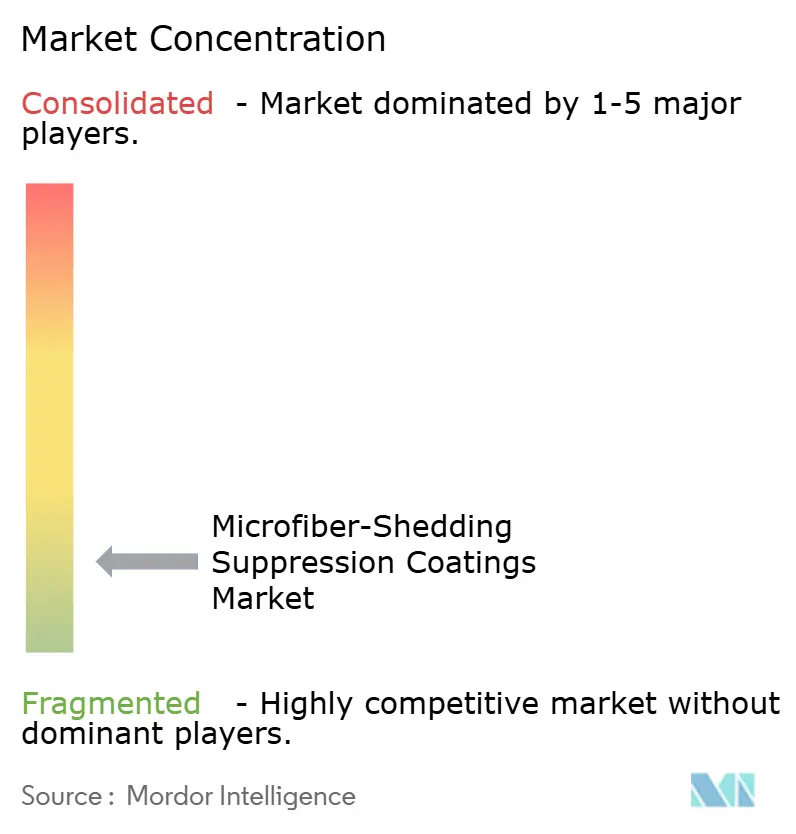
| Market Concentration | Low |
Major Players *Disclaimer: Major Players sorted in no particular order Image © Mordor Intelligence. Reuse requires attribution under CC BY 4.0. | |
Microfiber-Shedding Suppression Coatings Market Analysis by Mordor Intelligence
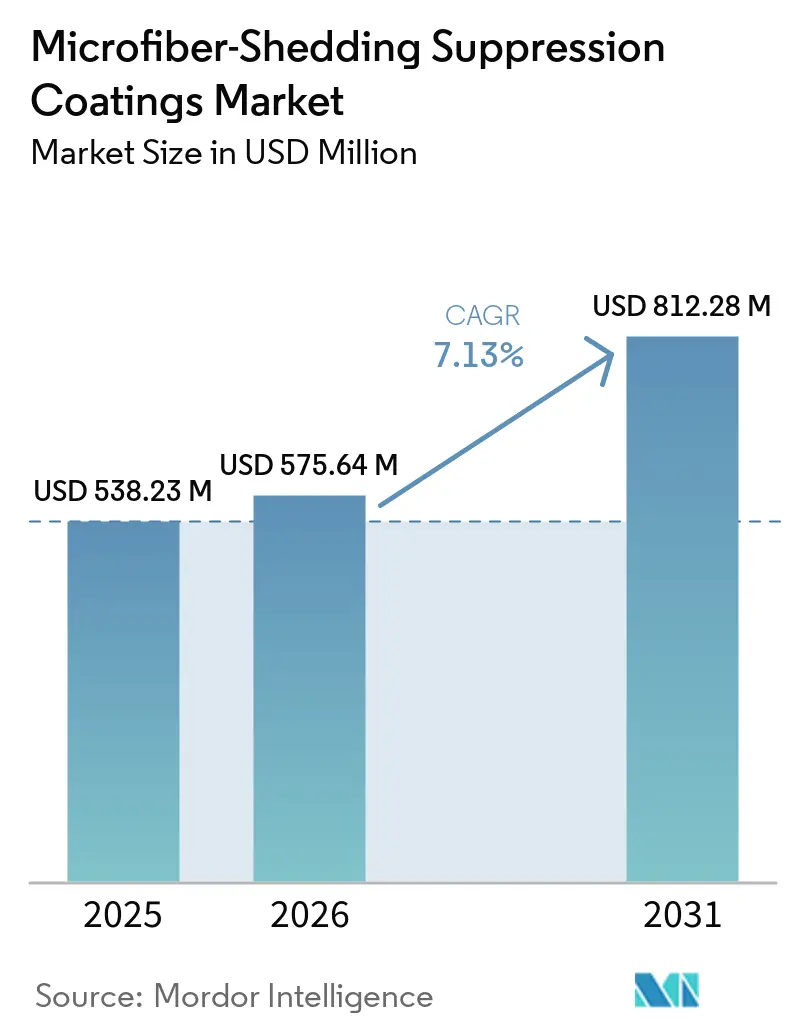
The Microfiber-Shedding Suppression Coatings Market size is expected to grow from USD 99.38 million in 2025 to USD 105.64 million in 2026 and is forecast to reach USD 149.07 million by 2031 at 7.13% CAGR over 2026-2031. The microfiber-shedding suppression coatings market is being shaped by brand sourcing requirements and policy measures that make measurable fiber-loss reduction more important in textile supply chains. Textile production provides a large treatment base, as global fiber output reached 132 million metric tons in 2024, and synthetic fibers accounted for 69% of production. Product passport requirements for textiles are expected to increase demand for documented performance data as the European Union develops requirements for this priority product group. Suppliers are competing on wash durability, compatibility with different fabrics, and the ability to combine shedding control with other finishing functions. Existing padding and exhaust equipment can apply many formulations, which lowers the equipment barrier for mills that need to meet buyer specifications.
Key Report Takeaways
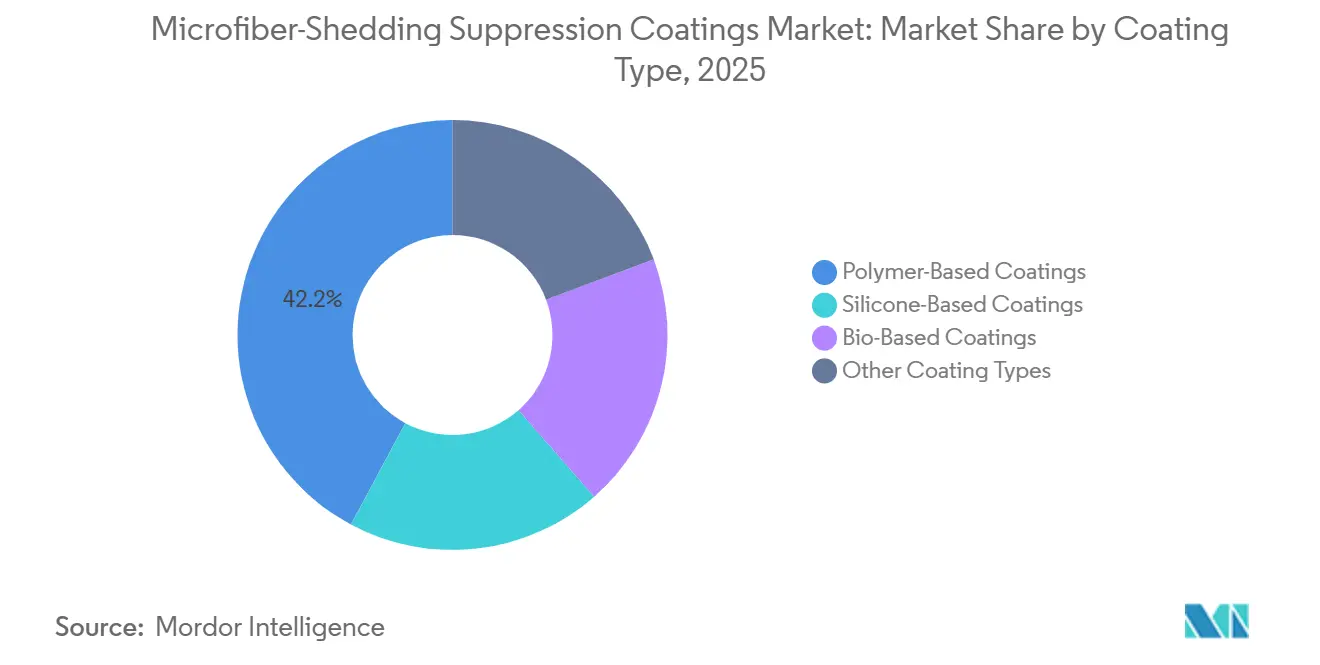
- By coating type, polymer-based coatings held 42.18% of the microfiber-shedding suppression coatings market share in 2025, while bio-based coatings are projected to grow at a 9.03% CAGR through 2031.
- By textile substrate, polyester accounted for 47.24% of the microfiber-shedding suppression coatings market share in 2025 and is projected to grow at a 7.78% CAGR through 2031.
- By formulation basis, waterborne formulations held 51.06% of the microfiber-shedding suppression coatings market share in 2025, while solvent-free formulations are projected to grow at an 8.27% CAGR through 2031.
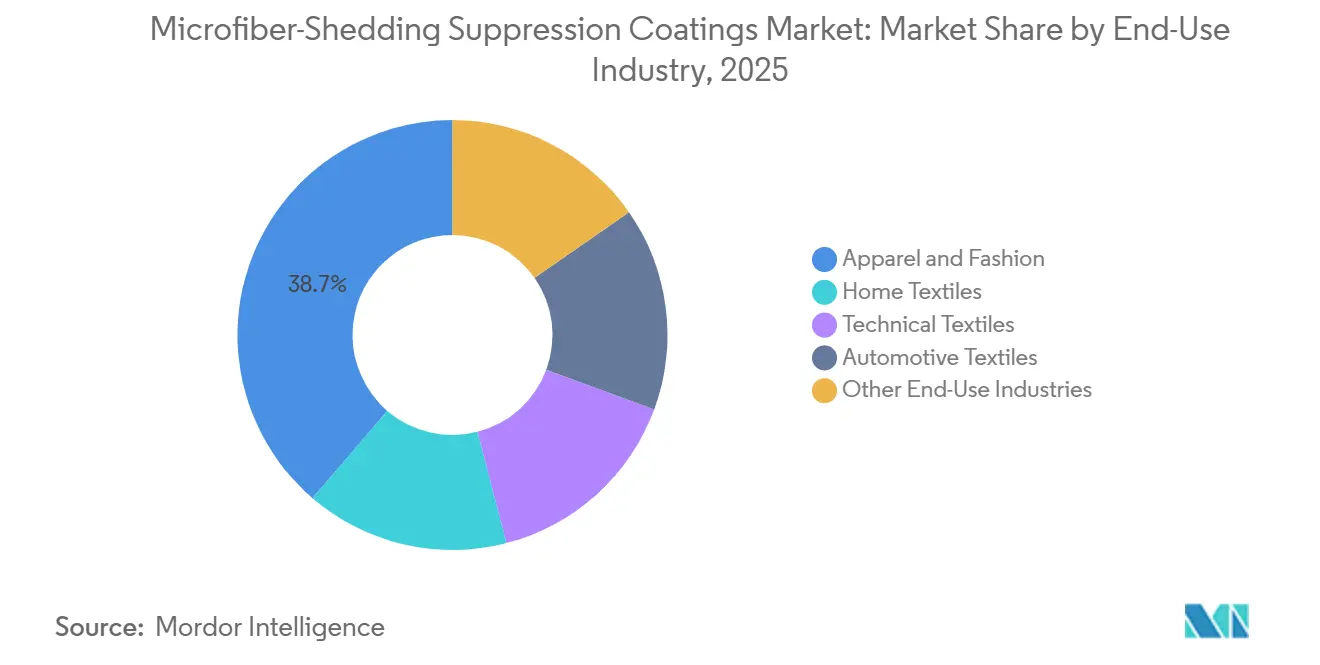
- By end-use industry, apparel and fashion accounted for 38.71% of the microfiber-shedding suppression coatings market share in 2025, while technical textiles are projected to grow at an 8.55% CAGR through 2031.
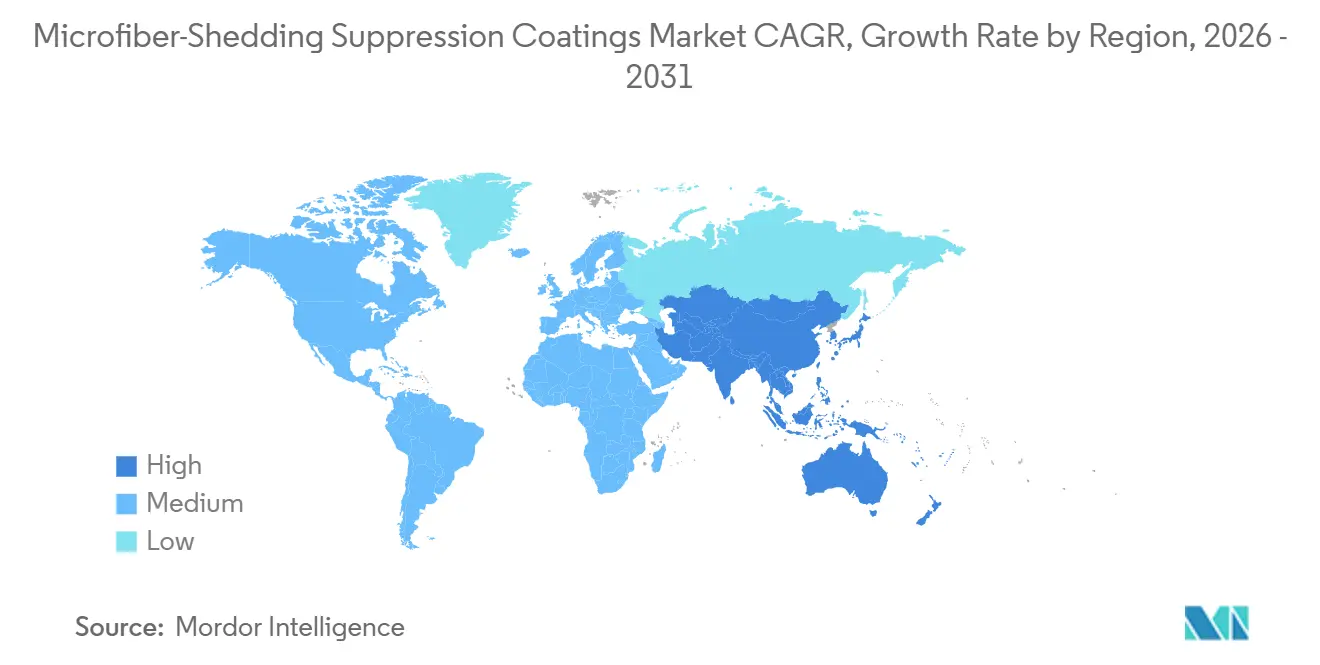
- By geography, Asia-Pacific held 34.37% of the microfiber-shedding suppression coatings market share in 2025 and is projected to grow at an 8.68% CAGR through 2031.
Note: Market size and forecast figures in this report are generated using Mordor Intelligence’s proprietary estimation framework, updated with the latest available data and insights as of January 2026.
Market Trends and Insights
Drivers Impact Analysis of Microfiber-Shedding Suppression Coatings Market*
| Driver | (~) % Impact on CAGR Forecast | Geographic Relevance | Impact Timeline |
|---|---|---|---|
| Growth in Brand and Retailer Requirements for Measurable Fiber-Shedding Reduction | +1.9% | Global | Short-term (≤ 2 years) |
| Expansion of Performance Textiles and Synthetic Fiber Consumption | +1.6% | Global, led by Asia-Pacific and MEA | Medium-term (2–4 years) |
| Increasing Adoption of Waterborne and Solvent-Free Finishing Chemistries | +1.2% | Global, concentrated in Europe and APAC | Medium-term (2–4 years) |
| Emergence of Standardized Fiber-Fragment Testing as a Purchasing Metric | +0.9% | EU primary; spill-over to North America and APAC | Short-term (≤ 2 years) |
| Integration of Microfiber Control With Odor, Anti-Pilling, and Durability Benefits | +0.7% | Global | Medium-term (2–4 years) |
| Lower-Cost Retrofit Potential Through Existing Padding and Exhaust Equipment | +0.5% | APAC and South America | Short-term (≤ 2 years) |
| Source: Mordor Intelligence | |||
Growth in Brand and Retailer Requirements for Measurable Fiber-Shedding Reduction
Brand procurement specifications are a major demand factor for the microfiber-shedding suppression coatings market. They shift future regulatory risk into current supplier contracts and move compliance responsibility toward mills. Several sports and outdoor brands have incorporated quantified shedding-reduction requirements into supplier specifications, which can require coating adoption before legislation takes effect. Suppliers with documented wash-test data from International Organization for Standardization (ISO) 4484-1 or American Association of Textile Chemists and Colorists (AATCC) TM212 methods can support preferred-supplier discussions and give mills evidence for buyer audits. The Microfibre Consortium's 2030 Roadmap, supported by Nike, Adidas, H&M, Gap, and Marks & Spencer, treats measurable fiber-fragment reduction as a baseline expectation. This requirement gives performance documentation a more direct commercial role in textile finishing decisions across the microfiber-shedding suppression coatings market.
Increasing Adoption of Waterborne and Solvent-Free Finishing Chemistries
The move from solvent-based systems to waterborne and solvent-free chemistry creates reformulation opportunities for the microfiber-shedding suppression coatings market. Mills can add functional coatings to existing finishing recipes during these reformulation cycles without replacing all application equipment, which makes the transition more practical for established operations. Archroma, Monforts, and BW Converting reported in February 2025 that TexCoat G4 digital spray application reduced water, chemistry, and energy use by up to 50% compared with traditional pad processes. A 2025 review found that waterborne polyurethane dispersions maintained antibacterial performance above 90% after 30 wash cycles and achieved Ultraviolet Protection Factor protection above 50. Precision spray application can also reduce over-application and help retain fabric breathability, a key requirement in performance apparel. Zero Discharge of Hazardous Chemicals (ZDHC), Gateway alignment, and Bluesign certification continue to guide sourcing toward verified lower-emission finishing chemistry.
Expansion of Performance Textiles and Synthetic Fiber Consumption
Expansion of performance textiles and synthetic fiber consumption increases the substrate base available to the microfiber-shedding suppression coatings market. Global fiber output reached 132 million metric tons in 2024, while synthetic fibers represented 69% of total production. Filtration and defense fabrics must limit particulate release during use as well as during laundering, which increases the performance requirements for treatments. This requirement broadens the relevance of coating performance beyond wash-cycle durability in the microfiber-shedding suppression coatings market. Rising fiber consumption supports continued demand for treatments that reduce the release from synthetic fabrics.
Emergence of Standardized Fiber-Fragment Testing as a Purchasing Metric
Standardized fiber-fragment testing is moving shedding-suppression coatings from a sustainability feature toward a procurement requirement. This shift supports documented performance requirements in the microfiber-shedding suppression coatings market. The International Organization for Standardization 4484 series covers material loss during washing, qualitative and quantitative microplastics analysis, and domestic washing simulation[1]. China published GB/T 45513-2025 in April 2025 for fabric fiber-loss determination by the washing method, and the standard took effect in November 2025. The Japan Chemical Fibres Association has conducted International Organization for Standardization 4484-3 product assessments since 2023 to build datasets that can inform future labeling and procurement guidance. Suppliers that offer validated reduction data can better address brand audit requirements, while those without documented data may face more difficulty retaining approved-supplier status.
Restraints Impact Analysis of Microfiber-Shedding Suppression Coatings Market*
| Restraint | (~) % Impact on CAGR Forecast | Geographic Relevance | Impact Timeline |
|---|---|---|---|
| Limited Harmonization of Global Microfiber-Shedding Test Protocols | -0.8% | Global | Medium-term (2–4 years) |
| Additional Formulation and Process Validation Costs for Textile Mills | -0.6% | APAC and South America | Short-term (≤ 2 years) |
| Risk of Coating Degradation and Secondary Particle Release During Use | -0.5% | Global | Long-term (≥ 4 years) |
| Potential Trade-Offs Between Shedding Reduction, Hand Feel, Breathability, and Recyclability | -0.4% | Global | Medium-term (2–4 years) |
| Source: Mordor Intelligence | |||
Limited Harmonization of Global Microfiber-Shedding Test Protocols
International Organization for Standardization 4484-1, American Association of Textile Chemists and Colorists TM212, and The Microfibre Consortium method can produce results that are not directly comparable across procurement workflows. Mills supplying multinational brands may therefore need parallel testing programs and additional laboratory spending. The extra validation steps can extend the period before a mill confirms performance claims to every customer and can delay commercial deployment. European requirements may increasingly use International Organization for Standardization methodology, while North American retailers may continue to cite American Association of Textile Chemists and Colorists TM212. Domestic standards in Asian markets add another layer of requirements for suppliers operating across regions.
Additional Formulation and Process Validation Costs for Textile Mills
Additional formulation and process validation costs for textile mills can delay adoption at smaller finishing operations and slow penetration in the microfiber-shedding suppression coatings market. Introducing a shedding-suppression chemistry requires application trials, fabric re-validation, and updated technical data sheets. This burden is more material for contract dyeing and finishing operations in Bangladesh, Vietnam, and India. Mills operating near full capacity on short-cycle fashion programs can also lose productive machine time during trials. The 2025 Archroma, Monforts, and BW Converting trials showed that precision spray systems can improve resource efficiency by up to 50%, but an initial investment is still required. Suppliers that provide co-validation and on-site application engineering can reduce this implementation burden for customers.
*Our forecasts treat driver/restraint impacts as directional, not additive. The impact forecasts reflect baseline growth, mix effects, and variable interactions.
Microfiber-Shedding Suppression Coatings Market Segment Analysis
By Coating Type:
Polymer-Based Coatings Lead Revenue While Bio-Based Coatings ExpandPolymer-based coatings held 42.18% of the microfiber-shedding suppression coatings market share in 2025. Their position reflected broad substrate compatibility, established supply chains, and wash-durability results across testing frameworks. Polymer binder systems can be customized for fiber structures and fabric constructions, which helps suppliers serve diverse finishing requirements. Research published in 2025 found that Siro compact spinning with a twist factor of 400 achieved low hairiness and microfiber release, showing that substrate construction affects coating outcomes. These conditions favor suppliers that can adapt chemistry to the textile construction rather than offer a single generic finish.
Bio-based coatings are projected to grow at a 9.03% CAGR through 2031. Brand commitments on biogenic carbon and specifications linked to the Zero Discharge of Hazardous Chemicals gateway support interest in bio-derived binders. These systems are extending the range of polymer options used in the microfiber-shedding suppression coatings market. Silicone-based coatings remain relevant for premium outerwear because they can support hand feel and water management. Nanotechnology-based products in the other coating types category are drawing research activity but remain at an earlier commercial stage.

By Textile Substrate:
Polyester Holds the Largest Position and Highest Growth RatePolyester accounted for 47.24% of the microfiber-shedding suppression coatings market size by textile substrate in 2025. Polyester is also forecast to expand at a 7.78% CAGR through 2031. Its large scale in global fiber production and fragmentation risk during laundering support both measures. Suppliers that optimize for polyester address the opportunity in the microfiber-shedding suppression coatings market, although this area also has high competitive density. The segment rewards coatings that maintain performance over repeated laundering without changing intended fabric properties.
Nylon activewear knits can release high levels of fiber during washing. Nylon-optimized formulations can therefore carry a premium position with active-lifestyle brands. Acrylic represents a relevant shedding concern for homeware brands focused on indoor air microplastics. The other textile substrates category includes polypropylene and polyamide-polyester blends used in automotive and filtration textiles. Updated 2025 OEKO-TEX criteria requiring evidence of biological degradability for certified chemicals support demand for bio-derived chemistry across substrate types.
By Formulation Basis:
Waterborne Formulations Retain Leadership While Solvent-Free Formulations Grow FasterWaterborne formulations held a 51.06% share by formulation basis in 2025. Their leadership reflected compatibility with water-based equipment used in many commercial textile finishing operations. Waterborne systems also fit supplier efforts to use lower-emission chemistry in the microfiber-shedding suppression coatings market. Compliance with the Zero Discharge of Hazardous Chemicals Manufacturing Restricted Substances List (MRSL) can further favor waterborne chemistry in brand sourcing. Their installed equipment base supports continued use across a broad set of fabrics and end uses.
Solvent-free formulations are forecast to grow at an 8.27% CAGR through 2031. They are gaining traction in performance outerwear and technical textiles, where zero volatile organic compound credentials support product positioning. Tanatex Chemicals described Spiro-Tex as a solvent-free, water-based concept that combines breathability, waterproofness, and windproofness. Solventborne formulations retain relevance in automotive textile lamination, where specific adhesion requirements slow the transition.
By End-Use Industry:
Apparel and Fashion Leads Revenue While Technical Textiles Grow FastestApparel and fashion accounted for 38.71% of the total value in 2025. The industry adopted shedding-suppression finishes early because sportswear and fast-fashion brands had visible sustainability commitments. Its scale gives the microfiber-shedding suppression coatings market a broad base of potential treated fabrics and widespread exposure to brand specifications. The segment also faces pricing pressure as performance becomes a standard qualification requirement in garment production. Suppliers will need to demonstrate durable performance and efficient application to protect value in this end use.
The technical textiles industry is forecast to grow at an 8.55% CAGR through 2031. Defense, filtration, and medical applications can specify low particle release in procurement requirements. This demand supports performance-certified systems with a stronger value proposition than standard apparel finishes in the microfiber-shedding suppression coatings market. Home textiles offer another route for adoption as premium bedding and upholstery brands address indoor air microplastic concerns. Automotive textiles can build on existing original equipment manufacturer requirements for cabin air quality.
Geography Analysis
APAC Microfiber-Shedding Suppression Coatings Market
Asia-Pacific held 34.37% of the microfiber-shedding suppression coatings market share in 2025 and is forecast to grow at an 8.68% CAGR through 2031. The region combines large dyeing and finishing capacity with increasingly formal testing requirements. China published GB/T 45513-2025 for washing-based fiber-loss measurement in April 2025, and it took effect in November 2025. China also published FZ/T 01185-2025 for drum-adhesion fiber-loss determination in December 2025, and the standard took effect in July 2026.
North America and Europe Microfiber-Shedding Suppression Coatings Market
In North America, U.S. brand sourcing specifications support demand for validated shedding reduction in textile supply chains. This demand environment supports the microfiber-shedding suppression coatings market among mills serving U.S. brands. The European Union policy framework for textiles and digital product passports supports Europe. The European Commission identifies textiles as a priority product group for the digital product passport framework, and product-specific requirements will be developed through delegated acts[2]. Germany, France, and Italy anchor European value, while German technical textile producers support demand for performance-certified systems.
MEA and South America Microfiber-Shedding Suppression Coatings Market
South America, and Middle-East and Africa are smaller regional markets with targeted opportunities. Brazil and Argentina lead South American demand, particularly where mills serve global buyers with textile standards. Existing padding and exhaust lines can lower adoption costs because many coatings do not require major capital equipment. Saudi Arabia supports Middle-East and Africa demand through Vision 2030 industrial textile activity and interest in internationally certified chemistry for the microfiber-shedding suppression coatings market.
Competitive Landscape
The microfiber-shedding suppression coatings market is highly fragmented, with the top five players including Polygiene Group AB, Livinguard, Archroma, RUDOLF Holding SE & Co. KG, and Elkem ASA. Suppliers can combine shedding control with odor control, durable water repellency, anti-pilling, and other functions in one application. RUDOLF Holding reported external laboratory validation of its BIONIC-FINISH ECO range against EN 17681-1:2025 in November 2025. The company used this validation to support fluorine-free performance claims under more stringent detection conditions.
Polygiene Group developed ShedGuard with the University of Manchester under the UK Research and Innovation Impact Acceleration Scheme. The company reported up to 80% microfiber reduction on knit fabrics in American Association of Textile Chemists and Colorists TM212 testing. This work illustrates the role of university collaboration and test-based performance claims in the microfiber-shedding suppression coatings market. BASF and LEMON Co., Ltd. signed a memorandum of understanding in October 2025 to develop apparel materials using Freeflex, a fiber based on Elastollan thermoplastic polyurethane, for South Korea and the Asia-Pacific region. The initiative supports material development for waterproof and windproof apparel rather than a direct shedding-suppression coating launch.
Validation service depth is becoming a competitive consideration for suppliers. Brands can value suppliers that co-validate performance at the mill and offer on-site application engineering. Automotive technical textiles and solvent-free bio-based coatings for premium apparel remain areas with room for broader supplier activity.
Microfiber-Shedding Suppression Coatings Industry Leaders
-
Polygiene Group AB
-
Livinguard
-
Archroma
-
RUDOLF Holding SE & Co. KG
-
Elkem ASA
- *Disclaimer: Major Players sorted in no particular order
Microfiber-Shedding Suppression Coatings Market Companies Covered in this Report
- Archroma
- BASF
- CLARIANT
- Covestro
- Dow
- Elkem ASA
- Evonik Industries AG
- HeiQ Materials AG
- Huntsman International LLC
- Livinguard
- NICCA CHEMICAL CO.,LTD.
- Polygiene Group AB
- RUDOLF Holding SE & Co. KG
- Tanatex Chemicals B.V.
Recent Industry Developments in Microfiber-Shedding Suppression Coatings Market
- July 2026: China implemented FZ/T 01185-2025, an industry standard for measuring textile fiber loss using the drum adhesion method. Together with GB/T 45513-2025, it establishes a comprehensive national framework for testing microfiber shedding through both washing and abrasion, increasing demand for coatings that help fabrics meet these performance standards.
- February 2025: Archroma, Monforts, and BW Converting installed a Baldwin TexCoat G4 digital spray unit at the Monforts’ Advanced Technology Center in Germany. The system enables precision application of waterborne textile finishing chemistries with up to 50% lower water, chemical, and energy consumption, supporting the commercial adoption of advanced microfiber-shedding suppression coatings.
Global Microfiber-Shedding Suppression Coatings Market Report Scope
Microfiber-shedding suppression coatings are specialized surface treatments designed to reduce the release of synthetic microfibers from textiles during manufacturing, use, and laundering. They enhance fiber retention, improve fabric durability, and help textile manufacturers meet increasing environmental and sustainability requirements by minimizing microfiber pollution.
The Microfiber-Shedding Suppression Coatings Market is segmented by coating type, textile substrate, formulation basis, end-use industry, and geography. By coating type, the market is segmented into polymer-based coatings, silicone-based coatings, bio-based coatings, and other coating types (including fluorine-free functional coatings, nanotechnology-based coatings, and other specialty coatings). By textile substrate, the market is segmented into polyester, nylon, acrylic, and other textile substrates (including polypropylene, polyamide-polyester blends, and other synthetic textile substrates). By formulation basis, the market is segmented into waterborne formulations, solventborne formulations, solvent-free formulations, and other formulation bases (including powder and solid-content formulations and hybrid formulations). By end-use industry, the market is segmented into apparel and fashion, home textiles, technical textiles, automotive textiles, and other end-use industries (including industrial textiles, sportswear and outdoor products, and healthcare and hygiene textiles). The report also covers the market size and forecasts for microfiber-shedding suppression coatings in 15 countries across major regions. For each segment, the market sizing and forecasts have been done on the basis of value (USD).
Segmentation Overview
| Polymer-Based Coatings |
| Silicone-Based Coatings |
| Bio-Based Coatings |
| Other Coating Types (Fluorine-Free Functional Coatings, Nanotechnology-Based Coatings, Other Specialty Coatings) |
| Polyester |
| Nylon |
| Acrylic |
| Other Textile Substrates (Polypropylene, Polyamide-Polyester Blends, Other Synthetic Textile Substrates) |
| Waterborne Formulations |
| Solventborne Formulations |
| Solvent-Free Formulations |
| Other Formulation Bases (Powder and Solid-Content Formulations, Hybrid Formulations) |
| Apparel and Fashion |
| Home Textiles |
| Technical Textiles |
| Automotive Textiles |
| Other End-Use Industries (Industrial Textiles, Sportswear and Outdoor Products, Healthcare and Hygiene Textiles) |
| Asia-Pacific | China |
| India | |
| Japan | |
| South Korea | |
| Rest of Asia-Pacific | |
| North America | United States |
| Canada | |
| Mexico | |
| Europe | Germany |
| United Kingdom | |
| France | |
| Italy | |
| Rest of Europe | |
| South America | Brazil |
| Argentina | |
| Rest of South America | |
| Middle-East and Africa | Saudi Arabia |
| South Africa | |
| Rest of Middle-East and Africa |
| By Coating Type | Polymer-Based Coatings | |
| Silicone-Based Coatings | ||
| Bio-Based Coatings | ||
| Other Coating Types (Fluorine-Free Functional Coatings, Nanotechnology-Based Coatings, Other Specialty Coatings) | ||
| By Textile Substrate | Polyester | |
| Nylon | ||
| Acrylic | ||
| Other Textile Substrates (Polypropylene, Polyamide-Polyester Blends, Other Synthetic Textile Substrates) | ||
| By Formulation Basis | Waterborne Formulations | |
| Solventborne Formulations | ||
| Solvent-Free Formulations | ||
| Other Formulation Bases (Powder and Solid-Content Formulations, Hybrid Formulations) | ||
| By End-Use Industry | Apparel and Fashion | |
| Home Textiles | ||
| Technical Textiles | ||
| Automotive Textiles | ||
| Other End-Use Industries (Industrial Textiles, Sportswear and Outdoor Products, Healthcare and Hygiene Textiles) | ||
| By Geography | Asia-Pacific | China |
| India | ||
| Japan | ||
| South Korea | ||
| Rest of Asia-Pacific | ||
| North America | United States | |
| Canada | ||
| Mexico | ||
| Europe | Germany | |
| United Kingdom | ||
| France | ||
| Italy | ||
| Rest of Europe | ||
| South America | Brazil | |
| Argentina | ||
| Rest of South America | ||
| Middle-East and Africa | Saudi Arabia | |
| South Africa | ||
| Rest of Middle-East and Africa | ||
Key Questions Answered in the Report
What is the size of the microfiber-shedding suppression coatings market?
The Microfiber-Shedding Suppression Coatings Market size is expected to grow from USD 99.38 million in 2025 to USD 105.64 million in 2026 and is forecast to reach USD 149.07 million by 2031 at 7.13% CAGR over 2026-2031.
Which coating type is growing fastest through 2031?
Bio-based coatings are forecast to grow at a 9.03% CAGR through 2031.
Which textile substrate leads the market demand?
Polyester held a 47.24% share in 2025 and is forecast to grow at a 7.78% CAGR through 2031.
Which region leads the market demand?
Asia-Pacific held a 34.37% share in 2025 and is forecast to record an 8.68% CAGR through 2031.