
Microbial Food Colors Market Size and Share
Market Overview
| Study Period | 2021 - 2031 |
|---|---|
| Market Size (2026) | USD 0.81 Billion |
| Market Size (2031) | USD 1.31 Billion |
| Growth Rate (2026 - 2031) | 10.01 % |
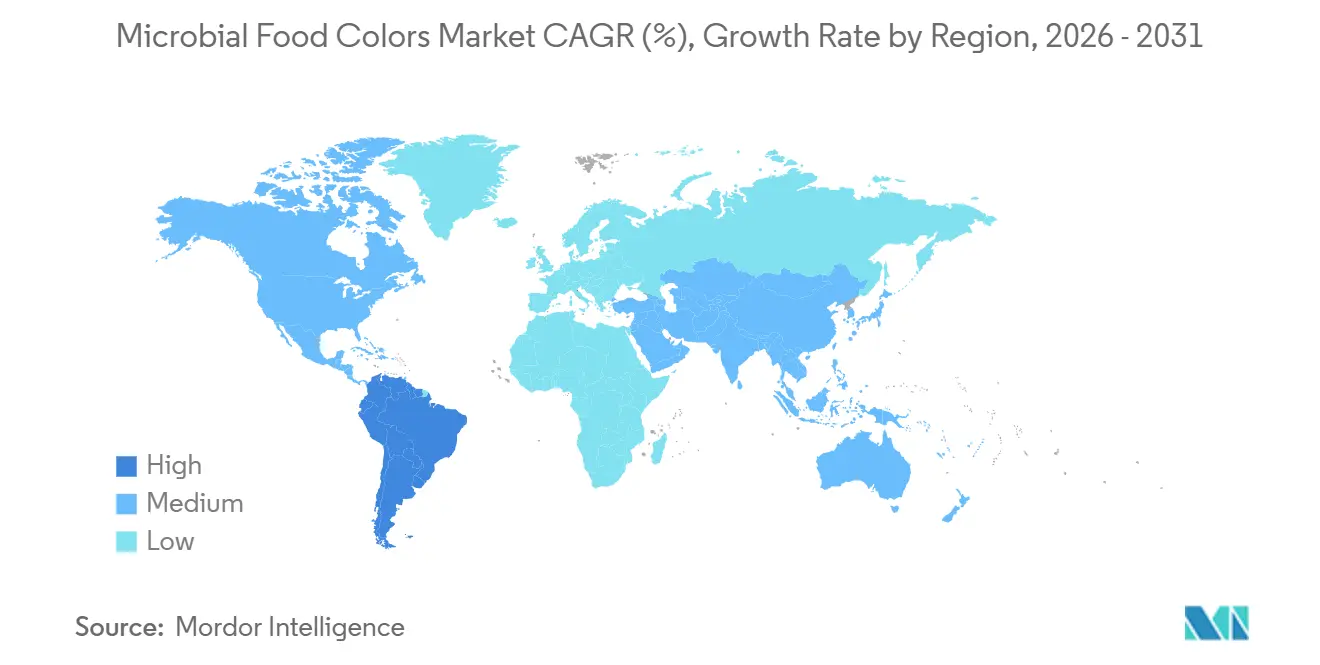
| Fastest Growing Market | South America |
| Largest Market | Asia-Pacific |
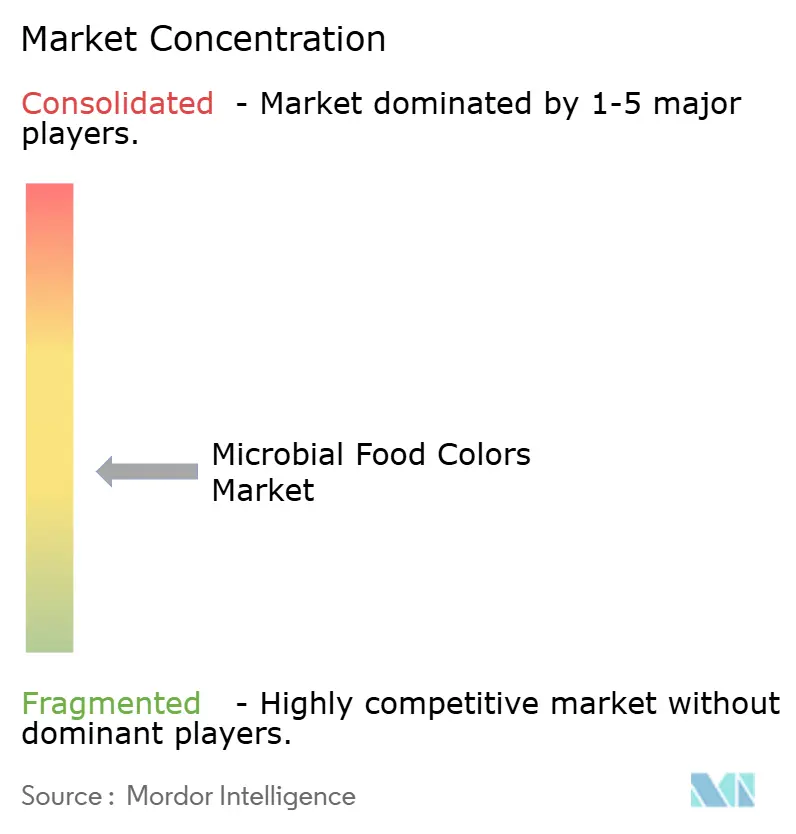
| Market Concentration | Medium |
Major Players *Disclaimer: Major Players sorted in no particular order Image © Mordor Intelligence. Reuse requires attribution under CC BY 4.0. | |
Microbial Food Colors Market Analysis by Mordor Intelligence
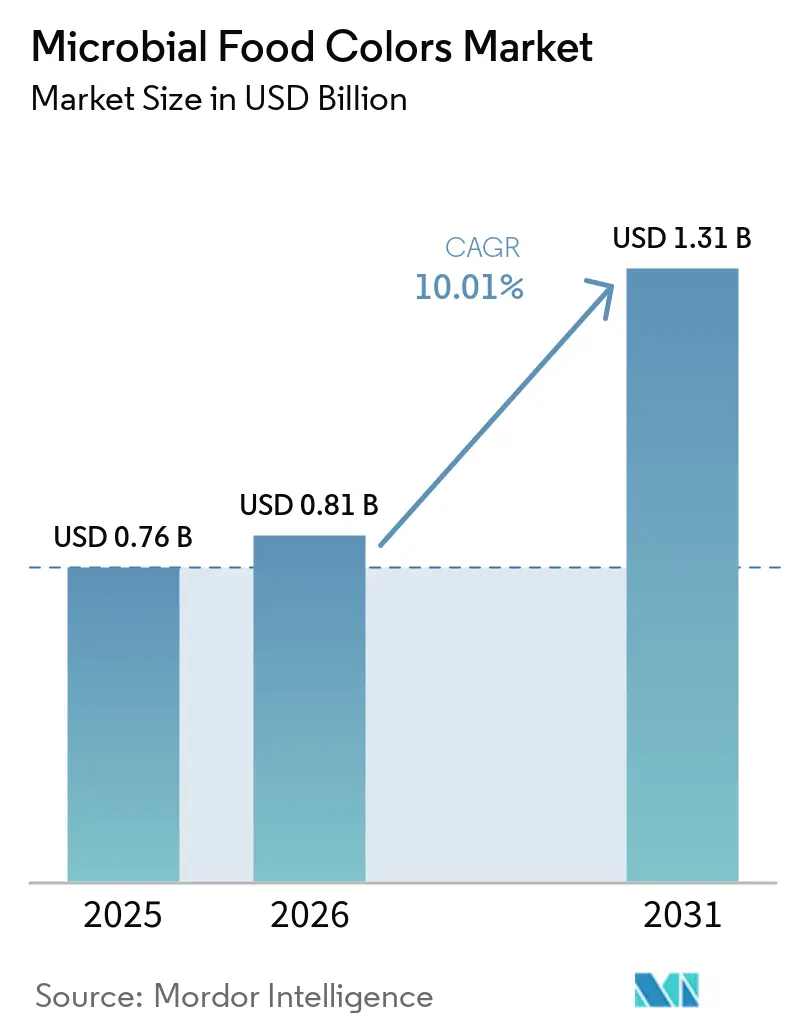
The microbial food colors market is projected to grow from USD 0.81 billion in 2025 to USD 1.31 billion by 2031, at a CAGR of 10.01% during 2026–2031. Growth reflects expanding applications in food, beverage, and dietary supplement formulations. Market growth depends on regulatory initiatives and suppliers’ ability to deliver natural colors with heat stability, acidity tolerance, shelf life, and batch consistency [1]. Fermentation offers a controlled, traceable production route that is less dependent on crop seasonality than botanical colors. However, high processing and purification costs may limit adoption in low-margin food products. The strongest opportunities exist where microbial pigments solve formulation challenges, support simpler ingredient declarations, or provide both color and functional benefits.
Key Report Takeaways
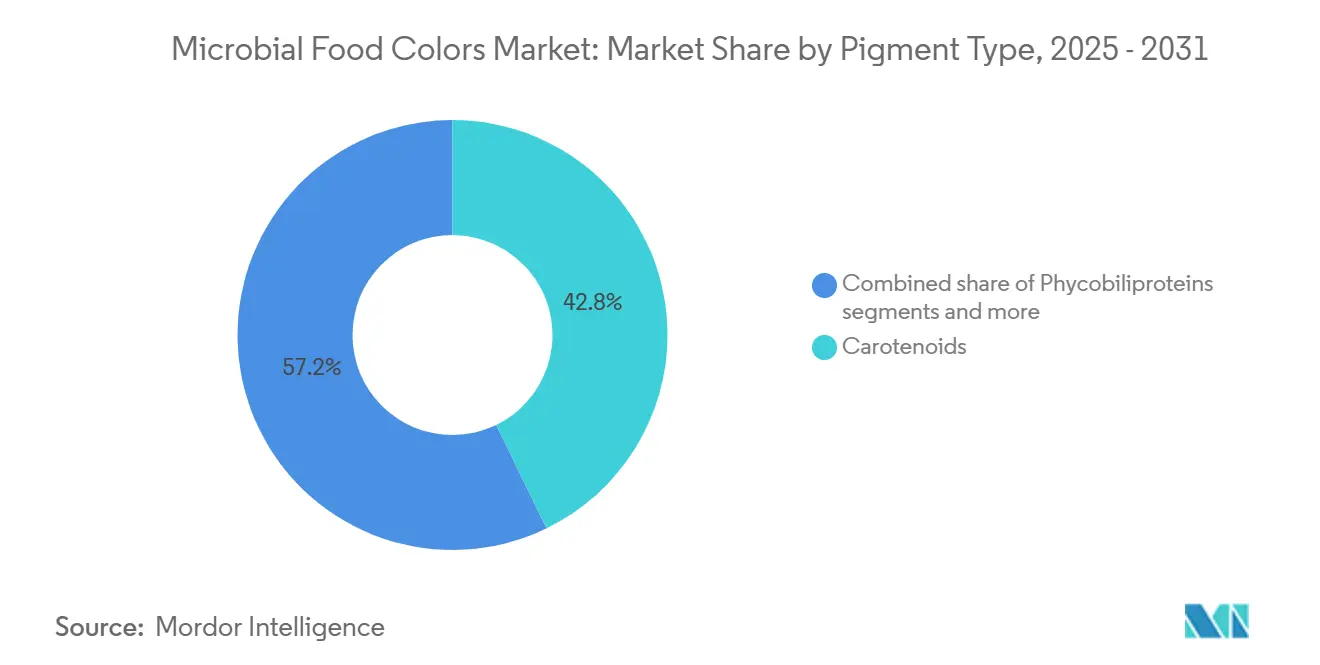
- By pigment type, carotenoids held 42.80% of the microbial colors market share in 2025, while phycobiliproteins are forecast to grow at a 12.09% CAGR through 2031.
- By source microorganism, fungi-derived colors held 51.04% of the microbial colors market share in 2025, while microalgae-derived colors are projected to advance at an 11.80% CAGR through 2031.
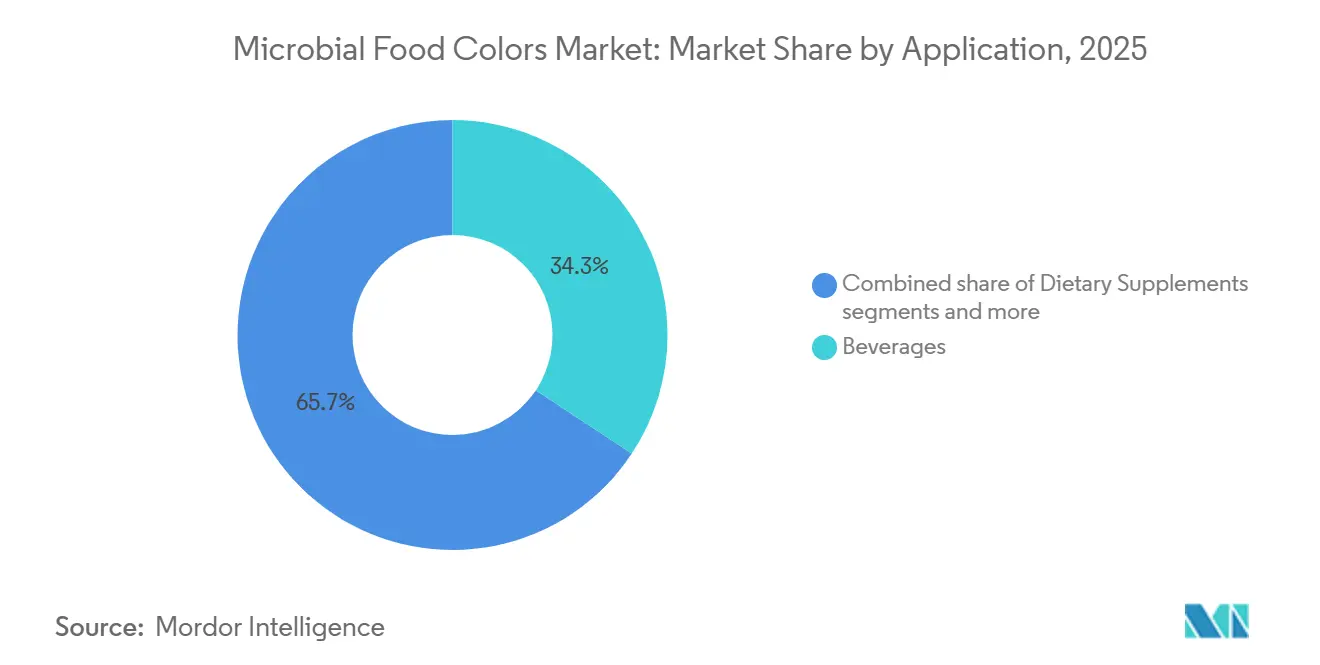
- By application, beverages accounted for 34.30% of the microbial colors market size in 2025, while dietary supplements are projected to grow at a 13.50% CAGR through 2031.
- By geography, Asia-Pacific held 33.70% revenue share in 2025, while South America is forecast to expand at a 13.20% CAGR through 2031.
Note: Market size and forecast figures in this report are generated using Mordor Intelligence’s proprietary estimation framework, updated with the latest available data and insights as of January 2026.
Market Trends and Insights
Drivers Impact Analysis of Microbial Food Colors Market*
| Driver | (~) % Impact on CAGR Forecast | Geographic Relevance | Impact Timeline |
|---|---|---|---|
| Shift toward synthetic dye replacement through product reformulation | +2.5% | North America | Short term (≤ 2 years) |
| Rising demand for clean-label and transparent ingredients | +1.8% | Europe | Medium term (2-4 years) |
| Advances in fermentation and metabolic engineering for higher pigment yield | +1.5% | Asia-Pacific | Long term (≥ 4 years) |
| Year-round production and reduced dependence on agricultural raw materials | +0.8% | Global | Medium term (2-4 years) |
| Increasing demand for stable natural colorants across food and beverage applications | +1.2% | South America | Short term (≤ 2 years) |
| Rising interest in the multifunctional properties of microbial pigments | +0.6% | North America and Europe | Medium term (2-4 years) |
| Source: Mordor Intelligence | |||
Shift Toward Synthetic Dye Replacement through Product Reformulation
The shift away from synthetic dyes is accelerating product reformulation across the food and beverage industry, creating opportunities for microbial food colors. Manufacturers are increasingly seeking natural, clean-label alternatives that deliver consistent color performance while addressing evolving consumer preferences and regulatory requirements. Microbial pigments can meet reformulation needs in applications such as beverages, confectionery, fruit preparations, and dairy products, where color stability is critical. Their ability to maintain stable, consistent color under varying processing and storage conditions supports their use across a wide range of food and beverage formulations. As manufacturers expand dye-replacement initiatives across their product portfolios, microbial colors are expected to gain traction.
Rising Demand for Clean-Label and Transparent Ingredients
Growing consumer preference for shorter, recognizable ingredient lists is driving the adoption of microbial colors across food, beverage, and supplement applications. Consumers increasingly demand clean-label products with transparent sourcing and no artificial additives, prompting manufacturers to incorporate microbial color solutions into their formulations. This trend is particularly prominent in beverages, bakery products, dairy products, and gummies, where transparent labeling and visual appeal significantly influence product positioning, brand differentiation, and purchasing decisions. Microbial colors enable manufacturers to achieve consistent, appealing product appearances while supporting clean-label formulation strategies.
Advances in Fermentation and Metabolic Engineering for Higher Pigment Yield
Advances in fermentation, metabolic engineering, and strain optimization are improving the productivity, consistency, and commercial viability of microbial food colors [2]. Higher pigment yields reduce feedstock and processing requirements, lower production costs, and enhance the scalability of microbial colors for a wide range of food and beverage applications. Improved fermentation efficiency also enables manufacturers to achieve more reliable color intensity and quality across production batches. These developments strengthen the competitiveness of microbial pigments against synthetic and plant-derived alternatives while supporting the growing demand for natural and sustainable food color solutions.
Year-Round Production and Reduced Dependence on Agricultural Raw Materials
Microbial production enables food color manufacturers to operate independently of harvest seasons and specific agricultural growing regions, ensuring a consistent year-round pigment supply. This approach reduces reliance on agricultural cycles and allows manufacturers to plan procurement, inventory management, and production schedules more effectively. Controlled fermentation enables food companies to maintain consistent color specifications across products and manufacturing locations while reducing exposure to weather-related disruptions, seasonal raw-material fluctuations, and supply-chain variability. It also supports scalable production under standardized conditions, helping manufacturers meet consistent quality and regulatory requirements.
Restraints Impact Analysis of Microbial Food Colors Market*
| Restraint | (~) % Impact on CAGR Forecast | Geographic Relevance | Impact Timeline |
|---|---|---|---|
| Higher cost-in-use compared with synthetic dyes | -1.8% | Asia-Pacific | Medium term (2-4 years) |
| Complex and jurisdiction-specific regulatory approval requirements | -1.2% | Global | Long term (≥ 4 years) |
| Safety, purification, and quality-control requirements | -0.7% | Europe and North America | Medium term (2-4 years) |
| Limited commercial-scale fermentation capacity | -1.0% | South America and Middle East and Africa | Long term (≥ 4 years) |
| Source: Mordor Intelligence | |||
Higher Cost-in-Use Compared with Synthetic Dyes
Higher cost-in-use remains a key restraint for microbial food colors compared with synthetic dyes, which benefit from established, large-scale, and cost-efficient production. Microbial color production involves fermentation, extraction, purification, concentration, and drying, which increase the cost of the finished pigment. Although low-cost substrates, such as whey, molasses, and food-processing residues, can improve production economics, they may require additional pretreatment and quality control. Limited commercial-scale fermentation capacity and specialized food-grade infrastructure further constrain supply and limit economies of scale. Consequently, microbial food colors are likely to gain faster adoption in premium and clean-label applications, where their value proposition justifies higher costs.
Complex and Jurisdiction-Specific Regulatory Approval Requirements
Complex, jurisdiction-specific regulatory approval requirements remain a key restraint on the microbial food colors market. Manufacturers must comply with differing safety, manufacturing, intended-use, and labeling requirements across countries and regions. Approval pathways vary by jurisdiction and require market-specific technical documentation, safety assessments, and supporting evidence before commercialization. Manufacturers must also demonstrate consistent strain identity, purity, stability, and batch-to-batch quality to validate the safety and performance of microbial pigments. These requirements can lengthen commercialization timelines and increase regulatory, testing, and compliance costs. The burden is particularly significant for emerging producers that may lack regulatory expertise, dedicated compliance teams, and validated food-grade production systems.
*Our forecasts treat driver/restraint impacts as directional, not additive. The impact forecasts reflect baseline growth, mix effects, and variable interactions.
Microbial Food Colors Market Segment Analysis
By Pigment Type:
Carotenoids Lead as Phycobiliproteins Expand Blue Coloring OptionsCarotenoids and phycobiliproteins are key pigment types in the microbial colors market. Carotenoids account for the largest market share at 42.80% in 2025, while phycobiliproteins are expected to register the fastest growth, with a CAGR of 12.09% through 2031. Carotenoids benefit from a long production history and broad adoption across food, beverage, dairy, bakery, confectionery, and dietary supplement applications. Manufacturers have produced beta-carotene from Blakeslea trispora for decades, establishing a well-developed manufacturing base. Phycobiliproteins, particularly blue and green pigments, are gaining commercial traction. Their potential stability under acidic conditions further supports their application in fruit beverages, sports drinks, and acidic dairy products.
Riboflavin and monascus pigments present additional opportunities in the microbial colors market, although they differ in commercial maturity. Riboflavin serves as both a colorant and a nutrient, supporting its use in fortified dairy and cereal products. Monascus pigments offer red, orange, and yellow shades for food applications. However, concerns over citrinin contamination and regulatory acceptance may restrict their broader adoption. Other microbial pigments, including melanins, prodigiosin, and violacein, remain largely in the research, pilot-scale, or early commercialization stages. These emerging pigments could expand the microbial color palette and create new application opportunities.

By Source Microorganism:
Fungi Lead While Microalgae Build Regulatory AccessFungi-derived colors accounted for the largest share of the microbial colors market by source microorganism, at 51.04% in 2025. Their established use in industrial pigment production and broad pigment portfolio, including carotenoids, melanins, anthraquinones, azaphilones, and naphthoquinones, support this market position. Submerged and stirred-tank fermentation enables controlled, year-round production at a commercial scale. Microalgae-derived colors are projected to be the fastest-growing source category, registering a 11.80% CAGR through 2031. Growing use of phycocyanin and astaxanthin in food and beverages, dietary supplements, and aquaculture drives this growth. Regulatory advancements for Galdieria-derived blue pigments in the United States and Europe support commercialization, while astaxanthin derived from Haematococcus pluvialis serves premium applications.
Bacteria-derived colors represent a smaller but promising source category within the natural colors market. Pigments such as prodigiosin, violacein, bacterial carotenoids, and melanin provide red, purple, yellow, orange, and dark shades for various applications. Rapid microbial growth, fermentation-based production, and strain improvement opportunities support scalable manufacturing and can enable more consistent pigment quality. These characteristics make bacterial pigments increasingly relevant for food, beverage, feed, cosmetic, and pharmaceutical applications. Yeast-derived colors offer opportunities for controlled pigment production through established fermentation platforms. Yeasts produce carotenoids, including astaxanthin, and other pigments used in food, beverages, feed, and dietary supplements. Year-round cultivation and compatibility with process optimization can reduce reliance on seasonal agricultural sources while supporting stable supply and consistent production output.
By Application:
Beverages Lead Demand While Dietary Supplements Grow FasterBeverages are projected to account for 34.30% of the microbial colors market in 2025, driven by demand for natural colorants that maintain consistent shades in acidic liquids, under light exposure, and during heat treatment. Fermentation-derived colors can meet these requirements when optimized for the stability needs of specific beverage formulations. Dietary supplements are projected to grow at a 13.50% CAGR through 2031, supported by applications in gummies, soft gels, and capsules. In these applications, microbial pigments such as phycocyanin and astaxanthin can provide both coloration and functional value. This combination of color and bioactive benefits can support higher-value applications than colorants used primarily for visual appeal.
Bakery and confectionery, dairy products, animal feed, meat, poultry and seafood, snacks, and other applications offer opportunities for microbial colors in food and feed markets [3]. Bakery and confectionery products require heat-stable pigments, while dairy applications use microbial colors, such as carotenoids, in cheese, butter alternatives, and flavored dairy beverages. Animal feed, particularly salmonid aquaculture, offers opportunities for astaxanthin-based pigments. Meat, poultry, and seafood applications remain less developed due to stability, regulatory, formulation, and cost requirements. Snacks and specialized applications are also gaining attention, although adoption depends on color intensity, stability, regulatory acceptance, and cost competitiveness.
Geography Analysis
APAC and South America Microbial Food Colors Market
Asia-Pacific and South America are key growth regions in the microbial colors market. Asia-Pacific accounted for 33.70% of the market in 2025, while South America is projected to register a 13.20% CAGR through 2031. Asia-Pacific benefits from China’s established production base and rising demand for higher-purity ingredients. Japan and South Korea represent premium markets, with a strong emphasis on quality and controlled ingredients. India offers opportunities as an emerging production hub and an expanding end market, supported by its growing processed food sector. South America, led by Brazil, benefits from a large food-processing industry and opportunities to use agricultural byproducts, including sugarcane molasses, dairy whey, and fruit-processing residues, as fermentation feedstocks.
North America and Europe Microbial Food Colors Market
North America and Europe are mature yet commercially significant markets, supported by established food manufacturing industries, robust demand for natural color alternatives, and continued innovation in microbial pigments. The United States is the leading market in North America, followed by Canada and other countries. Regulatory advancements are creating opportunities to commercialize novel natural colors. Europe also presents substantial opportunities across the United Kingdom, Germany, France, Italy, the Netherlands, and other countries, where demand for high-quality, naturally derived ingredients supports market growth. Clear regulatory frameworks and the increasing availability of heat- and acid-stable natural colors, particularly blue pigments, are encouraging wider adoption across food and beverage applications.
MEA Microbial Food Colors Market
The Middle East and Africa account for a smaller share of the microbial colors market but present selective opportunities in premium food, beverage, and feed applications. Growing consumer preference for clean-label, naturally sourced ingredients and the expansion of premium product portfolios across key urban markets primarily drive demand. Saudi Arabia and South Africa represent relatively developed markets in the region, supported by their established food and beverage industries. Other countries offer longer-term growth potential as consumer awareness increases and regulatory frameworks develop. Fermentation-derived pigments with traceable, non-animal origins can support applications requiring halal-compliant sourcing, provided the ingredients and production processes meet relevant certification requirements.
Competitive Landscape
The microbial colors market is medium with established specialty ingredient companies, regional fermentation producers, and emerging biotechnology developers competing across pigment categories and regions. No single supplier holds decisive pricing power across all pigment types or geographies. Established companies benefit from production expertise, customer relationships, application knowledge, and regulatory capabilities, particularly in commercially established pigment categories such as carotenoids. Meanwhile, emerging biotechnology companies focus on specialized pigments, including heat- and acid-stable blue and green colors, creating opportunities in applications where conventional natural colors have performance limitations.
Partnerships allow emerging pigment developers to leverage established manufacturing capabilities, formulation expertise, distribution networks, and relationships with food companies. These collaborations accelerate product commercialization and help developers meet the technical and regulatory requirements of food and beverage manufacturers. The commercial launch of nature-based color emulsions and the development of microalgal pigments indicate a shift toward performance-driven competition. Beyond natural sourcing, companies increasingly prioritize stability, processing tolerance, regulatory acceptance, consistent color performance, and technical support.
Companies that provide application-specific solutions and support customers throughout formulation and scale-up can strengthen their competitive positions. Carotenoids, phycobiliproteins, and other microbial pigments meet distinct formulation requirements, which reduces the likelihood of a single supplier dominating the overall market. Competitive positioning increasingly depends on regulatory approvals, production scale, consistent quality, application performance, and supply reliability. Improvements in fermentation yields and the adoption of alternative feedstocks could further strengthen individual suppliers' market positions.
Microbial Food Colors Industry Leaders
-
Allied Biotech Corporation
-
dsm-firmenich
-
GNT Group
-
ADM
-
ROHA Group
- *Disclaimer: Major Players sorted in no particular order
Microbial Food Colors Market Companies Covered in this Report
- Allied Biotech Corporation
- dsm-firmenich
- GNT Group B.V. – Exberry®
- ADM
- ROHA Group
- Kalsec Inc.
- Lycored
- BASF
- Chenguang Biotech Group Co., Ltd.
- Incoltec
- GRA Nutra AG
- Yaegaki Biotechnology, Inc.
- GLICO NUTRITION CO., LTD.
- Youngsun Industry Co., Ltd.
- NeFlora Naturals
- Xi'an Tongze Biotechnology Co., Ltd.
- Xi'an PuroNature Biotechnology Co., Ltd.
- DOBE IND. CO., LTD.
- Xi'an Green Spring Technology Co., Ltd.
- YANGGE Biotech Co., Ltd.
Recent Industry Developments in Microbial Food Colors Market
- May 2026: Oterra partnered with Debut Bio to develop and scale a precision-fermented alternative to Red 40 for food and beverage applications. The companies plan to seek FDA approval while continuing to develop and scale the precision-fermented colorant for use in confectionery, dairy, meat, prepared foods, and fruit preparations.
- January 2026: South Dakota State University advanced microbial carotenoid production toward commercialization by successfully completing 70-liter pilot batches using pigment-producing microorganisms. The research demonstrated that microbial fermentation could accelerate carotenoid production and provide natural colorants for food and animal feed applications.
- September 2025: Michroma partnered with CJ CheilJedang to scale the commercial production of fermentation-derived natural colors using filamentous fungi. This partnership enabled the large-scale, consistent production of pigments and supported the commercialization of heat- and pH-stable colors for applications including baked goods, dairy products, and meat products.
Global Microbial Food Colors Market Report Scope
The microbial food colors market comprises food-grade colorants derived from microorganisms, including bacteria, fungi, yeast, and microalgae. These colorants enhance the visual appeal of food and beverage products while meeting the growing demand for naturally sourced ingredients. The report analyzes the market by pigment type, source microorganism, application, and geography. The market includes carotenoids, phycobiliproteins, riboflavin, monascus, and other microbial pigments. Key applications include beverages, bakery and confectionery products, dairy products, dietary supplements, animal feed, meat, poultry, seafood, snacks, and other applications. The analysis evaluates the use of microbial food colors across these end-use applications. The report covers North America, Europe, Asia-Pacific, South America, the Middle East, and Africa, providing insights into market trends and developments across these regions.
Segmentation Overview
| Carotenoids |
| Phycobiliproteins |
| Riboflavin |
| Monascus Pigments |
| Others |
| Bacteria-Derived Colors |
| Fungi-Derived Colors |
| Yeast-Derived Colors |
| Microalgae-Derived Colors |
| Beverages |
| Bakery and Confectionery |
| Dairy Products |
| Dietary Supplements |
| Animal Feed |
| Meat, Poultry and Seafood |
| Snacks |
| Others |
| North America | United States |
| Canada | |
| Rest of North America | |
| Europe | United Kingdom |
| Germany | |
| France | |
| Italy | |
| Netherlands | |
| Rest of Europe | |
| Asia-Pacific | China |
| Japan | |
| India | |
| Australia | |
| South Korea | |
| Rest of Asia-Pacific | |
| South America | Brazil |
| Argentina | |
| Rest of South America | |
| Middle East and Africa | South Africa |
| Saudi Arabia | |
| Rest of Middle East and Africa |
| By Pigment Type | Carotenoids | |
| Phycobiliproteins | ||
| Riboflavin | ||
| Monascus Pigments | ||
| Others | ||
| By Source Microorganism | Bacteria-Derived Colors | |
| Fungi-Derived Colors | ||
| Yeast-Derived Colors | ||
| Microalgae-Derived Colors | ||
| By Application | Beverages | |
| Bakery and Confectionery | ||
| Dairy Products | ||
| Dietary Supplements | ||
| Animal Feed | ||
| Meat, Poultry and Seafood | ||
| Snacks | ||
| Others | ||
| By Geography | North America | United States |
| Canada | ||
| Rest of North America | ||
| Europe | United Kingdom | |
| Germany | ||
| France | ||
| Italy | ||
| Netherlands | ||
| Rest of Europe | ||
| Asia-Pacific | China | |
| Japan | ||
| India | ||
| Australia | ||
| South Korea | ||
| Rest of Asia-Pacific | ||
| South America | Brazil | |
| Argentina | ||
| Rest of South America | ||
| Middle East and Africa | South Africa | |
| Saudi Arabia | ||
| Rest of Middle East and Africa | ||
Key Questions Answered in the Report
Which pigment type leads microbial color demand?
Carotenoids led with 42.80% share in 2025 because of their established production methods and broad application record.
Which application is growing fastest for microbial pigments?
Dietary supplements are forecast to expand at a 13.50% CAGR through 2031, supported by gummies, capsules, and other premium formats.
How large is the microbial colors market?
The category is projected to reach USD 1.31 billion by 2031, growing at a 10.01% CAGR from 2026.
What limits wider adoption of microbial pigments?
High downstream processing costs, limited qualified capacity, and region-specific approval requirements remain the key constraints.