
Mexico ITSM Market Size and Share
Market Overview
| Study Period | 2024 - 2031 |
|---|---|
| Forecast Data Period | 2025 - 2031 |
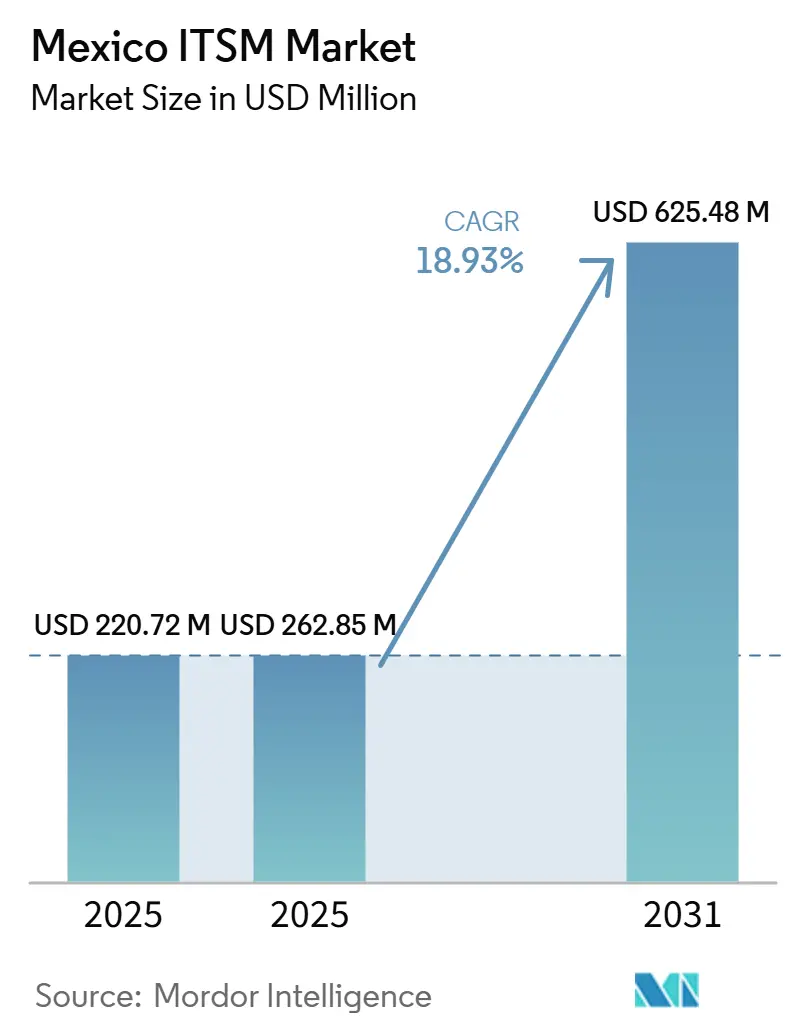
| Base Year Market Size (2025) | USD 220.72 Million |
| Market Size (2026) | USD 262.85 Million |
| Market Size (2031) | USD 625.48 Million |
| Growth Rate (2025 - 2031) | 18.93 % |
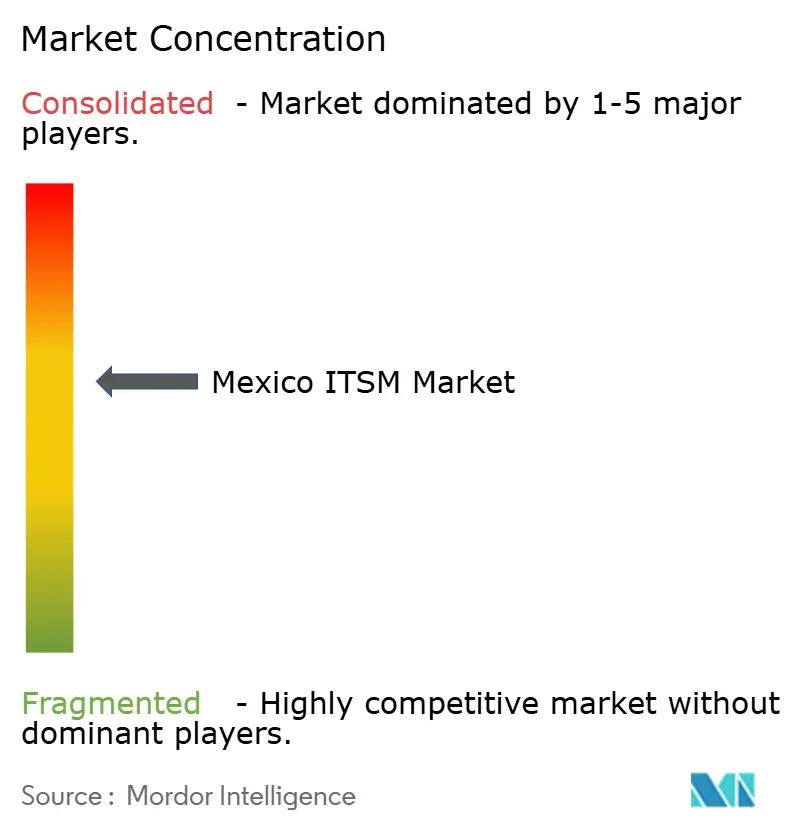
| Market Concentration | Medium |
Major Players *Disclaimer: Major Players sorted in no particular order Image © Mordor Intelligence. Reuse requires attribution under CC BY 4.0. | |
Mexico ITSM Market Analysis by Mordor Intelligence
The Mexico ITSM Market size is expected to grow from USD 220.72 million in 2025 to USD 262.85 million in 2026 and is forecast to reach USD 625.48 million by 2031 at 18.93% CAGR over 2026-2031.
In Mexico, the IT service management market is evolving, driven by a shift towards cloud solutions, an increased integration of AI in service workflows, and heightened operational demands in regulated industries. These sectors are emphasizing the need for meticulous documentation and uninterrupted service continuity. Large enterprises are fueling this demand, seeking a unified platform to manage incidents, requests, changes, assets, and knowledge across their distributed teams. This push underscores the importance of platform standardization in their digital investment strategies. While global platforms dominate enterprise accounts, there is a surge in competition. Mid-sized buyers, prioritizing shorter deployment times and reduced implementation challenges, are gravitating towards faster, more streamlined offerings. Mexico's strategic position in global networks further bolsters its IT service management market. Multinational companies often establish shared services, support centers, and digital functions in the country, necessitating a workflow governance that mirrors their parent company's standards. Looking ahead, the potential for growth is vast. As service management evolves, it is set to transcend its traditional IT boundaries, extending into areas like employee support, facilities management, finance, and other internal functions. These sectors, too, are recognizing the value of traceable processes, measurable response times, and consistent service visibility.
Key Report Takeaways
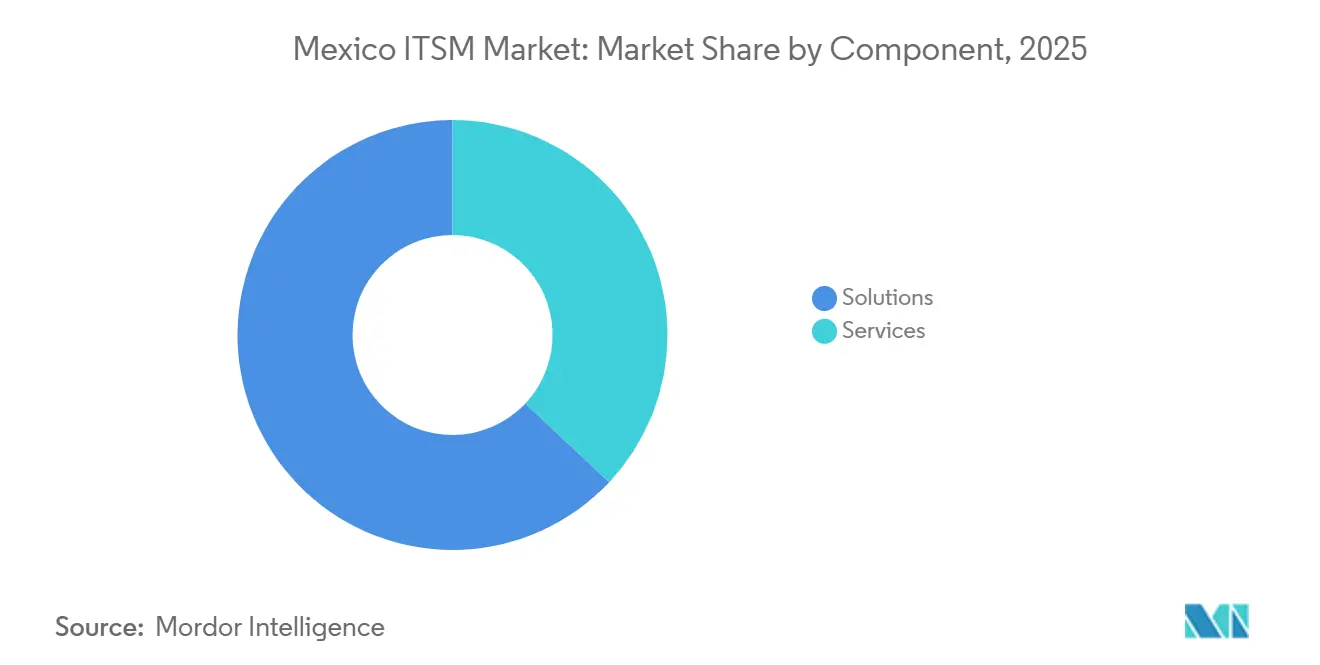
- By component, solutions held the largest share at 63.00% in 2025, while services are projected to expand at a 24.00% CAGR through 2031 as managed administration, implementation, and advisory work gains more weight in the Mexico IT service management market.
- By deployment, cloud-based ITSM accounted for 65.00% share in 2025 and is also expected to record the highest CAGR at 26.00% through 2031.
- By application, service desk and incident management led with 28.00% share in 2025, while knowledge management is projected to grow the fastest at a 25.00% CAGR through 2031.
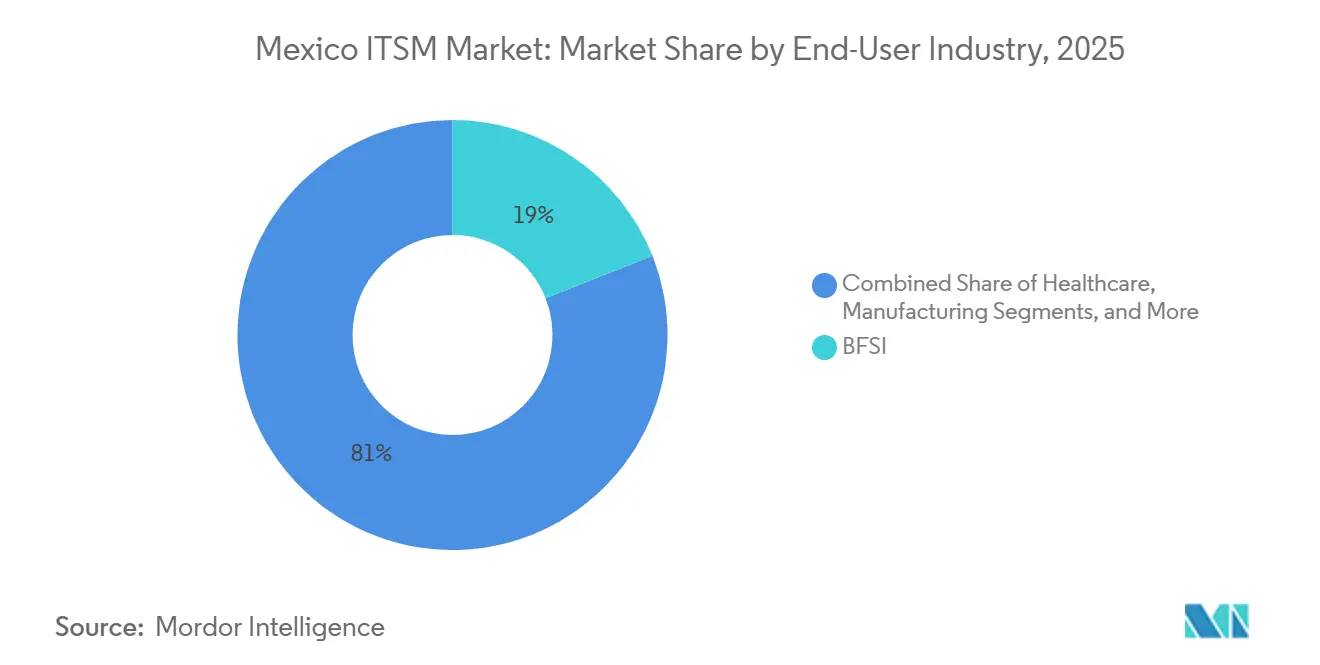
- By end-user industry, BFSI captured 19.00% share in 2025, while healthcare is expected to expand at the highest CAGR of 23.50% through 2031.
- By enterprise size, large enterprises commanded 65.00% share in 2025 and are also projected to remain the fastest-growing size segment at a 22.00% CAGR through 2031.
Note: Market size and forecast figures in this report are generated using Mordor Intelligence’s proprietary estimation framework, updated with the latest available data and insights as of January 2026.
Mexico ITSM Market Trends and Insights
Drivers Impact Analysis*
| Driver | (~) % Impact on CAGR Forecast | Geographic Relevance | Impact Timeline |
|---|---|---|---|
| Rising Cloud Migration Among Mexican Enterprises | +3.8% | National, with earlier gains concentrated in Mexico City, Guadalajara, and Monterrey | Short term (≤ 2 years) |
| Accelerating AI-Assisted Ticket Triage and Self-Service | +3.2% | National, strongest in large enterprise and multinational SSC hubs | Short term (≤ 2 years) |
| Expansion of Regulated Digital Operations in BFSI and Healthcare | +2.5% | National, with regulatory influence centered in Mexico City and public health networks | Medium term (2-4 years) |
| Nearshoring-Led IT Standardization Across Multinational Shared Service Centers | +2.2% | North America and Europe linked enterprise demand, with core impact in Monterrey, Guadalajara, and Querétaro | Medium term (2-4 years) |
| Growing Need for Unified Service Management Beyond IT | +1.5% | National, with higher adoption in BFSI and IT and telecommunications | Medium term (2-4 years) |
| Increasing Demand for Compliance-Ready Audit Trails and Process Visibility | +1.1% | BFSI, healthcare, and government corridors, with strongest pressure in Mexico City and Guadalajara | Long term (≥ 4 years) |
| Source: Mordor Intelligence | |||
Rising Cloud Migration Among Mexican Enterprises
Cloud migration stands as a pivotal force bolstering Mexico's IT service management market. Enterprises seldom transition workloads en masse without simultaneously refining their incident handling, change approvals, service catalogs, and configuration visibility across diverse environments. As organizations navigate a blend of hosted, private, and on-premises resources, they quickly realize the impracticality of using disconnected ticketing tools and manual handoffs for consistent service delivery. This operational shift amplifies the demand for platforms that seamlessly integrate requests, approvals, assets, and service performance into a unified workflow, accessible to both business and technology teams. In a significant move, ServiceNow and Google Cloud deepened their collaboration in January 2024. This expansion allows ServiceNow's ITSM, CRM, and Security Incident Response modules to be deployed on Google Distributed Cloud and made available via the Google Cloud Marketplace[1]Google Cloud, “ServiceNow and Google Cloud Expand Partnership to Deliver AI-Powered Tools to Millions of Users,” Google Cloud Press Corner, googlecloudpresscorner.com. This partnership fortifies the cloud-native trajectory for enterprises contemplating standardized rollout models. Such deployment versatility not only alleviates infrastructure challenges for buyers seeking swift implementations but also spares them the complexities of managing an entire platform stack in-house. Consequently, as cloud migration reshapes Mexico's technological landscape, it simultaneously accelerates the modernization of service management, making delays increasingly untenable.
Accelerating AI-Assisted Ticket Triage And Self-Service
In Mexico's IT service management market, AI-assisted operations are emerging as a pivotal growth driver. Buyers now demand platforms that not only log tickets but also minimize manual triage work. TeamDynamix highlighted the efficacy of AI, noting that its service management agents achieved response times 40–90% faster and trimmed 4–7 minutes off each ticket during initial customer tests. This underscores the shift of automation from a mere enhancement to a significant productivity booster, especially in high-volume support settings. Here, multilingual teams juggle repetitive incidents and routine requests, all under tight response deadlines. In September 2023, ManageEngine unveiled a generative AI update for ServiceDesk Plus. This update introduced features like conversational support, automatic resolution generation from historical tickets, and AI-driven article creation. These enhancements bolster self-service and knowledge loops, effectively lightening the analysts' workload. The competitive landscape is also shifting. Vendors unable to demonstrate tangible automation benefits may struggle to justify premium pricing. This is especially true against platforms that seamlessly integrate AI into their core service workflows. As a result, AI-centric upgrades and competitive replacements are poised to remain active in Mexico's IT service management arena.
Expansion Of Regulated Digital Operations In BFSI And Healthcare
In Mexico, the IT service management market thrives on the backbone of regulated digital operations. Industries managing sensitive records increasingly demand traceable service actions, controlled changes, and clear accountability among tech teams. For instance, in the financial sector, operational processes are subject to audit reviews and internal governance checks. This scrutiny amplifies the value of formal service management frameworks, even for organizations with established legacy support tools. A reform in January 2026 to the General Health Law underscores the significance of digital health, mandating electronic clinical records, telehealth integration, and interoperability. Such mandates heighten the demand for reliable service support, issue tracking, and access control in healthcare settings[2]Santa Marina Steta, “Reform to the General Health Law 2026, Digital Health, Health Regulation and New Obligations,” Santa Marina Steta, santamarinasteta.mx. Further emphasizing this trend, the Mexican government unveiled a modernization initiative. By the close of 2026, public health centers must ensure internet connectivity and adopt universal digital clinical records, broadening these operational mandates across extensive public health networks. As digital records and interconnected care systems become obligatory, the sustainability of informal support practices wanes. Outages, access challenges, and change activities now demand meticulous documentation. This evolution positions regulated operations as a lasting cornerstone for Mexico's IT service management market, transcending mere compliance.
Nearshoring-Led IT Standardization Across Multinational Shared Service Centers
Multinational companies, when expanding their delivery centers, typically enforce a unified service process across their global operations. This trend, driven by nearshoring, is bolstering Mexico's IT service management market. For instance, when teams in support, finance, analytics, and internal operations are established in Mexico, parent companies mandate these local entities to adopt the same service platforms and approval structures as their global counterparts. Such mandates create a consistent demand for enterprise-level implementation, integration, training, and managed administration services, even if the initial platform decisions were made abroad. Highlighting the importance of local integration, Softtek's partnership with ServiceNow for enterprises throughout South America underscores the reliance of global software vendors on regional specialists for tasks like rollout localization, workflow design, and governance execution. This trend provides Mexico's IT service management market with a distinct edge: standardized platforms, integral to multinational operations, are more frequently integrated into these operations rather than being seen as isolated local purchases. Furthermore, the demand for service management in Mexico is bolstered not just by domestic technology upgrades, but also by the discipline of operations and expectations of cross-border governance.
Restraints Impact Analysis*
| Restraint | (~) % Impact on CAGR Forecast | Geographic Relevance | Impact Timeline |
|---|---|---|---|
| Legacy Tool Fragmentation Across Large Installed Bases | -2.3% | National, most pronounced in large enterprises in Mexico City and industrial corridors | Medium term (2-4 years) |
| Shortage of Skilled ITSM Administrators and Workflow Architects | -1.9% | National, with the sharpest deficit in Mexico City, Guadalajara, and Monterrey | Long term (≥ 4 years) |
| Budget Sensitivity Among Mid-Market Buyers | -1.4% | National, especially across SME clusters in Monterrey, Puebla, and León | Short term (≤ 2 years) |
| Integration Complexity With ERP, Security, and Collaboration Stacks | -1.0% | Global for multinationals, with concentrated execution risk in Mexico City corporate headquarters | Medium term (2-4 years) |
| Source: Mordor Intelligence | |||
Legacy Tool Fragmentation Across Large Installed Bases
In Mexico's IT service management market, legacy fragmentation poses a significant challenge. Many large organizations continue to use multiple support tools, each adopted by different teams over extended periods. This patchwork creates duplicate workflows, inconsistent data, and weak reporting alignment. Moreover, it complicates migration planning for companies aiming for a unified service layer across their business units. The challenge intensifies when older platforms harbor undocumented rules or have deep links to ERP, security, and collaboration systems, making swift migration to a streamlined architecture difficult. Documented instances indicate that transitioning processes and data to ServiceNow requires prolonged parallel-run operations. This insight sheds light on why consolidation projects often demand more time and managerial effort than initially anticipated.[3]Teiva Systems, “Seamless ITSM Process and Data Migration to ServiceNow,” Teiva Systems, teivasystems.com When organizations juggle both old and new processes, leadership teams tend to delay approval decisions, aiming to sidestep service disruptions during the transition. While this fragmentation does not diminish demand in Mexico's IT service management market, it does postpone spending realization and complicates the journey to platform consolidation.
Shortage Of Skilled ITSM Administrators And Workflow Architects
In Mexico's IT service management market, talent scarcity poses a significant challenge. While purchasing a platform is straightforward, tasks like workflow design, process governance, and long-term management hinge on specialized skills that are hard to come by. According to the Inter-American Development Bank, 68% of Mexican employers struggle to find the specialized talent they need. They also noted that as digital acceleration progresses, gaps are widening, particularly in cloud computing and workflow automation. This talent shortage manifests in service management programs through delayed implementations, limited initial deployments, and modules that remain underutilized, often just handling basic incidents. Consequently, some buyers curtail the scope of their rollouts to maintain continuity. Yet, it is these very areas, such as knowledge, configuration, change, and automation functions, which demand a more refined architectural approach, that typically yield the most significant productivity boosts. The partner ecosystem is not immune to this challenge either. Certified specialists are essential, not just for software installation, but for translating governance needs into practical workflows. As long as the talent pool remains constrained, the pace at which Mexico's IT service management market can evolve from mere demand to full-fledged platform adoption will be tempered.
*Our forecasts treat driver/restraint impacts as directional, not additive. The impact forecasts reflect baseline growth, mix effects, and variable interactions.
Segment Analysis
By Component: Services Gain Weight As Managed ITSM Matures
In 2025, solutions commanded a dominant 63.00% share of Mexico's IT service management market. This underscores the enduring significance of software platform spending in buyer budgets, even as there is a heightened focus on services like implementation, optimization, and long-term management. The substantial installed base signals a robust demand from enterprises seeking integrated solutions for ticketing, change control, asset visibility, and reporting within a unified governance framework. In Mexico's IT service management landscape, solutions revenue thrives on multi-year platform commitments. This is largely because major enterprises prioritize continuity, configurability, and comprehensive process coverage once they have chosen a core platform. Vendors like ServiceNow, BMC Software, and ManageEngine are reaping the rewards of this trend. Enterprise clients favor tools that seamlessly scale across departments, eliminating the need for a new procurement process with each workflow expansion. This trend bolsters software spending, even as clients ramp up service purchases to bridge capability gaps.
Services are on track to expand at a robust 24.00% CAGR through 2031. This growth rate outpaces the broader Mexico IT service management market, highlighting organizations' increasing reliance on external expertise for rollout, customization, administration, and process redesign. A significant driver of this momentum is operational: many buyers lack the in-house expertise to develop sophisticated service architectures independently. Softtek, as a ServiceNow implementation partner, underscores this trend. Their credentials, including ISO 20000 and ISO 42001 compliance, highlight why enterprise clients gravitate towards integrators. These integrators not only execute workflows but also bring a level of governance credibility. The importance of the services layer amplifies post-deployment. The true value of a platform hinges on consistent refinement of service catalogs, approvals, automations, knowledge flows, and user engagement. Consequently, while software remains foundational in Mexico's IT service management market, it is the services that increasingly dictate the realization of that software's value over time.


By Deployment: Cloud Delivery Extends Its Structural Lead
In 2025, cloud-based ITSM captured 65.00% of deployment demand, solidifying its dominant position in Mexico's IT service management market just as it gears up for its next expansion phase. This dominance indicates that buyers are not merely dabbling in remote delivery models; they are increasingly adopting them as the primary choice for new platform launches and expanding workflows. Cloud deployment appeals to organizations seeking quicker provisioning, simpler upgrades, reduced infrastructure demands, and consistent support for dispersed users. It is particularly suited for service management programs that require swift iterations, as automated updates and centralized management thrive in hosted settings compared to heavily tailored on-premises systems. Consequently, cloud delivery is influencing not just deployment choices but also product design, pricing strategies, and competitive dynamics in Mexico's IT service management landscape.
With a projected 26.00% CAGR through 2031, cloud deployment is not just maintaining its lead but expanding its edge over traditional options. In January 2025, ServiceNow and Google Cloud bolstered their collaboration, making ServiceNow's ITSM and related modules accessible on Google Distributed Cloud and via the Google Cloud Marketplace, underscoring the push for cloud-native deployments in enterprises prioritizing security and scalability. While on-premises tools still cater to specific data handling preferences, internal hosting mandates, or legacy ERP ties, hybrid models attract larger firms favoring gradual modernization over complete overhauls. Nonetheless, the trend is unmistakable: hosted delivery simplifies the extension of service workflows across business units, remote teams, and an expanding internal user base. As buyers increasingly integrate AI and self-service features, more easily updated in cloud settings, the cloud deployment segment is poised to be pivotal in driving category growth in Mexico's IT service management market.
By Application: Knowledge Management Rises While Core Ticketing Holds Scale
In 2025, service desk and incident management accounted for 28.00% of application demand, underscoring that Mexico's IT service management market still leans heavily on core operational support over advanced workflow extensions. Organizations typically start with ticket intake, incident routing, service requests, and basic reporting. These functions address immediate issues, establishing a foundational operating baseline. This initial adoption is crucial; it often dictates which vendor secures the top spot within an account. Once workflows, agents, and users acclimate to a system, displacing that leading platform becomes challenging. Following this foundational step, enterprises often delve into asset and configuration management, change and release management, and service request management as their process maturity evolves. Thus, the Mexico IT service management market continues to anchor itself in foundational use cases, from which broader service governance can flourish.
Knowledge management is projected to grow at a robust 25.00% CAGR through 2031. This surge signals a shift in buyer perceptions: knowledge bases are evolving from mere static repositories to dynamic resolution engines integral to the service process. A testament to this evolution is ManageEngine's September 2025 update for ServiceDesk Plus. It introduced features such as the LLM-style Ask Zia interface, multi-modal support, automatic resolution generation from historical tickets, and AI-driven article creation. Such advancements highlight the direct link between knowledge functions, ticket deflection, and expedited agent responses. By transforming resolved tickets into reusable articles and searchable guidance, teams enhance service quality. This shift reduces reliance on individual analyst memory, leaning instead on systematic operational learning. Such a transition is pivotal in high-volume settings, where repetitive issues can be addressed through self-service or guided support, conserving analyst time. Thus, as the Mexico IT service management market broadens its application scope, it simultaneously pivots toward a more intelligent utilization of internal knowledge, positioning it as a vital productivity asset.
By End-User Industry: BFSI Leads Adoption While Healthcare Accelerates
In 2025, the BFSI sector commanded a 19.00% share, solidifying its position as the dominant player in Mexico's IT service management market. This prominence stems from banks, fintechs, and other financial entities prioritizing controlled operations and traceable service records. Given the potential compliance and trust issues arising from service outages and unmanaged changes, financial institutions emphasize robust issue logging, change approvals, access controls, and disciplined escalation. Consequently, there is a consistent demand for platforms that champion repeatable governance over mere basic help desk functionalities. Similarly, sectors like manufacturing, IT, and telecommunications, which manage extensive technology assets and operate in uptime-sensitive environments, also value structured change and service visibility. Thus, the composition of Mexico's IT service management market is closely aligned with sectors where process failures can lead to high costs, regulatory challenges, or disruptions in service continuity.
Healthcare is set to experience a robust growth trajectory, with projections indicating a 23.50% CAGR through 2031. This surge positions healthcare as the fastest-growing end-user vertical, driven by increasingly formalized legal and operational expectations surrounding digital care systems. A pivotal health law reform in January 2026 mandated electronic clinical records, telehealth integration, and interoperability. This reform amplifies the demand for reliable incident management, change tracking, and access governance in hospitals and health institutions. Furthermore, a nationwide push for internet-connected facilities and universal digital clinical records broadens this operational necessity, particularly in public health networks that rely on consistent support structures. While retail and e-commerce are poised to expand through enhanced digital services, government adoption of these services may face hurdles. Variations in procurement cycles and budget priorities could delay execution, even in the presence of digital mandates. Despite these sectoral disparities, it is evident that Mexico's IT service management market is increasingly influenced by sectors grappling with the complexities of digital operations and the limitations of informal support methods.

By Enterprise Size: Large Enterprises Set The Pace For Scale And Expansion
In 2025, large enterprises commanded a dominant 65.00% share of the Mexico IT service management market, underscoring their pivotal role and the market's inclination towards complex organizations. These larger entities, with expansive user bases and intricate approval hierarchies, necessitate advanced workflow designs and robust reporting capabilities, a contrast to their smaller counterparts. Such complexities amplify the rationale for platform standardization; as service demands traverse various functions, locations, and tech stacks, the costs of fragmented processes escalate. When a major player integrates a platform for core IT support, it is often seamless to extend its use to HR, procurement, facilities, or legal, leading to a compounded revenue growth in the Mexico IT service management market, driven by both deeper engagement with existing clients and the acquisition of new ones.
Forecasts indicate that large enterprises will continue to dominate, with a projected growth rate of 22.00% CAGR through 2031. This trajectory not only solidifies their revenue leadership but also highlights a trend of broader and more mature platform adoption. Typically, organizations initiate their enterprise service management journey with IT, subsequently expanding to other internal support functions as governance and user adoption solidify. OpenText's 2026 outlook on enterprise service management noted this strategic expansion into HR, finance, and facilities, emphasizing its role in diminishing service silos and enhancing employee experience, aligning with the observed trends in larger accounts. While smaller firms present a notable market opportunity, many exhibit heightened price sensitivity and a lack of readiness for extensive customization or prolonged deployment cycles. Consequently, the Mexico IT service management landscape remains predominantly steered by large enterprises, adept at justifying expansive rollouts. Meanwhile, vendors streamlining deployments stand poised to tap into the growth potential of smaller accounts as the forecast period progresses.
Competitive Landscape
In the Mexico IT service management market, global enterprise platforms dominate large accounts, leading to a top-heavy concentration. Below this tier, the landscape becomes notably fragmented. ServiceNow is the go-to for intricate enterprise deployments. Meanwhile, BMC Software, Atlassian, and Microsoft are pivotal for buyers valuing extensive workflow depth, ecosystem reach, or compatibility with current enterprise software. Competing fiercely on deployment speed, usability, and affordability, Freshworks, ManageEngine, Zoho, and SolarWinds ensure that price and implementation play a crucial role in vendor selection for mid-sized accounts. This dynamic creates a dual nature in the Mexico IT service management market: a handful of established names wield significant control, while competition for volume thrives outside this elite circle. This scenario underscores the importance of partner ecosystems, as buyers often weigh implementation support and governance just as heavily as product features.
Local and regional integrators play a pivotal role, bridging platform capabilities with the operational needs of both Mexican and multinational clients. Softtek emerges as a key player, bolstered by its ISO 20000 and ISO 42001 certifications. These credentials position Softtek favorably in regulated and AI-sensitive projects, where governance and implementation skills are paramount. Further cementing its stature, Softtek was recognized in January 2025 as a leading player in modern application development services, aligning with clients eyeing workflow redesigns and migrations. This landscape indicates that the Mexico IT service management market's dynamics extend beyond mere software vendors; delivery partners significantly shape the ease of platform deployment, governance, and expansion.
Moves in 2025 and 2026 highlight AI and cloud readiness as the key differentiators. ServiceNow and Google Cloud deepened their collaboration, integrating ServiceNow modules into Google Distributed Cloud and the Google Cloud Marketplace. This move bolsters ServiceNow's appeal to enterprises seeking deployment flexibility and alignment with their cloud choices. On another front, ManageEngine enhanced its ServiceDesk Plus with generative AI, introducing conversational support and automated knowledge creation.[4]Google Cloud, “ServiceNow and Google Cloud Expand Partnership to Deliver AI-Powered Tools to Millions of Users,” Google Cloud Press Corner, googlecloudpresscorner.com This upgrade positions ManageEngine to compete with pricier platforms, offering clients workflow efficiency without the complexities of enterprise-grade implementation. As these trends evolve, the Mexico IT service management market seems poised to favor vendors that adeptly blend automation, streamlined deployment, and robust governance support, rather than those solely emphasizing process depth.
Mexico ITSM Industry Leaders
ServiceNow, Inc
BMC Software, Inc
International Business Machines Corporation
Atlassian Corporation Plc
Ivanti, Inc.
- *Disclaimer: Major Players sorted in no particular order

Recent Industry Developments
- June 2026: Under President Claudia Sheinbaum, the Mexican government unveiled a digital modernization initiative. By the close of 2026, all public health centers in Mexico, including IMSS, ISSSTE, and IMSS-Bienestar institutions, must be equipped with internet connectivity and implement the universal digital clinical records system (expediente clínico electrónico). This directive broadens the ITSM market within Mexico's public healthcare, necessitating structured IT service and incident management across numerous facilities.
- May 2026: Freshworks introduced its AI Agent Studio within Freshservice, allowing for the no-code deployment of autonomous AI agents. These agents can address up to 80% of routine IT requests and integrate seamlessly with platforms such as Microsoft Teams, Slack, and Workday. This move positions Freshworks as a formidable competitor to ServiceNow's Now Assist, particularly targeting mid-market ITSM clients both globally and in Mexico.
- May 2026: ServiceNow rolled out its Build Agent in ServiceNow Studio, integrating it with prominent AI coding platforms. The announcement also highlighted a revamped AI Agent Studio set to debut in the second quarter of 2026, underscoring ServiceNow's dedication to enhancing agent workflows in enterprise ITSM.
- January 2026: Mexico's updated General Health Law now recognizes digital health as a public interest issue. It mandates the adoption of electronic health records, telemedicine, and interoperable data systems across all health institutions. This regulatory shift stands out as a pivotal driver for ITSM demand in the healthcare sector from 2026 to 2031.
- November 2025: Softtek, a South American tech leader, became the continent's first to secure the ISO 42001 certification for AI Management Systems, granted by Applus+ Laboratories. Concurrently, Softtek renewed its ISO 20000, ISO 27001, and ISO 9001 certifications, bolstering its credentials for regulated ITSM projects.


Mexico ITSM Market Report Scope
The Mexico ITSM Market Report is Segmented by Component (Solutions, Services), Deployment (Cloud, On-Premise, Hybrid), Application (Service Desk and Incident, Asset and Config, Change and Release, Service Request, Knowledge Mgmt, Others), End-User Industry (BFSI, Manufacturing, Government, IT and Telecom, Retail, Healthcare, Others), and Enterprise Size (Large Enterprises, SMEs). The Market Forecasts are Provided in Terms of Value (USD).
| Solutions |
| Services |
| Cloud |
| On-premise |
| Hybrid |
| Service Desk and Incident Management |
| Asset and Configuration Management |
| Change and Release Management |
| Service Request Management |
| Knowledge Management |
| Other Applications |
| BFSI |
| Manufacturing |
| Government and Public Sector |
| IT and Telecommunications |
| Retail and E-commerce |
| Healthcare |
| Travel and Hospitality |
| Other End-User Industries |
| Large Enterprises |
| Small and Mid-size Enterprises (SME) |
| By Component | Solutions |
| Services | |
| By Deployment | Cloud |
| On-premise | |
| Hybrid | |
| By Application | Service Desk and Incident Management |
| Asset and Configuration Management | |
| Change and Release Management | |
| Service Request Management | |
| Knowledge Management | |
| Other Applications | |
| By End-User Industry | BFSI |
| Manufacturing | |
| Government and Public Sector | |
| IT and Telecommunications | |
| Retail and E-commerce | |
| Healthcare | |
| Travel and Hospitality | |
| Other End-User Industries | |
| By Enterprise Size | Large Enterprises |
| Small and Mid-size Enterprises (SME) |


Key Questions Answered in the Report
What is the Mexico IT service management market size in 2026 and where is it expected to reach by 2031?
The Mexico IT service management market was projected at USD 262.85 million in 2026 and is expected to reach USD 625.48 million by 2031, growing at an 18.93% CAGR over 2026-2031.
Which deployment model leads adoption in Mexico?
Cloud-based ITSM led deployment with a 65.00% share in 2025 and is also the fastest-growing model with a 26.00% CAGR through 2031, which shows that hosted delivery remains the preferred expansion route.
Which application area is growing the fastest in ITSM platforms across Mexico?
Knowledge management is the fastest-growing application with a 25.00% CAGR through 2031, supported by AI-led article generation, conversational search, and stronger self-service resolution workflows.
Which end-user vertical is creating the strongest new demand?
Healthcare is expected to post the highest growth at a 23.50% CAGR through 2031 because digital clinical records, telehealth integration, and interoperability requirements are increasing the need for formal service governance.
Why do large enterprises dominate platform spending?
Large enterprises held 65.00% share in 2025 because they manage more users, more systems, and more approval layers, which makes standardized workflows and broader enterprise service management financially more compelling.
What are the main challenges slowing wider adoption?
The biggest constraints are legacy tool fragmentation and the shortage of skilled ITSM administrators and workflow architects, since both issues extend rollout timelines and limit how deeply organizations use advanced modules.
Page last updated on:





