
Mexico Fixed Wireless Access Market Size and Share
Market Overview
| Study Period | 2020 - 2031 |
|---|---|
| Forecast Data Period | 2026 - 2031 |
| Base Year Market Size (2025) | USD 0.91 Billion |
| Market Size (2026) | USD 1.02 Billion |
| Market Size (2031) | USD 2.01 Billion |
| Growth Rate (2026 - 2031) | 14.53 % |
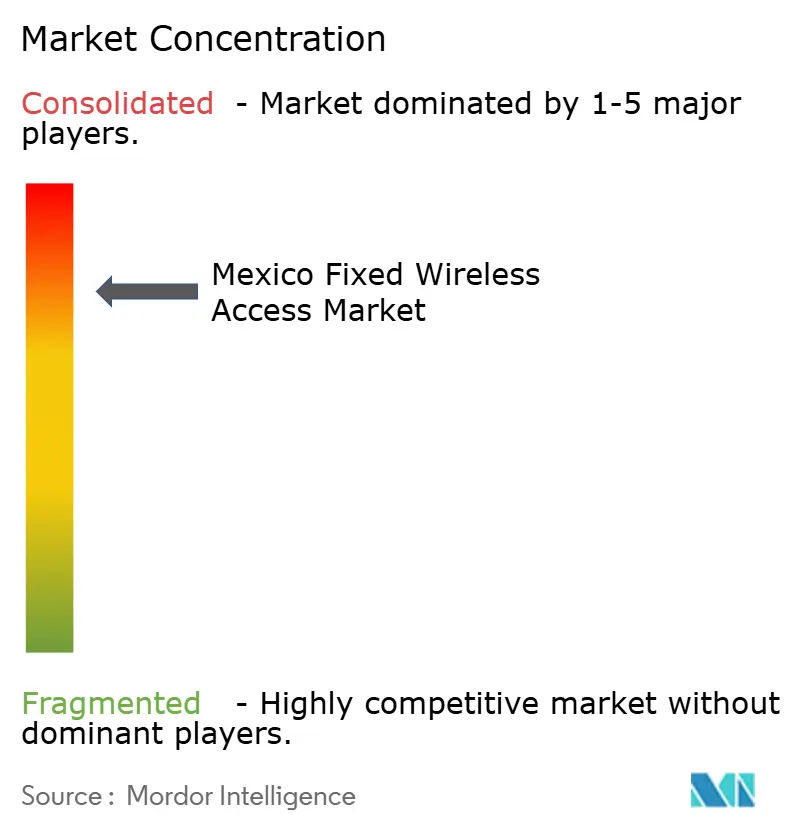
| Market Concentration | High |
Major Players *Disclaimer: Major Players sorted in no particular order Image © Mordor Intelligence. Reuse requires attribution under CC BY 4.0. | |
Mexico Fixed Wireless Access Market Analysis by Mordor Intelligence
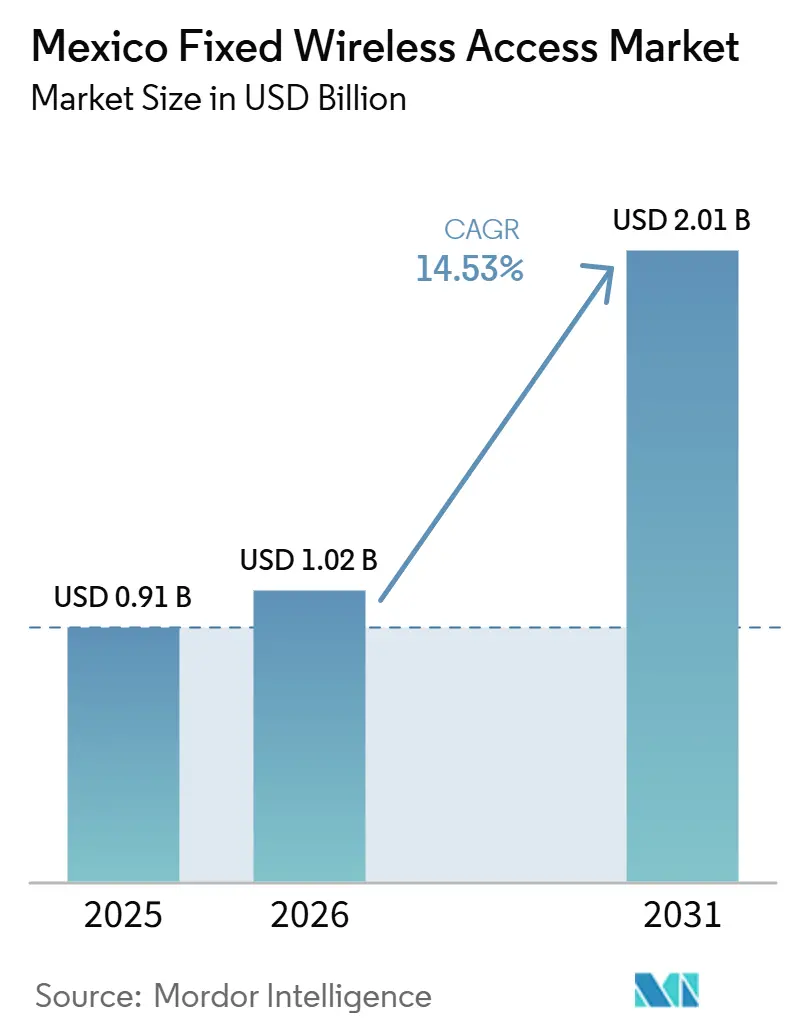
The Mexico fixed wireless access market size is projected to expand from USD 0.91 billion in 2025 and USD 1.02 billion in 2026 to USD 2.01 billion by 2031, registering a CAGR of 14.53% between 2026 to 2031. Growth is being shaped by a large household broadband gap, leaving 21.7% of homes without fixed broadband service, which gives wireless access a practical role in areas where fiber expansion remains difficult due to current economic conditions. The market is also benefiting from a stronger mobile network base, with Telcel's 5G footprint already broad enough to support FWA offers without the same civil works burden as last-mile fiber builds. Mexico's regulatory reset is also changing the cost structure for rural deployment, as spectrum policy is moving toward coverage-linked incentives that can widen participation beyond the largest operators. At the same time, CFE's control of Altán Redes provides the market with a wholesale network option that can support new rural service models and lower entry barriers in less-served territories. The main limits remain spectrum shortages, dense urban signal constraints, and price pressure from fiber and mobile bundles, while ownership changes among major telecom operators could reshape competitive positions over the next few years.
Key Report Takeaways
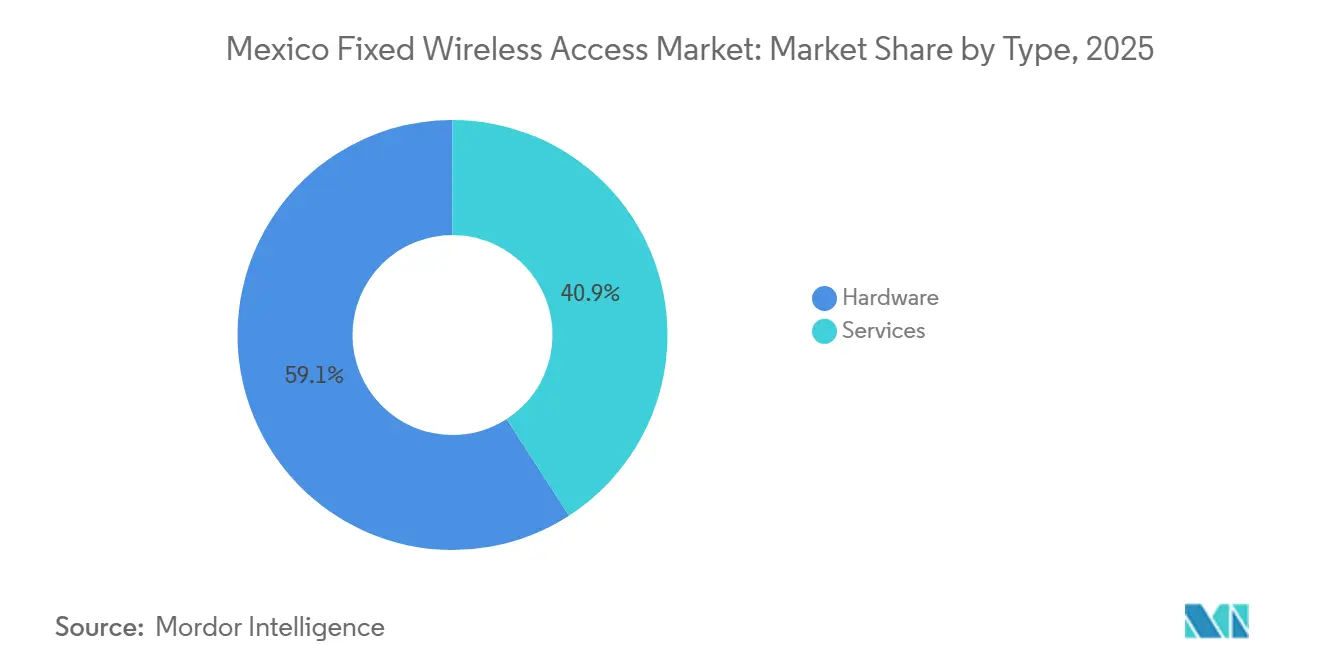
- By type, hardware held 59.12% share of the Mexico fixed wireless access market in 2025, while services are projected to expand at 15.11% CAGR through 2031.
- By application, residential accounted for 66.12% of revenue in 2025, while government and public safety are projected to record the fastest growth at a 16.21% CAGR through 2031.
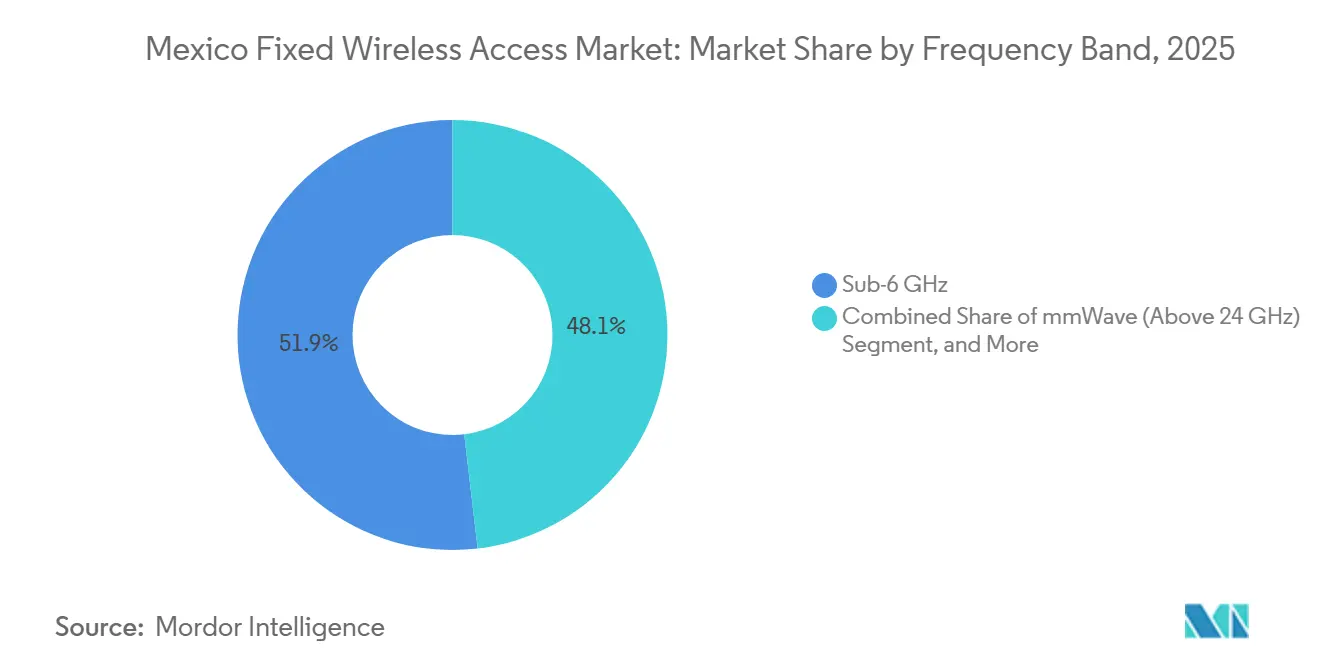
- By frequency band, sub-6 GHz accounted for 51.87% of the market share in 2025, while mmWave is projected to grow at a 15.98% CAGR through 2031.
- By deployment mode, indoor CPE accounted for 60.98% of the market in 2025, while self-install window-mount CPE is projected to expand at a 16.11% CAGR through 2031.
Note: Market size and forecast figures in this report are generated using Mordor Intelligence’s proprietary estimation framework, updated with the latest available data and insights as of January 2026.
Mexico Fixed Wireless Access Market Trends and Insights
Drivers Impact Analysis*
| DRIVER | (~) % IMPACT ON CAGR FORECAST | GEOGRAPHIC RELEVANCE | IMPACT TIMELINE |
|---|---|---|---|
| 5G Network Expansion Supporting FWA Capacity Growth | +4.2% | National, strongest in Baja California, Tamaulipas, Chihuahua, and major metro centers | Short term (≤ 2 years) |
| Fiber Rollout Gaps Across Underserved Municipalities | +3.2% | Chiapas, Oaxaca, Guerrero, Veracruz, and inland semi-urban corridors | Medium term (2-4 years) |
| Fixed Broadband Replacement Demand in Low Penetration Areas | +2.4% | Rural and peri-urban zones, with early gains in Bajío and Pacific coastal municipalities | Medium term (2-4 years) |
| Enterprise Demand for Rapid-Deploy Backup Connectivity | +1.8% | Bajío manufacturing corridor, Veracruz port complex, Tijuana, and Juárez | Short term (≤ 2 years) |
| Lower Time-To-Service Than Fiber for New Subscribers | +1.1% | National, especially in newly urbanizing areas with limited duct infrastructure | Short term (≤ 2 years) |
| Self-Install CPE Improving Acquisition Economics | +0.7% | National, with early gains in Guadalajara, Monterrey, and suburban Mexico City | Medium term (2-4 years) |
| Source: Mordor Intelligence | |||
5G Network Expansion Supporting FWA Capacity Growth
Telcel's 5G rollout reached 60% of Mexico's population by the end of 2025, giving operators a broad wireless base to launch new home and business access offers without waiting for new last-mile construction. Existing licensed spectrum in the 3.5 GHz and 2.5 GHz bands can be turned into FWA capacity with much lower build complexity than a comparable fiber rollout, enabling faster service expansion in the Mexico fixed wireless access market. América Móvil said it will maintain annual global capex at USD 7 billion from 2026 through 2028, supporting ongoing densification and service-layer monetization in Mexico. Altán Redes also received authorization in June 2026 to trial 5G in Mexico City, Jalisco, Colima, and Yucatán using the 29 GHz band, which creates an early test case for higher-capacity wireless access in the country. [1]Redacción El Economista, “Altán Probará la Tecnología 5G en CDMX, Jalisco, Colima y Yucatán con 360 MHz de Frecuencias,” El Economista, eleconomista.com.mx This combination of network scale, available spectrum, and ongoing investment shortens the time needed for the Mexico fixed wireless access market to expand beyond basic residential use and into enterprise and public connectivity.
Fiber Rollout Gaps Across Underserved Municipalities
Mexico's 4 major fixed-line operators invested USD 12.4 billion in fiber infrastructure between 2021 and 2025, but most of that build stayed concentrated in commercially dense urban and suburban corridors. ENDUTIH 2025 showed that rural internet access reached 75.2% in 2025, yet Chiapas, Oaxaca, Guerrero, and Veracruz remained 29 percentage points below the national mean, indicating a persistent access divide.[2]Instituto Nacional de Estadística y Geografía, “Resultados de la Encuesta Nacional sobre Disponibilidad y Uso de Tecnologías de la Información en los Hogares (ENDUTIH) 2025,” SNIEG, snieg.mx That leaves a large group of municipalities where fiber still does not meet return thresholds and where households have few fixed alternatives. CFE's network reached 101,111 localities and 2,452 municipalities by the end of 2025, supported by 22,896.97 km of fiber and 5,229 towers, which shows the scale needed to even approach broad territorial coverage. In those territories, the Mexico fixed wireless access market faces much less direct overlap from fiber, which supports a stronger role for sub-6 GHz FWA in last-mile delivery.
Fixed Broadband Replacement Demand in Low Penetration Areas
Mexico had 28.3 million fixed broadband accesses in mid-2025, led by Telmex with 40.8%, followed by Izzi with 19.8%, Totalplay with 19.3%, and Megacable with 18.6%. Even with 78.3% of households connected to the internet by some technology in 2025, the remaining 21.7% still represented a large underserved pool for the Mexico fixed wireless access market. FWA fits this group because service activation is faster, installation is lighter, and entry-level performance can compete with basic fiber offers where cabling is absent or delayed. ENDUTIH 2025 also showed that 44.7% of households lacked a computer, which means home access often centers on smartphones rather than a full fixed-device setup. That device pattern supports a shared home gateway model and broadens demand in the Mexico fixed wireless access market beyond a simple physical coverage problem.
Enterprise Demand for Rapid-Deploy Backup Connectivity
Manufacturing and logistics zones in Bajío, Veracruz, Tijuana, and Juárez need backup links that can be activated in hours rather than weeks, which gives FWA a clear operating advantage in site continuity planning. For many plants and distributed facilities, the cost of a single outage can exceed a year of wireless access fees, so buyers focus on uptime and failover rather than headline bandwidth alone. Inseego's FX4200 series router became commercially available in February 2026 with dual-SIM, dual-standby capability, Wi-Fi 7, and network slicing, which fits the needs of public-sector and enterprise sites with distributed operations. Veea launched SecureConnect in Mexico in March 2026 as a 5G FWA gateway with built-in cybersecurity and remote monitoring, directly targeting enterprise and SMB users who do not maintain large in-house IT teams. These product moves show that the Mexico fixed wireless access market is moving into higher-value business use cases rather than remaining limited to household access.[3]Veea Inc., “Veea Platform Solution to Address Cybersecurity Challenges Nationwide for Businesses in Mexico,” Telecom Ramblings, telecomramblings.com
Restraints Impact Analysis*
| RESTRAINT | (~) % IMPACT ON CAGR FORECAST | GEOGRAPHIC RELEVANCE | IMPACT TIMELINE |
|---|---|---|---|
| Spectrum Availability and Assignment Constraints | -2.8% | National, with acute pressure in Mexico City, Guadalajara, and Monterrey metro areas | Medium term (2-4 years) |
| Signal Degradation and Capacity Limits in Dense Urban Zones | -1.6% | Mexico City, Guadalajara, Monterrey, and dense border-city cores | Short term (≤ 2 years) |
| Price Competition from Mobile Broadband and Fiber | -1.0% | National, strongest in mid-income urban and suburban markets | Short term (≤ 2 years) |
| Site-Level Line-Of-Sight and Installation Constraints | -0.4% | Dense urban cores and high-rise building clusters | Medium term (2-4 years) |
| Source: Mordor Intelligence | |||
Spectrum Availability and Assignment Constraints
Mexico continues to operate with less IMT spectrum than the level deemed necessary for broad 5G expansion, keeping capacity tight in high-traffic areas and limiting the room for FWA scaling.[4]Agencia de Transformación Digital y Telecomunicaciones and Comisión Reguladora de Telecomunicaciones, “Programa Nacional de Espectro Radioeléctrico 2026-2030,” GMA Labs, gmalabs.com The transition from the IFT to the CRT after the July 2025 reform introduced a period of uncertainty while operators waited for clearer award and enforcement procedures. The 2026 annual band program identified commercial opportunities across 600 MHz, 800 MHz, 1.9 GHz, and 2.5 GHz, but Mexican spectrum processes have often extended well beyond their initial publication window. The rural coverage discount mechanism can improve service reach, but it also asks bidders to accept build obligations that smaller operators may not be able to finance at scale. That can leave new capacity concentrated with larger operators and slow the rate at which fresh entrants expand in the Mexico fixed wireless access market.
Signal Degradation and Capacity Limits in Dense Urban Zones
Dense areas of Mexico City, Guadalajara, and Monterrey still expose the main technical limit of FWA, as building losses, interference, and shared sector capacity all reduce consistent indoor performance. mmWave can improve throughput, but its short propagation range requires much denser site grids, making deployment economics harder outside high-value districts. This creates a difficult tradeoff because rural and suburban areas often offer a better technical fit, while dense cities can offer the best revenue per subscriber. Outdoor and window-mount devices improve signal quality by reducing indoor attenuation, but they do not remove the sector-capacity ceiling on busy cells. Inseego's FW3000 outdoor CPE, launched in January 2025 with download speeds up to 5 Gbps, shows how vendors are addressing signal gain even though the shared-capacity limit remains in place.
*Our forecasts treat driver/restraint impacts as directional, not additive. The impact forecasts reflect baseline growth, mix effects, and variable interactions.
Segment Analysis
By Type: Hardware Scale Supports Current Revenue While Services Deepen Value Capture
Hardware is expected to account for 59.12% of the Mexico fixed wireless access market share in 2025, while services are projected to grow at a CAGR of 15.11% from 2026 to 2031. Hardware continues to lead current revenue because operator-subsidized CPE bundles remain central to customer acquisition, and network rollouts in underserved municipalities still require a sizable device base. The services layer is gaining importance as managed connectivity contracts, SLA-backed enterprise agreements, and multi-year public broadband programs generate recurring revenue instead of one-time equipment sales. Qualcomm's Dragonwing FWA Gen 3 and Gen 4 Elite platforms are also improving device economics by integrating modem, CPU, and Wi-Fi functions into a more consolidated chipset design, shifting value toward service delivery over time.
Within hardware, CPE remains the core sub-segment across indoor, outdoor, and window-mount formats, as the Mexico fixed wireless access market still depends on practical last-mile installation models that suit different building conditions. Telcel's residential FWA pricing of MXN 399 per month (USD 22) to MXN 1,399 per month (USD 77) shows how operators spread device costs across 24-month contracts rather than requiring large upfront payments. This approach matters in lower-income and semi-urban areas, where hardware affordability directly affects adoption and churn. CRT homologation requirements also create a recurring device refresh cycle, as operators need certified equipment that complies with current technical rules and spectrum-use conditions. Access units, such as femtocells and picocells, remain smaller in revenue terms, but they continue to support densification in industrial campuses and high-demand commercial districts where macro capacity alone is insufficient.


By Application: Residential Volume Leads While Government Programs Support The Fastest Growth
Residential connections are expected to account for 66.12% of application revenue in 2025, making households the main demand base of the Mexico fixed wireless access market. The 21.7% household broadband gap identified in ENDUTIH 2025 continues to define the most immediate demand pool, especially in municipalities where fiber is unavailable or where households still rely only on mobile data for home use. Commercial demand follows the residential base, as SMBs, retail branches, and office locations value same-day-to-same-week activation over the longer timelines required for new fiber provisioning. Industrial demand remains smaller in volume, but adoption is rising in Bajío, Guadalajara, Veracruz, and Manzanillo for machine-to-machine links, video surveillance, and backup circuit use.
Government and public safety applications are projected to grow at a CAGR of 16.21% from 2026 to 2031, making this the fastest-growing application area in the Mexico fixed wireless access market. The Connectivity Program in Public Sites 2026 targets 27,749 public institutions, including 20,188 tele-schools and 7,561 IMSS Bienestar clinics, with CFE serving as the delivery arm for the access model described in the draft. The same program states a goal of connecting 640,000 additional inhabitants annually through those public sites. Mexico's National Connectivity Plan 2026-2030 also targets increasing internet coverage from 94% to 98% by 2030, keeping wireless last-mile solutions central to public expansion efforts. These contracts are commercially attractive because they usually offer multi-year durations, defined capacity requirements, and more predictable payment structures than many purely residential accounts.
By Frequency Band: Sub-6 GHz Carries The Broadest Load While MmWave Builds High-Capacity Niches
mmWave is projected to grow at a CAGR of 15.98% from 2026 to 2031, reflecting rising interest in high-throughput industrial connectivity and the adoption of dense urban small cells. Altán Redes is expected to receive CRT authorization in June 2026 to trial 320 MHz in the 29 GHz band across 4 states, marking the strongest current validation event for mmWave FWA on a Mexican wholesale network. Nokia's field-tested mmWave FWA receiver, built with AI-assisted beam steering and stronger antenna gain, addresses one of the format's main limitations by reducing installation difficulty in challenging signal environments. Mexico's structured release path in the 26 GHz and 28 GHz ranges also keeps industrial and campus use cases in focus as operators plan beyond current sub-6 GHz capacity.
Sub-6 GHz is expected to retain 51.87% of the Mexico fixed wireless access market share in 2025, as it remains the broadest coverage layer for last-mile wireless service. This band serves as the commercial backbone of the Mexico fixed wireless access market because it can cover several kilometers per sector and tolerate more building loss than higher frequencies. Its appeal is strongest in the 2,452 municipalities where existing macro infrastructure already provides a usable base for rapid service launch. Shared and unlicensed spectrum models are also gaining attention because they can support private industrial deployments and campus networks without requiring the purchase of full-band licensed spectrum. This band structure offers greater flexibility for manufacturers and regional operators that need localized coverage without assuming the cost burden of national spectrum ownership.

By Deployment Mode: Indoor CPE Dominates Today, While Window-Mount Devices Improve The Cost Case
Indoor CPE is expected to account for 60.98% of deployment-mode revenue in 2025, making it the default installation format across the Mexico fixed wireless access market. Its lead comes from self-install economics, as plug-and-play setup eliminates truck-roll costs and enables same-day activation at the household level. Operator-bundled routers, including ZTE-produced units and the Senwa RT5 model used by Telcel in the draft, simplify setup and reduce the technical barrier for first-time users. This matters in a market where high upfront installation friction can quickly increase churn risk and limit adoption in lower-income households.
Outdoor CPE delivers stronger raw signal performance, but it requires professional installation and appointment scheduling, which weakens part of FWA's convenience advantage over fiber. Self-install window-mount CPE is projected to grow at a CAGR of 16.11% from 2026 to 2031 because it captures much of the signal benefit of outdoor placement while preserving easy activation. Solace Power and NetComm Wireless announced a wirelessly powered window-mounted outdoor 5G CPE in December 2025, removing the power cable as another installation barrier and moving the device into operator evaluations during 2026. Vantiva's Hawk 5G home gateway also cited field results showing that a near-window form factor could replace outdoor units while maintaining comparable signal quality. As these form factors mature through 2027 and 2028, they should improve subscriber-acquisition economics in rural and semi-urban areas, where installation costs often determine whether a deployment is commercially viable.
Geography Analysis
Baja California, Tamaulipas, Nuevo León, and Chihuahua form the most mature zone of the Mexico fixed wireless access market, as network readiness is already strong in the north. Telcel's guaranteed 5G coverage is expected to exceed 70% of the population in Baja California, Tamaulipas, and Quintana Roo by 2025, supporting broader service packaging in these areas. In these states, FWA competes less on basic access and more on convenience, backup connectivity, and faster activation, as fiber competition is already dense. Mexico City's metropolitan area, with a draft population of 21 million, still has strong demand potential. However, indoor signal conditions in mid-rise buildings make window-mounted and outdoor CPE more important for reliable subscriber conversion.
Chiapas, Oaxaca, Guerrero, and Veracruz remain the most structurally open territories for the Mexico fixed wireless access market, as internet access levels there stayed 29 percentage points below the national mean in the draft. CFE's National Access and Aggregation Network provides this region with a basic transmission and tower backbone spanning 22,896.97 km of fiber, 5,229 towers, and a reach across 101,111 localities. Nokia and MX Fiber are also expected to complete a 1,800 km Flex-Grid DWDM optical backbone in southeastern Mexico during 2025, strengthening transport capacity along the Interoceanic Corridor and Maya Train routes. ATDT's public-site program is expected to add a government-backed demand layer by targeting 27,749 institutions for connection in 2026, where fiber is unavailable at the last mile. This combination makes the south and southeast the clearest fit for last-mile FWA deployment in the current planning cycle.
Jalisco, Guanajuato, Querétaro, and Puebla represent the enterprise center of the Mexico fixed wireless access market because they sit inside the Bajío industrial corridor and around Guadalajara's technology cluster. These states occupy a middle position where 4G coverage is already mature, but fiber penetration remains uneven in industrial zones and greenfield factory sites. Altán Redes included Jalisco in its June 2026 authorized 5G trials, while América Móvil also announced a USD 5 billion investment commitment for Mexico in 2026. These signals support a setting where backup access, fast site turn-up, and peri-urban extension are likely to remain the main regional demand themes through the forecast period.
Competitive Landscape
The Mexico fixed wireless access market operates on a service layer that remains open to multiple providers, but the underlying infrastructure base is far more concentrated. Telcel dominates the mobile access layer in terms of 5G rollout, while Telmex is expected to lead fixed broadband with 40.8% of accesses in mid-2025, followed by Izzi at 19.8%, Totalplay at 19.3%, and Megacable at 18.6%. This structure means major incumbents already control the customer relationships, backhaul routes, and device distribution channels needed to expand FWA alongside fiber. The vendor layer is also concentrated, as Nokia, Ericsson, Huawei, and ZTE anchor network equipment supply, while Qualcomm's Dragonwing platform supports CPE across several brands.
Strategic positioning in the Mexico fixed wireless access market is now moving in three visible directions. One path is enterprise-managed FWA with integrated security, which Veea targeted with its March 2026 SecureConnect launch in Mexico. Another path is regional and proximity operator participation, where a coverage-linked spectrum model could allow smaller operators to build economically in underserved zones if they meet deployment conditions. A third path is wholesale access through the Altán-CFE network, following CFE's January 2025 approval of its ownership of Altán, which can lower entry barriers for resellers without radio infrastructure. Telefónica's April 2026 agreement to sell Movistar Mexico to the Oxio-led consortium adds another strategic shift, as a cloud-native operating model could increase price pressure in secondary cities from 2027 onward.
Equipment specialists still have room in targeted parts of the Mexico fixed wireless access market, despite concentration at the top. Cambium Networks, Airspan Networks, and Tarana Wireless remain relevant in rural and semi-urban deployments, where point-to-multipoint economics can outperform standard cellular FWA models in lower-density settings. Nokia's 2025 backbone deployment for MX Fiber in southeastern Mexico also shows how infrastructure suppliers can use transport contracts to position for later radio and CPE opportunities in the same corridor. Competitive outcomes will therefore depend not only on subscriber pricing but also on who controls backhaul, who can pass device costs through monthly bundles, and who can use wholesale or shared spectrum structures more effectively.
Mexico Fixed Wireless Access Industry Leaders
América Móvil, S.A.B. de C.V.
Telefónica, S.A.
Ericsson AB
ZTE Corporation
Viasat, Inc.
- *Disclaimer: Major Players sorted in no particular order

Recent Industry Developments
- July 2026: Mexico's CRT and ATDT launched the country's first 5G industrial spectrum tender process, with active debate among operators and industry groups on bandwidth allocation widths and productive-pole geographic designations. The tender outcome will determine mmWave FWA deployment viability in manufacturing clusters through 2028 and shape the spectrum pipeline for small-cell densification in industrial zones across the Bajío corridor and northern border states.
- June 2026: The CRT authorized Altán Redes to conduct 5G technology trials across Mexico City, Jalisco, Colima, and Yucatán, deploying 12 base stations with 320 MHz in the 29 GHz band and 2.5 GHz spectrum for a two-year experimental window through May 2028. The authorization is the first structured mmWave FWA trial on a Mexican wholesale network and could inform Altán's product roadmap ahead of the 2028 5G spectrum auction.
- May 2026: Carlos Slim announced that Grupo Carso and América Móvil will invest USD 5 billion in Mexico in 2026, as part of a Plan México-aligned investment agenda. América Móvil separately guided at its May investor day that its annual global capex would be USD 7 billion from 2026 through 2028, with 5G densification and fixed broadband expansion, including FWA service layers, among its stated capital priorities.
- April 2026: Telefónica agreed to sell Movistar Mexico to a U.S.-led consortium of OXIO Inc. and Newfoundland Capital Management for USD 450 million. The transaction, subject to CRT regulatory approval, transfers more than 25 million subscribers to a new owner that plans to apply a cloud-native telecom-as-a-service operating model, a strategic pivot that introduces a software-defined competitive variable into Mexico's operator landscape.


Mexico Fixed Wireless Access Market Report Scope
The Mexico Fixed Wireless Access Market Report is Segmented by Type (Hardware [Consumer Premise Equipment and Access Units] and Services), Application (Residential, Commercial, Industrial, and Government and Public Safety), Frequency Band (Sub-6 GHz, mmWave (Above 24 GHz), and Unlicensed/Shared CBRS), and Deployment Mode (Indoor CPE, Outdoor CPE, and Self-Install Window-Mount CPE). The Market Forecasts are Provided in Terms of Value (USD).
| Hardware | Consumer Premise Equipment (CPE) |
| Access Units (Femto and Picocells) | |
| Services |
| Residential |
| Commercial |
| Industrial |
| Government and Public Safety |
| Sub-6 GHz |
| mmWave (Above 24 GHz) |
| Unlicensed / Shared CBRS |
| Indoor CPE |
| Outdoor CPE |
| Self-Install Window-Mount CPE |
| By Type | Hardware | Consumer Premise Equipment (CPE) |
| Access Units (Femto and Picocells) | ||
| Services | ||
| By Application | Residential | |
| Commercial | ||
| Industrial | ||
| Government and Public Safety | ||
| By Frequency Band | Sub-6 GHz | |
| mmWave (Above 24 GHz) | ||
| Unlicensed / Shared CBRS | ||
| By Deployment Mode | Indoor CPE | |
| Outdoor CPE | ||
| Self-Install Window-Mount CPE |


Key Questions Answered in the Report
What is the size outlook for the Mexico fixed wireless access market?
The Mexico fixed wireless access market size is projected to rise from USD 0.91 billion in 2025 and USD 1.02 billion in 2026 to USD 2.01 billion by 2031, at a 14.53% CAGR.
What is driving demand for fixed wireless access in Mexico?
The main demand drivers are the 21.7% household broadband gap, broader 5G coverage, and the need for faster deployment in municipalities where fiber is still uneconomic.
Which application area is growing the fastest in Mexico?
Government and public safety are projected to grow the fastest at 16.21% CAGR through 2031, supported by public-site connectivity programs and broader national coverage targets.
Which frequency band is most important today?
Sub-6 GHz is the main commercial layer today, with 51.87% share in 2025, because it offers wider coverage and better economics for underserved locations.
Why does indoor CPE lead deployment in Mexico?
Indoor CPE held 60.98% share in 2025 because it supports self-installation, lowers activation cost, and helps operators avoid truck-roll expenses.
How is competition shaping up among operators and vendors?
Competition is shaped by incumbent control of network assets, backhaul, and customer reach, while newer openings are appearing in enterprise FWA, regional operator models, and wholesale access through the Altán-CFE platform.
Page last updated on:





