
Mexico Enterprise Content Management (ECM) Market Size and Share
Market Overview
| Study Period | 2020 - 2031 |
|---|---|
| Forecast Data Period | 2026 - 2031 |
| Base Year Market Size (2025) | USD 0.86 Billion |
| Market Size (2026) | USD 0.98 Billion |
| Market Size (2031) | USD 1.95 Billion |
| Growth Rate (2026 - 2031) | 14.75% CAGR |
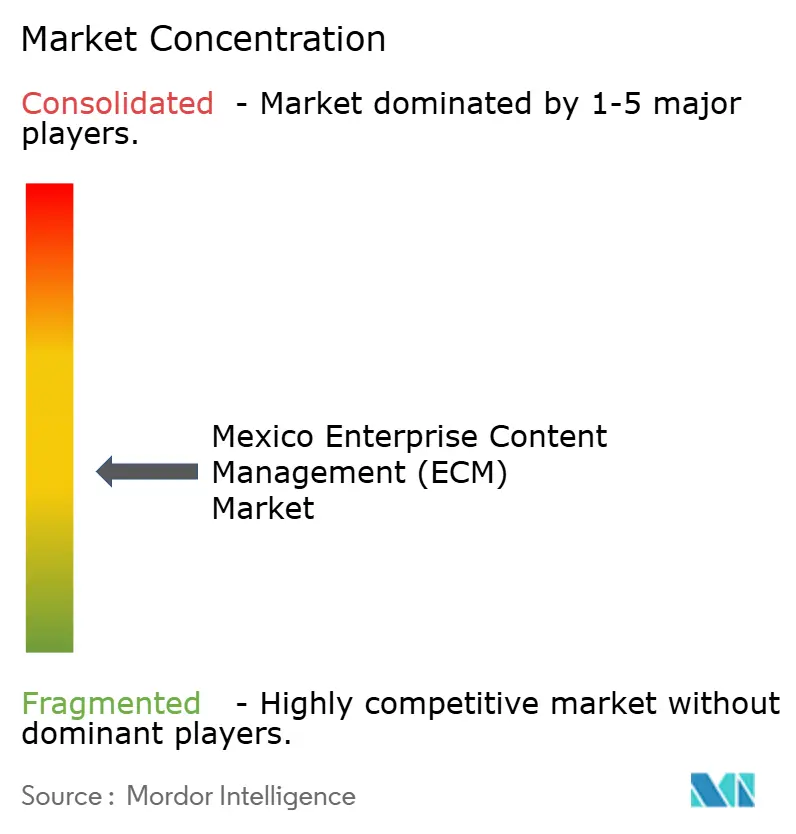
| Market Concentration | Medium |
Major Players *Disclaimer: Major Players sorted in no particular order Image © Mordor Intelligence. Reuse requires attribution under CC BY 4.0. | |
Mexico Enterprise Content Management (ECM) Market Analysis by Mordor Intelligence
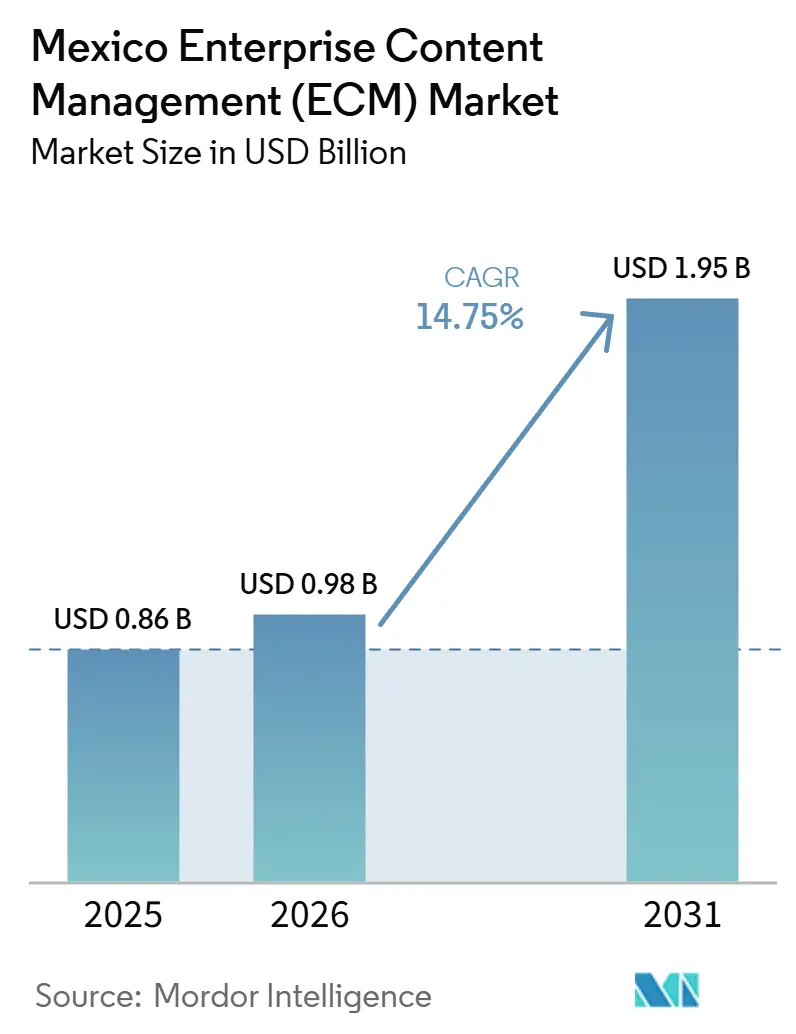
The Mexico Enterprise Content Management (ECM) Market was valued at USD 0.86 billion in 2025 and is forecast to reach USD 1.95 billion by 2031, expanding at a CAGR of 14.75% through 2026 to 2031. The Mexico Enterprise Content Management (ECM) Market is being shaped by a compliance environment that makes structured document control essential for taxable entities, financial institutions, and organizations that handle sensitive personal records. Government digitization programs are also raising expectations for faster retrieval, better traceability, and stronger audit support, which is moving enterprise buyers beyond basic storage tools. Cloud adoption is expanding the addressable market for the Mexico Enterprise Content Management (ECM) Market, as SaaS delivery lowers upfront cost barriers and makes advanced capabilities more accessible to mid-sized organizations. Demand is also shifting toward AI-assisted classification, workflow automation, and integrated compliance features, which is changing how vendors compete across the Mexico Enterprise Content Management (ECM) Market. This combination of regulation, digital service expansion, and platform-led competition provides the Mexico Enterprise Content Management (ECM) Market with a durable growth base throughout the forecast period.
Key Report Takeaways
- By solution type, document management accounted for 26.14% of revenue in Mexico's Enterprise Content Management (ECM) Market in 2025, while workflow and business process management is projected to expand at a 17.42% CAGR through 2031.
- By deployment mode, cloud accounted for 72.83% of the Mexico Enterprise Content Management (ECM) Market in 2025 and is expected to grow at a 16.94% CAGR through 2031.
- By enterprise size, large enterprises represented 57.62% of revenue in 2025, while SMEs are projected to record the fastest growth at a 17.18% CAGR through 2031.
- By end-user industry, BFSI captured 22.41% share in 2025, while healthcare is expected to expand at a 17.63% CAGR through 2031.
Note: Market size and forecast figures in this report are generated using Mordor Intelligence’s proprietary estimation framework, updated with the latest available data and insights as of January 2026.
Mexico Enterprise Content Management (ECM) Market Trends and Insights
Drivers Impact Analysis*
| Driver | (~) % Impact on CAGR Forecast | Geographic Relevance | Impact Timeline |
|---|---|---|---|
| Accelerating Digital Document Standardization Across Regulated Industries | +3.5% | National, with concentrated gains across CDMX, Monterrey, and Guadalajara | Medium term (2-4 years) |
| Rapid Shift Toward Cloud-First Content Platforms | +3.2% | Global, core gains in Mexico's BFSI, manufacturing, and SME sectors | Short term (≤ 2 years) |
| Growing Need for Audit-Ready Records and Traceability | +2.8% | National, strongest in BFSI, government, and healthcare verticals | Medium term (2-4 years) |
| Rising Demand for AI-Assisted Metadata Capture and Content Classification | +2.3% | Global, accelerating in North America and Mexico's technology corridors | Short term (≤ 2 years) |
| Expansion of Citizen-Facing and Customer-Facing Digital Workflows | +1.9% | National, primarily driven by federal government and financial institutions | Medium term (2-4 years) |
| Hybrid Work and Distributed Collaboration Requirements | +1.5% | Global, with spillover into Mexico's near-shoring service centers | Short term (≤ 2 years) |
| Source: Mordor Intelligence | |||
Accelerating Digital Document Standardization Across Regulated Industries
Mexico’s digital compliance framework is creating direct demand for governance-grade content systems across the Mexico Enterprise Content Management (ECM) Market. The SAT’s CFDI 4.0 system requires electronic invoices to be generated, validated, and archived in their original XML format for 5 years, making compliant document retention a daily operating requirement for taxable entities.[1] Laserfiche, “Laserfiche Introduces AI Agents, The Future of Intelligent Content Management,” Business Wire, businesswire.com NOM-151-SCFI-2016 adds a technical preservation layer by requiring timestamping, integrity controls, and advanced electronic signatures for digital records intended for legal or fiscal review. The CNBV’s June 2026 reform on electronic signatures for banking credit files is compressing upgrade timelines inside financial institutions that need compliant repositories and verifiable workflow history. This framework raises the minimum functional threshold for the Mexico Enterprise Content Management (ECM) Market, as basic storage tools do not meet the same legal, retrieval, and audit standards that regulated buyers now require.
Rapid Shift Toward Cloud-First Content Platforms
Cloud adoption is widening demand across the Mexico Enterprise Content Management (ECM) Market, as enterprises move from infrastructure ownership toward subscription-based deployment and faster feature updates. Cloud usage among Mexican enterprises grew by more than 25% annually through 2025, and 50% of large organizations used cloud computing extensively during that period. That shift is important because AI-enabled content search, metadata extraction, and process automation are easier to scale in cloud environments than in isolated on-premises setups. Near-shoring adds another layer of demand because cross-border teams need content systems that support distributed work, shared workflows, and faster collaboration across business units. At the same time, data localization rules in financial technology are pushing some buyers toward hybrid models, which is why vendors are designing cloud offerings with data-residency options that meet local compliance requirements.
Growing Need for Audit-Ready Records And Traceability
The enforcement environment is making audit-ready content governance more important across the Mexico Enterprise Content Management (ECM) Market. The CNBV imposed fines totaling MXN 185 million on financial sector institutions in 2025 for compliance failures related to content governance and audit-trail gaps, resulting in weak traceability and posing a direct financial risk. Fintech Law 2.0 is reducing dependence on manual and email-based reporting by shifting regulatory exchanges toward certified digital channels and advanced electronic signatures. The SAT-CNBV collaboration agreement, signed in July 2025, extends the use of e.firma across financial regulatory processes, increasing the need for full document history and signature validation within enterprise repositories. This need also extends to manufacturing, as IATF 16949-certified automotive supplier sites must maintain structured quality records that support version control, access discipline, and retrieval during inspections.[2]NSF, “NSF Ignites an Interest in Quality Management Certifications at Automechanika Mexico,” NSF, nsf.org
Rising Demand for AI-Assisted Metadata Capture And Content Classification
AI-assisted content handling is becoming increasingly relevant in the Mexico Enterprise Content Management (ECM) Market as large repositories reach a scale where manual indexing is no longer practical. IMSS maintained 53.7 million active clinical records and 722 million medical notes in its digital clinical record system, and it is developing an AI assistant to help physicians retrieve patient information during consultations. This institutional example matters because retrieval quality and classification discipline become central when document volumes reach tens of millions of records. Laserfiche introduced AI Agents in April 2026 to organize content and apply metadata through natural language prompts inside a governed framework. Box also introduced Box Extract in January 2026 to turn unstructured content into searchable metadata, which shows how vendors are embedding automated classification into mainstream enterprise workflows. For regulated buyers, these tools help reduce classification errors at ingestion and improve the consistency of retention, search, and audit preparation across the Mexico Enterprise Content Management (ECM) Market.[3]Box, “Box Announces General Availability of Box Extract to Transform Enterprise Content into Actionable Data,” Business Wire, businesswire.com
Restraints Impact Analysis*
| Restraint | (~) % Impact on CAGR Forecast | Geographic Relevance | Impact Timeline |
|---|---|---|---|
| Legacy Integration Complexity in Large Mexican Enterprises | -2.5% | National, most pronounced in legacy financial institutions and large manufacturers | Medium term (2-4 years) |
| Data Residency And Compliance Concerns for Sensitive Content | -2.0% | National, primarily affecting BFSI and regulated industries with cross-border data flows | Medium term (2-4 years) |
| Budget Pressure from Multi-Year Enterprise Software Modernization Cycles | -1.8% | National, affecting mid-to-large enterprises undergoing ERP and infrastructure overhauls | Long term (≥ 4 years) |
| Limited Internal ECM Skills in Mid-Market Organizations | -1.5% | National, concentrated in mid-market and SME segments outside major metropolitan areas | Medium term (2-4 years) |
| Source: Mordor Intelligence | |||
Legacy Integration Complexity in Large Mexican Enterprises
Legacy platforms remain a real drag on deployment speed in the Mexico Enterprise Content Management (ECM) Market. More than 60% of the installed base is served by non-world-class vendors or by older on-premises systems, indicating how fragmented past procurement has been across departments and business units. Many large enterprises built their repositories before current fiscal and signature rules became central, so older systems were designed for storage rather than traceability, validation, and workflow compliance. As a result, migration now requires reworking content models, document dependencies, retention controls, and process logic rather than simply moving files into a newer platform. Federation strategies can reduce disruption by leaving some content in place, but they often extend integration timelines and limit the full value of AI-led automation across the Mexico Enterprise Content Management (ECM) Market.
Data Residency and Compliance Concerns for Sensitive Content
Data residency rules are adding complexity to cloud deployment decisions across the Mexico Enterprise Content Management (ECM) Market. Under the Fintech Law, financial technology institutions must keep transaction and accounting records within Mexico, and larger institutions may need a secondary infrastructure provider in another jurisdiction after certain thresholds are met.[4]Information Technology and Innovation Foundation, “Mexico’s Cloud Service Restrictions,” ITIF, itif.org The CNBV also adds an authorization layer to cloud service usage, which lengthens decision cycles for regulated buyers that might otherwise move quickly toward full cloud adoption. Healthcare has its own burden because health data processing requires explicit consent, while NOM-024-SSA3-2012 shapes the technical requirements for electronic health record systems. These overlapping requirements increase implementation cost and slow standardization for organizations that manage financial, health, and personal data inside the same enterprise architecture.
*Our forecasts treat driver/restraint impacts as directional, not additive. The impact forecasts reflect baseline growth, mix effects, and variable interactions.
Segment Analysis
By Solution Type: Workflow Automation Reshapes Content Priorities
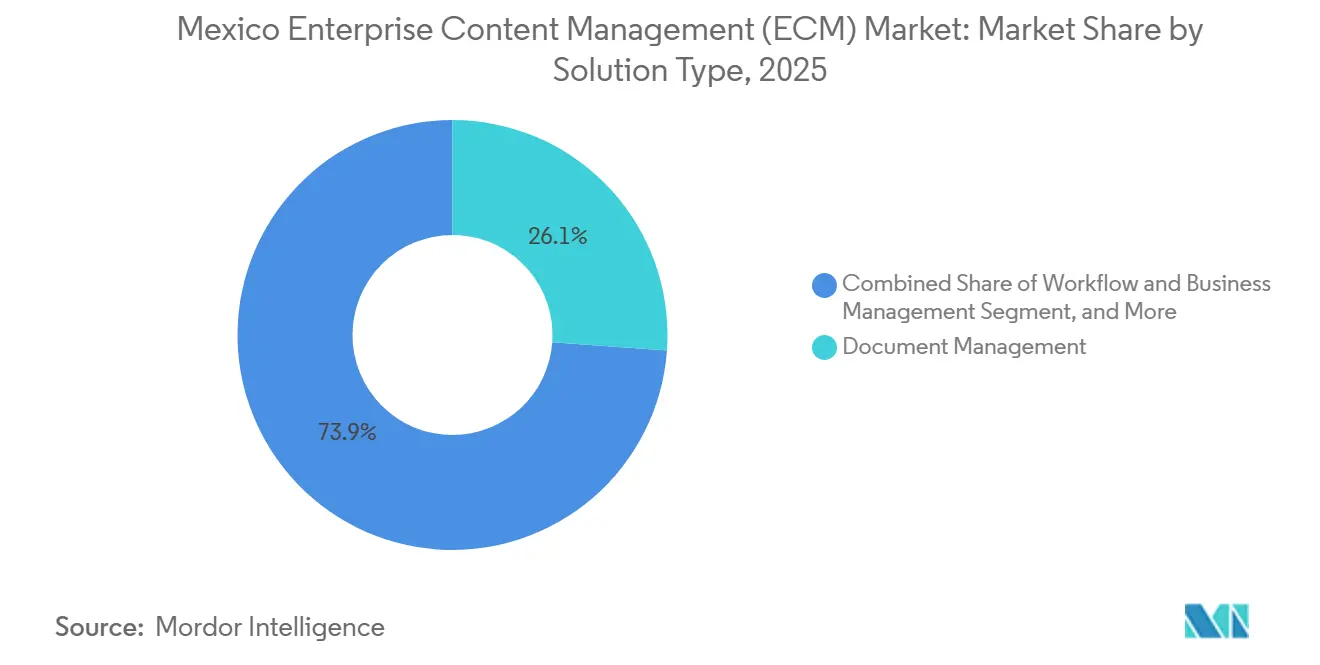
Document management held 26.14% of the Mexico Enterprise Content Management (ECM) Market share in 2025 because invoice retention and core repository control remained the starting point for most enterprise deployments. The broad CFDI archival requirement kept storage, indexing, and retrieval functions central to every taxable organization that needed a defensible document trail. Records management also remained important because NOM-151 and regulatory audit requirements increased demand for tamper-evident preservation, time-stamping, and structured retention rules. Case management has become relevant in insurance and legal settings where complex document histories and controlled approvals are critical to claims, reviews, and formal customer interactions. Digital asset management also expanded in media and retail environments where branded content must be versioned, shared, and governed across many channels.
The fastest growth is in workflow and business process management, which is projected to grow at a 17.42% CAGR through 2031 and stands out as the most dynamic part of the Mexico Enterprise Content Management (ECM) Market. Government digitization programs are encouraging agencies to replace paper-heavy approvals with digital routing, searchable records, and standardized citizen-facing processes. The National Public Technology Repository, launched in 2026, is also reinforcing demand for interoperable systems that align with shared technical standards across public entities. Web content management is benefiting from the same shift, as digital portals increasingly serve as the front end for service delivery, form submission, and controlled document exchange. Buyers are therefore placing greater value on platforms that combine repository control, workflow logic, and compliance management within a single deployment rather than maintaining disconnected tools for each content task.



By Deployment Mode: Cloud Leads While Hybrid Adds Staying Power
Cloud accounted for 72.83% of the Mexico Enterprise Content Management (ECM) Market in 2025 and is projected to grow at a 16.94% CAGR through 2031. This lead reflects clear buyer preference for a lower upfront investment, a faster rollout, and regular feature updates, which are difficult to match in isolated local systems. Cloud also aligns with enterprise demand because AI-led search, classification, analytics, and process automation require scalable compute and smoother integration with collaboration suites. The Hyland and Microsoft alliance announced in June 2026 shows how vendors are aligning cloud content management with Azure-based delivery and geographic data residency options for regulated buyers. That architecture matters because enterprises want AI-ready services without losing control over where sensitive records are kept.
Hybrid deployment is gaining depth because some regulated organizations need a balance between domestic control and cloud-based processing. Financial technology rules create a structural reason to keep sensitive transaction data within Mexico, even when companies want to use cloud tools for analytics, workflow, and collaboration. On-premises deployment still matters in large banks and government agencies where legacy systems remain deeply embedded, and migration risk is closely tied to compliance exposure. CNBV's review of cloud usage also delays full-cloud decisions, as infrastructure changes can become regulatory matters rather than simple IT purchases. As a result, deployment competition in the Mexico Enterprise Content Management (ECM) Market is not only about technical capability; it is also about how well vendors package cloud, hybrid, and residency options into a single policy-ready offer.
By Enterprise Size: SMEs Become The Stronger Growth Engine
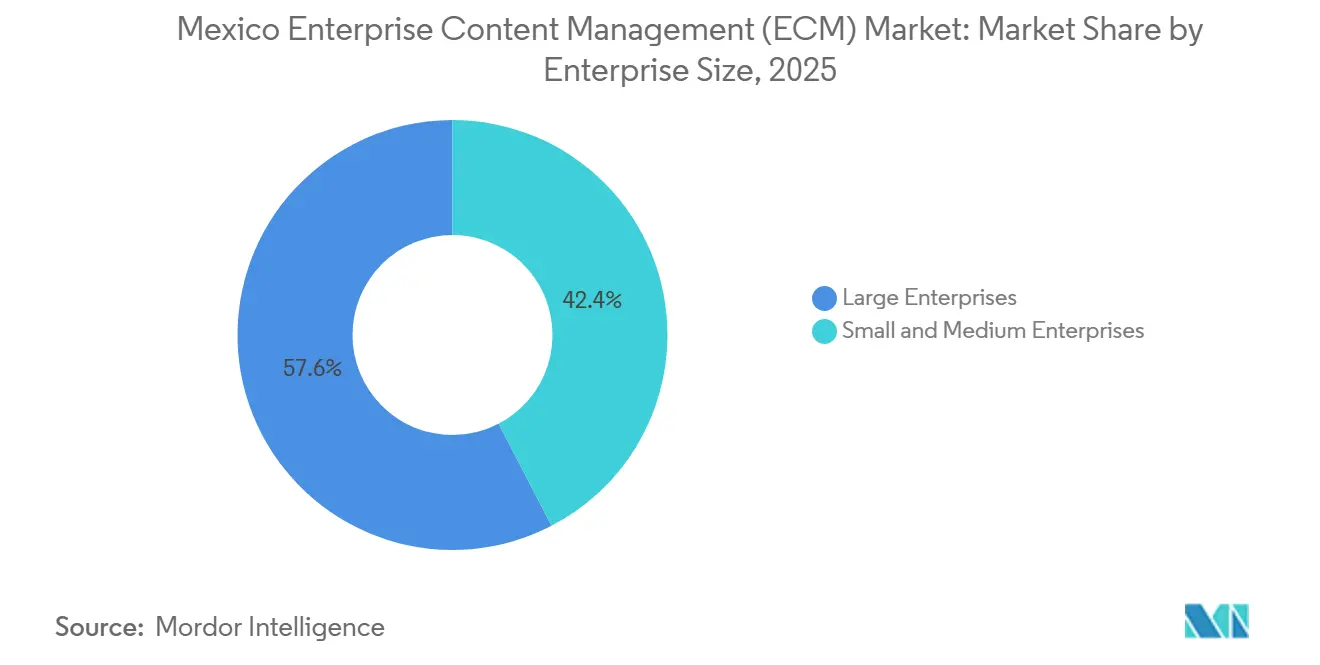
Large enterprises accounted for 57.62% of revenue in 2025, indicating that the Mexico Enterprise Content Management (ECM) Market still draws its largest spending base from organizations with deeper budgets and greater compliance exposure. These buyers usually face heavier audit requirements, larger repository volumes, and broader workflow needs across business units. They also tend to operate older systems that require structured modernization rather than simple first-time adoption, which keeps them central to vendor revenue plans. In banking, manufacturing, and government, enterprise-scale deployments often involve signature validation, legacy integration, and role-based document control at levels that smaller buyers rarely need. This explains why large accounts remain important even while the strongest growth is shifting elsewhere.
SMEs are expected to record the fastest growth at a 17.18% CAGR through 2031, which will shift the demand mix in the Mexico Enterprise Content Management (ECM) Market. Mexico had 5.5 million micro, small, and medium enterprises, equal to 99.8% of economic units and 60.1% of GDP, yet only 1% had reached advanced digitalization by early 2026. That gap matters because fiscal rules are making document traceability harder to postpone, while SaaS pricing makes compliant content tools far easier to adopt than older licensed systems. AI familiarity is also improving the growth path, as 57% of Mexican SMEs already use some AI application, and 71% of those users report gains in revenue and operational efficiency. Vendors that reach SMEs through local resellers, practical workflows, and simple compliance templates are therefore well placed to unlock a large unconverted base across the Mexico Enterprise Content Management (ECM) Market.
By End-User Industry: Healthcare Gains Pace While BFSI Holds The Lead
BFSI captured 22.41% of revenue in 2025 and remained the largest end-user segment in the Mexico Enterprise Content Management (ECM) Market. This lead is tied to a dense regulatory setting that includes electronic signature requirements, certified digital reporting, and stronger alignment between tax and financial regulatory processes. The CNBV’s administrative simplification measures published in May 2026 did not reduce the need for document governance; rather, they reinforced digital submission practices and required institutions to update compliance workflows to accommodate new filing structures. Financial institutions, therefore, remain heavy users of auditable repositories, controlled approval chains, and signature-enabled content processes. That combination keeps BFSI central to vendor strategy across compliance-heavy deployments.
Healthcare is projected to grow at a 17.63% CAGR through 2031 and is becoming one of the most important growth paths in the Mexico Enterprise Content Management (ECM) Market. IMSS maintained 53.7 million active clinical records and 722 million medical notes, already placing healthcare content volumes at a scale that requires automation, interoperability, and robust information retrieval. In June 2026, President Claudia Sheinbaum announced the Universal Digital Clinical Record initiative and committed MXN 13 billion (USD 667 million) to IMSS-Bienestar connectivity and a unified clinical record platform across 8,400 health centers. NOM-024-SSA3-2012 gives healthcare procurement a clear technical frame, which supports long-term investment in structured digital content systems. Government, IT and telecommunications, manufacturing, retail, media and entertainment, education, and energy and utilities remain relevant parts of the Mexico Enterprise Content Management (ECM) Market, with manufacturing supported by IATF 16949 record discipline and public agencies supported by national digital infrastructure programs.
Geography Analysis
Mexico City remained the main demand anchor for the Mexico Enterprise Content Management (ECM) Market in 2026, as it houses federal agencies, financial headquarters, and large corporate decision-making centers. The capital is where several national digital programs are coordinated, including SAT fiscal modernization, the National Public Technology Repository, and Llave MX linked identity initiatives. That concentration matters because procurement decisions tied to compliance, identity, records, and citizen-facing portals often begin in institutions based in Mexico City. BFSI buyers in the capital were also directly affected by the CNBV’s June 2026 signature reform for banking credit files, which pushed short-term upgrades in auditable content workflows.
Northern Mexico, led by Monterrey and the broader Nuevo León corridor, is emerging as the most dynamic growth pocket within the Mexico Enterprise Content Management (ECM) Market. The region benefits from near-shoring, large industrial operations, and a deep automotive supplier base that depends on structured quality records, controlled revisions, and repeatable audit support. Mexico had 2,164 IATF 16949-certified automotive supplier sites, many of them tied to the northern manufacturing belt, which supports ongoing demand for version-controlled document systems. Hyland also identified Monterrey and Guadalajara as expansion priorities for 2025 and 2026, leveraging local reseller networks to serve manufacturing accounts more effectively. Guadalajara adds a technology-driven layer, as IT and telecommunications providers, service firms, and cloud-oriented businesses in that market favor scalable, collaborative content platforms.
The Mexico Enterprise Content Management (ECM) Market also stands apart from peers in South America because Mexico’s regulatory digitization architecture is both deeper and more technically specific. The CFDI framework has shaped enterprise document practices for years, which means many buyers already understand the operational consequences of weak retention and poor retrieval discipline. Border states such as Baja California, Sonora, Chihuahua, and Tamaulipas are also important because cross-border manufacturing workflows require content systems that can support Mexican standards and North American quality documentation simultaneously. The 2025 data protection update adds another layer in these regions because records are often created, processed, and reviewed across jurisdictions within the same operating chain.
Competitive Landscape
The Mexico Enterprise Content Management (ECM) Market remains fragmented, and that fragmentation shapes both pricing behavior and vendor positioning. More than 60% of the installed base is still served by non-world-class or legacy vendors, which leaves a wide replacement pool for global providers and local specialists alike. OpenText, Microsoft, Oracle, and IBM compete through broad ecosystems, enterprise relationships, and integration capacity, while Laserfiche, M-Files, DocuWare, and Newgen focus more on workflow depth, classification tools, and targeted process use cases. Hyland held 10% of the Mexico Enterprise Content Management (ECM) Market in 2025 and has built its local position through a reseller-led approach and multiple product lines that meet the requirements of the public sector, healthcare, financial, and media sectors. This structure means no single vendor controls the field, and buyers still have room to compare compliance fit, deployment flexibility, and implementation support.
AI-enabled ecosystems are becoming the main battleground for competition in the Mexico Enterprise Content Management (ECM) Market. OpenText unveiled its AI Data Platform in November 2025 and paired that move with portfolio changes that sharpened its focus on AI-led information management, cloud, and security. OpenText then reported USD 295 million in Enterprise Cloud Bookings in Q2 FY2026, up 18.0% year over year, demonstrating real commercial traction for cloud-native content workflows. Hyland’s June 2026 collaboration with Microsoft brought the Content Innovation Cloud to Azure, with data residency options, directly addressing regulated deployment concerns. M-Files deepened its Microsoft 365 Copilot integration in March 2026, demonstrating how vendors are embedding content management within widely used productivity environments rather than treating ECM as a separate destination system.
The clearest open space in the Mexico Enterprise Content Management (ECM) Market lies in mid-market manufacturing and healthcare accounts outside the largest metropolitan clusters. These organizations often have strong compliance needs but limited internal implementation depth, which creates room for vendors that can combine local support with practical workflow templates. Local Mexican integrators also have an advantage in niche areas such as CFDI compliance, clinical record interoperability, and automotive quality documentation because regulatory fluency matters as much as software breadth in these projects. Vendors that can meet the expectations of NOM-151-SCFI-2016, NOM-024-SSA3-2012, and ISO 15489-1 in a single configuration will likely achieve stronger customer retention because they reduce compliance overhead after deployment.
Mexico Enterprise Content Management (ECM) Industry Leaders
Microsoft Corporation
OpenText Corporation
IBM Corporation
Hyland Software, Inc.
Oracle Corporation
- *Disclaimer: Major Players sorted in no particular order

Recent Industry Developments
- June 2026: Hyland announced a strategic partnership with Microsoft to bring the Hyland Content Innovation Cloud to Microsoft Azure. The alliance enables customers in regulated industries, including financial services, healthcare, and government, to deploy AI-ready content management with geographic data residency options and a joint go-to-market motion through Microsoft Marketplace, accelerating reach into cloud-committed enterprise buyers across Mexico and other regions.
- May 2026: Hyland launched its Hyland Global Partner Network, a redesigned partner ecosystem structured for SaaS-native and cloud deployment models. The program consolidates Hyland's global partner ecosystem under a single coherent framework to accelerate co-development of agentic enterprise workflows using Hyland's AI-embedded content intelligence platform, with direct application to its manufacturing sector expansion in northern Mexico.
- April 2026: Laserfiche introduced AI Agents at the Laserfiche Empower conference, virtual assistants executing multi-step repository actions, including content organization and metadata application, via natural language prompts within a governed, compliance-controlled ECM framework. General availability on Laserfiche Cloud was set for May 7, 2026.
- January 2026: Box announced the general availability of Box Extract, an AI-powered capability using generative AI models from Google, Anthropic, and OpenAI to extract structured information from unstructured enterprise documents and store results as searchable metadata, targeting enterprises seeking to automate content classification and accelerate decision-making.


Mexico Enterprise Content Management (ECM) Market Report Scope
The Mexico enterprise content management (ECM) market refers to the ecosystem of software solutions and services designed to systematically capture, manage, store, preserve, and deliver an organization's unstructured and structured content and documents within the country. This includes technologies such as document management, records management, workflow, business process management, case management, digital asset management, and web content management. Deployed on-premises, in the cloud, or in hybrid models, these solutions cater to organizations of all sizes across diverse industries in Mexico, including BFSI, government, healthcare, IT, and manufacturing. Driven by the country's accelerating digital transformation, the modernization of public and private sector operations, and the growing need for regulatory compliance and data security, ECM solutions enable Mexican businesses to streamline administrative workflows, enhance cross-departmental collaboration, ensure information governance, and reduce reliance on manual paper-based processes to improve overall productivity and decision-making.
The Mexico Enterprise Content Management (ECM) Market Report is Segmented by Solution Type (Document Management, Records Management, Workflow and Business Process Management, Case Management, Digital Asset Management, Web Content Management, and Other Solutions), Deployment Mode (On-Premises, Cloud, and Hybrid), Enterprise Size (Small and Medium Enterprises, and Large Enterprises), and End-User Industry (BFSI, Government and Public Sector, Healthcare, IT and Telecommunications, Manufacturing, Retail, Media and Entertainment, Education, Energy and Utilities, and Other End-User Industries). The Market Forecasts are Provided in Terms of Value (USD).
| Document Management |
| Records Management |
| Workflow and Business Process Management |
| Case Management |
| Digital Asset Management |
| Web Content Management |
| Other Solutions |
| On-Premises |
| Cloud |
| Hybrid |
| Small and Medium Enterprises |
| Large Enterprises |
| BFSI |
| Government and Public Sector |
| Healthcare |
| IT and Telecommunications |
| Manufacturing |
| Retail |
| Media and Entertainment |
| Education |
| Energy and Utilities |
| Other End-User Industries |
| By Solution Type | Document Management |
| Records Management | |
| Workflow and Business Process Management | |
| Case Management | |
| Digital Asset Management | |
| Web Content Management | |
| Other Solutions | |
| By Deployment Mode | On-Premises |
| Cloud | |
| Hybrid | |
| By Enterprise Size | Small and Medium Enterprises |
| Large Enterprises | |
| By End-User Industry | BFSI |
| Government and Public Sector | |
| Healthcare | |
| IT and Telecommunications | |
| Manufacturing | |
| Retail | |
| Media and Entertainment | |
| Education | |
| Energy and Utilities | |
| Other End-User Industries |


Key Questions Answered in the Report
What is the size outlook for the Mexico Enterprise Content Management (ECM) space through 2031?
The Mexico Enterprise Content Management (ECM) Market was valued at USD 0.86 billion in 2025 and is forecast to reach USD 1.95 billion by 2031 at a 14.75% CAGR.
Which deployment model leads adoption in Mexico?
Cloud led with 72.83% share in 2025 and is also the fastest-growing deployment model, supported by SaaS economics and AI-ready architecture.
Which end-user group is driving the most revenue today?
BFSI held the largest end-user share at 22.41% in 2025 because of strict regulatory reporting, signature, and audit requirements.
Which end-user group is expanding the fastest?
Healthcare is projected to grow at a 17.63% CAGR through 2031, supported by large clinical record volumes and national digital health initiatives.
Why are SMEs becoming more important for vendors?
SMEs are projected to grow at a 17.18% CAGR through 2031 because SaaS pricing is lowering entry barriers while compliance needs are making document control harder to delay.
What is changing vendor competition the most?
Competition is shifting toward AI-assisted classification, workflow automation, Microsoft and Azure ecosystem alignment, and the ability to support regulated cloud and hybrid deployments.
Page last updated on:






