
Metaverse Streaming Market Size and Share
Market Overview
| Study Period | 2020 - 2031 |
|---|---|
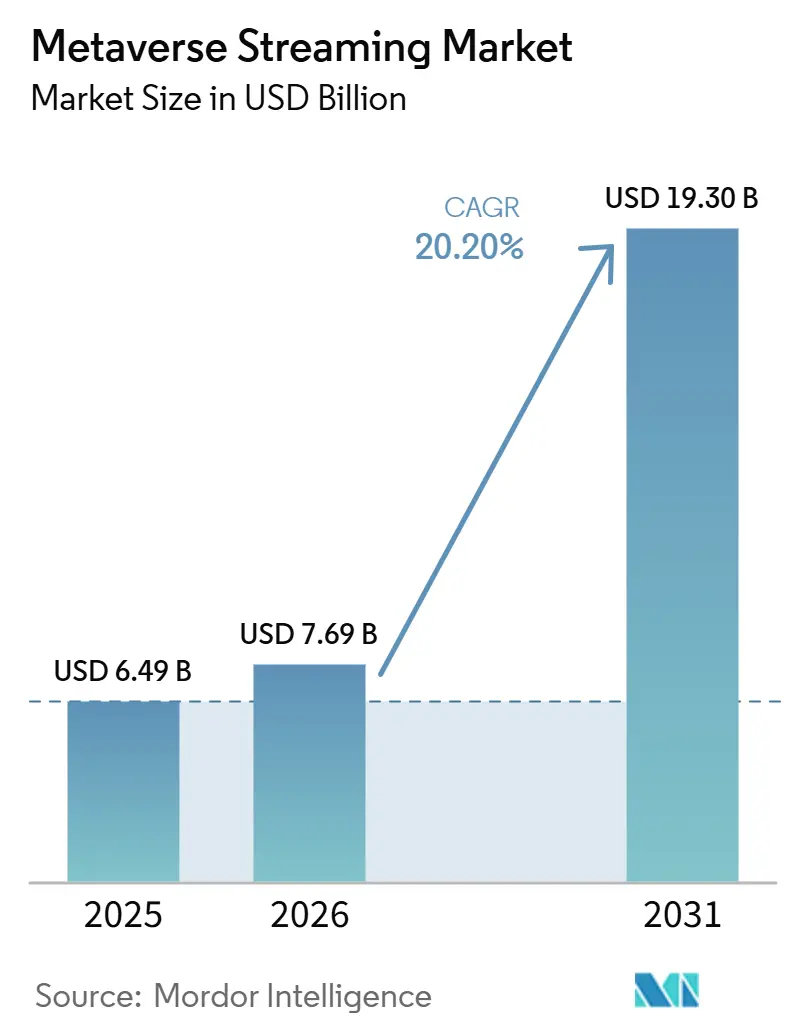
| Market Size (2026) | USD 7.69 Billion |
| Market Size (2031) | USD 19.30 Billion |
| Growth Rate (2026 - 2031) | 20.20 % |
| Fastest Growing Market | Asia-Pacific |
| Largest Market | North America |
| Market Concentration | Medium |
Major Players *Disclaimer: Major Players sorted in no particular order Image © Mordor Intelligence. Reuse requires attribution under CC BY 4.0. | |
Metaverse Streaming Market Analysis by Mordor Intelligence
The metaverse streaming market size is projected to expand from USD 6.49 billion in 2025 and USD 7.69 billion in 2026 to USD 19.30 billion by 2031, registering a CAGR of 20.2% between 2026 to 2031. The market is moving beyond pilot deployments because persistent virtual spaces are becoming practical channels for entertainment, brand engagement, training, and premium event distribution. Wider use of GPU-based cloud delivery, spatial computing devices, and creator payment systems is expanding addressable demand well beyond core gaming users and giving the metaverse streaming market a broader commercial base. Enterprises, sports rights holders, and premium media brands are committing to multi-year immersive streaming programs, which gives the metaverse streaming market a firmer revenue foundation for infrastructure investment and content planning. North America still provides the deepest commercial ecosystem, but Asia-Pacific is adding broad demand across gaming, fan platforms, enterprise XR, and mobile-first viewing models that do not depend on premium headsets. The main risks for the metaverse streaming market remain latency, bandwidth constraints, interoperability gaps, and moderation liability, even as competition widens across major platforms, infrastructure vendors, and specialized content providers.
Key Report Takeaways
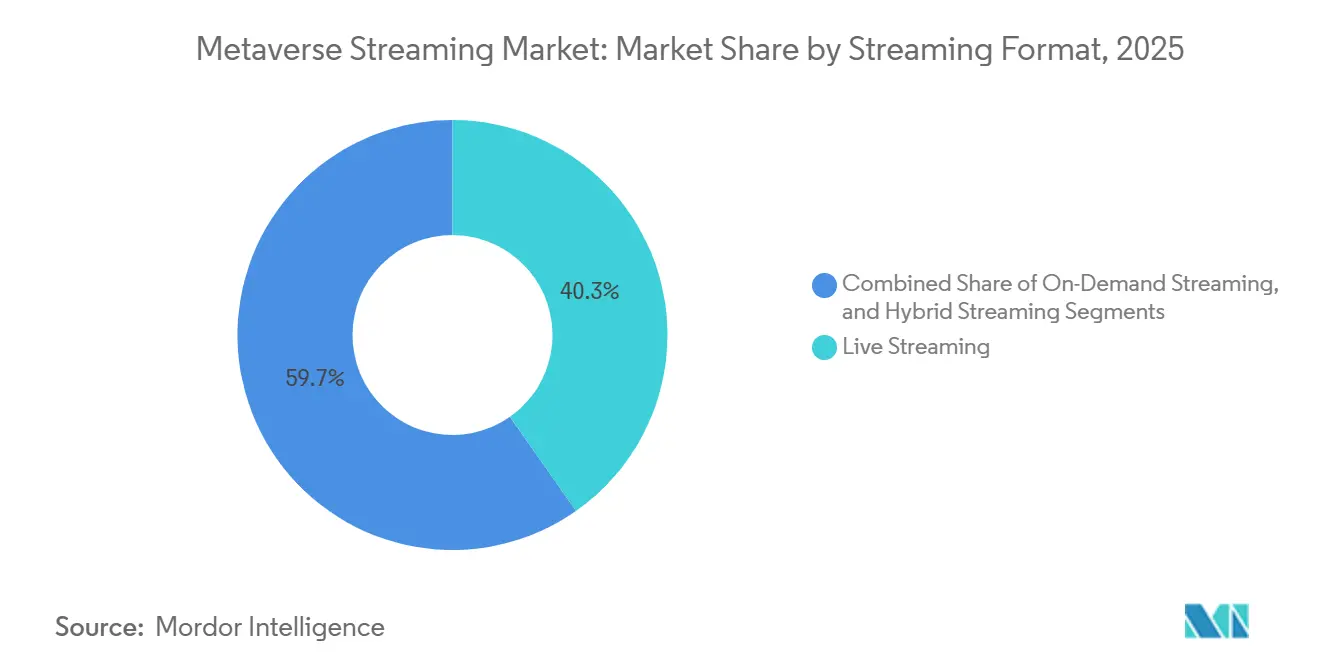
- By streaming format, Live Streaming led with 40.26% revenue share of the metaverse streaming market in 2025, and Hybrid Streaming is forecast to expand at a 20.81% CAGR through 2031.
- By content type, Music and Live Performances held 30.37% revenue share of the metaverse streaming market in 2025, and Sports is projected to record the highest CAGR at 21.06% through 2031.
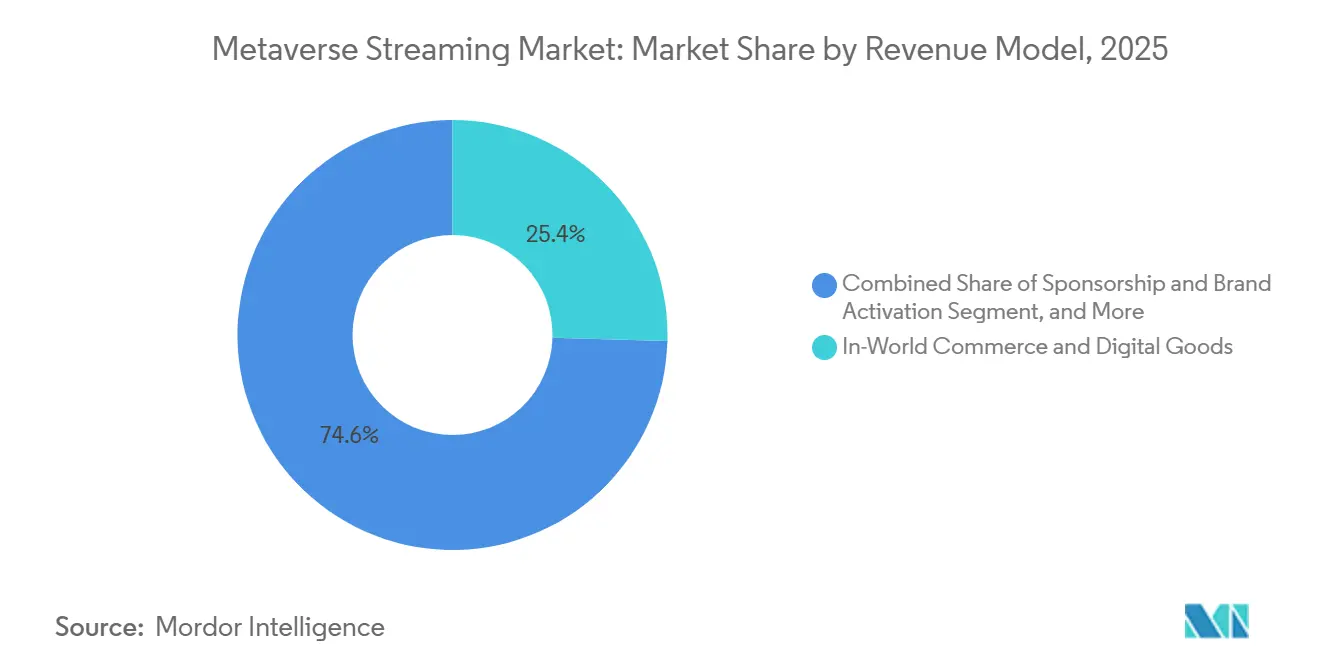
- By revenue model, In-World Commerce and Digital Goods accounted for 25.44% revenue share in 2025, and Pay Per View and Ticketing is projected to grow at a 20.96% CAGR through 2031.
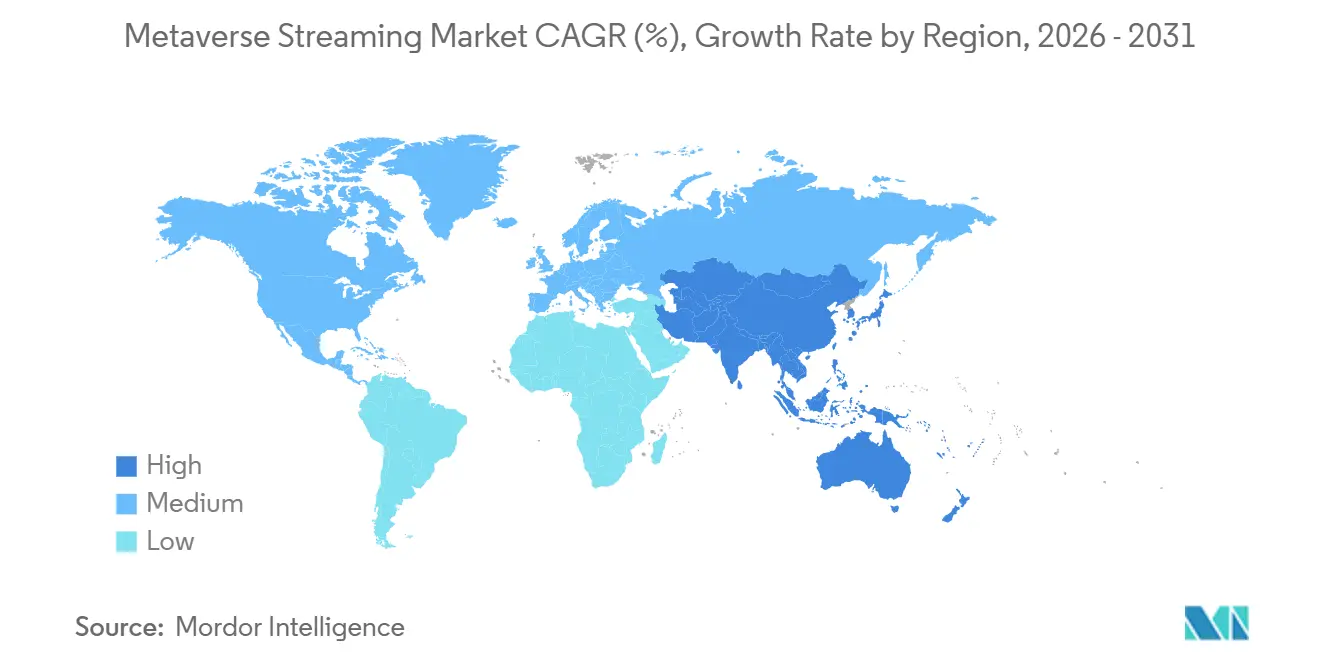
- By geography, North America held 31.24% share of the metaverse streaming market size in 2025, and Asia-Pacific is projected to grow at a 20.56% CAGR through 2031.
Note: Market size and forecast figures in this report are generated using Mordor Intelligence’s proprietary estimation framework, updated with the latest available data and insights as of January 2026.
Market Trends and Insights
Drivers Impact Analysis of Metaverse Streaming Market*
| Driver | (~) % Impact on CAGR Forecast | Geographic Relevance | Impact Timeline |
|---|---|---|---|
| Integration of Low-Latency Cloud Streaming With XR Devices | +4.8% | Global, with early gains in North America, Japan, and South Korea | Short term (≤ 2 years) |
| Rising Demand for Interactive Live Events Inside Virtual Worlds | +4.2% | Global, concentrated in North America and Asia-Pacific | Short term (≤ 2 years) |
| Expansion of Creator Monetization in Immersive Platforms | +3.5% | North America and Asia-Pacific core, spill-over to Europe | Medium term (2-4 years) |
| Growth of Virtual Education, Training, and Enterprise Broadcasting | +2.9% | Global, with leading adoption in Asia-Pacific and Europe | Medium term (2-4 years) |
| Rising Use of Spatial Commerce and Branded In-World Sponsorships | +2.5% | North America and Asia-Pacific, spill-over to Middle East | Medium term (2-4 years) |
| Rising Demand for Persistent Social Viewing and Co-Watching | +1.9% | Global, driven by Asia-Pacific and North America | Long term (≥ 4 years) |
| Source: Mordor Intelligence | |||
Integration of Low-Latency Cloud Streaming With XR Devices
Hardware decoupling is changing the cost profile of the metaverse streaming market because high-end rendering no longer needs to sit on the user device, which lowers the hardware barrier for premium immersive experiences. NVIDIA introduced CloudXR 6.0 at GTC 2026 with a universal OpenXR-based runtime that can stream 4K-equivalent spatial content at 90 FPS over standard 5 GHz Wi-Fi with pose-to-frame received latency in the 20 ms to 30 ms range.[1]NVIDIA Developer Blog, “Stream High-Fidelity Spatial Computing Content to Any Device With NVIDIA CloudXR 6.0,” NVIDIA Developer Blog, developer.nvidia.com Dynamic foveated streaming reduces data use by sending lower resolution imagery at the edge of the field of view and full detail at the focal point, which improves the economics of multi-user sessions and helps the metaverse streaming market support richer worlds at scale. Native visionOS 26.4 support extends this model to Apple Vision Pro and broadens the premium hardware base that immersive platforms can target, which matters for both enterprise deployments and consumer subscriptions. This shift moves more cost from consumer hardware purchases to platform operating spend, which can raise conversion for streaming-native services and give the metaverse streaming market a clearer path to scale.
Rising Demand for Interactive Live Events Inside Virtual Worlds
Interactive live events in virtual worlds are moving away from passive broadcast because platform revenue depends more on session length, repeat visits, and transaction activity than on headline audience size alone. DAZN and Immersiv.io delivered an XR experience for the FIFA Club World Cup 2025 on Meta Quest, giving fans access to all 63 matches in real-time 3D with interactive stats, tactical overlays, and 180° and 360° replay features during the later rounds of the tournament. Fox Sports, Cosm, and FIFA then extended that logic into shared-reality venues for FIFA World Cup 2026 coverage, using live spatial production workflows to bring immersive match viewing to dome environments in major U.S. cities.[2]Sports Video Group, “Fox Sports Teams Up With Cosm, FIFA to Deliver FIFA World Cup 2026 in Shared Reality at Cosm Venues in Los Angeles, Dallas and Atlanta,” Sports Video Group, sportsvideo.org Ticketed shared-reality attendance is emerging as its own revenue layer between linear streaming and stadium attendance, which gives the metaverse streaming market a pricing tier that traditional digital video did not fully capture. Rights holders that lock immersive terms into broader media negotiations are likely to improve monetization leverage as the metaverse streaming market matures.
Expansion of Creator Monetization in Immersive Platforms
Creator monetization on immersive platforms is becoming more durable as payout systems move closer to engagement depth than to impression volume, which makes revenue less dependent on short ad cycles and less volatile for creators. HTC launched the VIVERSE Partner Program in February 2026 and based creator payments on unique views and engagement time instead of advertising impressions, which signals a more engagement-led creator economy model inside the metaverse streaming market. This approach gives smaller creators a clearer path to earnings because it rewards user retention and interaction quality rather than pure audience scale. It also favors creators who build persistent rooms, co-viewing loops, virtual hangouts, and interactive story paths that keep users inside social spaces for longer periods. That change supports a steadier content pipeline for the metaverse streaming market and strengthens retention for platforms that can sustain active creator communities.
Growth of Virtual Education, Training, and Enterprise Broadcasting
Enterprise and education broadcasting is becoming a higher-value part of the metaverse streaming market because organizations can deliver training, internal events, and learning programs with lower travel costs and more structured participation. EON Reality launched its Global Virtual Campus in March 2026 with free access to more than 9,000 university-level courses, AI-generated immersive content, XR labs, and automated credentialing, which shows how formal learning is moving into persistent digital delivery environments. Regulated sectors such as healthcare and financial services also need immersive training systems that meet data residency, identity verification, and audit requirements, which raises the standard for vendors serving enterprise clients. Standards work across multimedia metaverse systems is increasing the barrier to entry, which can favor providers that achieve compliance earlier and can integrate across devices and networks. That makes enterprise contracts less price sensitive and gives the metaverse streaming market a more stable demand base than pure consumer entertainment alone.
Restraints Impact Analysis of Metaverse Streaming Market*
| Restraint | (~) % Impact on CAGR Forecast | Geographic Relevance | Impact Timeline |
|---|---|---|---|
| High Latency Sensitivity and Bandwidth Constraints | -2.6% | Global, with highest impact in Africa and South America | Short term (≤ 2 years) |
| Fragmented Platform Standards and Interoperability Gaps | -1.8% | Global, particularly North America, EU, and Asia-Pacific | Medium term (2-4 years) |
| Content Moderation, Safety, and Brand Risk in User-Generated Worlds | -1.1% | Global, with higher impact in EU due to DSA compliance | Medium term (2-4 years) |
| Weak Monetization Conversion Outside Core Gaming Audiences | -0.9% | North America, Europe, Middle East | Long term (≥ 4 years) |
| Source: Mordor Intelligence | |||
High Latency Sensitivity and Bandwidth Constraints
Network performance is still the main technical limit on mass adoption in the metaverse streaming market because immersive sessions break down quickly when response times and bandwidth fall below perception thresholds. A 2025 IEEE COMCOMAP study found 5G uplink latencies of 6.41 ms to 14.75 ms under multi-user metaverse load, which remained above the sub-5 ms level needed for haptic-enabled experiences and other highly responsive formats.[3]Usama Farooq, Timo Bräysy, and Paula Alavesa, “QoS Evaluation of a 5G Test Network for Metaverse Applications, Delay and Jitter Comparison With Wi-Fi and Ethernet,” IEEE COMCOMAP 2025, doi.org A separate 2025 assessment on Zenodo found that current architectures do not meet the sub-20-ms end-to-end latency and up to 1 Gbps per-user bandwidth needs of dense metaverse deployments, which highlights a wide infrastructure gap for the metaverse streaming market. When network quality drops below user expectations, engagement can collapse quickly, and platforms face churn dynamics that are harder to absorb than in standard video streaming. Edge computing and future 6G deployment may reduce this constraint over time, but those timelines do not fully match near-term content and platform investment cycles.
Fragmented Platform Standards and Interoperability Gaps
The lack of common standards is forcing creators, developers, and brands to rebuild assets across different environments, which slows scale and raises operating friction in the metaverse streaming market. The Metaverse Standards Forum warned that the environment could fragment into closed silos if open browser and platform approaches do not gain wider support, which shows how serious the interoperability issue has become. The ITU approved Recommendation H.770.1 in December 2025 to define service scenarios and high-level requirements for cross-platform interoperability, but commercial uptake still depends on voluntary implementation by major platform owners. IEC TR 63614-3:2026 also identified open standardization gaps across content, platforms, networks, and devices, which confirms that the metaverse streaming market still lacks a fully aligned technical base. Platforms that rely on proprietary avatar or scene formats may preserve lock-in in the near term, but they also face faster erosion if a major rival scales an open standard first.
*Our forecasts treat driver/restraint impacts as directional, not additive. The impact forecasts reflect baseline growth, mix effects, and variable interactions.
Metaverse Streaming Market Segment Analysis
By Streaming Format:
Live Formats Sustain Lead, Hybrid Emerges as Monetization ArchitectureLive Streaming held 40.26% of the metaverse streaming market share in 2025, which kept it ahead of the other delivery formats and confirmed that real-time participation remains the strongest anchor for immersive viewing. It led because users place a higher value on synchronous experiences such as concerts, esports finals, fan meetups, and branded activations that lose a large part of their appeal once the shared moment passes. That time-sensitive value supports higher event spending and stronger social pull than standard replay viewing, which keeps live inventory commercially attractive in the metaverse streaming market. Spectrum and Apple announced in January 2026 that select Los Angeles Lakers games would stream live through Spectrum Front Row on Apple Vision Pro, which showed that live spatial sports is reaching mainstream consumer hardware and moving beyond test use cases.
On-Demand Streaming still holds an important role because replay viewing, creator libraries, and training content support longer shelf life and broaden utility across the metaverse streaming market. Hybrid Streaming is forecast to grow at a 20.81% CAGR through 2031, making it the fastest-expanding format in the metaverse streaming market and showing that platforms want more than one session type inside a single environment. Providers are attaching persistent social layers to scheduled events so users remain in shared spaces before, during, and after the main broadcast, which raises visit length and opens more chances for transactions and upselling. This structure can reduce churn because the platform relationship does not end when the headline stream ends, and it gives operators more ways to balance subscriptions, ads, ticketing, and commerce inside the same user journey.



By Content Type:
Music Anchors Volume, Sports Drives Growth PremiumMusic and Live Performances commanded the largest content type share at 30.37% in 2025, which reflected the ability of artists and promoters to monetize audiences that physical tours cannot reach at similar unit economics. Virtual ticketing, merchandise sales, and premium fan access fit naturally into immersive music events, which helps the metaverse streaming market support revenue without depending on a single monetization format. For many artists, immersive performances work as an added commercial layer rather than a substitute for physical touring, which supports adoption from both performers and promoters. Branded experiences also remain meaningful because advertisers increasingly prefer placements inside active virtual environments with existing traffic rather than building isolated worlds that struggle to retain audiences over time.
Sports is projected to grow at a 21.06% CAGR through 2031, which makes it the fastest-growing content area in the metaverse streaming market and reflects the willingness of rights holders to experiment with premium immersive access. Immersiv.io and DAZN showed tournament-scale viability during the FIFA Club World Cup 2025 with real-time 3D viewing, interactive statistics, tactical overlays, and spatial replay features that moved beyond passive match streaming. Rights holders are using immersive delivery to reach fans who cannot access premium physical venues, which expands audience value without replacing in-person attendance and gives the metaverse streaming market a stronger premium layer. Social and community events, along with education and training content, also widen the mix because they keep the metaverse streaming market tied to recurring interaction and practical use cases instead of pure entertainment demand.
By Revenue Model:
Transactional Commerce Leads, Pay-Per-View AcceleratesIn-World Commerce and Digital Goods held the largest revenue model share at 25.44% in 2025, which showed that embedded transactions are becoming the clearest way to convert attention into spending inside the metaverse streaming market. The model leads because users can buy goods, access upgrades, or interact with branded products without leaving the immersive environment, which reduces friction and raises conversion potential. Advertising-supported access still matters for broad and lower-spending audiences, especially where platforms want scale before pushing premium offers more aggressively. Subscription models remain strongest in premium device ecosystems, and Meta Horizon+ had more than 1 million subscribers and paid nearly USD 20 million to developers in 2025, which shows how recurring content models can support platform depth.
Pay Per View and Ticketing is forecast to expand at a 20.96% CAGR through 2031, making it the fastest-growing revenue model in the metaverse streaming market and confirming that immersive access can command direct payment. Growth is tied to tiered immersive entry, where broad audiences may enter through free or lower-cost access and then move into premium viewpoints, exclusive participation, or higher-touch social features. The Fox Sports and Cosm shared-reality plan for FIFA World Cup 2026 supports this direction because it treats immersive viewing as a product category in its own right rather than as a simple extension of linear broadcast. Sponsorship and brand activation should also gain from measurable engagement inside virtual spaces, which helps the metaverse streaming market blend commerce, ticketing, advertising, and subscriptions instead of depending on a single income stream.
Geography Analysis
North America and Europe Metaverse Streaming Market
North America accounted for 31.24% share of the metaverse streaming market size in 2025, which kept it as the largest regional base and reflected the concentration of core platforms, infrastructure vendors, and premium rights holders in the United States. The region benefits from a dense ecosystem that links device makers, cloud providers, immersive software developers, sports media, and enterprise buyers in a way that supports faster commercialization than most other regions. The U.S. also leads visible sports experimentation, including the Spectrum and Apple Vision Pro rollout for Los Angeles Lakers games in January 2026, which signaled that immersive live viewing is moving into recognizable mainstream consumer channels. Canada and Mexico remain smaller markets, but both benefit from technology spillover, cross-border content influence, and digitally active bilingual audiences that can support localized adoption. Europe is a material secondary region where GDPR and the Digital Services Act are shaping data handling, trust, and moderation standards for immersive content, which raises compliance costs but can also strengthen enterprise confidence.
APAC Metaverse Streaming Market
Asia-Pacific is projected to advance at a 20.56% CAGR through 2031, making it the fastest-growing regional segment in the metaverse streaming market and giving the global outlook a broad second engine of expansion. China contributes the largest revenue base in the region through integrated gaming and social ecosystems, domestic platform scale, and XR hardware deployment that supports immersive content distribution. South Korea adds strong demand through dense 5G infrastructure, esports culture, and fan platforms tied to music and entertainment, which gives immersive live events a stronger commercial path. Japan supports growth through enterprise VR investment, and India widens the user base through mobile-first 5G rollout and a large young audience that can access lightweight cloud-streamed XR services without immediate headset dependence. This mix gives Asia-Pacific demand across gaming, fan engagement, enterprise broadcasting, and mobile social viewing, which makes the metaverse streaming market less reliant on one narrow use case.
MEA and South America Metaverse Streaming Market
The Middle East and Africa remain smaller in current revenue terms, but both regions have strategic importance for the future metaverse streaming market because public digital programs and younger digital populations can support longer-term adoption. Saudi Arabia and the UAE are investing in metaverse infrastructure as part of broader digital economy diversification efforts, which gives the region an institutional push that can support enterprise and event-led deployments. Africa faces the sharpest bandwidth limits, especially in South Africa, Nigeria, and Egypt, which slows high-quality immersive delivery and keeps network performance as a larger barrier than in more developed markets. South America, led by Brazil, can benefit from browser-based XR streaming models that reduce headset dependence and help the metaverse streaming market reach mobile-first users sooner than full hardware adoption would allow.

Competitive Landscape
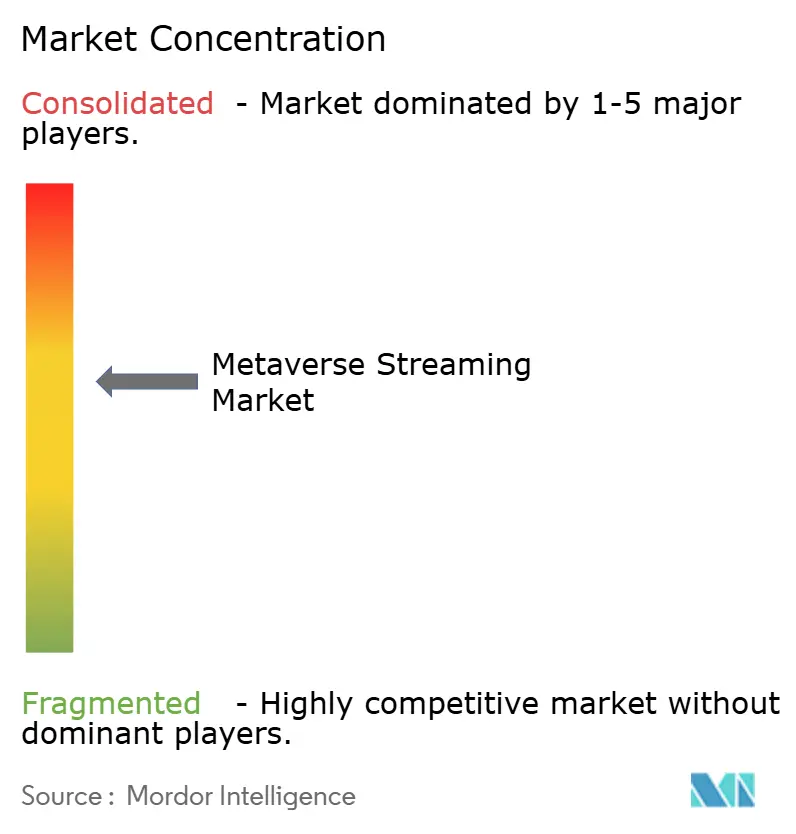
The metaverse streaming market remained moderately concentrated in 2026, with Meta Platforms, Roblox, Epic Games, Microsoft, and ByteDance holding the strongest platform positions across user reach, content ecosystems, and immersive technology layers. These firms benefit from control over hardware ecosystems, game engines, creator networks, social communities, or large pools of developer activity, which gives them a structural advantage in attracting both users and partners. A second group that includes NVIDIA, Akamai, Amazon, and Kaltura competes through cloud delivery, latency control, workflow tooling, and enterprise support, which means the infrastructure layer is active even when platform reach is more concentrated. This structure means audience access is tighter at the top of the stack, but implementation quality and service design are still contested across the metaverse streaming market. As a result, competition depends on content access, creator economics, streaming reliability, compliance readiness, and cross-platform usability rather than on scale alone.
Roblox strengthened its position in June 2026 by integrating Morpheus AI technology and acquiring Dynamics Lab and Lucid AI to support real-time photorealistic multiplayer worlds, which points to a strategy built around richer immersive creation and live shared environments. NVIDIA also widened its infrastructure role in March 2026 with CloudXR 6.0, which added universal OpenXR-based spatial streaming, browser access, and native Apple Vision Pro support that can benefit multiple platforms at once. Meta continued to reinforce its ecosystem through paid content and developer incentives, with Horizon+ exceeding 1 million subscribers and nearly USD 20 million in payouts during 2025, which shows how creator economics remain central to long-term platform retention. These moves show that leading firms are trying to control both the user experience and the commercial systems that keep creators, rights holders, and users active over time.
The clearest open spaces remain enterprise broadcasting in regulated fields, ticketed sports viewing for international fans, and hybrid social-commerce tools for mid-sized live events that are underserved by both linear streaming and full virtual-world platforms. Compliance is becoming a stronger competitive factor because cross-platform deployment is easier for vendors that align early with ITU Recommendation H.770.1 and ISO/IEC 23090-28:2026, which can lower integration friction for enterprise clients. This favors companies that can combine immersive delivery with governance, data handling, and interoperability support instead of offering experience design alone. It also leaves room for smaller specialists to win contracts inside the metaverse streaming market even when the largest platforms continue to hold broader audience reach and ecosystem visibility.
Metaverse Streaming Industry Leaders
Meta Platforms, Inc.
Roblox Corporation
Epic Games, Inc.
Microsoft Corporation
Tencent Holdings Limited
- *Disclaimer: Major Players sorted in no particular order
Metaverse Streaming Market Companies Covered in this Report
- Meta Platforms, Inc.
- Roblox Corporation
- Epic Games, Inc.
- Microsoft Corporation
- NVIDIA Corporation
- Alphabet Inc.
- Tencent Holdings Limited
- Sony Group Corporation
- ByteDance Ltd.
- Unity Software Inc.
- Amazon.com, Inc.
- Apple Inc.
- Zoom Video Communications, Inc.
- Kaltura, Inc.
- Brightcove Inc.
- Akamai Technologies, Inc.
- Vimeo, Inc.
- Twitch Interactive, Inc.
- BytePlus Pte. Ltd.
- The Sandbox

Recent Industry Developments in Metaverse Streaming Market
- July 2026: Fox Sports, Cosm, and FIFA presented select FIFA World Cup 2026 matches in Shared Reality across dome venues in Los Angeles, Dallas, and Atlanta, marking the first major live sports streaming deployment at 87-foot 12K+ LED immersive venue scale, with remote REMI production workflows enabling spatial switching from host stadiums.
- June 2026: Roblox announced the integration of Morpheus AI technology and acquisitions of Dynamics Lab and Lucid AI, targeting real-time photorealistic multiplayer worlds at 4K/60 Hz. The initiative centers on a hybrid architecture combining the Roblox game engine with AI video world models, accelerated by H200/B200-class edge GPUs.
- March 2026: Fox Sports and Cosm announced their collaboration for FIFA World Cup 2026 Shared Reality coverage, with Cosm capturing live immersive content from host stadiums and distributing to 3 U.S. venues across 40 Group Stage matches.
- March 2026: NVIDIA announced CloudXR 6.0 at GTC 2026, introducing universal OpenXR-based spatial streaming with native Apple Vision Pro visionOS 26.4 integration, dynamic foveated streaming at 90 FPS over standard 5 GHz Wi-Fi, and a zero-install CloudXR.js web client for Meta Quest 3, Pico 4 Ultra, and desktop browsers.


Global Metaverse Streaming Market Report Scope
Metaverse Streaming Market refers to platforms, technologies, and services that deliver live and on‑demand audio‑visual content inside immersive virtual environments, where users participate via avatars rather than traditional 2D interfaces.
The Metaverse Streaming Market Report is Segmented by Streaming Format (Live Streaming, On-Demand Streaming, and Hybrid Streaming), Content Type (Music and Live Performances, Sports, Education and Training, Branded Experiences and Advertising, and Social and Community Events), Revenue Model (Advertising Supported, Subscription Based, Pay Per View and Ticketing, In-World Commerce and Digital Goods, Sponsorship and Brand Activation), and Geography (North America, Europe, Asia-Pacific, Middle East, Africa, South America). The Market Forecasts are Provided in Terms of Value (USD).
| Live Streaming |
| On-Demand Streaming |
| Hybrid Streaming |
| Music and Live Performances |
| Sports |
| Education and Training |
| Branded Experiences, Brand Events and Advertising |
| Social and Community Events |
| Other Content Type |
| Advertising Supported |
| Subscription Based |
| Pay Per View and Ticketing |
| In-World Commerce and Digital Goods |
| Sponsorship and Brand Activation |
| North America | United States |
| Canada | |
| Mexico | |
| Europe | Germany |
| United Kingdom | |
| France | |
| Russia | |
| Rest of Europe | |
| Asia-Pacific | China |
| Japan | |
| India | |
| South Korea | |
| Australia | |
| Rest of Asia-Pacific | |
| Middle East | Saudi Arabia |
| United Arab Emirates | |
| Turkey | |
| Rest of Middle East | |
| Africa | South Africa |
| Egypt | |
| Nigeria | |
| Rest of Africa | |
| South America | Brazil |
| Argentina | |
| Rest of South America |
| By Streaming Format | Live Streaming | |
| On-Demand Streaming | ||
| Hybrid Streaming | ||
| By Content Type | Music and Live Performances | |
| Sports | ||
| Education and Training | ||
| Branded Experiences, Brand Events and Advertising | ||
| Social and Community Events | ||
| Other Content Type | ||
| By Revenue Model | Advertising Supported | |
| Subscription Based | ||
| Pay Per View and Ticketing | ||
| In-World Commerce and Digital Goods | ||
| Sponsorship and Brand Activation | ||
| By Geography | North America | United States |
| Canada | ||
| Mexico | ||
| Europe | Germany | |
| United Kingdom | ||
| France | ||
| Russia | ||
| Rest of Europe | ||
| Asia-Pacific | China | |
| Japan | ||
| India | ||
| South Korea | ||
| Australia | ||
| Rest of Asia-Pacific | ||
| Middle East | Saudi Arabia | |
| United Arab Emirates | ||
| Turkey | ||
| Rest of Middle East | ||
| Africa | South Africa | |
| Egypt | ||
| Nigeria | ||
| Rest of Africa | ||
| South America | Brazil | |
| Argentina | ||
| Rest of South America | ||


Key Questions Answered in the Report
What is the current size and outlook for metaverse streaming?
The metaverse streaming market stood at USD 7.69 billion in 2026 and is projected to reach USD 19.30 billion by 2031, growing at a 20.2% CAGR over 2026 to 2031.
Which streaming format is leading today?
Live Streaming led with 40.26% share in 2025 because real-time events such as concerts, esports, and sports viewing still create the strongest social pull and spending potential.
Which content area is growing the fastest?
Sports is projected to grow at a 21.06% CAGR through 2031, while Music and Live Performances remained the largest content category with a 30.37% share in 2025.
Which revenue model is most established right now?
In-World Commerce and Digital Goods led with a 25.44% share in 2025, showing that embedded transactions remain the clearest monetization path inside immersive environments.
Which region leads and which one is expanding fastest?
North America held the largest share at 31.24% in 2025, while Asia-Pacific is forecast to post the highest growth at a 20.56% CAGR through 2031.
What is the biggest barrier to wider adoption?
Latency and bandwidth limits remain the main challenge, and interoperability gaps add another layer of friction for creators, brands, and enterprise buyers.
Page last updated on:





