
Meta-Aramid Fiber Market Size and Share
Market Overview
| Study Period | 2022 - 2032 |
|---|---|
| Market Size (2027) | USD 1.69 Billion |
| Market Size (2032) | USD 2.45 Billion |
| Growth Rate (2027 - 2032) | 7.67 % |
| Fastest Growing Market | Asia-Pacific |
| Largest Market | Asia-Pacific |
| Market Concentration | Medium |
Major Players *Disclaimer: Major Players sorted in no particular order Image © Mordor Intelligence. Reuse requires attribution under CC BY 4.0. | |
Meta-Aramid Fiber Market Analysis by Mordor Intelligence
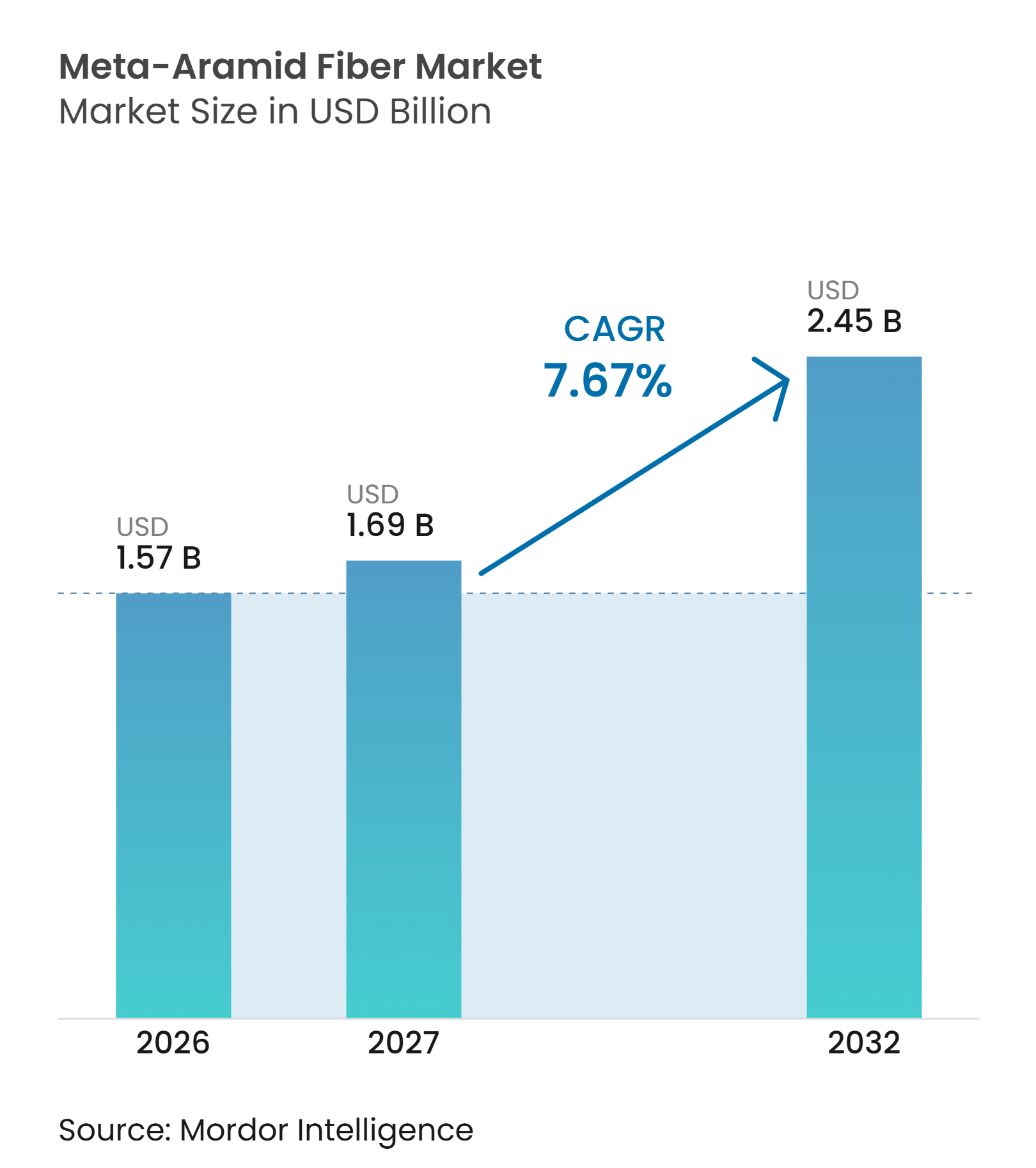
The Meta-Aramid Fiber market size was valued at USD 1.57 billion in 2026 and is estimated to grow from USD 1.69 billion in 2027 to USD 2.45 billion by 2032, at a CAGR of 7.67% during the forecast period (2027-2032). The meta-aramid fiber market is supported by investment in power grids, electrified transport, flame-resistant personal protective equipment, and lightweight aerospace and defense systems. These demand channels use fiber in different forms and at different price points, reducing dependence on a single end use. Safety regulations drive demand for protective garment replacements, while electrical equipment requires materials that meet higher thermal classes. Producers are also shifting focus toward application-engineered products as new capacity places pressure on standard grades. The meta-aramid fiber market therefore combines safety-driven demand with spending on energy and advanced manufacturing.
Key Report Takeaways
- By type, staple fiber held 41.34% of the Meta-Aramid Fiber market share in 2026, while paper fiber is forecast to grow at an 8.13% CAGR through 2032.
- By application, protective apparel accounted for 38.81% of global revenue in 2026, while electrical insulation is forecast to expand at an 8.36% CAGR through 2032.
- By end-user industry, the electrical and electronics industry accounted for 23.67% of global revenue in 2026 and is forecast to record an 8.81% CAGR through 2032.
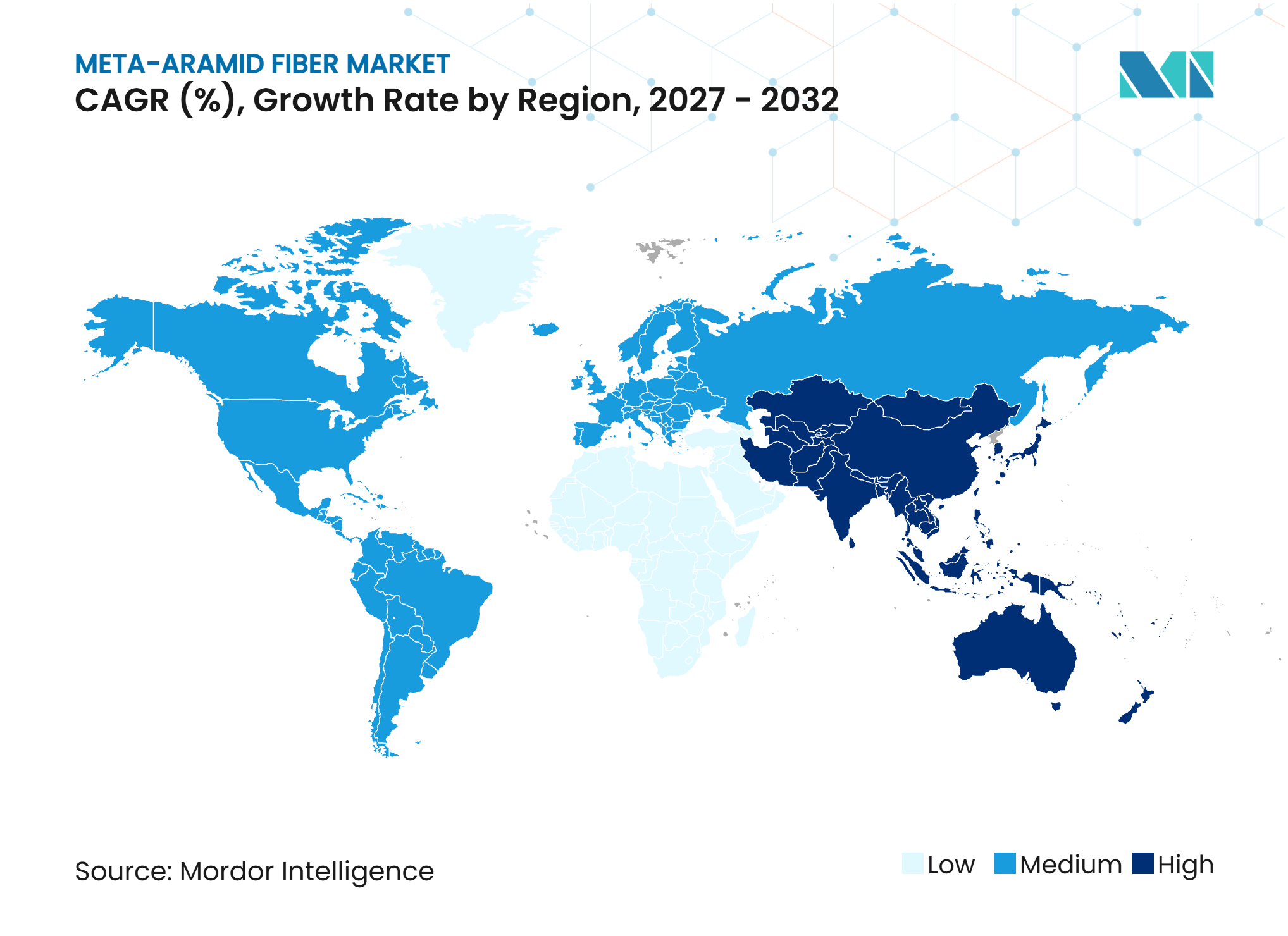
- By geography, Asia-Pacific held 35.19% of regional revenue in 2026 and is forecast to grow at an 8.62% CAGR through 2032.
Note: Market numbers in this report are based on Mordor Intelligence's proprietary estimation framework, which combines nine months of actuals with Q4 projections for base year 2026.
Market Trends and Insights
Drivers Impact Analysis of Meta-Aramid Fiber Market*
| Drivers | (~) % Impact on CAGR Forecast | Geographic Relevance | Impact Timeline |
|---|---|---|---|
| Expansion of Electrical Insulation in Grid, Renewable Energy and Electric Vehicle (EV) Systems | +2.0% | Global, led by China, U.S., EU, and India | Long term (≥ 4 years) |
| Mandatory Flame-Resistant Personal Protective Equipment (PPE) Standards and Replacement Demand | +1.5% | Global, with high regulatory intensity in North America and EU | Medium term (2-4 years) |
| Lightweighting in Aerospace, Defense and Mobility Platforms | +0.9% | North America, EU, and Asia-Pacific | Long term (≥ 4 years) |
| High-Temperature Filtration for Industrial Emission Control | +0.8% | EU, China, India, and Middle East and Africa | Medium term (2-4 years) |
| Qualification-Led Adoption in Safety-Critical Components | +0.6% | North America and EU | Long term (≥ 4 years) |
| Source: Mordor Intelligence | |||
Expansion of Electrical Insulation in Grid, Renewable Energy and Electric Vehicle (EV) Systems
The meta-aramid fiber market is gaining support from paper and sheet products used in higher-temperature transformer insulation. A 2025 review found that aramid papers retain stronger mechanical properties, breakdown voltage, and oxidation resistance than thermally upgraded kraft paper under high thermal stress. This performance supports demand for longer equipment service life and higher-thermal-class transformer designs, particularly where utilities seek to manage replacement costs. SINTEF reported that better transformer insulation paper could save Norway NOK 25 billion (~USD 2.71 billion) in grid investment by extending transformer life. Huvis presented a paper on meta-aramid electrical insulation for EV battery thermal-runaway protection at its 2025 R&D Solution Fair[1]. International Electrotechnical Commission (IEC) TR 61857-2:2025 provides updated guidance on selecting thermal test methods for electrical insulation systems.
Mandatory Flame-Resistant PPE Standards and Replacement Demand
The meta-aramid fiber market benefits from required replacement cycles in oil and gas, utilities, and industrial operations. Occupational Safety and Health Administration (OSHA) rules require employers in electric power generation and distribution to provide protective equipment, including appropriate protective clothing. National Fire Protection Association (NFPA) 70E establishes electrical workplace safety requirements, and ASTM F1506-25 specifies performance requirements for flame-resistant and arc-rated protective clothing. Tayho stated that flame-resistant protective clothing accounted for nearly 30% of demand for meta-aramid fiber in its May 2025 investor relations report. NFPA 1970, effective in September 2024, replaced several Personal Protective Equipment (PPE) standards and changed the framework for firefighter protective equipment. Inherently flame-resistant meta-aramid does not require a flame-retardant finish, which supports market demand where per- and polyfluoroalkyl substances (PFAS) restrictions affect treated alternatives.
Lightweighting in Aerospace, Defense and Mobility Platforms
The meta-aramid fiber market serves thermal protection, fire-blocking, and honeycomb-core applications in aerospace. A 2025 scientific review identified Nomex and Teijinconex in engine insulation blankets, aircraft-seat fire barriers, and flame-retardant honeycomb cores. These are not primary load-bearing uses, but they remain critical to aircraft safety and certification. EN 6049-009:2025 specifies self-wrapping meta-aramid fire-protection sleeves for aerospace electrical cable harnesses. The standard covers operation from -55°C to 260°C and requires 5-minute fire resistance at 1,100°C. Qualification requirements can secure market demand through multi-year procurement once a product is specified into an aircraft platform.
High-Temperature Filtration for Industrial Emission Control
The meta-aramid fiber market receives replacement demand from high-temperature bag filters in power plants, waste incinerators, and cement kilns. The EU Industrial Emissions Directive uses best available techniques requirements to control industrial emissions. Directive 2024/1785 extends this framework to an estimated 37,000 industrial installations across the EU. Arclin received a U.S. patent for a flue-gas filtration medium containing at least 80% meta-aramid fiber. The patent describes filtration efficiency above 95% for 2.5 μm particles and temperature resistance up to 200°C. Tighter emissions compliance in China also supports demand for meta-aramid fiber from domestic steel, cement, and waste-processing operators.
Restraints Impact Analysis of Meta-Aramid Fiber Market*
| Restraints | (~) % Impact on CAGR Forecast | Geographic Relevance | Impact Timeline |
|---|---|---|---|
| High R&D and Qualification Costs | -1.2% | Global | Long term (≥ 4 years) |
| Non-Biodegradability and End-of-Life Constraints | -0.6% | EU and North America, with global cost effects | Medium term (2-4 years) |
| Price Pressure from New Asian Capacity | -0.9% | Global, strongest in Asia-Pacific and export markets for commodity grades | Short term (≤ 2 years) |
| Source: Mordor Intelligence | |||
High R&D and Qualification Costs
High R&D and qualification costs constrain the meta-aramid fiber market, as developing a new grade requires specialized polycondensation expertise and extensive testing. A 2025 study revealed the molecular complexity underlying improvements in meta-aramid fibril adhesion in epoxy composites. Aerospace and electrical insulation customers also require multi-year qualification under IEC, ASTM, or customer-specific protocols. These procedures can cost more than the initial fiber purchase before a production order begins. Teijin recorded JPY 48.4 billion (~USD 0.30 billion) in aramid fixed-asset impairment in the first half of fiscal 2025 as part of a business restructuring. High fixed costs and qualification requirements favor established suppliers, but they can slow adoption by smaller buyers.
Non-Biodegradability and End-of-Life Constraints
The meta-aramid fiber market also faces end-of-life constraints because meta-aramid resists biological degradation due to its aromatic polyamide backbone. This durability makes the material effective in demanding thermal environments, but it creates end-of-life challenges for garments and filter bags. The EU Ecodesign for Sustainable Products Regulation took effect in July 2024 and established a framework for sustainability requirements across product groups. In April 2025, the European Defense Agency selected the REGEN project, which is developing solvent-based recycling of soft aramid layers from end-of-life ballistic vests[2]. A 2025 research report described microwave-based depolymerization that recovered 96% of aramid monomer in 15 minutes. Commercial recycling infrastructure remains limited, which can increase procurement risk for buyers with sustainability targets.
*Our forecasts treat driver/restraint impacts as directional, not additive. The impact forecasts reflect baseline growth, mix effects, and variable interactions.
Meta-Aramid Fiber Market Segment Analysis
By Type:
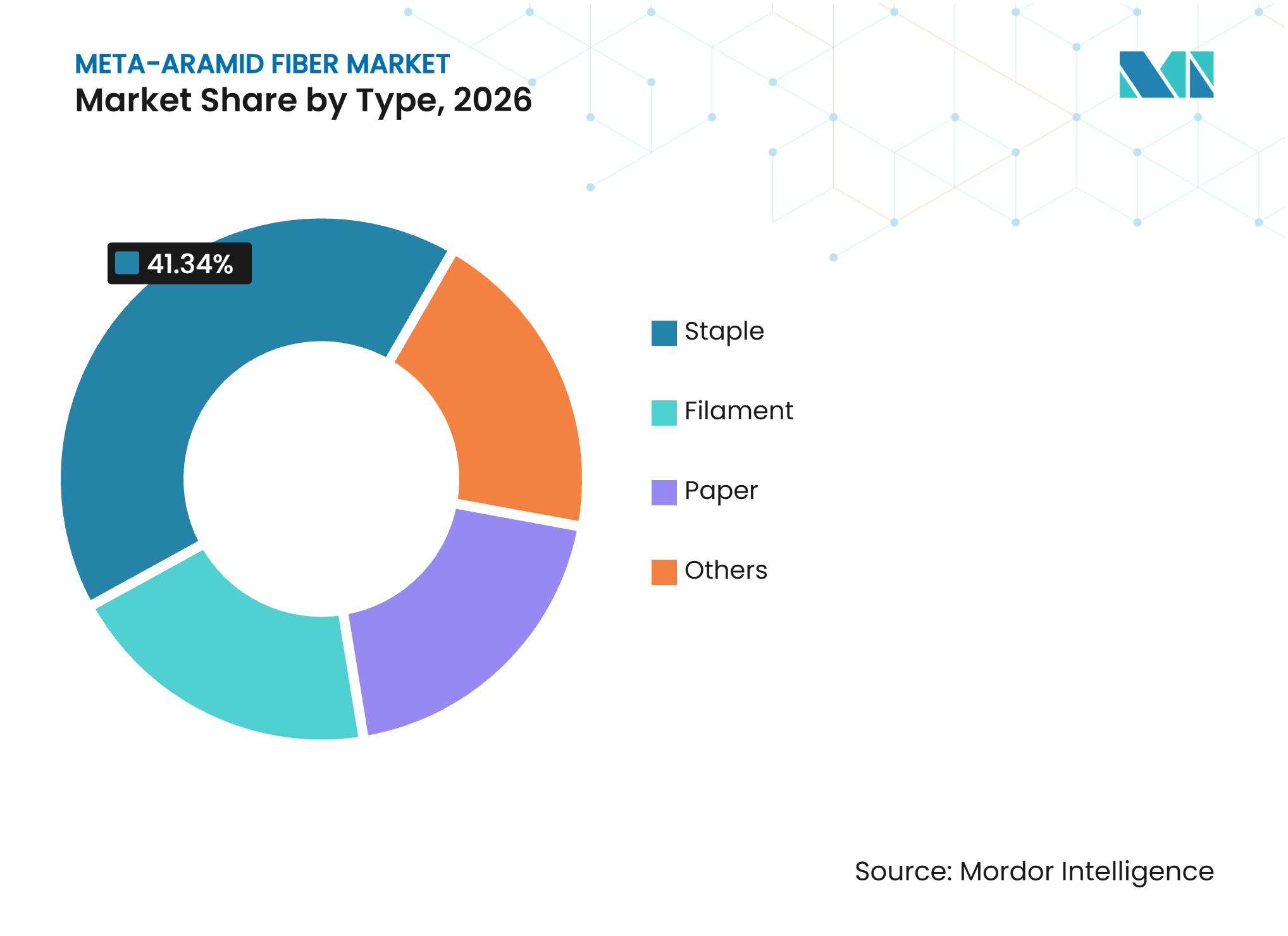
Paper Fiber Gains Ground in Insulation and AerospaceStaple fiber held 41.34% of global revenue in 2026. Its position reflects established use in protective apparel, nonwoven filter media, and friction materials. The meta-aramid fiber market continues to rely on staple processing through needlepunching, carding, and wet laying because those routes fit established conversion lines. Filament fiber is used for more specialized applications, including turbo-hose reinforcement and selected aerospace sleeve applications. These applications require the dimensional consistency and continuous-yarn strength that filament products offer.
Paper fiber is projected to record an 8.13% CAGR from 2027 to 2032, the fastest rate among all types. The paper fiber segment benefits from a shift toward higher-performance transformer insulation. A 2025 IEEE study compared kraft, thermally upgraded kraft, and aramid paper in oil-impregnated transformers, providing evidence of different behavior under thermal stress. Meta-aramid pulp and fibrids are also used as binders in specialty papers, wet-laid filtration media, and composite prepregs. Tayho reported that paper and pulp products accounted for nearly 20% of its aramid shipments, consistent with rising demand for grid infrastructure.



By Application:
Electrical Insulation Grows Fastest While Protective Apparel LeadsProtective apparel accounted for 38.81% of global revenue in 2026. The meta-aramid fiber market draws stable demand from this application because regulated workers require arc-rated and flame-resistant garments. ASTM F1506-25 sets performance specifications for fabrics used by workers exposed to flames and electric arcs. NFPA 70E and NFPA 2112 also establish compliance requirements for electrical and industrial protective clothing. This framework makes replacement demand less discretionary in regulated work settings.
Electrical insulation is forecast to grow at an 8.36% CAGR from 2026 to 2032. The application covers transformers, EV motors, battery thermal barriers, and high-voltage equipment. Huvis demonstrated meta-aramid insulation paper aimed at preventing EV battery thermal runaway in 2025. Nonwoven bag filters benefit from tightening emissions regulations in China and the EU. Turbo hose reinforcement and aerospace honeycomb cores add smaller, steady demand channels to the meta-aramid fiber market.
By End-User Industry:
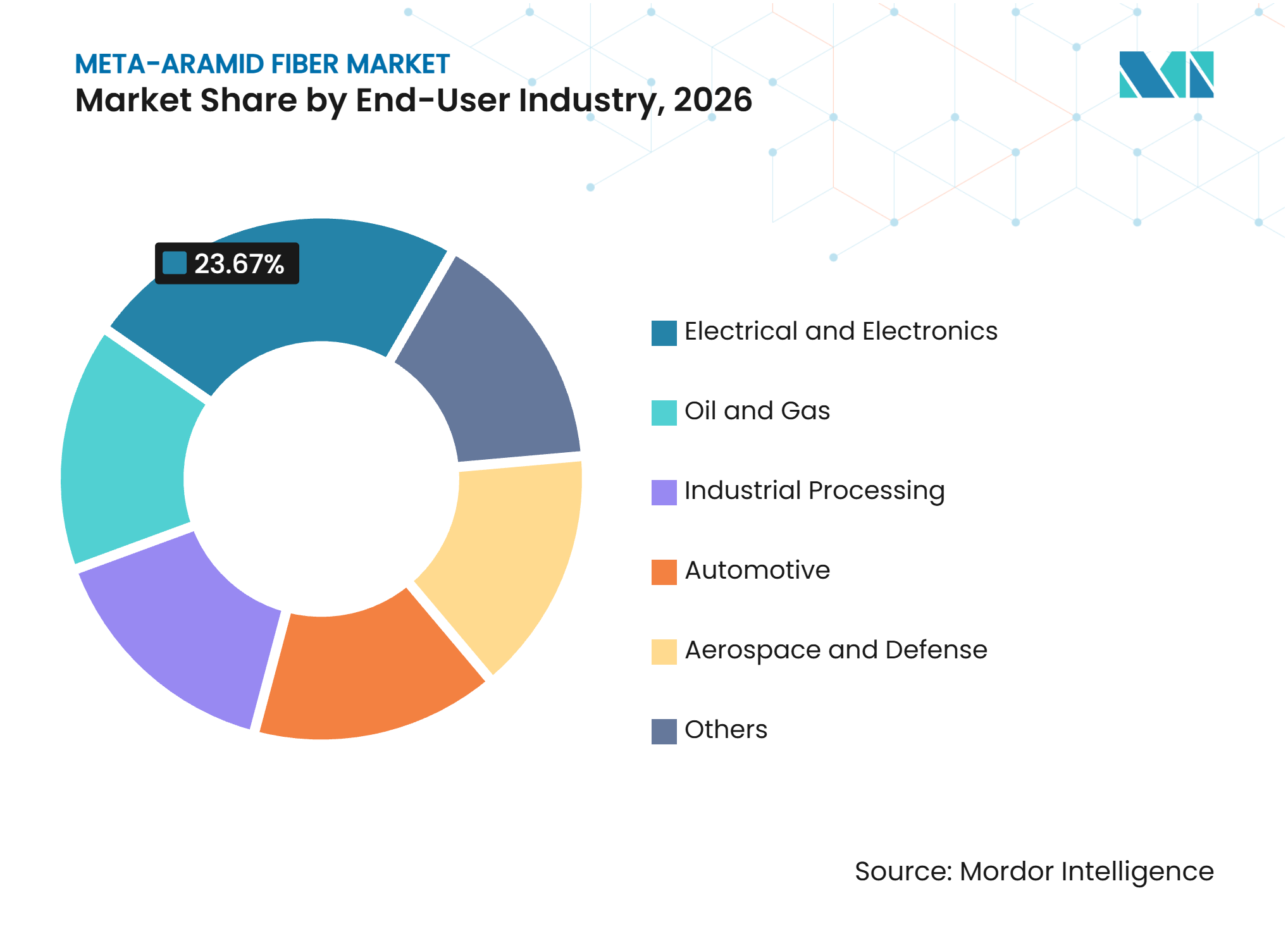
Electrical and Electronics Combines Scale and GrowthElectrical and electronics held 23.67% of global revenue in 2026. This segment is also forecast to record the highest CAGR at 8.81% through 2032. The meta-aramid fiber market serves this segment through power transformers, EV drive motors, battery thermal management, switchgear, and grid equipment. These uses require different product forms, including paper, sheet, pulp, and fiber. IEC thermal-evaluation guidance provides a relevant compliance reference for electrical insulation systems.
Automotive manufacturers use meta-aramid in turbo hoses, brake pads, gaskets, and thermal barrier films. Kolon Industries stated in April 2025 that aramid pulp-reinforced brake pads and gaskets remain part of its mobility-materials business. Aerospace and defense buyers value qualification history and long-term supply commitments. EN 6049-009:2025 supports the use of meta-aramid sleeves to protect aerospace electrical cables. Oil and gas and industrial processing users require protective apparel and high-temperature filtration products that meet safety requirements.

Geography Analysis
Asia-Pacific: Scale and Growth Occur Together
Asia-Pacific held 35.19% of regional revenue in 2026 and is forecast to grow at an 8.62% CAGR through 2032. The meta-aramid fiber market in the region is supported by grid modernization, EV production, and safety requirements across China, India, South Korea, and Japan. China had 38,000 tons of annual domestic meta-aramid capacity by 2025. Yantai Tayho reported 16,000 tons of meta-aramid capacity and stated that it held 25% of global capacity. Inner Mongolia Fengshengtai launched a 3,000-ton Phase I meta-aramid line in June 2025.
North America: Regulatory Intensity Sustains Demand Amid Supply Shifts
North America relies on established protective-equipment rules, including OSHA 1910.269, NFPA 70E, and ASTM F1506-25. These compliance requirements sustain demand for meta-aramid fiber in inherently flame-resistant fabrics for utilities and industrial workplaces. Arclin agreed in August 2025 to acquire DuPont's Aramids business, including the Nomex brand, for USD 1.8 billion. DuPont reported USD 1.3 billion in 2024 net sales for the business, along with 5 manufacturing sites and 1,900 employees. The acquirer identified aerospace, electrical infrastructure, EV, and defense applications as growth priorities.
Regional Divergence Shapes Europe, South America, and MEA
Europe applies the EU Industrial Emissions Directive to industrial facilities, reinforcing demand for filtration media. The European meta-aramid fiber market is also influenced by the Ecodesign for Sustainable Products Regulation and its sustainability framework. Germany and Nordic countries support filtration demand from cement, waste incineration, and steel operations. Kermel introduced UV-stable fibers in December 2025 that retained more than 90% of their tensile strength after prolonged UV exposure. Brazil supports South American demand through protective apparel for petrochemical, mining, and utility workers, while Saudi Arabian petrochemicals, South African mining, and Sub-Saharan grid expansion support demand in the Middle East and Africa.
Competitive Landscape
Market Concentration
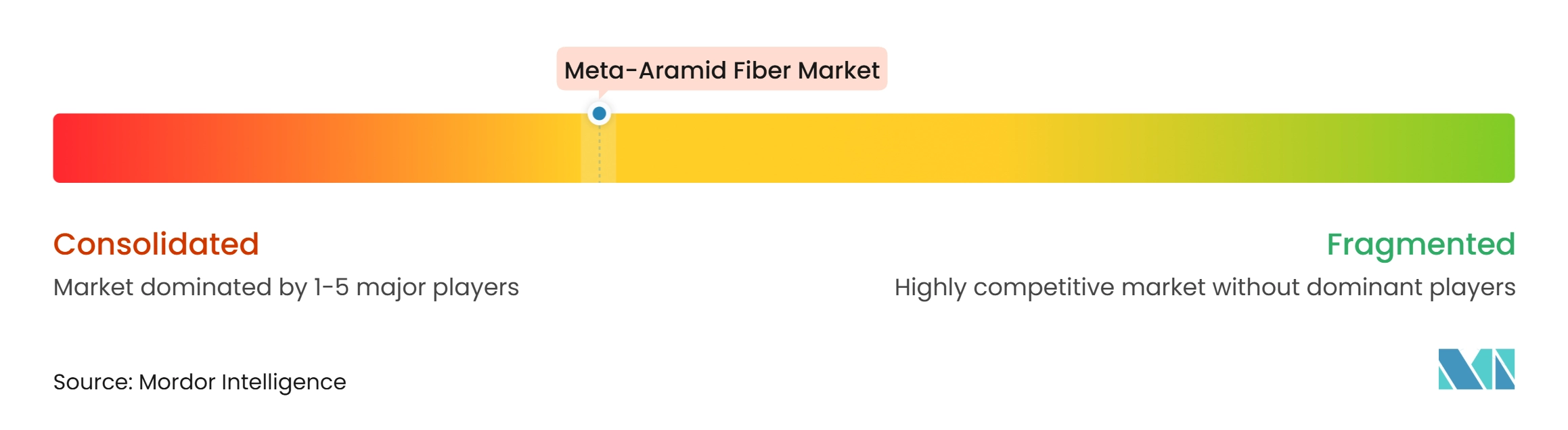
The meta-aramid fiber market is moderately consolidated, with established suppliers retaining advantages in polymer synthesis, qualification history, and manufacturing scale. Arclin agreed to acquire DuPont's Aramids business and its Nomex brand in August 2025. Teijin remains a major established supplier, while Yantai Tayho reports holding 25% of global meta-aramid capacity. New Chinese suppliers are increasing competitive pressure on standard filter and fabric grades, encouraging incumbents to focus on grades that require engineering support and lengthy approvals.
Teijin's 2025 restructuring included JPY 48.4 billion (~USD 0.30 billion) of fixed-asset impairment and a workforce reduction of more than 400 people. The company also formed a joint venture in March 2025 for meta-aramid fiber-reinforced cable material for floating offshore wind transmission. Toray Advanced Materials Korea began operating an expanded meta-aramid raw-yarn facility in September 2025, bringing capacity to 5,400 tons. The facility serves demand for naval, military, EV motor, and ultra-high-voltage transformer applications. Teijin has also advanced dope-dyed meta-aramid products for specialized fabric uses.
Closed-loop recycling remains a strategic gap, as end-of-life collection and processing are still limited. Teijin commercialized fiber-to-fiber recycled aramid for tire reinforcement in June 2025. EV battery separator coatings represent another technical opportunity, with suppliers pursuing materials with stronger oxidation resistance and dielectric performance. ISO 9001 and AS9100D remain baseline certifications for aerospace and defense supply chains.
Meta-Aramid Fiber Industry Leaders
-
ARCLIN
-
TEIJIN LIMITED
-
Yantai Tayho Advanced Materials Co., Ltd.
-
Toray Advanced Materials Korea Inc.
-
Huvis Corp.
- *Disclaimer: Major Players sorted in no particular order
Meta-Aramid Fiber Market Companies Covered in this Report
- ARCLIN
- Aramid Hpm, LLC
- China National Bluestar (Group) Co., Ltd.
- Huvis Corp.
- Hyosung Corporation
- Kermel
- Kolon Industries, Inc.
- Labon
- Lydall, Inc.
- Pro-Systems SpA
- SRO Group (China) Ltd.
- TEIJIN LIMITED
- Toray Advanced Materials Korea Inc.
- X-FIPER SEO
- Yantai Tayho Advanced Materials Co., Ltd.
Recent Industry Developments in Meta-Aramid Fiber Market
- September 2025: Toray Advanced Materials Korea commenced full operations at an expanded eco-friendly meta-aramid fiber raw yarn production facility, bringing total annual capacity to 5,400 tons. The dope-dyed product line, used in naval and military uniform fabrics, has been commercialized since 2021 and is being expanded into the EV drive motor and ultra-high-voltage transformer markets.
- August 2025: Arclin entered a definitive agreement to acquire DuPont's Aramids business, including the Kevlar and Nomex brands, for approximately USD 1.8 billion. The transaction closed in Q1 2026, transferring the world's largest meta-aramid fiber producer to a new owner that has stated plans to expand into aerospace, electrical infrastructure, EV, and defense applications.
Global Meta-Aramid Fiber Market Report Scope
Meta-aramid fiber is a synthetic, high-temperature-resistant, and flame-retardant aromatic polyamide. It is produced by the polymerization of meta-phenylenediamine and isophthaloyl chloride, yielding a fiber with exceptional thermal stability, chemical resistance, and mechanical strength. These properties make meta-aramid fiber suitable for applications in protective clothing, electrical insulation, filtration, and industrial reinforcement.
The meta-aramid fiber market is segmented by type, application, end-user industry, and geography. By type, the market is segmented into staple, filament, paper, and others. By application, the market is segmented into nonwoven bag filter, protective apparel, turbo hose, electrical insulation, honeycomb reinforcement, and others. By end-user industry, the market is segmented into automotive, aerospace and defense, electrical and electronics, oil and gas, industrial processing, and others. The report also covers market sizes and forecasts for meta-aramid fiber across 15 countries in major regions. The market sizes and forecasts are provided in terms of value (USD).
Segmentation Overview
| Staple |
| Filament |
| Paper |
| Others |
| Nonwoven Bag Filter |
| Protective Apparel |
| Turbo Hose |
| Electrical Insulation |
| Honeycomb Reinforcement |
| Others |
| Automotive |
| Aerospace and Defense |
| Electrical and Electronics |
| Oil and Gas |
| Industrial Processing |
| Others |
| Asia-Pacific | China |
| India | |
| Japan | |
| South Korea | |
| ASEAN Countries | |
| Rest of Asia-Pacific | |
| North America | United States |
| Canada | |
| Mexico | |
| Europe | Germany |
| United Kingdom | |
| France | |
| Italy | |
| NORDIC Countries | |
| Rest of Europe | |
| South America | Brazil |
| Argentina | |
| Rest of South America | |
| Middle East and Africa | Saudi Arabia |
| South Africa | |
| Rest of Middle East and Africa |
| By Type | Staple | |
| Filament | ||
| Paper | ||
| Others | ||
| By Application | Nonwoven Bag Filter | |
| Protective Apparel | ||
| Turbo Hose | ||
| Electrical Insulation | ||
| Honeycomb Reinforcement | ||
| Others | ||
| By End-User Industry | Automotive | |
| Aerospace and Defense | ||
| Electrical and Electronics | ||
| Oil and Gas | ||
| Industrial Processing | ||
| Others | ||
| By Geography | Asia-Pacific | China |
| India | ||
| Japan | ||
| South Korea | ||
| ASEAN Countries | ||
| Rest of Asia-Pacific | ||
| North America | United States | |
| Canada | ||
| Mexico | ||
| Europe | Germany | |
| United Kingdom | ||
| France | ||
| Italy | ||
| NORDIC Countries | ||
| Rest of Europe | ||
| South America | Brazil | |
| Argentina | ||
| Rest of South America | ||
| Middle East and Africa | Saudi Arabia | |
| South Africa | ||
| Rest of Middle East and Africa | ||
Key Questions Answered in the Report
What is current market size of Meta-Aramid Fiber Market?
The Meta-Aramid Fiber market size was valued at USD 1.57 billion in 2026 and is estimated to grow from USD 1.69 billion in 2027 to USD 2.45 billion by 2032, at a CAGR of 7.67% during the forecast period (2027-2032).
Which meta-aramid fiber type has the largest share?
Staple fiber accounted for 41.34% in 2026 due to its use in protective apparel, filter media, and friction materials. Its processing routes are already established among needlepunching, carding, and wet-laying converters.
Which application is expected to grow fastest?
Electrical insulation is forecast to grow at an 8.36% CAGR through 2032, supported by uses in transformers, Electric Vehicles (EVs), and high-voltage equipment. The segment benefits from higher thermal-class requirements in electrical systems.
Why is meta-aramid used in protective clothing?
Its inherent flame resistance supports compliance with rules and standards for workers exposed to electrical arcs, flames, and heat. This can support replacement demand in utilities, industrial facilities, and oil and gas operations.