
Mesh Nozzle Plates Market Size and Share
Market Overview
| Study Period | 2020 - 2031 |
|---|---|
| Market Size (2026) | USD 12.38 Million |
| Market Size (2031) | USD 17.93 Million |
| Growth Rate (2026 - 2031) | 7.68 % |
| Fastest Growing Market | Asia Pacific |
| Largest Market | North America |
| Market Concentration | Medium |
Major Players *Disclaimer: Major Players sorted in no particular order Image © Mordor Intelligence. Reuse requires attribution under CC BY 4.0. | |
Mesh Nozzle Plates Market Analysis by Mordor Intelligence
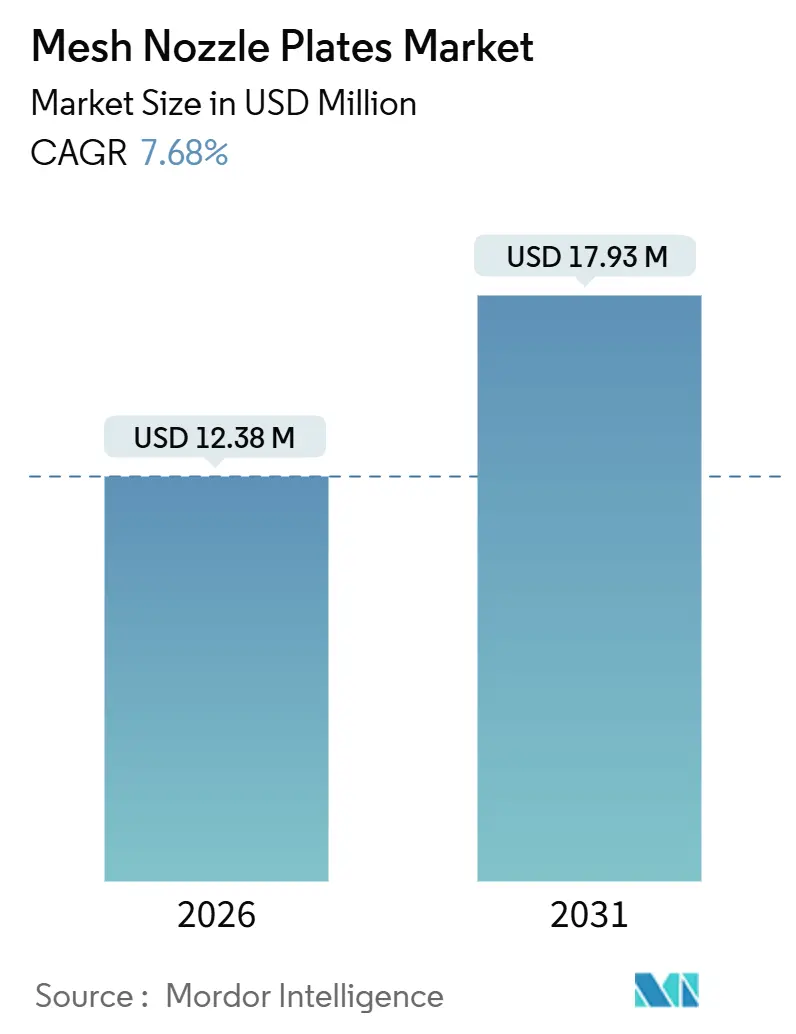
The Mesh Nozzle Plates Market size is estimated at USD 12.38 million in 2026, and is expected to reach USD 17.93 million by 2031, at a CAGR of 7.68% during the forecast period (2026-2031).
Growing demand for biologically friendly aerosolization, rapid adoption of portable nebulizers for home care, and expanding contract manufacturing capacity in the Asia-Pacific are reshaping competitive dynamics. Device makers are pairing vibrating-mesh architectures with combination-drug approvals, while investments in cleanroom electroforming and high-speed laser drilling are driving aperture densities past 7,000 holes per square centimeter, doubling output without sacrificing droplet uniformity. Meanwhile, cost-sensitive health systems are catalyzing the development of single-use polymer variants that reduce per-unit pricing to below USD 2 and eliminate reprocessing labor. The interplay of precision manufacturing, regulatory tightening, and shifting care settings keeps the mesh nozzle plates market on a steady upward trajectory.
Key Report Takeaways
- By material, stainless steel captured 41.45% of the mesh nozzle plates market share in 2025, while polymer plates are forecast to expand at a 9.54% CAGR through 2031.
- By end user, hospitals led the market with 36.54% of the mesh nozzle plate market share in 2025; medical device manufacturers are advancing at a 9.87% CAGR through 2031.
- By application, medical device manufacturing commanded 44.56% of the mesh nozzle plates market share in 2025, and wound care devices are projected to grow at a 10.23% CAGR through 2031.
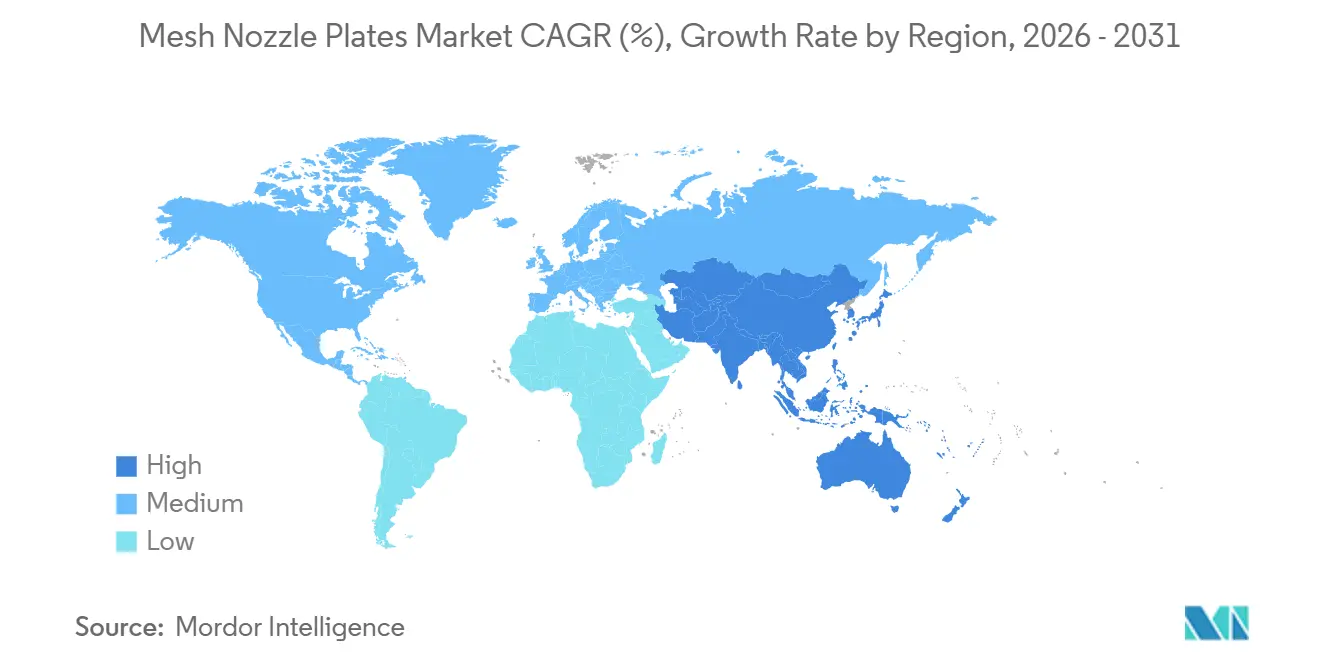
- By geography, North America accounted for 44.76% of the mesh nozzle plates market size in 2025, whereas Asia-Pacific is set to register an 8.54% CAGR between 2026 and 2031.
Note: Market size and forecast figures in this report are generated using Mordor Intelligence’s proprietary estimation framework, updated with the latest available data and insights as of January 2026.
Market Trends and Insights
Drivers Impact Analysis of Mesh Nozzle Plates Market*
| Driver | (~) % Impact on CAGR Forecast | Geographic Relevance | Impact Timeline |
|---|---|---|---|
| Growing demand for precise drug delivery systems | +2.1% | Global, with concentration in North America & Europe | Medium term (2-4 years) |
| Increasing adoption of advanced medical devices | +1.8% | APAC core, spill-over to MEA | Short term (≤ 2 years) |
| Rising prevalence of chronic diseases requiring targeted therapies | +1.5% | Global | Long term (≥ 4 years) |
| Technological advancements in mesh fabrication | +1.2% | North America & EU, early adoption in China | Medium term (2-4 years) |
| Rising investment in healthcare infrastructure | +0.7% | APAC, MEA, Latin America | Long term (≥ 4 years) |
| Growing focus on minimally invasive procedures | +0.4% | Global, led by North America & Europe | Medium term (2-4 years) |
| Source: Mordor Intelligence | |||
Growing Demand for Precise Drug Delivery Systems
Biologics accounted for more than 30% of investigational new drug applications in 2026, and their sensitivity to shear and heat has accelerated the shift from jet nebulizers to vibrating-mesh designs that generate aerosols with mass median aerodynamic diameters below 5 micrometers. Hospitals sourced 62% of their nebulizers from mesh platforms in 2025, up from 48% in 2022, a shift driven by pulmonologists who view dose consistency as essential, as even a 10% deviation can waste thousands of dollars on monoclonal antibody therapies. The FDA’s 2024 guidance on combination products now requires nozzle-level droplet characterization, embedding mesh suppliers deeper into device R&D programs. Reimbursement models are also evolving; U.S. commercial payers classify mesh nebulizers as durable medical equipment and reimburse up to USD 120 per unit, helping offset higher component costs compared with jet systems. As biologics penetrate chronic respiratory and endocrine pipelines, demand for precision aerosols is expected to rise in tandem with drug approvals.
Increasing Adoption of Advanced Medical Devices
Asia-Pacific added 47 new ISO 13485-certified device plants in 2025 alone, creating a ready customer base for local nozzle-plate producers. Veco reported that the region’s share of its electroformed shipments climbed to 40% in 2025 from 28% in 2023, underscoring a manufacturing pivot eastward. Vertical integration allows Chinese and Indian original-equipment manufacturers to avoid tariffs while tightening intellectual-property control on droplet-size distributions. Western suppliers still dominate sub-3-micrometer aperture work, but Asian vendors are scaling 5-to-7-micrometer commodity plates at prices 30% below European equivalents, expanding the market for mesh nozzle plates in budget-constrained settings.
Rising Prevalence of Chronic Diseases Requiring Targeted Therapies
Non-communicable diseases claimed 41 million lives in 2024, with respiratory illness and diabetes accounting for 15 million deaths. Diabetes now affects 830 million adults, and more than 537 million require daily hormone therapy that could migrate to inhalable formats if mesh aerosol bioavailability meets pharmacokinetic thresholds[1]. Chronic obstructive pulmonary disease burdens 392 million patients worldwide, many of whom rely on portable mesh devices that can be operated during commutes. Cost analyses show reusable vibrating-mesh nebulizers deliver per-treatment costs under USD 0.15 after 500 cycles, half the price of jet alternatives, favoring adoption where out-of-pocket spending remains high.
Technological Advancements in Mesh Fabrication
Prototype lead times have fallen from 12 weeks in 2022 to 4 weeks in 2025, thanks to laser direct-imaging electroforming and high-speed photochemical etching. Temicon’s semi-automated line inspects 100% of parts and holds ±1 micrometer positional tolerances across 7,000 holes per square centimeter, a capability deemed unattainable only three years earlier. Next-generation plates achieve aerosol outputs of 0.5 milliliters per minute at unchanged drive voltages, extending battery life in handheld devices critical to emergency medical services kits.
Restraints Impact Analysis of Mesh Nozzle Plates Market*
| Restraint | (~) % Impact on CAGR Forecast | Geographic Relevance | Impact Timeline |
|---|---|---|---|
| High Manufacturing Costs | -1.4% | Global, acute in emerging markets | Short term (≤ 2 years) |
| Limited Awareness About Mesh Nozzle Benefits | -0.8% | APAC, MEA, Latin America | Medium term (2-4 years) |
| Stringent Regulatory Approvals | -0.6% | North America & EU | Long term (≥ 4 years) |
| Competition From Alternative Technologies | -0.5% | Global | Medium term (2-4 years) |
| Source: Mordor Intelligence | |||
High Manufacturing Costs
Electroforming stainless-steel plates with 5,000 sub-3-micrometer apertures requires up to 24 hours of tank time and multiple post-processing steps, pushing costs above USD 8 per unit at volumes below 50,000 pieces. Tooling amortization adds USD 2-4 more, and break-even lots start near 20,000, excluding smaller device firms from in-house fabrication. Asian suppliers counter with relaxed ±2 micrometer tolerances that bring unit costs into the USD 3-5 band, but the trade-off is wider droplet distribution that may erode lung deposition efficacy in premium inhalers.
Limited Awareness About Mesh Nozzle Benefits
Surveys in Southeast Asia and Sub-Saharan Africa show 68% of pulmonologists still view mesh devices as premium branding rather than performance upgrades. The WHO Essential Medicines List references jet nebulizers as the procurement baseline, and many generic formulations remain suspension-based, precluding mesh compatibility. Without localized comparative trials, adoption lags in price-sensitive markets despite lower life-cycle costs.
*Our forecasts treat driver/restraint impacts as directional, not additive. The impact forecasts reflect baseline growth, mix effects, and variable interactions.
Mesh Nozzle Plates Market Segment Analysis
By Material:
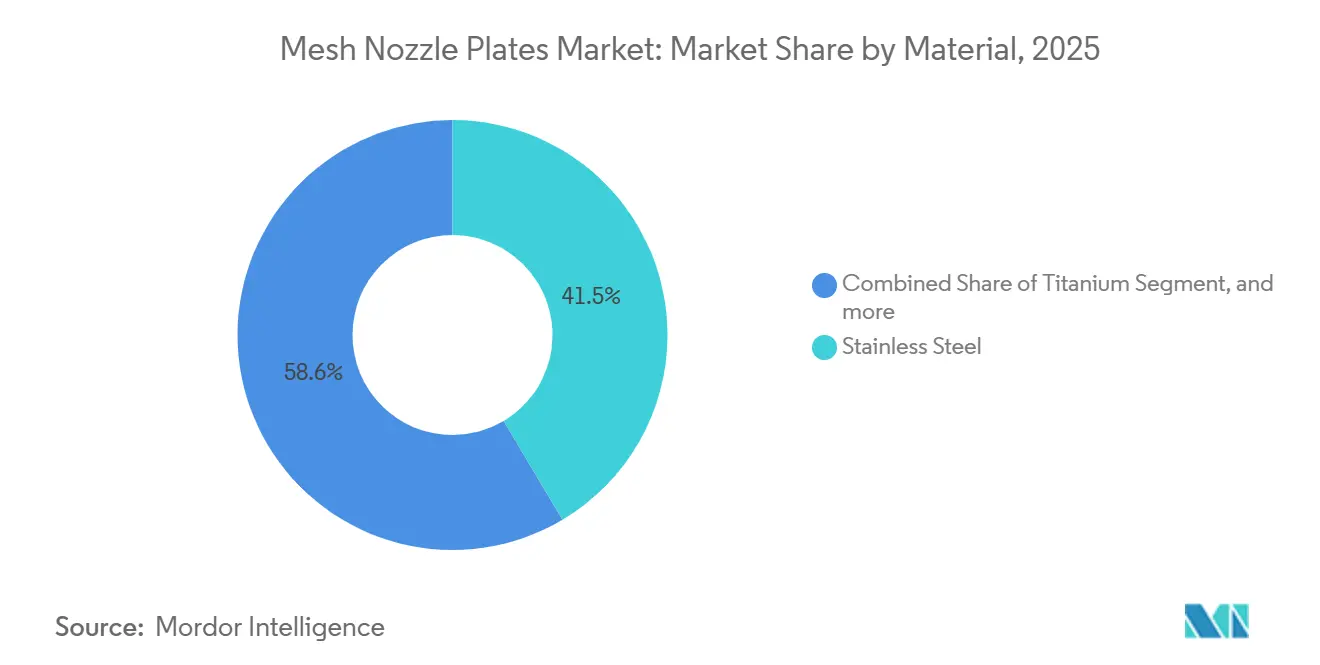
Stainless Steel Anchors Share, Polymers Gain on DisposabilityStainless steel held 41.45% of mesh nozzle plates market share in 2025, reflecting hospital preferences for autoclavable, reusable devices that amortize costs across 3-5 years. Its corrosion resistance permits exposure to acidic formulations down to pH 3.5, making it the default choice for chronic respiratory-care kits. Titanium remains a niche, specified in implantable or ophthalmic devices that demand nickel-free alloys. At the same time, ceramic plates fill high-temperature sterilization niches yet comprise under 5% of shipments due to brittleness.
Polymer plates are forecast to grow at a 9.54% CAGR, driven by single-use device architectures that eliminate cleaning validation. Injection-molded PEEK and liquid-crystal polymers reach per-unit costs below USD 2, enabling budget nebulizers for home use. Aperture tolerances hover at ±3 micrometers—wider than metal plates—but computational fluid dynamics now compensates by optimizing aperture spacing and vibration waveforms, narrowing deposition efficiency gaps to acceptable clinical ranges[2].

By End-User:
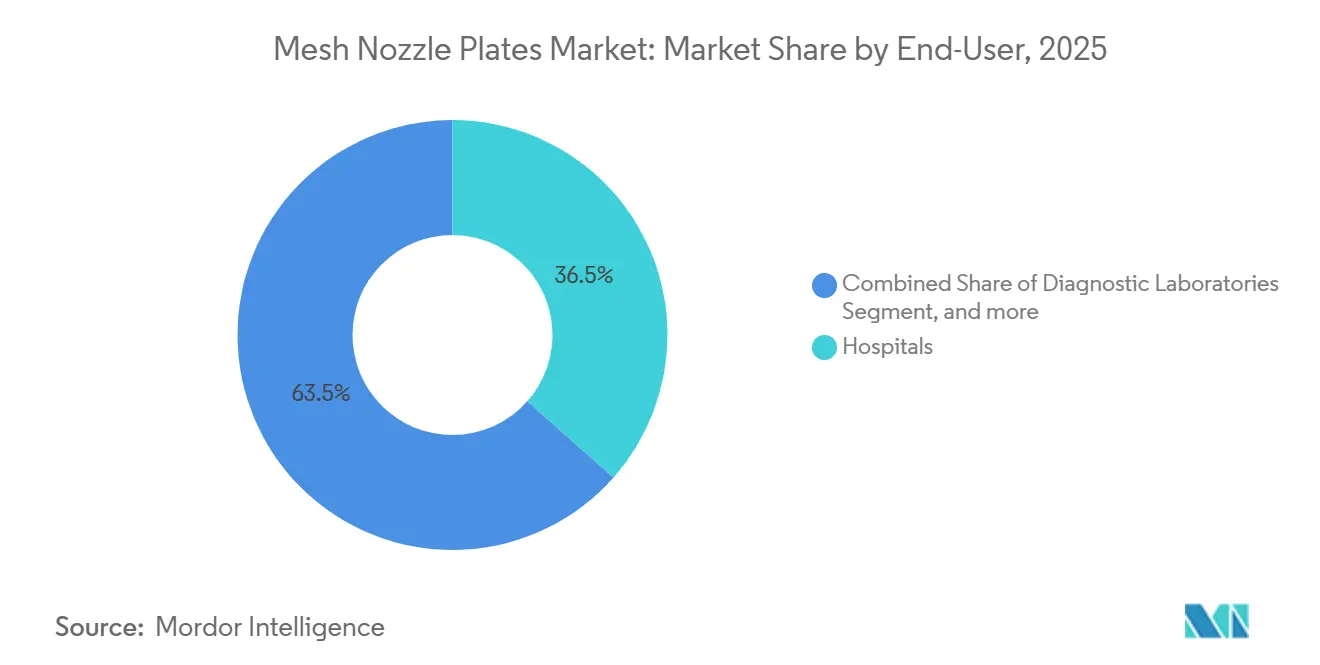
Hospitals Lead, Device Manufacturers Accelerate In-House SourcingHospitals captured 36.54% of the mesh nozzle plate market in 2025, supported by service contracts that bundle annual replacements into USD 200-400 device maintenance packages. Diagnostic labs and research units use mesh atomizers for mass spectrometry sample prep, valuing aerosol uniformity that boosts ionization efficiency.
Medical device manufacturers are projected to grow at a 9.87% CAGR as they backward-integrate precision components. Johnson Matthey’s USD 700 million divestiture of its Medical Device Components business in July 2024 exemplifies the shift, as OEMs acquire fabrication capacity to shorten R&D cycles. Veco’s 2025 co-development program embeds engineers inside customer labs, trading design IP for multiyear volume commitments.
By Application:
Medical Device Manufacturing Dominates, Wound Care SurgesMedical device manufacturing accounted for 44.56% of the mesh nozzle plates market size in 2025, reflecting an installed base of 28 million active vibrating-mesh nebulizers that need new plates every 12-18 months. Surgical irrigation employs mesh plates to mist saline or antiseptics, reducing case times by several minutes. Diagnostic instruments leverage atomizers in breath analysis and antigen tests for precise droplet formation.
Wound care devices will expand at a 10.23% CAGR, as chronic ulcers affect 2.5% of the U.S. population and cost USD 28 billion annually. Micro-spray dressings deliver antimicrobials as 15-25 micrometer droplets, extending dressing change intervals and reducing monthly care costs by USD 150-200. Regulatory pathways vary: the FDA requires combination approvals, while the EMA allows decoupled submissions if drug kinetics remain unchanged.
Geography Analysis
North America Mesh Nozzle Plates Market
North America commanded 44.76% of the mesh nozzle plates market share in 2025, underpinned by the United States’ USD 200 billion device sector and streamlined 510(k) pathways. More than 12 million mesh nebulizers were in active use, generating USD 36 million in plate replacements at ASPs of USD 8-12. Canada’s cystic fibrosis reimbursement policies drove incremental demand, while Mexican nearshoring initiatives added four cleanroom facilities for subassembly work.
EMEA and South America Mesh Nozzle Plates Market
Europe maintained a robust position thanks to Germany, Switzerland, and the Netherlands, where precision electroforming clusters reside. Veco supplies 35% of regional demand, and Temicon specializes in sub-2-micrometer plates for premium inhalers. MDR enforcement increased compliance costs, prompting consolidation and raising entry barriers for smaller firms. The Middle East and Africa rely on imports, with South Africa acting as a modest fabrication node. South America grew slowly amid tariffs and currency volatility that dampen device affordability outside Brazil’s urban centers.
APAC Mesh Nozzle Plates Market
Asia-Pacific is forecast to grow at an 8.54% CAGR, propelled by China’s USD 60 billion device market and India’s production-linked incentives. China commissioned 23 nozzle-plate fabrication lines in 2025, leveraging semiconductor-grade etching assets to cut unit costs to USD 3-5 and win 18% of global exports. India’s domestic brands launched mesh nebulizers priced 40% below multinationals, fueling local plate demand. Japan and South Korea focus on ultra-precision segments such as robotic surgery, commanding USD 20-30 per plate and insulating margins against commodity competition.
Competitive Landscape
The mesh nozzle plates market is moderately fragmented; the top five suppliers held roughly 45-50% share in 2025, leaving ample room for regional specialists and OEM captive lines. Veco and temicon anchor Europe’s precision tier, offering sub-3-micrometer tolerances and multi-year co-development contracts. Asian players, including Microbase, Dongguan Cosson, and Informatic Component, run high-volume photochemical etching lines that sacrifice tight tolerances for 30-40% lower pricing, catering to commodity nebulizers. Johnson Matthey’s exit via a USD 700 million sale to Montagu in July 2024 opened contract opportunities for smaller producers.
Technical differentiation revolves around aperture density and fatigue life. Veco’s patented interference-pattern drilling reduces stress concentrations, extending membrane life from 500 to 1,200 cycles and justifying premium pricing in reusable hospital devices. Module suppliers like APC International now ship piezo-actuator-and-plate assemblies that cut bonding failures below 5% and shorten OEM assembly lines by 40%. Should polymer injection molding achieve ±1 micrometer tolerances, the cost advantage of electroformed metal could erode, pressuring established suppliers to shift toward highly custom or implantable segments of the mesh nozzle plate market.
Mesh Nozzle Plates Industry Leaders
-
temicon GmbH
-
Veco B.V.
-
Microbase Technology Corp.
-
Aerogen
-
OMRON Healthcare, Inc
- *Disclaimer: Major Players sorted in no particular order

Mesh Nozzle Plates Market Companies Covered in this Report
- temicon GmbH
- Veco B.V.
- MicroBase Technology Corp
- Aerogen
- OMRON Healthcare, Inc
- Tekceleo
- Piezo Direct
- APC International, Ltd.
Global Mesh Nozzle Plates Market Report Scope
As per the scope of the report, mesh nozzle plates in medical devices are specialized components featuring a fine mesh or grid that controls the flow or dispersion of fluids or gases. They ensure precise, uniform distribution, which is crucial for applications such as drug delivery, respiratory support, and sterilization. Their design enhances accuracy, safety, and efficiency in medical procedures.
The Mesh Nozzle Plates Market is Segmented by Material (Stainless Steel, Titanium, Polymer-Based Materials, and Ceramic), End-User (Hospitals, Diagnostic Laboratories, Medical Device Manufacturers, and Research & Development Labs), Application (Medical Device Manufacturing, Surgical Equipment, Diagnostic Instruments, and Wound Care And Skin Treatment Devices), and Geography (North America, Europe, Asia-Pacific, and Rest of the World). The market report also covers the estimated market sizes and trends for 17 countries across major regions globally. The report offers the value (in USD million) for the above segments.
Segmentation Overview
| Stainless Steel |
| Titanium |
| Polymer-Based Materials |
| Ceramic |
| Hospitals |
| Diagnostic Laboratories |
| Medical Device Manufacturers |
| Research & Development Labs |
| Medical Device Manufacturing |
| Surgical Equipment |
| Diagnostic Instruments |
| Wound Care And Skin Treatment Devices |
| North America | United States |
| Canada | |
| Mexico | |
| Europe | Germany |
| United Kingdom | |
| France | |
| Italy | |
| Spain | |
| Rest Of Europe | |
| Asia-Pacific | China |
| Japan | |
| India | |
| Australia | |
| South Korea | |
| Rest Of Asia-Pacific | |
| Middle East & Africa | GCC |
| South Africa | |
| Rest Of Middle East & Africa | |
| South America | Brazil |
| Argentina | |
| Rest Of South America |
| By Material | Stainless Steel | |
| Titanium | ||
| Polymer-Based Materials | ||
| Ceramic | ||
| By End-User | Hospitals | |
| Diagnostic Laboratories | ||
| Medical Device Manufacturers | ||
| Research & Development Labs | ||
| By Application | Medical Device Manufacturing | |
| Surgical Equipment | ||
| Diagnostic Instruments | ||
| Wound Care And Skin Treatment Devices | ||
| Geography | North America | United States |
| Canada | ||
| Mexico | ||
| Europe | Germany | |
| United Kingdom | ||
| France | ||
| Italy | ||
| Spain | ||
| Rest Of Europe | ||
| Asia-Pacific | China | |
| Japan | ||
| India | ||
| Australia | ||
| South Korea | ||
| Rest Of Asia-Pacific | ||
| Middle East & Africa | GCC | |
| South Africa | ||
| Rest Of Middle East & Africa | ||
| South America | Brazil | |
| Argentina | ||
| Rest Of South America | ||
Key Questions Answered in the Report
What is the global value of mesh nozzle plates in 2026 and how much is it expected to reach by 2031?
Revenue stands at USD 12.38 million in 2026 and is projected to rise to USD 17.93 million by 2031.
Which material currently dominates unit shipments of nozzle plates?
Stainless steel leads with 41.45% share because it tolerates repeated autoclave cycles and resists corrosion from acidic formulations.
Which region is expanding fastest in precision nozzle-component demand?
Asia-Pacific is advancing at an 8.54% CAGR, driven by ChinaÕs new photochemical-etching lines and IndiaÕs production-linked incentives.
Why are polymer variants gaining popularity in new devices?
Injection-molded polymers priced under USD 2 per plate enable single-use nebulizers that avoid cleaning validation and reduce ownership costs for home care.
Who are the principal suppliers of high-precision mesh plates?
Veco B.V., temicon GmbH, Microbase Technology, Dongguan Cosson, and Informatic Component collectively hold nearly half of global shipments.
What regulatory pathway applies to mesh plates integrated into U.S. combination products?
They fall under Class II 510(k) rules, requiring ISO 10993 biocompatibility data and three-lot aerosol validation before clearance.