
Medical Shoe Covers Market Size and Share
Market Overview
| Study Period | 2020 - 2031 |
|---|---|
| Market Size (2026) | USD 642.98 Million |
| Market Size (2031) | USD 792.83 Million |
| Growth Rate (2026 - 2031) | 4.28 % |
| Fastest Growing Market | Asia Pacific |
| Largest Market | North America |
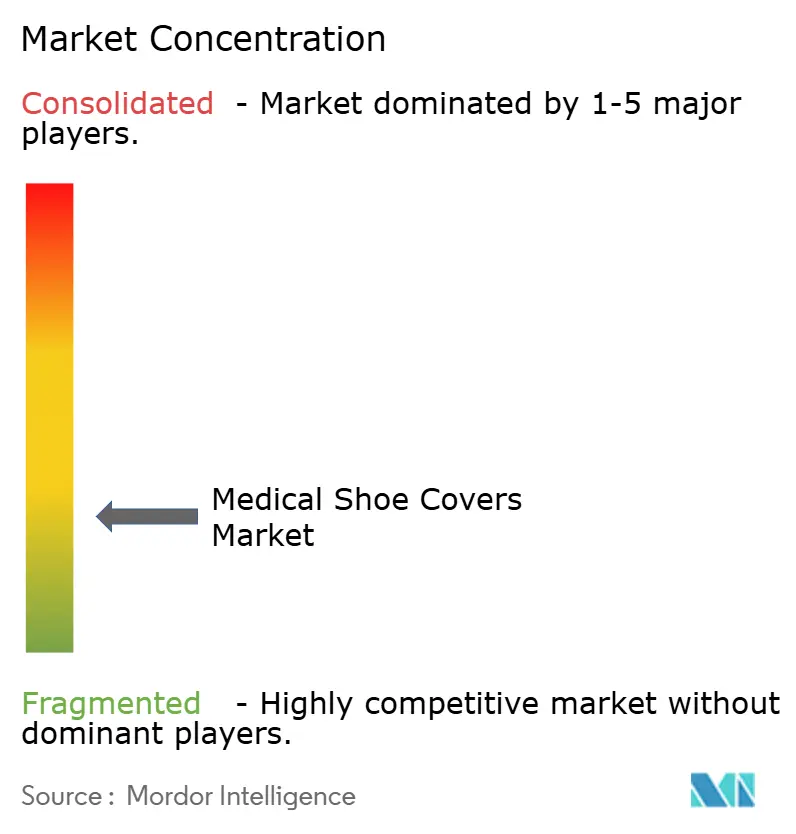
| Market Concentration | Low |
Major Players *Disclaimer: Major Players sorted in no particular order Image © Mordor Intelligence. Reuse requires attribution under CC BY 4.0. | |
Medical Shoe Covers Market Analysis by Mordor Intelligence
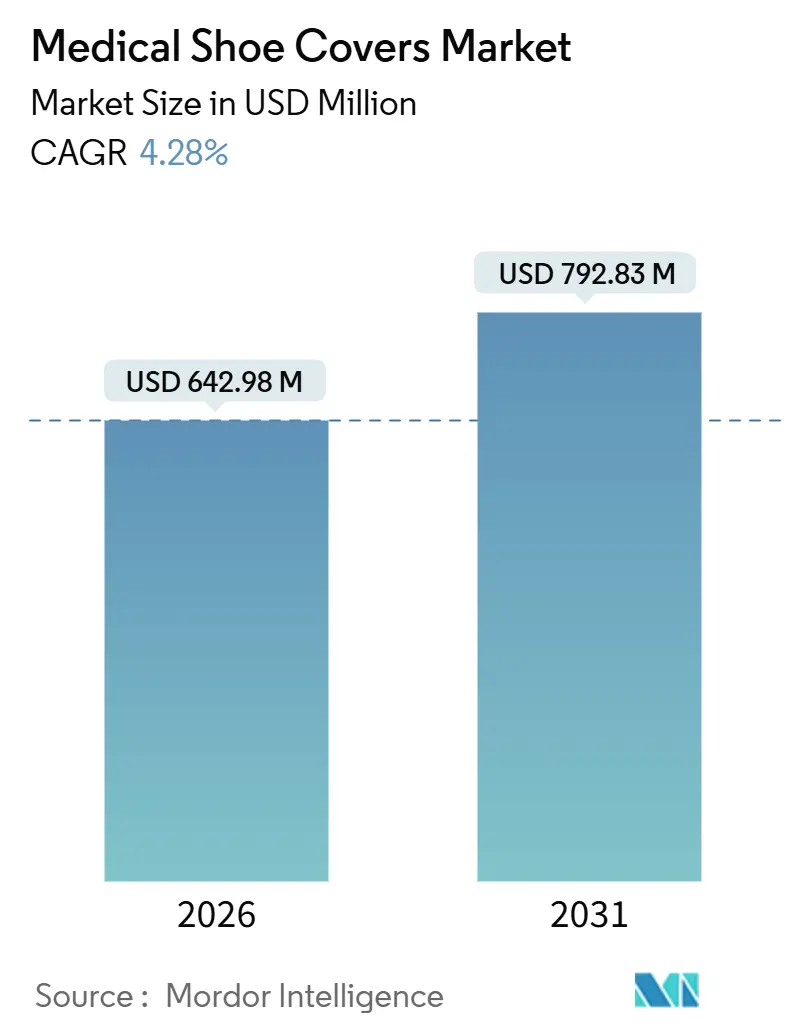
The Medical Shoe Covers Market size is estimated at USD 642.98 million in 2026, and is expected to reach USD 792.83 million by 2031, at a CAGR of 4.28% during the forecast period (2026-2031).
Steady demand arises from infection-control mandates, rising surgical volumes, and an ongoing shift toward digital procurement. North American hospitals still consume the most units because Joint Commission audits emphasize environmental sterility, yet Asia-Pacific now delivers the fastest incremental growth, as China, India, and ASEAN members open tertiary facilities that must meet ISO 13485 standards. Procurement teams rely on B2B e-commerce portals to unlock 8%-12% unit-price savings, but raw-material cost spikes, such as polypropylene rising 18% in 2025, continue to compress converter margins. Environmental regulation is another speed limiter: the European Union’s Single-Use Plastics Directive, effective 2024, obliges suppliers to introduce bio-attributed blends or face tender exclusion.
Key Report Takeaways
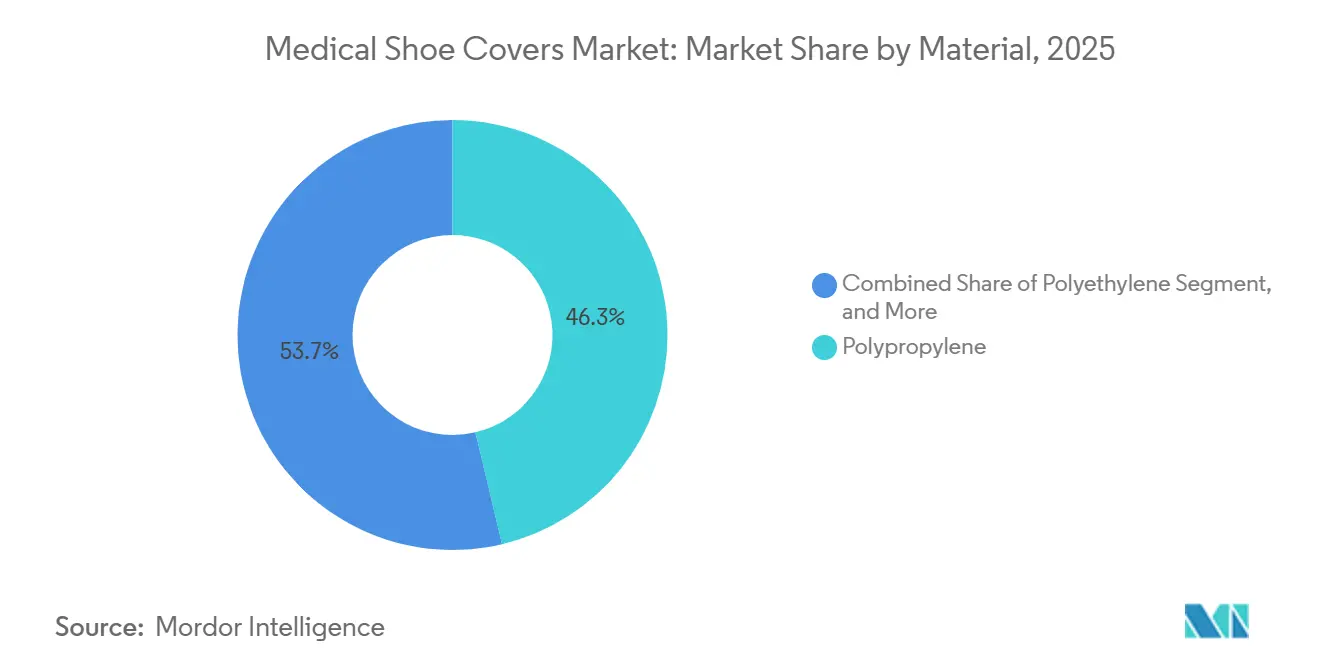
- By material, polypropylene led with 46.29% of the medical shoe covers market share in 2025, while nylon variants are advancing at a 5.43% CAGR through 2031.
- By product type, disposable formats accounted for 84.73% of the medical shoe covers market in 2025; reusable covers are forecast to expand at a 5.96% CAGR through 2031.
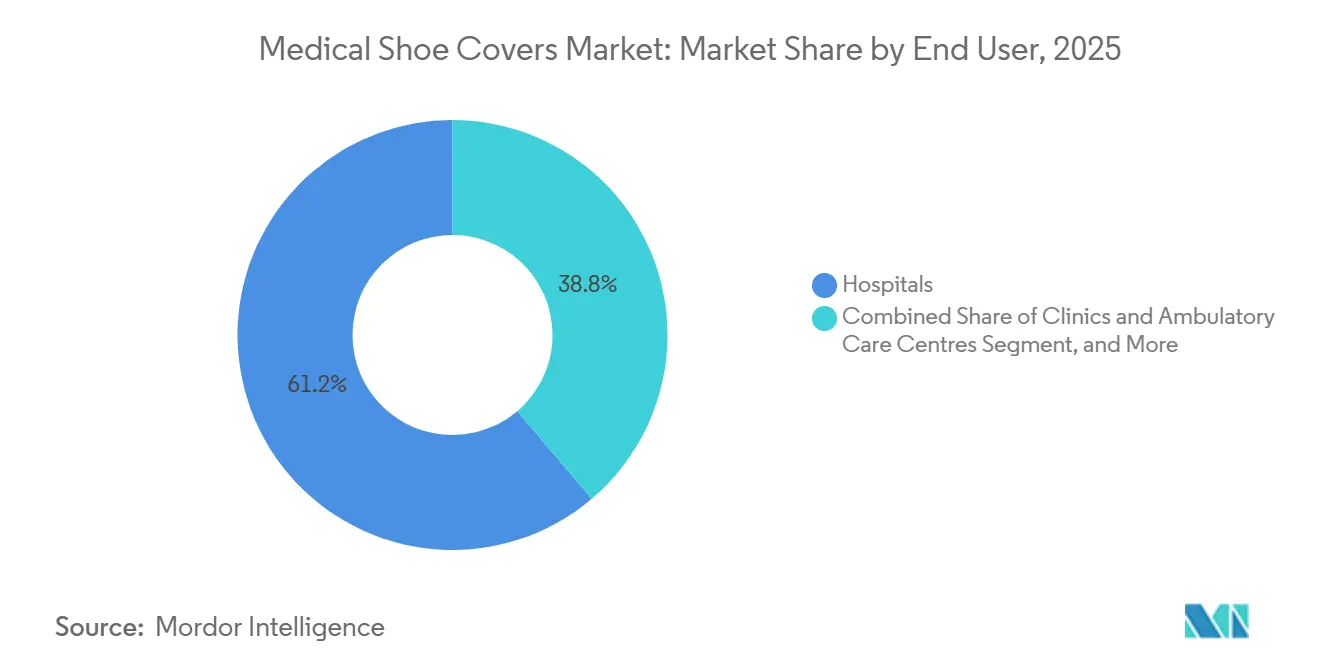
- By end user, hospitals accounted for 61.24% of revenue share in 2025, whereas clinics and ambulatory centers recorded the highest projected CAGR of 7.42% through 2031.
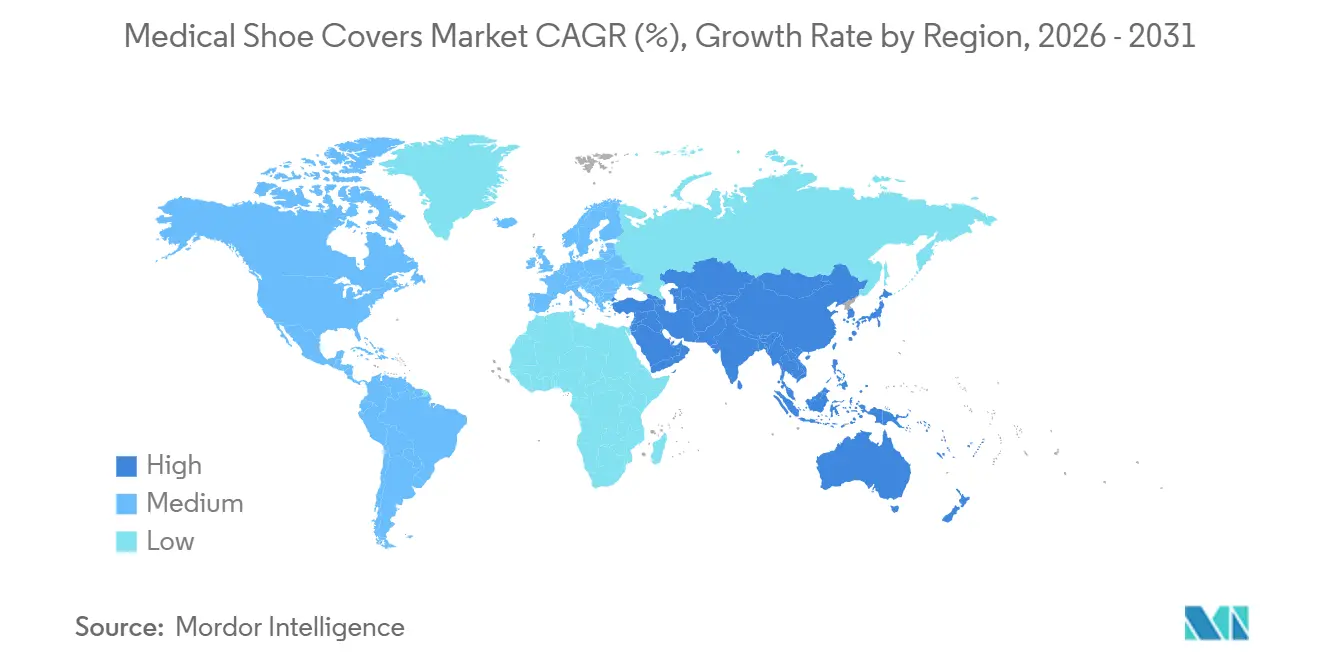
- By geography, North America accounted for a 38.63% share of the medical shoe covers market in 2025, but Asia-Pacific is set to grow at a 7.86% CAGR during the outlook period.
Note: Market size and forecast figures in this report are generated using Mordor Intelligence’s proprietary estimation framework, updated with the latest available data and insights as of January 2026.
Market Trends and Insights
Drivers Impact Analysis of Medical Shoe Covers Market*
| Driver | (~) % Impact on CAGR Forecast | Geographic Relevance | Impact Timeline |
|---|---|---|---|
| Rising Incidence of Healthcare-Associated Infections | +0.9% | Global, strong focus in North America and Europe | Medium term (2-4 years) |
| Increase in Global Surgical Procedure Volumes | +1.1% | Global, led by Asia-Pacific and Middle East | Long term (≥4 years) |
| Expansion of Healthcare Infrastructure in Emerging Economies | +0.8% | Asia-Pacific, Middle East & Africa, South America | Long term (≥4 years) |
| Adoption of Automated Shoe-Cover Dispensers in Operating Suites | +0.5% | North America, Europe, select APAC metros | Short term (≤2 years) |
| Growth of B2B E-Commerce Procurement Platforms | +0.6% | Global, early adoption in North America and Europe | Medium term (2-4 years) |
| Shift Toward Biodegradable Polymers | +0.4% | Europe, California, Canada | Medium term (2-4 years) |
| Source: Mordor Intelligence | |||
Rising Incidence of Healthcare-Associated Infections
The Centers for Disease Control and Prevention estimates that 1 in 31 U.S. inpatients acquires at least one HAI every day, generating USD 28.4 billion in direct medical costs.[1] Footwear is a known transmission vector, and hospitals now deploy mandatory shoe-cover protocols backed by real-time environmental surveillance. The European Centre for Disease Prevention and Control noted a 12% rise in surgical-site infections between 2023 and 2025, prompting broader PPE audits that now include footwear. In the Asia-Pacific region, color-coded covers prevent cross-zone traffic and have lifted per-hospital consumption by 22% since early 2024.
Increase in Global Surgical Procedure Volumes
Worldwide surgeries climbed to 421 million in 2025, up from 387 million in 2023, as aging populations and the resumption of elective care drive throughput.[2] China performed 68 million inpatient procedures in 2025 under its Healthy China 2030 program, while Indian hospitals logged 23 million surgeries, buoyed by medical tourism. Ambulatory centers execute a growing share; U.S. facilities completed 28.6 million procedures in 2025, up 14% since 2023. Extended staff rotations per case actually raise shoe-cover consumption by as much as 20%.
Expansion of Healthcare Infrastructure in Emerging Economies
Asia-Pacific governments will invest USD 1.7 trillion in hospitals and equipment by 2030, according to the Asian Development Bank. Saudi Arabia’s Vision 2030 earmarked USD 64 billion for 40 new hospitals in 2025, each of which is to specify disposable or certified reusable covers in sterile zones. Brazil’s Mais Médicos initiative added 12,000 beds over two years, despite ANVISA procurement rules that exclude non-certified imports. Indonesia’s e-tender platform continues to drive aggregate volume even as unit prices moderate.
Adoption of Automated Shoe-Cover Dispensers in Operating Suites
Solventum reported 320 installed automated dispensers by end-2025, delivering a 27% reduction in shoe-cover waste and a 19% increase in audit compliance. Badge-based access logs dispense events, allowing infection-prevention teams to flag anomalies. The capital cost of USD 8,000-12,000 returns the investment in 18-24 months for centers performing more than 4,000 procedures a year. Manufacturers are now beta-testing biodegradable-cover compatibility, aligning environmental and infection-control goals.
Restraints Impact Analysis of Medical Shoe Covers Market*
| Restraint | (~) % Impact on CAGR Forecast | Geographic Relevance | Impact Timeline |
|---|---|---|---|
| Volatility in Polypropylene/Polyethylene Prices | -0.7% | Global, acute in Asia-Pacific and Europe | Short term (≤2 years) |
| Regulatory & Public Pressure on Single-Use Plastics | -0.5% | Europe, North America, select APAC markets | Medium term (2-4 years) |
| Penetration of Counterfeit Shoe Covers | -0.3% | Asia-Pacific, Middle East & Africa, South America | Medium term (2-4 years) |
| Staff Non-Compliance Due to Discomfort | -0.2% | Global, higher incidence in high-humidity climates | Long term (≥4 years) |
| Source: Mordor Intelligence | |||
Volatility in Polypropylene/Polyethylene Prices
Spot polypropylene climbed from USD 1,020 to USD 1,203 per metric ton during 2025, an 18% surge tied to refinery outages and tighter naphtha supply. Converters with 12-month hospital contracts could not pass through costs, squeezing margins further, a trend Ansell quantified as a 1.8-point hit to its single-use segment in fiscal 2025. Smaller Asian players suffered sporadic feedstock shortages, forcing hospitals to raise safety stock and complicating just-in-time models.
Regulatory & Public Pressure on Single-Use Plastics
Medical disposables account for about 12% of the 5.9 million tons of healthcare waste in the United States.[3] The EU Circular Economy Action Plan calls for a 50% drop in single-use plastic waste by 2030. California’s Senate Bill 54 sets a 25% recycled-content or compostability minimum by 2028. Reusable programs help outpatient areas meet sustainability targets, yet a 6% failure rate after 75 wash cycles, as documented in 2025, tempers use in high-acuity zones.
*Our forecasts treat driver/restraint impacts as directional, not additive. The impact forecasts reflect baseline growth, mix effects, and variable interactions.
Medical Shoe Covers Market Segment Analysis
By Material:
Nylon Gains Ground Through Dispenser CompatibilityPolypropylene retained 46.29% of the medical shoe covers market share in 2025 due to its low unit cost and extensive converter network. Nylon’s 5.43% CAGR reflects superior tear strength that prevents automated-dispenser jams. Non-woven blends with cellulose improve breathability, capturing 14% share, while PVC continues to decline as European tenders exclude phthalate-laden products.
Demand for nylon is highest in North America and Europe, where hospitals are retrofitting entryways with automated units. DuPont’s nylon-6 cover adds textured soles for slip control and withstands 50% higher tensile stress than polypropylene. Bio-based options remain a niche at USD 0.18-0.25 per unit, but EU and California tenders elevate interest. Polyvinyl chloride is fast disappearing as incineration fees rise and sustainability policies tighten.

By Product Type:
Reusables Carve Out Economic NicheDisposable variants accounted for 84.73% of the medical shoe covers market in 2025, underpinning stringent operating-room protocols. Reusable covers, however, post a 5.96% CAGR as laundry contracts bring per-use cost down to USD 0.06 when amortized over 75 cycles. Anti-slip models held 9% volume, gaining adoption in endoscopy and hybrid theaters.
Reusable momentum is anchored in outpatient clinics processing over 500 covers each week. Ansell’s nylon-spandex washable cover, launched in 2025, targets this base and reduces waste-disposal fees that can reach USD 0.03 per disposable unit. Developers now embed thermoplastic rubber particles into soles to achieve a slip coefficient below 0.5, as specified in ASTM F2913. Disposables remain entrenched in high-acuity units where zero-tolerance sterility overrides sustainability ambitions.
By End User:
Ambulatory Centers Drive Fastest ExpansionHospitals delivered 61.24% of 2025 revenue, supported by multi-theater layouts and comprehensive PPE mandates. Clinics and ambulatory centers are rising fastest, at a 7.42% CAGR, as payers shift procedures from inpatient wings to same-day facilities. Nursing homes accounted for 12% of the volume, mainly for wound care and isolation cases.
The ambulatory trend is concrete: U.S. centers ran 28.6 million cases in 2025, led by cataract extraction and total knee replacements. Forty-seven percent of these facilities source at least 60% of disposables via digital platforms, boosting price transparency and automating replenishment. Nursing-home compliance lags at 58%, reflecting staffing constraints, yet diagnostic labs improve adoption due to stricter CLIA inspections.
Geography Analysis
North America Medical Shoe Covers Market
North America commanded a 38.63% share in 2025, fueled by the United States’ 5,564 registered hospitals and Canada’s province-wide volume contracts with ISO-compliant vendors. Mexico’s private sector adopts disposable covers to secure international accreditation and attract medical tourists. Regional growth moderates to 3.1% CAGR through 2031 as hospital penetration saturates and outpatient clinics pivot toward reusable options.
APAC Medical Shoe Covers Market
Asia-Pacific is the primary growth engine, with a 7.86% CAGR. China added 1,240 hospitals in 2025 and will mandate automated dispensers in tertiary hospitals by December 2026. India’s chains standardize protocols for NABH accreditation, while Japan’s cultural preference for reusables restrains disposable uptake to a 2.9% CAGR. Australia and South Korea are piloting biodegradable covers in government-funded programs to assess life-cycle costs and waste diversion.
EMEA and South America Medical Shoe Covers Market
Germany’s 1,914 acute hospitals consumed 420 million units, driven by DRG quality incentives. The United Kingdom updated guidance in March 2025, lifting procurement by 14% year-on-year. The Middle East & Africa market is driven by Saudi investment but fights counterfeit influx, while South America’s growth centers on Brazil and Argentina, aided by PAHO programs.
Competitive Landscape
The medical shoe covers market is moderately concentrated. Strategies pivot on cost leadership via offshore extrusion, differentiation through dispenser-ready or biodegradable covers, and channel entrenchment by integrating with group purchasing organizations.
Technology reinforces moats. Solventum’s sensor-enabled dispensers create stickiness as hospitals link compliance dashboards to audit workflows. DuPont’s bio-attributed polyethylene blends secure ASTM D6400 certification, targeting sustainability-driven tenders in California and the European Union. Group purchasing power remains decisive: Premier Inc. negotiated a 9% discount on polypropylene for 4,200 hospitals in 2025, squeezing small converters that lack scale.
Emerging disruptors are surfacing in Asia-Pacific, where Henan Zhongjian Medical and Kwalitex Healthcare undercut multinational pricing by up to 25% while maintaining ISO 13485 certification. Yet regulatory hurdles, FDA 510(k) for U.S. sales, and CE marking under the EU MDR, slow immediate expansion beyond home regions. Commodity segments stay price-competitive, but the capex and documentation needed for sterile-packaged variants raise the barrier enough to deter quick entry.
Medical Shoe Covers Industry Leaders
-
Cardinal Health, Inc.
-
Medline Industries, LP
-
CONMED Corporation
-
Kimberly-Clark Corporation
-
DuPont de Nemours, Inc.
- *Disclaimer: Major Players sorted in no particular order
Medical Shoe Covers Market Companies Covered in this Report
- 3M (Solventum)
- Akzenta International
- Alpha Pro Tech, Ltd.
- AlphaGuard
- AlphaMed
- Ansell
- Bellcross Industries
- Cardinal Health
- Conmed
- Demophorius Healthcare
- DuPont
- Franz Mensch GmbH
- Honeywell International
- Kimberly-Clark Worldwide
- Kwalitex Healthcare
- Medline Industries
- NR Hygiene Solutions
- Royal Shoe Covers
- Sara Healthcare
- Vogt Medical Vertrieb
Recent Industry Developments in Medical Shoe Covers Market
- December 2025: Solventum installed automated dispensers in 85 additional hospitals, bringing the global base to 320 units, and reported a 19% increase in compliance with infection-control audits.
- November 2024: DuPont introduced a Tyvek cover with 30% bio-attributed polyethylene, ASTM D6400-certified for compostability, securing 12 million units in first-year orders .
Global Medical Shoe Covers Market Report Scope
The Medical Shoe Covers Market refers to the global industry that manufactures, distributes, and sells medical shoe covers (also known as disposable or reusable overshoes, booties, or protective shoe covers), protective footwear barriers designed to prevent contamination in healthcare and cleanroom environments.
The Medical Shoe Covers Market Report is segmented by material into polypropylene, polyethylene, polyvinyl chloride, non-woven fabric blends, nylon, and other materials; by product type into disposable, reusable/washable, anti-slip/treaded, and other product types; by end user into hospitals, clinics & ambulatory care centres, nursing homes & long-term-care facilities, and other end users; and by geography into North America, Europe, Asia-Pacific, Middle East & Africa, and South America. Market forecasts are provided in terms of value (USD).
Segmentation Overview
| Polypropylene |
| Polyethylene |
| Polyvinyl Chloride |
| Non-woven Fabric Blends |
| Nylon |
| Other Materials (Rubber, Bio-based Blends, etc.) |
| Disposable Shoe Covers |
| Reusable / Washable Shoe Covers |
| Anti-slip / Treaded Variants |
| Other Product Types (Waterproof Variants, Specialty Products, etc.) |
| Hospitals |
| Clinics & Ambulatory Care Centres |
| Nursing Homes & Long-term-care Facilities |
| Other End Users (Diagnostic Laboratories, Speciality Clinics, etc.) |
| North America | United States |
| Canada | |
| Mexico | |
| Europe | Germany |
| United Kingdom | |
| France | |
| Italy | |
| Spain | |
| Rest of Europe | |
| Asia-Pacific | China |
| Japan | |
| India | |
| Australia | |
| South Korea | |
| Rest of Asia-Pacific | |
| Middle East & Africa | GCC |
| South Africa | |
| Rest of Middle East & Africa | |
| South America | Brazil |
| Argentina | |
| Rest of South America |
| By Material | Polypropylene | |
| Polyethylene | ||
| Polyvinyl Chloride | ||
| Non-woven Fabric Blends | ||
| Nylon | ||
| Other Materials (Rubber, Bio-based Blends, etc.) | ||
| By Product Type | Disposable Shoe Covers | |
| Reusable / Washable Shoe Covers | ||
| Anti-slip / Treaded Variants | ||
| Other Product Types (Waterproof Variants, Specialty Products, etc.) | ||
| By End User | Hospitals | |
| Clinics & Ambulatory Care Centres | ||
| Nursing Homes & Long-term-care Facilities | ||
| Other End Users (Diagnostic Laboratories, Speciality Clinics, etc.) | ||
| By Geography | North America | United States |
| Canada | ||
| Mexico | ||
| Europe | Germany | |
| United Kingdom | ||
| France | ||
| Italy | ||
| Spain | ||
| Rest of Europe | ||
| Asia-Pacific | China | |
| Japan | ||
| India | ||
| Australia | ||
| South Korea | ||
| Rest of Asia-Pacific | ||
| Middle East & Africa | GCC | |
| South Africa | ||
| Rest of Middle East & Africa | ||
| South America | Brazil | |
| Argentina | ||
| Rest of South America | ||
Key Questions Answered in the Report
How fast is the medical shoe covers market expected to grow through 2031?
The market is projected to advance at a 4.28% CAGR, moving from USD 642.98 million in 2026 to USD 792.83 million by 2031.
Which region presents the strongest growth opportunity?
Asia-Pacific is forecast to expand at a 7.86% CAGR, driven by new hospital construction in China, India, and Southeast Asia.
Why are reusable shoe covers gaining interest?
Facilities processing high volumes can cut per-use cost to USD 0.06 after 75 laundry cycles, aligning with sustainability targets without sacrificing barrier performance.
What material trend should suppliers monitor closely?
Nylon variants are outpacing other materials with a 5.43% CAGR, as they resist tearing and work smoothly with automated dispensers.
How are digital procurement platforms reshaping purchasing behavior?
E-commerce portals from Medline and Cardinal Health reduce unit costs by up to 12% through volume aggregation and automated reordering, accelerating adoption among mid-sized hospital networks.