
Medical and Pharmaceutical Static Sealing Solutions Market Size and Share
Market Overview
| Study Period | 2020 - 2031 |
|---|---|
| Market Size (2026) | USD 233.52 Million |
| Market Size (2031) | USD 291.39 Million |
| Growth Rate (2026 - 2031) | 4.53 % |
| Fastest Growing Market | Asia-Pacific |
| Largest Market | North America |
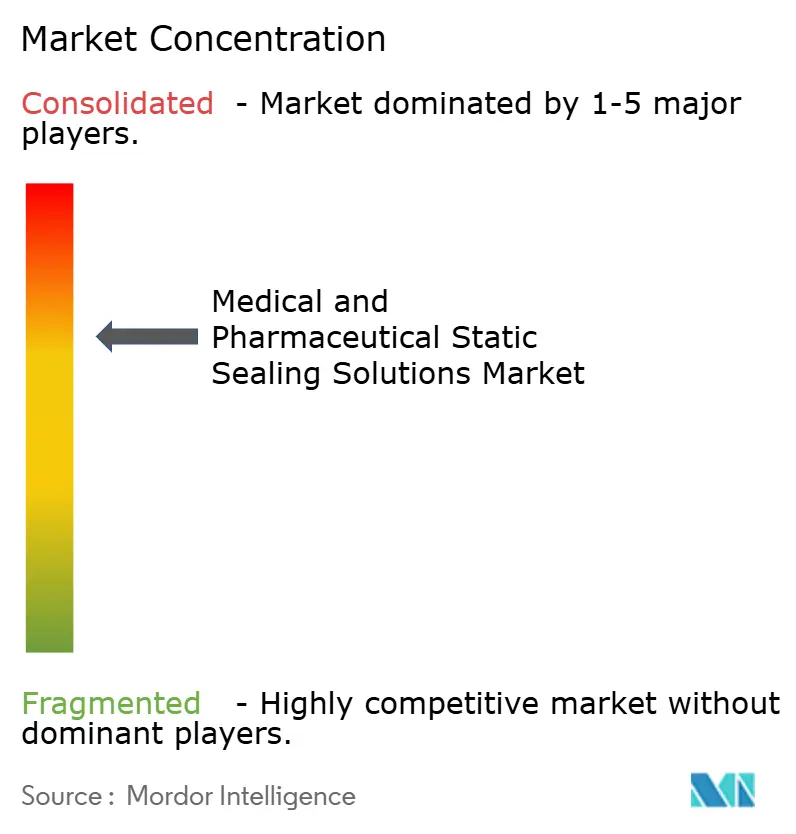
| Market Concentration | Medium |
Major Players *Disclaimer: Major Players sorted in no particular order Image © Mordor Intelligence. Reuse requires attribution under CC BY 4.0. | |
Medical and Pharmaceutical Static Sealing Solutions Market Analysis by Mordor Intelligence
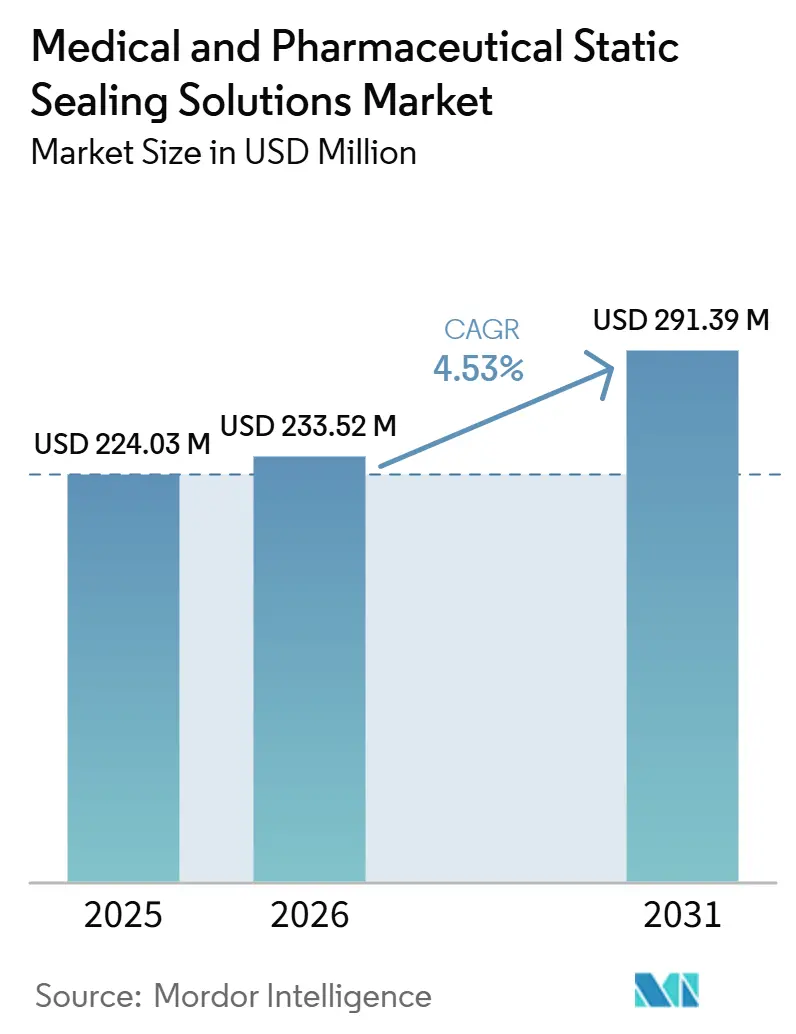
The medical and pharmaceutical static sealing solutions market is expected to grow from USD 224.03 million in 2025 to reach USD 233.52 million in 2026 and is forecasted to reach USD 291.39 million by 2031, growing at a CAGR of 4.53% from 2026 to 2031. The medical and pharmaceutical static sealing solutions market is being supported by a larger biologics pipeline, wider use of biosimilars, and faster adoption of single-use bioprocessing systems that increase the number of validated seals needed in each manufacturing run. Regulatory changes around extractables and leachables are also tightening qualification work, which is reducing the number of suppliers that can compete with complete documentation and system-level validation support. In this setting, supplier choice is being shaped more by compliance files, traceability, and proven material behavior than by unit price, which keeps incumbent suppliers in a strong position once they are qualified. The medical and pharmaceutical static sealing solutions market is also influenced by long requalification cycles, because even unchanged materials can face repeat testing when standards move, and that slows substitution across regulated production lines. Demand opportunities remain strongest where new bioreactor, sterile processing, and fill finish capacity is being added, especially in Asia-Pacific and in facilities that need low extractable materials with a cleanroom-backed supply.
Key Report Takeaways
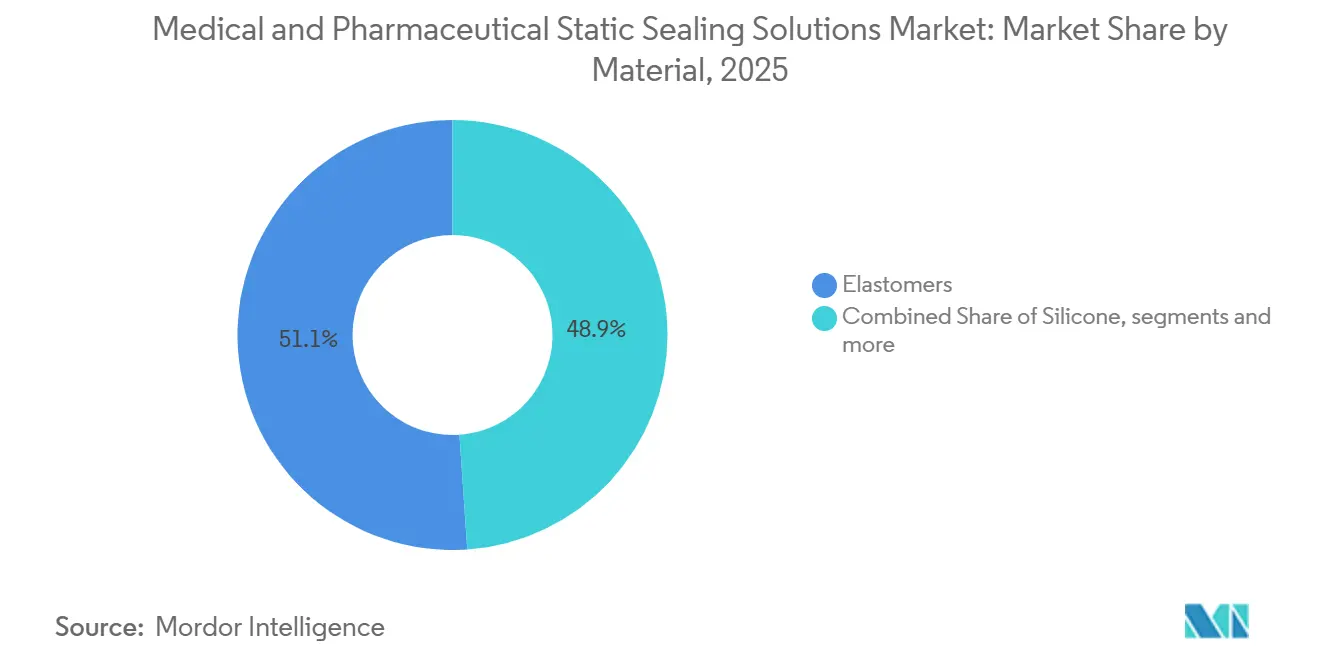
- By material, elastomers led with 51.11% revenue share in 2025, while silicone is forecasted to expand at a 6.18% CAGR through 2031.
- By product type, O-rings held 48.27% of demand in 2025, while lip seals are projected to record the fastest growth at a 5.25% CAGR through 2031.
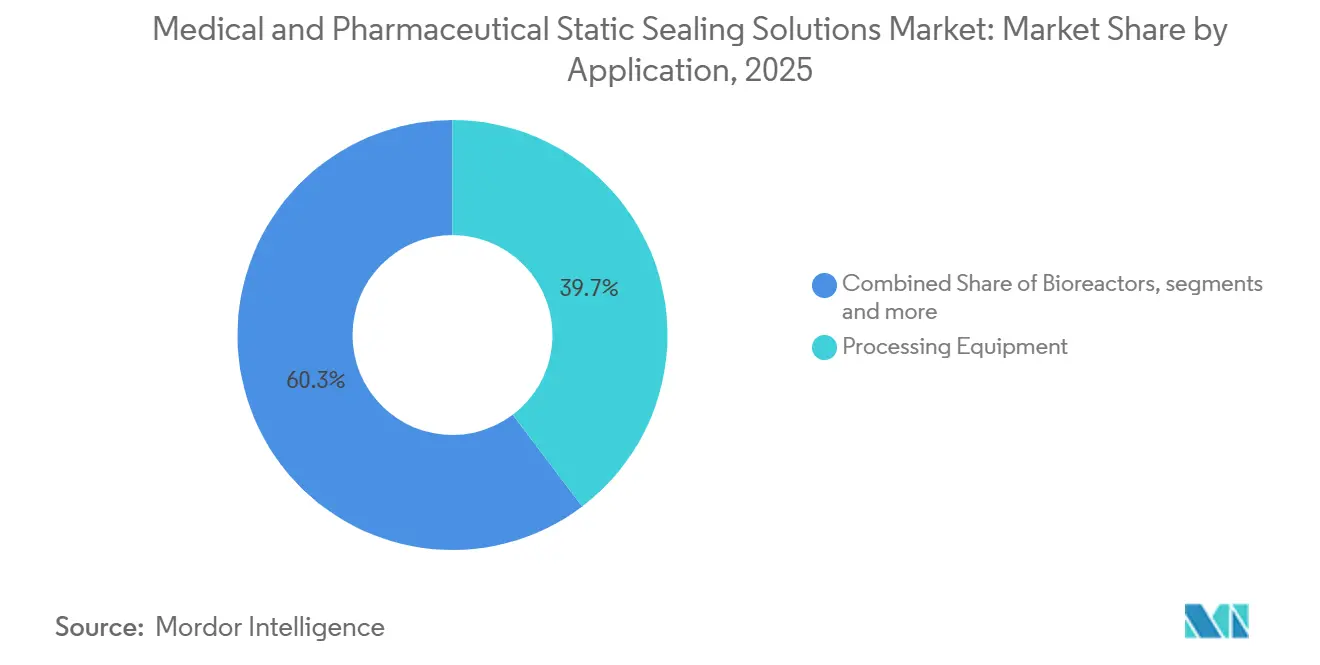
- By application, processing equipment accounted for 39.72% share in 2025, while bioreactors are expected to advance at a 7.20% CAGR through 2031.
- By end-user, pharmaceutical manufacturers held 40.01% share in 2025, while medical device manufacturers are projected to grow at a 6.90% CAGR through 2031.
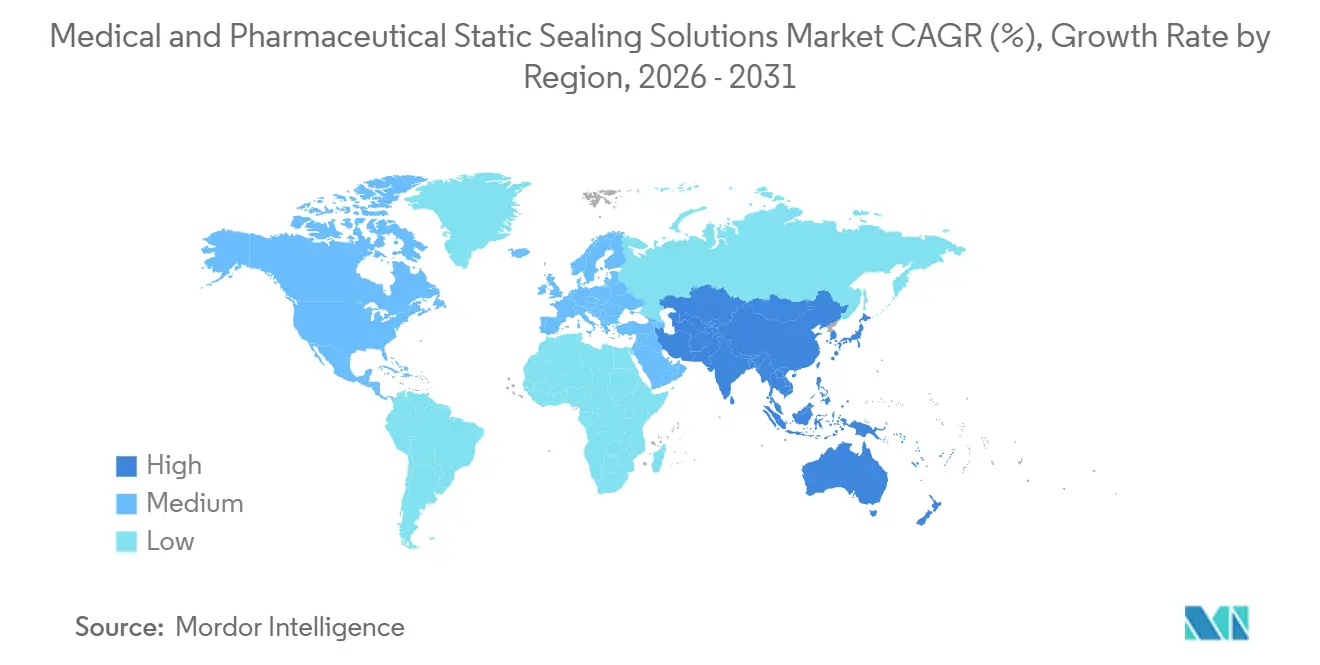
- By geography, North America led with 40.60% share in 2025, while Asia-Pacific is forecasted to expand at a 6.47% CAGR through 2031.
Note: Market size and forecast figures in this report are generated using Mordor Intelligence’s proprietary estimation framework, updated with the latest available data and insights as of January 2026.
Market Trends and Insights
Drivers Impact Analysis of Medical and Pharmaceutical Static Sealing Solutions Market*
| Driver | (~) % Impact on CAGR Forecast | Geographic Relevance | Impact Timeline |
|---|---|---|---|
| Rising Biologics, Biosimilars, and Sterile Drug Output | +1.5% | Global, concentrated in North America, Europe, and Asia-Pacific biomanufacturing corridors | Long term (≥ 4 years) |
| Tightened Extractables and Leachables Qualification Expectations | +0.8% | North America and Europe are primary, while Asia-Pacific adoption is accelerating | Medium term (2-4 years) |
| Expansion of Single-Use and Disposable Bioprocess Assemblies | +0.7% | Global, led by North America and Western Europe, with spillover into Asia-Pacific | Medium term (2-4 years) |
| Cleanroom Traceability Demand Across Multi-Site Pharma Networks | +0.4% | Global | Short term (≤ 2 years) |
| Growth in CIP, SIP, And High-Validation Maintenance Cycles | +0.5% | North America and Europe | Long term (≥ 4 years) |
| Supplier Qualification Burden Favors Deeply Certified Sealing Partners | +0.3% | Global | Short term (≤ 2 years) |
| Source: Mordor Intelligence | |||
Rising Biologics, Biosimilars, and Sterile Drug Output
The shift toward biologic therapies is changing sealing requirements across the medical and pharmaceutical static sealing solutions market, because these products need tighter control over purity, compatibility, and process stability. Each new biologic or biosimilar line adds many validated sealing points across upstream bioreactors, downstream purification trains, and aseptic filling systems, which raises total component demand beyond the installed equipment count. Drug substances such as monoclonal antibodies, recombinant proteins, and cell-based therapies are more sensitive to trace leachables, so standard industrial materials are less suitable in these settings. Biosimilar facilities also need to mirror reference product manufacturing conditions more closely, which expands the number of qualified seals that must be documented at the process level. The United States had more than 60 biosimilar approvals through mid 2025, which supports broader manufacturing activity tied to validated container closure and process sealing frameworks.[1]U.S. Food and Drug Administration, “Biosimilar Approvals,” FDA, fda.govThis pattern benefits suppliers in the medical and pharmaceutical static sealing solutions market that already hold application matched libraries and supporting documentation, rather than suppliers that compete mainly on volume pricing.
Tightened Extractables and Leachables Qualification Expectations
Extractables and leachables rules have become a stronger growth force in the medical and pharmaceutical static sealing solutions market, because qualification is moving from simple material acceptance toward full system performance review. USP General Chapter <382> became an official requirement on December 1, 2025, and it places more attention on the assembled elastomeric sealing system rather than only the individual material grade.[2]United States Pharmacopeia, “〈382〉 Elastomeric Component Functional Suitability in Parenteral Product Packaging/Delivery Systems,” USP-NF, uspnf.com That change means historical USP Class VI data is no longer enough by itself for many regulated applications, and manufacturers now need additional testing for products already in use. The ICH Q3E Guideline for Extractables and Leachables, endorsed in August 2025 and published by the FDA in December 2025, adds harmonized risk based expectations across regulators and reinforces the same direction of travel.[3]U.S. Food and Drug Administration, “Q3E Guideline for Extractables and Leachables,” Federal Register, govinfo.govAs a result, the medical and pharmaceutical static sealing solutions market is seeing stronger pull toward suppliers that can provide pre validated components, deeper dossiers, and faster support for qualification packages. This also narrows the qualified supplier pool, because smaller participants often struggle to sustain repeated testing and documentation updates across multiple product families.
Expansion of Single-Use and Disposable Bioprocess Assemblies
Single use processing has moved well beyond a narrow cost-saving role, and it now supports commercial scale biologics manufacturing across many plants that are buying into the medical and pharmaceutical static sealing solutions market. Disposable bioreactor bags, pre sterilized filtration assemblies, and single use fluid paths all rely on validated static seals at ports, connectors, tubing interfaces, and filter housings. Even though single use systems remove some vessel level cleaning steps, they still multiply the number of junction level sealing points that must meet purity and functional performance requirements. This is especially important where manufacturers are moving from pilot setups toward larger commercial configurations, because every new format expands the number of components that need validation and supply continuity. Asia-Pacific is also broadening the addressable base for the medical and pharmaceutical static sealing solutions market, as new ISO certified facilities adopt single use workflows in biosimilars, vaccines, and contract development and manufacturing services. These changes are pushing demand forward, because producers prefer validated sealing sets that can move through procurement and qualification without delaying production schedules.
Growth in CIP, SIP, and High-Validation Maintenance Cycles
CIP and SIP cycles remain a major driver for the medical and pharmaceutical static sealing solutions market because they expose seals to caustic agents, pressurized steam, temperature stress, and repeated contact with high purity streams. In these environments, seal degradation is not just a maintenance concern, because it can trigger batch loss, contamination review, and extra regulatory scrutiny across a line. This makes compatibility with cleaning and sterilization conditions a baseline procurement requirement, which limits the use of lower grade alternatives even where prices are lower. EPDM remains common in steam intensive duties, while perfluoroelastomers are being used where aggressive cleaning chemistry and high resistance are needed across validation heavy applications. Greene Tweed has continued to position its pharma sealing range around ISO 7 cleanroom manufacturing and certification to USP Class VI and FDA standards, which shows how documentation and production control support customer retention in this part of the value chain. Multi product campaigns in shared facilities also increase replacement cycles, so the medical and pharmaceutical static sealing solutions market gains recurring demand from operating intensity as much as from new equipment installations.
Restraints Impact Analysis of Medical and Pharmaceutical Static Sealing Solutions Market*
| Restraint | (~) % Impact on CAGR Forecast | Geographic Relevance | Impact Timeline |
|---|---|---|---|
| Long Validation and Requalification Cycles Delay New Product Adoption | -0.8% | Global, most acute in North America and Europe | Long term (≥ 4 years) |
| High Cost of Pharma-Grade Polymers, Metals, And Documentation | -0.6% | Global, with stronger effects in cost-sensitive Asia-Pacific and South America | Medium term (2-4 years) |
| Compatibility Gaps with Aggressive Sterilization and Cleaning Regimes | -0.5% | Global, particularly affecting North America, Europe, and Japan | Medium to long term (2-5 years) |
| Production Fragmentation Across Device Formats Raises Customization Cost | -0.4% | Global, with stronger impact in Asia-Pacific and emerging markets | Medium term (2-4 years) |
| Source: Mordor Intelligence | |||
Long Validation and Requalification Cycles Delay New Product Adoption
Long validation timelines remain one of the clearest limits on faster expansion in the medical and pharmaceutical static sealing solutions market, because new components must move through several layers of technical and regulatory review. Qualification can run from material selection through extractables work, biocompatibility review, functional assessment, and stability testing before a seal is accepted for a regulated product or process. When testing frameworks are updated, legacy data often cannot be carried forward without more work, which means even unchanged materials may need fresh studies before continued use. Smaller biopharma firms and many CDMOs are affected more sharply, because they often have less internal quality capacity to run several qualification programs at the same time.
High Cost of Pharma-Grade Polymers, Metals, and Documentation
The cost of pharma grade materials is another brake on the medical and pharmaceutical static sealing solutions market, because purity controls, testing, traceability, and documentation raise the total landed cost well beyond industrial equivalents. Perfluoroelastomers and low extractable platinum cured silicone compounds can command a major premium, which limits their use to applications where chemical resistance or very low leachable profiles are required. Cost pressure does not come from materials alone, because qualification packets, cleanroom manufacturing controls, and batch level traceability add expense all the way through supply and procurement. The result is a structural tension between compliance goals and budget limits, and it keeps a portion of demand concentrated in established formulations rather than in higher performance alternatives. Unless cost reduction and documentation efficiency improve at a broader level, the medical and pharmaceutical static sealing solutions market will continue to face slower adoption in more price sensitive facilities.
*Our forecasts treat driver/restraint impacts as directional, not additive. The impact forecasts reflect baseline growth, mix effects, and variable interactions.
Medical and Pharmaceutical Static Sealing Solutions Market Segment Analysis
By Material:
Elastomers Anchor Volume as Silicone Redefines Growth ExpectationsElastomers held 51.11% of the medical and pharmaceutical static sealing solutions market share in 2025, and that lead reflected long standing use in cleaning and sterilization heavy production settings. Their position has been built over many years of validated performance in CIP and SIP environments, where repeatability matters more than experimentation with less proven compounds. Silicone is expected to be the fastest growing material, with a 6.18% CAGR through 2031, and that rise is tied to its biocompatibility profile and its fit with sterile processing and single use applications. Platinum cured liquid silicone rubber is gaining traction in bioreactor interfaces and other sensitive contact points, because low particulate behavior and sterilization compatibility support cleaner qualification paths.
Metals, largely in reinforced gasket designs for high pressure process connections, continue to serve a narrower set of conventional line requirements within the medical and pharmaceutical static sealing solutions market. The more important material shift is that scrutiny around fluorocarbon alternatives is making formulation choice more strategic, which raises interest in silicone where qualification risk looks lower over time. In practice, suppliers are strongest when they can offer both material performance and documentation depth, because customers in the medical and pharmaceutical static sealing solutions market are buying the qualification package along with the physical component.



By Product Type:
O-Rings Dominate While Lip Seals Target Precision Growth VerticalsO-rings accounted for 48.27% of product demand in 2025, which kept them at the center of the medical and pharmaceutical static sealing solutions market across vessels, valves, flanged connections, and equipment penetrations. Their geometry is widely standardized, and that reduces design complexity, eases compatibility review, and supports multi supplier benchmarking when manufacturers qualify a line or retrofit an asset. This standardization also helps procurement teams maintain supply continuity without restarting every part of the qualification process when they review alternatives.
Lip seals are expected to be the fastest-growing product type, and the medical and pharmaceutical static sealing solutions market size for this segment is projected to rise at a 5.25% CAGR through 2031. Their growth comes from more precision filling lines, prefilled syringe assemblies, and closed system transfer devices that need functional reliability in compact drug delivery settings. Diaphragms move closely with sterile valve and pump isolation demand in bioprocessing suites, especially where membrane valve volumes rise with integrated process islands. The remaining product group, which includes PTFE seals, high end gaskets, and septum related formats, serves more specialized programs where low extractables and sterilization stability justify higher prices within the medical and pharmaceutical static sealing solutions market.
By Application:
Processing Equipment, Anchors Volume as Bioreactor Sealing Becomes the Strategic PriorityProcessing equipment represented 39.72% of application demand in 2025, giving it the broadest installed base within the medical and pharmaceutical static sealing solutions market across pumps, heat exchangers, filtration housings, and vessel closures. This category benefits from basic operating needs, because even modest additions in API or drug product capacity create matching demand for static seals in existing and new lines. That gives it a stable volume floor, even when growth in more specialized applications becomes uneven from one year to the next. Bioreactors are anticipated to be the fastest growing application, and the medical and pharmaceutical static sealing solutions market for this use case is expected to advance at a 7.20% CAGR through 2031. The main reason is the rapid spread of single-use bioreactor platforms across monoclonal antibody production, mRNA processes, and cell and gene therapy manufacturing, where low extractable sealing interfaces are central to qualification.
A notable feature of this shift is that single use bags remove some vessel level seals but increase the number of validated seals at ports, filters, connectors, and bag to skid interfaces across each run. That means the total seal count per batch can rise even when the main reactor vessel itself becomes disposable, which supports faster demand growth in bioreactor related sealing than many equipment level views would suggest. Laboratory instruments, diagnostic analyzers, and research bioreactors add smaller but rising volumes, and together they show that application demand in the medical and pharmaceutical static sealing solutions market is being shaped more by what is being processed than by the equipment label.
By End-User:
Pharma Manufacturers Set the Volume Floor While Medical Device Firms Define the Growth TrajectoryPharmaceutical manufacturers held 40.01% of end-user demand in 2025, making them the largest buyer group in the medical and pharmaceutical static sealing solutions market across conventional production, fill finish, and sterile processing lines. Medical device manufacturers are projected to be the fastest-growing end user, with a 6.90% CAGR through 2031, as drug device combination products, wearable delivery systems, and next generation diagnostics expand. Biotechnology companies also form a meaningful and growing base, because scaling from clinical work to commercial manufacturing pulls in more demand for bioreactor, sterile transfer, and processing related seal formats.
CDMOs present a distinct operating pattern within the medical and pharmaceutical static sealing solutions market, because they need component libraries that can be requalified across multiple client programs without slowing plant utilization. Smaller end users, including research institutes and in vitro diagnostics manufacturers, hold a lower share but often adopt new material specifications earlier than large commercial operators. For that reason, they can act as an early marker for how the medical and pharmaceutical static sealing solutions industry may evolve before broader uptake appears in high volume pharmaceutical lines.
Geography Analysis
North America Medical and Pharmaceutical Static Sealing Solutions Market
North America accounted for 40.60% of the medical and pharmaceutical static sealing solutions market share in 2025, which made it the largest regional base for validated static seals in regulated pharmaceutical and bioprocessing applications. The region benefits from a dense mix of biopharmaceutical innovators, contract manufacturers, and large-scale sterile production assets that need qualified sealing across upstream and downstream operations. New fill finish lines, biologics capacity, and upstream bioreactor investments continue to require validated sealing from the first equipment specification stage onward. North America also acts as the earliest procurement response zone when standards change, since suppliers and manufacturers in the region often move first on requalification, change control, and documentation updates.
Europe Medical and Pharmaceutical Static Sealing Solutions Market
Europe held the second-largest regional position in 2025, and its demand pattern remains shaped by layered regulatory expectations and a strong installed base in pharmaceutical production. Germany, France, and the United Kingdom anchor most of the established volume, with Germany's contract manufacturing network creating concentrated demand for elastomeric seals used in bioreactor and sterile transfer environments. European buyers also tend to maintain strict attention to container closure integrity and sterile manufacturing performance, which sustains preference for higher specification sealing materials and established suppliers. Italy, Spain, and production sites across Central and Eastern Europe are adding to regional depth as contract manufacturing capacity broadens and more facilities serve cross border pharmaceutical supply chains.
APAC, MEA and South America Medical and Pharmaceutical Static Sealing Solutions Market
Asia-Pacific is projected to be the fastest-growing regional segment, and the medical and pharmaceutical static sealing solutions market is projected to expand there at a 6.47% CAGR through 2031. China and India are driving most of that momentum through new biosimilar, vaccine, and CDMO capacity that increases demand for qualified static seals across single use and conventional lines. Japan and South Korea remain established manufacturing centers, and Japan's 2025 emphasis on Liveo medical silicone materials for biopharma applications points to continued regional work in compliant formulation development. Middle East and Africa remain smaller in current revenue terms, but healthcare and pharmaceutical capacity investment in the GCC is creating a firmer local base for regulated production support. South America, led by Brazil and Argentina, is also becoming more active as local manufacturers expand domestic supply and increase procurement of validated components for higher quality pharmaceutical output.

Competitive Landscape
The medical and pharmaceutical static sealing solutions market shows moderate consolidation at the top, with a small group of global polymer and engineered component suppliers holding strong positions in validated product volumes across regulated applications. Parker Hannifin, Freudenberg Sealing Technologies, Trelleborg Medical Solutions, Saint-Gobain Life Sciences, and Greene Tweed form the most visible leadership set, because they combine material expertise with documentation depth and manufacturing control. Their advantage is not limited to broad catalogs, since customers in this market also need cleanroom production, traceability discipline, and stable change control when a component enters a validated process. These conditions create high switching costs once a supplier is approved, which means scale and compliance capability matter more than aggressive pricing in many bids. In the medical and pharmaceutical static sealing solutions market, competition is strongest where suppliers can reduce customer qualification work while still meeting application specific material demands.
Below the largest suppliers, several regional specialists and niche formulators continue to compete through custom design support, shorter development cycles, and responsiveness in specific sealing geometries or materials. This creates room for companies such as James Walker, Garlock Sealing Technologies, Precision Associates, Bal Seal Engineering, and Datwyler in programs where application fit matters more than broad global reach. White space remains visible in cell and gene therapy related sealing, where gamma stable and ultra low extractable configurations are still less standardized than in older pharmaceutical process lines. Asian silicone compounders are also testing the mid tier portion of the medical and pharmaceutical static sealing solutions market, although regulated applications still limit rapid share gain because quality system maturity and documentation remain important entry barriers.
Strategic activity in the medical and pharmaceutical static sealing solutions market is centered on capability extension, because leading suppliers are pushing beyond simple part supply into adjacent functions that strengthen their place in validated workflows. Greene Tweed continues to position its pharma sealing line around ISO 7 cleanroom manufacturing and USP and FDA aligned documentation, which helps defend share where CIP and SIP performance must be supported by process control evidence. The result is a field where repeated wins depend on validation support, manufacturing discipline, and application knowledge as much as on the part itself, which keeps competition active but prevents easy displacement of qualified suppliers.
Medical and Pharmaceutical Static Sealing Solutions Industry Leaders
Trelleborg AB
Parker Hannifin Corporation
Datwyler Holding Inc.
Greene, Tweed and Co.
Saint-Gobain S.A.
- *Disclaimer: Major Players sorted in no particular order
Medical and Pharmaceutical Static Sealing Solutions Market Companies Covered in this Report
- APM Hexseal Corporation
- Apple Rubber Products, Inc.
- Bal Seal Engineering, Inc.
- Datwyler Holding Inc.
- Dichtomatik GmbH
- EagleBurgmann GmbH and Co. KG
- Freudenberg Sealing Technologies GmbH and Co. KG
- Garlock Sealing Technologies LLC
- Greene, Tweed and Co.
- IDEX
- James Walker and Co. Ltd.
- Marco Rubber and Plastics, LLC
- Minnesota Rubber and Plastics, Inc.
- Morgan Advanced Materials plc
- Parker Hannifin
- Precision Associates, Inc.
- Saint-Gobain
- Sealmatic India Pvt. Ltd.
- SKF AB
- Technetics Group
- Trelleborg AB

Recent Industry Developments in Medical and Pharmaceutical Static Sealing Solutions Market
- April 2026: Freudenberg Medical launched CleanAssure, an ISO Class 5 controlled cleanroom service at its Kaiserslautern, Germany site, delivering pre-washed, dried, and gamma-sterilized single-use assemblies under cGMP conditions. The service eliminates the cleaning validation burden from drug manufacturers, representing a supply-chain model shift from component provision to turnkey sterile assembly supply.
- February 2026: Freudenberg Medical introduced LUBRITEQ, a high-performance hydrophilic coating solution launched globally across its vertically integrated operations. The product targets enhanced fluid-path and device performance in drug delivery and biopharma fill-finish applications, expanding the company's offering beyond structural sealing into functional surface engineering.
- December 2025: Trelleborg Medical Solutions inaugurated its Costa Rica manufacturing facility, a 10,000 square metre plant at the Evolution Free Zone Industrial Park. The site received ISO 13485:2016 certification, qualifying it for regulated medical device production and positioning Trelleborg to serve near-shore supply strategies for North American biopharma and medtech customers.


Global Medical and Pharmaceutical Static Sealing Solutions Market Report Scope
According to the report’s scope, the medical and pharmaceutical static sealing solutions market refers to the industry focused on the development, manufacturing, and supply of sealing components designed to prevent leakage between stationary mating surfaces in medical devices, pharmaceutical equipment, and processing systems. These solutions, including gaskets, O-rings, diaphragms, and custom static seals, ensure sterility, contamination control, pressure retention, and regulatory compliance across applications such as drug manufacturing, bioprocessing, diagnostic equipment, and medical devices.
The medical and pharmaceutical static sealing solutions market is segmented into material, product type, application, and geography. By material, the market is segmented into elastomers, silicone, metals, and others. By product type, the market is segmented into o-rings, gaskets, lip seals, diaphragms, and others. By application, the market is segmented into processing equipment, bioreactors, filling systems, sterile processing equipment, medical devices, and other applications. By geography, the market is segmented into North America, Europe, Asia-Pacific, the Middle East and Africa, and South America. The report also covers the estimated market sizes and trends for 17 countries across major regions globally. The report offers values (USD) for all the above segments.
| Elastomers |
| Silicone |
| Metals |
| Others |
| O-Rings |
| Gaskets |
| Lip Seals |
| Diaphragms |
| Others |
| Processing Equipment |
| Bioreactors |
| Filling Systems |
| Sterile Processing Equipment |
| Medical Devices |
| Other Applications |
| Pharmaceutical Manufacturing Plants |
| Biotechnology Companies |
| Contract Manufacturing Organizations |
| Medical Device Manufacturers |
| Other End-Users |
| North America | United States |
| Canada | |
| Mexico | |
| Europe | Germany |
| United Kingdom | |
| France | |
| Italy | |
| Spain | |
| Rest of Europe | |
| Asia-Pacific | China |
| Japan | |
| India | |
| Australia | |
| South Korea | |
| Rest of Asia-Pacific | |
| Middle East and Africa | GCC |
| South Africa | |
| Rest of Middle East and Africa | |
| South America | Brazil |
| Argentina | |
| Rest of South America |
| By Material | Elastomers | |
| Silicone | ||
| Metals | ||
| Others | ||
| By Product Type | O-Rings | |
| Gaskets | ||
| Lip Seals | ||
| Diaphragms | ||
| Others | ||
| By Application | Processing Equipment | |
| Bioreactors | ||
| Filling Systems | ||
| Sterile Processing Equipment | ||
| Medical Devices | ||
| Other Applications | ||
| By End-User | Pharmaceutical Manufacturing Plants | |
| Biotechnology Companies | ||
| Contract Manufacturing Organizations | ||
| Medical Device Manufacturers | ||
| Other End-Users | ||
| By Geography | North America | United States |
| Canada | ||
| Mexico | ||
| Europe | Germany | |
| United Kingdom | ||
| France | ||
| Italy | ||
| Spain | ||
| Rest of Europe | ||
| Asia-Pacific | China | |
| Japan | ||
| India | ||
| Australia | ||
| South Korea | ||
| Rest of Asia-Pacific | ||
| Middle East and Africa | GCC | |
| South Africa | ||
| Rest of Middle East and Africa | ||
| South America | Brazil | |
| Argentina | ||
| Rest of South America | ||


Key Questions Answered in the Report
What is the expected value of the medical and pharmaceutical static sealing solutions market by 2031?
The medical and pharmaceutical static sealing solutions market is forecasted to reach USD 291.39 million by 2031, rising from USD 224.03 million in 2025 to USD 233.52 million in 2026 at a 4.53% CAGR over 2026 to 2031.
Which material category leads demand for medical and pharmaceutical static sealing solutions?
Elastomers led demand with 51.11% share in 2025, because they remain widely validated for CIP and SIP conditions and are familiar across regulated pharmaceutical processing lines.
Which product type is expanding fastest in pharmaceutical static sealing applications?
Lip seals are expected to be the fastest growing product type, with a projected 5.25% CAGR through 2031, supported by higher use in prefilled syringes, filling lines, and closed system transfer devices.
Which region offers the strongest growth outlook through 2031?
Asia-Pacific shows the fastest growth, with a projected 6.47% CAGR through 2031, driven mainly by capacity additions in China and India across biosimilars, vaccines, and CDMO operations.
Page last updated on:





