
Medical and Pharmaceutical Sealing Solutions Market Size and Share
Market Overview
| Study Period | 2020 - 2031 |
|---|---|
| Market Size (2026) | USD 0.56 Billion |
| Market Size (2031) | USD 0.72 Billion |
| Growth Rate (2026 - 2031) | 5.12 % |
| Fastest Growing Market | Asia-Pacific |
| Largest Market | North America |
| Market Concentration | Medium |
Major Players *Disclaimer: Major Players sorted in no particular order Image © Mordor Intelligence. Reuse requires attribution under CC BY 4.0. | |
Medical and Pharmaceutical Sealing Solutions Market Analysis by Mordor Intelligence
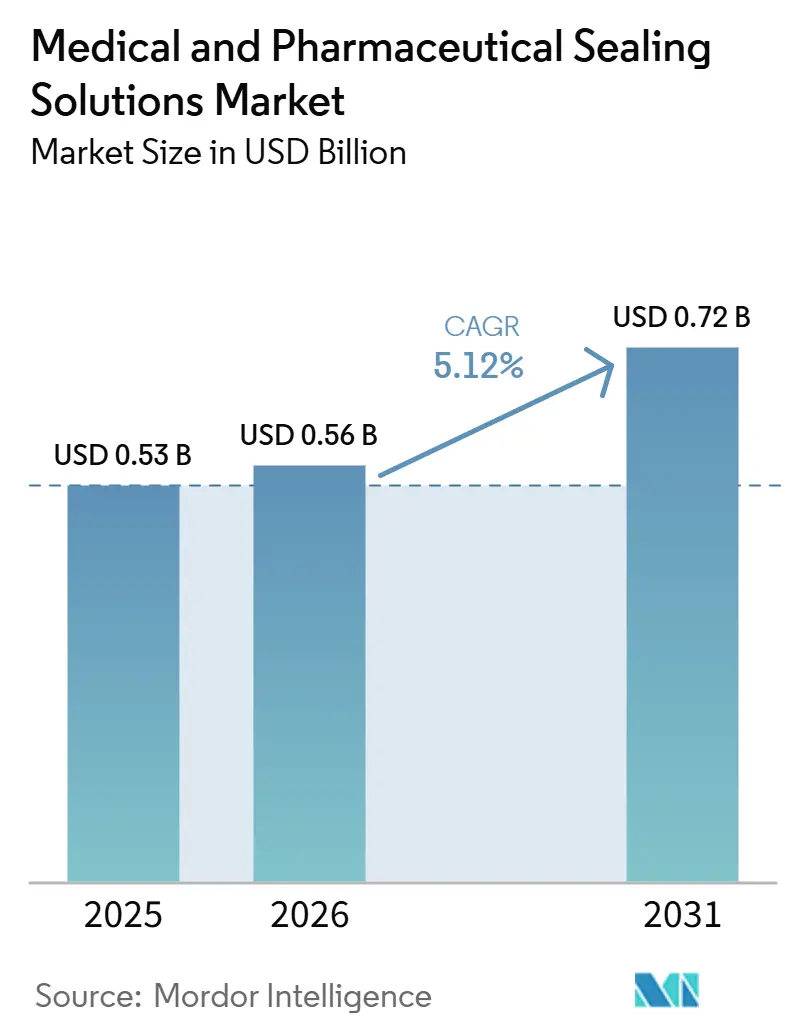
The medical & pharmaceutical sealing solutions market is projected to expand from USD 0.53 billion in 2025 and USD 0.56 billion in 2026 to USD 0.72 billion by 2031, registering a CAGR of 5.12% between 2026 and 2031. The medical & pharmaceutical sealing solutions market is being supported by steady demand from injectable drug formulation, biologics fill finish activity, and wider use of closure components in drug-device combination products. Product qualification needs are becoming more exacting because the U.S. FDA cleared 55 novel drugs in 2024, including 28 large molecule therapies that depend on validated container closure systems with tightly controlled material and performance specifications. The medical & pharmaceutical sealing solutions market is also moving toward higher value components because coated elastomers, pre-sterilized formats, and documentation-ready systems are becoming harder to replace once they are included in regulatory filings. Supplier competition remains strongest in the validated tier, where qualification support, coating know-how, and regulatory documentation carry more weight than price, a pattern also reflected in West Pharmaceutical Services’ 15.1% organic growth in High Value Products Components revenue in Q4 2025. Cost pressure from aluminum and the gradual use of alternative filling technologies still limit upside, yet long validation cycles continue to protect established suppliers and keep the medical & pharmaceutical sealing solutions market structurally resilient.
Key Report Takeaways
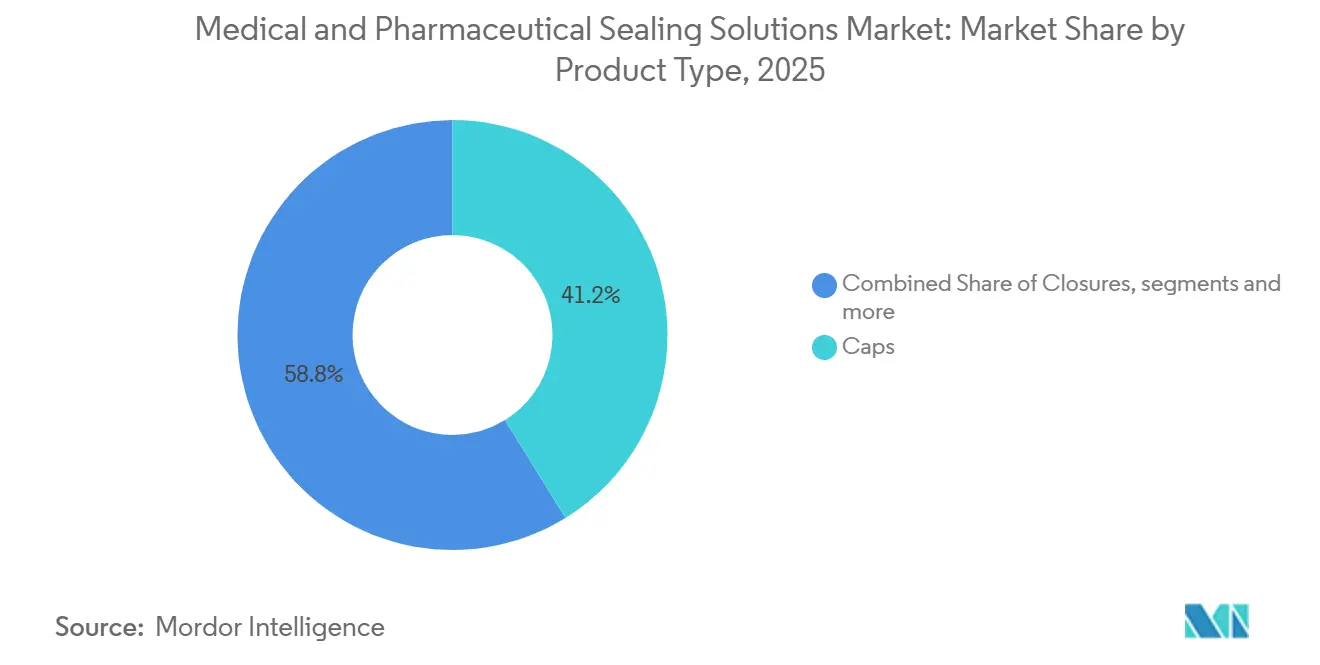
- By product type, caps led with 41.23% revenue share in 2025, while seals are projected to grow at a 5.49% CAGR through 2031.
- By material type, plastics captured 44.72% of revenue in 2025, while elastomers and rubber are expected to expand at a 5.74% CAGR through 2031.
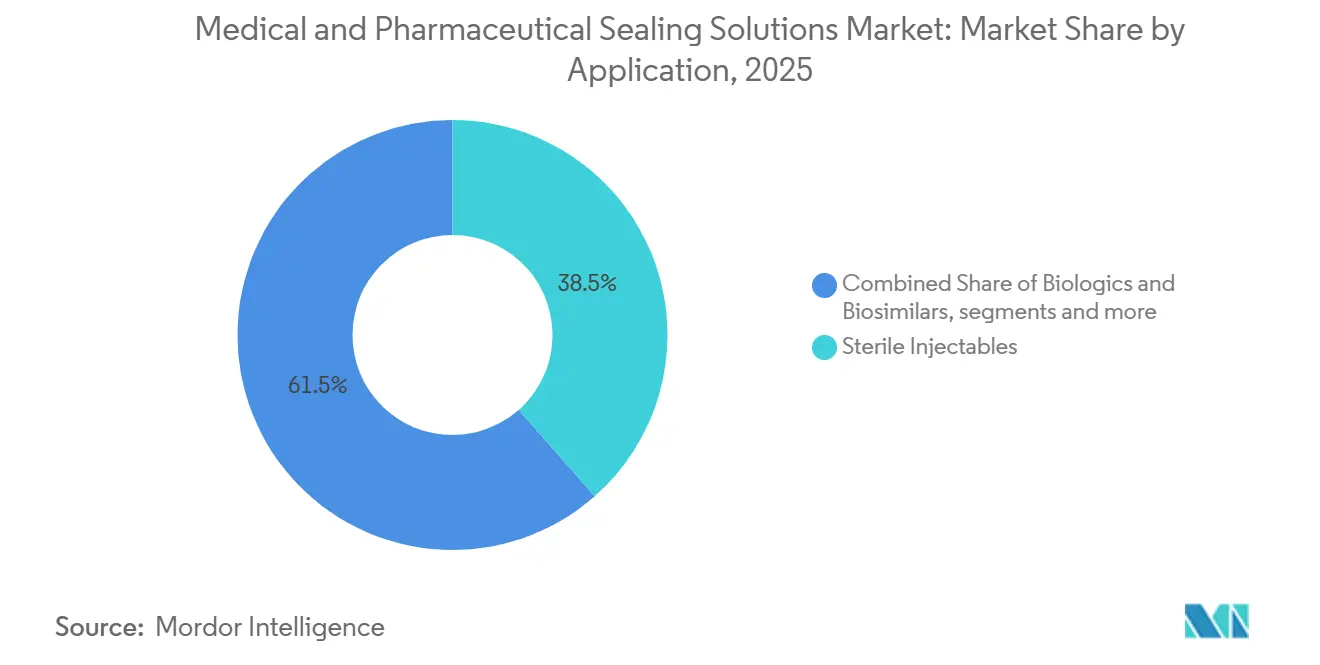
- By application, sterile injectables accounted for 38.53% of revenue in 2025, while biologics and biosimilars are forecasted to grow at a 6.13% CAGR through 2031.
- By geography, North America held 41.38% of revenue in 2025, while the Asia-Pacific is projected to advance at a 7.26% CAGR through 2031.
Note: Market size and forecast figures in this report are generated using Mordor Intelligence’s proprietary estimation framework, updated with the latest available data and insights as of January 2026.
Global Medical and Pharmaceutical Sealing Solutions Market Trends and Insights
Drivers Impact Analysis*
| Driver | (~) % Impact on CAGR Forecast | Geographic Relevance | Impact Timeline |
|---|---|---|---|
| Rising Biologics and Sterile Injectable Demand | +1.8% | Global, with originator biologics concentrated in North America and Europe, and biosimilar demand concentrated in Asia-Pacific | Medium term (2-4 years) |
| EU GMP Annex 1 Driven Container Closure Integrity Upgrades | +1.2% | Europe and export markets serving the EU and UK, with spillover into North America, Asia-Pacific, and South America | Short term (≤ 2 years) |
| Growth in Ready-to-Use Sterile Closure Formats | +0.7% | North America and Europe, with emerging uptake in India, China, and Southeast Asia | Medium term (2-4 years) |
| Self-Administration and Home Care Packaging Requirements | +0.6% | Global, with strongest concentration in North America and Europe | Medium term (2-4 years) |
| Ultra Cold and Cryogenic Compatibility for Advanced Therapies | +0.4% | North America and Europe, with emerging relevance in Asia-Pacific | Long term (≥ 4 years) |
| Sustainability Pressure Toward Recyclable and Low Waste Closure Designs | +0.3% | Europe first, followed by North America and parts of Asia-Pacific | Long term (≥ 4 years) |
| Source: Mordor Intelligence | |||
Rising Biologics and Sterile Injectable Demand
The medical & pharmaceutical sealing solutions market is gaining support from the expanding biologics pipeline, because these therapies place more demanding requirements on closures than standard injectable products. The U.S. FDA approved 28 large molecule therapies out of 55 novel drug approvals in 2024, which reinforced the need for validated closure systems with stable elastomer composition, fluoropolymer coatings, and low temperature performance.[1]U.S. Food and Drug Administration, “Novel Drug Approvals for 2024,” FDA, fda.gov High concentration monoclonal antibodies and viscous GLP 1 formulations need tighter control over protein interaction, break loose force, glide force, and particulate risk than older injectable formats. Aptar Pharma’s GLP 1 closure offering shows how suppliers are building more specialized portfolios around rigid needle shields, prefilled syringe plungers, and cartridge closures rather than relying on standard components. As originator biologics and biosimilars scale, demand is moving toward suppliers that can support filings in multiple regulatory systems with one validated component package, which keeps the medical & pharmaceutical sealing solutions market tilted toward high specification supply.
EU GMP Annex 1 Driven Container Closure Integrity Upgrades
The medical & pharmaceutical sealing solutions market is also being shaped by stricter aseptic manufacturing expectations under revised EU GMP Annex 1. Datwyler’s compliance guidance shows that the rule has elevated primary packaging suppliers into documented quality partners through its emphasis on contamination control strategy, sterilization records, and validated process controls. Caps, stoppers, and plungers now need stronger support files around washing, sterilization, endotoxin reduction, and the cleanroom conditions tied to crimping and filling operations. The effect extends beyond Europe because manufacturers in India, China, and other export-oriented markets also need closure systems that can support EU and UK submissions. That shift has been pushing business toward larger suppliers with ready documentation and away from mid tier companies that still compete mainly on standard components, which strengthens pricing and qualification power across the medical & pharmaceutical sealing solutions market.
Growth in Ready-to-Use Sterile Closure Formats
The medical & pharmaceutical sealing solutions market is benefiting from wider adoption of ready to use closure formats as fill-finish plants try to reduce process steps inside aseptic operations. Gerresheimer, Stevanato Group, and SCHOTT Pharma announced their Alliance for RTU in September 2024, which signaled coordinated support for broader industrial use of ready-to-use vials and cartridges.[2]Gerresheimer AG, “Gerresheimer, Stevanato Group and SCHOTT Pharma Announce Strategic Industry Alliance for RTU,” Press Release, gerresheimer.comFor drug manufacturers, ready-to-use formats reduce the need for in-house washing and sterilization equipment, which is valuable when biologics facilities are running at high utilization. They also shorten internal preparation time for closures and lower the operational burden tied to contamination control. This gives ready-to-use seals, caps, and elastomer components a stronger value position in the medical & pharmaceutical sealing solutions market than wash-in-house alternatives.
Self-Administration and Home Care Packaging Requirements
The medical & pharmaceutical sealing solutions market is being pulled into closer alignment with patient self-administration and home care device design. SCHOTT Pharma and SHL Medical jointly developed a 5 mL large volume cartridge and autoinjector combination, which shows that closure systems now need to perform under actuation forces, transport stress, and repeated temperature exposure in home use settings. Datwyler added to this shift in January 2026 with its NeoFlex 20 mL universal plunger, which was pre-verified for all 20 mL ISO cartridges and designed to cut development time by up to 3 years.[3]Datwyler Holding, “Launch of 20mL Universal Plunger,” Datwyler, datwyler.com These launches show that large volume subcutaneous delivery is creating a tighter link between closure selection and device engineering. As more GLP-1 products, monoclonal antibodies, and advanced therapies move into wearable or self-injection formats, the medical & pharmaceutical sealing solutions market will continue to favor suppliers that can co-develop components with device makers.
Restraints Impact Analysis*
| Restraint | (~) % Impact on CAGR Forecast | Geographic Relevance | Impact Timeline |
|---|---|---|---|
| Extractables and Leachables Validation Burden | -0.6% | Global, with the highest burden in North America and Europe and growing importance in Asia-Pacific | Medium term (2-4 years) |
| Raw Material and Aluminum Price Volatility | -0.4% | Global, with acute impact on North American and European converters under fixed price contracts | Short term (≤ 2 years) |
| Blow Fill Seal Substitution in Select Sterile Formats | -0.3% | Global, concentrated in small molecule sterile injectables and less relevant to biologics | Long term (≥ 4 years) |
| Long Qualification Cycles and Supplier Switching Costs | -0.4% | Global, with the heaviest regulatory burden in North America and Europe | Medium term (2-4 years) |
| Source: Mordor Intelligence | |||
Extractables and Leachables Validation Burden
The medical & pharmaceutical sealing solutions market faces a persistent restraint from extractables and leachables validation, because component changes can trigger long and costly studies. The EMA published the ICH Q3E guideline as a scientific guideline in August 2025, and the FDA followed with draft guidance in December 2025, which pushed the sector toward a more harmonized but more demanding framework for container closure evaluation. USP has also noted the lack of fully harmonized system suitability expectations in this area, which leaves room for uneven practice across suppliers and testing programs. The burden is wider now because the framework reaches into cell and gene therapies and drug device combination products, not only standard injectables. Once a closure system is locked into a product dossier, the time and cost of repeating extractables and leachables work makes switching difficult, which slows supplier changes and keeps expansion in the medical & pharmaceutical sealing solutions market more selective than broad based.
Raw Material and Aluminum Price Volatility
The medical & pharmaceutical sealing solutions market also remains exposed to raw material pressure, especially in aluminum-based seals and caps. Henan Huawei Aluminum reported that pharmaceutical aluminum foil prices rose 6% in 2024 and 6.5% in 2025, with a further 4% increase expected in 2026, which adds cost strain across closure converters. Additional pressure came from U.S. tariff increases on aluminum imports during 2025, which raised the cost base for manufacturers dependent on imported grades. Smaller suppliers are more exposed because they have less leverage in procurement and less room to absorb margin compression under fixed price contracts. Even when substitution looks attractive on cost, regulated sealing formats still require fresh validation when manufacturers move away from aluminum, which limits how quickly the medical & pharmaceutical sealing solutions market can reduce this exposure.
*Our forecasts treat driver/restraint impacts as directional, not additive. The impact forecasts reflect baseline growth, mix effects, and variable interactions.
Segment Analysis
By Product Type: Caps Lead While Seals Advance in High Specification Uses
Caps held 41.23% of the medical & pharmaceutical sealing solutions market share by product type in 2025, which kept them as the largest product category across vial-based pharmaceutical packaging. Their position reflects a basic but unavoidable role in vial closure systems used in aseptic and clean process crimping environments. West Pharmaceutical Services developed its Flip Off CCS seal to support sterilized seal use in Annex 1-aligned manufacturing, and the product is assembled in an ISO 8 cleanroom and sterilized by gamma irradiation. That example shows how product differentiation in caps is tied less to shape and more to sterility readiness, documentation quality, and fit with regulated crimping conditions. In the medical & pharmaceutical sealing solutions market, this keeps caps firmly linked to broader trends in aseptic compliance and ready-to-use component supply.
Closures and stoppers continue to carry the main elastomeric barrier role in vials, syringes, and cartridges, especially in higher-value biologic applications where coated variants are preferred. Plungers remain essential in prefilled syringe and autoinjector formats, and recent launches show that this subsegment is becoming more device-specific than before. Seals are expected to be the fastest-growing product type at a 5.49% CAGR through 2031, supported by deep freeze storage needs in advanced therapies and wider use of induction seal formats in selected pharmaceutical packs. The divide between standard components and validated, ready-to-use grade products is widening across product types, which supports premium pricing for suppliers that can meet more demanding qualification needs.



By Material Type: Plastics Hold the Largest Share While Elastomers Gain with Biologics
Plastics accounted for 44.72% of the medical & pharmaceutical sealing solutions market size in 2025, which made them the largest material group across closures, tip caps, and needle shields. Polypropylene, COC, and COP are benefiting from their clarity, lower interaction risk, and suitability for sensitive biologic handling and low temperature use. In the medical & pharmaceutical sealing solutions market, that shift is important because polymer based formats can support lower protein adsorption and tighter process control in high sensitivity applications. Plastics therefore remain the broadest material base even as performance expectations continue to rise.
Elastomers and rubber are projected to grow at a 5.74% CAGR through 2031, supported by demand for butyl rubber and EPDM based stoppers, plungers, and combiseals in autoinjectors and subcutaneous delivery systems. Their appeal comes from low gas permeability, chemical resistance, and compatibility with sterilization and coating processes used in injectable packaging. Metals, led by aluminum, remain central to crimp seals, vial caps, and flip off formats, although cost volatility is creating pressure in that layer of the value chain. Glass remains more important as a companion container material than as a sealing material itself, but the glass stopper interface still anchors performance in high barrier injectable systems within the medical & pharmaceutical sealing solutions industry.
By Application: Sterile Injectables Anchor Volume While Biologics and Biosimilars Raise Value Per Component
Sterile injectables represented 38.53% of the medical & pharmaceutical sealing solutions market size in 2025, which kept them as the largest application segment. This base is supported by broad use across generic injectables, specialty medicines, vials, prefilled syringes, cartridges, and ampoules. The segment also benefits from a multiplier effect because each injectable container needs more than one validated sealing component to maintain system performance.
Biologics and biosimilars are forecasted to grow at a 6.13% CAGR through 2031, reflecting tighter requirements around protein interaction, silicone control, extractables, and low force delivery performance. High-concentration monoclonal antibodies and newer GLP 1 formulations are a major reason that plungers and stoppers now need narrower technical tolerances than standard injectable products. Vaccines remain an important high volume use case, while ophthalmic, otic, and oral dosage formats maintain steady demand for droppers, induction seals, desiccant stoppers, and standard closures. The result is a medical & pharmaceutical sealing solutions market where base volume still comes from conventional injectables, but value growth is increasingly concentrated in biologic and device-linked applications.
Geography Analysis
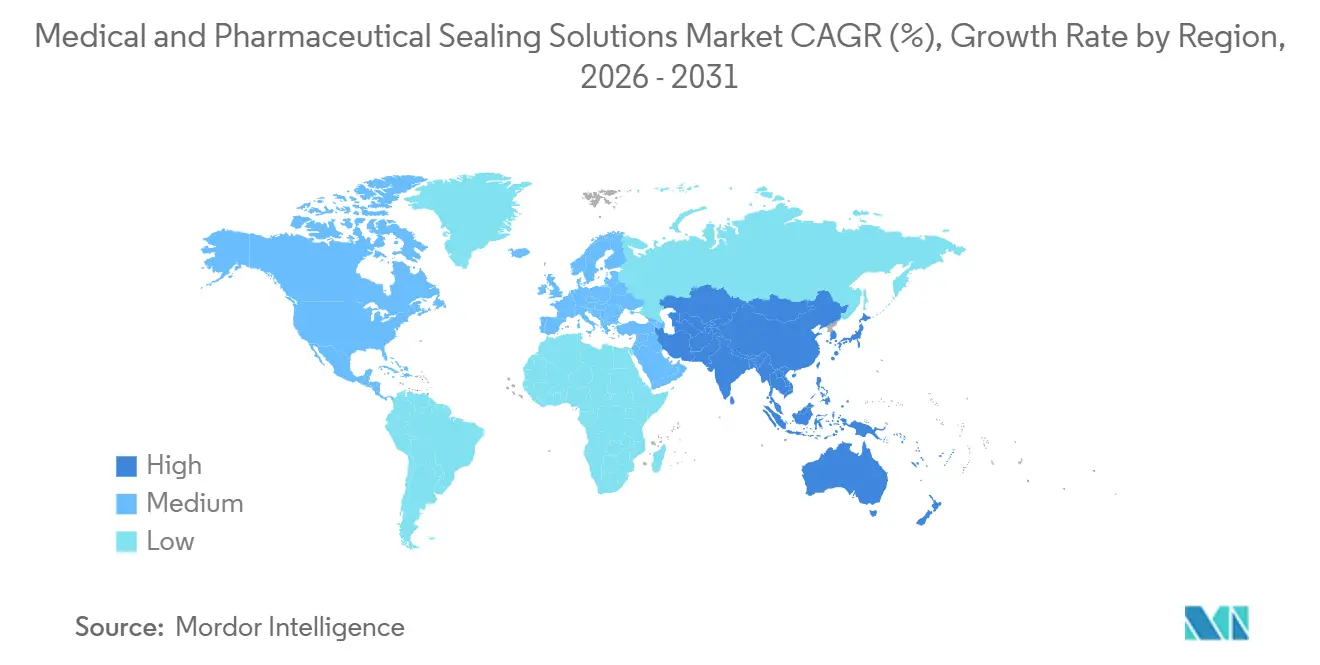
North America held 41.38% of the medical & pharmaceutical sealing solutions market share in 2025, which kept the region in the leading position. The region benefits from a dense concentration of biologics manufacturers, CDMOs, and fill finish operations across the Northeast U.S. pharmaceutical corridor. U.S. validation standards continue to tighten through container closure integrity expectations and the expected progression of ICH Q3E-related requirements, which reinforces demand for pre-validated and documentation-ready components. Canada and Mexico add regional volume through generic manufacturing and contract packaging. Still, the United States remains the main source of high-value demand in the medical & pharmaceutical sealing solutions market.
Europe remains the second-largest regional block in the medical & pharmaceutical sealing solutions market, with Germany, France, and Italy forming the core demand centers. Gerresheimer expanded its Wertheim site with a new production facility for ready-to-fill vials in September 2025, while Stevanato Group expanded manufacturing capacity in Germany in October 2025, which points to continued investment around biologics-related packaging demand. Sustainability pressure is also becoming more visible in European closure design decisions, especially in formats where recyclable and lower waste structures can be adopted more easily.
Asia-Pacific is projected to be the fastest-growing region in the medical & pharmaceutical sealing solutions market, with a projected CAGR of 7.26% through 2031. Growth is being driven by India’s scaling CDMO base, China’s biosimilar production buildout, and Southeast Asia’s rise as both a supply and demand center for validated closure components. New sterile filling capacity and more export-oriented pharmaceutical manufacturing are raising the specification level for seals, stoppers, plungers, and related packaging inputs across the region. South America, the Middle East, and Africa remain smaller in scale. Still, Brazil, South Africa, and several GCC countries are steadily increasing local pharmaceutical production, which supports a gradual rise in demand across the medical & pharmaceutical sealing solutions market.

Competitive Landscape
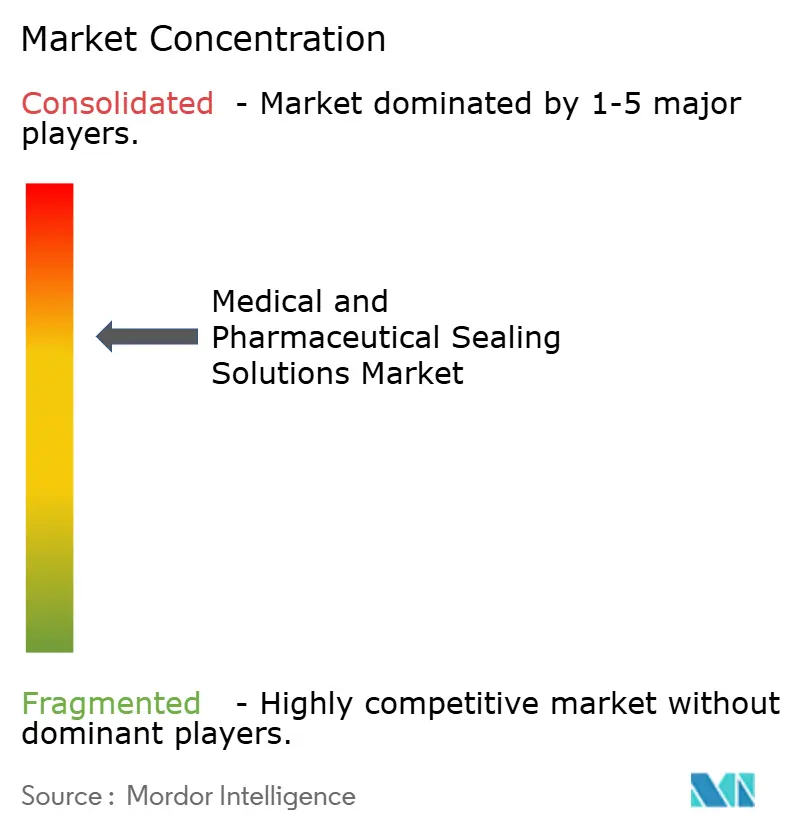
The medical & pharmaceutical sealing solutions market is moderately consolidated at the validated high-value tier, where a limited group of suppliers controls much of the ready-to-use component base. West Pharmaceutical Services, Datwyler Holding, Gerresheimer, Stevanato Group, and SCHOTT Pharma compete mainly through documentation depth, coating technology, qualification support, and co-development capability rather than pure price. In the medical & pharmaceutical sealing solutions market, this premium layer benefits from long switching cycles because once a component is validated, customers are reluctant to reopen dossier work. That helps leading suppliers defend pricing and stay embedded in complex injectable and combination product programs.
A clear strategic pattern has been the move toward integrated offerings that combine containers, closures, and delivery compatibility. The Alliance for RTU announced by Gerresheimer, Stevanato Group, and SCHOTT Pharma in September 2024 reflected a coordinated push to accelerate ready-to-use packaging adoption at scale. Datwyler, LTS Device Technologies, and Stevanato Group built on that direction in January 2026 through a pre-verified large volume delivery ecosystem for home-administered biologics. These actions show that major companies are trying to win the medical & pharmaceutical sealing solutions market through system level relevance, not just component supply.
Below the top tier, the medical & pharmaceutical sealing solutions market is more fragmented, with regional and specialized suppliers serving CDMOs, generic manufacturers, and selected therapy niches. Companies such as Lonstroff AG, Sanner GmbH, TekniPlex, Adelphi Healthcare Packaging, Comar, and Bormioli Pharma have room to compete where customers need flexibility, regional support, or narrower product specialization. A meaningful opening remains in validation support services, because mid sized suppliers can differentiate by helping customers with extractables and leachables studies, contamination control files, and shelf life programs. Material science remains the main technical battleground, especially in fluoropolymer coating processes and multi layer elastomer formulations that protect product contact performance. Another change is the growth of deterministic container closure integrity testing, which is drawing more instrumentation and service expertise into the ecosystem around the medical & pharmaceutical sealing solutions market.
Medical and Pharmaceutical Sealing Solutions Industry Leaders
West Pharmaceutical Services, Inc.
AptarGroup, Inc.
Gerresheimer AG
Datwyler Holding Inc.
Berry Global Group, Inc.
- *Disclaimer: Major Players sorted in no particular order

Recent Industry Developments
- June 2026: SCHOTT Pharma inaugurated expanded production lines for standard and sterile RTU glass vials at its Lebanon, Pennsylvania facility, backed by over USD 60 million in investment including approximately USD 38 million from BARDA, more than tripling U.S. local manufacturing capacity for high-value vial solutions and reinforcing domestic supply chain resilience for injectable packaging.
- January 2026: West Pharmaceutical Services signed a definitive agreement to sell all manufacturing and supply rights for the SmartDose 3.5 mL on-body delivery system to AbbVie for total consideration of USD 112.5 million, refocusing West's strategic portfolio toward injectable packaging components and away from proprietary delivery device platforms.
- January 2026: Datwyler launched the industry's first 20 mL universal plunger under its NeoFlex range at Pharmapack 2026, pre-verified for compatibility with all 20 mL ISO cartridges on the market and engineered to reduce pharmaceutical developer and device manufacturer development time by up to 3 years.


Global Medical and Pharmaceutical Sealing Solutions Market Report Scope
According to the report’s scope, the medical & pharmaceutical sealing solutions market is the specialized segment of sealing technologies, covering both static and dynamic seals, used in pharmaceutical manufacturing, bioprocessing, and medical equipment. It ensures sterility, containment, and compliance with strict regulatory standards, supporting safe drug production, cleanroom operations, and reliable medical devices.
The medical & pharmaceutical sealing solutions market is segmented into product type, material type, application, and geography. By product type, the market is segmented into caps, closures, stoppers, seals, plungers, and other product types. By material type, the market is segmented into plastics, elastomers and rubber, metals, and glass components. By application, the market is segmented into sterile injectables, biologics and biosimilars, vaccines, ophthalmic and otic products, oral solid and liquid drugs, and other applications. By geography, the market is segmented into North America, Europe, Asia-Pacific, the Middle East and Africa, and South America. The report also covers the estimated market sizes and trends for 17 countries across major regions globally. The report offers values (USD) for all the above segments.
| Caps |
| Closures |
| Stoppers |
| Seals |
| Plungers |
| Other Product Types |
| Plastics |
| Elastomers and Rubber |
| Metals |
| Glass Components |
| Sterile Injectables |
| Biologics and Biosimilars |
| Vaccines |
| Ophthalmic and Otic Products |
| Oral Solid and Liquid Drugs |
| Other Applications |
| North America | United States |
| Canada | |
| Mexico | |
| Europe | Germany |
| United Kingdom | |
| France | |
| Italy | |
| Spain | |
| Rest of Europe | |
| Asia-Pacific | China |
| Japan | |
| India | |
| Australia | |
| South Korea | |
| Rest of Asia-Pacific | |
| Middle East and Africa | GCC |
| South Africa | |
| Rest of Middle East and Africa | |
| South America | Brazil |
| Argentina | |
| Rest of South America |
| By Product Type | Caps | |
| Closures | ||
| Stoppers | ||
| Seals | ||
| Plungers | ||
| Other Product Types | ||
| By Material Type | Plastics | |
| Elastomers and Rubber | ||
| Metals | ||
| Glass Components | ||
| By Application | Sterile Injectables | |
| Biologics and Biosimilars | ||
| Vaccines | ||
| Ophthalmic and Otic Products | ||
| Oral Solid and Liquid Drugs | ||
| Other Applications | ||
| By Geography | North America | United States |
| Canada | ||
| Mexico | ||
| Europe | Germany | |
| United Kingdom | ||
| France | ||
| Italy | ||
| Spain | ||
| Rest of Europe | ||
| Asia-Pacific | China | |
| Japan | ||
| India | ||
| Australia | ||
| South Korea | ||
| Rest of Asia-Pacific | ||
| Middle East and Africa | GCC | |
| South Africa | ||
| Rest of Middle East and Africa | ||
| South America | Brazil | |
| Argentina | ||
| Rest of South America | ||


Key Questions Answered in the Report
What is the projected value of medical & pharmaceutical sealing solutions by 2031?
The medical & pharmaceutical sealing solutions market is forecasted to reach USD 0.53 billion in 2025 and USD 0.72 billion by 2031, rising from USD 0.56 billion in 2026 at a 5.1% CAGR.
Which region leads demand for medical & pharmaceutical sealing solutions?
North America led in 2025 with 41.38% revenue share, supported by dense biologics manufacturing and tighter validation requirements.
Which application is growing fastest in medical & pharmaceutical sealing solutions?
Biologics and biosimilars are expected to be the fastest-growing applications, with a projected 6.13% CAGR through 2031, because these therapies need more specialized sealing performance.
Which product category holds the largest share?
Caps held the largest share by product type in 2025 at 41.23%, reflecting their essential role in vial closure systems used across injectable packaging.
Page last updated on:


 Your data is secure and never sold or shared.


