
Medical and Pharmaceutical Dynamic Sealing Solutions Market Size and Share
Market Overview
| Study Period | 2020 - 2031 |
|---|---|
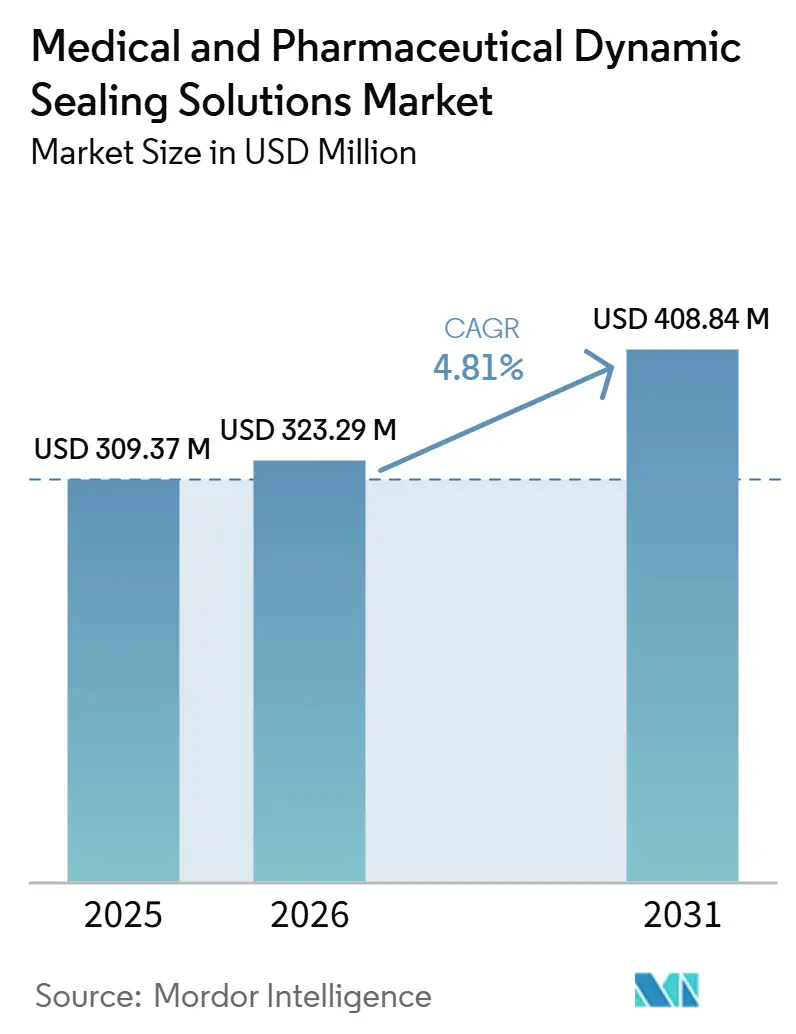
| Market Size (2026) | USD 323.29 Million |
| Market Size (2031) | USD 408.84 Million |
| Growth Rate (2026 - 2031) | 4.81 % |
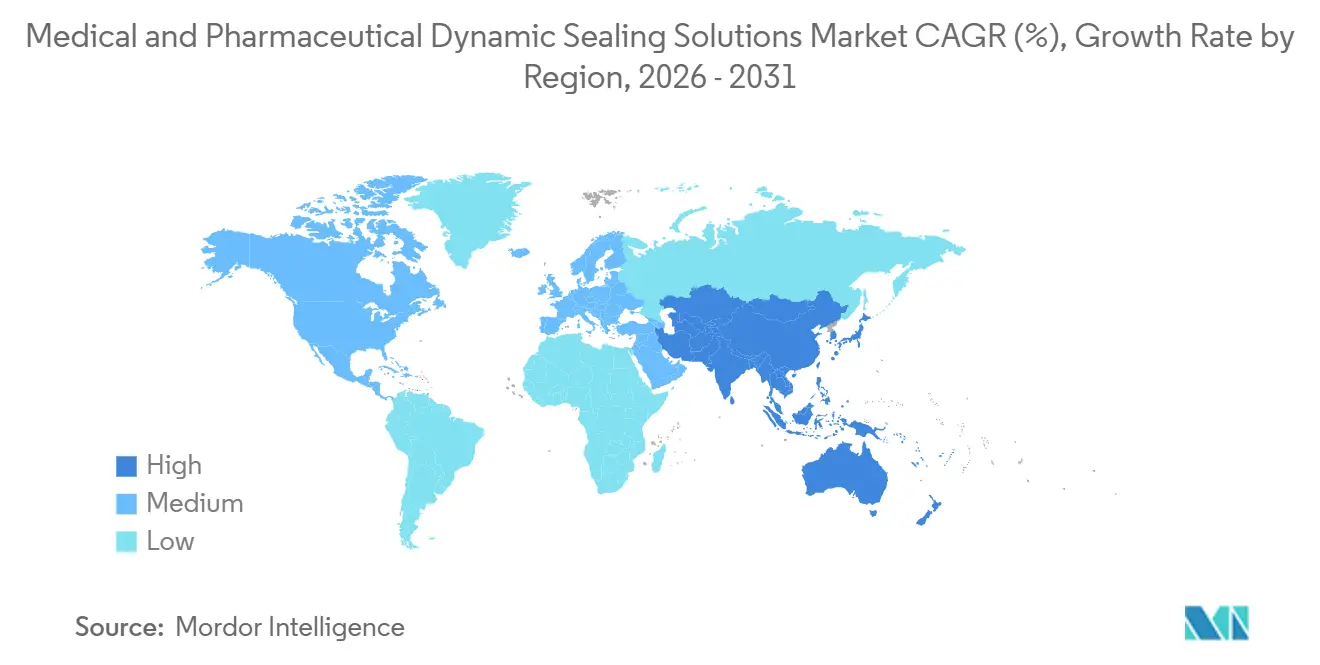
| Fastest Growing Market | Asia-Pacific |
| Largest Market | North America |
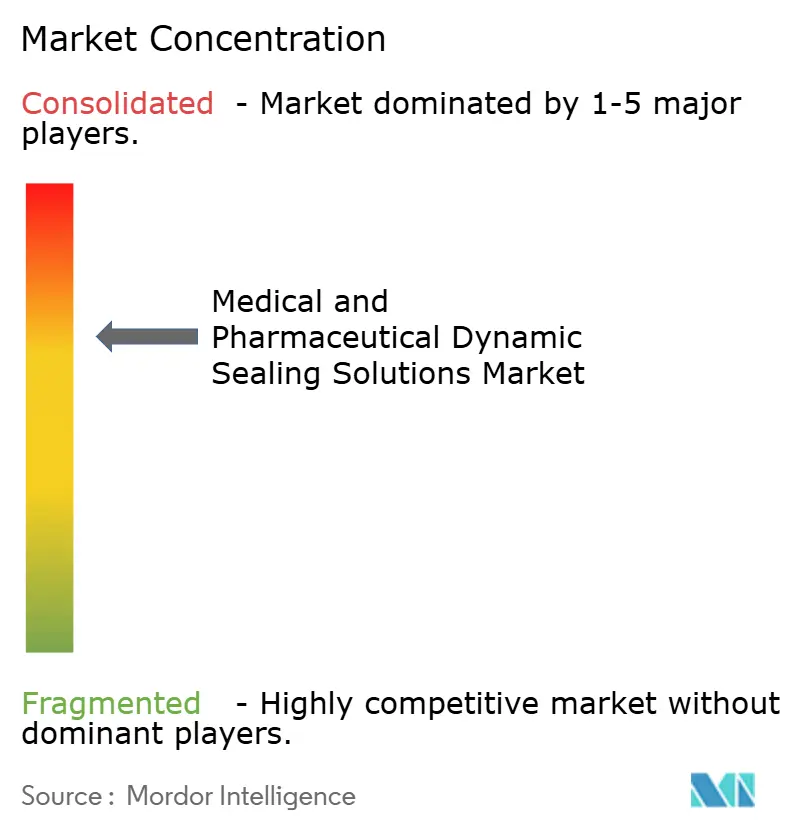
| Market Concentration | Medium |
Major Players *Disclaimer: Major Players sorted in no particular order Image © Mordor Intelligence. Reuse requires attribution under CC BY 4.0. | |
Medical and Pharmaceutical Dynamic Sealing Solutions Market Analysis by Mordor Intelligence
The medical and pharmaceutical dynamic sealing solutions market is projected to expand from USD 309.37 million in 2025 and USD 323.29 million in 2026 to USD 408.84 million by 2031, registering a CAGR of 4.81% between 2026 and 2031. The medical and pharmaceutical dynamic sealing solutions market is advancing as biologics manufacturing capacity rises and contamination control moves closer to the center of equipment design decisions. Updated pharmacopeial and sterile manufacturing requirements are pushing OEMs and drug manufacturers to specify seals with stronger validation packages, broader traceability, and lower extractables risk. In 2026, full Annex 1 enforcement is reinforcing the shift from standard catalog components to engineered sealing solutions that are chosen earlier in aseptic system design. That shift is lengthening qualification cycles, but it is also increasing the long-term value of approved supply relationships in the medical and pharmaceutical dynamic sealing solutions market. Material substitution pressure tied to PFAS scrutiny is adding supply chain risk, while also creating room for suppliers that can qualify cleaner alternatives without weakening process performance.
Key Report Takeaways
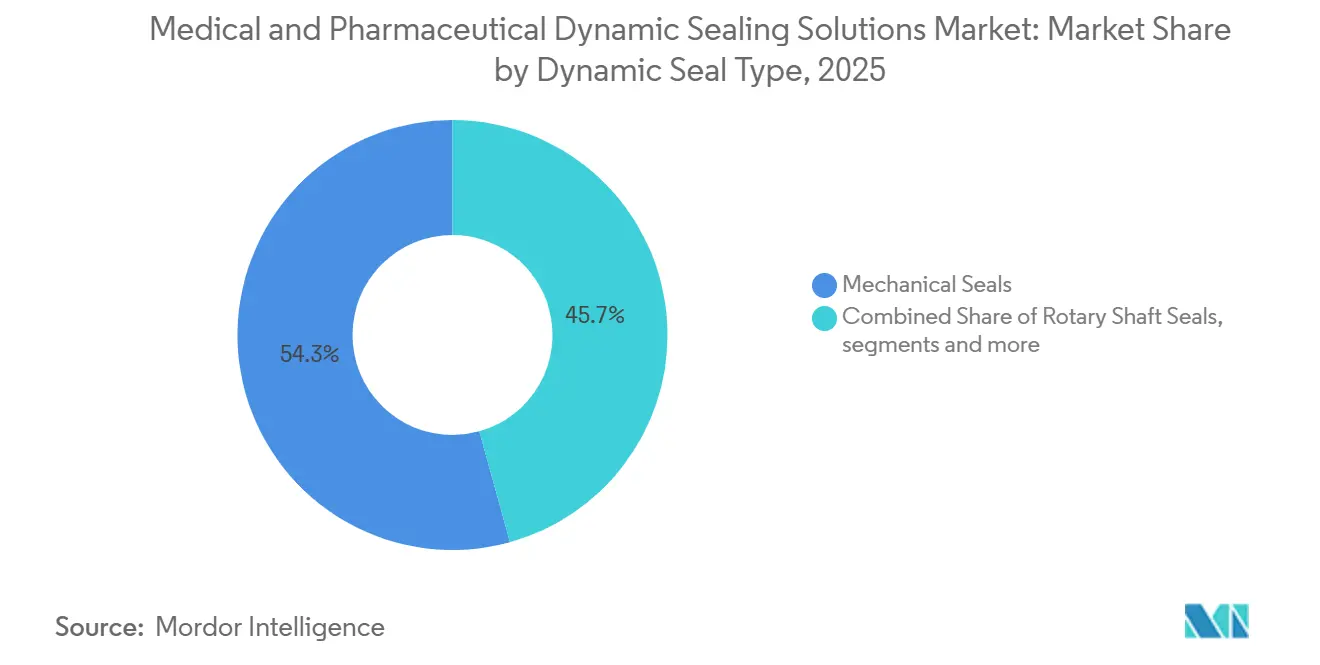
- By dynamic seal type, mechanical seals held 54.32% of revenue in 2025, while rotary shaft seals are projected to expand at 5.15% CAGR through 2031.
- By motion type, rotary motion seals held 46.13% of revenue in 2025, while reciprocating seals are projected to grow fastest at 5.64% CAGR through 2031.
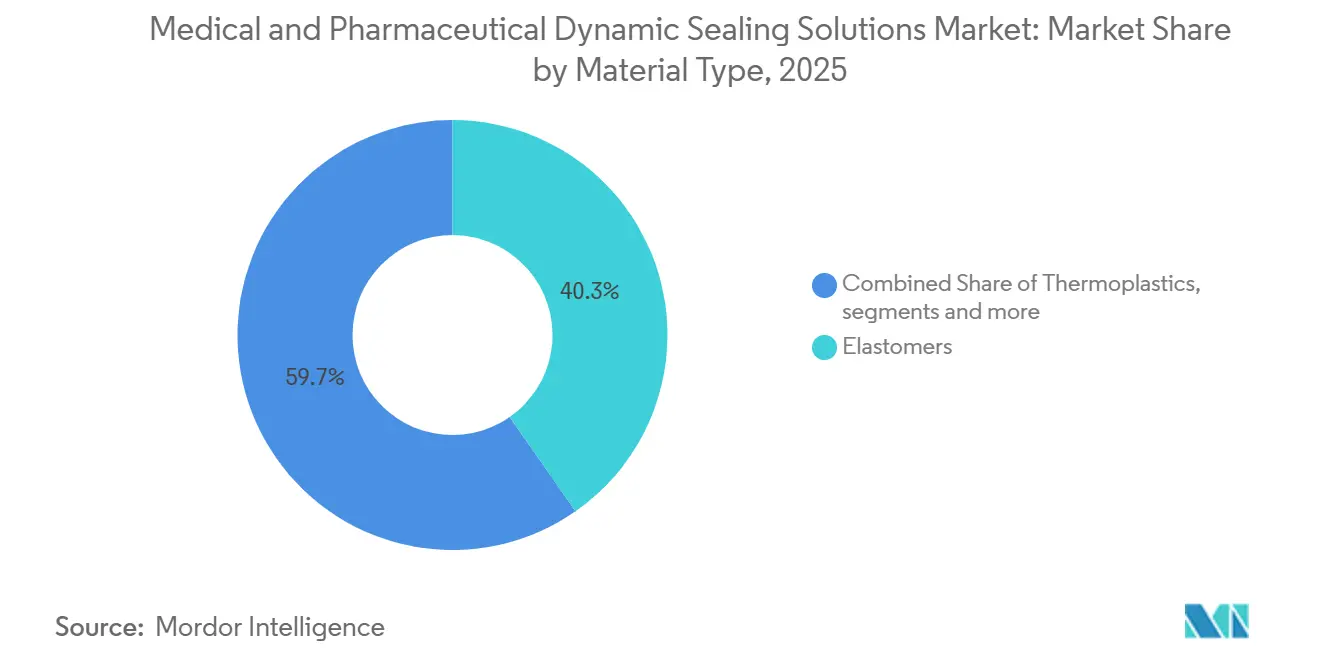
- By material type, elastomers held 40.26% of revenue in 2025, while metal seals are projected to record the highest CAGR at 6.11% through 2031.
- By application, medical equipment and devices accounted for 57.14% of the medical and pharmaceutical dynamic sealing solutions market share in 2025, while pharma and biopharma are projected to advance at 6.75% CAGR through 2031.
- By geography, North America held 46.37% of the medical and pharmaceutical dynamic sealing solutions market in 2025, while Asia-Pacific is projected to expand at 7.22% CAGR through 2031.
Note: Market size and forecast figures in this report are generated using Mordor Intelligence’s proprietary estimation framework, updated with the latest available data and insights as of January 2026.
Market Trends and Insights
Drivers Impact Analysis of Medical and Pharmaceutical Dynamic Sealing Solutions Market*
| Driver | (~) % Impact on CAGR Forecast | Geographic Relevance | Impact Timeline |
|---|---|---|---|
| Rising OEM Preference for High-Reliability Rotary and Hydraulic Seals | +0.8% | North America and Europe | Short term (≤ 2 years) |
| Expansion of Sterile Pharma Processing Equipment Installations | +1.2% | Global, APAC core with spill-over to MEA | Medium term (2-4 years) |
| Higher Seal Duty Cycles in Medical Devices with Moving Components | +0.5% | North America and Europe | Medium term (2-4 years) |
| Replacement Demand from GMP Validation and Preventive Maintenance | +0.6% | Global | Short term (≤ 2 years) |
| Growth in Custom-Machined Dynamic Seals for Short-Lead OEM Programs | +0.7% | North America and Europe | Long term (≥ 4 years) |
| Rising Need for Low-Extractables Dynamic Seals in Bioprocessing | +0.8% | Global | Short term (≤ 2 years) |
| Source: Mordor Intelligence | |||
Rising OEM Preference for High-Reliability Rotary and Hydraulic Seals
The medical and pharmaceutical dynamic sealing solutions market is benefiting from a change in how medical device OEMs buy sealing systems for injectable platforms. Higher injectable therapy volumes are increasing the need for high-integrity elastomeric sealing in prefilled syringes, auto-injectors, and on-body delivery systems. Datwyler stated in 2026 that GLP-1 platform demand is lifting requirements for premium elastomeric components used in these applications. OEMs are also narrowing approved supplier lists toward companies that can provide material certification and finished-component test data with each program.[1]Datwyler, “Datwyler Capital Market Day 2025 Presentations,” Datwyler, datwyler.com That preference is becoming more durable as current pharmacopeial expectations make raw material certificates less useful on their own. The result is a steadier tilt in the medical and pharmaceutical dynamic sealing solutions market toward validated suppliers with audit-ready documentation and established testing infrastructure.
Expansion of Sterile Pharma Processing Equipment Installations
The medical and pharmaceutical dynamic sealing solutions market is also gaining from new sterile processing capacity across biologics and injectable manufacturing. Each added fill-finish line, bioreactor train, mixer, and fluid transfer assembly creates recurring seal demand across pumps, agitators, and rotating equipment. This effect becomes stronger when facilities are designed for stricter aseptic operation from the start. In 2026, full Annex 1 enforcement is pushing manufacturers to formalize contamination control strategies, and that is moving seal qualification into earlier engineering decisions. As a result, seals are being selected as quality-critical contact components instead of routine maintenance items. That change is increasing the value of design-stage participation for suppliers serving the medical and pharmaceutical dynamic sealing solutions market.
Growth in Custom-Machined Dynamic Seals for Short-Lead OEM Programs
The medical and pharmaceutical dynamic sealing solutions market is seeing stronger demand for custom-machined sealing as device miniaturization moves faster than standard catalog development. Surgical robotics, wearable drug delivery, and minimally invasive instruments often need geometries and performance windows that standard lip seals cannot support. Bal Seal Engineering highlighted spring-energized PTFE seals for rotary applications where wear, thermal cycling, and tight leak control are critical. Short development timelines are also favoring suppliers that can adapt proven platform designs instead of starting every program with new tooling.[2]Bal Seal Engineering, “Custom Rotary Shaft Seals, Spring-Energized PTFE Seals,” Bal Seal Engineering, balseal.com That lowers qualification friction for OEMs working under aggressive commercialization schedules. Over time, this is widening the addressable role of engineered sealing within the medical and pharmaceutical dynamic sealing solutions market.
Rising Need for Low-Extractables Dynamic Seals in Bioprocessing
The medical and pharmaceutical dynamic sealing solutions market is being reshaped by stricter focus on extractables and leachables in biologics, drug delivery, and sterile processing. Daicel noted that rubber oligomers and related leachables are now closely examined in extractables and leachables studies tied to pharmaceutical packaging and closure systems. That scrutiny is making low-extractable materials more important in dynamic seals that operate near sensitive drug product contact zones. At the same time, PFAS restriction discussions in Europe are raising concern around fluoropolymer-based materials that have been favored for purity and chemical resistance. The industry is therefore working toward alternatives such as HNBR, EPDM, and TPEs that can meet biocompatibility and cleanliness requirements without the same regulatory exposure. This is creating a clear material innovation window inside the medical and pharmaceutical dynamic sealing solutions market, even as qualification demands remain high.
Restraints Impact Analysis of Medical and Pharmaceutical Dynamic Sealing Solutions Market*
| Restraint | (~) % Impact on CAGR Forecast | Geographic Relevance | Impact Timeline |
|---|---|---|---|
| Long Qualification Cycles for Dynamic Seal Materials and Designs | -0.7% | Global, with highest impact in North America and Europe | Long term (≥ 4 years) |
| Cost Sensitivity in Price-Competitive Medical and Pharma Equipment Procurement | -0.5% | Asia-Pacific, South America, MEA | Medium term (2-4 years) |
| Limited Standardization Across OEM Platforms | -0.4% | Global | Long term (≥ 4 years) |
| Performance Tradeoffs Under Sterilization and Cleaning Regimes | -0.4% | Global | Medium term (2-4 years) |
| Source: Mordor Intelligence | |||
Long Qualification Cycles for Dynamic Seal Materials and Designs
Long qualification cycles remain one of the clearest structural restraints on the medical and pharmaceutical dynamic sealing solutions market. In regulated applications, even a minor compound or design change can trigger extensive change control, documentation, and validation work before it is accepted for commercial use. Cowseal notes that pharmaceutical equipment materials must comply with requirements linked to nonreactivity and product compatibility under FDA 21 CFR Part 211, which raises the burden of any specification change.[3]Cowseal, “GMP Compliant Mechanical Seal Requirements for Pharmaceutical Industry,” Cowseal, cowseal.comThat burden typically sits with the drug manufacturer or equipment owner rather than the seal supplier. This makes customers reluctant to switch to new materials unless a regulatory requirement or supply issue leaves little choice. It also slows the pace at which the medical and pharmaceutical dynamic sealing solutions market can respond to emerging PFAS substitution needs.
Cost Sensitivity in Price-Competitive Medical and Pharma Equipment Procurement
Cost sensitivity is a second restraint because premium materials can carry very large price differences against commodity sealing compounds. In generic drug processing, contract packaging, and cost-pressured healthcare manufacturing, buyers often target minimum acceptable compliance rather than premium material performance. That creates a split market where validated high-value programs can support stronger pricing, while replacement demand in lower-cost settings remains exposed to aggressive price competition. The effect is more visible in emerging regions where procurement budgets and manufacturing infrastructure place tighter limits on total system cost. Documentation, installation, and periodic replacement can add to that burden even when the seal itself performs better over time. This dynamic keeps part of the medical and pharmaceutical dynamic sealing solutions market tied to lower average selling prices despite stronger technical needs in sterile and biopharma applications.
*Our forecasts treat driver/restraint impacts as directional, not additive. The impact forecasts reflect baseline growth, mix effects, and variable interactions.
Medical and Pharmaceutical Dynamic Sealing Solutions Market Segment Analysis
By Dynamic Seal Type:
Mechanical Seals Anchor the Market, Rotary Shaft Variants Gain TractionMechanical seals held 54.32% of revenue in 2025, making them the leading product group in the medical and pharmaceutical dynamic sealing solutions market. Their position comes from broad use in pharmaceutical pumps, mixers, bioreactor agitators, and fill-finish equipment, where clean fluid separation is critical. Cowseal describes modern pharmaceutical mechanical seals as traceable, hygienic, and aligned with GMP-focused design requirements for regulated processing. Rotary Shaft Seals are expected to be the fastest-growing sub-type with a 5.15% CAGR through 2031 as higher-speed diagnostic, dispensing, and single-use mixing applications expand.
That growth reflects a performance gap between older rubber-based designs and spring-energized PTFE options that can handle intermittent duty and tighter leak control. Bal Seal Engineering highlighted the value of spring-energized PTFE seals in rotary environments that combine speed, wear, and thermal stress. Hydraulic and pneumatic seals remain smaller but relevant in powered surgical tools, implant delivery systems, and lab automation, where precise actuation matters. Other Dynamic Seals, including inflatable and diaphragm styles, still hold a modest base but are gaining attention as isolator and barrier technologies spread across the medical and pharmaceutical dynamic sealing solutions industry.



By Motion Type:
Rotary Applications Lead, Reciprocating Seals Accelerate in Fill-FinishRotary motion seals held 46.13% of revenue in 2025, giving them the largest share within this motion category analysis of the medical and pharmaceutical dynamic sealing solutions market. Their lead reflects the installed base of centrifugal pumps, reactor agitators, and motor-driven dispensing systems across pharmaceutical and medical manufacturing. As campaigns run for longer periods, particle generation from rotary wear becomes more important because it affects sterility assurance over cumulative operating time. This is pushing OEMs to evaluate wear behavior and contamination control together rather than as separate issues.
Reciprocating seals are projected to grow at 5.64% CAGR through 2031, supported by high-speed fill-finish systems where piston movement is repeated at very high cycle counts. Growth is also influenced by the wider shift toward cleaner fluid handling in automated dosing and drug delivery equipment. Some applications are being offset by peristaltic systems in single-use biomanufacturing, but that is also creating demand for new connector and clamp sealing points. Motion type decisions are therefore becoming more strategic in the medical and pharmaceutical dynamic sealing solutions industry because contamination control planning now reaches further into equipment architecture and operating mode selection.
By Material Type:
Elastomers Dominate, Metal Seals Emerge for Aseptic Critical ApplicationsElastomers accounted for 40.26% of revenue in 2025, the largest material share in the medical and pharmaceutical dynamic sealing solutions market size. Their lead comes from the practical range of EPDM, FKM, and FFKM across water systems, steam exposure, cleaning media, and solvent contact. Metal Seals, however, are projected to grow fastest at 6.11% CAGR through 2031 as fill-finish lines and aseptic downstream operations seek lower particle generation and lower leachable risk.
That pattern is revenue-led as much as volume-led because metal seal unit values are much higher than elastomeric alternatives. Thermoplastics such as PTFE remain important in chemically aggressive service where conventional elastomers reach compatibility limits. Composite constructions are also gaining ground because they combine chemical resistance with more stable seating force across demanding operating windows. If European PFAS restrictions move ahead as discussed, a sizable portion of fluoropolymer-based materials could face requalification pressure, which would redirect part of the medical and pharmaceutical dynamic sealing solutions market toward alternative compounds and hybrid structures.
By Application:
Medical Equipment Drives Volume, Pharma and Biopharma AcceleratesMedical equipment and devices captured 57.14% of revenue in 2025, the largest application share in the medical and pharmaceutical dynamic sealing solutions market share analysis. This broad category includes surgical instruments, orthopedic delivery systems, dental equipment drives, medical filtration units, and drug delivery actuators. Demand is widening as minimally invasive procedures, robotic systems, and advanced injection platforms call for smaller and more precise seals that can tolerate sterilization without sacrificing motion quality. Datwyler linked current growth in injectable platforms to stronger demand for premium elastomeric components used in combination product settings.
Pharma and biopharma are forecasted to expand at 6.75% CAGR through 2031, making it the fastest-growing application in the medical and pharmaceutical dynamic sealing solutions market. The segment is benefiting from continued buildout of upstream, downstream, and fill-finish capacity for biologics, biosimilars, and gene therapy-related production. Seal requirements in these environments are stricter because fluid paths must tolerate variable chemistry, repeated cleaning, and sterility checks without contributing contamination. Saint-Gobain Life Sciences and VERDOT announced an April 2026 collaboration focused on integrated PUPSIT solutions, showing how compliance requirements are shaping new commercial partnerships around critical bioprocessing interfaces.
Geography Analysis
North America Medical and Pharmaceutical Dynamic Sealing Solutions Market
North America held 46.37% of revenue in 2025, the largest regional contribution to the medical and pharmaceutical dynamic sealing solutions market share. The region benefits from dense pharmaceutical manufacturing, medical device production, and specialized CDMO activity across major U.S. clusters. It also remains a high-specification environment where FDA, USP, and biocompatibility expectations raise the barrier for non-validated suppliers. Datwyler’s Middletown, Delaware site entered commercial supply for GLP-1 therapy packaging components in March 2026 after a cumulative investment of more than USD 120 million, which shows how suppliers are placing capital close to advanced healthcare customers. That localization trend supports the medical and pharmaceutical dynamic sealing solutions market as buyers place greater weight on domestic supply resilience and validated production footprints.
Europe Medical and Pharmaceutical Dynamic Sealing Solutions Market
Europe remained the second-largest regional market, supported by Germany’s concentration of pharmaceutical equipment OEMs, sterile bioprocess suppliers, and contract manufacturing capacity. West Pharma noted that revised Annex 1 expectations are changing how contamination control is managed around critical components in sterile processing. Europe also faces sharper PFAS-related material transition risk than North America, which adds pressure to reformulate and requalify parts of the medical and pharmaceutical dynamic sealing solutions market.
APAC, South America and MEA Medical and Pharmaceutical Dynamic Sealing Solutions Market
Asia-Pacific is projected to grow at 7.22% CAGR through 2031, making it the fastest-expanding regional block in the medical and pharmaceutical dynamic sealing solutions market size outlook. Growth is tied to larger biologics investment, wider injectable manufacturing capacity, and more localized component production in India, China, and South Korea. ElringKlinger’s Qingdao high-performance plastics facility reflects the region’s supply localization trend and its rising importance in medical technology component sourcing. South America and the Middle East and Africa remain smaller today, but Brazil and the GCC stand out as the more promising sub-markets as healthcare investment and pharmaceutical localization improve.

Competitive Landscape
The medical and pharmaceutical dynamic sealing solutions market is moderately consolidated at the global level. Large groups such as Trelleborg, Freudenberg Sealing Technologies, Parker Hannifin, and Saint-Gobain compete through broad materials portfolios, manufacturing reach, and validation-heavy customer support. At the same time, specialized players such as Bal Seal Engineering, Precision Polymer Engineering, Marco Rubber and Plastics, and Datwyler retain strong positions in application-specific niches. This balance gives the medical and pharmaceutical dynamic sealing solutions market a layered structure rather than a winner-take-all pattern.
Competition is moving beyond price and catalog breadth toward validation depth, contamination control capability, and material reformulation speed. Greene Tweed’s Chemraz line illustrates how proprietary materials still matter in high-purity service where solvent exposure and repeated sterilization place unusual stress on seal integrity. Datwyler also expanded its strategic position in the U.S. through commercial supply from Middletown for GLP-1 therapy components in 2026, strengthening its role in advanced injectable applications. These moves show that the medical and pharmaceutical dynamic sealing solutions market is rewarding suppliers that combine process knowledge with compliance execution.
A second line of competition is opening around local manufacturing depth and cleaner material platforms. ElringKlinger’s expansion in Qingdao shows how suppliers are positioning closer to Asian demand centers while still serving high-performance medical applications. At the same time, PFAS discussions are giving an advantage to companies that can move customers toward requalified alternatives without interrupting validated operations. That combination of global scale, niche engineering skill, and regulatory readiness should keep the medical and pharmaceutical dynamic sealing solutions market competitive, but not highly fragmented.
Medical and Pharmaceutical Dynamic Sealing Solutions Industry Leaders
Trelleborg AB
Parker Hannifin Corporation
Saint-Gobain S.A.
Datwyler Holding Inc.
Greene, Tweed and Co.
- *Disclaimer: Major Players sorted in no particular order
Medical and Pharmaceutical Dynamic Sealing Solutions Market Companies Covered in this Report
- Bal Seal Engineering
- Datwyler Holding Inc.
- ElringKlinger Group
- Enpro Industries
- Flowserve Corporation
- Freudenberg Sealing Technologies
- Greene, Tweed and Co.
- Hutchinson (TotalEnergies Group)
- James Walker Group
- John Crane
- Marco Rubber & Plastics
- Minnesota Rubber & Plastics
- Nippon Valqua Industries Ltd
- Parker Hannifin
- Precision Polymer Engineering Limited (IDEX Corporation)
- Saint-Gobain
- Trelleborg AB
- TRP Polymer Solutions

Recent Industry Developments in Medical and Pharmaceutical Dynamic Sealing Solutions Market
- April 2026: Saint-Gobain Life Sciences and VERDOT announced a strategic collaboration to develop and commercialize next-generation Pre-Use Post-Sterilization Integrity Testing (PUPSIT) single-use assemblies for biopharmaceutical manufacturers operating under EU GMP Annex 1 sterility assurance requirements. This partnership positions both companies to serve the growing mandatory PUPSIT validation market across European and US CDMOs.
- April 2026: Freudenberg Medical opened a new ISO Class 5 controlled cleanroom at its Kaiserslautern, Germany facility, launching the CleanAssure pre-sterilization service for single-use biopharmaceutical assemblies. The service uses ultrapure water produced via multi-stage filtration and delivers gamma-sterilized tubing assemblies and overmolded components directly to biomanufacturers, reducing downstream cleaning and sterilization burden at customer fill-finish sites.
- March 2026: Datwyler's Middletown, Delaware FirstLine facility initiated commercial supply of pharmaceutical packaging components for GLP-1 therapies in the US market, following a cumulative investment exceeding USD 120 million in the site since its acquisition in 2017. The facility uses advanced cleanroom technology and automated quality inspection to supply premium elastomeric sealing components for injectable drug delivery platforms.


Global Medical and Pharmaceutical Dynamic Sealing Solutions Market Report Scope
According to the report’s scope, the medical and pharmaceutical dynamic sealing solutions market focuses on sealing technologies such as mechanical seals, rotary seals, and other motion‑resistant components used in pharmaceutical machinery, bioprocessing equipment, and medical devices. These solutions maintain sterility and containment under dynamic operating conditions, ensuring reliability in processes like sterile filling, fluid transfer, and continuous drug manufacturing. The market is driven by rising biologics production, cleanroom automation, and regulatory emphasis on contamination control.
The medical and pharmaceutical dynamic sealing solutions market is segmented into dynamic seal type, motion type, material type, application, and geography. By dynamic seal type, the market is segmented into mechanical seals, rotary shaft seals, hydraulic & pneumatic seals, and other dynamic seals. By motion type, the market is segmented into rotary, reciprocating, and oscillating. By material type, the market is segmented into elastomers, thermoplastics, metal seals, and composite materials. By application, the market is segmented into medical equipment & devices and pharma & biopharma production. The medical equipment & devices are further segmented into surgical & operating equipment, orthopedic equipment, dental equipment, medical fluid handling systems, drug delivery devices, and other medical equipment & devices. The pharma & biopharma production is further segmented into upstream processing, downstream processing, fill-finish equipment, and other pharma & biopharma production systems. By geography, the market is segmented into North America, Europe, Asia-Pacific, the Middle East and Africa, and South America. The report also covers the estimated market sizes and trends for 17 countries across major regions globally. The report offers values (USD) for all the above segments.
| Mechanical Seals |
| Rotary Shaft Seals |
| Hydraulic & Pneumatic Seals |
| Other Dynamic Seals |
| Rotary |
| Reciprocating |
| Oscillating |
| Elastomers |
| Thermoplastics |
| Metal Seals |
| Composite Materials |
| Medical Equipment & Devices | Surgical & Operating Equipment |
| Orthopedic Equipment | |
| Dental Equipment | |
| Medical Fluid Handling Systems | |
| Drug Delivery Devices | |
| Other Medical Equipment & Devices | |
| Pharma & Biopharma Production | Upstream Processing |
| Downstream Processing | |
| Fill-Finish Equipment | |
| Other Pharma & Biopharma Production Systems |
| North America | United States |
| Canada | |
| Mexico | |
| Europe | Germany |
| United Kingdom | |
| France | |
| Italy | |
| Spain | |
| Rest of Europe | |
| Asia-Pacific | China |
| Japan | |
| India | |
| Australia | |
| South Korea | |
| Rest of Asia-Pacific | |
| Middle East and Africa | GCC |
| South Africa | |
| Rest of Middle East and Africa | |
| South America | Brazil |
| Argentina | |
| Rest of South America |
| By Dynamic Seal Type | Mechanical Seals | |
| Rotary Shaft Seals | ||
| Hydraulic & Pneumatic Seals | ||
| Other Dynamic Seals | ||
| By Motion Type | Rotary | |
| Reciprocating | ||
| Oscillating | ||
| By Material Type | Elastomers | |
| Thermoplastics | ||
| Metal Seals | ||
| Composite Materials | ||
| By Application | Medical Equipment & Devices | Surgical & Operating Equipment |
| Orthopedic Equipment | ||
| Dental Equipment | ||
| Medical Fluid Handling Systems | ||
| Drug Delivery Devices | ||
| Other Medical Equipment & Devices | ||
| Pharma & Biopharma Production | Upstream Processing | |
| Downstream Processing | ||
| Fill-Finish Equipment | ||
| Other Pharma & Biopharma Production Systems | ||
| By Geography | North America | United States |
| Canada | ||
| Mexico | ||
| Europe | Germany | |
| United Kingdom | ||
| France | ||
| Italy | ||
| Spain | ||
| Rest of Europe | ||
| Asia-Pacific | China | |
| Japan | ||
| India | ||
| Australia | ||
| South Korea | ||
| Rest of Asia-Pacific | ||
| Middle East and Africa | GCC | |
| South Africa | ||
| Rest of Middle East and Africa | ||
| South America | Brazil | |
| Argentina | ||
| Rest of South America | ||


Key Questions Answered in the Report
What is the projected value of the medical and pharmaceutical dynamic sealing solutions space by 2031?
The market is projected to reach USD 408.84 million by 2031 from USD 309.37 million in 2025 to USD 323.29 million in 2026, at a 4.81% CAGR over 2026-2031.
Which region leads demand for medical and pharmaceutical dynamic sealing solutions?
North America led in 2025 with 46.37% share, supported by dense pharmaceutical manufacturing, device production, and high validation requirements.
Which region is growing fastest through 2031?
Asia-Pacific is projected to grow fastest at 7.22% CAGR through 2031 as biologics and injectable manufacturing capacity expands.
Which product type holds the largest share in dynamic sealing solutions for medical and pharma uses?
Mechanical seals led with 54.32% share in 2025 because they are deeply used in pumps, mixers, agitators, and fill-finish equipment.
Page last updated on:





