
Media Measurement Software Market Size and Share
Market Overview
| Study Period | 2020 - 2031 |
|---|---|
| Market Size (2026) | USD 6.29 Billion |
| Market Size (2031) | USD 10.96 Billion |
| Growth Rate (2026 - 2031) | 11.75 % |
| Fastest Growing Market | Asia-Pacific |
| Largest Market | North America |
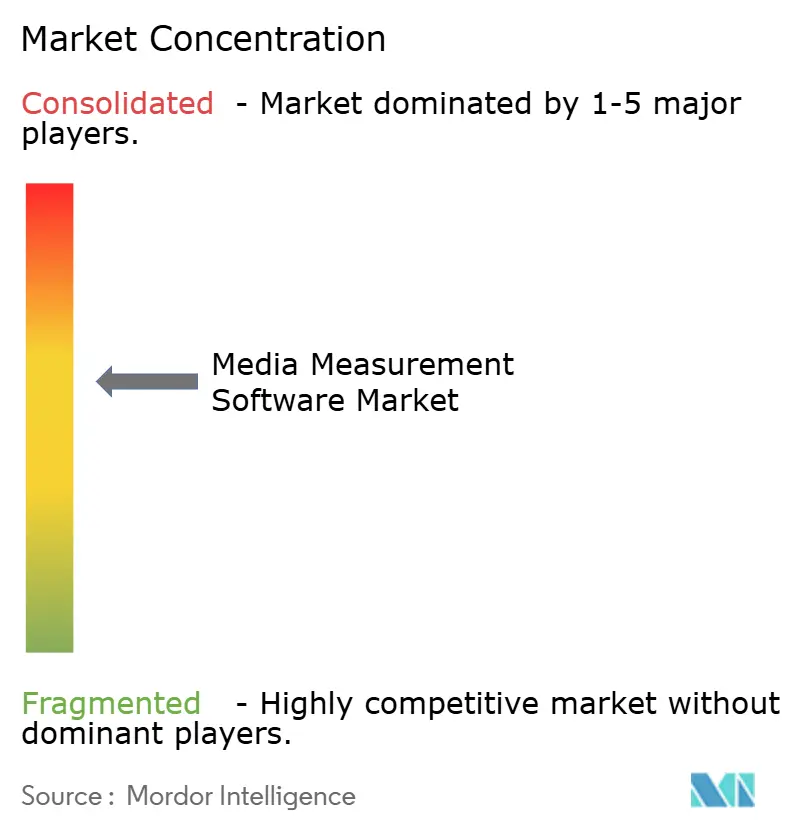
| Market Concentration | Medium |
Major Players *Disclaimer: Major Players sorted in no particular order Image © Mordor Intelligence. Reuse requires attribution under CC BY 4.0. | |
Media Measurement Software Market Analysis by Mordor Intelligence
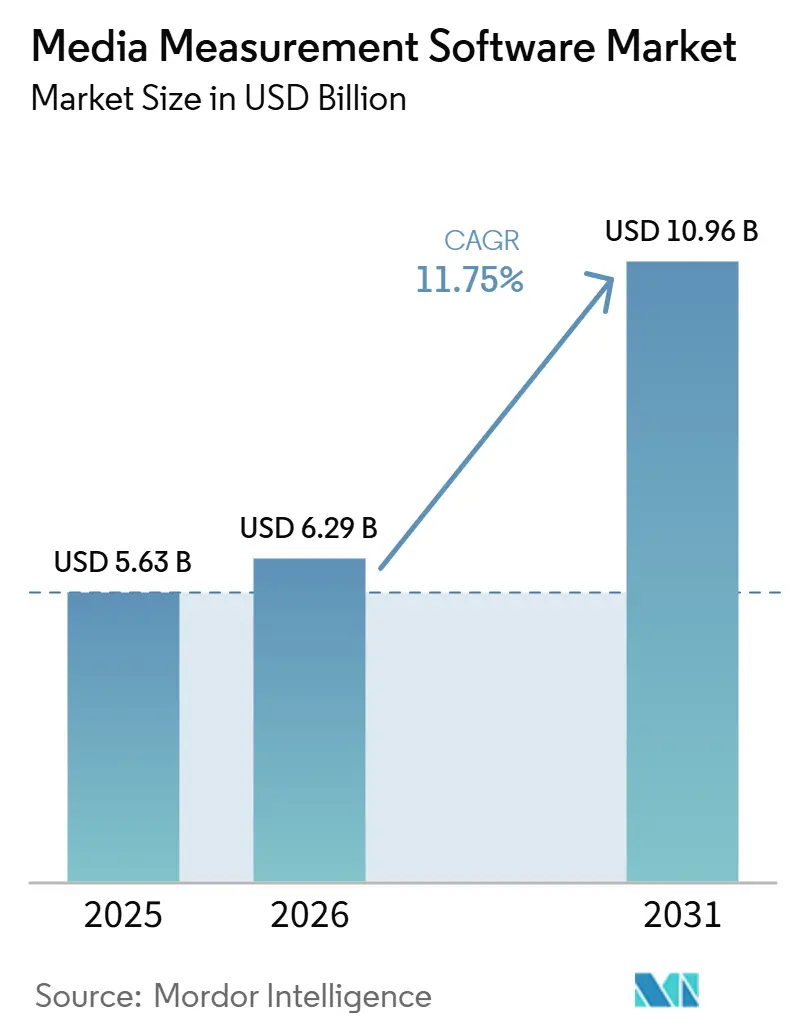
The media measurement software market size was USD 5.63 billion in 2025, and USD 6.29 billion in 2026, and is forecast to reach USD 10.96 billion by 2031, at a CAGR of 11.75% during 2026-2031. The media measurement software market is being reshaped by the move away from deterministic tracking toward privacy-safe methods built on first-party data, clean rooms, and marketing mix modeling. The spread of streaming, connected TV, retail media networks, and AI-led analytics is changing what buyers expect from measurement platforms and how vendors position their products. The media measurement software market is also seeing competition split between long-established measurement companies with panel and broadcast depth, and newer software providers focused on attribution, social intelligence, and automated reporting. Procurement decisions now depend more on cross-platform coverage, data governance, and reporting speed than on legacy measurement alone. This leaves the media measurement software market open to vendors that can connect audience measurement, attribution, and optimization into a single usable workflow.
Key Report Takeaways
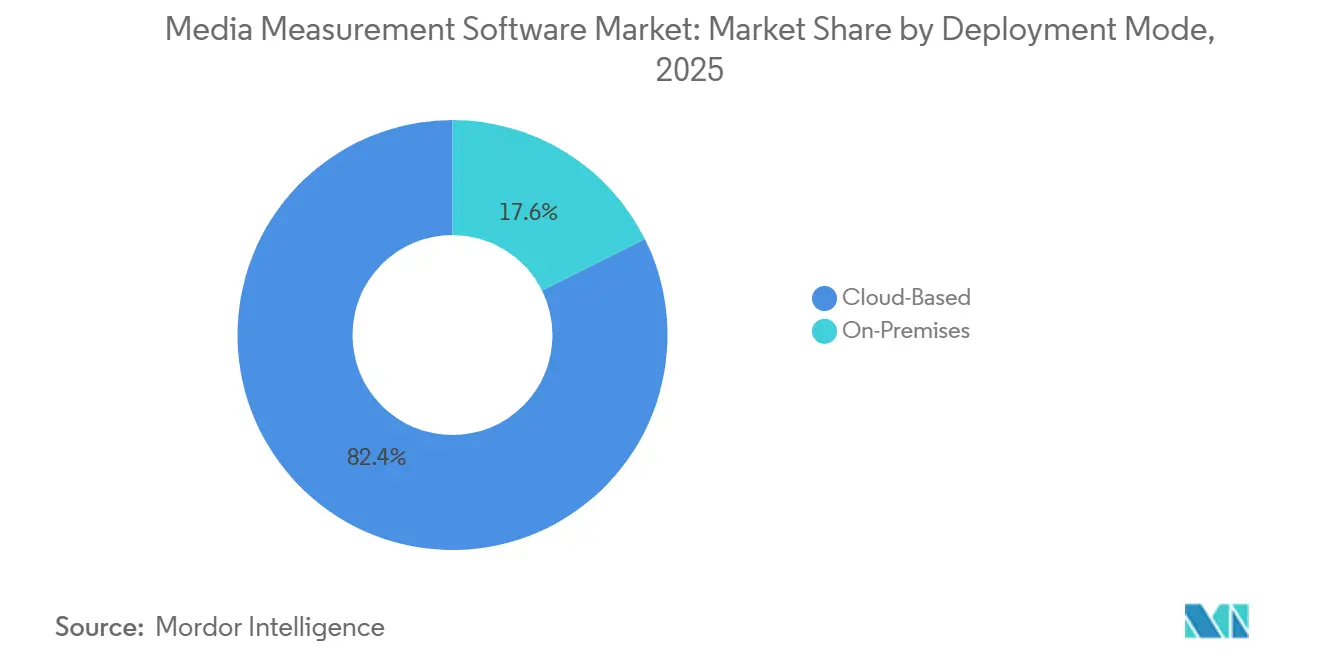
- By deployment mode, cloud-based accounted for 82.36% of the media measurement software market in 2025 and is also expected to record the fastest CAGR of 13.06% through 2031.
- By organization size, large enterprises captured 66.57% share in 2025, while SMEs are projected to expand at a 13.64% CAGR through 2031.
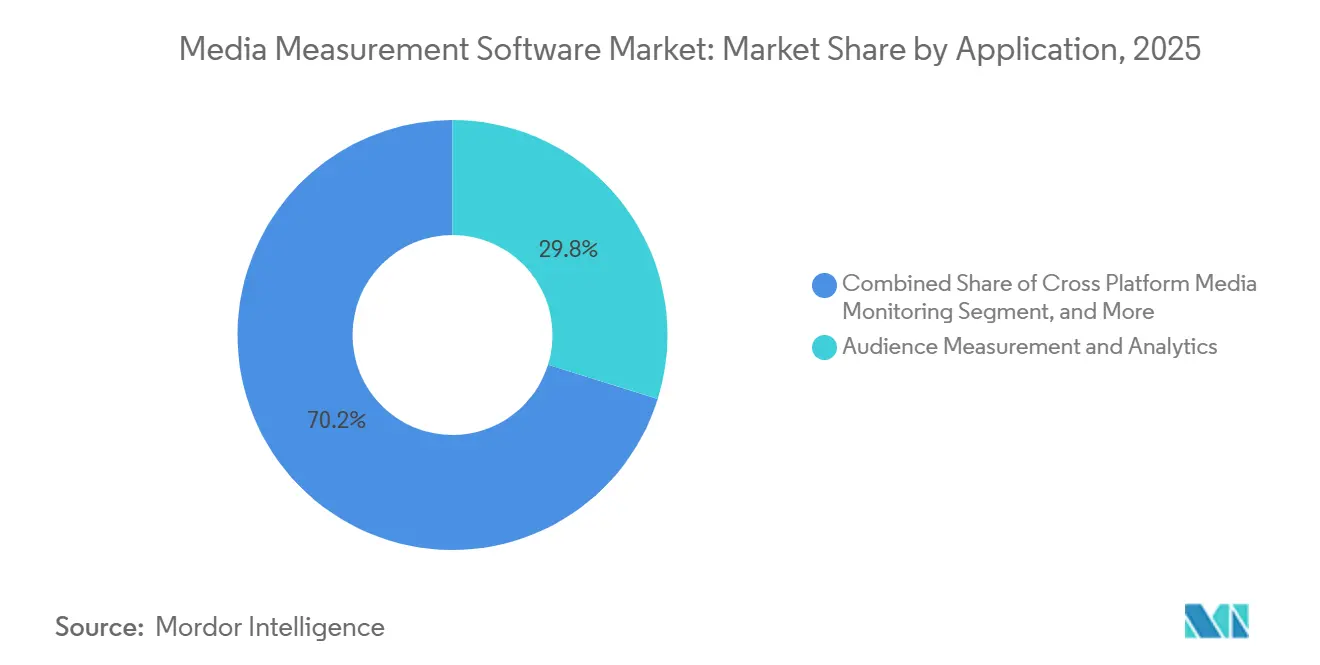
- By application, audience measurement and analytics accounted for a 29.81% share in 2025, while the attribution and marketing performance measurement segment is projected to advance at a 14.73% CAGR through 2031.
- By end user, advertising agencies led with 27.56% revenue share in 2025, while retail and consumer brands are expected to grow at a 15.29% CAGR through 2031.
- By geography, North America held 34.97% share in 2025, while Asia-Pacific is projected to record the highest CAGR of 16.83% through 2031.
Note: Market size and forecast figures in this report are generated using Mordor Intelligence’s proprietary estimation framework, updated with the latest available data and insights as of January 2026.
Global Media Measurement Software Market Trends and Insights
Drivers Impact Analysis*
| DRIVER | (~) % IMPACT ON CAGR FORECAST | GEOGRAPHIC RELEVANCE | IMPACT TIMELINE |
|---|---|---|---|
| Rising Demand for Cross-Channel Attribution and Unified Reporting | +2.5% | Global, North America and Europe as primary adopters | Medium term (2-4 years) |
| AI-Enabled Audience Insights and Automated Insight Generation | +2.2% | Global, North America and APAC lead adoption velocity | Short term (≤ 2 years) |
| Shift Toward Privacy-Safe First-Party Measurement | +1.8% | EU and North America primary, spill-over to APAC and MEA | Medium term (2-4 years) |
| Growing Need for Real-Time Campaign Optimization | +1.3% | Global, concentrated in North America | Short term (≤ 2 years) |
| Enterprise Migration to Cloud-Native Measurement Platforms | +1.0% | Global, APAC fastest transition rate | Medium term (2-4 years) |
| Increasing Media Fragmentation Across Streaming, Social, and Retail Media | +0.7% | North America and Europe, emerging in APAC | Long term (≥ 4 years) |
| Source: Mordor Intelligence | |||
Rising Demand for Cross-Channel Attribution and Unified Reporting
The media measurement software market is seeing stronger demand for platforms that can present one reporting view across linear TV, connected TV, digital video, social media, and retail media. Buyers no longer want separate systems for audience reporting, attribution, and campaign evaluation because fragmented reporting slows decision-making and weakens comparability across channels. The U.S. Joint Industry Committee's July 2025 mid-term audit reaffirmed full certification and currency-grade readiness for Comscore, iSpot, and VideoAmp, which strengthened confidence in accredited cross-platform measurement systems.[1]U.S. Joint Industry Committee, “JIC Currency Certification Midterm Audit 2025,” U.S. Joint Industry Committee, USJOINTINDUSTRYCOMMITTEE.COM Nielsen also widened the scope of unified reporting in July 2025 through its Outcomes Marketplace, which brought partner metrics for brand, sales, attention, and conversion into the Nielsen ONE environment. In Japan, Hakuhodo DY Group's Analytics AaaS integration with Google's Meridian framework showed that agencies are also building unified measurement frameworks that tie cross-channel ROI work more closely to budget planning.
AI-Enabled Audience Insights and Automated Insight Generation
The media measurement software market is moving from static dashboards toward systems that interpret audience signals and return decision-ready outputs. Adobe introduced Brand Intelligence in April 2026 after integrating Semrush capabilities, extending measurement to AI-powered search visibility and connecting that view to campaign management workflows.[2]Adobe, “Adobe Introduces Brand Intelligence and Expands GenStudio Content Supply Chain Solution for Customer Experience Orchestration,” Adobe, ADOBE.COM NIQ introduced NIQ Cadence in June 2026 as a compound AI operating system for marketing effectiveness, signaling a broader shift from isolated analytics tools to continuous decision environments. Meltwater and Sprout Social both expanded agentic AI features in 2026, showing that automated reporting, signal extraction, and guided action are now core product expectations rather than optional add-ons. Cision's July 2026 AI Visibility Dashboard added another layer by helping communications teams monitor how brands appear across AI answer surfaces, which shows how audience insight generation is expanding beyond traditional media channels.
Shift Toward Privacy-Safe First-Party Measurement
The media measurement software market is being pushed toward first-party and privacy-safe methods because browser, regulatory, and client requirements are narrowing the space for deterministic cross-site tracking. The W3C published its Privacy-Preserving Attribution working draft in June 2025, which signaled a browser-level move toward aggregate and privacy-aware attribution reporting rather than unrestricted user-level tracking. The U.S. Federal Trade Commission also clarified in November 2024 that data clean rooms are not automatically privacy-preserving and that design choices, aggregation rules, and export controls matter in practice. These changes raise the importance of consent handling, auditability, and regional data governance within platform architecture. Vendors that can present privacy engineering as a built-in product capability are likely to face less friction in the media measurement software market than those treating compliance as a separate legal step.
Growing Need for Real-Time Campaign Optimization
The media measurement software market is being shaped by a stronger need for faster feedback loops during live campaigns. Nielsen introduced Predictive Sales Lift in April 2026 to help Nielsen ONE Ads users estimate incremental revenue and sales lift for active campaigns, which reflects a shift toward decision support inside the measurement workflow. Nielsen also announced in June 2026 that its advanced audience measurement would be embedded in Mediaocean's Prisma platform, which shows how optimization and reporting are moving closer to the planning and buying layer. In Japan, Nielsen's June 2026 launch of Four-Screen Ad Deduplication for YouTube campaigns addressed the operational need to measure unified campaigns across computers, mobile, connected TV, and linear TV without waiting for delayed post-campaign reporting. Vendors that can shorten the cycle between campaign delivery, audience insights, and spending adjustments should continue to gain ground in the media measurement software market.
Restraints Impact Analysis*
| RESTRAINT | (~) % IMPACT ON CAGR FORECAST | GEOGRAPHIC RELEVANCE | IMPACT TIMELINE |
|---|---|---|---|
| High Total Cost of Ownership for Enterprise-Grade Suites | -1.6% | Global, most acute in North America and Europe | Medium term (2-4 years) |
| Data Privacy and Consent Compliance Constraints | -1.2% | EU primary, expanding to APAC and North America via CCPA | Long term (≥ 4 years) |
| API Dependency and Platform Access Volatility | -0.7% | Global, most severe in walled-garden-heavy markets | Short term (≤ 2 years) |
| Measurement Fragmentation Across Walled Gardens | -0.5% | Global, North America and China most affected | Long term (≥ 4 years) |
| Source: Mordor Intelligence | |||
High Total Cost of Ownership for Enterprise-Grade Suites
The media measurement software market still carries a heavy operating burden for enterprise buyers because adoption usually requires integration across planning, audience, reporting, and internal data systems. This makes deployment more than a software purchase, because the platform must fit existing media workflows and decision-making structures. Nielsen's June 2026 integration with Mediaocean Prisma shows how enterprise buyers expect measurement systems to connect directly with established buying platforms rather than sit outside them. Adobe's April 2026 Brand Intelligence launch, built after integrating Semrush capabilities, points to the same pattern, where value depends on tying adjacent intelligence layers into a broader operating environment. This favors larger vendors with broader implementation depth and makes procurement slower and heavier for smaller organizations in the media measurement software market.
Data Privacy and Consent Compliance Constraints
The media measurement software market faces a continuing restraint from privacy and consent complexity because audience coverage, identity resolution, and reporting design now depend on rules that differ by jurisdiction. The W3C's Privacy-Preserving Attribution draft signals that browsers are moving toward more restricted attribution methods, which reduces the room for open cross-site measurement. The FTC's November 2024 guidance on data clean rooms also makes clear that privacy claims depend on specific controls rather than broad labels, which increases scrutiny during vendor evaluation. As data localization rules expand across Asia-Pacific, the Middle East, and parts of Europe, vendors must support regional data handling models without weakening usability. This raises infrastructure complexity and slows adoption for platforms that cannot balance compliant architecture with usable cross-platform reporting in the media measurement software market.
*Our forecasts treat driver/restraint impacts as directional, not additive. The impact forecasts reflect baseline growth, mix effects, and variable interactions.
Segment Analysis
By Deployment Mode: Cloud Becomes the Operating Default
The cloud-based segment accounted for 82.36% of the media measurement software market size in 2025 and is projected to grow at 13.06% CAGR through 2031. Cloud has become the default architecture because buyers want scalable ingestion of signals from streaming platforms, connected TV, retail media, social channels, and web environments without relying on slow release cycles. Product launches in 2026 from Adobe, Sprout Social, Meltwater, and Cision all pointed to continuously updated software environments where AI features, reporting views, and brand visibility tools can be added in near real time.[3]Meltwater, “Meltwater Unveils 2026 Mid-Year Release,” Meltwater, MELTWATER.COM This deployment model also supports broader API-based interoperability, which matters because the media measurement software market now depends on linking audience data, planning tools, and outcome analysis across more than one system.
On-premises deployments still have a place, especially where internal security standards or data residency demands limit external processing. That is why cloud does not eliminate local control requirements, even though it has become the preferred model in the media measurement software market. The privacy direction signaled by the W3C and FTC supports this mixed view because buyers want flexible architectures that can handle consent limits and regional rules without losing reporting continuity. Cloud-based platforms are also better positioned to support frequent AI feature releases, which strengthens their role as the main delivery model for the next phase of the media measurement software market. The result is a market where cloud is standard, hybrid models remain relevant, and pure on-premises setups are increasingly limited to narrower use cases.


By Organization Size: Large Enterprises Lead While SMEs Expand Faster
Large enterprises held 66.57% of the media measurement software market in 2025, which reflected their need to manage campaigns across geographies, channels, brands, and reporting teams. Large accounts usually require deep systems integration, broad audience coverage, and consistent reporting definitions across many internal stakeholders. Nielsen's June 2026 integration with Mediaocean Prisma illustrates the level of workflow connection these buyers expect from their vendors.[4]Federal Trade Commission, “Federal Trade Commission,” Federal Trade Commission, FTC.GOV These clients also place greater value on procurement stability, methodological transparency, and governance controls, which tends to favor providers with longer operating histories and deeper product stacks in the media measurement software market.
SMEs are projected to expand at 13.64% CAGR through 2031, which shows how access barriers are easing even though enterprise demand still dominates revenue. The media measurement software industry is widening its addressable base because AI-supported workflows and SaaS delivery reduce the need for large in-house analyst teams at the point of adoption. Sprout Social expanded Trellis across key workflows in May 2026 and made the engine available to all customers from July 2026, which supports the move toward more accessible automation. Meltwater and Cision also expanded AI-led monitoring and reporting features in 2026, which helps smaller organizations get more usable outputs from fewer manual steps. This creates room for SMEs to adopt the media measurement software market earlier in their growth cycle, even if the largest budgets still sit with enterprises.
By Application: Audience Measurement Stays Largest While Attribution Advances Fastest
Audience Measurement and Analytics accounted for 29.81% of the media measurement software market in 2025, which kept it as the largest application because advertisers still need consistent views of reach, frequency, duplication, and audience quality. The July 2025 U.S. Joint Industry Committee audit reinforced the importance of validated currency systems in television and cross-platform audience reporting. Nielsen's Four-Screen Ad Deduplication launch in Japan also showed that advertisers are moving beyond single-screen audience reporting and want unified views across computers, mobile, connected TV, and linear TV. This keeps audience measurement central to the media measurement software market because other use cases still depend on accurate coverage and comparability at the top of the workflow.
Attribution and Marketing Performance Measurement is projected to grow at a 14.73% CAGR through 2031, which makes it the fastest-expanding application area. The shift is visible in Nielsen's Outcomes Marketplace and Predictive Sales Lift, both of which pushed measurement closer to sales, attention, and conversion outcomes rather than stopping at exposure metrics. Competitive intelligence and benchmarking are also expanding as application boundaries blur, with Adobe Brand Intelligence and Cision's AI Visibility Dashboard showing how brand visibility, search presence, and media analysis are moving into the same decision space. Media planning and campaign optimization are being pulled closer to attribution for the same reason, because buyers want the measurement layer to influence allocation and not just summarize what already happened. This gives the media measurement software market a more outcome-oriented application mix through the forecast period.

By End User: Agencies Retain Breadth While Retail Brands Add Momentum
Advertising agencies led with 27.56% revenue share in 2025, which reflected their role as spend aggregators across many client accounts and media channels. Agencies often need one platform to support audience reporting, campaign analysis, competitive benchmarking, and client-facing reporting across portfolios. That breadth aligns well with the way the media measurement software market has evolved, because cross-channel complexity makes separate tools harder to manage at scale. Nielsen's Outcomes Marketplace and its integration with Mediaocean Prisma both support agency workflows by connecting measurement outputs more closely to planning, buying, and performance discussions. This helps explain why agencies remain the broadest organized source of demand in the media measurement software market.
Retail and consumer brands are projected to grow at a 15.29% CAGR through 2031, driven by the rise of retail media and the need to connect ad exposure with transaction outcomes. That demand is structurally different from traditional awareness tracking because buyers want closed-loop evidence and clearer links between media activity and sales movement. Nielsen's Predictive Sales Lift shows how vendors are responding by giving advertisers a way to estimate incremental campaign impact earlier in the workflow. BFSI and healthcare and life sciences also remain important end users because monitoring and measurement needs in those sectors are shaped by stricter governance and traceability requirements. The media measurement software industry therefore serves both broad commercial buyers and more regulated verticals, but retail brands are adding some of the strongest new momentum to the media measurement software market.
Geography Analysis
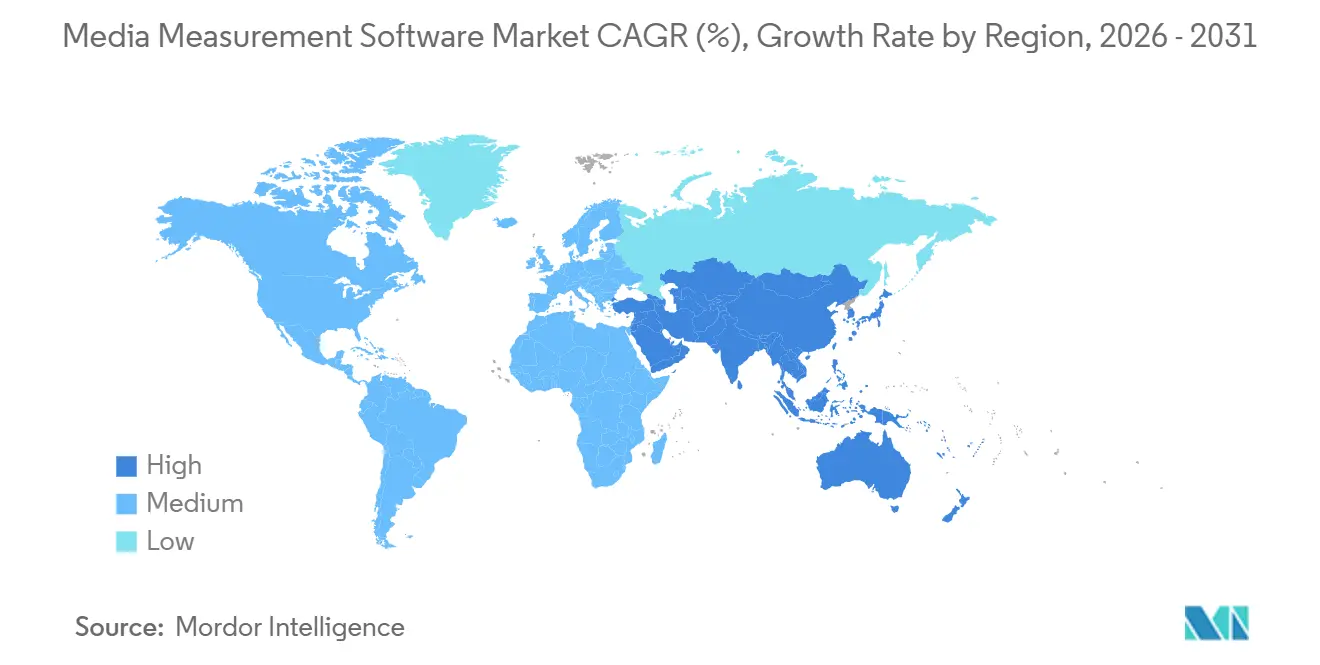
North America held 34.97% of the media measurement software market share in 2025, which kept it as the largest regional position. The region benefits from a dense base of national TV advertisers, mature programmatic buying ecosystems, and a more developed multi-currency television measurement structure than other regions. The U.S. Joint Industry Committee's July 2025 mid-term audit reaffirmed full certification for Comscore, iSpot, and VideoAmp, which underscored the institutional depth of the U.S. measurement environment. North America also remains central to product launches that connect measurement to media execution, including Nielsen's integration with Mediaocean Prisma and its rollout of Predictive Sales Lift. Europe remained a strong secondary region because privacy regulation and consent handling there continue to shape platform architecture and procurement standards far beyond the region itself.
Asia-Pacific is projected to grow at 16.83% CAGR through 2031, which makes it the fastest-growing geography in the media measurement software market. The region combines mobile-first advertising behavior, expanding retail media activity, and a clear need for better cross-platform measurement relative to advertising scale. Nielsen's June 2026 Four-Screen Ad Deduplication launch in Japan showed that global vendors are treating the region as a product priority rather than only a sales market. Hakuhodo DY Group's January 2025 Meridian-based Analytics AaaS also showed that regional agencies are building proprietary measurement infrastructure instead of relying only on imported frameworks.[5]Nielsen, “Nielsen, Mediaocean Announce New Integration to Power the Next Phase of Data-Driven Linear, Advanced Audience Measurement,” Nielsen, NIELSEN.COM China remains structurally complex because major digital platforms operate as walled gardens, while India, South Korea, Australia, and Southeast Asia are creating more demand for cloud-based attribution and audience tools.
South America, the Middle East, and Africa represent an earlier-stage demand profile, but they still matter to the long-term outlook for the media measurement software market. Brazil leads South America through a more formal privacy and compliance environment that encourages advertisers to evaluate auditable measurement setups. In the Middle East, Saudi Arabia and the UAE are building new demand around media and entertainment expansion, which supports audience measurement and campaign analytics needs. Africa remains less mature overall, but mobile-first usage patterns and South Africa's more developed advertising ecosystem create a practical starting point for future growth in the media measurement software market.

Competitive Landscape
The media measurement software market shows moderate concentration at the top and far more fragmentation below that top tier. Nielsen, Comscore, and Kantar remain the most entrenched names in traditional measurement because they built scale through long-standing advertiser relationships, proprietary data assets, and established methodology credibility. The strongest competitive tension is visible in television and cross-platform audience measurement, where the July 2025 U.S. Joint Industry Committee audit reaffirmed the transactability of alternative providers and kept pressure on long-standing leaders. At the same time, the media measurement software market is much more fragmented in attribution, social intelligence, PR monitoring, and AI-led reporting, where vendors compete less on legacy panels and more on workflow speed. This split structure means the competitive story depends heavily on which measurement use case is being examined.
Leading companies are trying to widen their role inside customer workflows rather than defend one narrow product category. Nielsen's July 2025 launch of Outcomes Marketplace expanded its position from reach and frequency into brand, sales, attention, and conversion metrics within one environment. Adobe's April 2026 introduction of Brand Intelligence after integrating Semrush capabilities showed how adjacent intelligence layers are being folded into campaign and content systems. Sprout Social and Meltwater both expanded agentic AI in 2026, which showed that middle-tier competitors are using automation and faster insight delivery to attack slower enterprise workflows. Cision's AI Visibility Dashboard added another competitive front by measuring how brands appear across AI answer systems, which pushes media intelligence vendors into a newer area of visibility tracking.
Partnerships and ecosystem expansion are becoming a faster route to capability than stand-alone product building in the media measurement software market. Nielsen's integration with Mediaocean Prisma is one example, and Hakuhodo DY Group's work with Google's Meridian framework is another, because both moves connect measurement more closely to planning and optimization workflows. The largest open space remains unified cross-screen and cross-channel measurement that can connect linear TV, connected TV, digital video, and retail media in one practical attribution model. Until one vendor can deliver that consistently at scale, the media measurement software market is likely to remain led by a few strong incumbents at the top and many specialized challengers across adjacent use cases.
Media Measurement Software Industry Leaders
Nielsen Holdings plc
Kantar Group Ltd.
Ipsos Group S.A.
Comscore, Inc.
YouGov plc
- *Disclaimer: Major Players sorted in no particular order

Recent Industry Developments
- June 2026: Nielsen launched Four-Screen Ad Deduplication measurement for YouTube campaigns in Japan, extending cross-platform audience measurement across computers, mobile, CTV, and linear TV in a market where advertisers are combining all 4 screens in unified campaign strategies.
- June 2026: Nielsen and Mediaocean announced a collaboration embedding Nielsen's Big Data and Panel advanced audience measurement directly into Mediaocean's Prisma platform for data-driven linear TV campaign reporting, targeting launch in September 2026 ahead of the fall broadcast season.
- May 2026: Meltwater released its 2026 Mid-Year Product Release, adding AI-powered reporting and recommendations within GenAI Lens for LLM brand visibility monitoring and expanding agentic assistant capabilities across its media, social, and AI signal processing stack.
- April 2026: Nielsen introduced Predictive Sales Lift for Nielsen ONE Ads customers, using historical data from hundreds of past campaigns to predict incremental revenue and sales lift for current campaigns. The feature reached general availability in May 2026.


Global Media Measurement Software Market Report Scope
Media measurement software refers to analytics technology that tracks and evaluates advertising performance across channels, including TV, digital, social, print, and streaming. It measures audience reach, engagement, attribution, and ROI, enabling advertisers, agencies, and publishers to optimize spending and demonstrate campaign effectiveness. The media measurement software market comprises companies that provide cross-channel measurement and attribution solutions. Growth in connected TV, digital platforms, and privacy-compliant measurement frameworks is increasing the demand for accurate and comprehensive insights into media performance.
The Media Measurement Software Market Report is Segmented by Deployment Mode (Cloud-Based, and On-Premises), Organization Size (Large Enterprises, and Small and Medium Enterprises), Application (Audience Measurement and Analytics, Media Planning and Campaign Optimization, Attribution and Marketing Performance Measurement, Competitive Intelligence and Benchmarking, Cross Platform Media Monitoring, and Other Applications), End User Industry (Advertising Agencies, Media and Entertainment, Publishers and Broadcasters, Retail and Consumer Brands, Banking, Financial Services, and Insurance (BFSI), Healthcare and Life Sciences, IT and Telecommunication, and Other End User Industries), and Geography (North America, South America, Europe, Asia-Pacific, and Middle East and Africa). The Market Forecasts are Provided in Terms of Value (USD).
| Cloud-Based |
| On-Premises |
| Large Enterprises |
| Small and Medium Enterprises |
| Audience Measurement and Analytics |
| Media Planning and Campaign Optimization |
| Attribution and Marketing Performance Measurement |
| Competitive Intelligence and Benchmarking |
| Cross Platform Media Monitoring |
| Other Applications |
| Advertising Agencies |
| Media and Entertainment |
| Publishers and Broadcasters |
| Retail and Consumer Brands |
| Banking, Financial Services, and Insurance (BFSI) |
| Healthcare and Life Sciences |
| IT and Telecommunication |
| Other End User Industries |
| North America | United States | |
| Canada | ||
| Mexico | ||
| South America | Brazil | |
| Argentina | ||
| Rest of South America | ||
| Europe | United Kingdom | |
| Germany | ||
| France | ||
| Italy | ||
| Spain | ||
| Russia | ||
| Rest of Europe | ||
| Asia-Pacific | China | |
| India | ||
| Japan | ||
| South Korea | ||
| Australia | ||
| Rest of Asia-Pacific | ||
| Middle East and Africa | Middle East | Turkey |
| Saudi Arabia | ||
| United Arab Emirates | ||
| Rest of Middle East | ||
| Africa | South Africa | |
| Egypt | ||
| Rest of Africa | ||
| By Deployment Mode | Cloud-Based | ||
| On-Premises | |||
| By Organization Size | Large Enterprises | ||
| Small and Medium Enterprises | |||
| By Application | Audience Measurement and Analytics | ||
| Media Planning and Campaign Optimization | |||
| Attribution and Marketing Performance Measurement | |||
| Competitive Intelligence and Benchmarking | |||
| Cross Platform Media Monitoring | |||
| Other Applications | |||
| By End User Industry | Advertising Agencies | ||
| Media and Entertainment | |||
| Publishers and Broadcasters | |||
| Retail and Consumer Brands | |||
| Banking, Financial Services, and Insurance (BFSI) | |||
| Healthcare and Life Sciences | |||
| IT and Telecommunication | |||
| Other End User Industries | |||
| By Geography | North America | United States | |
| Canada | |||
| Mexico | |||
| South America | Brazil | ||
| Argentina | |||
| Rest of South America | |||
| Europe | United Kingdom | ||
| Germany | |||
| France | |||
| Italy | |||
| Spain | |||
| Russia | |||
| Rest of Europe | |||
| Asia-Pacific | China | ||
| India | |||
| Japan | |||
| South Korea | |||
| Australia | |||
| Rest of Asia-Pacific | |||
| Middle East and Africa | Middle East | Turkey | |
| Saudi Arabia | |||
| United Arab Emirates | |||
| Rest of Middle East | |||
| Africa | South Africa | ||
| Egypt | |||
| Rest of Africa | |||


Key Questions Answered in the Report
What is the size outlook for media measurement software through 2031?
The media measurement software market size was USD 5.63 billion in 2025, and USD 6.29 billion in 2026, and is forecast to reach USD 10.96 billion by 2031, at a CAGR of 11.75% during 2026-2031.
Which deployment model leads media measurement software adoption?
Cloud-based deployment led with 82.36% share in 2025 and is also projected to grow the fastest at a 13.06% CAGR through 2031.
Which application area is expanding the fastest in media measurement software?
Attribution and marketing performance measurement is the fastest-growing application, with a projected 14.73% CAGR through 2031, while audience measurement and analytics remained the largest in 2025 with 29.81% share.
Why are agencies still the largest buyers of measurement platforms?
Advertising agencies held 27.56% of end-user revenue in 2025 because they manage measurement across multiple clients, channels, and reporting needs inside one operating structure.
Which region offers the strongest growth opportunity?
Asia-Pacific is projected to grow at a 16.83% CAGR through 2031, supported by mobile-first advertising, retail media expansion, and stronger demand for cross-platform measurement tools.
What is changing competition among measurement vendors?
Competition is moving toward unified reporting, AI-led insight delivery, privacy-safe architecture, and tighter links between measurement, planning, and campaign optimization.
Page last updated on:


 Your data is secure and never sold or shared.


