
Media and Entertainment Enterprise Content Management (ECM) Market Size and Share
Market Overview
| Study Period | 2020 - 2031 |
|---|---|
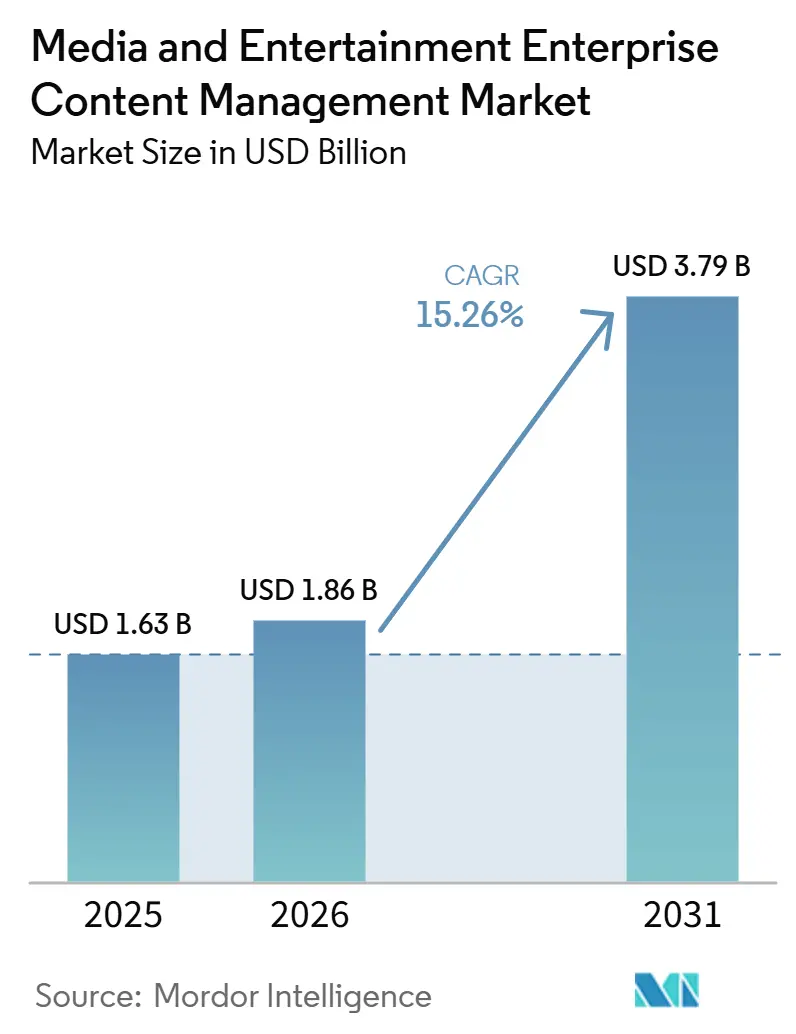
| Market Size (2026) | USD 1.86 Billion |
| Market Size (2031) | USD 3.79 Billion |
| Growth Rate (2026 - 2031) | 15.26% CAGR |
| Fastest Growing Market | Asia-Pacific |
| Largest Market | North America |
| Market Concentration | Medium |
Major Players *Disclaimer: Major Players sorted in no particular order Image © Mordor Intelligence. Reuse requires attribution under CC BY 4.0. | |
Media and Entertainment Enterprise Content Management (ECM) Market Analysis by Mordor Intelligence
The Media and Entertainment Enterprise Content Management (ECM) market size is projected to expand from USD 1.63 billion in 2025 and USD 1.86 billion in 2026 to USD 3.79 billion by 2031, registering a CAGR of 15.26% between 2026 and 2031. The Media and Entertainment Enterprise Content Management (ECM) market is advancing as content libraries now span vast video, audio, image, and rights datasets that require governed repositories rather than informal file storage. Cloud-led production models, wider use of AI for metadata and search, and the need to move assets across OTT, broadcast, social, and advertising channels are pushing buyers toward unified platforms. Compliance needs are also becoming more important as companies need clear audit trails for AI-assisted workflows and stronger control over rights, retention, and access. Competitive activity is rising as large ECM vendors add AI and orchestration features while media-focused DAM vendors expand governance and workflow capabilities. This leaves the Media and Entertainment Enterprise Content Management (ECM) market with clear opportunities in hybrid cloud management, workflow automation, rights-aware governance, and lower-cost SaaS adoption among smaller media businesses.
Key Report Takeaways
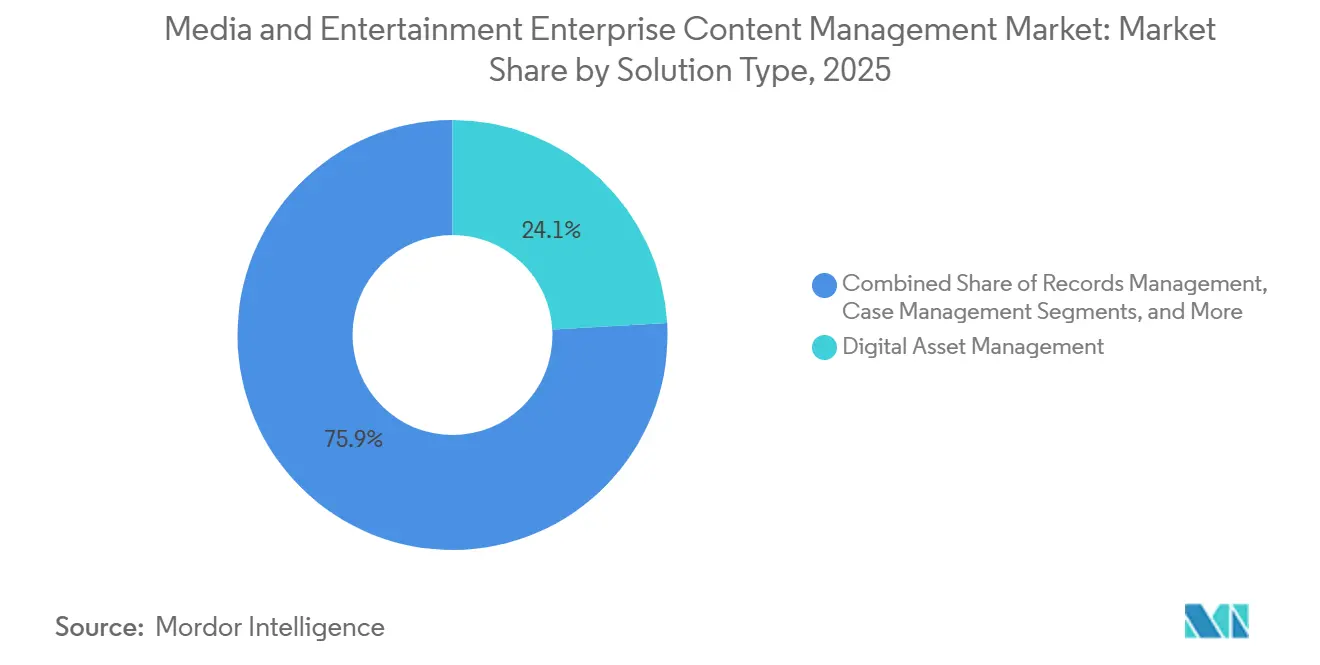
- By solution type, digital asset management held 24.11% of the Media and Entertainment Enterprise Content Management (ECM) market share in 2025, while workflow and business process management is projected to expand at a 16.71% CAGR through 2031.
- By deployment mode, cloud accounted for 72.41% share of the Media and Entertainment Enterprise Content Management (ECM) market in 2025 and is projected to expand at a 17.45% CAGR through 2031.
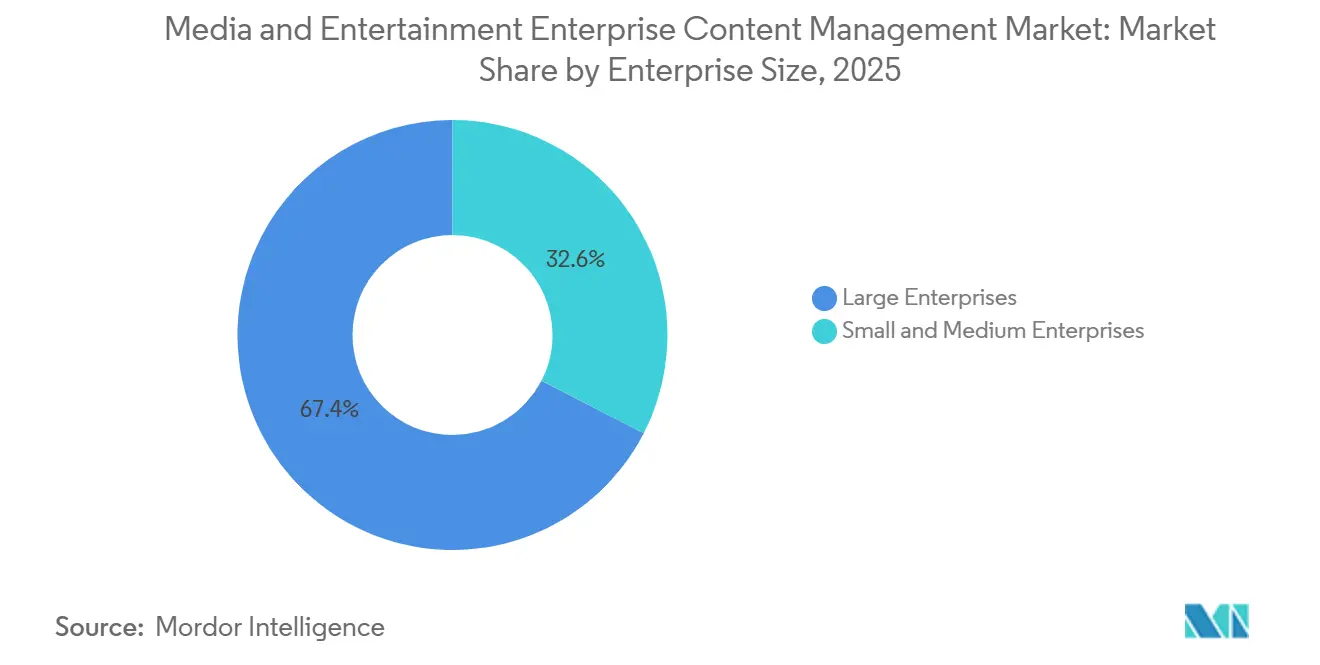
- By enterprise size, large enterprises held 67.44% of the Media and Entertainment Enterprise Content Management (ECM) market share in 2025, while small and medium enterprises are projected to expand at a 17.91% CAGR through 2031.
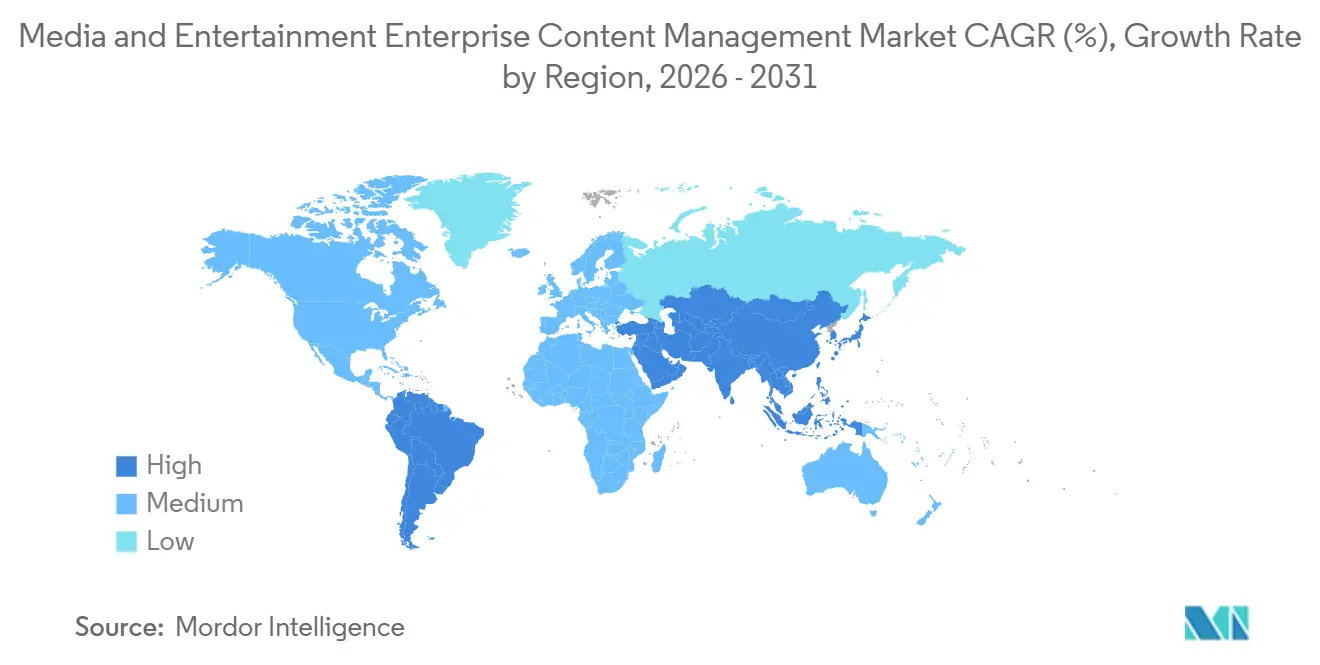
- By geography, North America held 41.29% share in 2025, while the Asia-Pacific is projected to expand at a 17.04% CAGR through 2031.
Note: Market size and forecast figures in this report are generated using Mordor Intelligence’s proprietary estimation framework, updated with the latest available data and insights as of January 2026.
Global Media and Entertainment Enterprise Content Management (ECM) Market Trends and Insights
Drivers Impact Analysis*
| Driver | (~) % Impact on CAGR Forecast | Geographic Relevance | Impact Timeline |
|---|---|---|---|
| AI-Assisted Metadata Tagging and Searchability | +3.2% | Global, with concentration in North America and Europe | Short term (≤ 2 years) |
| Rising OTT and Streaming Content Volume | +3.0% | Global, with high impact in North America and Asia-Pacific | Short term (≤ 2 years) |
| Cloud-First Production and Collaboration Workflows | +2.8% | Global, with early leadership in North America, with spillover to Asia-Pacific and Europe | Medium term (2-4 years) |
| Need for Faster Multi-Channel Content Reuse | +2.2% | Global, most acute in North America and Europe | Short term (≤ 2 years) |
| Greater Demand for Rights-Aware Content Governance | +1.8% | Europe and North America, with spillover to Asia-Pacific | Medium term (2-4 years) |
| Integration of Content Repositories with Revenue Workflows | +1.5% | North America and Europe, with growing relevance in Asia-Pacific | Long term (≥ 4 years) |
| Source: Mordor Intelligence | |||
AI-Assisted Metadata Tagging and Searchability
The Media and Entertainment Enterprise Content Management (ECM) market is gaining momentum as metadata quality becomes central to search, reuse, and compliance. AI-based tagging is reducing the time required to make new assets searchable and reducing the manual workload on content teams. Content teams saw time savings from AI-powered workflows for transcription, translation, and clip search, while weekly time savings rose from 11 hours to 18 hours when AI was combined with templating tools. Cloudinary strengthened this trend in May 2026 by launching AI agents for taxonomy, search, moderation, and workflow tasks in enterprise-scale media libraries. As a result, the Media and Entertainment Enterprise Content Management (ECM) market is shifting away from passive storage and toward active content intelligence. This also underscores the value of well-structured repositories, as personalization, recommendation, and discovery systems depend on clean metadata to perform effectively.
Rising OTT and Streaming Content Volume
The Media and Entertainment Enterprise Content Management (ECM) market is also being boosted by the scale of streaming output and the costs associated with content libraries. Backlight's 2026 iconik report showed that data managed on the platform reached 324 petabytes in 2025, after 56% annual growth, while new content entered the system at 11.1 terabytes per hour. Netflix stated in its March 31, 2026, Form 10-Q that its streaming content obligations stood at USD 24.139 billion, underscoring the financial and operational burden of large content pipelines.[1]Netflix, “Form 10-Q, Quarter Ended March 31, 2026,” SEC, sec.gov This scale makes unstructured storage harder to manage because rights, delivery formats, archive retrieval, and reuse need to work together across large libraries. The Media and Entertainment Enterprise Content Management (ECM) market, therefore, benefits when platforms need governed environments that can handle both current production flows and older archives. Archive reuse speed is also becoming increasingly important because faster retrieval and repackaging can improve margins without increasing the original production spend.
Cloud-First Production and Collaboration Workflows
Cloud-led operations are deepening the role of the Media and Entertainment Enterprise Content Management (ECM) market in daily production and distribution work. Embrace stated in September 2025 that TF1 Group launched a hybrid cloud media supply chain on Amazon Web Services via Pulse-IT, bringing multiple content systems into a single orchestration environment. Backlight's iconik report also found that 71% of media organizations operated hybrid cloud environments in 2026. This matters because many media companies still keep some live broadcast systems and regulated archives on-premises, even as active workflows move to the cloud. The Media and Entertainment Enterprise Content Management (ECM) market is therefore favoring vendors that can manage metadata, permissions, and access controls across both cloud and on-premises environments. Cloud-first workflows also support distributed post-production, localization, and review cycles, which makes integration depth a core buying factor.
Need for Faster Multi-Channel Content Reuse
The Media and Entertainment Enterprise Content Management (ECM) market is expanding as content reuse moves closer to revenue generation. Media companies now need to repurpose assets quickly for OTT, broadcast, social media, and advertising channels without repeating production work. MediaValet reported that DAM integration with project management tools cut content duplication by 59% and saved more than 15 hours per week on production and approvals. That makes governed rendition, format conversion, and approval workflows more valuable across high-volume content operations. The Media and Entertainment Enterprise Content Management (ECM) market is also seeing stronger demand for systems that consolidate metadata, rights, and delivery rules in a single place. At the same time, uneven tagging standards and fragmented archives continue to limit how quickly companies can reuse older assets across channels.
Restraints Impact Analysis*
| Restraint | (~) % Impact on CAGR Forecast | Geographic Relevance | Impact Timeline |
|---|---|---|---|
| Complex Legacy Media System Migration | -1.5% | Global, most acute in North America and Europe | Medium term (2-4 years) |
| High Metadata Cleanup and Content Normalization Burden | -1.2% | Global | Short term (≤ 2 years) |
| Security and Rights Management Integration Complexity | -0.9% | Global, concentrated in North America and Europe | Medium term (2-4 years) |
| Resistance from Decentralized Creative Teams | -0.7% | Global | Long term (≥ 4 years) |
| Source: Mordor Intelligence | |||
Complex Legacy Media System Migration
The Media and Entertainment Enterprise Content Management (ECM) market still faces a major hurdle in legacy migration. Many media organizations run older repositories where metadata, permissions, workflows, and rights rules were built over many years and are difficult to transfer cleanly. That makes modernization more risky because downtime, broken access controls, or lost rights history can disrupt broadcast and distribution operations. Compliance rules add another layer of complexity because AI governance, retention, and data control requirements must remain in place during system changes. The EU AI Act has added pressure for transparent, auditable workflows, raising the stakes for poorly executed migrations. This is slowing refresh cycles for some mid-tier broadcasters and regional media operators that do not want to absorb a long and complex transition at once.
High Metadata Cleanup and Content Normalization Burden
Metadata cleanup remains one of the less visible restraints in the Media and Entertainment Enterprise Content Management (ECM) market. Many archives were built on inconsistent tagging, siloed logs, and manual production records, leaving a large volume of assets harder to search and reuse. This issue has become more serious as companies try to use AI for discovery and workflow support, because poor metadata lowers the quality of automated outputs. It also raises implementation costs because normalization work can span formats, taxonomy rules, duplicate rights records, and archive hierarchies before the benefits of the software become clear. The Media and Entertainment Enterprise Content Management (ECM) market, therefore, depends not only on platform features but also on the practical effort needed to clean the underlying content estate. This burden is often highest in long-established media groups that manage multi-decade archives across many content formats.
*Our forecasts treat driver/restraint impacts as directional, not additive. The impact forecasts reflect baseline growth, mix effects, and variable interactions.
Segment Analysis
By Solution Type: Digital Asset Management Anchors Enterprise Media Libraries
Digital asset management held 24.11% of the Media and Entertainment Enterprise Content Management (ECM) market share in 2025, which confirmed its central role in managing image, video, and audio libraries at scale. DAM remains the base layer for metadata governance, asset retrieval, and multichannel distribution across studios, broadcasters, and streaming operators. In the media and entertainment enterprise content management industry, document management and records management continue to support compliance and archival needs, while case management and web content management serve narrower operational use cases. This distribution shows that repository control still comes before advanced automation in many buying decisions.
Workflow and business process management is projected to expand at a 16.71% CAGR through 2031, making it the fastest-growing solution area in the Media and Entertainment Enterprise Content Management (ECM) market. That growth reflects a shift from simply storing content to automating ingestion, review, approval, rights checks, and final delivery steps. The EU AI Act is reinforcing this move because media companies need clearer process records for AI-assisted actions tied to production and publishing.[2]European Parliament, “Regulation (EU) 2024/1689,” EUR-Lex, eur-lex.europa.eu OpenText stated in February 2026 that it was named a Leader in digital asset management by Forrester, which supports the continued importance of enterprise-grade DAM in content-heavy environments. As a result, solution competition is moving toward workflow depth, traceability, and governance rather than solely on repository scale.



By Deployment Mode: Cloud Leadership Continues to Strengthen
Cloud accounted for 72.41% share of the Media and Entertainment Enterprise Content Management (ECM) market in 2025 and is also projected to expand at a 17.45% CAGR through 2031. That combination makes cloud the only segment here that leads in both present scale and forward growth. The Media and Entertainment Enterprise Content Management (ECM) market is favoring cloud because elastic infrastructure supports large-volume ingest, remote collaboration, and AI processing that fixed hardware cannot match as easily. This also helps buyers handle spikes in archive access, localization, and cross-border review cycles without having to rebuild physical capacity.
Hybrid models still matter because many broadcasters need to balance cloud agility with on-premises control for live operations and regulated archives. Backlight reported that 71% of media organizations operate hybrid cloud environments, confirming that hybrid is becoming a durable operating model rather than a temporary step. Storj reinforced this direction in September 2025, when it launched Production Cloud for post-production, news, and sports teams, featuring distributed storage and AI-powered proxy generation. Within the Media and Entertainment Enterprise Content Management (ECM) market, vendors now need consistent metadata and access governance across cloud and on-premises estates, not just strong performance in one environment. This is pushing hybrid management from a useful feature into a normal procurement requirement.
By Enterprise Size: Large Buyers Still Dominate, While Smaller Firms Gain Speed
Large enterprises held a 67.44% share in 2025, indicating that the Media and Entertainment Enterprise Content Management (ECM) market still leans toward organizations with complex rights structures, large archives, and multi-system integration needs. Large media groups have historically been better placed to fund enterprise repositories, long migrations, and specialized governance layers. They also treat repository decisions as broader operating choices because content systems affect archive use, personalization readiness, and distribution control. This helps explain why the market remains concentrated in large studio, broadcast, and streaming environments at this stage.
Small and medium enterprises are projected to expand at a 17.91% CAGR through 2031, marking the fastest shift by buyer size in the Media and Entertainment Enterprise Content Management (ECM) market. Many organizations achieved a DAM return on investment within 6 months, and that figure rose when DAM was used with templating solutions. Lower SaaS entry costs and modular licensing are widening access for smaller production companies, regional broadcasters, and independent streaming services. In the media and entertainment enterprise content management industry, this means future growth will increasingly come from buyers who start with core DAM and later add workflow and governance modules. The addressable user base is therefore broadening, even though the largest revenue pools still sit with large enterprises.
Geography Analysis
North America held 41.29% of the Media and Entertainment Enterprise Content Management (ECM) market share in 2025, which made it the largest regional cluster. The region benefits from the concentration of major streaming platforms, broadcast networks, and large media groups that operate under complex rights and distribution models. Netflix, Amazon Prime Video, Disney+, and similar platforms manage large content estates that require rights tracking, archive control, and coordination across multiple formats. The ATSC published its A362 recommended practice on digital rights management in April 2026, and this is shaping expectations for rights-aware broadcast and streaming workflows in the United States. The Media and Entertainment Enterprise Content Management (ECM) market in North America, therefore, remains anchored by high content budgets and a mature vendor ecosystem.
Asia-Pacific is projected to expand at a 17.04% CAGR through 2031, giving the region the fastest pace in the Media and Entertainment Enterprise Content Management (ECM) market. Growth is tied to OTT expansion, archive digitization, and the need to manage multilingual metadata and regional rights variants at scale. Toshiba Digital Solutions launched its meify integrated video content management system in June 2026, centralizing program metadata, rights data, and creator records, and providing AI-supported recognition tools for broadcasters.[3]Toshiba Digital Solutions, “Launch Of Meify Integrated Video Content Management System,” Toshiba, global.toshiba Sony Marketing also launched updated versions of A2 Production and Ci Media Cloud in July 2026, featuring AI video analysis, broader file support, and automated watch-folder synchronization.
Europe is moving through cloud-first supply chain modernization, while South America, the Middle East, and Africa remain earlier-stage but growing parts of the media and entertainment enterprise content management industry. Europe also faces stronger policy pressure on governance, as the GDPR and the EU AI Act increase the need for demonstrable control over content data, workflow logs, and automated decisions. In April 2026, BCE integrated Perfect Memory into its Media-as-a-Service offering, demonstrating how managed service models are helping mid-scale broadcasters achieve stronger asset governance and metadata control. In South America, Brazil remains the main investment point as media groups build systems for VOD and advertising workflows, while the Middle East and Africa are growing through archive digitization, production expansion, and rising cloud adoption across newer content ecosystems.

Competitive Landscape
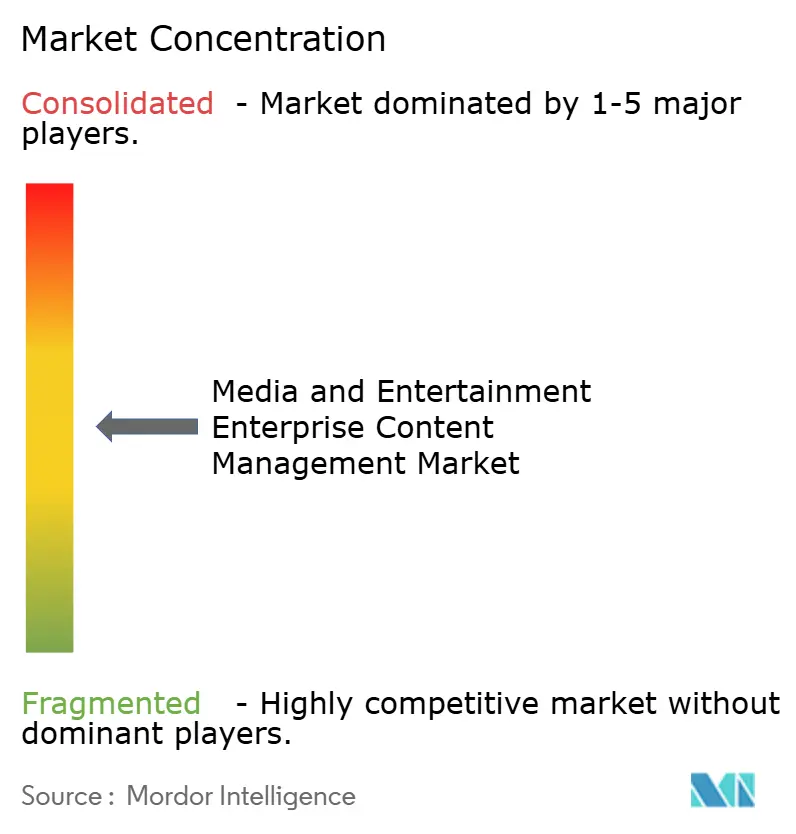
The Media and Entertainment Enterprise Content Management (ECM) market is moderately consolidated at the enterprise tier, where long-established vendors still benefit from installed systems, enterprise integrations, and deep governance capabilities. OpenText, IBM, Microsoft, and Adobe remain important players because large media customers value interoperability with wider enterprise software environments. At the same time, media-focused DAM specialists such as Cloudinary, Bynder, and Wedia are gaining ground where API flexibility, visual asset delivery, and faster deployment matter more than broad document governance. This leaves the Media and Entertainment Enterprise Content Management (ECM) market in a state where incumbents defend scale and specialists compete on speed and media-native functionality. Vendor differentiation is also narrowing as AI becomes a common product layer rather than a niche add-on.
One clear pattern is AI-led platform expansion. IBM announced Content Cortex Essentials Edition in June 2026 as an agile content automation platform that evolved its FileNet base to accelerate the classification and activation of unstructured content at scale. Adobe also expanded its GenStudio content supply chain offering in April 2026, adding Brand Intelligence and agentic orchestration across planning, creation, activation, delivery, and reporting.[4]Adobe, “Adobe Introduces Brand Intelligence And Expands GenStudio Content Supply Chain Solution,” Adobe Newsroom, news.adobe.com In the Media and Entertainment Enterprise Content Management (ECM) market, these moves show that buyers increasingly expect content systems to automate both asset management and related operational processes.
Another pattern is the ecosystem and openness strategy. Hyland announced in 2025 plans to open-source its Cloud Content Repository, combining Alfresco and Nuxeo technologies into a unified AI-ready repository with semantic indexing and rapid retrieval. Cloudinary launched AI agents in 2026 for taxonomy, search, moderation, and workflow tasks, demonstrating how specialists are expanding beyond asset delivery toward governance and process automation. The media and entertainment enterprise content management industry still has room for rights-aware automation, as many companies keep rights databases separate from ECM and DAM platforms. Procurement standards are also tightening, especially in regulated broadcast environments, making security credentials and auditable governance increasingly important alongside media workflow performance.
Media and Entertainment Enterprise Content Management (ECM) Industry Leaders
Oracle Corporation
IBM Corporation
Microsoft Corporation
OpenText Corporation
Hyland Software, Inc.
- *Disclaimer: Major Players sorted in no particular order

Recent Industry Developments
- June 2026: IBM launched the Content Cortex Essentials Edition, an agentic content services platform that evolves FileNet Content Manager into an AI-native system. The platform includes a Navigator Core Agent capable of classifying, organizing, and updating documents in under a minute, along with intelligent archiving supporting ingestion of hundreds of millions of content sections per day and retrieval within seconds.
- June 2026: Toshiba Digital Solutions launched meify, an integrated video content management system for broadcasters, centralizing program metadata, rights records, and creator data with AI-powered face recognition and telop text extraction. The modular platform enables broadcasters to supplement existing systems without full replacement, reducing initial investment barriers.
- May 2026: Cloudinary launched four AI agents, Taxonomy Agent, Search Agent, Moderation Agent, and Workflow Agent, targeting enterprise-scale visual media management and brand governance. The agents automate metadata classification, intent-based asset discovery, brand standards enforcement, and plain-language workflow automation across existing DAM and CMS ecosystems.
- May 2026: Newgen Software introduced the Enterprise Orchestration Layer within its NewgenONE platform, embedding agentic AI, MCP-based tool generation, and industry-trained AI models to enable enterprises to transition from isolated content automation to continuously adaptive, governed content operations at enterprise scale.


Global Media and Entertainment Enterprise Content Management (ECM) Market Report Scope
The Media and Entertainment Enterprise Content Management (ECM) Market comprises software platforms and associated services that enable media companies, broadcasters, publishers, streaming providers, production houses, and entertainment organizations to capture, manage, store, organize, secure, distribute, and archive digital content throughout its lifecycle. These solutions support content creation workflows, digital asset management, document management, content collaboration, rights management, regulatory compliance, and multi-channel content distribution across various media formats. The increasing volume of digital content, the growing adoption of cloud-based content management solutions, the rising demand for streamlined content production workflows, and the need to manage media assets efficiently across multiple distribution channels drive the market. Enterprise Content Management (ECM) solutions help organizations improve the accessibility of content, operational efficiency, collaboration, governance, and the monetization of digital content assets.
The Media and Entertainment Enterprise Content Management (ECM) Market Report is Segmented by Solution Type (Document Management, Records Management, Workflow and Business Process Management, Case Management, Digital Asset Management, Web Content Management, and Other Solutions), Deployment Mode (On-Premises, Cloud, and Hybrid), Enterprise Size (Small and Medium Enterprises, and Large Enterprises), and Geography (North America, South America, Europe, Asia-Pacific, Middle East, and Africa). The Market Forecasts are Provided in Terms of Value (USD).
| Document Management |
| Records Management |
| Workflow and Business Process Management |
| Case Management |
| Digital Asset Management |
| Web Content Management |
| Other Solutions |
| On-Premises |
| Cloud |
| Hybrid |
| Small and Medium Enterprises |
| Large Enterprises |
| North America | United States |
| Canada | |
| Mexico | |
| South America | Brazil |
| Argentina | |
| Rest of South America | |
| Europe | United Kingdom |
| Germany | |
| France | |
| Rest of Europe | |
| Asia-Pacific | China |
| Japan | |
| India | |
| South Korea | |
| Australia | |
| Rest of Asia-Pacific | |
| Middle East | United Arab Emirates |
| Saudi Arabia | |
| Rest of Middle East | |
| Africa | South Africa |
| Kenya | |
| Rest of Africa |
| By Solution Type | Document Management | |
| Records Management | ||
| Workflow and Business Process Management | ||
| Case Management | ||
| Digital Asset Management | ||
| Web Content Management | ||
| Other Solutions | ||
| By Deployment Mode | On-Premises | |
| Cloud | ||
| Hybrid | ||
| By Enterprise Size | Small and Medium Enterprises | |
| Large Enterprises | ||
| By Geography | North America | United States |
| Canada | ||
| Mexico | ||
| South America | Brazil | |
| Argentina | ||
| Rest of South America | ||
| Europe | United Kingdom | |
| Germany | ||
| France | ||
| Rest of Europe | ||
| Asia-Pacific | China | |
| Japan | ||
| India | ||
| South Korea | ||
| Australia | ||
| Rest of Asia-Pacific | ||
| Middle East | United Arab Emirates | |
| Saudi Arabia | ||
| Rest of Middle East | ||
| Africa | South Africa | |
| Kenya | ||
| Rest of Africa | ||


Key Questions Answered in the Report
What is the 2026 size of the media and entertainment enterprise content management space?
The Media and Entertainment Enterprise Content Management (ECM) market is valued at USD 1.86 billion in 2026 and is projected to reach USD 3.79 billion by 2031 at a 15.26% CAGR.
Which solution area currently leads adoption?
Digital asset management led with 24.11% share in 2025 because media companies need strong control over video, audio, image, and metadata libraries.
Which deployment model is growing the fastest?
Cloud leads both current adoption and future growth, with 72.41% share in 2025 and a projected 17.45% CAGR through 2031.
Why are smaller media companies adopting these platforms faster now?
Small and medium enterprises are projected to grow at 17.91% CAGR because SaaS pricing, modular licensing, and faster return on investment are lowering entry barriers.
Which region offers the strongest growth opportunity through 2031?
Asia-Pacific is projected to grow at 17.04% CAGR, supported by OTT expansion, archive digitization, and rising demand for multilingual metadata and rights control.
What is driving vendor competition most strongly in 2026?
AI-led workflow automation, hybrid cloud support, and stronger rights and governance controls are driving competition as vendors try to move beyond storage into operational orchestration.
Page last updated on:






